
Lesson 9 Water Systems Modelling K D W
- Slides: 38
Lesson 9. Water Systems Modelling K. D. W. Nandalal Professor University of Peradeniya, Sri Lanka kdwnandalal 5@gmail. com
Why Manage Water ? Too little water Too much water Polluted water Other issues such as; Navigation Ecosystem degradation Environmental and morphological impacts Etc. , Water Systems Modelling 2
Water Resources System Includes all elements required to produce water and water-related goods and services Elements Natural - (Lakes, rivers, etc. ) Physical / Man-made - (Weirs, canals, etc. ) Administrative – (Regulations, etc. ) Water Systems Modelling 3
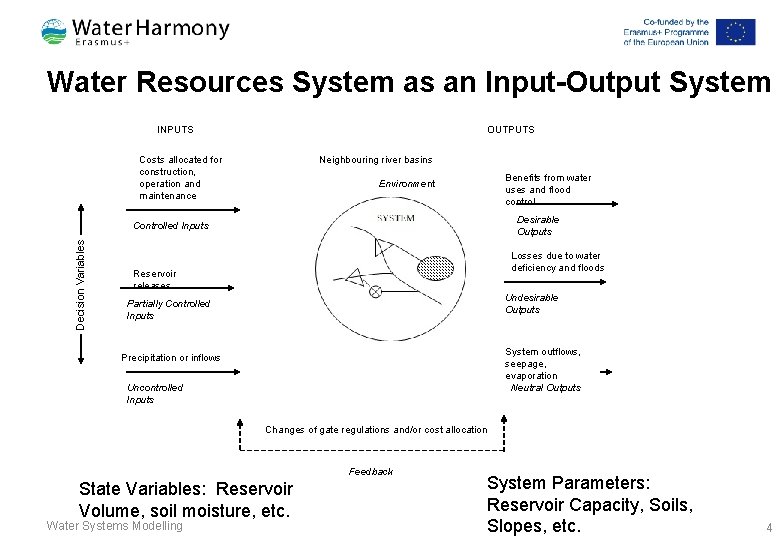
Water Resources System as an Input-Output System INPUTS OUTPUTS Costs allocated for construction, operation and maintenance Neighbouring river basins Benefits from water uses and flood control Environment Desirable Outputs Decision Variables Controlled Inputs Losses due to water deficiency and floods Reservoir releases Undesirable Outputs Partially Controlled Inputs System outflows, seepage, evaporation Neutral Outputs Precipitation or inflows Uncontrolled Inputs Changes of gate regulations and/or cost allocation Feedback State Variables: Reservoir Volume, soil moisture, etc. Water Systems Modelling System Parameters: Reservoir Capacity, Soils, Slopes, etc. 4
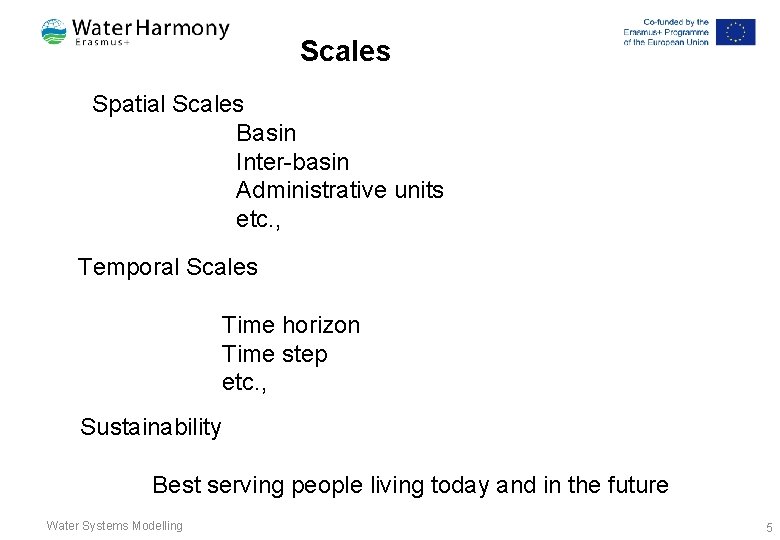
Scales Spatial Scales Basin Inter-basin Administrative units etc. , Temporal Scales Time horizon Time step etc. , Sustainability Best serving people living today and in the future Water Systems Modelling 5
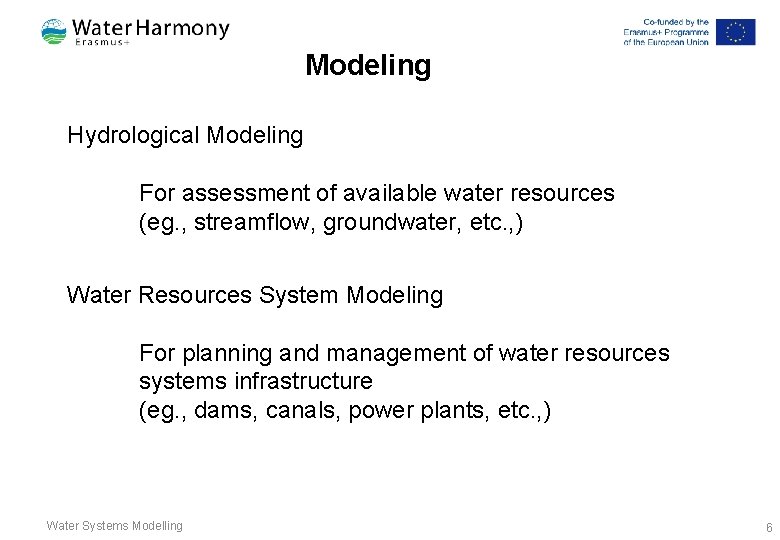
Modeling Hydrological Modeling For assessment of available water resources (eg. , streamflow, groundwater, etc. , ) Water Resources System Modeling For planning and management of water resources systems infrastructure (eg. , dams, canals, power plants, etc. , ) Water Systems Modelling 6
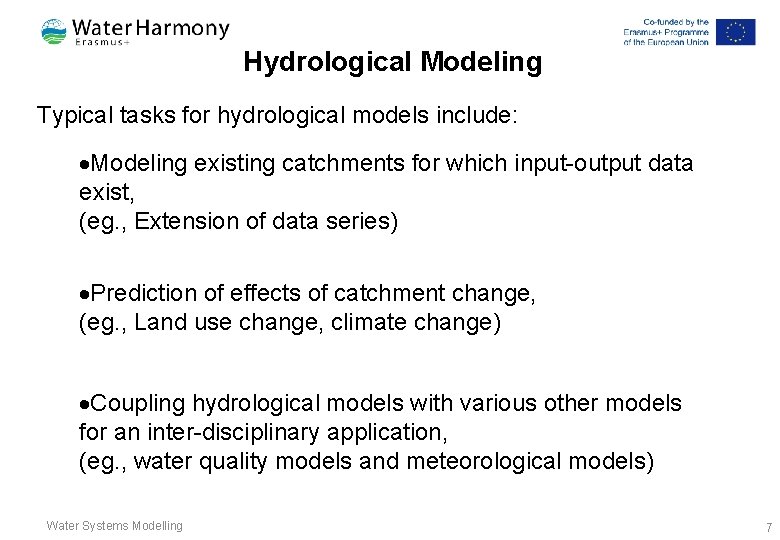
Hydrological Modeling Typical tasks for hydrological models include: Modeling existing catchments for which input-output data exist, (eg. , Extension of data series) Prediction of effects of catchment change, (eg. , Land use change, climate change) Coupling hydrological models with various other models for an inter-disciplinary application, (eg. , water quality models and meteorological models) Water Systems Modelling 7
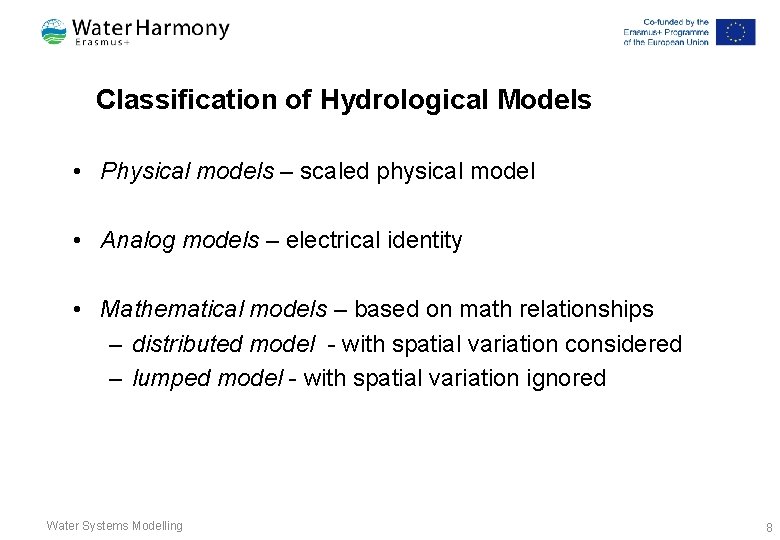
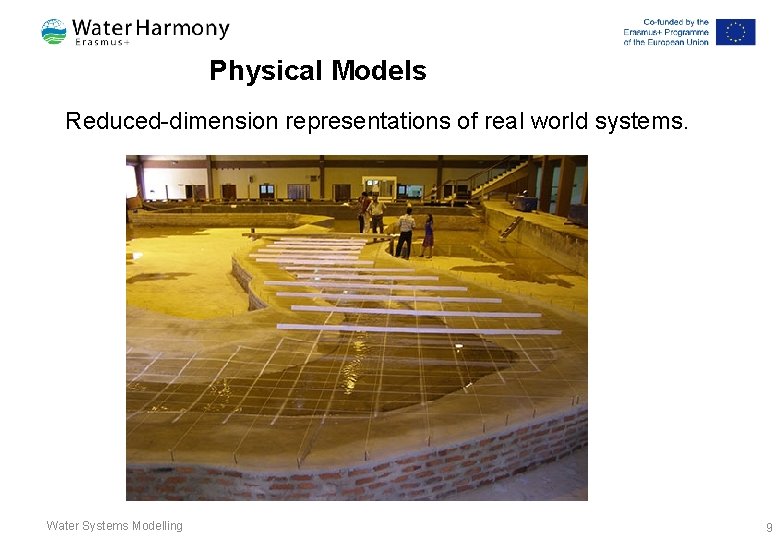
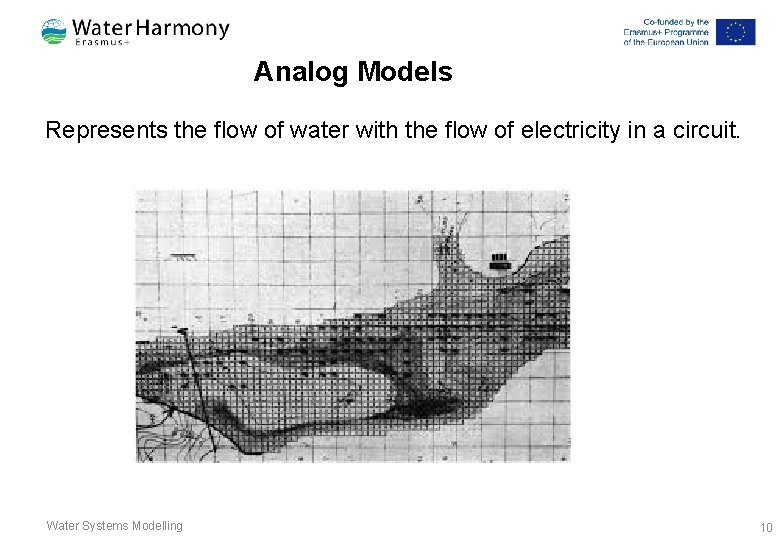
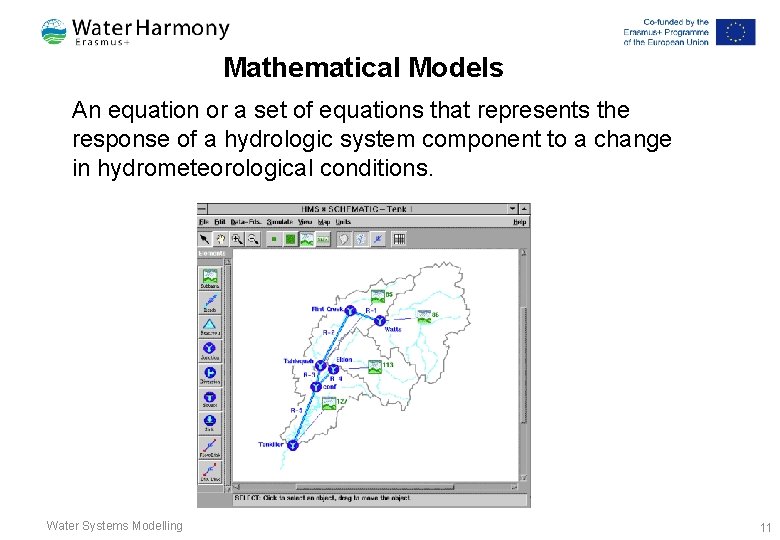
Classification of Hydrological Models • Physical models – scaled physical model • Analog models – electrical identity • Mathematical models – based on math relationships – distributed model - with spatial variation considered – lumped model - with spatial variation ignored Water Systems Modelling 8
Physical Models Reduced-dimension representations of real world systems. Water Systems Modelling 9
Analog Models Represents the flow of water with the flow of electricity in a circuit. Water Systems Modelling 10
Mathematical Models An equation or a set of equations that represents the response of a hydrologic system component to a change in hydrometeorological conditions. Water Systems Modelling 11
Water Resources Modeling Assessment and prediction of availability of water resources Traditional approach is based on water balance and demand prediction It does not capture temporal and spatial dynamics of main variables such as climatic change, socio-economic change, institutional change, environmental change, etc. , and how they affect water use Therefore, the prediction of future water use and balance is subject to a wide margin of error Water Systems Modelling 12
System Dynamics Approach “system dynamics” approach offers a way of modeling the future dynamics of complex systems increasing the ability to correctly assess and predict availability, use and balance of water, which enhances sustainable management of resources. The model considers the dynamic interactions between quantitative characteristics of the available water resources and water use that are determined by the socio-economic development, population, agricultural development and food production in a country Water Systems Modelling 13
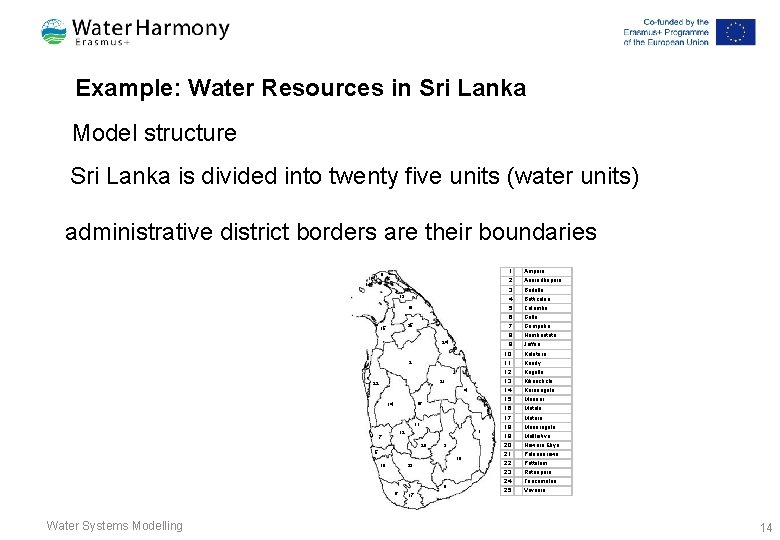
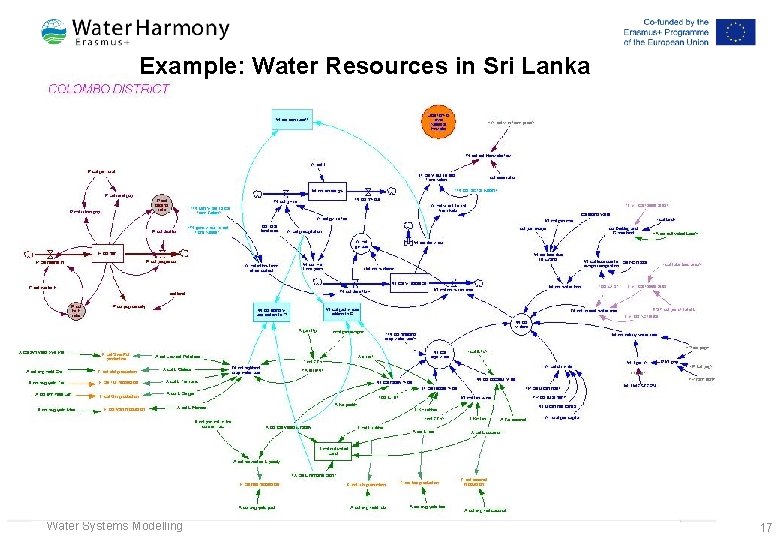
Example: Water Resources in Sri Lanka Model structure Sri Lanka is divided into twenty five units (water units) administrative district borders are their boundaries 9 13 19 25 15 24 1 Ampara 2 Anuradhapura 3 Badulla 4 Batticaloa 5 Colombo 6 Galle 7 Gampaha 8 Hambantota 9 Jaffna 10 2 21 22 4 16 14 11 1 12 7 20 3 5 18 10 23 8 6 Water Systems Modelling 17 Kalutara 11 Kandy 12 Kegalle 13 Kilinochchi 14 Kurunagala 15 Mannar 16 Matale 17 Matara 18 Monaragala 19 Mulllaitivu 20 Nuwara Eliya 21 Polonnaruwa 22 Puttalam 23 Ratnapura 24 Trincomalee 25 Vavunia 14
Example: Water Resources in Sri Lanka Each water unit comprises of four sectors; water quantity population agriculture food All twenty five units, each with the above four sectors, are integrated to build the overall model for the whole country Water Systems Modelling 15
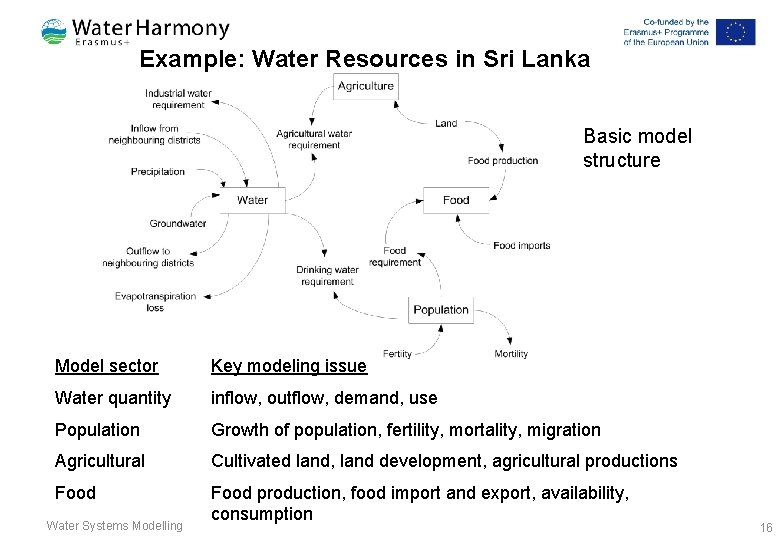
Example: Water Resources in Sri Lanka Basic model structure Model sector Key modeling issue Water quantity inflow, outflow, demand, use Population Growth of population, fertility, mortality, migration Agricultural Cultivated land, land development, agricultural productions Food production, food import and export, availability, consumption Water Systems Modelling 16
Example: Water Resources in Sri Lanka Water Systems Modelling 17
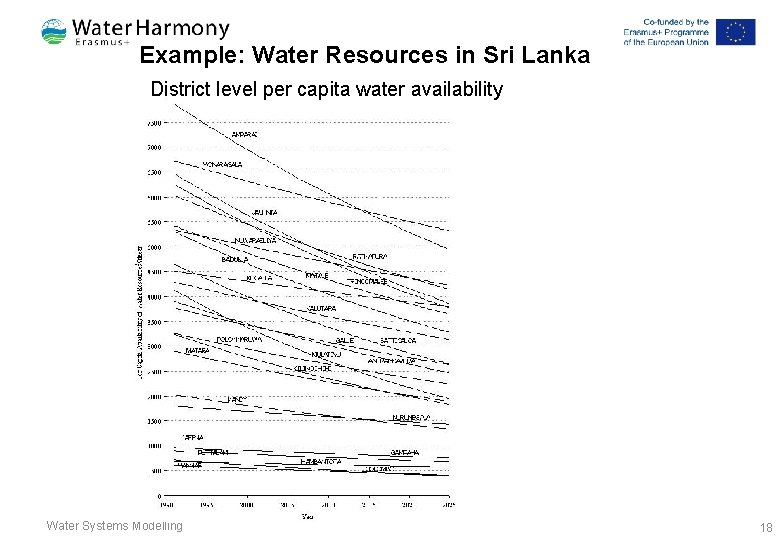
Example: Water Resources in Sri Lanka District level per capita water availability Water Systems Modelling 18
Water Resources System Planning and Management Modeling Planning and managing water resources systems involve impact prediction through modeling Note: models will have limitations in representing real systems Model structure, input data, objectives and other model assumptions related to how real system functions or will behave under alternative plans and management practices may be uncertain Water Systems Modelling 19
Water Resources System Planning and Management Modeling Water resources systems are very complex We do not understand sufficiently the multiple independent physical, biochemical, ecological, social, legal and political processes that govern behaviour of water resources systems Models of real-world systems are always simplified representations Models can represent in a fairly structured and ordered manner the important interdependencies and interactions among various control structures and users of a water resources system Water Systems Modelling 20
Water Resources System Planning and Management Modeling Models permit evaluation of the consequences of alternative engineering structures, of various operating and allocation policies and different assumptions regarding future supplies, demands, technology, costs and social and legal requirements. Water Systems Modelling 21
Model components Models (mathematical) contain algebraic equations. The equations include; Parameters –known variables Decision variables – unknown variables Models are developed for identifying base values for decision variables (include design and operating policy of water resources systems) Water Systems Modelling 22
Model components Models describe, in mathematical terms, the system being analyzed and the conditions that the system has to satisfy. These conditions are called constraints Solving a model: Finding values of unknown decision variables Water Systems Modelling 23
Modeling Methods: Optimization and Simulation address “what if” question Or a trial-and-error procedure Optimization A more organized mathematical approach Automatically gives the best solution Water Systems Modelling 24
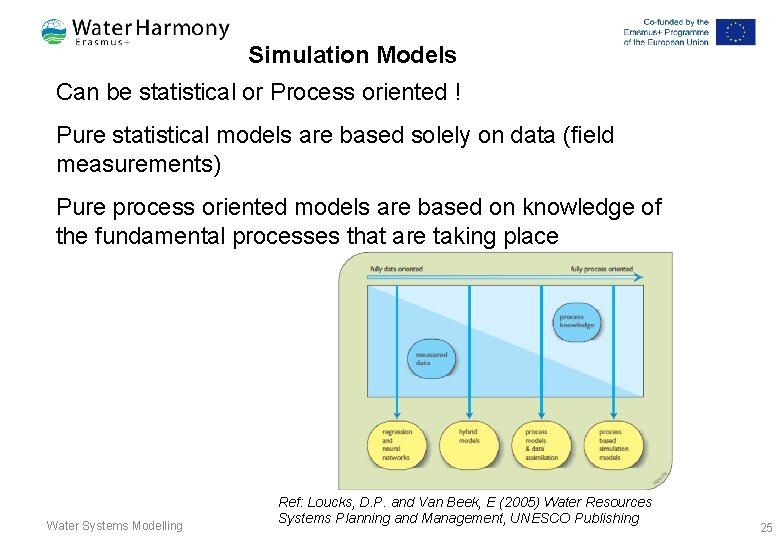
Simulation Models Can be statistical or Process oriented ! Pure statistical models are based solely on data (field measurements) Pure process oriented models are based on knowledge of the fundamental processes that are taking place Water Systems Modelling Ref: Loucks, D. P. and Van Beek, E (2005) Water Resources Systems Planning and Management, UNESCO Publishing 25
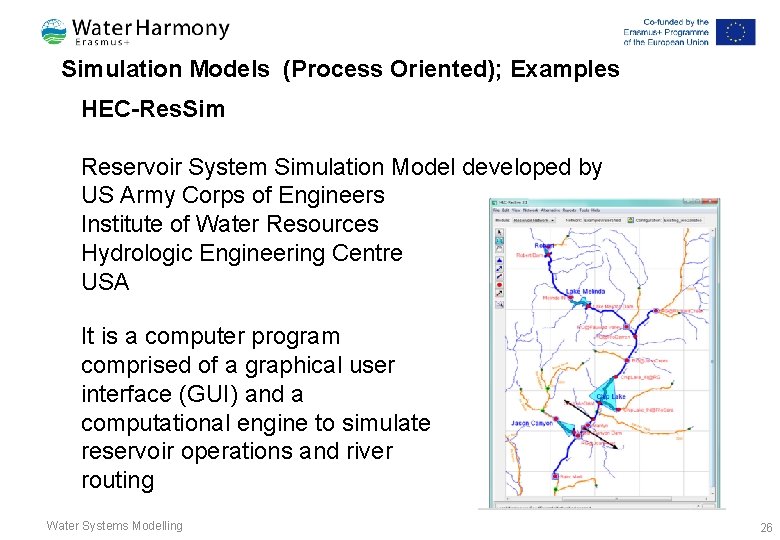
Simulation Models (Process Oriented); Examples HEC-Res. Sim Reservoir System Simulation Model developed by US Army Corps of Engineers Institute of Water Resources Hydrologic Engineering Centre USA It is a computer program comprised of a graphical user interface (GUI) and a computational engine to simulate reservoir operations and river routing Water Systems Modelling 26
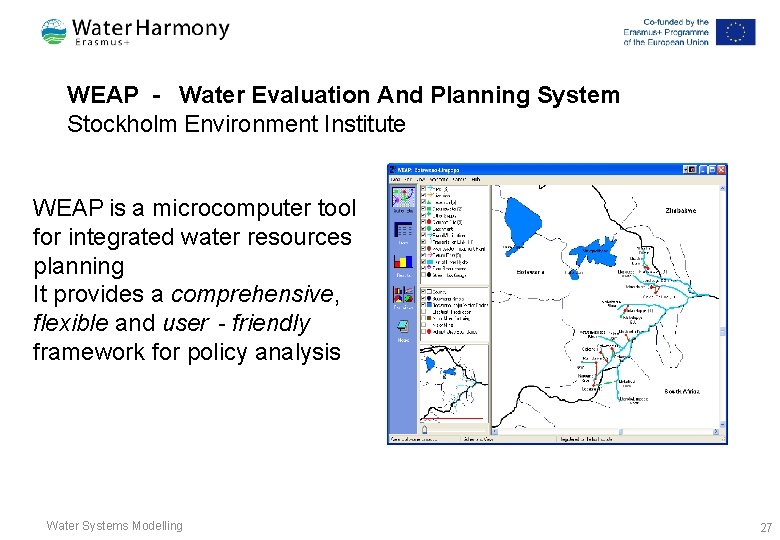
WEAP - Water Evaluation And Planning System Stockholm Environment Institute WEAP is a microcomputer tool for integrated water resources planning It provides a comprehensive, flexible and user‐friendly framework for policy analysis Water Systems Modelling 27
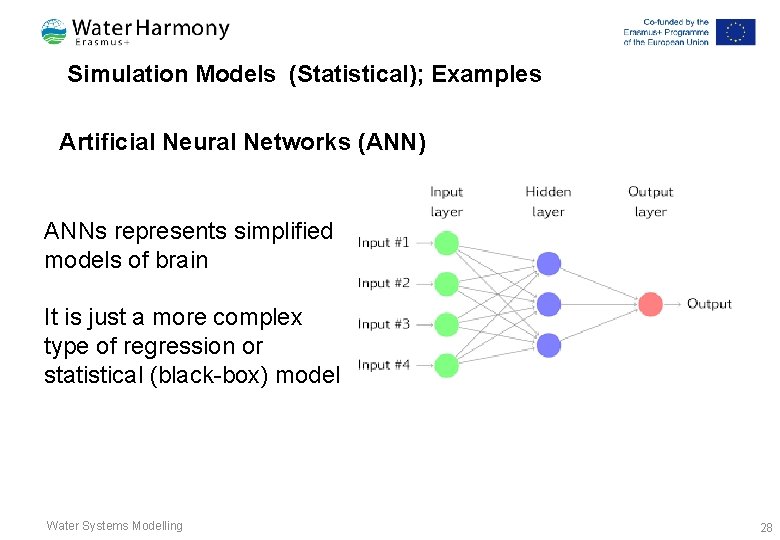
Simulation Models (Statistical); Examples Artificial Neural Networks (ANN) ANNs represents simplified models of brain It is just a more complex type of regression or statistical (black-box) model Water Systems Modelling 28
Optimization Models; Can be Deterministic or Probabilistic or a mixture Can be Static or Dynamic with respect to time Can be Linear or Non-linear Regardless of the type , they all include an objective function (which is used to evaluate multiple possible solutions) Water Systems Modelling 29
Optimization Models Optimization models can be classified into different types depending on the algorithm to be used to solve the model Lagrange multipliers Linear Programming Non-linear Programming Dynamic Programming Quadratic Programming Geometric Programming Water Systems Modelling etc. , 30
Water Demand Management Effective management of water resources has become very important due to limited water supplies and increasing water demands at present Demand management is defined as the development and implementation of strategies aimed at influencing demand, so as to achieve efficient and sustainable use of a scarce resource, namely water It consists of five categories; (1)engineering, (2)economics, (3)enforcement, (4)encouragement, and (5) education Water Systems Modelling 31
Benefits of Water Demand Management § Reduces water demand with no deterioration in life style § Reduces capital requirements for expansion of water supply and lowers operating costs § Reduces generation of pollutants, and therefore the requirements for new or expanded wastewater treatment systems § Facilities expansion of the coverage of available fund § Enhances development and adoption of new technologies § Leads to financially sustainable water systems Water Systems Modelling 32
Water Demand Management Measures Water Demand Management relies upon a range of measures (tools and techniques) § Economic § Socio-political, and § Structural and operational Water Systems Modelling 33
Water Demand Management Measures Economic Measures § Incentives (eg. , rebates, tax credits) § Disincentives (eg. , real cost, penalties, fines) Socio-political Measures § Policies and Laws § Economic policies, government regulations, standards on appliances (eg. , promote water saving devices, encourage water savings in industries) § Effective public/stakeholder education and awareness measures § Wise use of water, direct restriction on use Water Systems Modelling 34
Structural and Operational Measures These are used to achieve better control over water demand § Metering, retrofitting, rationing, recycling § Reduction of non-revenue water (NRW), leakage detection and repair § Use of water efficient devices § Water use restrictions during periods of water shortage Water Systems Modelling 35
Approaches for Water Demand Management § Increase system efficiency § Increase end use efficiency § Promoting distributed sources of supply § Substitute resource use § Improve the market on resource usage Water Systems Modelling 36
Approaches for Water Demand Management Increase system efficiency § No change in usage, but change in system operation § Leak detection and repair, pressure reduction Increase end use efficiency § Less resource use by consumers by using water advertising, education and use of water efficient devices § More efficient watering of public open spaces § Water efficiency in the planning, design and construction of homes and buildings Water Systems Modelling 37
Approaches for Water Demand Management Promoting distributed sources of supply § Provide service via local resource not being used § Encourage rainwater use and grey-water reuse Substitute resource use § Provide same service without resource use § Waterless sanitation, low water-use garden plants, plants adapted to local rainfall Improve the market on resource usage § Inform consumers about full cost of resource § Full cost pricing, universal metering, information on impact excessive water use Water Systems Modelling 38