
Lesson 9 Structure of an NCSE Outline Structure


- Slides: 39
Lesson 9: Structure of an NCSE
Outline § Structure of an NCSE § Example DOC in Public area
Structure of an NCSE
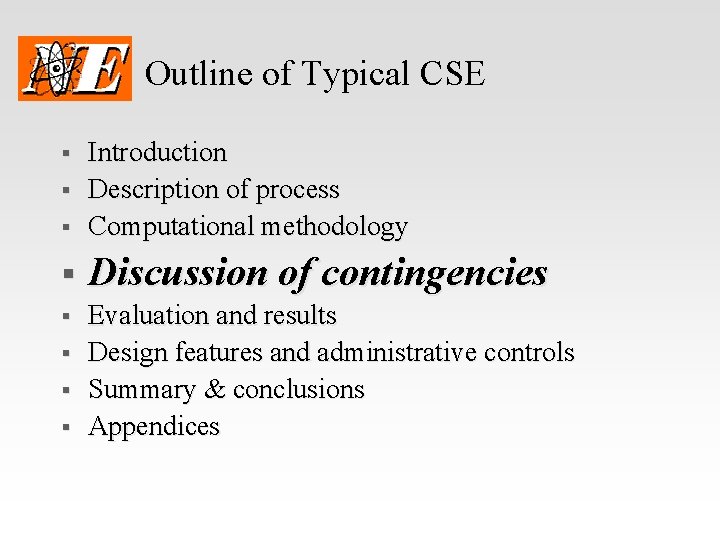
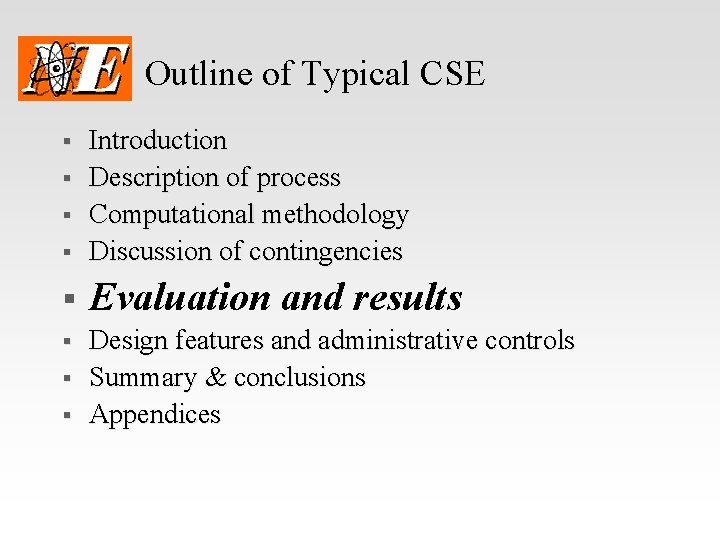
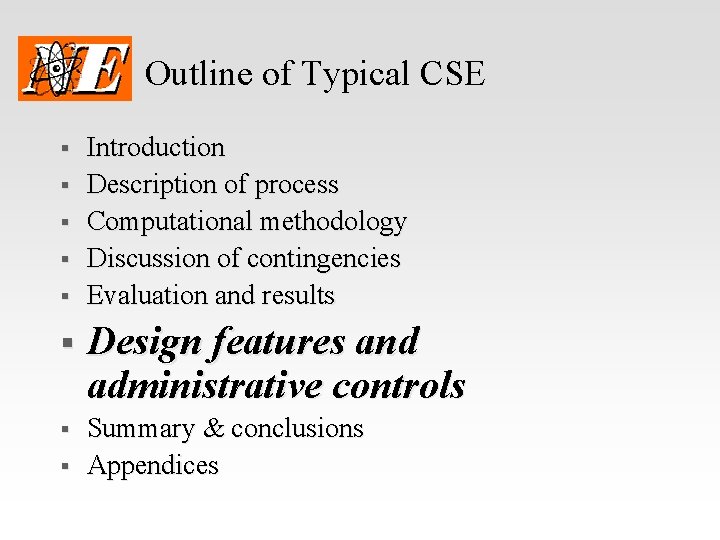
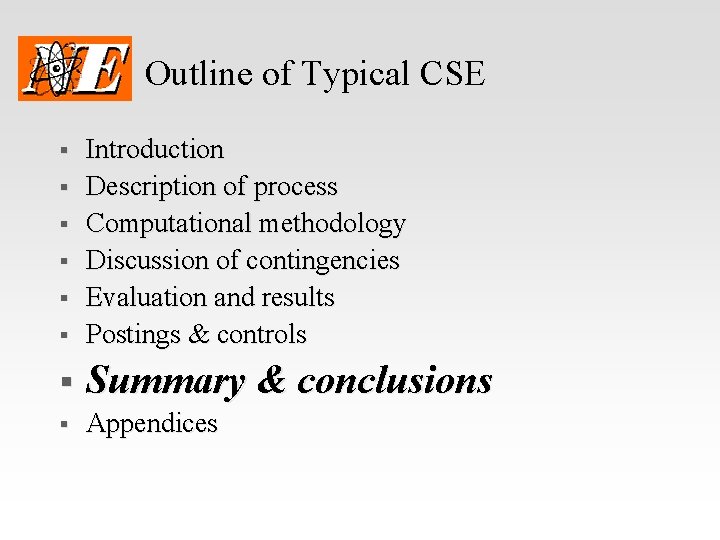
Outline of Typical CSE § Introduction Description of process Computational methodology § Discussion of contingencies § Evaluation and results Design features and administrative controls Summary & conclusions Appendices § § §
Discussion of contingencies § § Discuss how contingencies were identified (copy the first two paragraphs) Contingency Table 5. 1 including controls (it had better agree with your discussion!) § § I will look for the BIG THREE even if the example CSE did not have all of them! Parametric review: Step-by-step sweep through MAGICMERV, either listing contingencies or saying why the parameter was N/A and/or saying what was assumed for it.
Discussion of contingencies (2) § There is one subsection per MAGICMERV parameter § § All contingencies in the category should be listed and described Each should include a statement of why it is unlikely Student was counted off for saying UNUSED parameters were “not considered as a contingency” rather than “not controlled” HINT: If a parameter has something in the Control column, a failure of the control us USUALLY a contingency
Outline of Typical CSE § Introduction Description of process Computational methodology Discussion of contingencies § Evaluation and results § Design features and administrative controls Summary & conclusions Appendices § § §
Evaluation and results § § Materials discussion, including assumptions (point to Appendix A) Normal Model development § § § Normal & accident Simplified through the use of parametric studies Contingency case models as variation on normal model
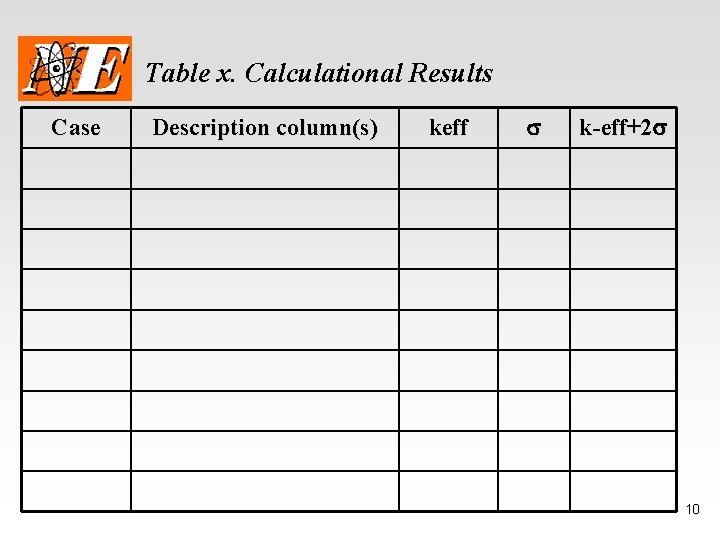
Evaluation and results (2) § JUST DO IT: Calculate the normal case and each of the contingencies you have identified § § Table of results that stands alone § § § But, you CAN save effort by combining multiple contingencies into one calculation, if you want. Like Tables in Section 6. 4 of Example. CSE Enough columns to differentiate cases (repeat columns from contingency table, if desired) Keff column, sigma column, AND Keff+2 sigma column Mark the limiting case with BOLD or larger font (or both) Discuss results in text
Table x. Calculational Results Case Description column(s) keff s k-eff+2 s 10
Outline of Typical CSE § § § Introduction Description of process Computational methodology Discussion of contingencies Evaluation and results § Design features and administrative controls § Summary & conclusions Appendices §
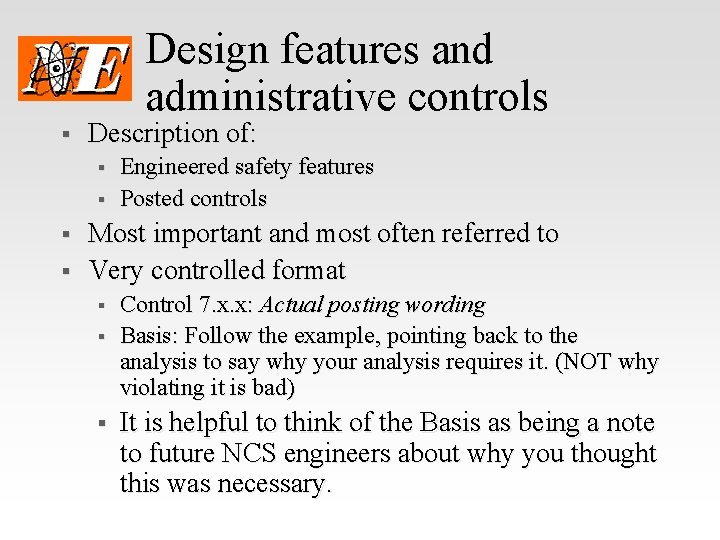
Design features and administrative controls § Description of: § § Engineered safety features Posted controls Most important and most often referred to Very controlled format § § § Control 7. x. x: Actual posting wording Basis: Follow the example, pointing back to the analysis to say why your analysis requires it. (NOT why violating it is bad) It is helpful to think of the Basis as being a note to future NCS engineers about why you thought this was necessary.
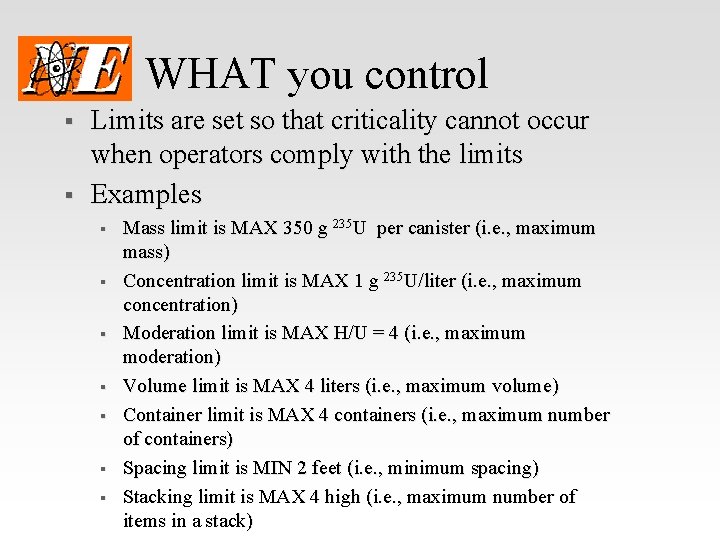
WHAT you control § § Limits are set so that criticality cannot occur when operators comply with the limits Examples § § § § Mass limit is MAX 350 g 235 U per canister (i. e. , maximum mass) Concentration limit is MAX 1 g 235 U/liter (i. e. , maximum concentration) Moderation limit is MAX H/U = 4 (i. e. , maximum moderation) Volume limit is MAX 4 liters (i. e. , maximum volume) Container limit is MAX 4 containers (i. e. , maximum number of containers) Spacing limit is MIN 2 feet (i. e. , minimum spacing) Stacking limit is MAX 4 high (i. e. , maximum number of items in a stack)
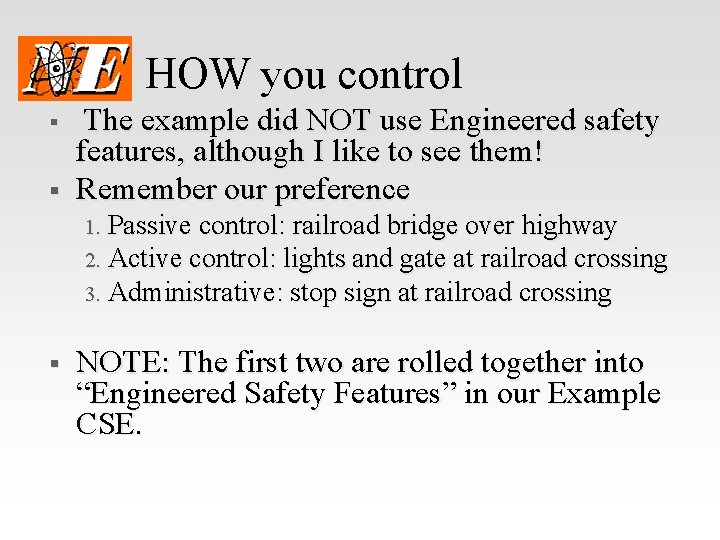
HOW you control § § The example did NOT use Engineered safety features, although I like to see them! Remember our preference 1. Passive control: railroad bridge over highway 2. Active control: lights and gate at railroad crossing 3. Administrative: stop sign at railroad crossing § NOTE: The first two are rolled together into “Engineered Safety Features” in our Example CSE.
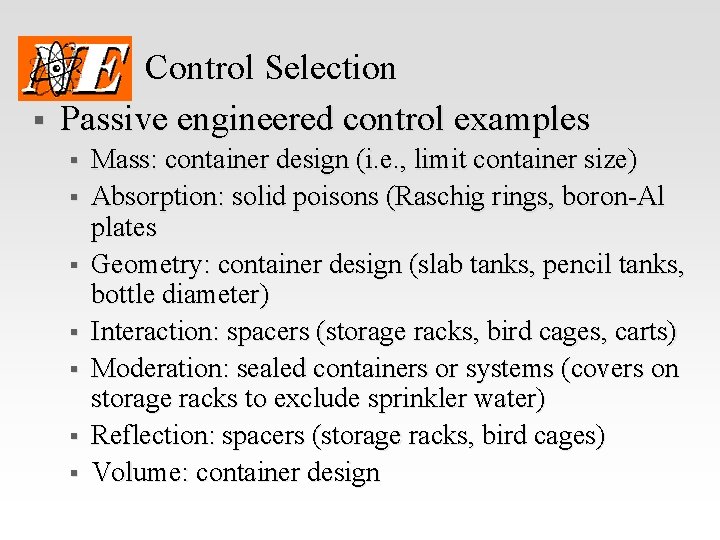
§ Control Selection Passive engineered control examples § § § § Mass: container design (i. e. , limit container size) Absorption: solid poisons (Raschig rings, boron-Al plates Geometry: container design (slab tanks, pencil tanks, bottle diameter) Interaction: spacers (storage racks, bird cages, carts) Moderation: sealed containers or systems (covers on storage racks to exclude sprinkler water) Reflection: spacers (storage racks, bird cages) Volume: container design
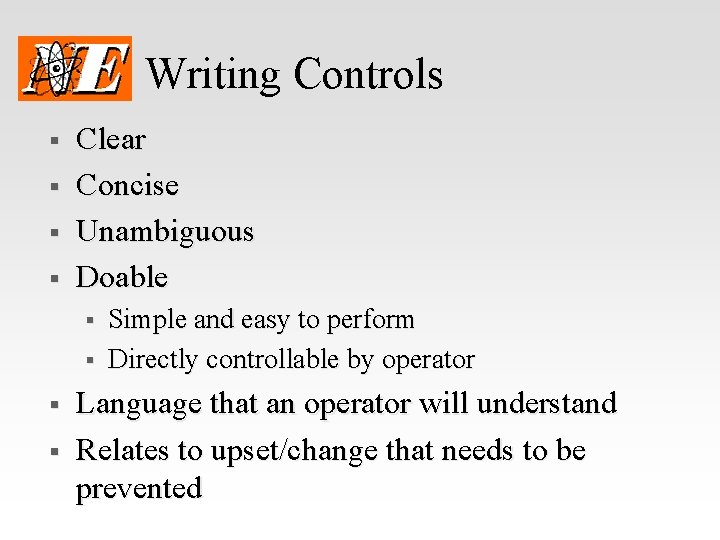
Writing Controls § § Clear Concise Unambiguous Doable § § Simple and easy to perform Directly controllable by operator Language that an operator will understand Relates to upset/change that needs to be prevented
Design features and administrative controls (2) § In addition, Appendix C contains Power. Point slide examples of the Postings themselves
Outline of Typical CSE § Introduction Description of process Computational methodology Discussion of contingencies Evaluation and results Postings & controls § Summary & conclusions § Appendices § § §
Summary & conclusions § § Summary Conclusions
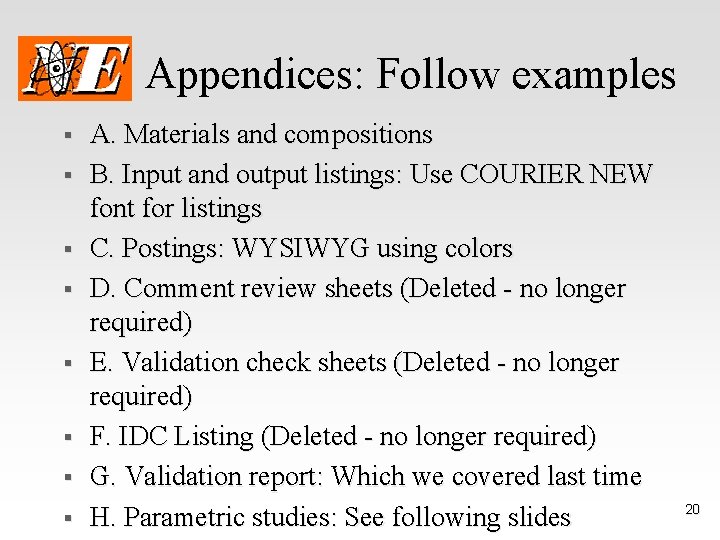
Appendices: Follow examples § § § § A. Materials and compositions B. Input and output listings: Use COURIER NEW font for listings C. Postings: WYSIWYG using colors D. Comment review sheets (Deleted - no longer required) E. Validation check sheets (Deleted - no longer required) F. IDC Listing (Deleted - no longer required) G. Validation report: Which we covered last time H. Parametric studies: See following slides 20
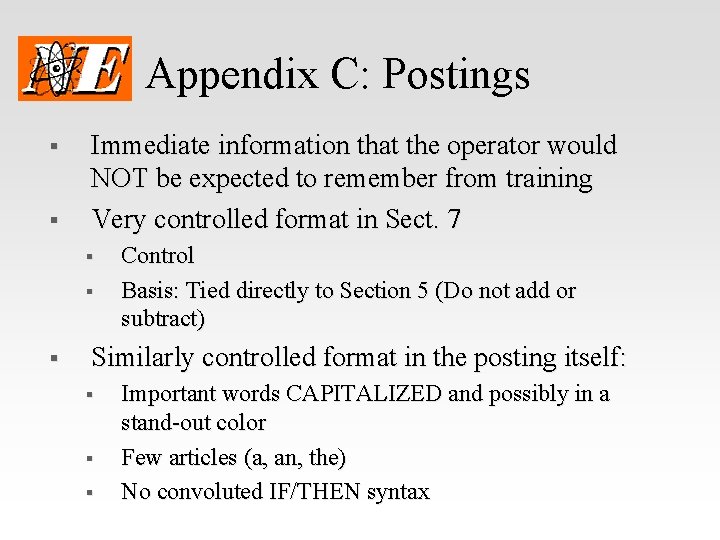
Appendix C: Postings § § Immediate information that the operator would NOT be expected to remember from training Very controlled format in Sect. 7 § § § Control Basis: Tied directly to Section 5 (Do not add or subtract) Similarly controlled format in the posting itself: § § § Important words CAPITALIZED and possibly in a stand-out color Few articles (a, an, the) No convoluted IF/THEN syntax
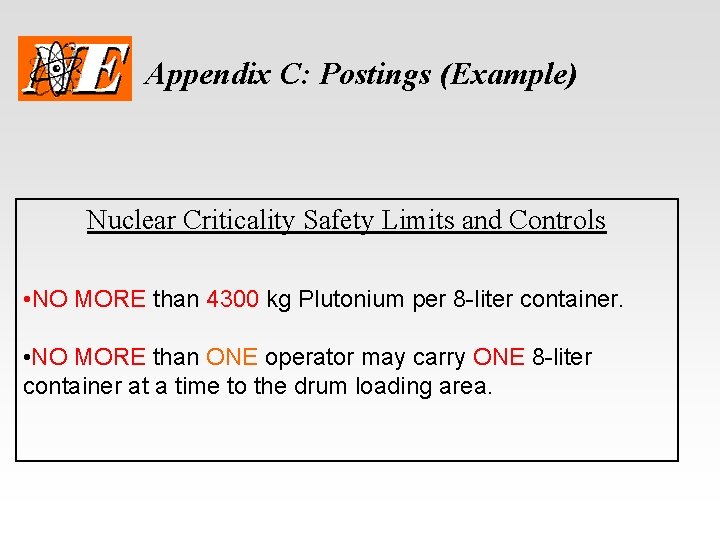
Appendix C: Postings (Example) Nuclear Criticality Safety Limits and Controls • NO MORE than 4300 kg Plutonium per 8 -liter container. • NO MORE than ONE operator may carry ONE 8 -liter container at a time to the drum loading area.
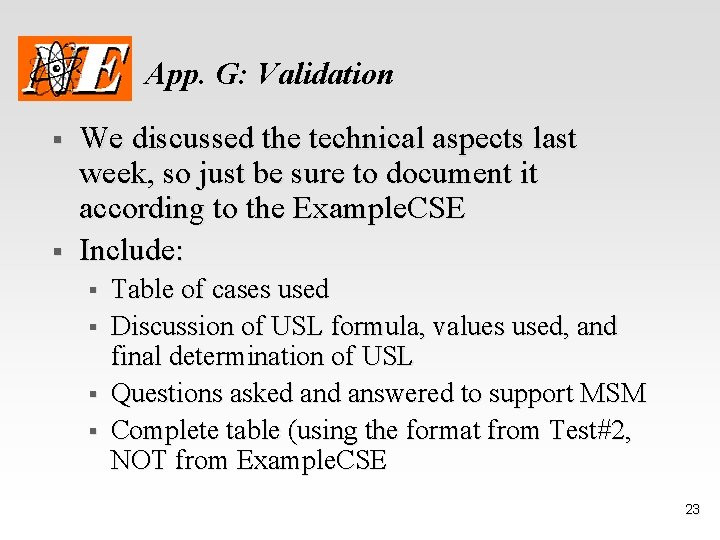
App. G: Validation § § We discussed the technical aspects last week, so just be sure to document it according to the Example. CSE Include: § § Table of cases used Discussion of USL formula, values used, and final determination of USL Questions asked answered to support MSM Complete table (using the format from Test#2, NOT from Example. CSE 23
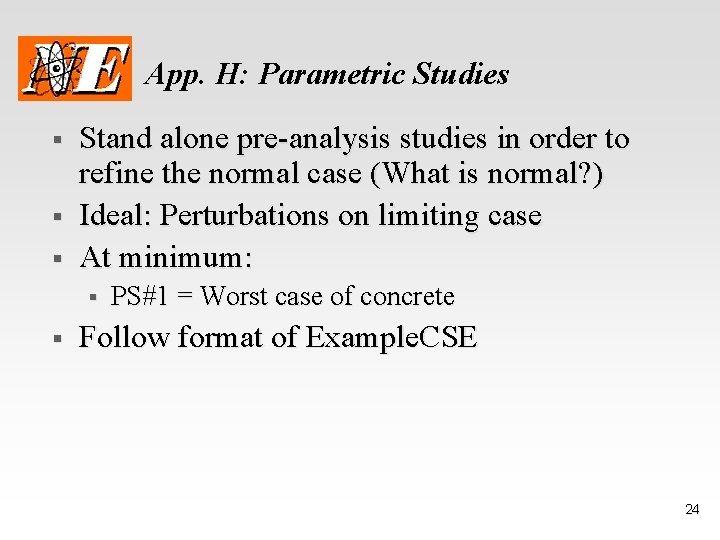
App. H: Parametric Studies § § § Stand alone pre-analysis studies in order to refine the normal case (What is normal? ) Ideal: Perturbations on limiting case At minimum: § § PS#1 = Worst case of concrete Follow format of Example. CSE 24
Parametric studies § Arise out of modeling questions § § § Most reactive material makeup Most reactive reflection Most reactive placement of fissile (primary) Most reactive arrangement of other material (including other fissile elements) Acceptability of modeling simplification (e. g. , leaving out walls, ceilings, etc. ) Sometimes order matters—you want to clear up the most “independent” modeling questions first to use in the others 25
Final Reports
What I will look for in your reports 1. 2. 3. 4. 5. 6. 7. 8. 9. Report clearly written, all elements of each part of report there § Pictures Normal and contingency analysis complete and clear “Controls” in Sect. 5 table justify “contingency” (i. e. , unlikely) status Sect 7 controls are covered in Sect 5 table § Conversely, all controls from table that need to be listed in Sect 7 are Engineering safety features relied on are in Sect 5 table AND Sect 7 list Example postings are in App C and agree with Sect 7 Controls are justified (BASIS) in Sect 7 Validation appendix complete, clear, and approval has been given (e -mail) Parametric studies appendix complete (i. e. , if mentioned in Sect 6, show up in App. H and vice versa)
What I will look for (cont’d) Normal and contingencies from table are actually calculated 11. SCALE input corresponds with cases quoted 12. Calculations could be reproduced from data given (NOT including the input deck—the next person to calculate might not be able to “read” SCALE) 13. Results make sense 14. App A and B complete 10.
Final report requirements The Final Report MUST be e-mailed to me by the due date/time: Stand alone—no cutting and pasting required by the professor! =ONE WORD document
I. Z. 26. University of Alabama, 19 October 2019 Marsha Goodstudent
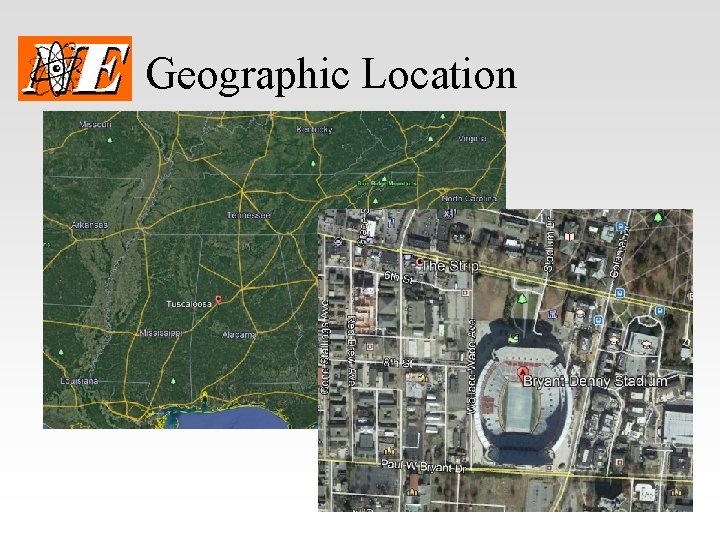
Geographic Location
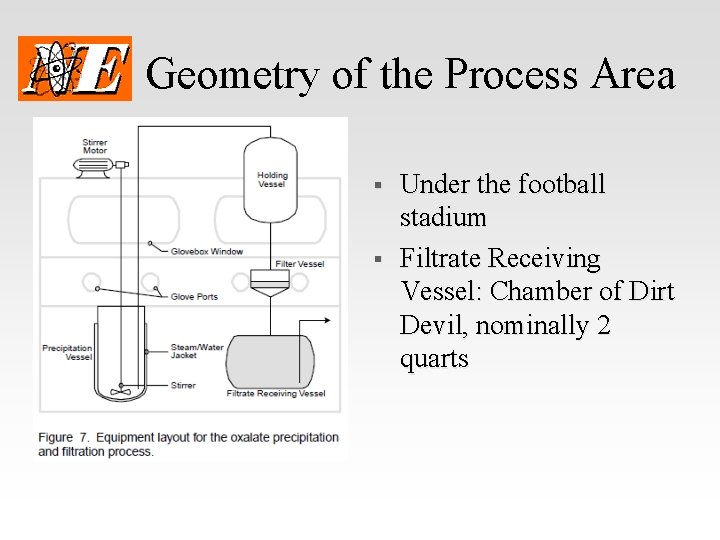
Geometry of the Process Area § § Under the football stadium Filtrate Receiving Vessel: Chamber of Dirt Devil, nominally 2 quarts
Important Equipment �Item 1 �Item 2 �Item 3 �Item 4 �Glovebox �No temperature monitoring device (temp was controlled by feeling the container) �No on-line instrumentation for measuring process parameters such as uranium concentration (the operators just guessed)
Normal Steps of the Process � The main feed material, impure uranyl nitrate, was generated in the Field House next door � This, along with was introduced into the precipitation vessel using small buckets. Which was stirred by hand. � The precipitate slurry was then vacuum into a holding tank using a Dirt Devil � The precipitate was collected on the filter fabric (old football jerseys) and the filtrate was saved in the Dirt Devil chamber.
Changes to the Normal Geometry and Process § § The operators were in a hurry to get to the game. No jerseys were available (since it was game day, duh) Therefore all of the fissile material went into the vacuum cleaner The Dirt Devil had been taken for use in the game, so an old Hoover was used, which had a larger collection chamber
How the Accident Progressed �Occurred during vacuum (non)-filtration. �Hoover chamber glowed blue, followed by violent release of gas and ejection of some of the precipitate onto the glove box floor. �Operator ran out of the room screaming. �Release of gas or vapor continued for three hours (until the game was over and someone realized that the operator was not screaming because Alabama was losing to the Vols).
Emergency Response � Criticality alarm went unnoticed because of crowd noise. � Operators had no criticality safety training, since no viable Engineering College on campus. � Criticality accident determined to have occurred by a UTNE nuclear engineering student who happened to be passing by. � Measurements indicated intense gamma radiation field 20 minutes after this occurred. � Prompt evacuation of the area. early anyway. ) (Most of the crowd had left
Outcome and Consequences § Operator received dose of about xxx rad. He was treated…. . § 5 other operators in the room at varying distances from the reacting vessel. Received dose of approximately xxx rad. § Equipment cleaned and put back into use with addition of a radiation meter.
Lessons Learned § Operating instructions were revised. § Enhanced operator training was implemented. § Lead to the decision to set up an implant critical experiment measurement capability to better determine critical parameters for vessels in routine use.