
Lesson 9 Section 9 Performance Evaluation Section 9
- Slides: 26
Lesson 9 Section 9: Performance Evaluation
Section 9 | Performance Evaluation 9. 1, 9. 1. 1 Monitoring, Measurement, Analysis and Evaluation The organization shall determine: a) what needs to be monitored and measured; b) the methods for monitoring, measurement, analysis and evaluation needed to ensure valid results; c) when the monitoring and measuring shall be performed; d) when the results from monitoring and measurement shall be analysed and evaluated. The organization shall evaluate the performance and the effectiveness of the quality management system. The organization shall retain appropriate documented information as evidence of the results.
Section 9 | Performance Evaluation Auditing 9. 1, 9. 1. 1 Monitoring, Measurement, Analysis and Evaluation (OE) Verify the plan for monitoring, measurement, analysis and evaluation is established. No procedure required, but process should address all items listed in standard. Meeting minutes are common with action items and regular reviews. Verify where the performance and effectiveness of the QMS is evaluated – management review is common. Verify that there are records that cover all items.
Section 9 | Performance Evaluation 9. 1. 2 Customer Satisfaction The organization shall monitor customers’ perceptions of the degree to which their needs and expectations have been fulfilled. The organization shall determine the methods for obtaining, monitoring and reviewing this information. NOTE: Examples of monitoring customer perceptions can include customer surveys, customer feedback on delivered products and services, meetings with customers, marketshare analysis, compliments, warranty claims and dealer reports.
Section 9 | Performance Evaluation Auditing 9. 1. 2 Customer Satisfaction (OE) Shall monitor customers perceptions. Determine methods for obtaining, monitoring and reviewing information. OE – Surveys, interviews (would need records for review).
Section 9 | Performance Evaluation 9. 1. 3 Analysis and Evaluation The organization shall analyze and evaluate appropriate data and information arising from monitoring and measurement. The results of analysis shall be used to evaluate: a) conformity of products and services; b) the degree of customer satisfaction; c) the performance and effectiveness of the quality management system; d) if planning has been implemented effectively; e) the effectiveness of actions taken to address risks and opportunities; f) the performance of external providers; g) the need for improvements to the quality management system. NOTE: Methods to analyze data can include statistical techniques.
Section 9 | Performance Evaluation Auditing 9. 1. 3 Analysis and Evaluation (OE)
Section 9 | Performance Evaluation 9. 2 & 9. 2. 1 Internal Audit The organization shall conduct internal audits at planned intervals to provide information on whether the quality management system: a) conforms to: 1) the organization’s own requirements for its quality management system; 2) the requirements of this International Standard; b) is effectively implemented and maintained.
Section 9 | Performance Evaluation 9. 2. 2 Internal Audit The organization shall: a) plan, establish, implement and maintain an audit programme(s) including the frequency, methods, responsibilities, planning requirements and reporting, which shall take into consideration the importance of the processes concerned, changes affecting the organization, and the results of previous audits; b) define the audit criteria and scope for each audit; c) select auditors and conduct audits to ensure objectivity and the impartiality of the audit process;
Section 9 | Performance Evaluation 9. 2. 2 Internal Audit - Continued The organization shall: d) ensure that the results of the audits are reported to relevant management; e) take appropriate correction and corrective actions without undue delay; f) r� etain documented information as evidence of the implementation of the audit programme and the audit results. NOTE: See ISO 19011 for guidance.
Section 9 | Performance Evaluation Auditing 9. 2 Internal Audit (OE) Verify audit schedule, plan, criteria, scope, evaluation against ISO & QMS. Verify auditors training & independent. Records of internal audits, e. g. reports, findings and corrective actions. Verify communication to management (MR. )
Section 9 | Performance Evaluation 9. 3, 9. 3. 1 Management Review - General Top management shall review the organization’s quality management system, at planned intervals, to ensure its continuing suitability, adequacy, effectiveness and alignment with the strategic direction of the organization.
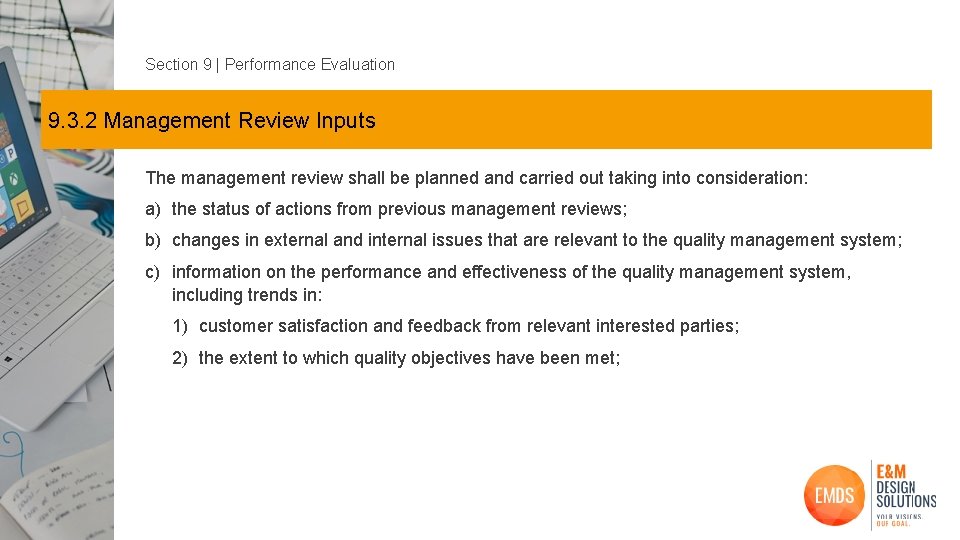
Section 9 | Performance Evaluation 9. 3. 2 Management Review Inputs The management review shall be planned and carried out taking into consideration: a) the status of actions from previous management reviews; b) changes in external and internal issues that are relevant to the quality management system; c) information on the performance and effectiveness of the quality management system, including trends in: 1) customer satisfaction and feedback from relevant interested parties; 2) the extent to which quality objectives have been met;
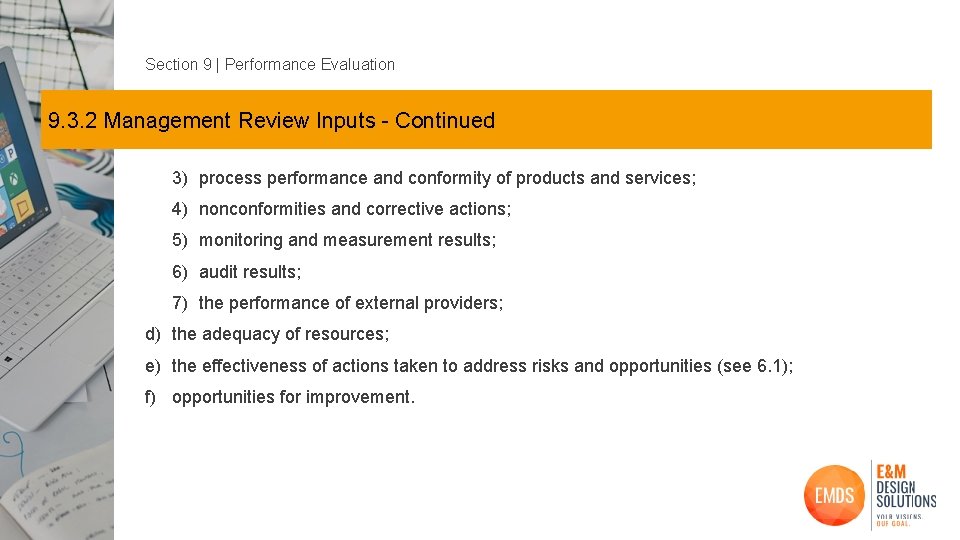
Section 9 | Performance Evaluation 9. 3. 2 Management Review Inputs - Continued 3) process performance and conformity of products and services; 4) nonconformities and corrective actions; 5) monitoring and measurement results; 6) audit results; 7) the performance of external providers; d) the adequacy of resources; e) the effectiveness of actions taken to address risks and opportunities (see 6. 1); f) opportunities for improvement.
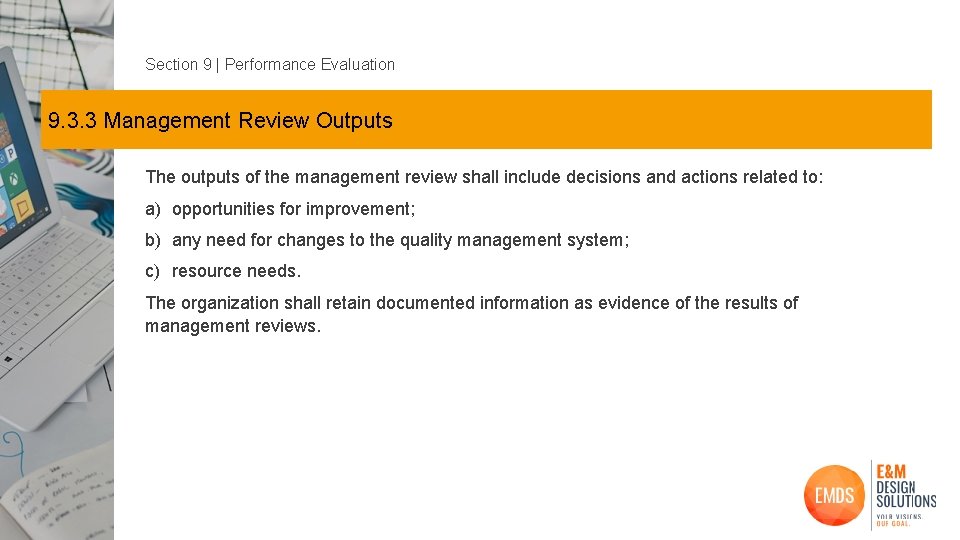
Section 9 | Performance Evaluation 9. 3. 3 Management Review Outputs The outputs of the management review shall include decisions and actions related to: a) opportunities for improvement; b) any need for changes to the quality management system; c) resource needs. The organization shall retain documented information as evidence of the results of management reviews.
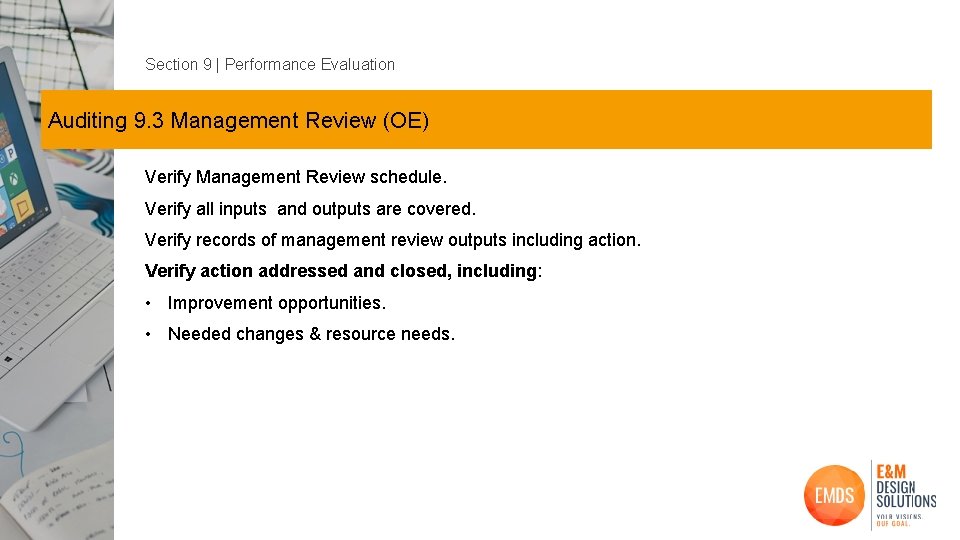
Section 9 | Performance Evaluation Auditing 9. 3 Management Review (OE) Verify Management Review schedule. Verify all inputs and outputs are covered. Verify records of management review outputs including action. Verify action addressed and closed, including: • Improvement opportunities. • Needed changes & resource needs.
Lesson 10 Section 10: Improvements
Section 10 | Improvements 10, 10. 1 Improvements The organization shall determine and select opportunities for improvement and implement any necessary actions to meet customer requirements and enhance customer satisfaction. These shall include: a) improving products and services to meet requirements as well as to address future needs and expectations; b) correcting, preventing or reducing undesired effects; c) improving the performance and effectiveness of the quality management system. NOTE: Examples of improvement can include correction, corrective action, continual improvement, breakthrough change, innovation and re-organization.
Section 10 | Improvements Auditing 10, 10. 1 Improvements (OE) Verify that there action plans for improvement – these may be addressed through combined processes, e. g. risk analysis, preventive action, continual improvement programs, etc. Verify there is a focus on improving Products and Services, and QMS. Can include corrective action.
Section 10 | Improvements 10. 2. 1 Nonconformity and Corrective Action When a nonconformity occurs, including any arising from complaints, the organization shall: a) react to the nonconformity and, as applicable: 1) take action to control and correct it; 2) deal with the consequences; b) evaluate the need for action to eliminate the cause(s) of the nonconformity, in order that it does not recur or occur elsewhere, by: 1) reviewing and analyzing the nonconformity; 2) determining the causes of the nonconformity; 3) determining if similar nonconformities exist, or could potentially occur;
Section 10 | Improvements 10. 2. 1 Nonconformity and Corrective Action - Continued the organization shall: c) implement any action needed; d) review the effectiveness of any corrective action taken; e) update risks and opportunities determined during planning, if necessary; f) make changes to the quality management system, if necessary. Corrective actions shall be appropriate to the effects of the nonconformities encountered.
Section 10 | Improvements 10. 2. 2 Nonconformity and Corrective Action The organization shall retain documented information as evidence of: a) the nature of the nonconformities and any subsequent actions taken; b) the results of any corrective action.
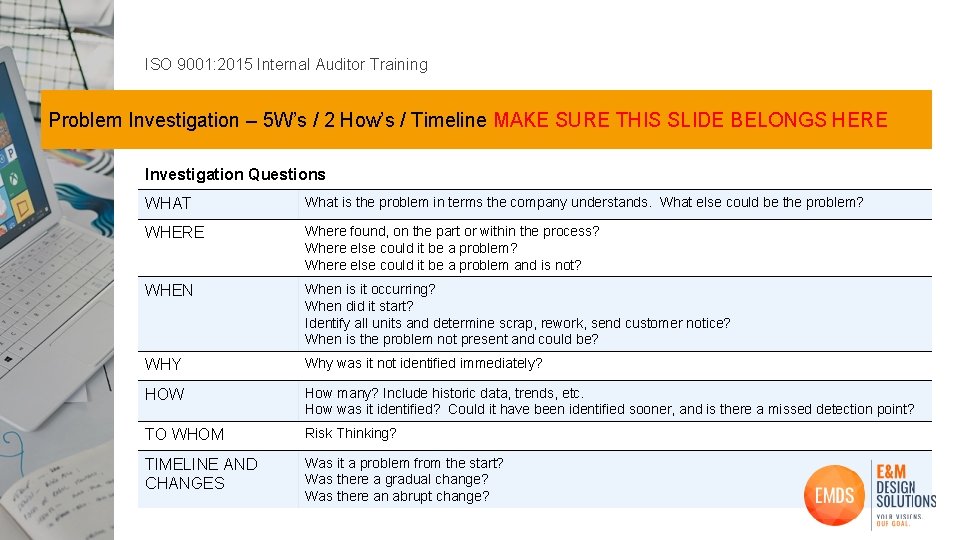
ISO 9001: 2015 Internal Auditor Training Problem Investigation – 5 W’s / 2 How’s / Timeline MAKE SURE THIS SLIDE BELONGS HERE Investigation Questions WHAT What is the problem in terms the company understands. What else could be the problem? WHERE Where found, on the part or within the process? Where else could it be a problem and is not? WHEN When is it occurring? When did it start? Identify all units and determine scrap, rework, send customer notice? When is the problem not present and could be? WHY Why was it not identified immediately? HOW How many? Include historic data, trends, etc. How was it identified? Could it have been identified sooner, and is there a missed detection point? TO WHOM Risk Thinking? TIMELINE AND CHANGES Was it a problem from the start? Was there a gradual change? Was there an abrupt change?
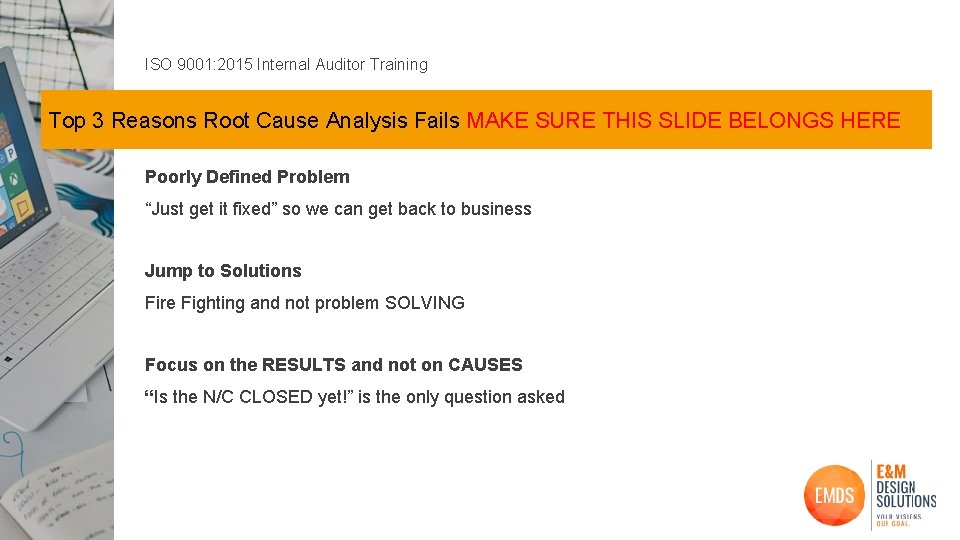
ISO 9001: 2015 Internal Auditor Training Top 3 Reasons Root Cause Analysis Fails MAKE SURE THIS SLIDE BELONGS HERE Poorly Defined Problem “Just get it fixed” so we can get back to business Jump to Solutions Fire Fighting and not problem SOLVING Focus on the RESULTS and not on CAUSES “Is the N/C CLOSED yet!” is the only question asked
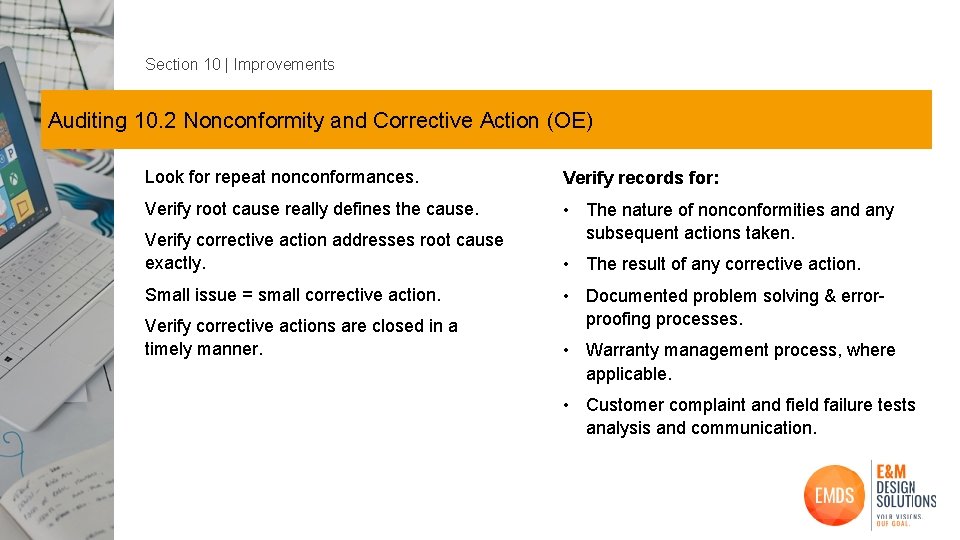
Section 10 | Improvements Auditing 10. 2 Nonconformity and Corrective Action (OE) Look for repeat nonconformances. Verify records for: Verify root cause really defines the cause. • The nature of nonconformities and any subsequent actions taken. Verify corrective action addresses root cause exactly. Small issue = small corrective action. Verify corrective actions are closed in a timely manner. • The result of any corrective action. • Documented problem solving & errorproofing processes. • Warranty management process, where applicable. • Customer complaint and field failure tests analysis and communication.
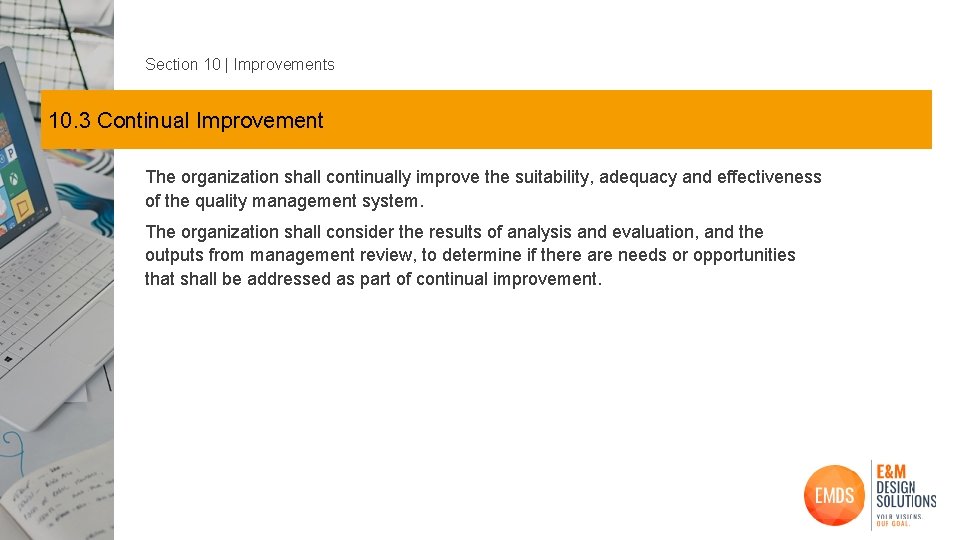
Section 10 | Improvements 10. 3 Continual Improvement The organization shall continually improve the suitability, adequacy and effectiveness of the quality management system. The organization shall consider the results of analysis and evaluation, and the outputs from management review, to determine if there are needs or opportunities that shall be addressed as part of continual improvement.