
Lesson 9 Compositions of Functions IBHL 1 Math
Lesson 9 – Compositions of Functions IBHL 1 Math - Santowski 2/27/2021 HL 1 Math - Santowski 1
The BIG Picture n And we are studying this because. . ? n Functions will be a unifying theme throughout the course so a solid understanding of what functions are and why they are used and how they are used will be very important! n Sometimes, complicated looking equations can be easier to understand as being combinations of simpler, parent functions 2/27/2021 HL 1 Math - Santowski 2
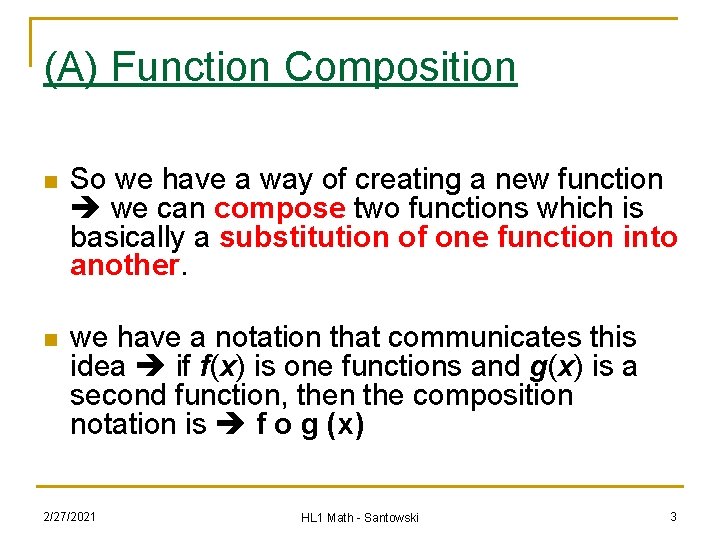
(A) Function Composition n So we have a way of creating a new function we can compose two functions which is basically a substitution of one function into another. n we have a notation that communicates this idea if f(x) is one functions and g(x) is a second function, then the composition notation is f o g (x) 2/27/2021 HL 1 Math - Santowski 3
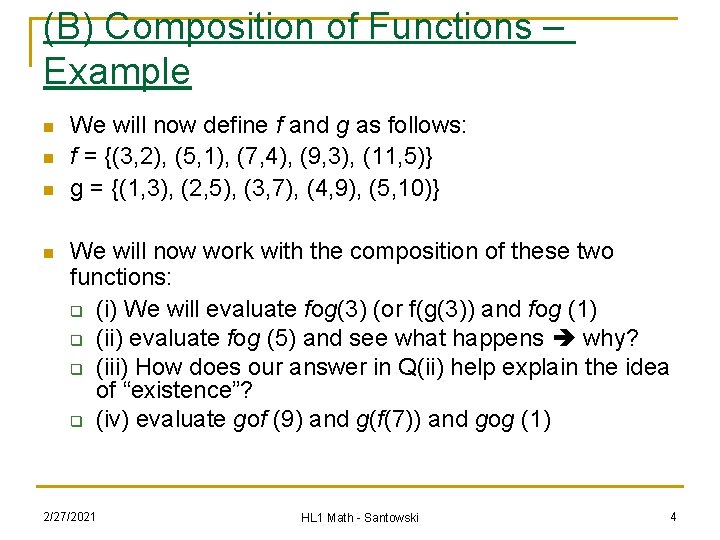
(B) Composition of Functions – Example n n We will now define f and g as follows: f = {(3, 2), (5, 1), (7, 4), (9, 3), (11, 5)} g = {(1, 3), (2, 5), (3, 7), (4, 9), (5, 10)} We will now work with the composition of these two functions: q (i) We will evaluate fog(3) (or f(g(3)) and fog (1) q (ii) evaluate fog (5) and see what happens why? q (iii) How does our answer in Q(ii) help explain the idea of “existence”? q (iv) evaluate gof (9) and g(f(7)) and gog (1) 2/27/2021 HL 1 Math - Santowski 4
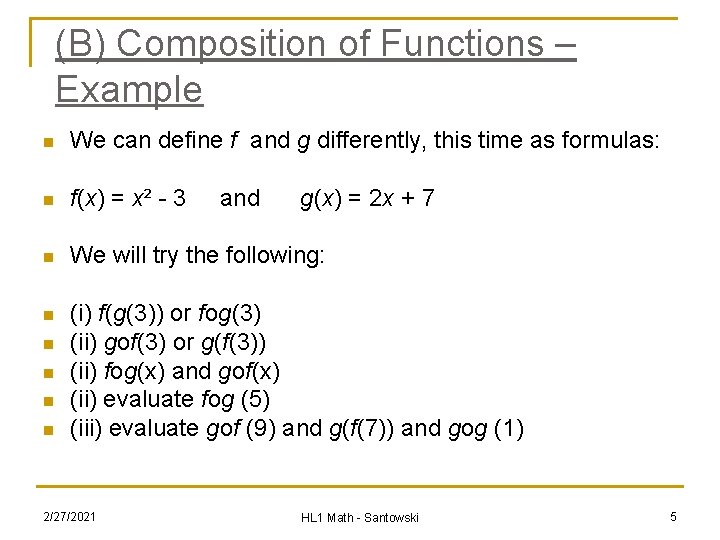
(B) Composition of Functions – Example n We can define f and g differently, this time as formulas: n f(x) = x² - 3 and g(x) = 2 x + 7 n We will try the following: n (i) f(g(3)) or fog(3) (ii) gof(3) or g(f(3)) (ii) fog(x) and gof(x) (ii) evaluate fog (5) (iii) evaluate gof (9) and g(f(7)) and gog (1) n n 2/27/2021 HL 1 Math - Santowski 5
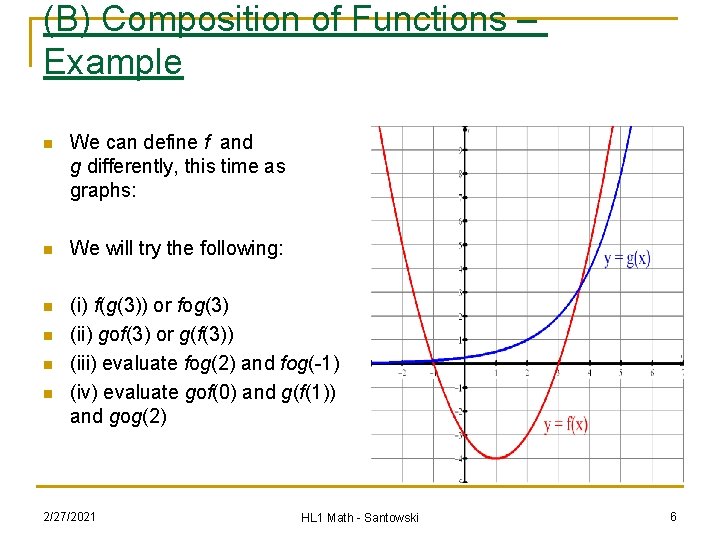
(B) Composition of Functions – Example n We can define f and g differently, this time as graphs: n We will try the following: n (i) f(g(3)) or fog(3) (ii) gof(3) or g(f(3)) (iii) evaluate fog(2) and fog(-1) (iv) evaluate gof(0) and g(f(1)) and gog(2) n n n 2/27/2021 HL 1 Math - Santowski 6
(C) “Existence of Composite” n Use DESMOS to graph the following functions: n State the RANGE of f(x) and of g(x). Determine the equation for fog(x) Graph the composite function, fog(x) and determine its DOMAIN n n Q(a)? Does fog(x) exist Why is the answer NO!? !? !? Q(b)? Under what domain conditions of g(x) does fog(x) exist 2/27/2021 HL 1 Math - Santowski 7
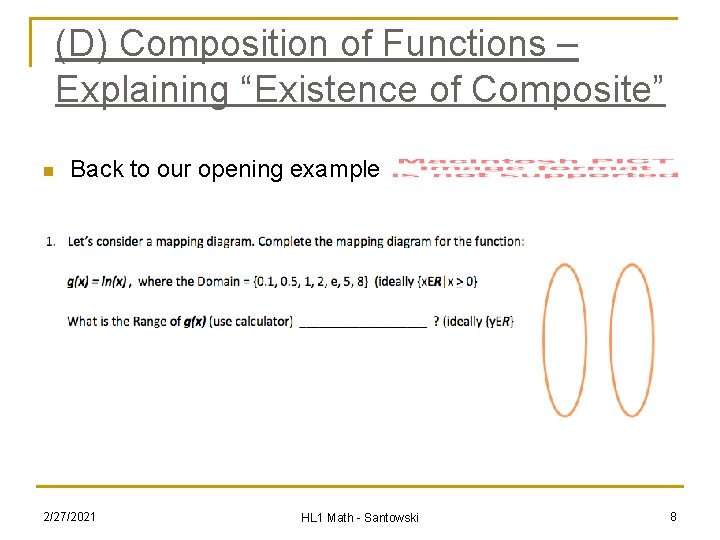
(D) Composition of Functions – Explaining “Existence of Composite” n Back to our opening example n 2/27/2021 HL 1 Math - Santowski 8

(D) Composition of Functions – Explaining “Existence of Composite” 2/27/2021 HL 1 Math - Santowski 9
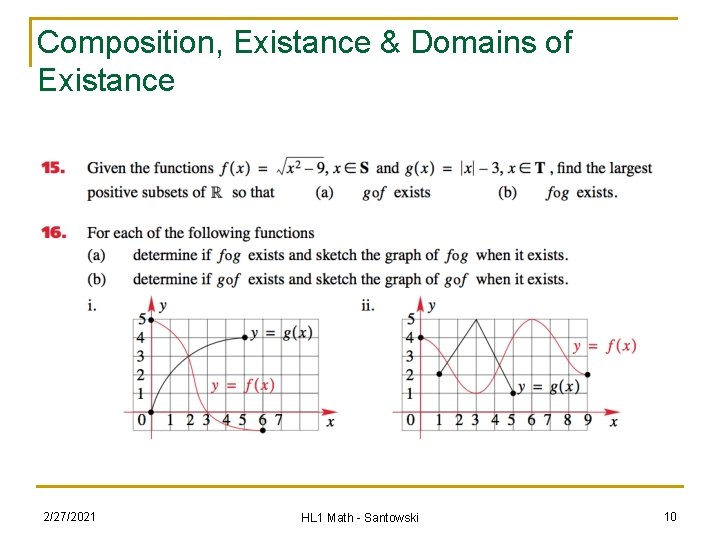
Composition, Existance & Domains of Existance 2/27/2021 HL 1 Math - Santowski 10
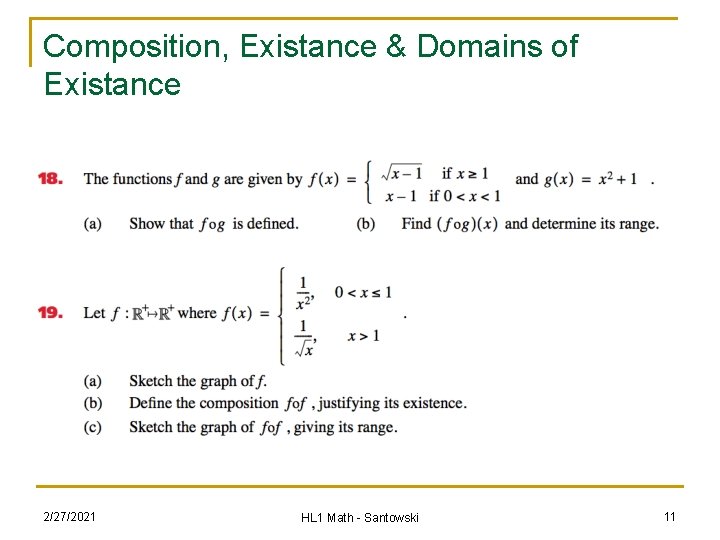
Composition, Existance & Domains of Existance 2/27/2021 HL 1 Math - Santowski 11
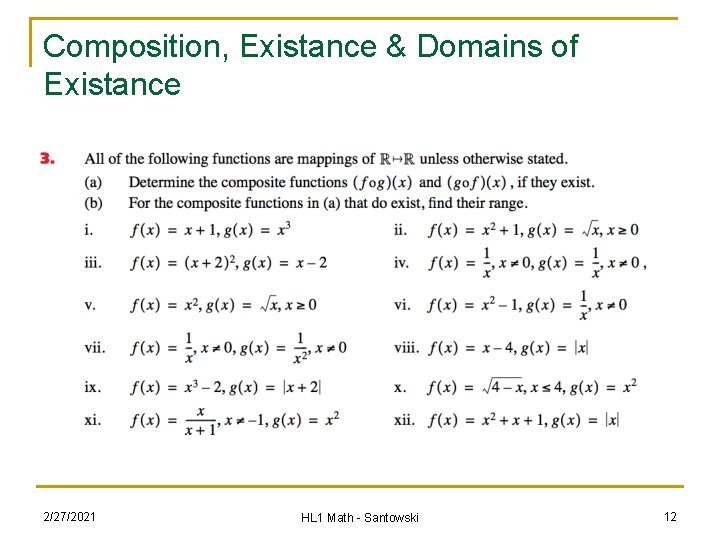
Composition, Existance & Domains of Existance 2/27/2021 HL 1 Math - Santowski 12
(F) Composition of Functions – Example n For the following pairs of functions n (a) Determine fog (x) (b) Determine gof (x) n n (c) Graph the original two functions in a square view window & make observations about the graph then relate these observations back to the composition result 2/27/2021 HL 1 Math - Santowski 13
- Slides: 13