
lesson 9 4 STOPPING DISTANCE There are three
- Slides: 12
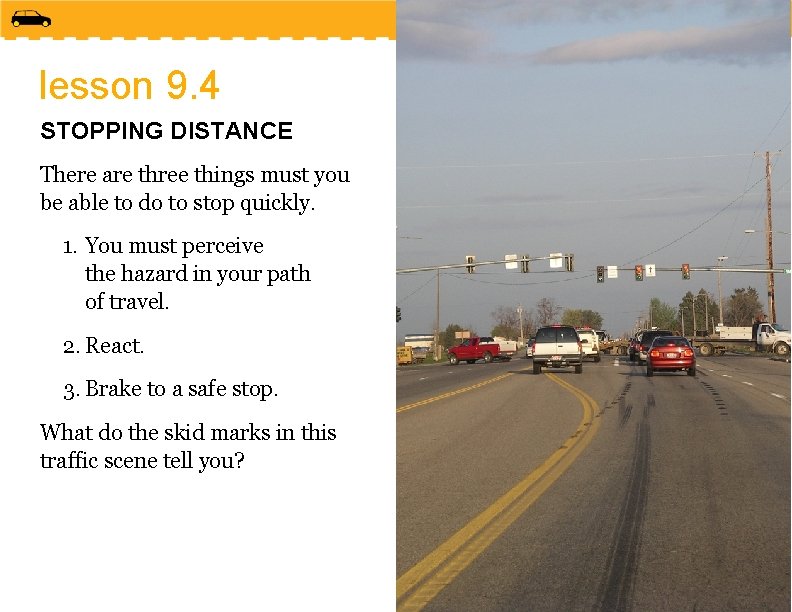
lesson 9. 4 STOPPING DISTANCE There are three things must you be able to do to stop quickly. 1. You must perceive the hazard in your path of travel. 2. React. 3. Brake to a safe stop. What do the skid marks in this traffic scene tell you?
OBJECTIVE Describe three actions that determine total stopping distance.
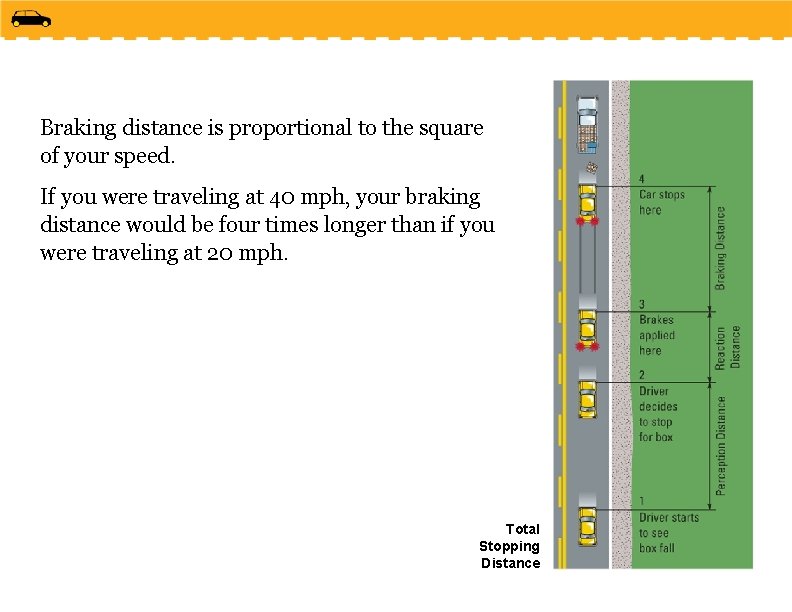
Total Stopping Distance The distance your car travels from the time you first perceive a hazard until you reach a full stop is your total stopping distance. • You should always be able to stop within the distance you can see ahead. • It will take you almost 300 feet, or the length of a football field, to stop if you are traveling at 65 mph.
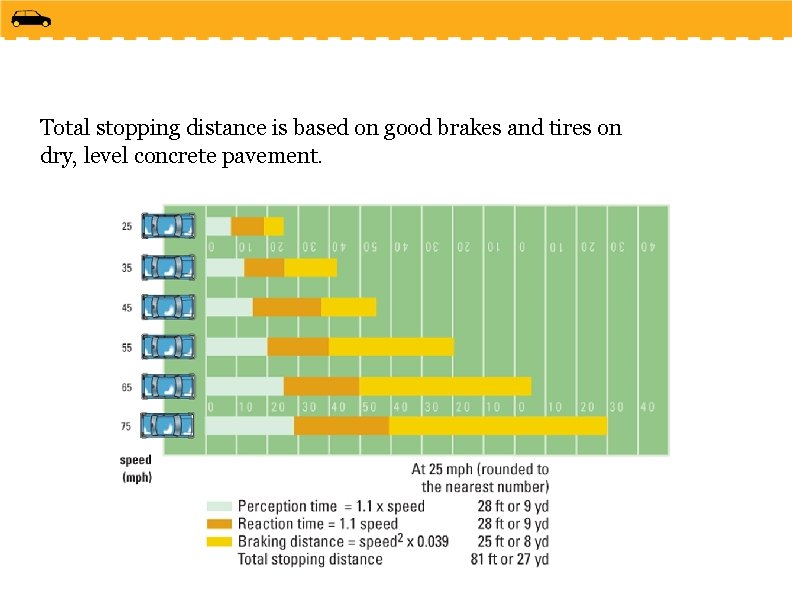
Total stopping distance is based on good brakes and tires on dry, level concrete pavement.
Perception Time and Distance The length of time it takes you to identify a hazard, predict a conflict, and decide to brake is your perception time. • Perception time for alert drivers is about three fourths of a second.
The distance your vehicle travels during your perception time is your perception distance. • What factors can affect your perception time? • How can you improve your perception time?
Reaction Time and Distance Once you identify a hazard, the length of time you take to apply the brake is your reaction time. • An alert driver’s reaction time is about three fourths of a second. • The distance your vehicle travels while you react is called your reaction distance.
Braking Distance The distance your vehicle travels from the time you apply the brake until you stop is your braking distance. • What natural law affects your braking distance?
Braking distance is proportional to the square of your speed. If you were traveling at 40 mph, your braking distance would be four times longer than if you were traveling at 20 mph. Total Stopping Distance
OBJECTIVE Identify key factors that affect braking distance.
Factors That Affect Braking Distance What is the most efficient way to stop? Why? Factors that can affect your total braking distance include: • driver ability • speed • vehicle condition • roadway surface • hills • weight of the vehicle’s load
lesson 9. 4 review 1. In the order they occur, list the three actions that determine total stopping distance. 2. List six factors that can increase your braking distance. Which of these can the driver control?