
Lesson 9 1 Local Food Systems Lesson Outcomes

- Slides: 18
Lesson 9. 1 Local Food Systems
Lesson Outcomes • Define a local food system • Explain the advantages and disadvantages of local food systems • Examine methods for distributing local foods to consumers ©i. Stock. com/123 Artist. Images Copyright Goodheart-Willcox Co. , Inc. May not be posted to a publicly accessible website.
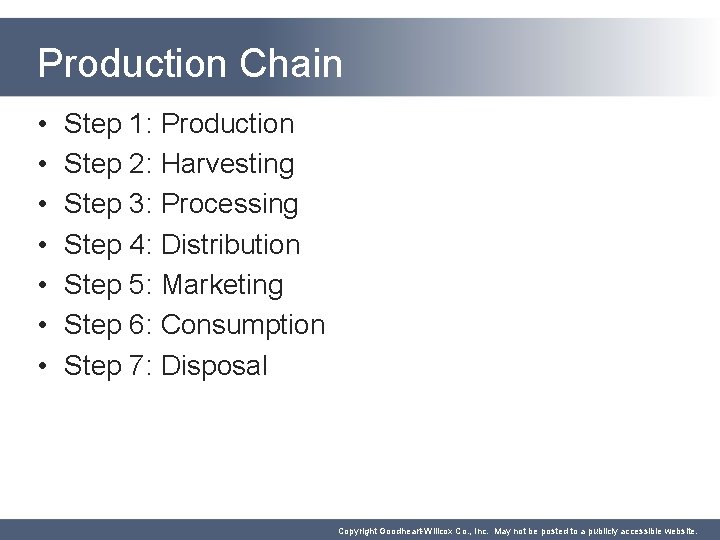
Production Chain • • Step 1: Production Step 2: Harvesting Step 3: Processing Step 4: Distribution Step 5: Marketing Step 6: Consumption Step 7: Disposal Copyright Goodheart-Willcox Co. , Inc. May not be posted to a publicly accessible website.
Step One: Production • Food production is growing crops or raising animals for food – Crops are cultivated animals are raised until optimal harvesting stage • In early days of agriculture, all food systems were local food systems – All food was produced and consumed locally Copyright Goodheart-Willcox Co. , Inc. May not be posted to a publicly accessible website.
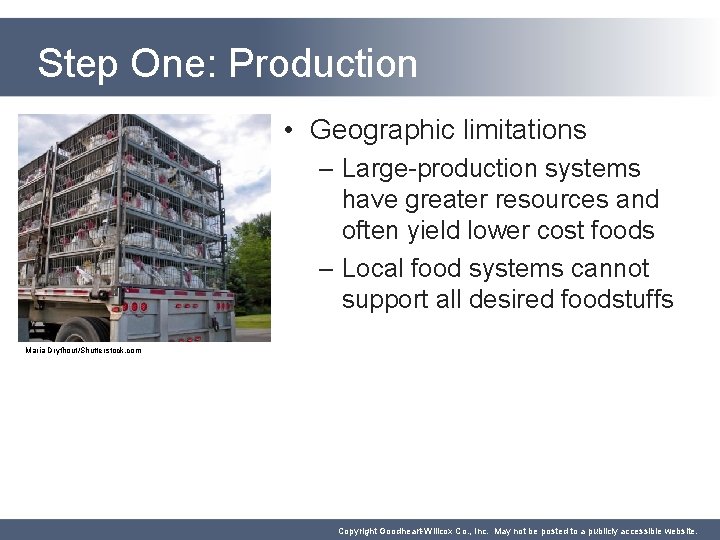
Step One: Production • Geographic limitations – Large-production systems have greater resources and often yield lower cost foods – Local food systems cannot support all desired foodstuffs Maria Dryfhout/Shutterstock. com Copyright Goodheart-Willcox Co. , Inc. May not be posted to a publicly accessible website.
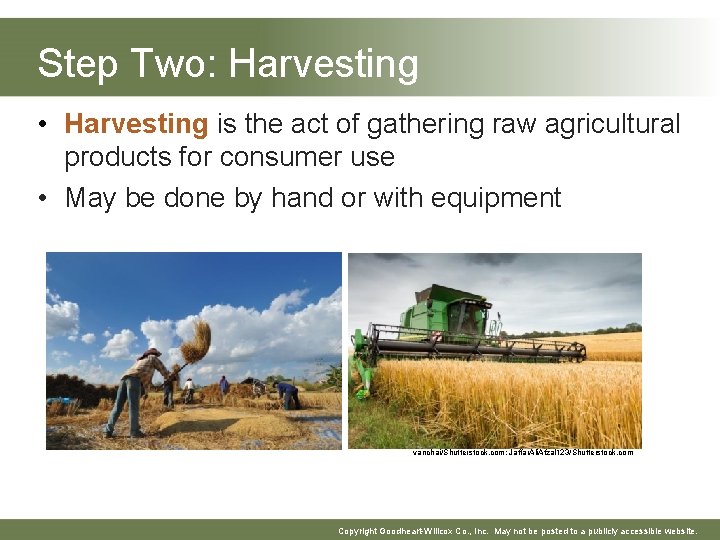
Step Two: Harvesting • Harvesting is the act of gathering raw agricultural products for consumer use • May be done by hand or with equipment vanchai/Shutterstock. com; Jaffar. Ali. Afzal 123/Shutterstock. com Copyright Goodheart-Willcox Co. , Inc. May not be posted to a publicly accessible website.
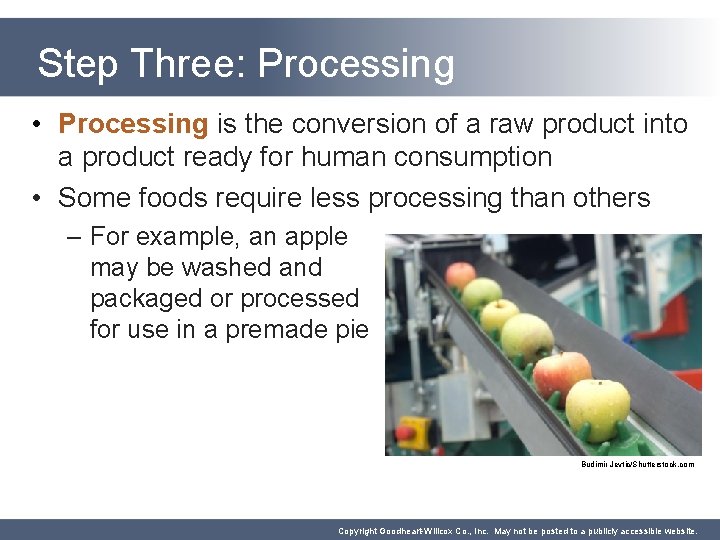
Step Three: Processing • Processing is the conversion of a raw product into a product ready for human consumption • Some foods require less processing than others – For example, an apple may be washed and packaged or processed for use in a premade pie Budimir Jevtic/Shutterstock. com Copyright Goodheart-Willcox Co. , Inc. May not be posted to a publicly accessible website.
Step Four: Distribution • Distribution is the transportation of products from their processing point to the place where they are available for sale • Key components – Distance between local and global food systems – Exotic foods – Out-of-season foods Copyright Goodheart-Willcox Co. , Inc. May not be posted to a publicly accessible website.
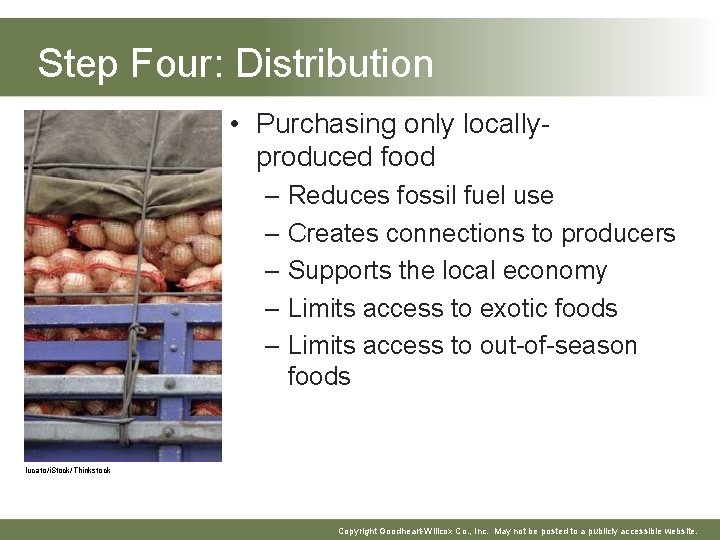
Step Four: Distribution • Purchasing only locallyproduced food – Reduces fossil fuel use – Creates connections to producers – Supports the local economy – Limits access to exotic foods – Limits access to out-of-season foods lucato/i. Stock/Thinkstock Copyright Goodheart-Willcox Co. , Inc. May not be posted to a publicly accessible website.
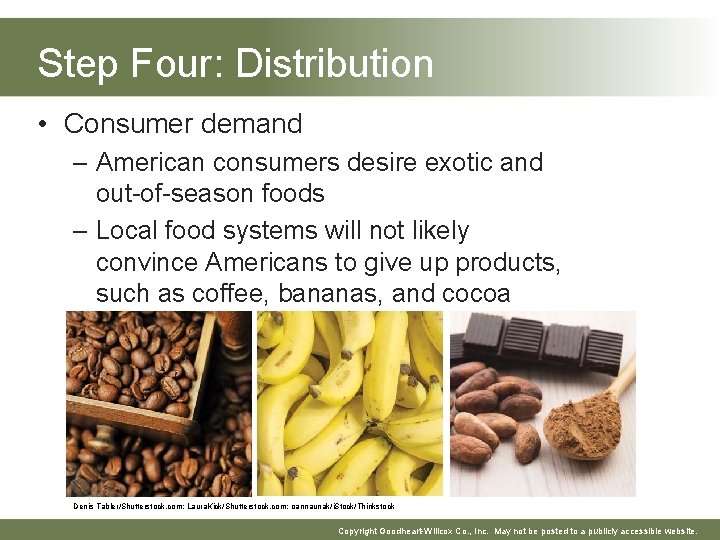
Step Four: Distribution • Consumer demand – American consumers desire exotic and out-of-season foods – Local food systems will not likely convince Americans to give up products, such as coffee, bananas, and cocoa Denis Tabler/Shutterstock. com; Laura. Kick/Shutterstock. com; oannaunak/i. Stock/Thinkstock Copyright Goodheart-Willcox Co. , Inc. May not be posted to a publicly accessible website.
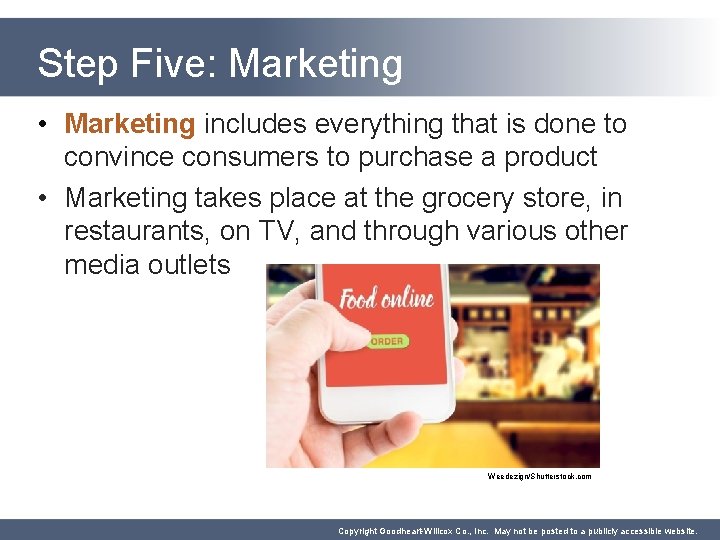
Step Five: Marketing • Marketing includes everything that is done to convince consumers to purchase a product • Marketing takes place at the grocery store, in restaurants, on TV, and through various other media outlets Weedezign/Shutterstock. com Copyright Goodheart-Willcox Co. , Inc. May not be posted to a publicly accessible website.
Step Six: Consumption • Consumption is the use of the food product by the consumer • American consumption habits – Purchasing prepared foods – Eating mainly away from home • Negative effects on well-being has led many consumers to seek locally-produced food Copyright Goodheart-Willcox Co. , Inc. May not be posted to a publicly accessible website.
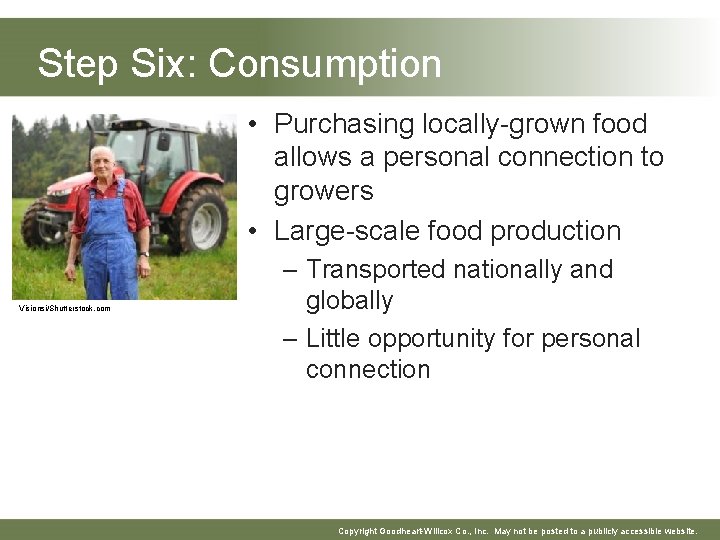
Step Six: Consumption • Purchasing locally-grown food allows a personal connection to growers • Large-scale food production Visionsi/Shutterstock. com – Transported nationally and globally – Little opportunity for personal connection Copyright Goodheart-Willcox Co. , Inc. May not be posted to a publicly accessible website.
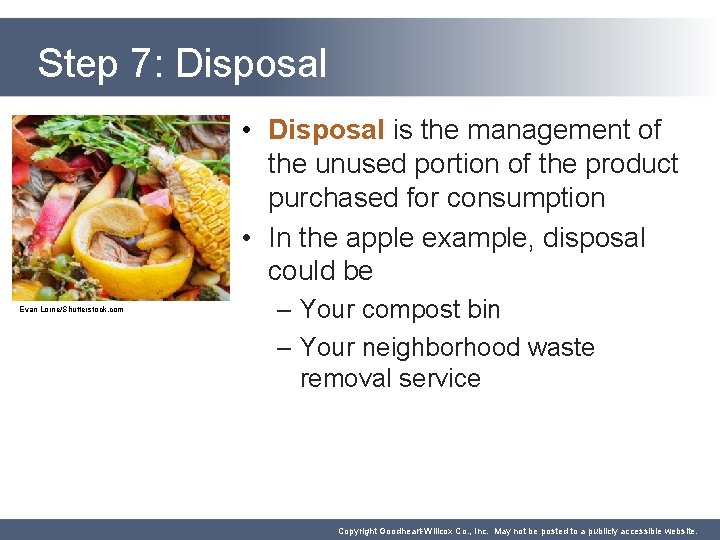
Step 7: Disposal • Disposal is the management of the unused portion of the product purchased for consumption • In the apple example, disposal could be Evan Lorne/Shutterstock. com – Your compost bin – Your neighborhood waste removal service Copyright Goodheart-Willcox Co. , Inc. May not be posted to a publicly accessible website.
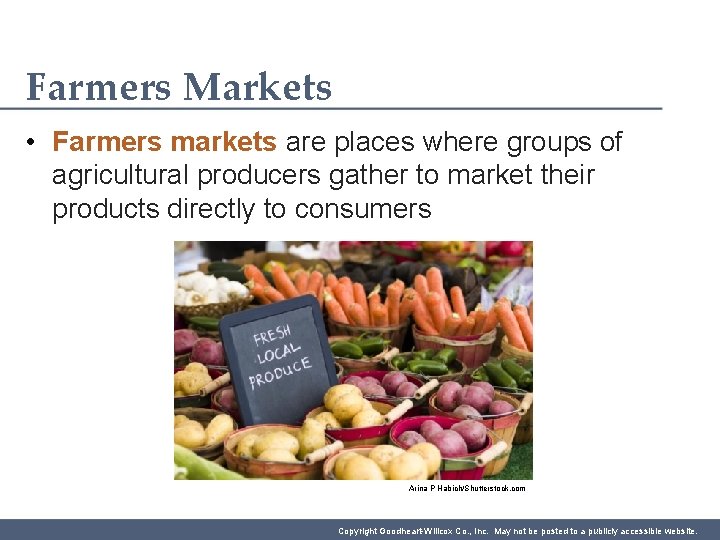
Farmers Markets • Farmers markets are places where groups of agricultural producers gather to market their products directly to consumers Arina P Habich/Shutterstock. com Copyright Goodheart-Willcox Co. , Inc. May not be posted to a publicly accessible website.
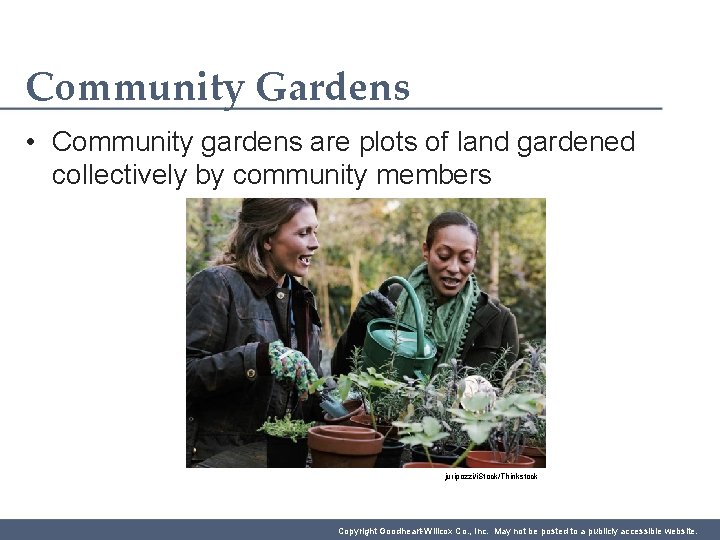
Community Gardens • Community gardens are plots of land gardened collectively by community members juripozzi/i. Stock/Thinkstock Copyright Goodheart-Willcox Co. , Inc. May not be posted to a publicly accessible website.
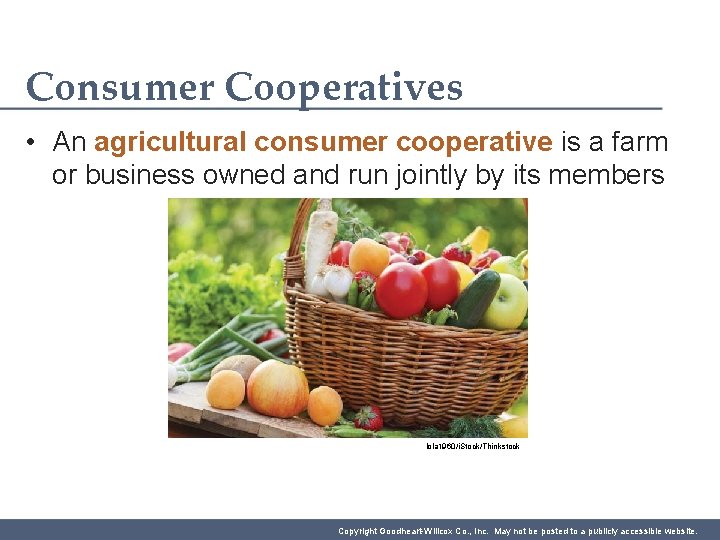
Consumer Cooperatives • An agricultural consumer cooperative is a farm or business owned and run jointly by its members lola 1960/i. Stock/Thinkstock Copyright Goodheart-Willcox Co. , Inc. May not be posted to a publicly accessible website.