
LESSON 8 7 Solving ax 2 bx c
LESSON 8– 7 Solving ax 2 + bx + c = 0

Five-Minute Check (over Lesson 8– 6) TEKS Then/Now New Vocabulary Key Concept: Factoring ax 2 + bx + c Example 1: Factor ax 2 + bx + c Example 2: Factor ax 2 – bx + c Example 3: Determine Whether a Polynomial is Prime Example 4: Real-World Example: Solve Equations by Factoring
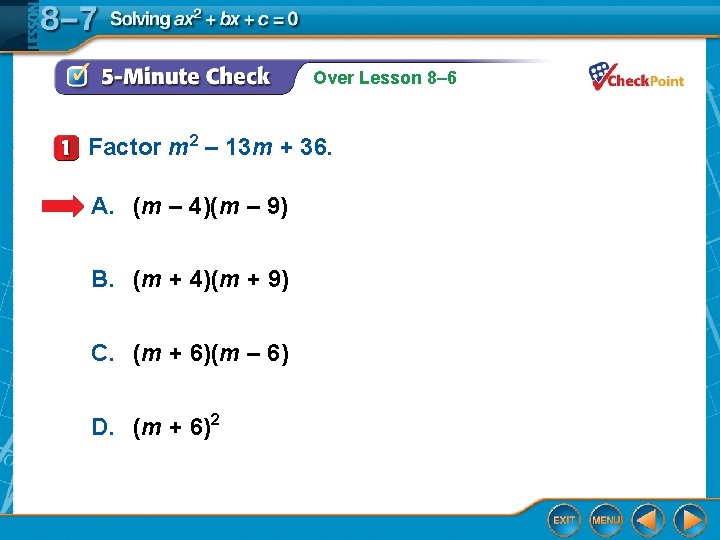
Over Lesson 8– 6 Factor m 2 – 13 m + 36. A. (m – 4)(m – 9) B. (m + 4)(m + 9) C. (m + 6)(m – 6) D. (m + 6)2
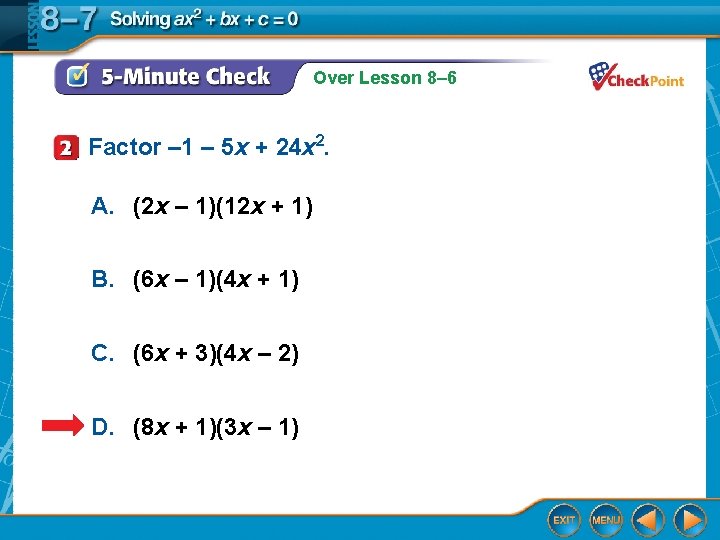
Over Lesson 8– 6 Factor – 1 – 5 x + 24 x 2. A. (2 x – 1)(12 x + 1) B. (6 x – 1)(4 x + 1) C. (6 x + 3)(4 x – 2) D. (8 x + 1)(3 x – 1)
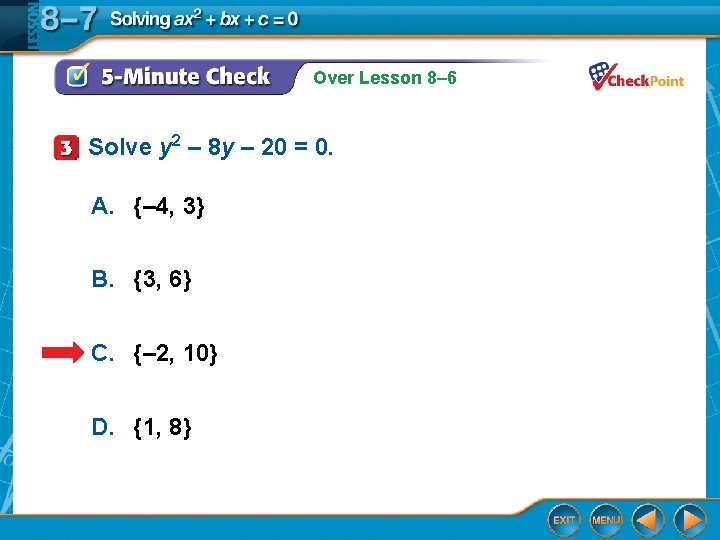
Over Lesson 8– 6 Solve y 2 – 8 y – 20 = 0. A. {– 4, 3} B. {3, 6} C. {– 2, 10} D. {1, 8}
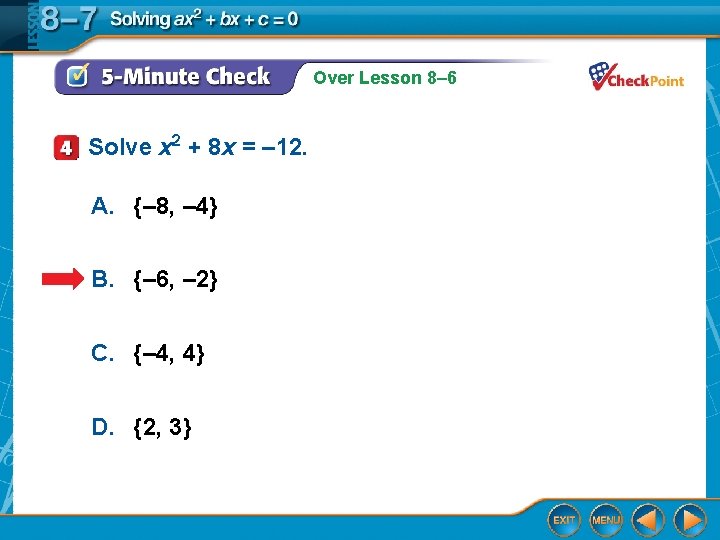
Over Lesson 8– 6 Solve x 2 + 8 x = – 12. A. {– 8, – 4} B. {– 6, – 2} C. {– 4, 4} D. {2, 3}
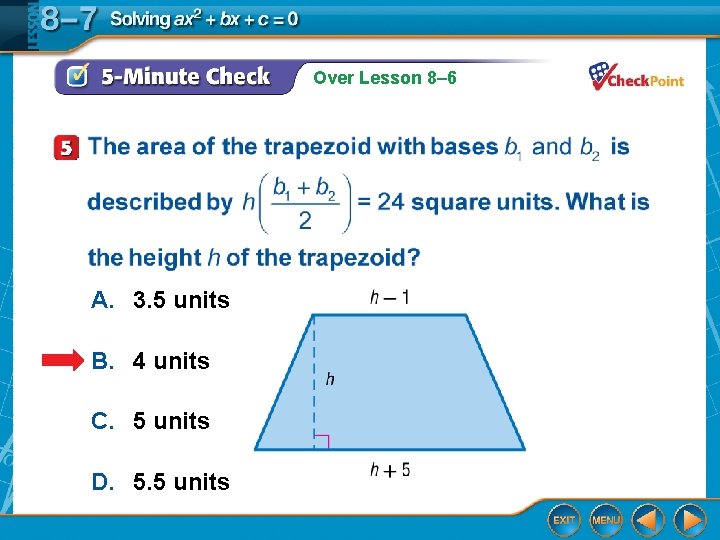
Over Lesson 8– 6 A. 3. 5 units B. 4 units C. 5 units D. 5. 5 units
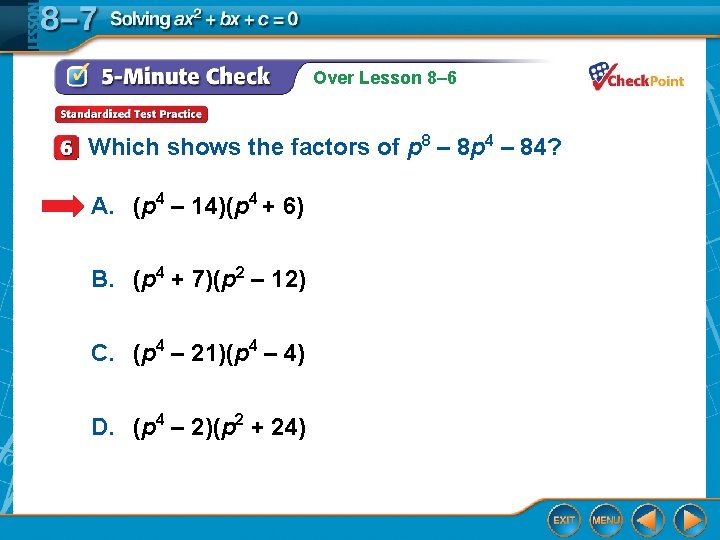
Over Lesson 8– 6 Which shows the factors of p 8 – 8 p 4 – 84? A. (p 4 – 14)(p 4 + 6) B. (p 4 + 7)(p 2 – 12) C. (p 4 – 21)(p 4 – 4) D. (p 4 – 2)(p 2 + 24)

Targeted TEKS A. 8(A) Solve quadratic equations having real solutions by factoring, taking square roots, completing the square, and applying the quadratic formula. A. 10(E) Factor, if possible, trinomials with real factors in the form ax 2 + bx + c, including perfect square trinomials of degree two. Mathematical Processes A. 1(B), A. 1(D)
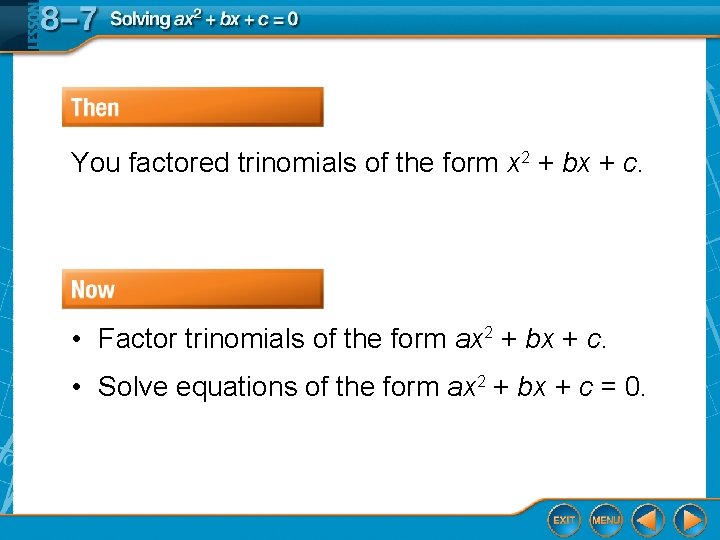
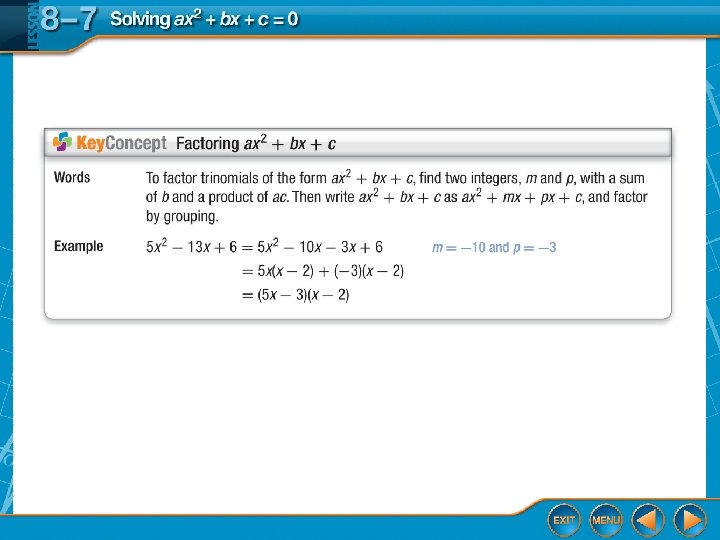
You factored trinomials of the form x 2 + bx + c. • Factor trinomials of the form ax 2 + bx + c. • Solve equations of the form ax 2 + bx + c = 0.
• prime polynomial
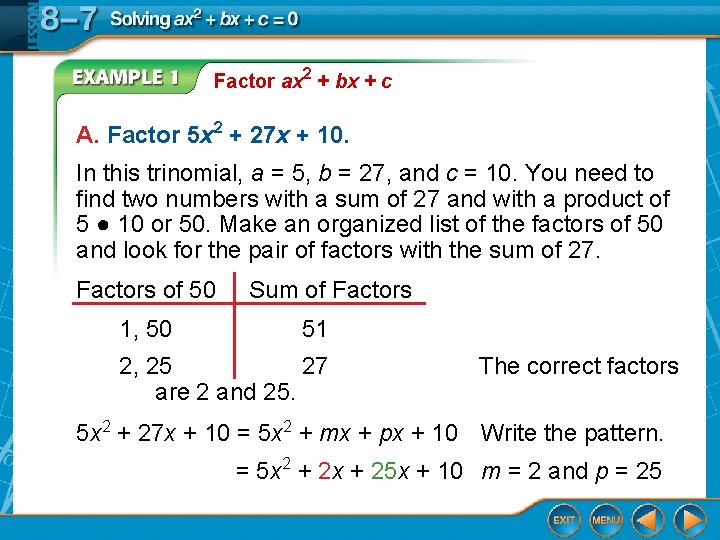
Factor ax 2 + bx + c A. Factor 5 x 2 + 27 x + 10. In this trinomial, a = 5, b = 27, and c = 10. You need to find two numbers with a sum of 27 and with a product of 5 ● 10 or 50. Make an organized list of the factors of 50 and look for the pair of factors with the sum of 27. Factors of 50 1, 50 Sum of Factors 51 2, 25 27 are 2 and 25. The correct factors 5 x 2 + 27 x + 10 = 5 x 2 + mx + px + 10 Write the pattern. = 5 x 2 + 2 x + 25 x + 10 m = 2 and p = 25
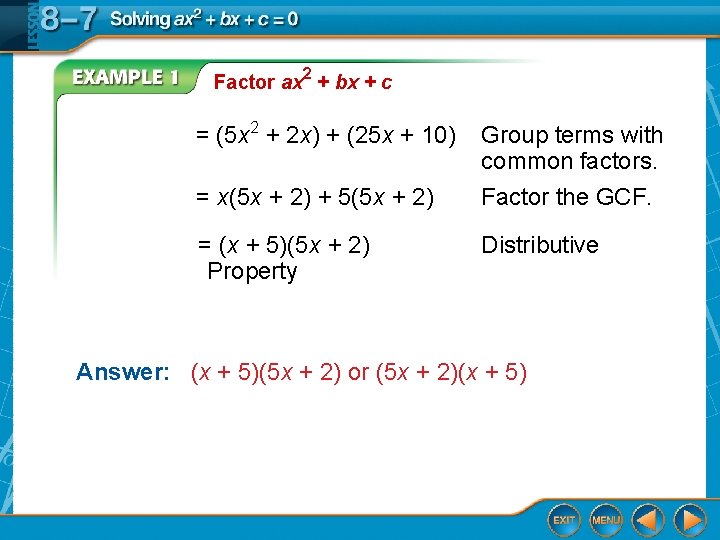
Factor ax 2 + bx + c = (5 x 2 + 2 x) + (25 x + 10) = x(5 x + 2) + 5(5 x + 2) = (x + 5)(5 x + 2) Property Group terms with common factors. Factor the GCF. Distributive Answer: (x + 5)(5 x + 2) or (5 x + 2)(x + 5)
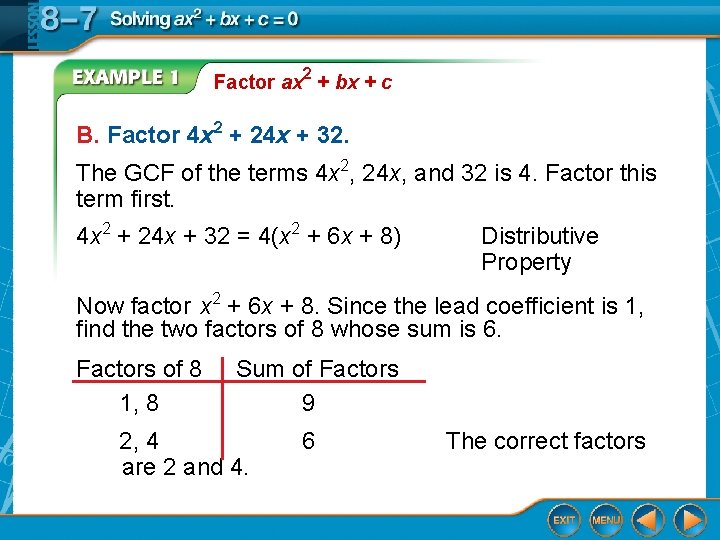
Factor ax 2 + bx + c B. Factor 4 x 2 + 24 x + 32. The GCF of the terms 4 x 2, 24 x, and 32 is 4. Factor this term first. 4 x 2 + 24 x + 32 = 4(x 2 + 6 x + 8) Distributive Property Now factor x 2 + 6 x + 8. Since the lead coefficient is 1, find the two factors of 8 whose sum is 6. Factors of 8 1, 8 Sum of Factors 9 2, 4 are 2 and 4. 6 The correct factors
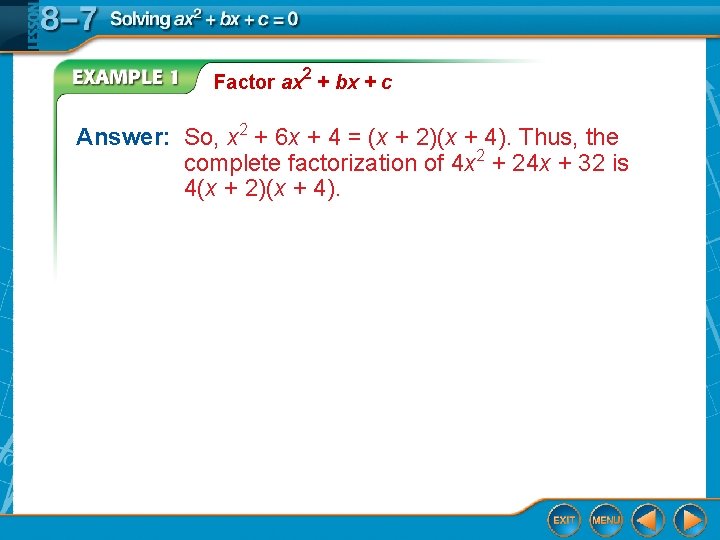
Factor ax 2 + bx + c Answer: So, x 2 + 6 x + 4 = (x + 2)(x + 4). Thus, the complete factorization of 4 x 2 + 24 x + 32 is 4(x + 2)(x + 4).
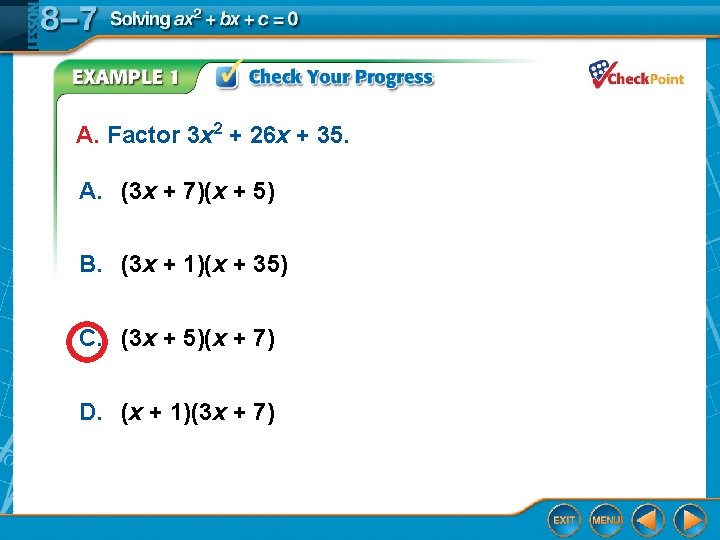
A. Factor 3 x 2 + 26 x + 35. A. (3 x + 7)(x + 5) B. (3 x + 1)(x + 35) C. (3 x + 5)(x + 7) D. (x + 1)(3 x + 7)
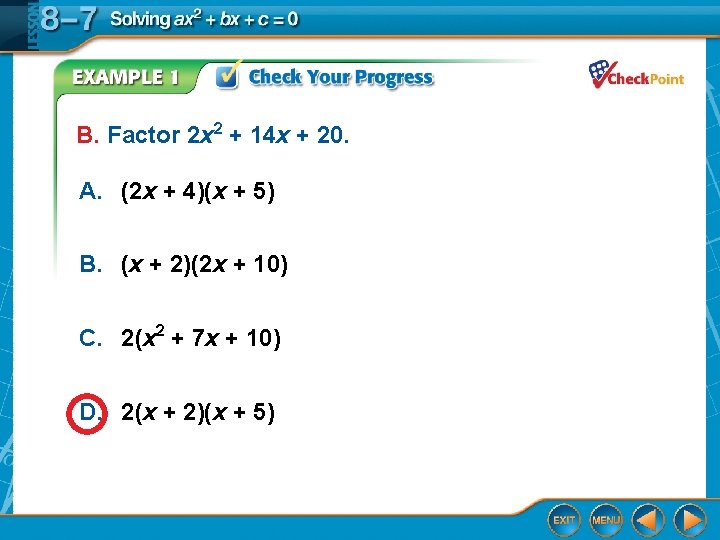
B. Factor 2 x 2 + 14 x + 20. A. (2 x + 4)(x + 5) B. (x + 2)(2 x + 10) C. 2(x 2 + 7 x + 10) D. 2(x + 2)(x + 5)
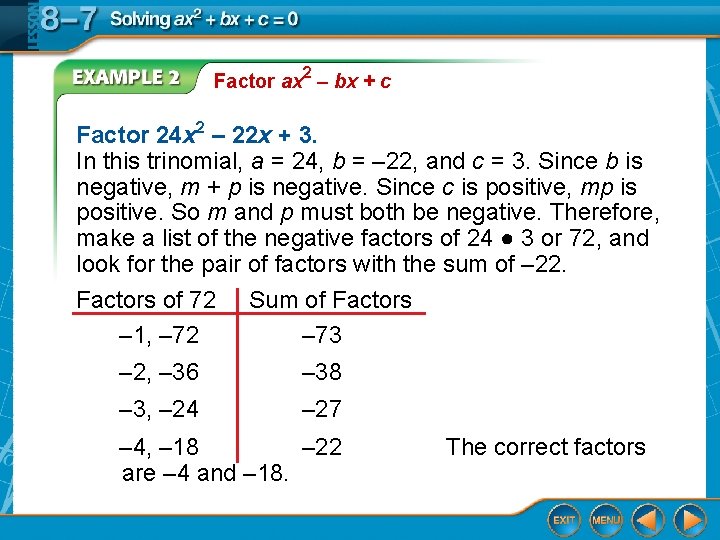
Factor ax 2 – bx + c Factor 24 x 2 – 22 x + 3. In this trinomial, a = 24, b = – 22, and c = 3. Since b is negative, m + p is negative. Since c is positive, mp is positive. So m and p must both be negative. Therefore, make a list of the negative factors of 24 ● 3 or 72, and look for the pair of factors with the sum of – 22. Factors of 72 Sum of Factors – 1, – 72 – 73 – 2, – 36 – 38 – 3, – 24 – 27 – 4, – 18 – 22 are – 4 and – 18. The correct factors
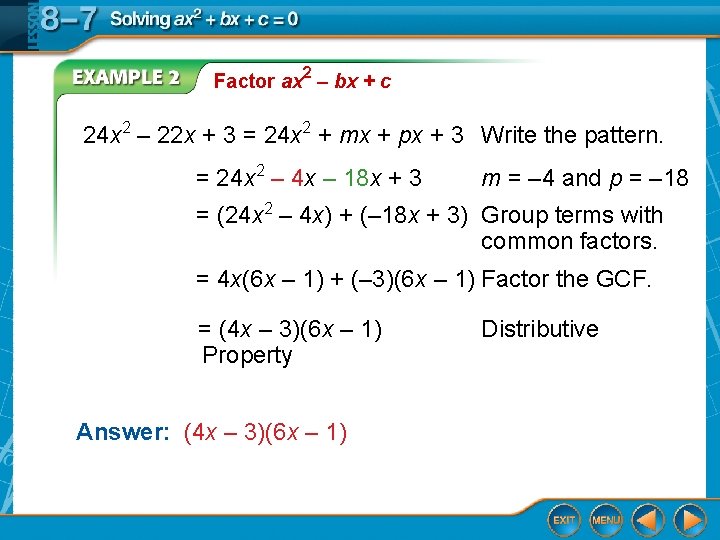
Factor ax 2 – bx + c 24 x 2 – 22 x + 3 = 24 x 2 + mx + px + 3 Write the pattern. = 24 x 2 – 4 x – 18 x + 3 m = – 4 and p = – 18 = (24 x 2 – 4 x) + (– 18 x + 3) Group terms with common factors. = 4 x(6 x – 1) + (– 3)(6 x – 1) Factor the GCF. = (4 x – 3)(6 x – 1) Property Answer: (4 x – 3)(6 x – 1) Distributive
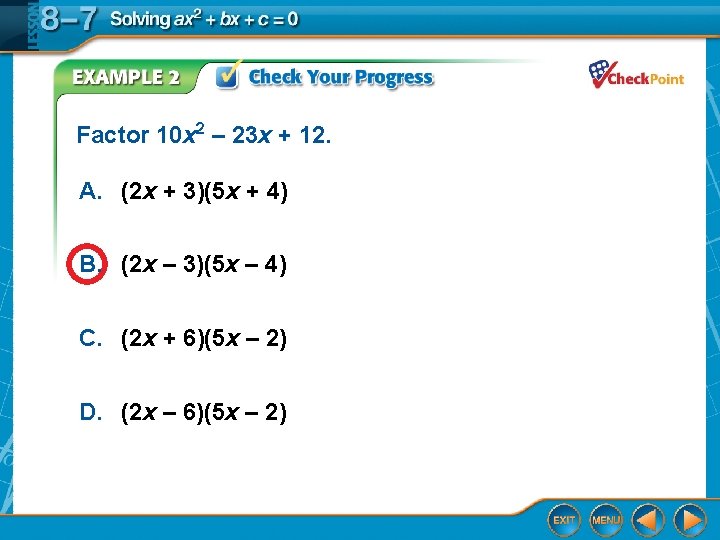
Factor 10 x 2 – 23 x + 12. A. (2 x + 3)(5 x + 4) B. (2 x – 3)(5 x – 4) C. (2 x + 6)(5 x – 2) D. (2 x – 6)(5 x – 2)
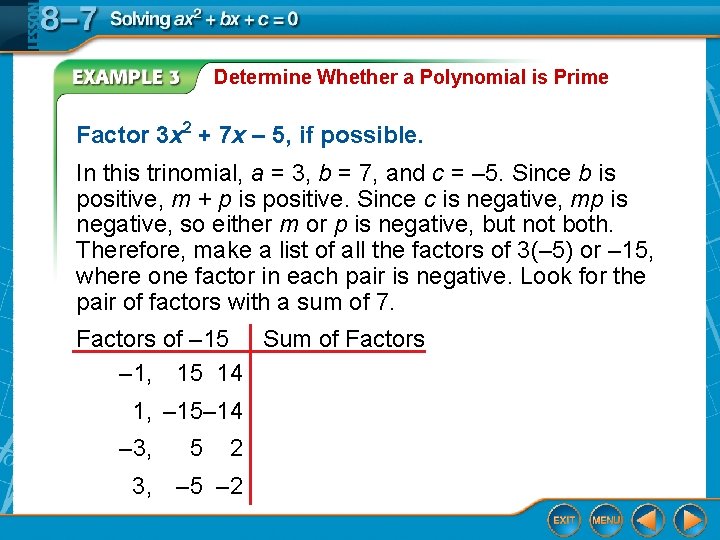
Determine Whether a Polynomial is Prime Factor 3 x 2 + 7 x – 5, if possible. In this trinomial, a = 3, b = 7, and c = – 5. Since b is positive, m + p is positive. Since c is negative, mp is negative, so either m or p is negative, but not both. Therefore, make a list of all the factors of 3(– 5) or – 15, where one factor in each pair is negative. Look for the pair of factors with a sum of 7. Factors of – 15 Sum of Factors – 1, 15 14 1, – 15– 14 – 3, 5 2 3, – 5 – 2
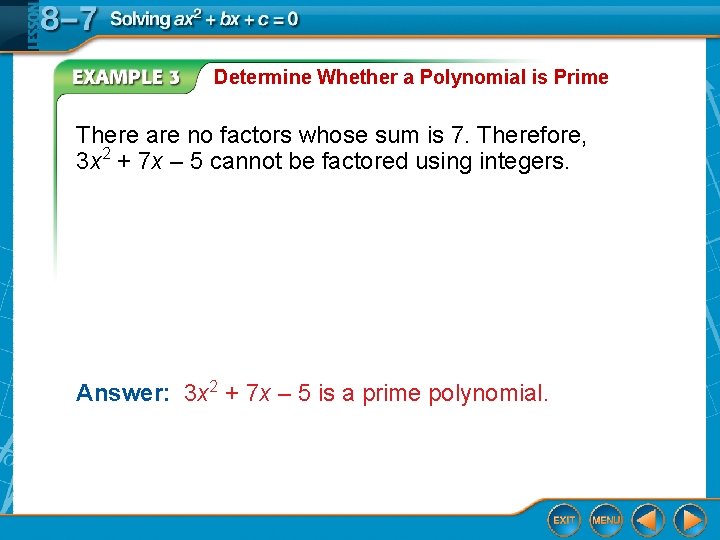
Determine Whether a Polynomial is Prime There are no factors whose sum is 7. Therefore, 3 x 2 + 7 x – 5 cannot be factored using integers. Answer: 3 x 2 + 7 x – 5 is a prime polynomial.
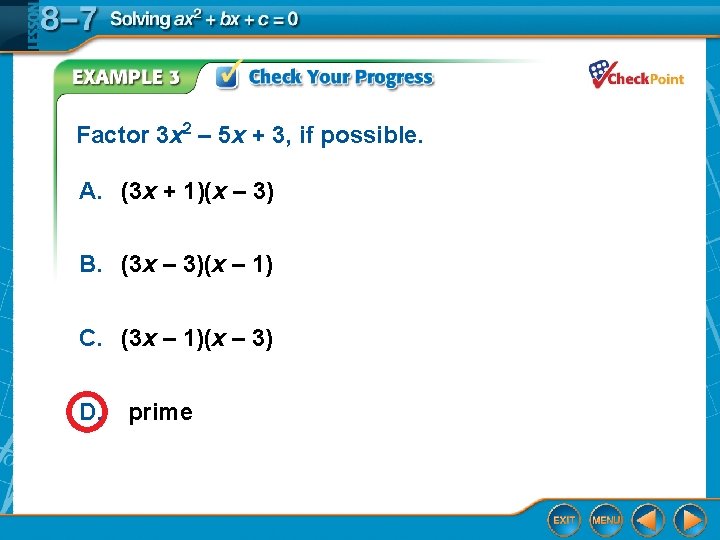
Factor 3 x 2 – 5 x + 3, if possible. A. (3 x + 1)(x – 3) B. (3 x – 3)(x – 1) C. (3 x – 1)(x – 3) D. prime
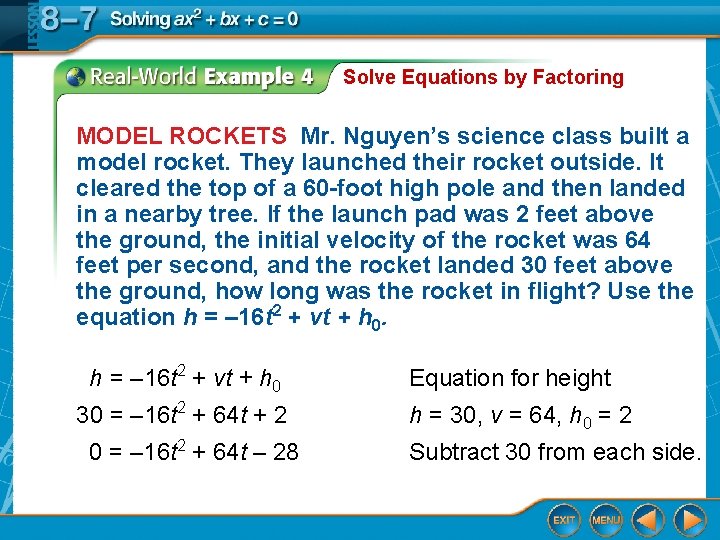
Solve Equations by Factoring MODEL ROCKETS Mr. Nguyen’s science class built a model rocket. They launched their rocket outside. It cleared the top of a 60 -foot high pole and then landed in a nearby tree. If the launch pad was 2 feet above the ground, the initial velocity of the rocket was 64 feet per second, and the rocket landed 30 feet above the ground, how long was the rocket in flight? Use the equation h = – 16 t 2 + vt + h 0 30 = – 16 t 2 + 64 t + 2 0 = – 16 t 2 + 64 t – 28 Equation for height h = 30, v = 64, h 0 = 2 Subtract 30 from each side.
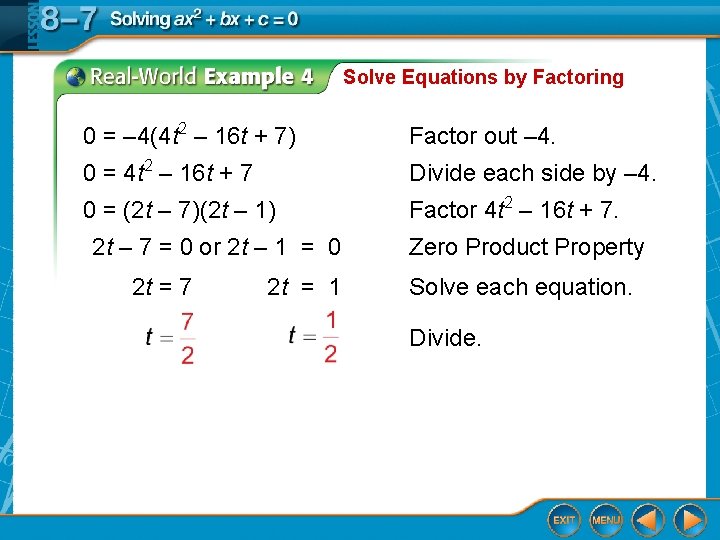
Solve Equations by Factoring 0 = – 4(4 t 2 – 16 t + 7) Factor out – 4. 0 = 4 t 2 – 16 t + 7 Divide each side by – 4. 0 = (2 t – 7)(2 t – 1) Factor 4 t 2 – 16 t + 7. 2 t – 7 = 0 or 2 t – 1 = 0 2 t = 7 2 t = 1 Zero Product Property Solve each equation. Divide.
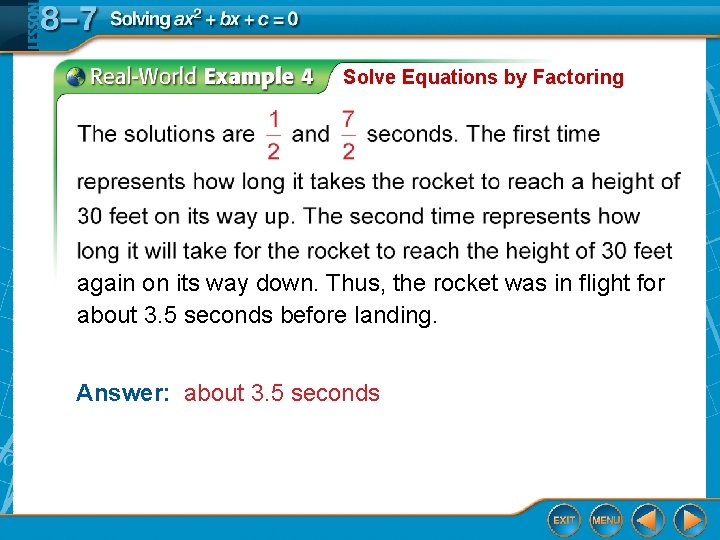
Solve Equations by Factoring again on its way down. Thus, the rocket was in flight for about 3. 5 seconds before landing. Answer: about 3. 5 seconds
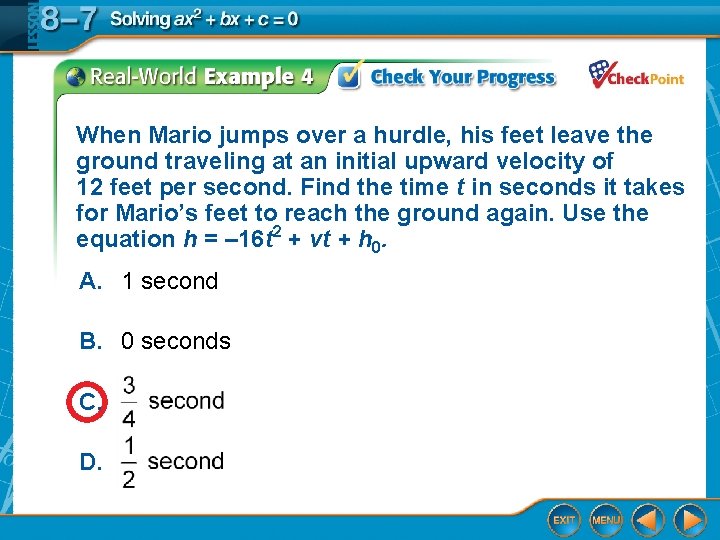
When Mario jumps over a hurdle, his feet leave the ground traveling at an initial upward velocity of 12 feet per second. Find the time t in seconds it takes for Mario’s feet to reach the ground again. Use the equation h = – 16 t 2 + vt + h 0. A. 1 second B. 0 seconds C. D.
LESSON 8– 7 Solving ax 2 + bx + c = 0
- Slides: 29