
LESSON 7 Robots How They Work and Learn

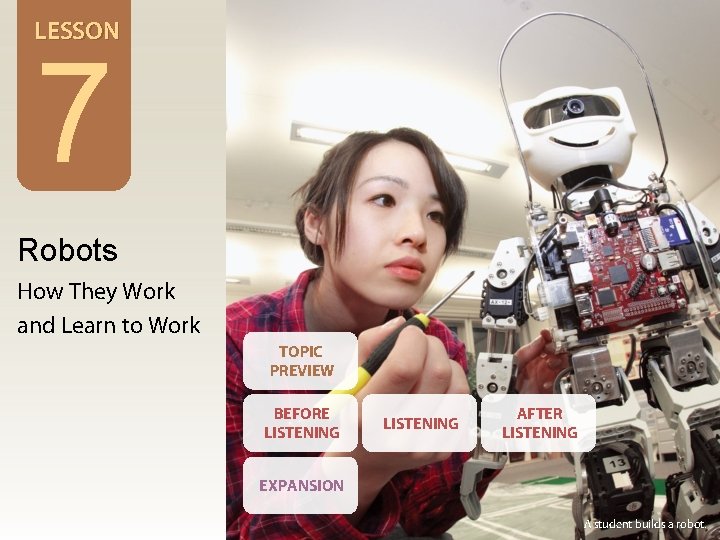
LESSON 7 Robots How They Work and Learn to Work TOPIC PREVIEW BEFORE LISTENING AFTER LISTENING EXPANSION A student builds a robot.
TOPIC PREVIEW n Answer the following questions with a partner or your classmates. 1. What do you picture when you think of “a robot”? What does it look like? What does it do? Draw a simple picture of your robot. 2. Have you seen a movie or TV show in which robots play an important role? What was the name of the movie? What did the robots do in the movie? How do “real” robots differ from “movie” robots? 3. What will robots look like and be doing in 10 years? in 20 years? in 50 years?
BEFORE LISTENING VOCABULARY PREVIEW Proper Names Honda 日本本田公司 ASIMO 日本本田公司开发的步行机器人
BEFORE LISTENING Audio Track 1 -7 -1 -a VOCABULARY PREVIEW a Listen to the following sentences that contain information from the lecture. As you listen, write the word from the box that completes the sentence. assembly autonomous detect efficiently guidance industrial precise repetitive sensors stores 1. Today, I’m going to talk mostly about industrial robots. 2. These robots do work that is repetitive, dangerous, or boring. 3. The robot learns to do its job with the guidance of a human being. 4. Robotic arms on the assembly line join the parts of a car together. 5. Robots are very precise when repeating a task.
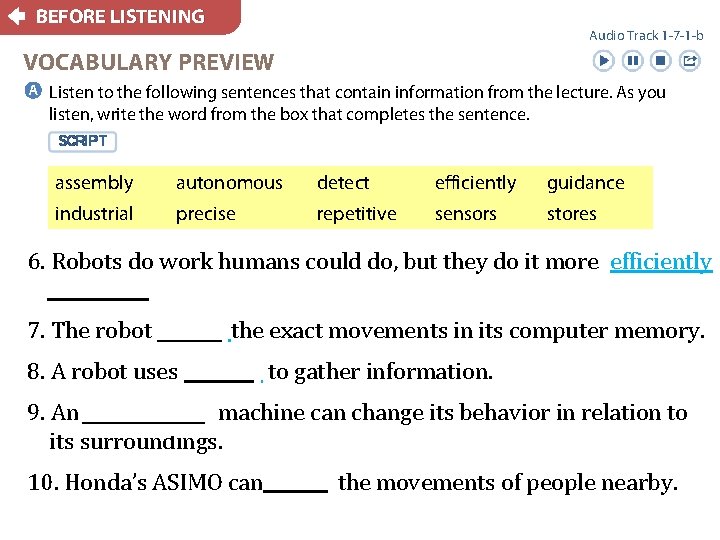
BEFORE LISTENING Audio Track 1 -7 -1 -b VOCABULARY PREVIEW a Listen to the following sentences that contain information from the lecture. As you listen, write the word from the box that completes the sentence. assembly autonomous detect efficiently guidance industrial precise repetitive sensors stores 6. Robots do work humans could do, but they do it more efficiently. 7. The robot stores the exact movements in its computer memory. 8. A robot uses sensors to gather information. 9. An autonomous machine can change its behavior in relation to its surroundings. 10. Honda’s ASIMO can detect the movements of people nearby.
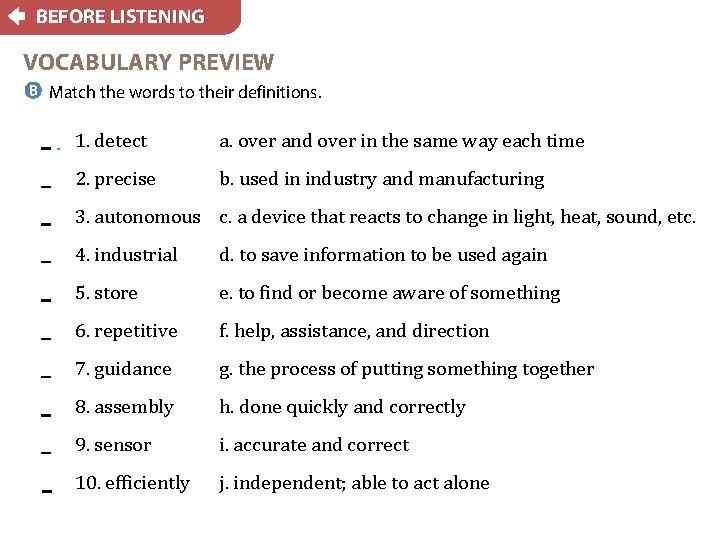
BEFORE LISTENING VOCABULARY PREVIEW b Match the words to their definitions. e 1. detect a. over and over in the same way each time i 2. precise b. used in industry and manufacturing j 3. autonomous c. a device that reacts to change in light, heat, sound, etc. b 4. industrial d. to save information to be used again d 5. store e. to find or become aware of something a 6. repetitive f. help, assistance, and direction f g. the process of putting something together 7. guidance g 8. assembly h. done quickly and correctly c i. accurate and correct 9. sensor h 10. efficiently j. independent; able to act alone
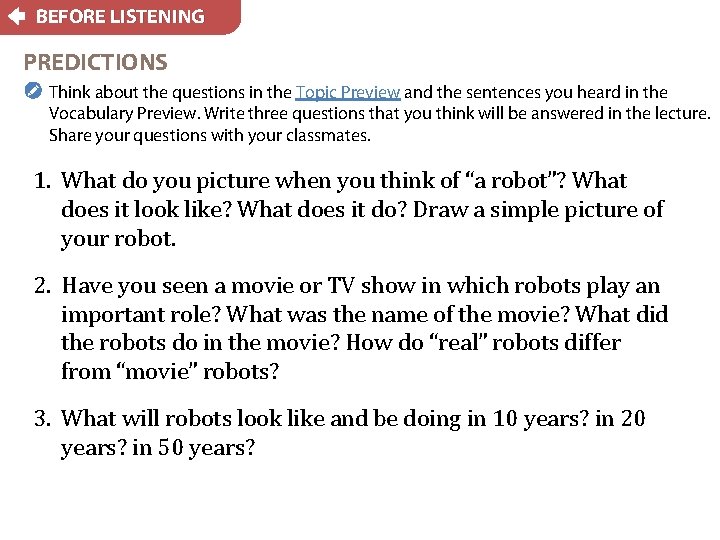
BEFORE LISTENING PREDICTIONS n Think about the questions in the Topic Preview and the sentences you heard in the Vocabulary Preview. Write three questions that you think will be answered in the lecture. Share your questions with your classmates. 1. What do you picture when you think of “a robot”? What does it look like? What does it do? Draw a simple picture of your robot. 2. Have you seen a movie or TV show in which robots play an important role? What was the name of the movie? What did the robots do in the movie? How do “real” robots differ from “movie” robots? 3. What will robots look like and be doing in 10 years? in 20 years? in 50 years?
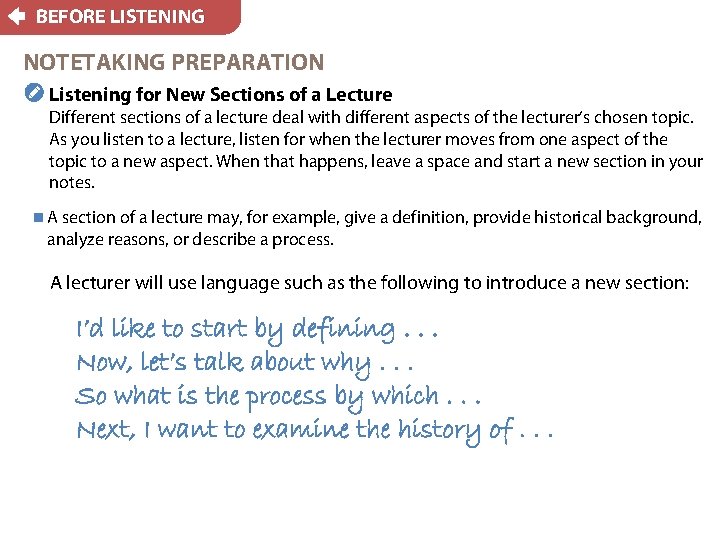
BEFORE LISTENING NOTETAKING PREPARATION n Listening for New Sections of a Lecture Different sections of a lecture deal with different aspects of the lecturer’s chosen topic. As you listen to a lecture, listen for when the lecturer moves from one aspect of the topic to a new aspect. When that happens, leave a space and start a new section in your notes. n A section of a lecture may, for example, give a definition, provide historical background, analyze reasons, or describe a process. A lecturer will use language such as the following to introduce a new section: I’d like to start by defining. . . Now, let’s talk about why. . . So what is the process by which. . . Next, I want to examine the history of. . .
BEFORE LISTENING NOTETAKING PREPARATION a Listen to three section openings from the lecture. Take notes. Audio Track 1 -7 -2
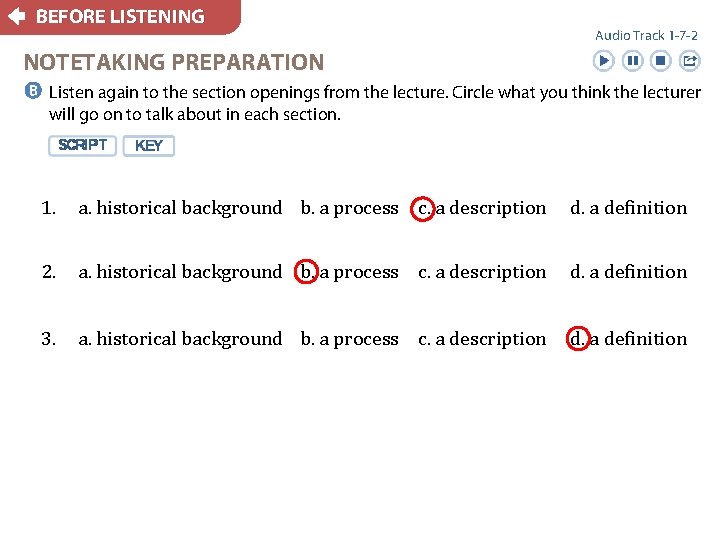
BEFORE LISTENING Audio Track 1 -7 -2 NOTETAKING PREPARATION b Listen again to the section openings from the lecture. Circle what you think the lecturer will go on to talk about in each section. 1. a. historical background b. a process c. a description d. a definition 2. a. historical background b. a process c. a description d. a definition 3. a. historical background b. a process c. a description d. a definition
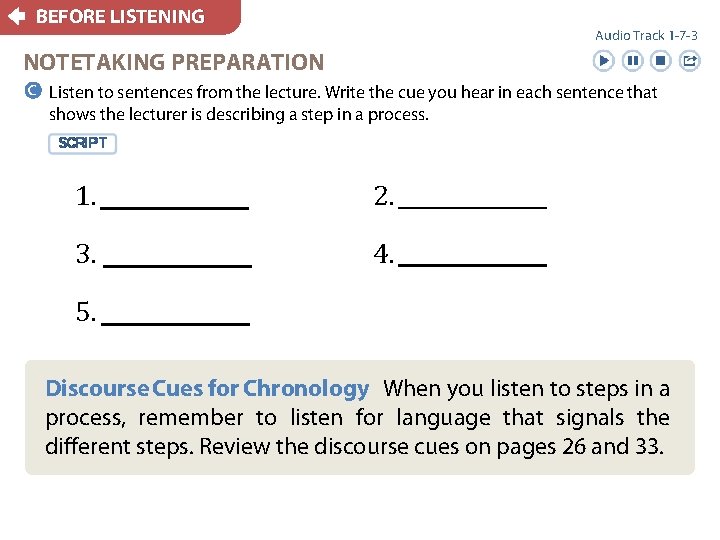
BEFORE LISTENING Audio Track 1 -7 -3 NOTETAKING PREPARATION c Listen to sentences from the lecture. Write the cue you hear in each sentence that shows the lecturer is describing a step in a process. 1. first . 2. so now . 3. and then . 4. next . 5. until . Discourse Cues for Chronology When you listen to steps in a process, remember to listen for language that signals the different steps. Review the discourse cues on pages 26 and 33.
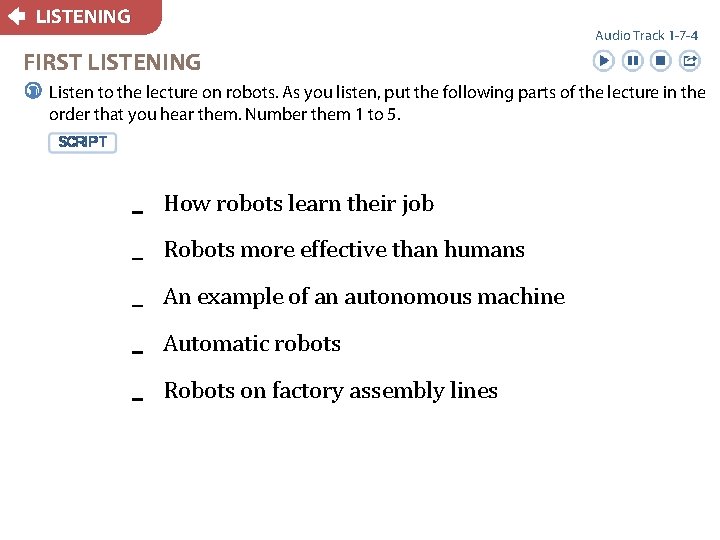
LISTENING Audio Track 1 -7 -4 FIRST LISTENING p Listen to the lecture on robots. As you listen, put the following parts of the lecture in the order that you hear them. Number them 1 to 5. 3 How robots learn their job 2 Robots more effective than humans 5 An example of an autonomous machine 4 Automatic robots 1 Robots on factory assembly lines
LISTENING Audio Track 1 -7 -5 SECOND LISTENING p Listen to information from the lecture. The speaker will talk slowly and carefully. You don’t have to do anything as you listen. Just relax and listen.
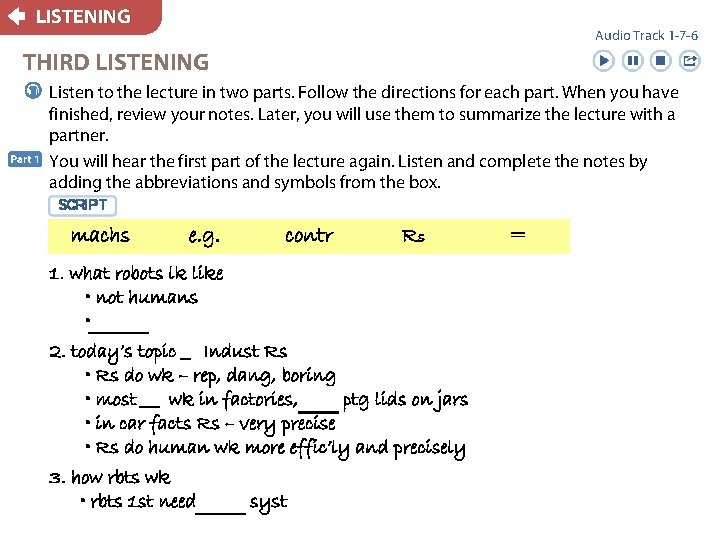
LISTENING Audio Track 1 -7 -6 THIRD LISTENING p Listen to the lecture in two parts. Follow the directions for each part. When you have finished, review your notes. Later, you will use them to summarize the lecture with a partner. 1 You will hear the first part of the lecture again. Listen and complete the notes by adding the abbreviations and symbols from the box. machs e. g. contr Rs 1. what robots lk like • not humans • machs 2. today’s topic = Indust Rs • Rs do wk – rep, dang, boring • most Rs wk in factories, e. g. ptg lids on jars • in car facts Rs – very precise • Rs do human wk more effic’ly and precisely 3. how rbts wk • rbts 1 st need contr syst =
LISTENING Audio Track 1 -7 -7 THIRD LISTENING 2 As you listen to the second part of the lecture, take your own notes on a separate piece of paper.
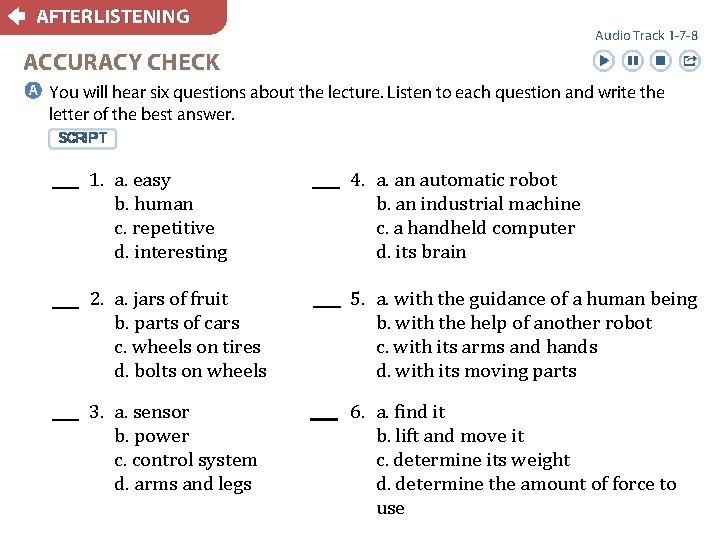
AFTER LISTENING Audio Track 1 -7 -8 ACCURACY CHECK a You will hear six questions about the lecture. Listen to each question and write the letter of the best answer. c 1. a. easy b. human c. repetitive d. interesting d 4. a. an automatic robot b. an industrial machine c. a handheld computer d. its brain a 2. a. jars of fruit b. parts of cars c. wheels on tires d. bolts on wheels a 5. a. with the guidance of a human being b. with the help of another robot c. with its arms and hands d. with its moving parts c 3. a. sensor b. power c. control system d. arms and legs a 6. a. find it b. lift and move it c. determine its weight d. determine the amount of force to use
AFTER LISTENING Audio Track 1 -7 -9 ACCURACY CHECK b You will hear four questions about the lecture. Write a short answer to each question. Use your notes. 1. With the help and guidance of a human being who uses a handheld computer to guide the robot’s motions. . 2. Because they are programmed to follow specific series of movements. . 3. It can move to avoid bumping into someone or something in its way. . 4. It can learn to dance. .
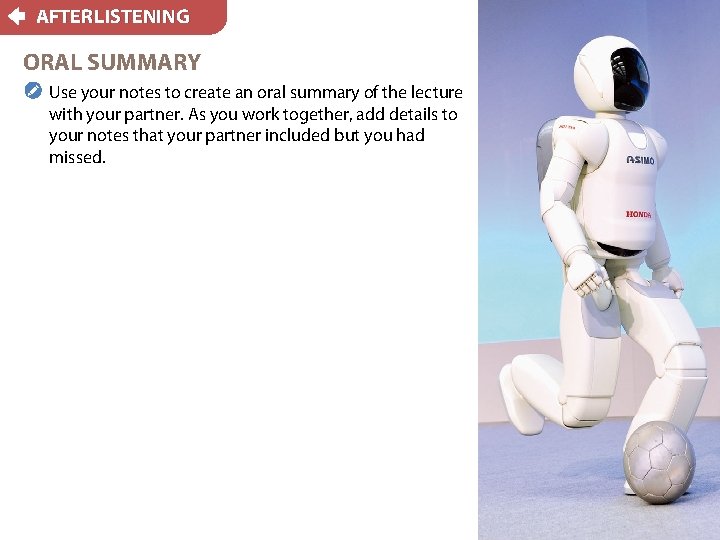
AFTER LISTENING ORAL SUMMARY n Use your notes to create an oral summary of the lecture with your partner. As you work together, add details to your notes that your partner included but you had missed.
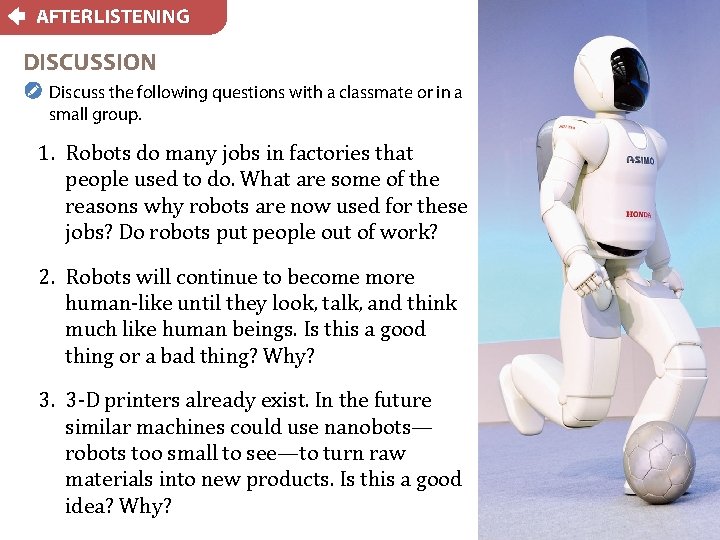
AFTER LISTENING DISCUSSION n Discuss the following questions with a classmate or in a small group. 1. Robots do many jobs in factories that people used to do. What are some of the reasons why robots are now used for these jobs? Do robots put people out of work? 2. Robots will continue to become more human-like until they look, talk, and think much like human beings. Is this a good thing or a bad thing? Why? 3. 3 -D printers already exist. In the future similar machines could use nanobots— robots too small to see—to turn raw materials into new products. Is this a good idea? Why?
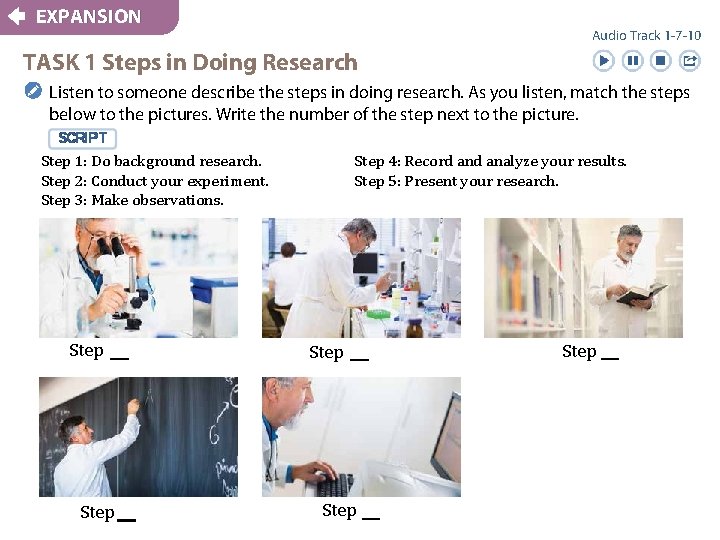
EXPANSION Audio Track 1 -7 -10 TASK 1 Steps in Doing Research n Listen to someone describe the steps in doing research. As you listen, match the steps below to the pictures. Write the number of the step next to the picture. Step 1: Do background research. Step 2: Conduct your experiment. Step 3: Make observations. Step 3 Step 5 Step 4: Record analyze your results. Step 5: Present your research. Step 2 Step 4 Step 1
EXPANSION TASK 2 A Simple Experiment Words and Phrases baking soda 小苏打,发酵粉 carbon dioxide 二氧化碳
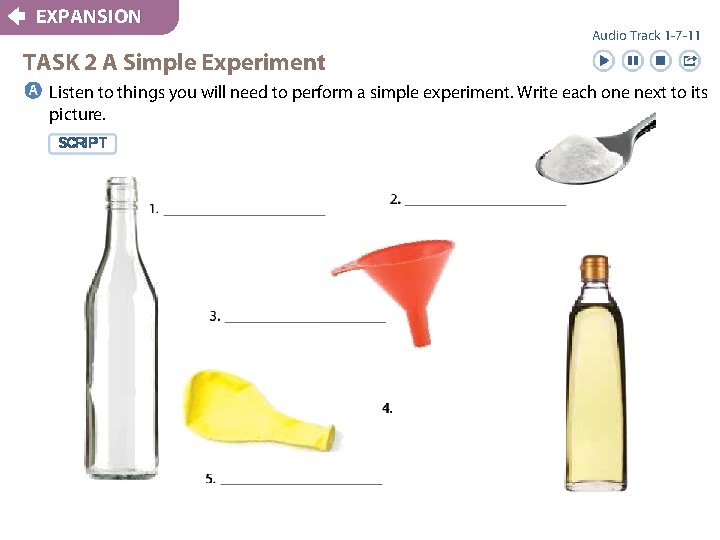
EXPANSION Audio Track 1 -7 -11 TASK 2 A Simple Experiment a Listen to things you will need to perform a simple experiment. Write each one next to its picture. bottle baking soda funnel vinegar balloon
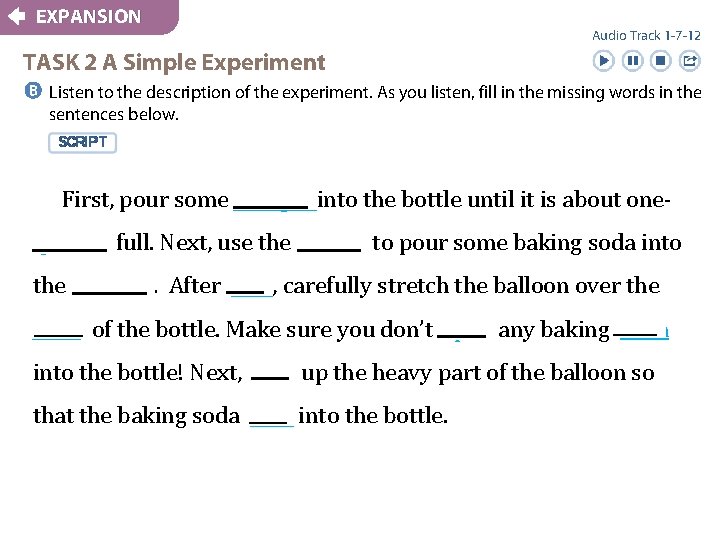
EXPANSION Audio Track 1 -7 -12 TASK 2 A Simple Experiment b Listen to the description of the experiment. As you listen, fill in the missing words in the sentences below. First, pour some vinegar into the bottle until it is about onequarter full. Next, use the funnel to pour some baking soda into the balloon. After that, carefully stretch the balloon over the neck of the bottle. Make sure you don’t spill any baking soda into the bottle! Next, pick up the heavy part of the balloon so that the baking soda falls into the bottle.
EXPANSION TASK 2 A Simple Experiment c Work with a partner. Talk about what you think will happen next.
EXPANSION Audio Track 1 -7 -13 TASK 2 A Simple Experiment d Listen to the description of the end of the experiment. Was your guess correct?
LESSON 7 The End Napoleon Bonaparte
- Slides: 27