
Lesson 7 Motivation Concepts 7 1 Learning Objectives

Lesson 7: Motivation Concepts 7 -1
Learning Objectives After studying this chapter, you should be able to: 1. Describe three key elements of motivation. 2. Evaluate the applicability of early theories of motivation. 3. Apply the predictions of self-determination theory to intrinsic and extrinsic rewards. 4. Identify the implications of employee job engagement for management. 5. Describe goal-setting theory, self-efficacy theory, and reinforcement theory. 6. Demonstrate how organizational justice is a refinement of equity theory. 7. Apply the key tenets of expectancy theory to motivating employees. 8. Compare contemporary theories of motivation. 7 -2

LO 1 Describe the Three Key Elements of Motivation • Motivation is the processes that account for an individual’s intensity, direction, and persistence of effort toward attaining a goal. • The level of motivation varies both between individuals and within individuals at different times. 7 -3

LO 1 Describe the Three Key Elements of Motivation • The three key elements of motivation are: 1. Intensity: concerned with how hard a person tries. 2. Direction: the orientation that benefits the organization. 3. Persistence: a measure of how long a person can maintain his/her effort. 7 -4
LO 2 Evaluate the Applicability of Early Theories of Motivation 7 -5
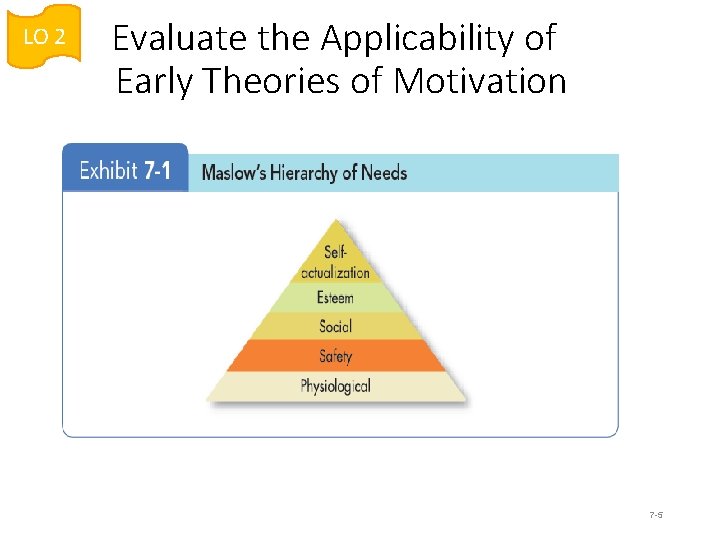
LO 2 Evaluate the Applicability of Early Theories of Motivation • Maslow’s need theory has received wide recognition, particularly among practicing managers. • Research does not generally validate theory. • Some researchers have attempted to revive components of the need hierarchy concept, using principles from evolutionary psychology. 7 -6
LO 2 Evaluate the Applicability of Early Theories of Motivation • Theory X and Theory Y • Theory X assumptions are basically negative. • Employees inherently dislike work and must be coerced into performing. • Theory Y assumptions are basically positive. • Employees can view work as being as natural as rest or play. 7 -7
LO 2 Evaluate the Applicability of Early Theories of Motivation • The implications for managers can be explained by using Maslow’s framework • Theory X: lower-order needs dominate individuals. • Theory Y: higher-order needs dominate individuals. • Mc. Gregor himself believed that Theory Y assumptions were more valid than Theory X. • There is no evidence to suggest that either set of assumptions is valid. 7 -8

LO 2 Evaluate the Applicability of Early Theories of Motivation 7 -9
LO 2 Evaluate the Applicability of Early Theories of Motivation 7 -10
LO 2 Evaluate the Applicability of Early Theories of Motivation • Criticisms of Herzberg’s theory: • Limited because it relies on self-reports. • Reliability of methodology is questioned. • No overall measure of satisfaction was utilized. • Herzberg assumed a relationship between satisfaction and productivity, but the research methodology he used looked only at satisfaction, not at productivity. 7 -11
LO 2 • Evaluate the Applicability of Early Theories of Motivation Mc. Clelland’s Theory of Needs • The theory focuses on three needs: 1. Need for achievement (n. Ach): drive to excel, to achieve in relation to a set of standards, to strive to succeed. 2. Need for power (n. Pow): need to make others behave in a way that they would not have behaved otherwise. 3. Need for affiliation (n. Afl): desire for friendly and close interpersonal relationships. 7 -12
LO 2 Evaluate the Applicability of Early Theories of Motivation • Mc. Clelland’s theory has had the best support. • It has less practical effect than the others. • Because Mc. Clelland argued that the three needs are subconscious—we may rank high on them but not know it—measuring them is not easy. • The process is time consuming and expensive, and few organizations have been willing to invest in measuring Mc. Clelland’s concept. 7 -13
LO 3 Apply the Predictions of Self-Determination Theory to Intrinsic and Extrinsic Rewards • Self-Determination Theory • Proposes that people prefer to feel they have control over their actions. • Research on self-determination theory has focused on cognitive evaluation theory. • People paid for work feel less like they want to do it and more like they have to it. • Proposes that in addition to being driven by a need for autonomy, people seek ways to achieve competence and positive connections to others. 7 -14
LO 3 Apply the Predictions of Self-Determination Theory to Intrinsic and Extrinsic Rewards • When extrinsic rewards are used as payoffs for performance, employees feel they are doing a good job. • Eliminating extrinsic rewards can also shift an individual’s perception of why he or she works on a task from an external to an internal explanation. • Self-determination theory acknowledges that extrinsic rewards can improve even intrinsic motivation under specific circumstances. 7 -15

LO 3 Apply the Predictions of Self-Determination Theory to Intrinsic and Extrinsic Rewards • What does self-determination theory suggest for providing rewards? • A senior sales representative may be motivated by a commission. • A computer programmer who values writing code because she likes to solve problems might react negatively to an external standard like having to write a certain number of lines of code every day. • Self-concordance: considers how strongly people’s reasons for pursuing goals are consistent with their interests and core values. 7 -16

LO 3 Apply the Predictions of Self-Determination Theory to Intrinsic and Extrinsic Rewards • What does all of this mean? • For individuals: • Choose your job for reasons other than extrinsic rewards. • For organizations: • Provide intrinsic as well as extrinsic incentives. 7 -17
LO 4 Identify the Implications of Employee Job Engagement for Management • Job engagement is the investment of an employee’s physical, cognitive, and emotional energies into job performance. • Many studies attempt to measure this deeper level of commitment. • Gallup organization: more engaged employees in successful organizations than in average organizations. • Academic studies: job engagement is positively associated with performance and citizenship behaviors. 7 -18
LO 4 Identify the Implications of Employee Job Engagement for Management • What makes people more engaged in their job? • The degree to which an employee believes it is meaningful to engage in work. • A match between the individual’s values and the organization’s. • Leadership behaviors that inspire workers to a greater sense of mission. 7 -19
LO 4 Identify the Implications of Employee Job Engagement for Management • Are highly engaged employees getting “too much of a good thing? ” • Construct is partially redundant with job attitudes. • It may have a “dark side. ” • Positive relationships between engagement and workfamily conflict. 7 -20
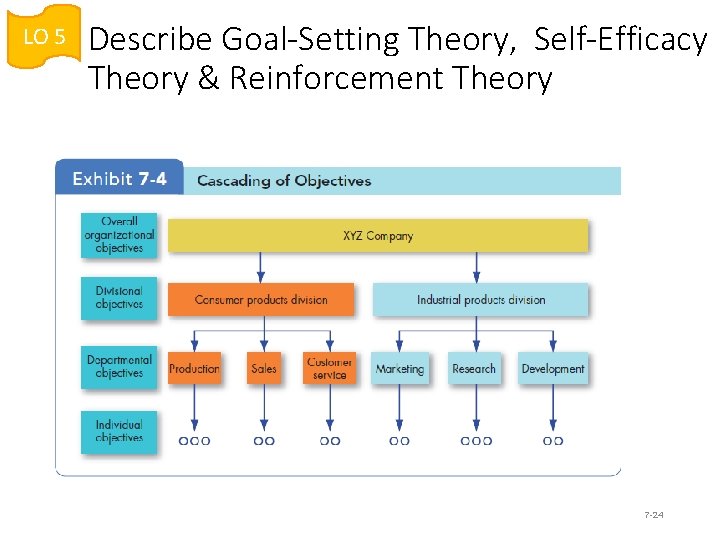
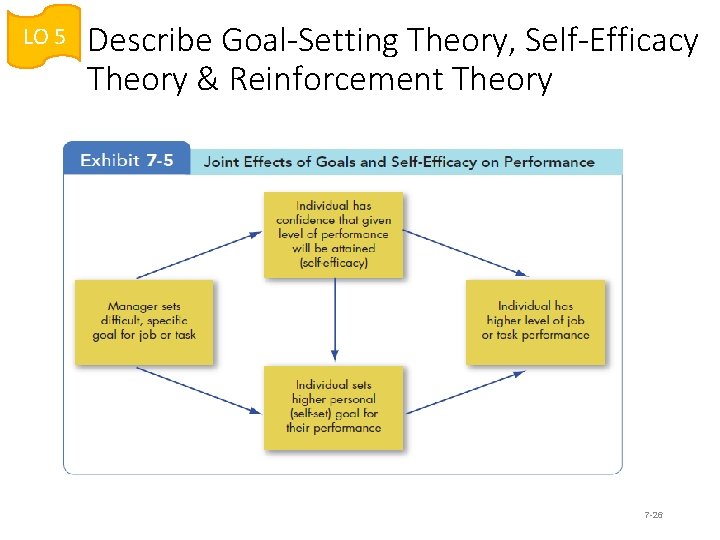
LO 5 Describe Goal-Setting Theory, Self-Efficacy Theory & Reinforcement Theory • Goal-Setting Theory • Goals tell an employee what needs to be done and how much effort is needed. • Evidence suggests: • Specific goals increase performance. • Difficult goals, when accepted, result in higher performance than do easy goals. • Feedback leads to higher performance than does non-feedback. 7 -21
LO 5 Describe Goal-Setting Theory, Self-Efficacy Theory & Reinforcement Theory • Three other factors influencing the goals-performance relationship: 1. Goal commitment 2. Task characteristics 3. National culture 7 -22
LO 5 Describe Goal-Setting Theory, Self-Efficacy Theory & Reinforcement Theory • People differ in the way they regulate their thoughts and behaviors. • Those with a promotion focus strive for advancement and accomplishment and approach conditions that move them closer toward desired goals. • Those with a prevention focus strive to fulfill duties and obligations and avoid conditions that pull them away from desired goals. • It’s probably best to be both promotion and prevention oriented. 7 -23
LO 5 Describe Goal-Setting Theory, Self-Efficacy Theory & Reinforcement Theory 7 -24
LO 5 Describe Goal-Setting Theory, Self-Efficacy Theory & Reinforcement Theory • Self-efficacy theory is an individual’s belief that he or she is capable of performing a task. • Enactive mastery • Vicarious modeling • Verbal persuasion • Arousal • Also known as social cognitive theory and social learning theory. 7 -25
LO 5 Describe Goal-Setting Theory, Self-Efficacy Theory & Reinforcement Theory 7 -26
LO 5 Describe Goal-Setting Theory, Self-Efficacy Theory & Reinforcement Theory • Implications of self-efficacy theory: • Training programs often make use of enactive mastery by having people practice and build their skills. • Intelligence and personality are absent from Bandura’s list, but they can increase self-efficacy. 7 -27
LO 5 Describe Goal-Setting Theory, Self-Efficacy Theory & Reinforcement Theory • Reinforcement theory: behavior is a function of its consequences. • Takes a behavioristic view, arguing that reinforcement conditions behavior. • Behavior is environmentally caused. • Goal-setting is a cognitive approach: an individual’s purposes direct his or her action. • Operant conditioning theory: people learn to behave to get something they want or to avoid something they don’t want. • B. F. Skinner’s behaviorism 7 -28
LO 5 Describe Goal-Setting Theory, Self-Efficacy Theory & Reinforcement Theory • In its pure form, reinforcement theory ignores feelings, attitudes, expectations, and other cognitive variables known to affect behavior. • Some researchers look at the same experiments reinforcement theorists use to support their position and interpret the findings in a cognitive framework. • Reinforcement is undoubtedly an important influence on behavior, but few scholars are prepared to argue it is the only one. 7 -29
LO 5 Describe Goal-Setting Theory, Self-Efficacy Theory & Reinforcement Theory • Social-learning theory: we can learn through both observation and direct experience. • Models are central, and four processes determine their influence on an individual: 1. Attentional processes 2. Retention processes 3. Motor reproduction processes 4. Reinforcement processes 7 -30
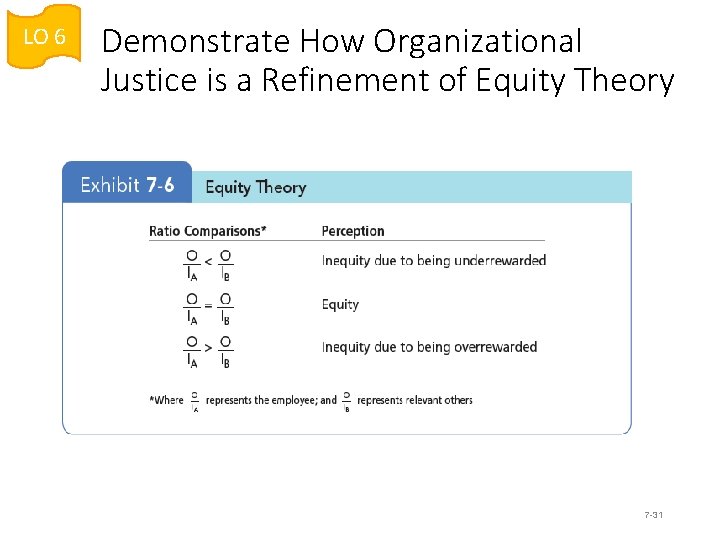
LO 6 Demonstrate How Organizational Justice is a Refinement of Equity Theory 7 -31
LO 6 Demonstrate How Organizational Justice is a Refinement of Equity Theory • When employees perceive an inequity, they can be predicted to make one of six choices: 1. Change their inputs. 2. Change their outcomes. 3. Distort perceptions of self. 4. Distort perceptions of others. 5. Choose a different referent. 6. Leave the field. 7 -32
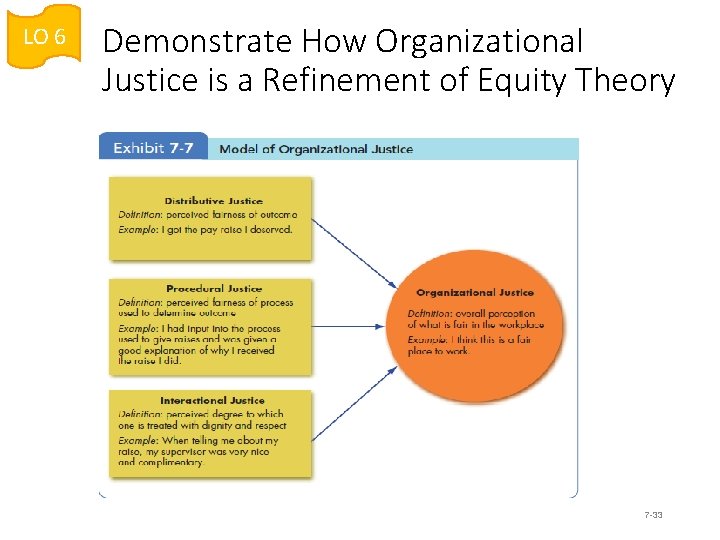
LO 6 Demonstrate How Organizational Justice is a Refinement of Equity Theory 7 -33
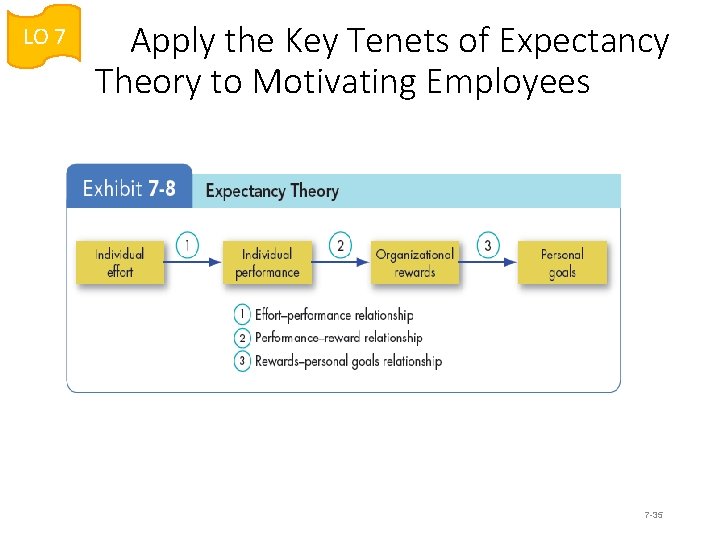
LO 7 Apply the Key Tenets of Expectancy Theory to Motivating Employees • Expectancy theory argues that a tendency to act in a certain way depends on an expectation that the act will be followed by a given outcome and on the attractiveness of that outcome to the individual. • An employee will be motivated to exert a high level of effort when he or she believes that: • Effort will lead to a good performance appraisal. • A good appraisal will lead to rewards. • The rewards will satisfy his or her personal goals. 7 -34
LO 7 Apply the Key Tenets of Expectancy Theory to Motivating Employees 7 -35
LO 7 Apply the Key Tenets of Expectancy Theory to Motivating Employees • Expectancy theory helps explain why a lot of workers aren’t motivated on their jobs and do only the minimum necessary to get by. • Three questions employees need to answer in the affirmative if their motivation is to be maximized: 1. If I give maximum effort, will it be recognized in my performance appraisal? 2. If I get a good performance appraisal, will it lead to organizational rewards? 3. If I’m rewarded, are the rewards attractive to me? 7 -36
LO 7 Apply the Key Tenets of Expectancy Theory to Motivating Employees • Does expectancy theory work? • It tends to be more valid in situations where effortperformance and performance-reward linkages are clearly perceived by the individual. • If individuals were actually rewarded for performance rather than seniority, effort, skill level, and job difficulty, it might be much more valid. 7 -37
LO 8 Compare Contemporary Theories of Motivation 7 -38
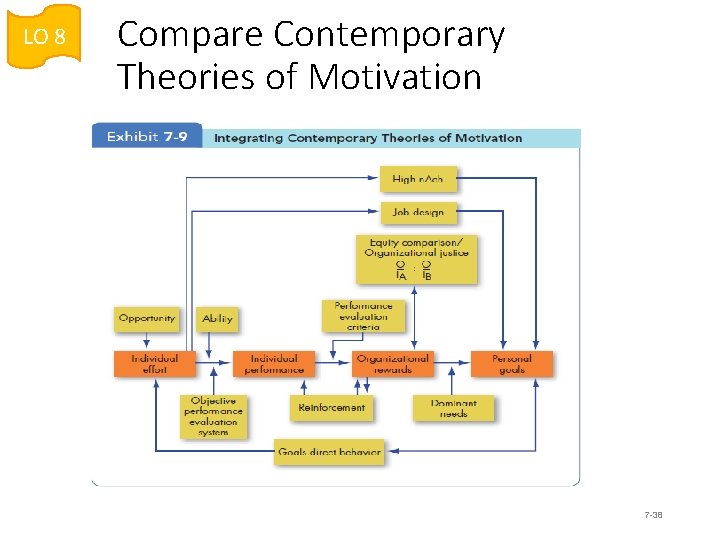
Implications for Managers • Make sure extrinsic rewards for employees are not viewed as coercive, but instead provide information about competence and relatedness. • Consider goal-setting theory, as clear and difficult goals often lead to higher levels of employee productivity. • Consider reinforcement theory regarding quality and quantity of work, persistence of effort, absenteeism, tardiness, and accident rates. • Consult equity theory to help understand productivity, satisfaction, absence, and turnover variables. • Expectancy theory also offers a powerful explanation of performance variables such as employee productivity, absenteeism, and turnover. 7 -39
- Slides: 39