
Lesson 7 Moral Hazard and Bad Behavior in
Lesson 7 Moral Hazard and Bad Behavior in Banking
E. Moral Hazard and the Asset Substitution Problem • Corporate law provides limited liability for shareholders. • Limited shareholder liability is valuable to shareholders and is costly to creditors. • Limited liability provides opportunity for increased risktaking by managers on behalf of shareholders. • Increased risk-taking by managers increases shareholder wealth by enabling shareholders to benefit from highly successful ventures. • While creditors do not share proportionately in the gains of the successful venture, they do stand to lose if the risky ventures are unsuccessful. • Shareholders have a call option on the firm's assets. • Creditors have riskless debt and a short position in a put.
Illustration 1: The Asset Substitution Problem; Part 1: Safe Investment • Consider an example involving a bank that has $100 in assets, financed by $94 in deposits at an interest rate of 5% and $6 in equity. • If the bank were to invest $100 by extending a loan on a very safe residential real estate mortgage, surely to earn a 6% return in one year: – Depositors would receive $94 ∙ 1. 05 = $98. 70 – Shareholders receive the remaining ($100 ∙ 1. 06 - $98. 70 = $7. 30. • Thus, assuming that the residential real estate is quite safe and ignoring administrative costs, shareholders earn an expected profit of $1. 30 on their $6 investment.
Illustration 1: The Asset Substitution Problem; Part 2: Risky Investment • Alternatively, the bank can invest $100 into a risky commercial real estate loan whose return is 15% with probability equal to 80%, while the probability of default equals 20%, in which case the bank receives nothing. • Depositors receive $98. 70 with a probability of 80% and zero (there are no assets with which to pay creditors) with a probability of 20%. • In the more successful scenario, shareholders receive $115 - $98. 70 = $16. 30 with a probability of 80%, while facing a 20% probability of receiving zero. • The potential profits to shareholders based on their initial $6 investment are: – $16. 30 -$6=$10. 30 with probability. 8 and – -$6 with probability. 2. – The expected profit to shareholders is $8. 24 -$1. 2 = $7. 04, much higher than the expected profit for the safe residential real estate strategy.
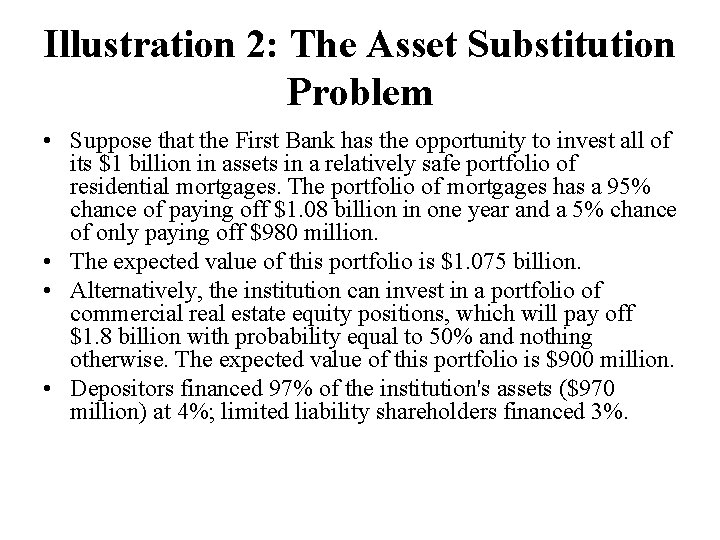
Illustration 2: The Asset Substitution Problem • Suppose that the First Bank has the opportunity to invest all of its $1 billion in assets in a relatively safe portfolio of residential mortgages. The portfolio of mortgages has a 95% chance of paying off $1. 08 billion in one year and a 5% chance of only paying off $980 million. • The expected value of this portfolio is $1. 075 billion. • Alternatively, the institution can invest in a portfolio of commercial real estate equity positions, which will pay off $1. 8 billion with probability equal to 50% and nothing otherwise. The expected value of this portfolio is $900 million. • Depositors financed 97% of the institution's assets ($970 million) at 4%; limited liability shareholders financed 3%.
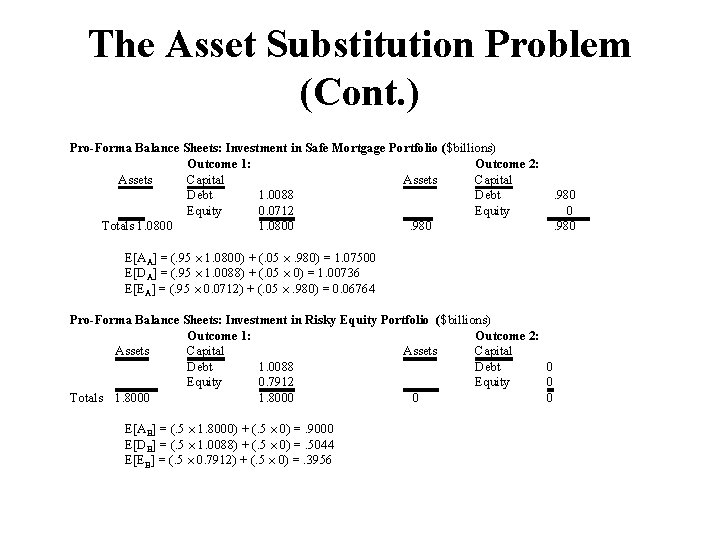
The Asset Substitution Problem (Cont. ) Pro-Forma Balance Sheets: Investment in Safe Mortgage Portfolio ($billions) Outcome 1: Outcome 2: Assets Capital Debt 1. 0088 Debt Equity 0. 0712 Equity Totals 1. 0800. 980 E[AA] = (. 95 1. 0800) + (. 05 . 980) = 1. 07500 E[DA] = (. 95 1. 0088) + (. 05 0) = 1. 00736 E[EA] = (. 95 0. 0712) + (. 05 . 980) = 0. 06764 . 980 0 _. 980 Pro-Forma Balance Sheets: Investment in Risky Equity Portfolio ($billions) Outcome 1: Outcome 2: Assets Capital Debt 1. 0088 Debt 0 Equity 0. 7912 Equity 0 Totals 1. 8000 0 0 E[AB] = (. 5 1. 8000) + (. 5 0) =. 9000 E[DB] = (. 5 1. 0088) + (. 5 0) =. 5044 E[EB] = (. 5 0. 7912) + (. 5 0) =. 3956
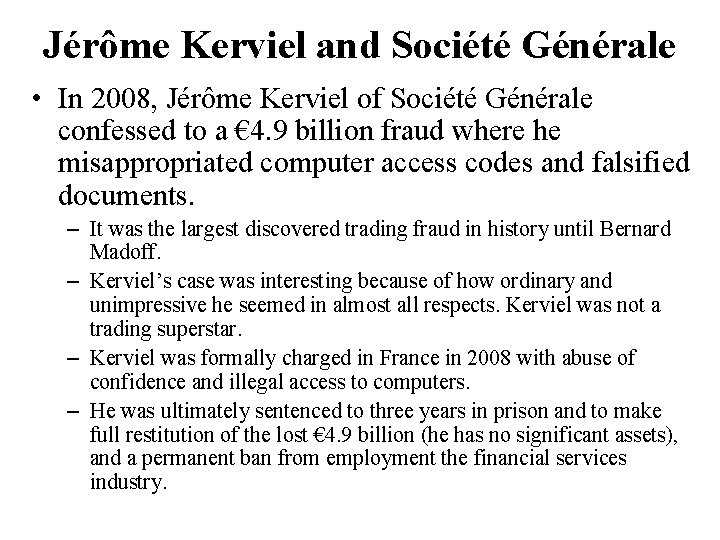
Jérôme Kerviel and Société Générale • In 2008, Jérôme Kerviel of Société Générale confessed to a € 4. 9 billion fraud where he misappropriated computer access codes and falsified documents. – It was the largest discovered trading fraud in history until Bernard Madoff. – Kerviel’s case was interesting because of how ordinary and unimpressive he seemed in almost all respects. Kerviel was not a trading superstar. – Kerviel was formally charged in France in 2008 with abuse of confidence and illegal access to computers. – He was ultimately sentenced to three years in prison and to make full restitution of the lost € 4. 9 billion (he has no significant assets), and a permanent ban from employment the financial services industry.
- Slides: 7