
Lesson 7 Derivatives of Power Functions SL 2
- Slides: 18
Lesson 7 – Derivatives of Power Functions SL 2 – Santowski 2/15/2022 SL 2 - Santowski 1
Lesson Objectives 1. Use first principles (limit definitions) to develop the power rule 2. Use graphic differentiation to verify the power rule 3. Use graphic evidence to verify antiderivative functions 4. Apply the power rule to real world problems 5. Apply the power rule to determine characteristics of polynomial function 2/15/2022 SL 2 - Santowski 2
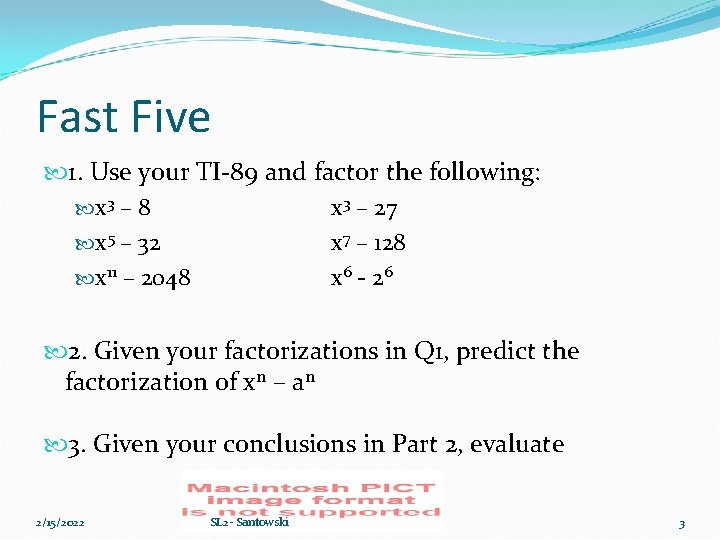
Fast Five 1. Use your TI-89 and factor the following: x 3 – 8 x 3 – 27 x 5 – 32 x 7 – 128 x 11 – 2048 x 6 - 2 6 2. Given your factorizations in Q 1, predict the factorization of xn – an 3. Given your conclusions in Part 2, evaluate 2/15/2022 SL 2 - Santowski 3
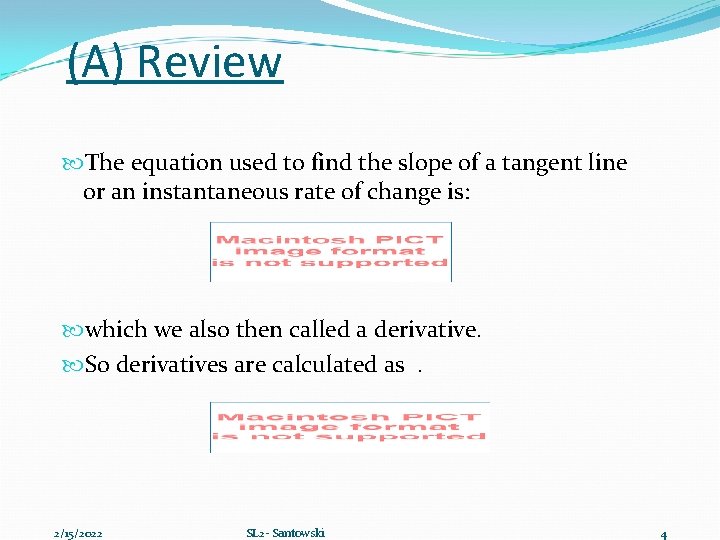
(A) Review The equation used to find the slope of a tangent line or an instantaneous rate of change is: which we also then called a derivative. So derivatives are calculated as. 2/15/2022 SL 2 - Santowski 4
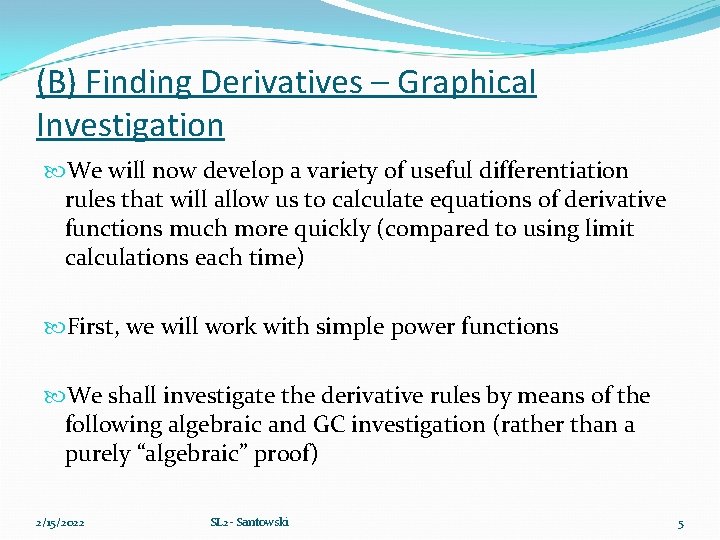
(B) Finding Derivatives – Graphical Investigation We will now develop a variety of useful differentiation rules that will allow us to calculate equations of derivative functions much more quickly (compared to using limit calculations each time) First, we will work with simple power functions We shall investigate the derivative rules by means of the following algebraic and GC investigation (rather than a purely “algebraic” proof) 2/15/2022 SL 2 - Santowski 5
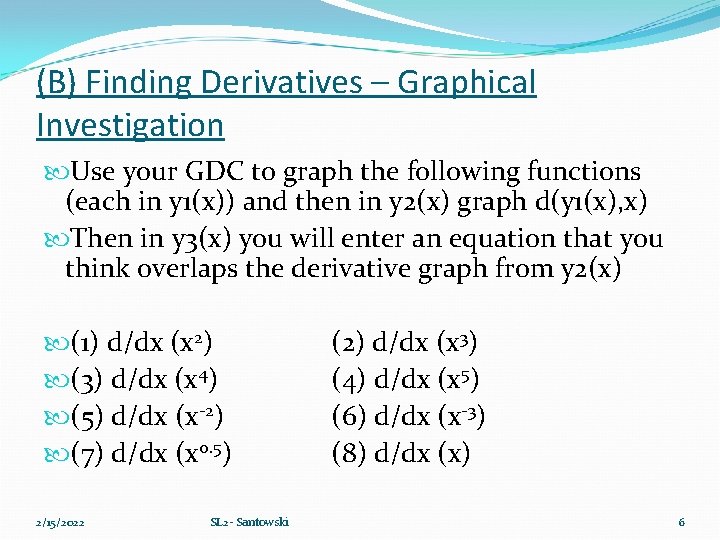
(B) Finding Derivatives – Graphical Investigation Use your GDC to graph the following functions (each in y 1(x)) and then in y 2(x) graph d(y 1(x), x) Then in y 3(x) you will enter an equation that you think overlaps the derivative graph from y 2(x) (1) d/dx (x 2) (3) d/dx (x 4) (5) d/dx (x-2) (7) d/dx (x 0. 5) 2/15/2022 SL 2 - Santowski (2) d/dx (x 3) (4) d/dx (x 5) (6) d/dx (x-3) (8) d/dx (x) 6
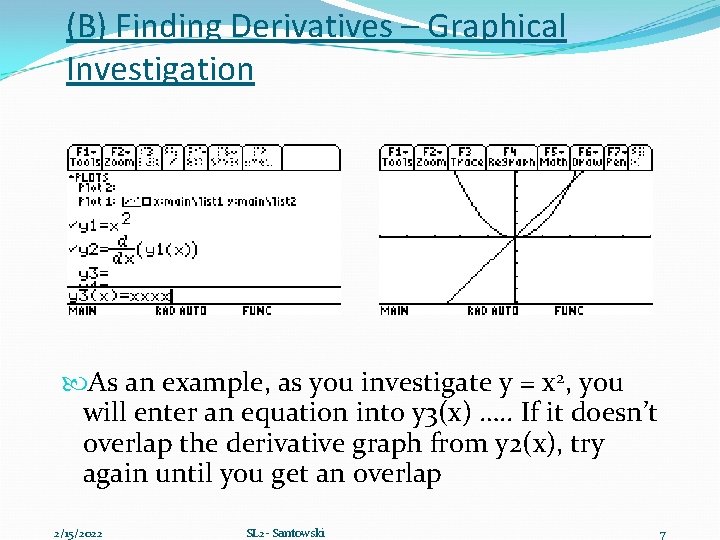
(B) Finding Derivatives – Graphical Investigation As an example, as you investigate y = x 2, you will enter an equation into y 3(x) …. . If it doesn’t overlap the derivative graph from y 2(x), try again until you get an overlap 2/15/2022 SL 2 - Santowski 7
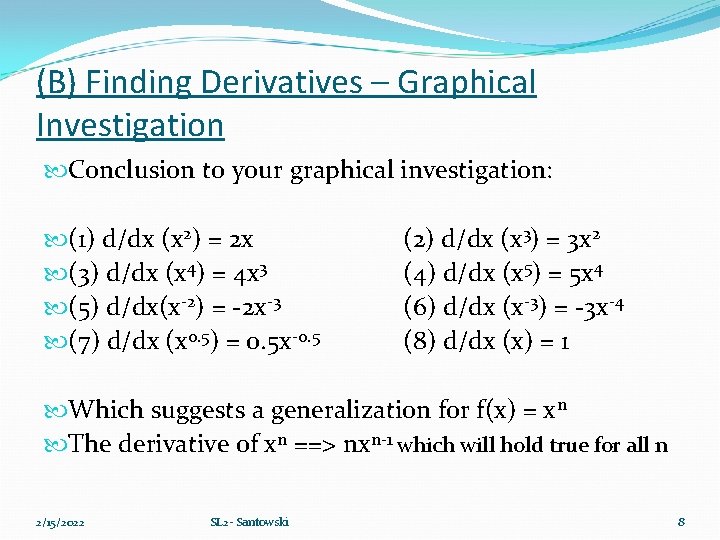
(B) Finding Derivatives – Graphical Investigation Conclusion to your graphical investigation: (1) d/dx (x 2) = 2 x (3) d/dx (x 4) = 4 x 3 (5) d/dx(x-2) = -2 x-3 (7) d/dx (x 0. 5) = 0. 5 x-0. 5 (2) d/dx (x 3) = 3 x 2 (4) d/dx (x 5) = 5 x 4 (6) d/dx (x-3) = -3 x-4 (8) d/dx (x) = 1 Which suggests a generalization for f(x) = xn The derivative of xn ==> nxn-1 which will hold true for all n 2/15/2022 SL 2 - Santowski 8
(C) Finding Derivatives - Sum and Difference and Constant Rules Now that we have seen the derivatives of power functions, what about functions that are made of various combinations of power functions (i. e. sums and difference and constants with power functions? ) Ex 1: d/dx (3 x 2) Ex 2: d/dx(x 2 + x 3) Ex 3: d/dx (x 4 - x) 2/15/2022 SL 2 - Santowski d/dx(-4 x-2) d/dx(x-3 + x-5) d/dx (x 3 - x-2) 9
(C) Finding Derivatives - Sum and Difference and Constant Rules Use the same graphical investigation approach to determine/predict what about fractional exponents? Ex 1: d/dx (x 1/2) = ? Ex 2: d/dx(x 2/3 + x 1/3)= ? 2/15/2022 SL 2 - Santowski d/dx(-4 x-1/2) = ? d/dx(x-1/3 + x-2/5) = ? 10
(C) Finding Derivatives - Sum and Difference and Constant Rules The previous investigation leads to the following conclusions: (1) (2) (3) 2/15/2022 SL 2 - Santowski 11
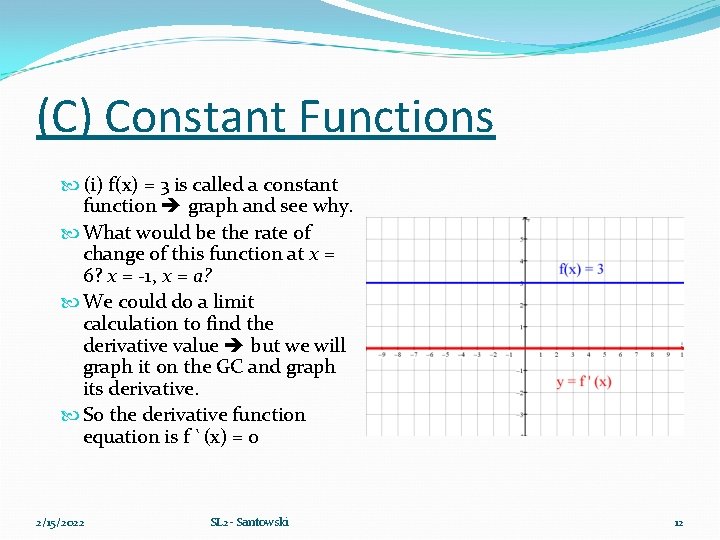
(C) Constant Functions (i) f(x) = 3 is called a constant function graph and see why. What would be the rate of change of this function at x = 6? x = -1, x = a? We could do a limit calculation to find the derivative value but we will graph it on the GC and graph its derivative. So the derivative function equation is f `(x) = 0 2/15/2022 SL 2 - Santowski 12
(D) Examples Ex 1: Differentiate the following: (a) (b) Ex 2. Find the second derivative : (a) f(x) = x 2 (c) h(x) = x 1/2 2/15/2022 SL 2 - Santowski (b) g(x) = x 3 13
(E) Examples - Analyzing Functions Ex 1: Find the equation of the line which is normal to the curve y = x 2 - 2 x + 4 at x = 3. Ex 2. Given an external point A(-4, 0) and a parabola f(x) = x 2 - 2 x + 4, find the equations of the 2 tangents to f(x) that pass through A Ex 3: On what intervals is the function f(x) = x 4 - 4 x 3 both concave up and decreasing? Ex 4: For what values of x is the graph of g(x) = x 5 - 5 x both increasing and concave up? 2/15/2022 SL 2 - Santowski 14
(F) Examples - Applications A ball is dropped from the top of the Empire State building to the ground below. The height in feet, h(t), of the ball above the ground is given as a function of time, t, in seconds since release by h(t) = 1250 - 16 t 2 (a) Determine the velocity of the ball 5 seconds after release (b) How fast is the ball going when it hits the ground? (c) what is the acceleration of the ball? 2/15/2022 SL 2 - Santowski 15
(G) Examples - Economics Suppose that the total cost in hundreds of dollars of producing x thousands of barrels of oil is given by the function C(x) = 4 x 2 + 100 x + 500. Determine the following. (a) the cost of producing 5000 barrels of oil (b) the cost of producing 5001 barrels of oil (c) the cost of producing the 5001 st barrelof oil (d) C `(5000) = the marginal cost at a production level of 5000 barrels of oil. Interpret. (e) The production level that minimizes the average cost (where AC(x) = C(x)/x)) 2/15/2022 SL 2 - Santowski 16
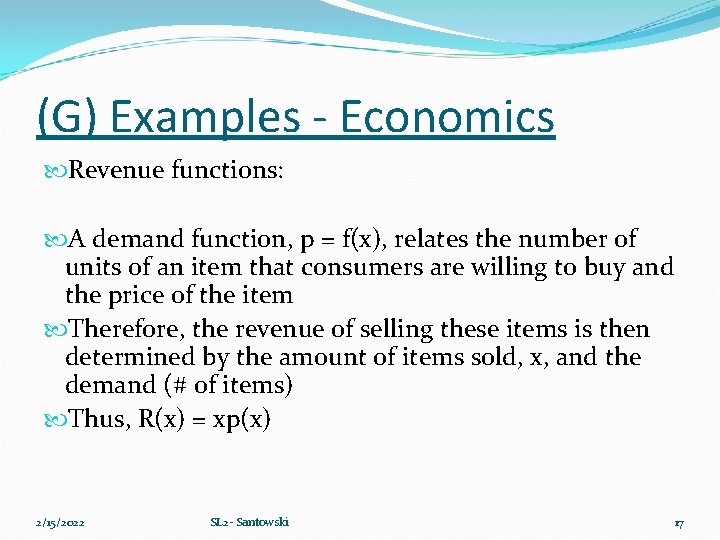
(G) Examples - Economics Revenue functions: A demand function, p = f(x), relates the number of units of an item that consumers are willing to buy and the price of the item Therefore, the revenue of selling these items is then determined by the amount of items sold, x, and the demand (# of items) Thus, R(x) = xp(x) 2/15/2022 SL 2 - Santowski 17
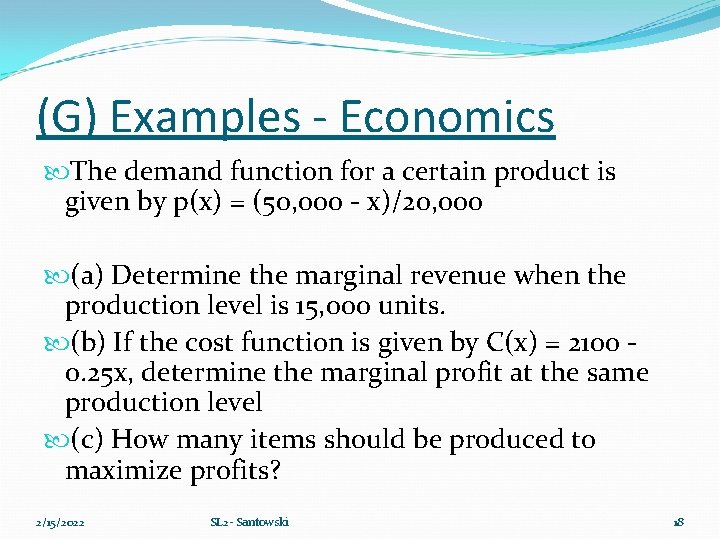
(G) Examples - Economics The demand function for a certain product is given by p(x) = (50, 000 - x)/20, 000 (a) Determine the marginal revenue when the production level is 15, 000 units. (b) If the cost function is given by C(x) = 2100 0. 25 x, determine the marginal profit at the same production level (c) How many items should be produced to maximize profits? 2/15/2022 SL 2 - Santowski 18