
Lesson 7 b Market Structures Monopoly Oligopoly Copyright
Lesson 7 b Market Structures Monopoly & Oligopoly Copyright© 2004 South-Western
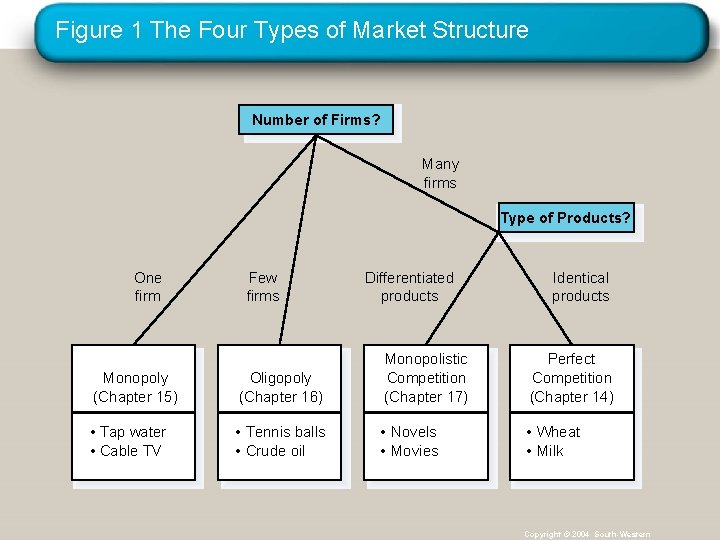
Figure 1 The Four Types of Market Structure Number of Firms? Many firms Type of Products? One firm Few firms Differentiated products Monopoly (Chapter 15) Oligopoly (Chapter 16) Monopolistic Competition (Chapter 17) • Tap water • Cable TV • Tennis balls • Crude oil • Novels • Movies Identical products Perfect Competition (Chapter 14) • Wheat • Milk Copyright © 2004 South-Western
BETWEEN MONOPOLY AND PERFECT COMPETITION • Imperfect competition refers to those market structures that fall between perfect competition and pure monopoly. Copyright © 2004 South-Western
BETWEEN MONOPOLY AND PERFECT COMPETITION • Imperfect competition includes industries in which firms have competitors but do not face so much competition that they are price takers. Copyright © 2004 South-Western
BETWEEN MONOPOLY AND PERFECT COMPETITION • Types of Imperfectly Competitive Markets • Oligopoly • Only a few sellers, each offering a similar or identical product to the others. • Monopolistic Competition • Many firms selling products that are similar but not identical. Copyright © 2004 South-Western
• While a competitive firm is a price taker, a monopoly firm is a price maker. Copyright © 2004 South-Western
• A firm is considered a monopoly if. . . • it is the sole seller of its product. • its product does not have close substitutes. Copyright © 2004 South-Western
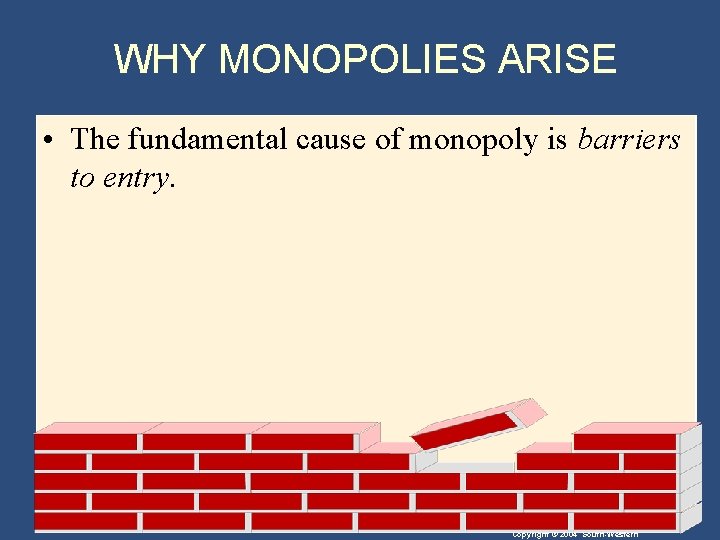
WHY MONOPOLIES ARISE • The fundamental cause of monopoly is barriers to entry. Copyright © 2004 South-Western
WHY MONOPOLIES ARISE • Barriers to entry have three sources: • Ownership of a key resource. • The government gives a single firm the exclusive right to produce some good. • Costs of production make a single producer more efficient than a large number of producers. Copyright © 2004 South-Western
Monopoly Resources • Although exclusive ownership of a key resource is a potential source of monopoly, in practice monopolies rarely arise for this reason. Copyright © 2004 South-Western
Government-Created Monopolies • Governments may restrict entry by giving a single firm the exclusive right to sell a particular good in certain markets. Copyright © 2004 South-Western
Government-Created Monopolies • Patent and copyright laws are two important examples of how government creates a monopoly to serve the public interest. Copyright © 2004 South-Western
Natural Monopolies • An industry is a natural monopoly when a single firm can supply a good or service to an entire market at a smaller cost than could two or more firms. Copyright © 2004 South-Western
Natural Monopolies • A natural monopoly arises when there are economies of scale over the relevant range of output. Copyright © 2004 South-Western
HOW MONOPOLIES MAKE PRODUCTION AND PRICING DECISIONS • Monopoly versus Competition • Monopoly • • Is the sole producer Faces a downward-sloping demand curve Is a price maker Reduces price to increase sales • Competitive Firm • • Is one of many producers Faces a horizontal demand curve Is a price taker Sells as much or as little at same price Copyright © 2004 South-Western
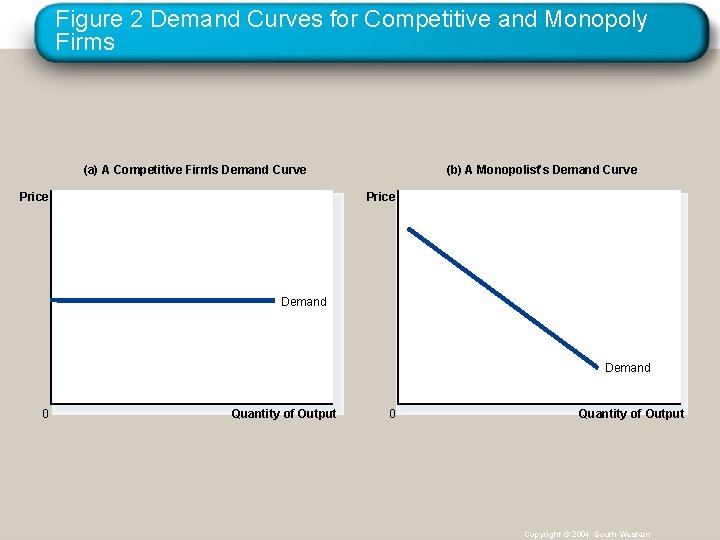
Figure 2 Demand Curves for Competitive and Monopoly Firms (a) A Competitive Firm’s Demand Curve Price (b) A Monopolist’s Demand Curve Price Demand 0 Quantity of Output Copyright © 2004 South-Western
PUBLIC POLICY TOWARD MONOPOLIES • Government responds to the problem of monopoly in one of four ways. • Making monopolized industries more competitive. • Regulating the behavior of monopolies. • Turning some private monopolies into public enterprises. • Doing nothing at all. Copyright © 2004 South-Western
Increasing Competition with Antitrust Laws • Antitrust laws are a collection of statutes aimed at curbing monopoly power. • Antitrust laws give government various ways to promote competition. • They allow government to prevent mergers. • They allow government to break up companies. • They prevent companies from performing activities that make markets less competitive. Copyright © 2004 South-Western
Increasing Competition with Antitrust Laws • Two Important Antitrust Laws • Sherman Antitrust Act (1890) • Reduced the market power of the large and powerful “trusts” of that time period. • Clayton Act (1914) • Strengthened the government’s powers and authorized private lawsuits. Copyright © 2004 South-Western
Regulation • Government may regulate the prices that the monopoly charges. • The allocation of resources will be efficient if price is set to equal marginal cost. Copyright © 2004 South-Western
Regulation • In practice, regulators will allow monopolists to keep some of the benefits from lower costs in the form of higher profit, a practice that requires some departure from marginal-cost pricing. Copyright © 2004 South-Western
Public Ownership • Rather than regulating a natural monopoly that is run by a private firm, the government can run the monopoly itself (e. g. in the United States, the government runs the Postal Service). Copyright © 2004 South-Western
Doing Nothing • Government can do nothing at all if the market failure is deemed small compared to the imperfections of public policies. Copyright © 2004 South-Western
PRICE DISCRIMINATION • Price discrimination is the business practice of selling the same good at different prices to different customers, even though the costs for producing for the two customers are the same. Copyright © 2004 South-Western
PRICE DISCRIMINATION • Price discrimination is not possible when a good is sold in a competitive market since there are many firms all selling at the market price. In order to price discriminate, the firm must have some market power. • Perfect Price Discrimination • Perfect price discrimination refers to the situation when the monopolist knows exactly the willingness to pay of each customer and can charge each customer a different price. Copyright © 2004 South-Western
PRICE DISCRIMINATION • Examples of Price Discrimination • • • Movie tickets Airline prices Discount coupons Financial aid Quantity discounts Copyright © 2004 South-Western
Summary • A monopoly is a firm that is the sole seller in its market. • It faces a downward-sloping demand curve for its product. • A monopoly’s marginal revenue is always below the price of its good. Copyright © 2004 South-Western
Summary • Like a competitive firm, a monopoly maximizes profit by producing the quantity at which marginal cost and marginal revenue are equal. • Unlike a competitive firm, its price exceeds its marginal revenue, so its price exceeds marginal cost. Copyright © 2004 South-Western
Summary • A monopolist’s profit-maximizing level of output is below the level that maximizes the sum of consumer and producer surplus. • A monopoly causes deadweight losses similar to the deadweight losses caused by taxes. Copyright © 2004 South-Western
Summary • Policymakers can respond to the inefficiencies of monopoly behavior with antitrust laws, regulation of prices, or by turning the monopoly into a government-run enterprise. • If the market failure is deemed small, policymakers may decide to do nothing at all. Copyright © 2004 South-Western
Summary • Monopolists can raise their profits by charging different prices to different buyers based on their willingness to pay. • Price discrimination can raise economic welfare and lessen deadweight losses. Copyright © 2004 South-Western
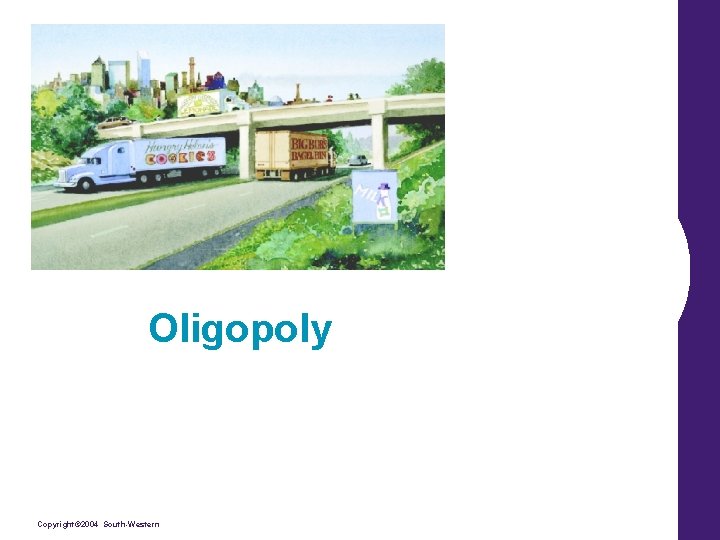
Oligopoly Copyright© 2004 South-Western
BETWEEN MONOPOLY AND PERFECT COMPETITION • Imperfect competition refers to those market structures that fall between perfect competition and pure monopoly. Copyright © 2004 South-Western
BETWEEN MONOPOLY AND PERFECT COMPETITION • Imperfect competition includes industries in which firms have competitors but do not face so much competition that they are price takers. Copyright © 2004 South-Western
BETWEEN MONOPOLY AND PERFECT COMPETITION • Types of Imperfectly Competitive Markets • Oligopoly • Only a few sellers, each offering a similar or identical product to the others. • Monopolistic Competition • Many firms selling products that are similar but not identical. Copyright © 2004 South-Western
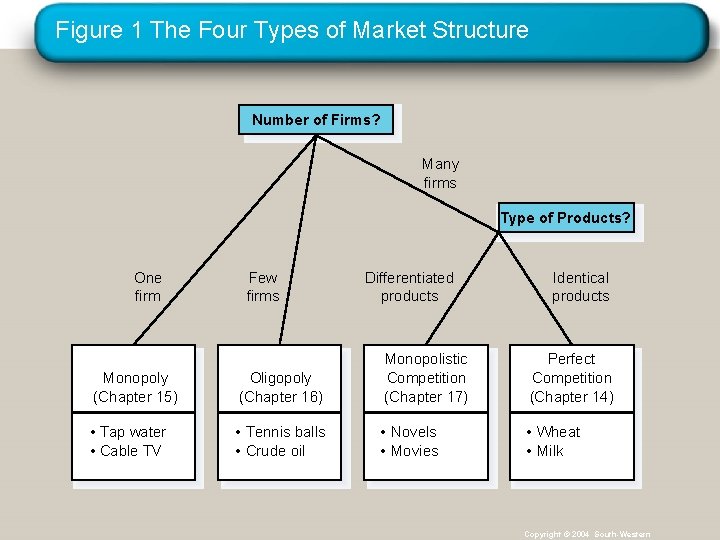
Figure 1 The Four Types of Market Structure Number of Firms? Many firms Type of Products? One firm Few firms Differentiated products Monopoly (Chapter 15) Oligopoly (Chapter 16) Monopolistic Competition (Chapter 17) • Tap water • Cable TV • Tennis balls • Crude oil • Novels • Movies Identical products Perfect Competition (Chapter 14) • Wheat • Milk Copyright © 2004 South-Western
MARKETS WITH ONLY A FEW SELLERS • Because of the few sellers, the key feature of oligopoly is the tension between cooperation and self-interest. Copyright © 2004 South-Western
MARKETS WITH ONLY A FEW SELLERS • Characteristics of an Oligopoly Market • Few sellers offering similar or identical products • Interdependent firms • Best off cooperating and acting like a monopolist by producing a small quantity of output and charging a price above marginal cost Copyright © 2004 South-Western
A Duopoly Example • A duopoly is an oligopoly with only two members. It is the simplest type of oligopoly. Copyright © 2004 South-Western
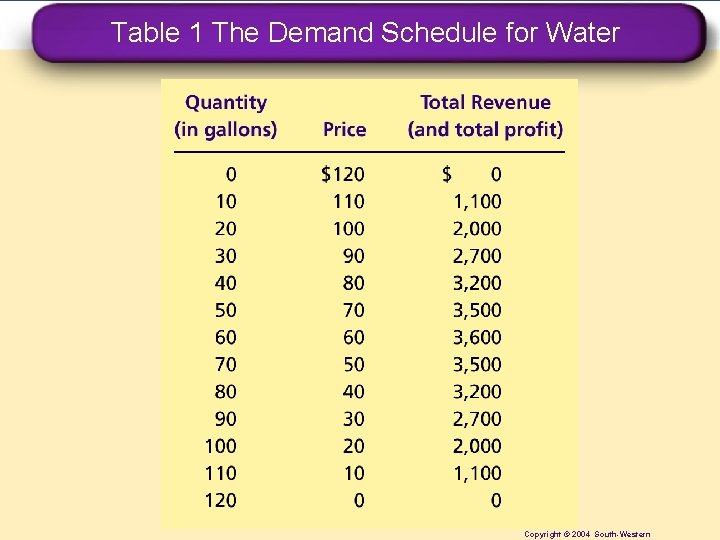
Table 1 The Demand Schedule for Water Copyright © 2004 South-Western
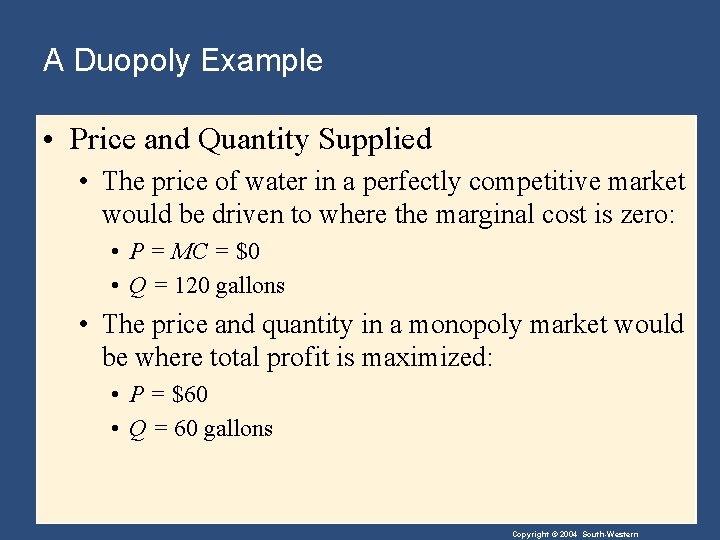
A Duopoly Example • Price and Quantity Supplied • The price of water in a perfectly competitive market would be driven to where the marginal cost is zero: • P = MC = $0 • Q = 120 gallons • The price and quantity in a monopoly market would be where total profit is maximized: • P = $60 • Q = 60 gallons Copyright © 2004 South-Western
A Duopoly Example • Price and Quantity Supplied • The socially efficient quantity of water is 120 gallons, but a monopolist would produce only 60 gallons of water. • So what outcome then could be expected from duopolists? Copyright © 2004 South-Western
Competition, Monopolies, and Cartels • The duopolists may agree on a monopoly outcome. • Collusion • An agreement among firms in a market about quantities to produce or prices to charge. • Cartel • A group of firms acting in unison. Copyright © 2004 South-Western
Competition, Monopolies, and Cartels • Although oligopolists would like to form cartels and earn monopoly profits, often that is not possible. Antitrust laws prohibit explicit agreements among oligopolists as a matter of public policy. Copyright © 2004 South-Western
The Equilibrium for an Oligopoly • A Nash equilibrium is a situation in which economic actors interacting with one another each choose their best strategy given the strategies that all the others have chosen. Copyright © 2004 South-Western
The Equilibrium for an Oligopoly • When firms in an oligopoly individually choose production to maximize profit, they produce quantity of output greater than the level produced by monopoly and less than the level produced by competition. Copyright © 2004 South-Western
The Equilibrium for an Oligopoly • The oligopoly price is less than the monopoly price but greater than the competitive price (which equals marginal cost). Copyright © 2004 South-Western
Equilibrium for an Oligopoly • Summary • Possible outcome if oligopoly firms pursue their own self-interests: • Joint output is greater than the monopoly quantity but less than the competitive industry quantity. • Market prices are lower than monopoly price but greater than competitive price. • Total profits are less than the monopoly profit. Copyright © 2004 South-Western
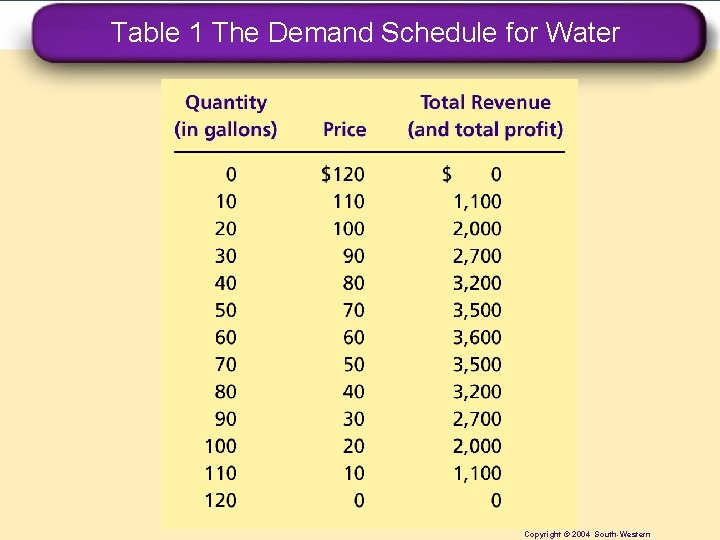
Table 1 The Demand Schedule for Water Copyright © 2004 South-Western
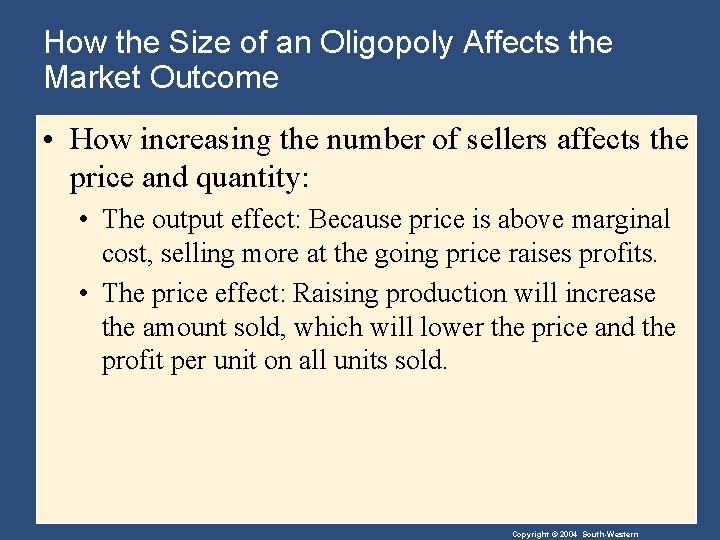
How the Size of an Oligopoly Affects the Market Outcome • How increasing the number of sellers affects the price and quantity: • The output effect: Because price is above marginal cost, selling more at the going price raises profits. • The price effect: Raising production will increase the amount sold, which will lower the price and the profit per unit on all units sold. Copyright © 2004 South-Western
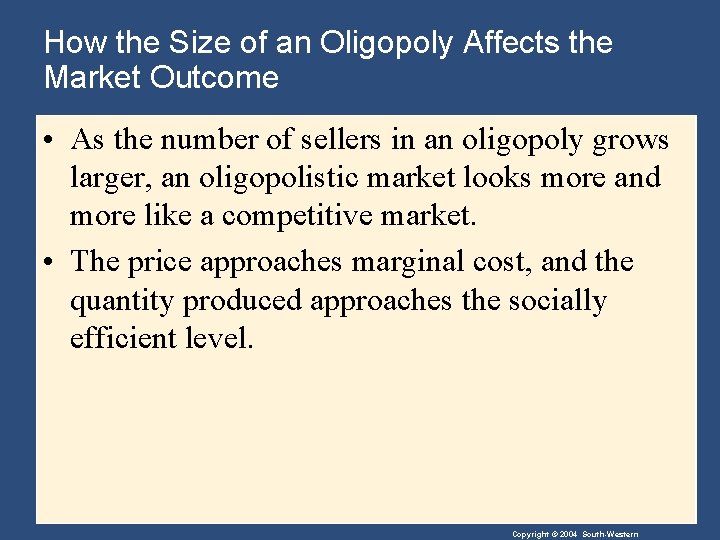
How the Size of an Oligopoly Affects the Market Outcome • As the number of sellers in an oligopoly grows larger, an oligopolistic market looks more and more like a competitive market. • The price approaches marginal cost, and the quantity produced approaches the socially efficient level. Copyright © 2004 South-Western
GAME THEORY AND THE ECONOMICS OF COOPERATION • Game theory is the study of how people behave in strategic situations. • Strategic decisions are those in which each person, in deciding what actions to take, must consider how others might respond to that action. Copyright © 2004 South-Western
GAME THEORY AND THE ECONOMICS OF COOPERATION • Because the number of firms in an oligopolistic market is small, each firm must act strategically. • Each firm knows that its profit depends not only on how much it produces but also on how much the other firms produce. Copyright © 2004 South-Western
The Prisoners’ Dilemma • The prisoners’ dilemma provides insight into the difficulty in maintaining cooperation. • Often people (firms) fail to cooperate with one another even when cooperation would make them better off. Copyright © 2004 South-Western
The Prisoners’ Dilemma • The prisoners’ dilemma is a particular “game” between two captured prisoners that illustrates why cooperation is difficult to maintain even when it is mutually beneficial. Copyright © 2004 South-Western
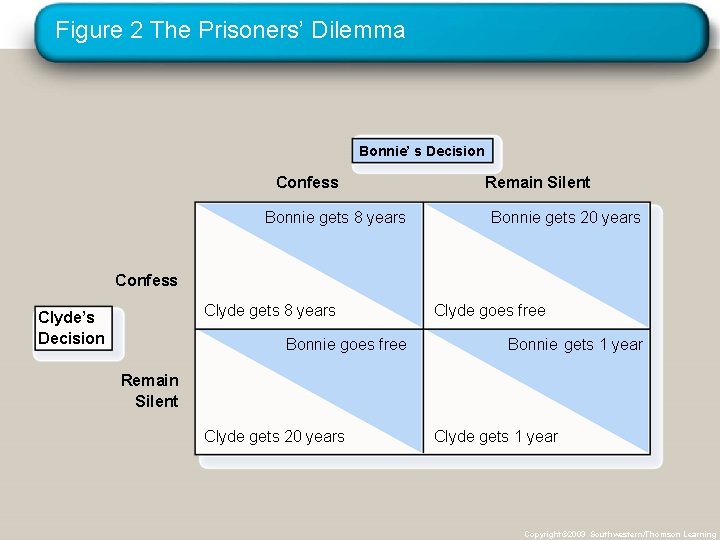
Figure 2 The Prisoners’ Dilemma Bonnie’ s Decision Confess Bonnie gets 8 years Remain Silent Bonnie gets 20 years Confess Clyde gets 8 years Clyde’s Decision Bonnie goes free Clyde goes free Bonnie gets 1 year Remain Silent Clyde gets 20 years Clyde gets 1 year Copyright © 2004 South-Western Copyright© 2003 Southwestern/Thomson Learning
The Prisoners’ Dilemma • The dominant strategy is the best strategy for a player to follow regardless of the strategies chosen by the other players. Copyright © 2004 South-Western
The Prisoners’ Dilemma • Cooperation is difficult to maintain, because cooperation is not in the best interest of the individual player. Copyright © 2004 South-Western
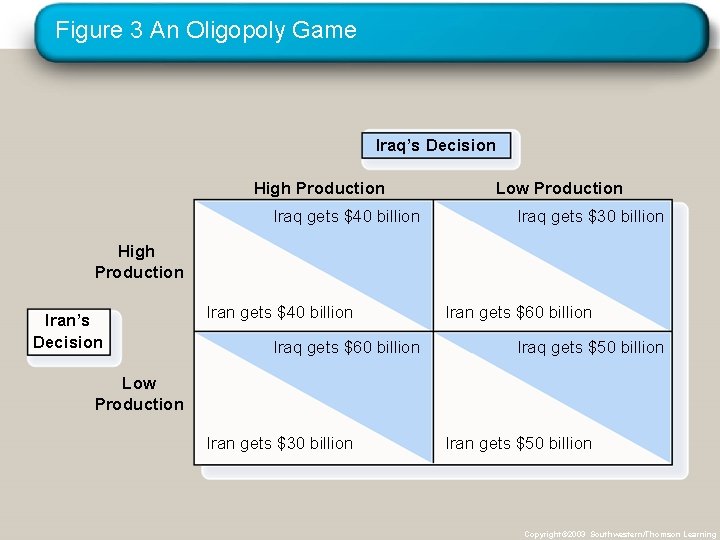
Figure 3 An Oligopoly Game Iraq’s Decision High Production Iraq gets $40 billion Low Production Iraq gets $30 billion High Production Iran’s Decision Iran gets $40 billion Iraq gets $60 billion Iran gets $60 billion Iraq gets $50 billion Low Production Iran gets $30 billion Iran gets $50 billion Copyright © 2004 South-Western Copyright© 2003 Southwestern/Thomson Learning
Oligopolies as a Prisoners’ Dilemma • Self-interest makes it difficult for the oligopoly to maintain a cooperative outcome with low production, high prices, and monopoly profits. Copyright © 2004 South-Western
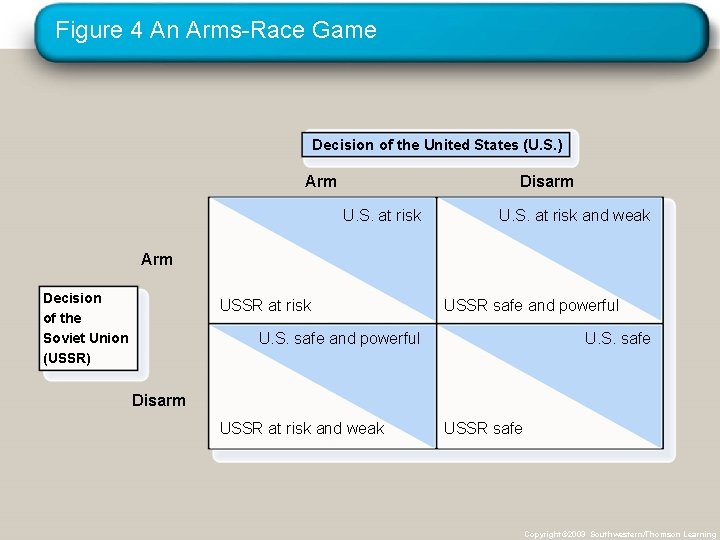
Figure 4 An Arms-Race Game Decision of the United States (U. S. ) Arm Disarm U. S. at risk and weak Arm Decision of the Soviet Union (USSR) USSR at risk USSR safe and powerful U. S. safe Disarm USSR at risk and weak USSR safe Copyright © 2004 South-Western Copyright© 2003 Southwestern/Thomson Learning
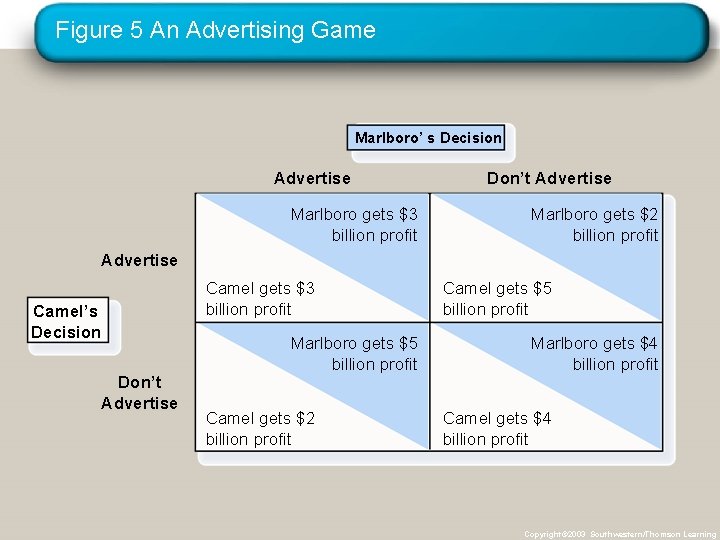
Figure 5 An Advertising Game Marlboro’ s Decision Advertise Marlboro gets $3 billion profit Don’t Advertise Marlboro gets $2 billion profit Advertise Camel’s Decision Don’t Advertise Camel gets $3 billion profit Marlboro gets $5 billion profit Camel gets $2 billion profit Camel gets $5 billion profit Marlboro gets $4 billion profit Camel gets $4 billion profit Copyright © 2004 South-Western Copyright© 2003 Southwestern/Thomson Learning
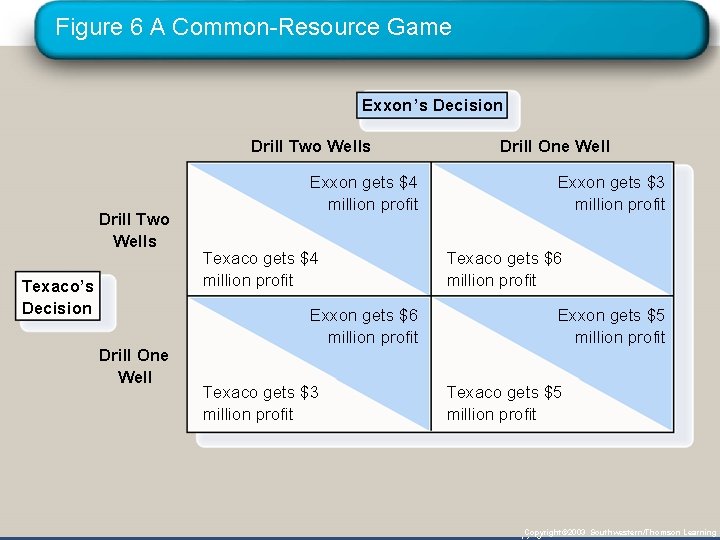
Figure 6 A Common-Resource Game Exxon’s Decision Drill Two Wells Texaco’s Decision Drill One Well Exxon gets $4 million profit Texaco gets $4 million profit Exxon gets $6 million profit Texaco gets $3 million profit Drill One Well Exxon gets $3 million profit Texaco gets $6 million profit Exxon gets $5 million profit Texaco gets $5 million profit Copyright© 2003 Southwestern/Thomson Learning Copyright © 2004 South-Western
Why People Sometimes Cooperate • Firms that care about future profits will cooperate in repeated games rather than cheating in a single game to achieve a one-time gain. Copyright © 2004 South-Western
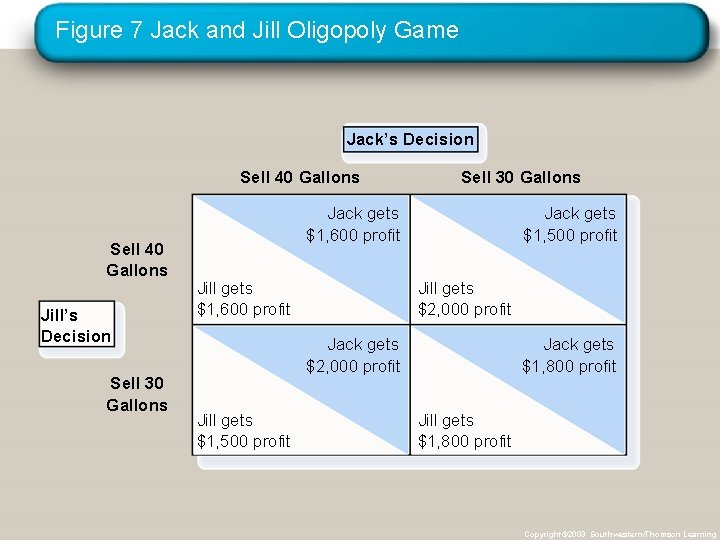
Figure 7 Jack and Jill Oligopoly Game Jack’s Decision Sell 40 Gallons Jill’s Decision Sell 30 Gallons Jack gets $1, 500 profit Jack gets $1, 600 profit Jill gets $2, 000 profit Jack gets $2, 000 profit Jill gets $1, 500 profit Jack gets $1, 800 profit Jill gets $1, 800 profit Copyright © 2004 South-Western Copyright© 2003 Southwestern/Thomson Learning
PUBLIC POLICY TOWARD OLIGOPOLIES • Cooperation among oligopolists is undesirable from the standpoint of society as a whole because it leads to production that is too low and prices that are too high. Copyright © 2004 South-Western
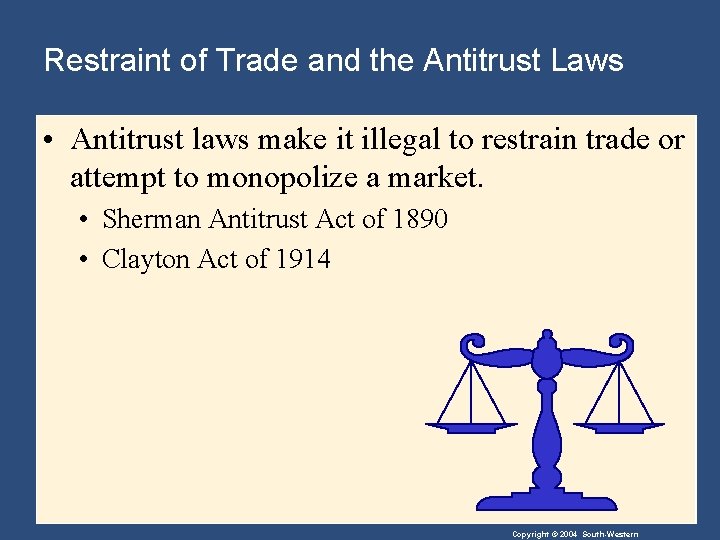
Restraint of Trade and the Antitrust Laws • Antitrust laws make it illegal to restrain trade or attempt to monopolize a market. • Sherman Antitrust Act of 1890 • Clayton Act of 1914 Copyright © 2004 South-Western
Controversies over Antitrust Policy • Antitrust policies sometimes may not allow business practices that have potentially positive effects: • Resale price maintenance • Predatory pricing • Tying Copyright © 2004 South-Western
Controversies over Antitrust Policy • Resale Price Maintenance (or fair trade) • occurs when suppliers (like wholesalers) require retailers to charge a specific amount • Predatory Pricing • occurs when a large firm begins to cut the price of its product(s) with the intent of driving its competitor(s) out of the market • Tying • when a firm offers two (or more) of its products together at a single price, rather than separately Copyright © 2004 South-Western
Summary • Oligopolists maximize their total profits by forming a cartel and acting like a monopolist. • If oligopolists make decisions about production levels individually, the result is a greater quantity and a lower price than under the monopoly outcome. Copyright © 2004 South-Western
Summary • The prisoners’ dilemma shows that self-interest can prevent people from maintaining cooperation, even when cooperation is in their mutual self-interest. • The logic of the prisoners’ dilemma applies in many situations, including oligopolies. Copyright © 2004 South-Western
Summary • Policymakers use the antitrust laws to prevent oligopolies from engaging in behavior that reduces competition. Copyright © 2004 South-Western
- Slides: 72