
Lesson 7 5 Roots and Zeros For our
- Slides: 16
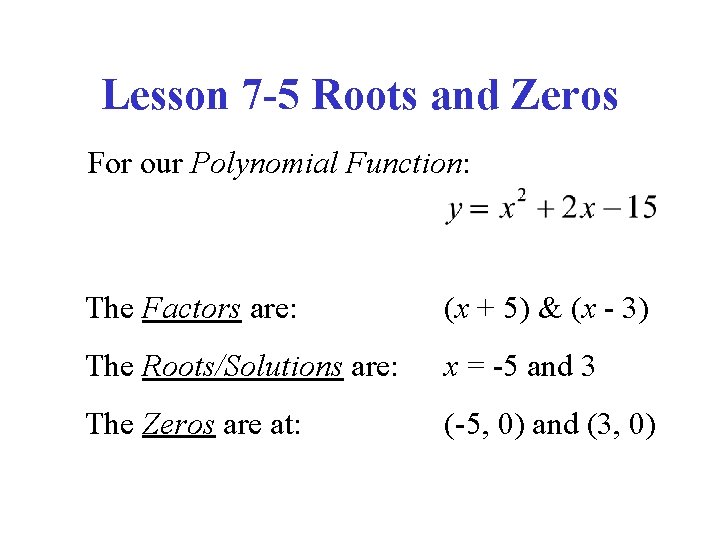
Lesson 7 -5 Roots and Zeros For our Polynomial Function: The Factors are: (x + 5) & (x - 3) The Roots/Solutions are: x = -5 and 3 The Zeros are at: (-5, 0) and (3, 0)
Fundamental Theorem Of Algebra Every Polynomial Equation with a degree higher than zero has at least one root in the set of Complex Numbers. COROLLARY: A Polynomial Equation of the form P(x) = 0 of degree ‘n’ with complex coefficients has exactly ‘n’ Roots in the set of Complex Numbers.
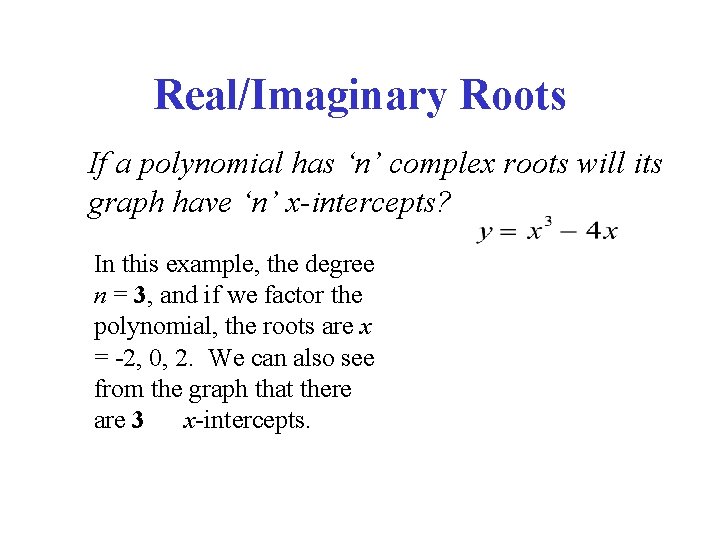
Real/Imaginary Roots If a polynomial has ‘n’ complex roots will its graph have ‘n’ x-intercepts? In this example, the degree n = 3, and if we factor the polynomial, the roots are x = -2, 0, 2. We can also see from the graph that there are 3 x-intercepts.
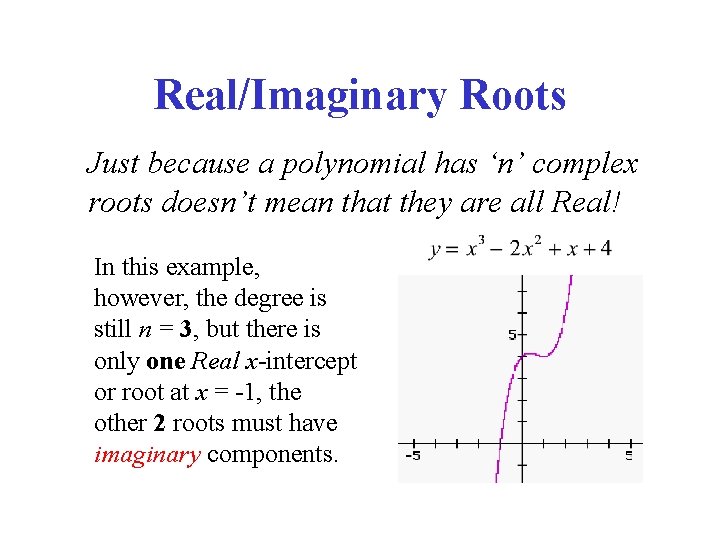
Real/Imaginary Roots Just because a polynomial has ‘n’ complex roots doesn’t mean that they are all Real! In this example, however, the degree is still n = 3, but there is only one Real x-intercept or root at x = -1, the other 2 roots must have imaginary components.
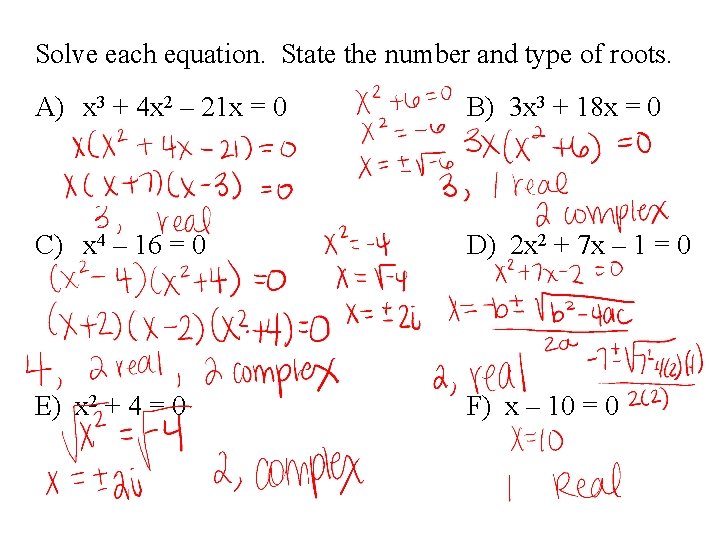
Solve each equation. State the number and type of roots. A) x 3 + 4 x 2 – 21 x = 0 B) 3 x 3 + 18 x = 0 C) x 4 – 16 = 0 D) 2 x 2 + 7 x – 1 = 0 E) x 2 + 4 = 0 F) x – 10 = 0
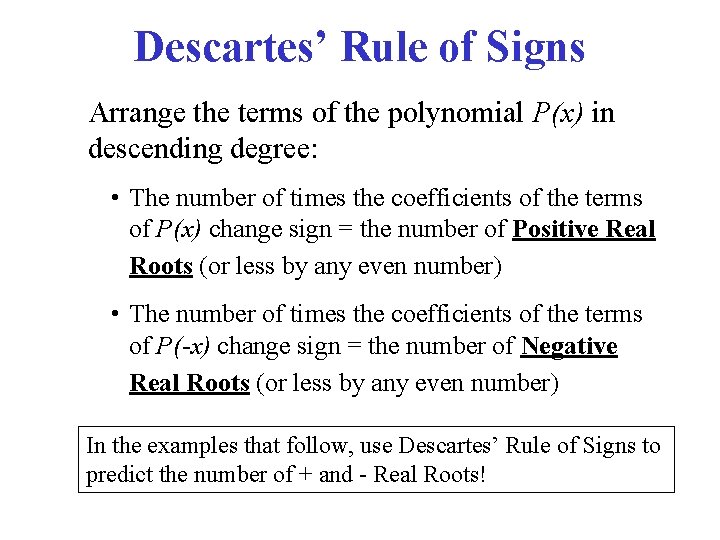
Descartes’ Rule of Signs Arrange the terms of the polynomial P(x) in descending degree: • The number of times the coefficients of the terms of P(x) change sign = the number of Positive Real Roots (or less by any even number) • The number of times the coefficients of the terms of P(-x) change sign = the number of Negative Real Roots (or less by any even number) In the examples that follow, use Descartes’ Rule of Signs to predict the number of + and - Real Roots!
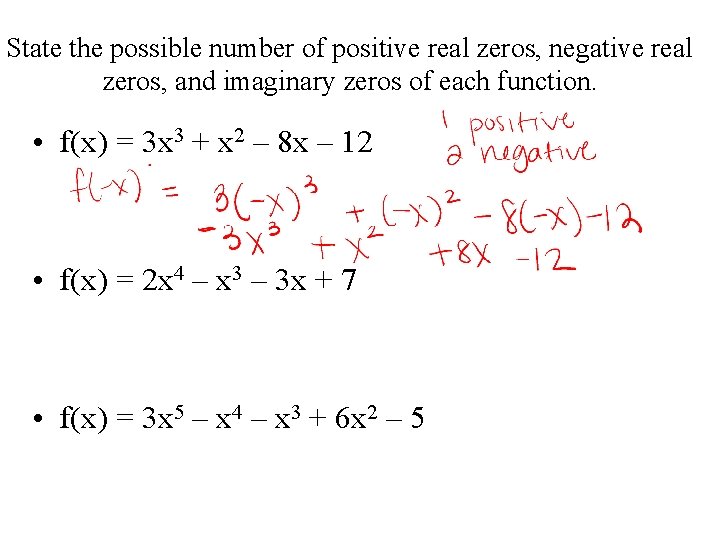
State the possible number of positive real zeros, negative real zeros, and imaginary zeros of each function. • f(x) = 3 x 3 + x 2 – 8 x – 12 • f(x) = 2 x 4 – x 3 – 3 x + 7 • f(x) = 3 x 5 – x 4 – x 3 + 6 x 2 – 5
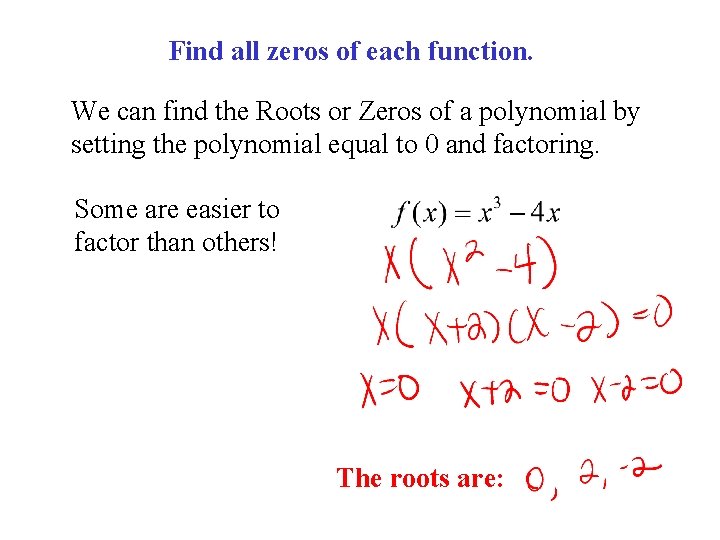
Find all zeros of each function. We can find the Roots or Zeros of a polynomial by setting the polynomial equal to 0 and factoring. Some are easier to factor than others! The roots are:
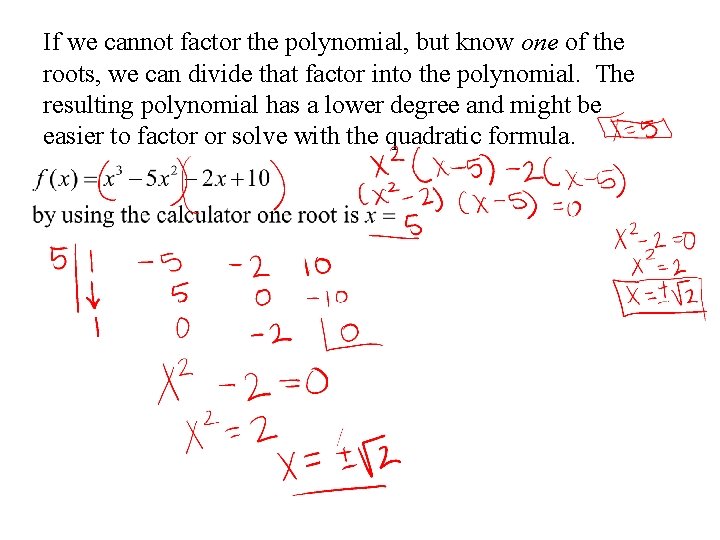
If we cannot factor the polynomial, but know one of the roots, we can divide that factor into the polynomial. The resulting polynomial has a lower degree and might be easier to factor or solve with the quadratic formula.
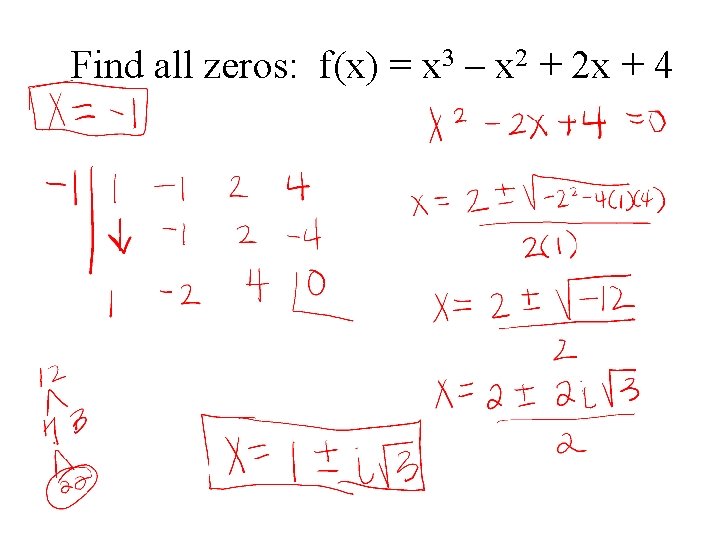
Find all zeros: f(x) = x 3 – x 2 + 2 x + 4
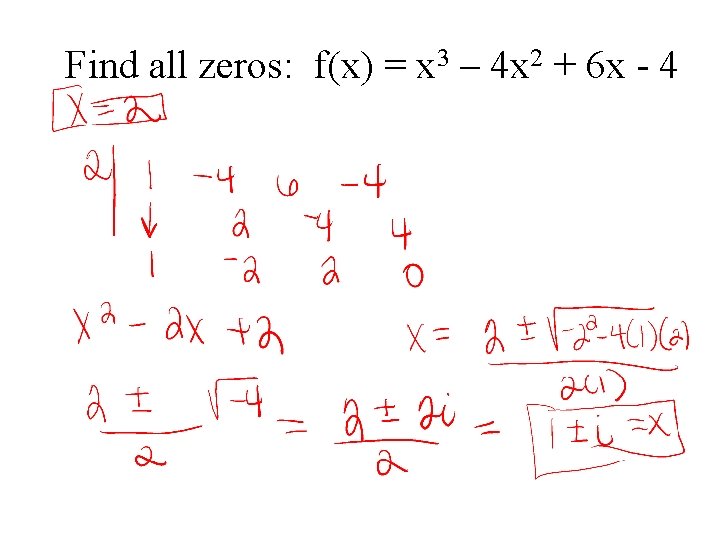
Find all zeros: f(x) = x 3 – 4 x 2 + 6 x - 4
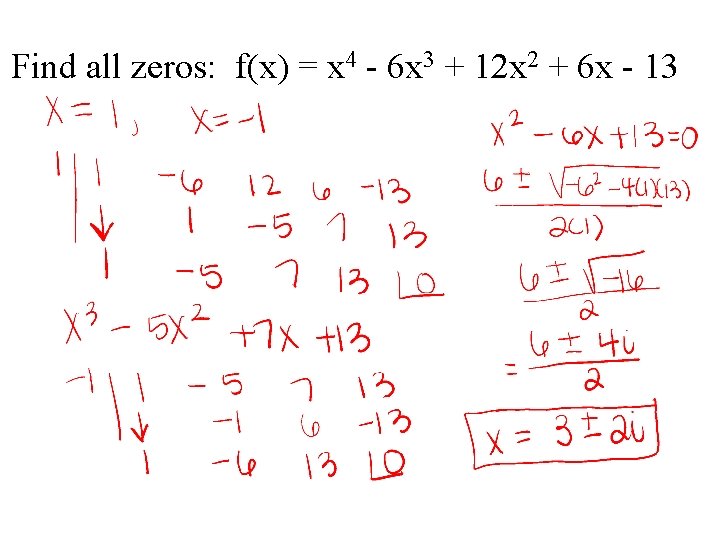
Find all zeros: f(x) = x 4 - 6 x 3 + 12 x 2 + 6 x - 13
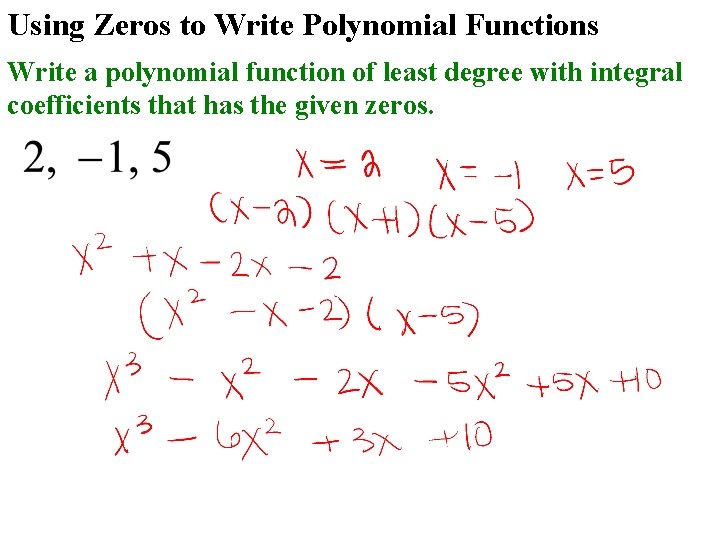
Using Zeros to Write Polynomial Functions Write a polynomial function of least degree with integral coefficients that has the given zeros.
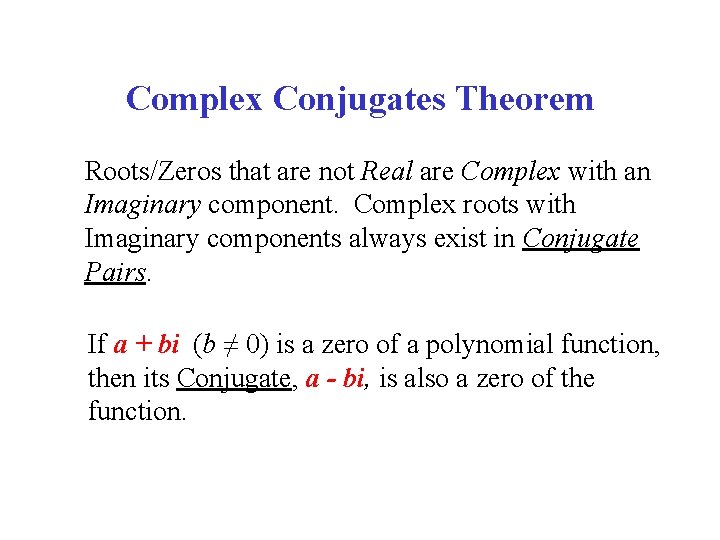
Complex Conjugates Theorem Roots/Zeros that are not Real are Complex with an Imaginary component. Complex roots with Imaginary components always exist in Conjugate Pairs. If a + bi (b ≠ 0) is a zero of a polynomial function, then its Conjugate, a - bi, is also a zero of the function.
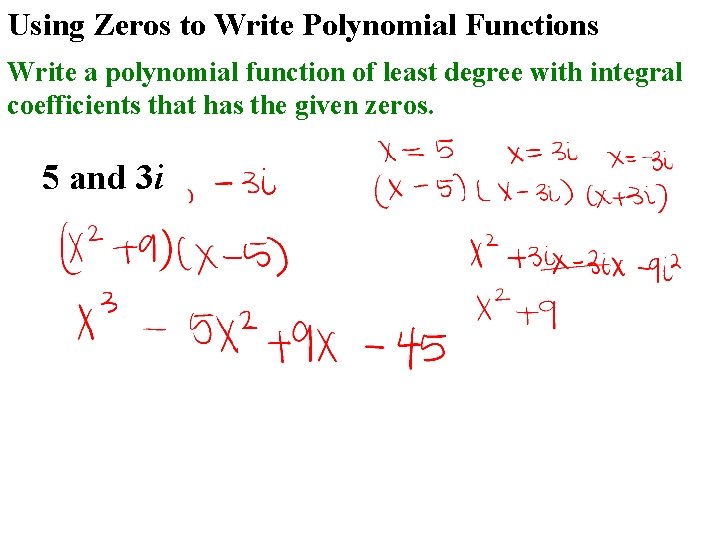
Using Zeros to Write Polynomial Functions Write a polynomial function of least degree with integral coefficients that has the given zeros. 5 and 3 i
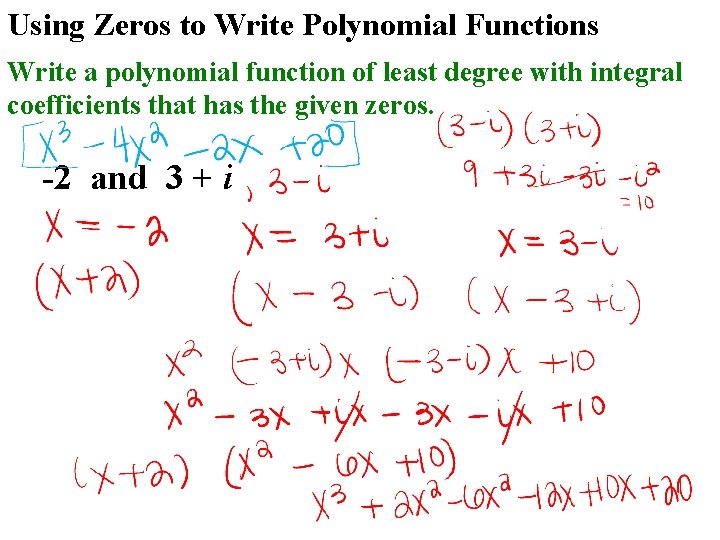
Using Zeros to Write Polynomial Functions Write a polynomial function of least degree with integral coefficients that has the given zeros. -2 and 3 + i