
LESSON 7 2 Objectives Monopolistic Competition and Oligopoly
LESSON 7. 2 Objectives Monopolistic Competition and Oligopoly Identify the features of monopolistic competition. Identify the features of oligopoly, and analyze firm behavior when these firms cooperate and when they compete. 1 CONTEMPORARY ECONOMICS: LESSON 7. 2 © SOUTH-WESTERN
LESSON 7. 2 Key Terms Monopolistic Competition and Oligopoly monopolistic competition oligopoly cartel 2 CONTEMPORARY ECONOMICS: LESSON 7. 2 © SOUTH-WESTERN
Monopolistic Competition Monopolistic competition—a market structure with low entry barriers and many firms selling products differentiated enough that each firm’s demand curve slopes downward. It contains elements of both monopoly and competition. 3 CONTEMPORARY ECONOMICS: LESSON 7. 2 © SOUTH-WESTERN
Market Characteristics Can enter or leave the market with ease They behave competitively 4 CONTEMPORARY ECONOMICS: LESSON 7. 2 © SOUTH-WESTERN
Product Differentiation Physical differences Location Services Product image 5 CONTEMPORARY ECONOMICS: LESSON 7. 2 © SOUTH-WESTERN
Costs of Product Differentiation Advertising Promotional expenses 6 CONTEMPORARY ECONOMICS: LESSON 7. 2 © SOUTH-WESTERN
Excess Capacity Excess capacity means that a firm could lower its average cost by selling more. 7 CONTEMPORARY ECONOMICS: LESSON 7. 2 © SOUTH-WESTERN
Oligopoly is a market dominated by just a few firms Oligopolistic industries include the markets for steel, oil, automobiles, breakfast cereals, and tobacco. 8 CONTEMPORARY ECONOMICS: LESSON 7. 2 © SOUTH-WESTERN
Barriers to Entry Economies of scale The high cost of entry Product differentiation costs 9 CONTEMPORARY ECONOMICS: LESSON 7. 2 © SOUTH-WESTERN
When Oligopolists Collude Collusion is an agreement among firms in the industry to divide the market and fix the price. A cartel is a group of firms that agree to act as a single monopolist to increase the market price and maximize the group’s profits. Colluding firms usually produce less, charge higher prices, earn more profit, and try to block the entry of new firms. Collusion and cartels are illegal in the United States. 10 CONTEMPORARY ECONOMICS: LESSON 7. 2 © SOUTH-WESTERN
When Oligopolists Compete Oligopolists may compete so fiercely that price wars erupt. Markets for cigarettes, computers, airline fares, long-distance phone service 11 CONTEMPORARY ECONOMICS: LESSON 7. 2 © SOUTH-WESTERN
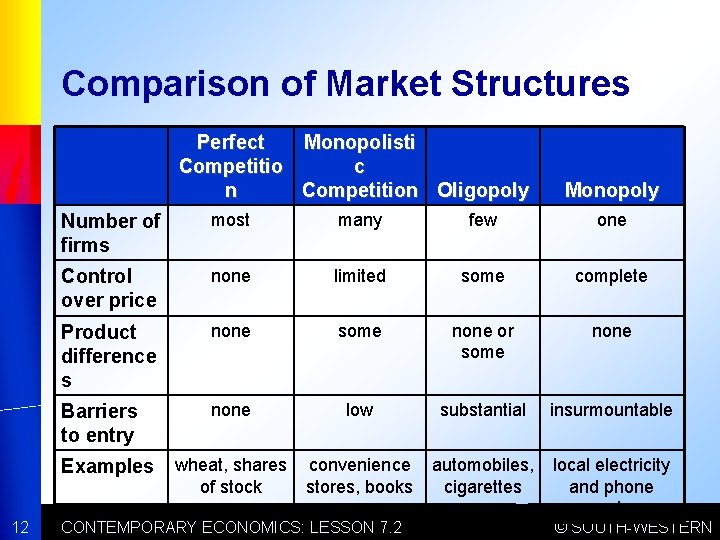
Comparison of Market Structures Perfect Monopolisti Competitio c n Competition Oligopoly Number of firms most many few one Control over price none limited some complete Product difference s none some none or some none Barriers to entry none low substantial insurmountable wheat, shares of stock convenience stores, books automobiles, cigarettes local electricity and phone service Examples 12 Monopoly CONTEMPORARY ECONOMICS: LESSON 7. 2 © SOUTH-WESTERN
- Slides: 12