
Lesson 6 Understanding the Management Process 2016 Cengage
- Slides: 18
Lesson 6 Understanding the Management Process © 2016 Cengage Learning. All Rights Reserved. May not be copied, scanned, or duplicated, in whole or in part, except for use as permitted in a license distributed with a certain product or service or otherwise on a password-protected website for classroom use.
Learning Objectives LO 6 -1 LO 6 -2 LO 6 -3 Summarize the four basic management functions Given a set of strategic factors for a company, classify the factors using SWOT analysis Given an example of management activities, identify the level and area of the manager © 2016 Cengage Learning. All Rights Reserved. May not be copied, scanned, or duplicated, in whole or in part, except for use as permitted in a license distributed with a certain product or service or otherwise on a password-protected website for classroom use. 2
Learning Objectives LO 6 -4 LO 6 -5 LO 6 -6 Characterize how the required mix of skills changes for managers at different levels Given an example of manager behavior, identify the leadership style of the manager List the four steps of the managerial decision making process © 2016 Cengage Learning. All Rights Reserved. May not be copied, scanned, or duplicated, in whole or in part, except for use as permitted in a license distributed with a certain product or service or otherwise on a password-protected website for classroom use. 3
Management Functions • Planning: Establishing goals for the organization and developing strategies to accomplish them – Developed by top management • Organizing: Arranging resources and activities to effectively and efficiently accomplish goals LO 6 -1 © 2016 Cengage Learning. All Rights Reserved. May not be copied, scanned, or duplicated, in whole or in part, except for use as permitted in a license distributed with a certain product or service or otherwise on a password-protected website for classroom use. 4
Management Functions • Leading and motivating – Leading: Influencing people in the organization to work toward a common goal – Managers determine factors that motivate workers and provide incentives to encourage effective performance • Controlling: Measuring results against goals and making corrections when needed LO 6 -1 © 2016 Cengage Learning. All Rights Reserved. May not be copied, scanned, or duplicated, in whole or in part, except for use as permitted in a license distributed with a certain product or service or otherwise on a password-protected website for classroom use. 5
SWOT Analysis • Tool that analyzes strengths, weaknesses, opportunities, and threats for a company – Used during strategic planning process to set goals and objectives • Forces companies to: – Look inside and outside the company – Consider both positive and negative aspects LO 6 -2 © 2016 Cengage Learning. All Rights Reserved. May not be copied, scanned, or duplicated, in whole or in part, except for use as permitted in a license distributed with a certain product or service or otherwise on a password-protected website for classroom use. 6
SWOT Analysis • Opportunities – External conditions that could produce rewards for the company if properly pursued • Threats – External conditions or that could prevent the company from reaching its objectives LO 6 -2 © 2016 Cengage Learning. All Rights Reserved. May not be copied, scanned, or duplicated, in whole or in part, except for use as permitted in a license distributed with a certain product or service or otherwise on a password-protected website for classroom use. 7
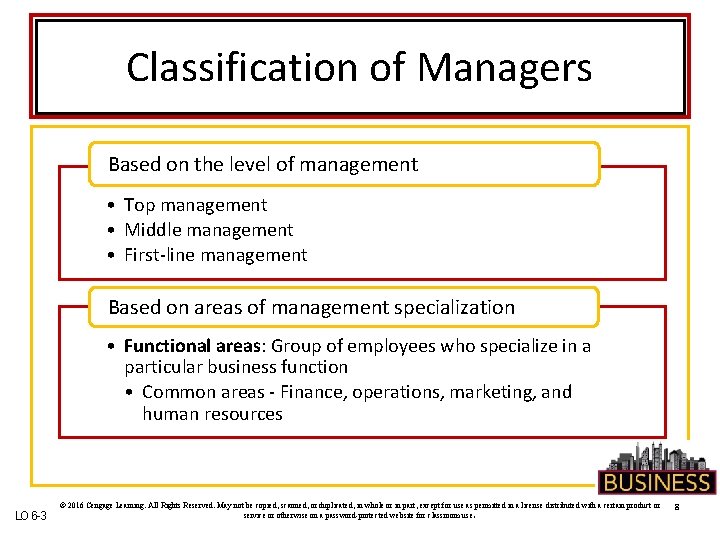
Classification of Managers Based on the level of management • Top management • Middle management • First-line management Based on areas of management specialization • Functional areas: Group of employees who specialize in a particular business function • Common areas - Finance, operations, marketing, and human resources LO 6 -3 © 2016 Cengage Learning. All Rights Reserved. May not be copied, scanned, or duplicated, in whole or in part, except for use as permitted in a license distributed with a certain product or service or otherwise on a password-protected website for classroom use. 8
Nontraditional Management Roles • Middle and first-line managers are reorganized into multiple roles every few years • Employees are organized into project and product teams working on specific initiatives – Makes it difficult to identify the level and area of a manager • Act as a key to empower employees and stay responsive to market needs LO 6 -3 © 2016 Cengage Learning. All Rights Reserved. May not be copied, scanned, or duplicated, in whole or in part, except for use as permitted in a license distributed with a certain product or service or otherwise on a password-protected website for classroom use. 9
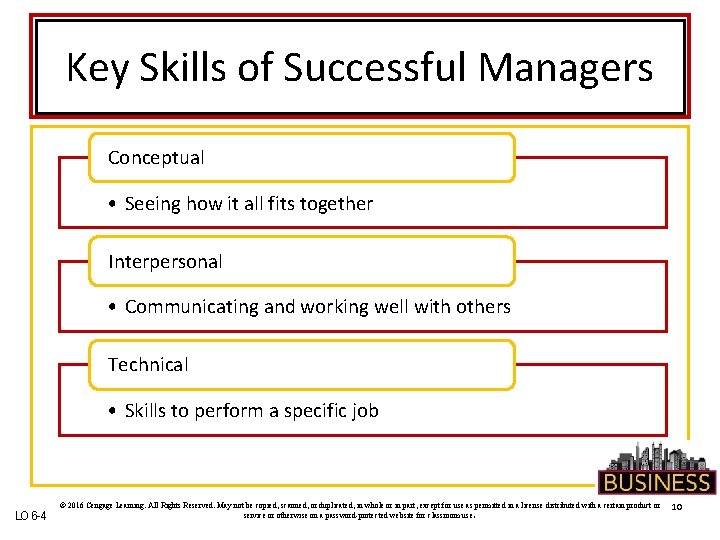
Key Skills of Successful Managers Conceptual • Seeing how it all fits together Interpersonal • Communicating and working well with others Technical • Skills to perform a specific job LO 6 -4 © 2016 Cengage Learning. All Rights Reserved. May not be copied, scanned, or duplicated, in whole or in part, except for use as permitted in a license distributed with a certain product or service or otherwise on a password-protected website for classroom use. 10
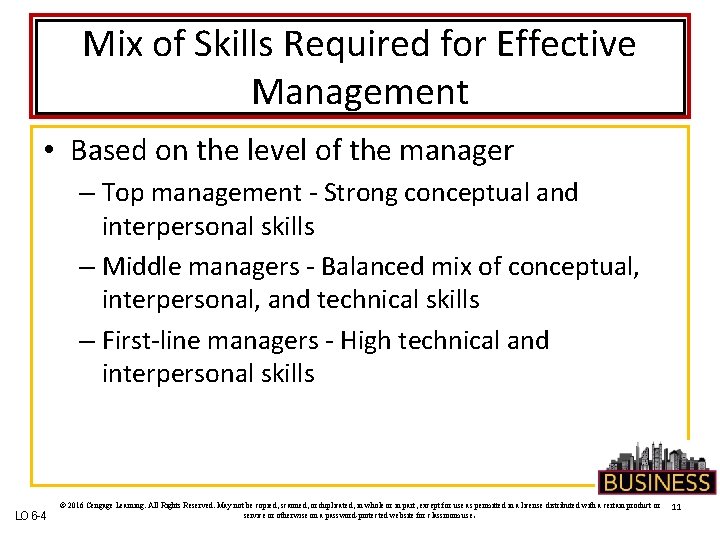
Mix of Skills Required for Effective Management • Based on the level of the manager – Top management - Strong conceptual and interpersonal skills – Middle managers - Balanced mix of conceptual, interpersonal, and technical skills – First-line managers - High technical and interpersonal skills LO 6 -4 © 2016 Cengage Learning. All Rights Reserved. May not be copied, scanned, or duplicated, in whole or in part, except for use as permitted in a license distributed with a certain product or service or otherwise on a password-protected website for classroom use. 11
Leadership • Ability to influence others to work toward a common goal • Differs from management – Managers have formal authority over others • Coerce others to work toward a common goal – Leaders influence and persuade others • To voluntarily work toward a common goal LO 6 -5 © 2016 Cengage Learning. All Rights Reserved. May not be copied, scanned, or duplicated, in whole or in part, except for use as permitted in a license distributed with a certain product or service or otherwise on a password-protected website for classroom use. 12
Styles of Leadership • Autocratic: Leader makes decisions and the employees are expected to execute the decisions exactly as directed – Advantages • Fast decisions • Unified and consistent vision – Disadvantages • Risk of low morale • Stifles creativity LO 6 -5 © 2016 Cengage Learning. All Rights Reserved. May not be copied, scanned, or duplicated, in whole or in part, except for use as permitted in a license distributed with a certain product or service or otherwise on a password-protected website for classroom use. 13
Styles of Leadership • Participative: Leader consults employees before making decisions – Advantages • Helps team understand goals • Increased commitment from team – Disadvantages • Participative decisions take longer • Team may react poorly when their input is not accepted LO 6 -5 © 2016 Cengage Learning. All Rights Reserved. May not be copied, scanned, or duplicated, in whole or in part, except for use as permitted in a license distributed with a certain product or service or otherwise on a password-protected website for classroom use. 14
Styles of Leadership • Laissez-faire: Leader provides a basic vision and the necessary resources for the team – Acts as an advisor – Advantages • Fully utilizes the talents of skilled employees • Reduces number of managers – Disadvantages • Leaders can lose control of the process • Morale can drop LO 6 -5 © 2016 Cengage Learning. All Rights Reserved. May not be copied, scanned, or duplicated, in whole or in part, except for use as permitted in a license distributed with a certain product or service or otherwise on a password-protected website for classroom use. 15
Managerial Decision Making • Act of choosing one alternative from a set of alternatives • Necessary for managers at all levels of an organization • Relevant to all management functions LO 6 -6 © 2016 Cengage Learning. All Rights Reserved. May not be copied, scanned, or duplicated, in whole or in part, except for use as permitted in a license distributed with a certain product or service or otherwise on a password-protected website for classroom use. 16
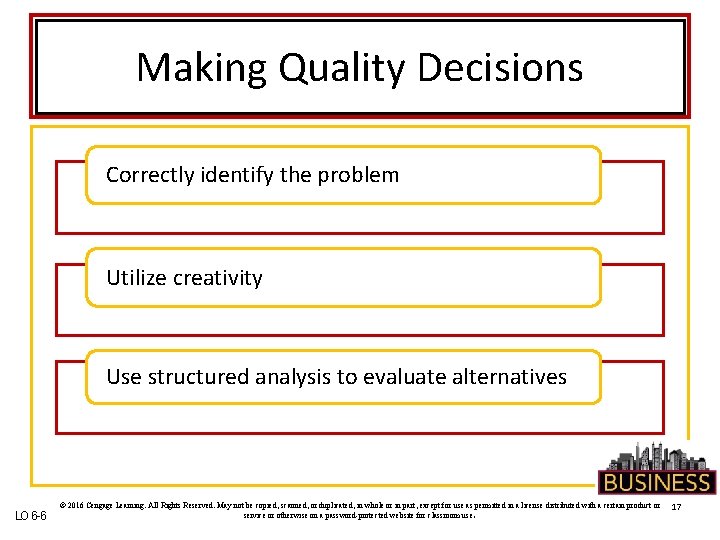
Making Quality Decisions Correctly identify the problem Utilize creativity Use structured analysis to evaluate alternatives LO 6 -6 © 2016 Cengage Learning. All Rights Reserved. May not be copied, scanned, or duplicated, in whole or in part, except for use as permitted in a license distributed with a certain product or service or otherwise on a password-protected website for classroom use. 17
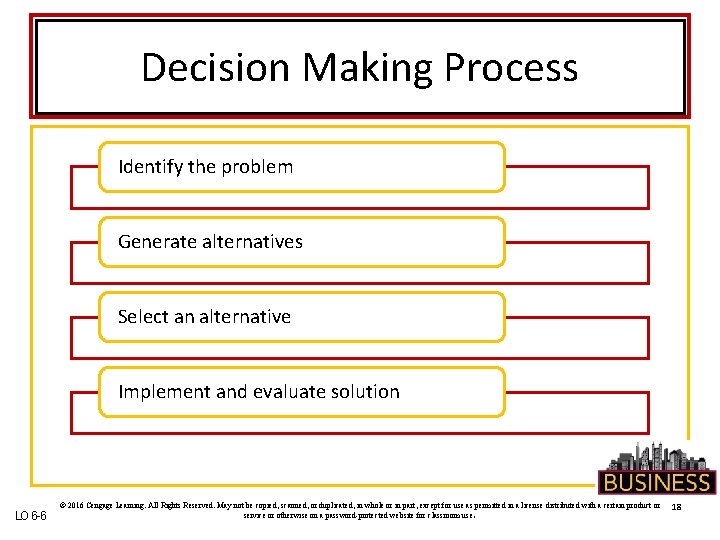
Decision Making Process Identify the problem Generate alternatives Select an alternative Implement and evaluate solution LO 6 -6 © 2016 Cengage Learning. All Rights Reserved. May not be copied, scanned, or duplicated, in whole or in part, except for use as permitted in a license distributed with a certain product or service or otherwise on a password-protected website for classroom use. 18