
Lesson 6 Experments etc SCALE examples w parametric

- Slides: 42
Lesson 6: Experments, etc. § § SCALE examples w/ parametric studies Overview of the “benchmark book”
SCALE Sequence CSAS 1
SCALE overview § § Standard Computerized Analysis for Licensing Evaluation (I think) Pulls together what used to be separate nuclear analysis codes into a single input package § § Saves duplication of problem description Allows for reduced user control: Makes it easier for reviewers Makes “black box” use much more likely Organized in “sequences: CSAS 1 X & CSAS 25 in this course § § Resonance processing (BONAMI & NITAWL) Transport calculation (XSDRNPM or KENO-Va)
SCALE input: Material descriptions § Several ways to specify materials § § § Pre-mixed mixtures Natural elements (with modification allowed) By isotope (be careful with densities) Can have several lines to define a single material--Use VF to mix Example of using the manual description
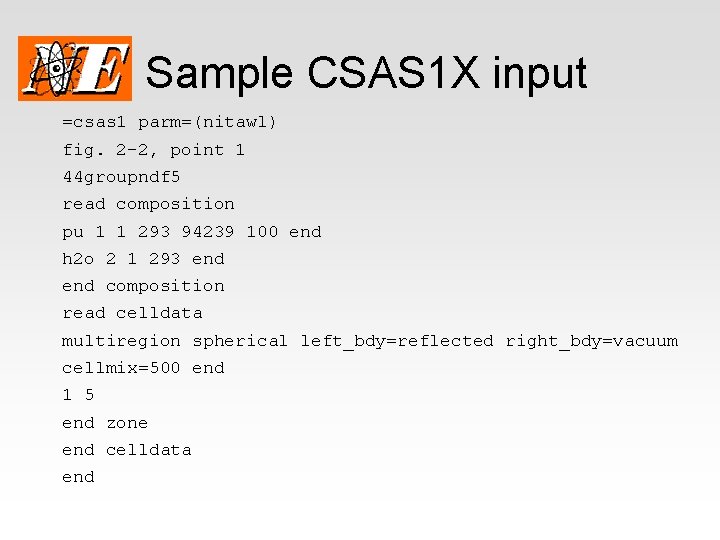
Sample CSAS 1 X input =csas 1 parm=(nitawl) fig. 2 -2, point 1 44 groupndf 5 read composition pu 1 1 293 94239 100 end h 2 o 2 1 293 end composition read celldata multiregion spherical left_bdy=reflected right_bdy=vacuum cellmix=500 end 1 5 end zone end celldata end
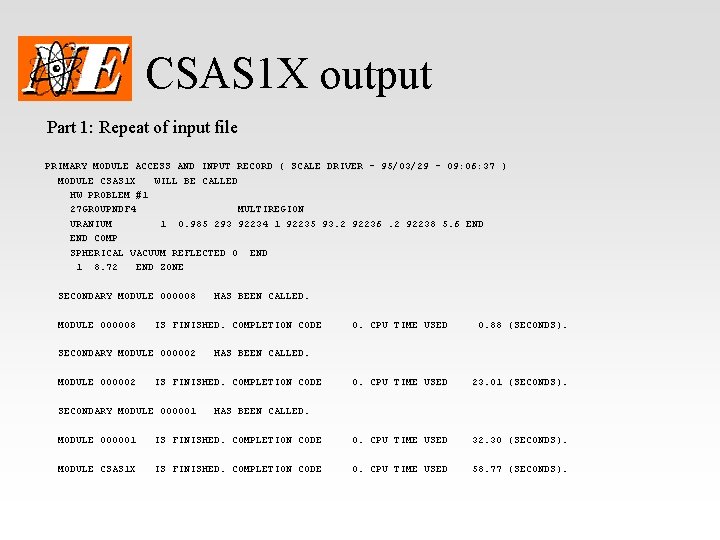
CSAS 1 X output Part 1: Repeat of input file PRIMARY MODULE ACCESS AND INPUT RECORD ( SCALE DRIVER - 95/03/29 - 09: 06: 37 ) MODULE CSAS 1 X WILL BE CALLED HW PROBLEM #1 27 GROUPNDF 4 MULTIREGION URANIUM 1 0. 985 293 92234 1 92235 93. 2 92236. 2 92238 5. 6 END COMP SPHERICAL VACUUM REFLECTED 0 END 1 8. 72 END ZONE SECONDARY MODULE O 0 O 008 HAS BEEN CALLED. MODULE O 0 O 008 IS FINISHED. COMPLETION CODE 0. CPU TIME USED 0. 88 (SECONDS). SECONDARY MODULE O 0 O 002 HAS BEEN CALLED. MODULE O 0 O 002 IS FINISHED. COMPLETION CODE 0. CPU TIME USED 23. 01 (SECONDS). SECONDARY MODULE O 0 O 001 HAS BEEN CALLED. MODULE O 0 O 001 IS FINISHED. COMPLETION CODE 0. CPU TIME USED 32. 30 (SECONDS). MODULE CSAS 1 X IS FINISHED. COMPLETION CODE 0. CPU TIME USED 58. 77 (SECONDS).
CSAS 1 X output, cont’d Part 2: BONAMI output: Check input BBBBBB OOOOOO NN AAAAA MM IIIIII 222222 BBBBBBB OOOOOOO NNN AAAAAA MMM IIIIII 2222222 BB OO NNNN AA MMMM II 22 BB OO NN NN AA MM MM II 22 BB OO NN NN AA MM MM MM II 22 BBBBBB OO NN NN ------- AAAAAAA MMM MM II 22 BBBBBB OO NN NN ------- AAAAAAA MM M MM II 22 BB OO NN NN NN AA MM II 22 BB OO NN NN NN AA MM II 22 BB OO NN NNNN AA MM II 22 BBBBBBB OOOOOOO NNN AA MM IIIIII 2222222 BBBBBB OOOOOO NN AA MM IIIIII 2222222 SSSSSS CCCCCC AAAAA LL EEEEEEE PPPPPP CCCCCC SSSSSSS CCCCCCC AAAAAA LL EEEEEEE PPPPPPP CCCCCCC SS CC AA LL EE PP CC SS CC AA LL EE PP CC SSSSSS CC AAAAAAA LL EEEEE ------- PPPPPPP CC SSSSSS CC AAAAAAA LL EEEEE ------- PPPPPP CC SS CC AA LL EE PP CC SS CC AA LL EE PP CC SSSSSSS CCCCCCC AA LLLLLLL EEEEEEE PP CCCCCCC SSSSSS CCCCCC AA LLLLLLL EEEEEEE PP CCCCCC 0000000 999999 // 222222 44 // 999999 7777777 00000 9999999 // 2222222 444 // 9999999 777777 00 99 // 22 4444 // 99 77 00 99 // 22 44 44 // 99 77
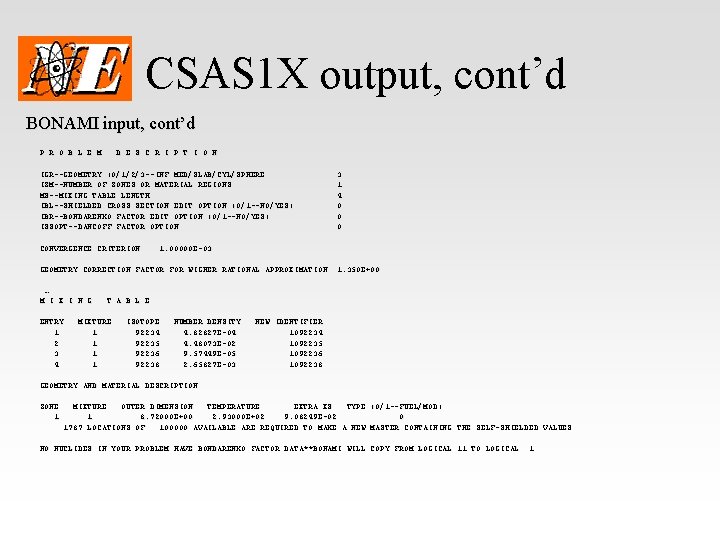
CSAS 1 X output, cont’d BONAMI input, cont’d P R O B L E M D E S C R I P T I O N IGR--GEOMETRY (0/1/2/3 --INF MED/SLAB/CYL/SPHERE 3 IZM--NUMBER OF ZONES OR MATERIAL REGIONS 1 MS--MIXING TABLE LENGTH 4 IBL--SHIELDED CROSS SECTION EDIT OPTION (0/1 --NO/YES) 0 IBR--BONDARENKO FACTOR EDIT OPTION (0/1 --NO/YES) 0 ISSOPT--DANCOFF FACTOR OPTION 0 CONVERGENCE CRITERION 1. 00000 E-03 GEOMETRY CORRECTION FACTOR FOR WIGNER RATIONAL APPROXIMATION 1. 350 E+00 … M I X I N G T A B L E ENTRY MIXTURE ISOTOPE NUMBER DENSITY NEW IDENTIFIER 1 1 92234 4. 82827 E-04 1092234 2 1 92235 4. 48073 E-02 1092235 3 1 92236 9. 57449 E-05 1092236 4 1 92238 2. 65827 E-03 1092238 GEOMETRY AND MATERIAL DESCRIPTION ZONE MIXTURE OUTER DIMENSION TEMPERATURE EXTRA XS TYPE (0/1 --FUEL/MOD) 1 1 8. 72000 E+00 2. 93000 E+02 9. 08249 E-02 0 1787 LOCATIONS OF 100000 AVAILABLE ARE REQUIRED TO MAKE A NEW MASTER CONTAINING THE SELF-SHIELDED VALUES NO NUCLIDES IN YOUR PROBLEM HAVE BONDARENKO FACTOR DATA**BONAMI WILL COPY FROM LOGICAL 11 TO LOGICAL 1
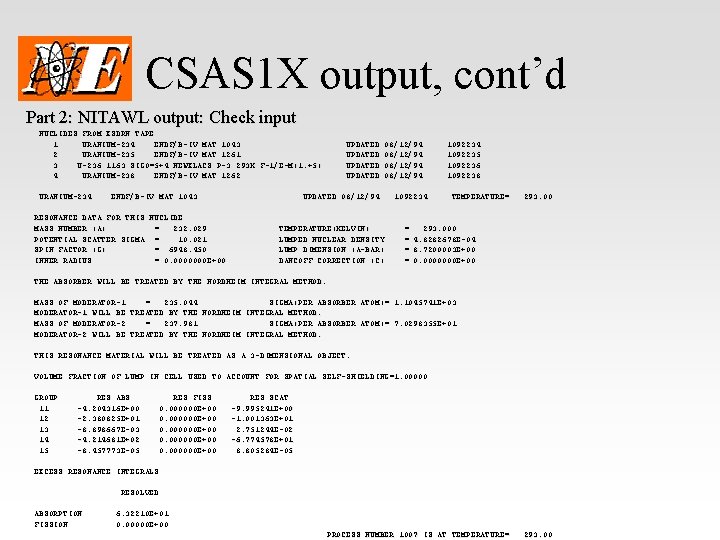
CSAS 1 X output, cont’d Part 2: NITAWL output: Check input NUCLIDES FROM XSDRN TAPE 1 URANIUM-234 ENDF/B-IV MAT 1043 UPDATED 08/12/94 1092234 2 URANIUM-235 ENDF/B-IV MAT 1261 UPDATED 08/12/94 1092235 3 U-236 1163 SIGO=5+4 NEWXLACS P-3 293 K F-1/E-M(1. +5) UPDATED 08/12/94 1092236 4 URANIUM-238 ENDF/B-IV MAT 1262 UPDATED 08/12/94 1092238 URANIUM-234 ENDF/B-IV MAT 1043 UPDATED 08/12/94 1092234 TEMPERATURE= 293. 00 RESONANCE DATA FOR THIS NUCLIDE MASS NUMBER (A) = 232. 029 TEMPERATURE(KELVIN) = 293. 000 POTENTIAL SCATTER SIGMA = 10. 021 LUMPED NUCLEAR DENSITY = 4. 8282678 E-04 SPIN FACTOR (G) = 6948. 450 LUMP DIMENSION (A-BAR) = 8. 7200003 E+00 INNER RADIUS = 0. 0000000 E+00 DANCOFF CORRECTION (C) = 0. 0000000 E+00 THE ABSORBER WILL BE TREATED BY THE NORDHEIM INTEGRAL METHOD. MASS OF MODERATOR-1 = 235. 044 SIGMA(PER ABSORBER ATOM)= 1. 1045741 E+03 MODERATOR-1 WILL BE TREATED BY THE NORDHEIM INTEGRAL METHOD. MASS OF MODERATOR-2 = 237. 981 SIGMA(PER ABSORBER ATOM)= 7. 0298355 E+01 MODERATOR-2 WILL BE TREATED BY THE NORDHEIM INTEGRAL METHOD. THIS RESONANCE MATERIAL WILL BE TREATED AS A 3 -DIMENSIONAL OBJECT. VOLUME FRACTION OF LUMP IN CELL USED TO ACCOUNT FOR SPATIAL SELF-SHIELDING=1. 00000 GROUP RES ABS RES FISS RES SCAT 11 -4. 204316 E+00 0. 000000 E+00 -9. 995241 E+00 12 -2. 380825 E+01 0. 000000 E+00 -1. 001363 E+01 13 -8. 898667 E-03 0. 000000 E+00 2. 751244 E-02 14 -4. 214681 E+02 0. 000000 E+00 -6. 774578 E+01 15 -8. 457773 E-05 0. 000000 E+00 8. 805284 E-05 EXCESS RESONANCE INTEGRALS RESOLVED ABSORPTION 6. 32210 E+01 FISSION 0. 00000 E+00 PROCESS NUMBER 1007 IS AT TEMPERATURE= 293. 00
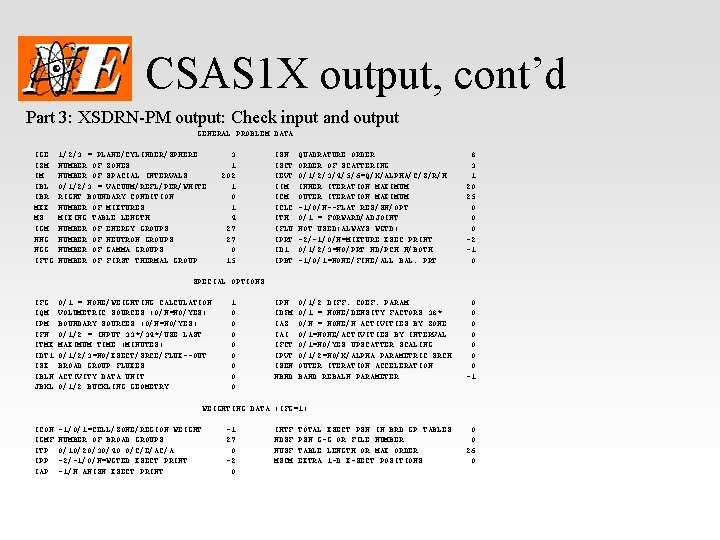
CSAS 1 X output, cont’d Part 3: XSDRN-PM output: Check input and output GENERAL PROBLEM DATA IGE 1/2/3 = PLANE/CYLINDER/SPHERE 3 ISN QUADRATURE ORDER 8 IZM NUMBER OF ZONES 1 ISCT ORDER OF SCATTERING 3 IM NUMBER OF SPACIAL INTERVALS 202 IEVT 0/1/2/3/4/5/6=Q/K/ALPHA/C/Z/R/H 1 IBL 0/1/2/3 = VACUUM/REFL/PER/WHITE 1 IIM INNER ITERATION MAXIMUM 20 IBR RIGHT BOUNDARY CONDITION 0 ICM OUTER ITERATION MAXIMUM 25 MXX NUMBER OF MIXTURES 1 ICLC -1/0/N--FLAT RES/SN/OPT 0 MS MIXING TABLE LENGTH 4 ITH 0/1 = FORWARD/ADJOINT 0 IGM NUMBER OF ENERGY GROUPS 27 IFLU NOT USED(ALWAYS WGTD) 0 NNG NUMBER OF NEUTRON GROUPS 27 IPRT -2/-1/0/N=MIXTURE XSEC PRINT -2 NGG NUMBER OF GAMMA GROUPS 0 ID 1 0/1/2/3=NO/PRT ND/PCH N/BOTH -1 IFTG NUMBER OF FIRST THERMAL GROUP 15 IPBT -1/0/1=NONE/FINE/ALL BAL. PRT 0 SPECIAL OPTIONS IFG 0/1 = NONE/WEIGHTING CALCULATION 1 IPN 0/1/2 DIFF. COEF. PARAM 0 IQM VOLUMETRIC SOURCES (0/N=NO/YES) 0 IDFM 0/1 = NONE/DENSITY FACTORS 38* 0 IPM BOUNDARY SOURCES (0/N=NO/YES) 0 IAZ 0/N = NONE/N ACTIVITIES BY ZONE 0 IFN 0/1/2 = INPUT 33*/34*/USE LAST 0 IAI 0/1=NONE/ACTIVITIES BY INTERVAL 0 ITMX MAXIMUM TIME (MINUTES) 0 IFCT 0/1=NO/YES UPSCATTER SCALING 0 IDT 1 0/1/2/3=NO/XSECT/SRCE/FLUX--OUT 0 IPVT 0/1/2=NO/K/ALPHA PARAMETRIC SRCH 0 ISX BROAD GROUP FLUXES 0 ISEN OUTER ITERATION ACCELERATION 0 IBLN ACTIVITY DATA UNIT 0 NBND BAND REBALN PARAMETER -1 JBKL 0/1/2 BUCKLING GEOMETRY 0 WEIGHTING DATA (IFG=1) ICON -1/0/1=CELL/ZONE/REGION WEIGHT -1 IHTF TOTAL XSECT PSN IN BRD GP TABLES 0 IGMF NUMBER OF BROAD GROUPS 27 NDSF PSN G-G OR FILE NUMBER 0 ITP 0/10/20/30/40 0/C/E/AC/A 0 NUSF TABLE LENGTH OR MAX ORDER 26 IPP -2/-1/0/N=WGTED XSECT PRINT -2 MSCM EXTRA 1 -D X-SECT POSITIONS 0 IAP -1/N ANISN XSECT PRINT 0
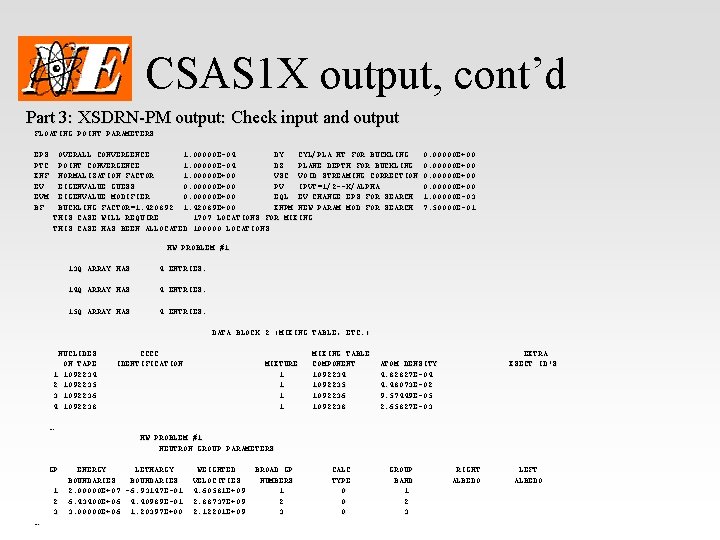
CSAS 1 X output, cont’d Part 3: XSDRN-PM output: Check input and output FLOATING POINT PARAMETERS EPS OVERALL CONVERGENCE 1. 00000 E-04 DY CYL/PLA HT FOR BUCKLING 0. 00000 E+00 PTC POINT CONVERGENCE 1. 00000 E-04 DZ PLANE DEPTH FOR BUCKLING 0. 00000 E+00 XNF NORMALIZATION FACTOR 1. 00000 E+00 VSC VOID STREAMING CORRECTION 0. 00000 E+00 EV EIGENVALUE GUESS 0. 00000 E+00 PV IPVT=1/2 --K/ALPHA 0. 00000 E+00 EVM EIGENVALUE MODIFIER 0. 00000 E+00 EQL EV CHANGE EPS FOR SEARCH 1. 00000 E-03 BF BUCKLING FACTOR=1. 420892 1. 42089 E+00 XNPM NEW PARAM MOD FOR SEARCH 7. 50000 E-01 THIS CASE WILL REQUIRE 1707 LOCATIONS FOR MIXING THIS CASE HAS BEEN ALLOCATED 100000 LOCATIONS HW PROBLEM #1 13 Q ARRAY HAS 4 ENTRIES. 14 Q ARRAY HAS 4 ENTRIES. 15 Q ARRAY HAS 4 ENTRIES. DATA BLOCK 2 (MIXING TABLE, ETC. ) NUCLIDES CCCC MIXING TABLE EXTRA ON TAPE IDENTIFICATION MIXTURE COMPONENT ATOM DENSITY XSECT ID'S 1 1092234 1 1092234 4. 82827 E-04 2 1092235 1 1092235 4. 48073 E-02 3 1092236 1 1092236 9. 57449 E-05 4 1092238 1 1092238 2. 65827 E-03 … HW PROBLEM #1 NEUTRON GROUP PARAMETERS GP ENERGY LETHARGY WEIGHTED BROAD GP CALC GROUP RIGHT LEFT BOUNDARIES VELOCITIES NUMBERS TYPE BAND ALBEDO 1 2. 00000 E+07 -6. 93147 E-01 4. 60581 E+09 1 0 1 2 6. 43400 E+06 4. 40989 E-01 2. 88737 E+09 2 0 2 3 3. 00000 E+06 1. 20397 E+00 2. 12201 E+09 3 0 3 …
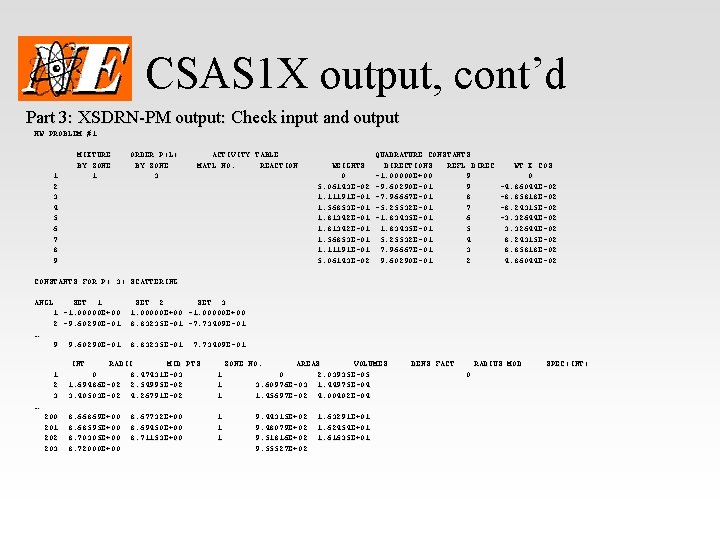
CSAS 1 X output, cont’d Part 3: XSDRN-PM output: Check input and output HW PROBLEM #1 MIXTURE ORDER P(L) ACTIVITY TABLE QUADRATURE CONSTANTS BY ZONE MATL NO. REACTION WEIGHTS DIRECTIONS REFL DIREC WT X COS 1 1 3 0 -1. 00000 E+00 9 0 2 5. 06143 E-02 -9. 60290 E-01 9 -4. 86044 E-02 3 1. 11191 E-01 -7. 96667 E-01 8 -8. 85818 E-02 4 1. 56853 E-01 -5. 25532 E-01 7 -8. 24315 E-02 5 1. 81342 E-01 -1. 83435 E-01 6 -3. 32644 E-02 6 1. 81342 E-01 1. 83435 E-01 5 3. 32644 E-02 7 1. 56853 E-01 5. 25532 E-01 4 8. 24315 E-02 8 1. 11191 E-01 7. 96667 E-01 3 8. 85818 E-02 9 5. 06143 E-02 9. 60290 E-01 2 4. 86044 E-02 CONSTANTS FOR P( 3) SCATTERING ANGL SET 1 SET 2 SET 3 1 -1. 00000 E+00 2 -9. 60290 E-01 8. 83235 E-01 -7. 73409 E-01 … 9 9. 60290 E-01 8. 83235 E-01 7. 73409 E-01 INT RADII MID PTS ZONE NO. AREAS VOLUMES DENS FACT RADIUS MOD SPEC(INT) 1 0 8. 47431 E-03 1 0 2. 03935 E-05 0 2 1. 69486 E-02 2. 54995 E-02 1 3. 60976 E-03 1. 44975 E-04 3 3. 40503 E-02 4. 26791 E-02 1 1. 45697 E-02 4. 00402 E-04 … 200 8. 66869 E+00 8. 67732 E+00 1 9. 44315 E+02 1. 63291 E+01 201 8. 68595 E+00 8. 69450 E+00 1 9. 48079 E+02 1. 62454 E+01 202 8. 70305 E+00 8. 71153 E+00 1 9. 51816 E+02 1. 61635 E+01 203 8. 72000 E+00 9. 55527 E+02
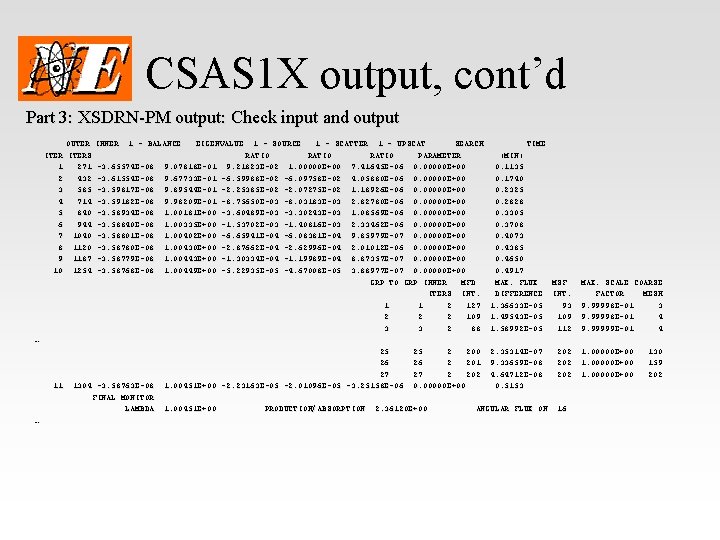
CSAS 1 X output, cont’d Part 3: XSDRN-PM output: Check input and output OUTER INNER 1 - BALANCE EIGENVALUE 1 - SOURCE 1 - SCATTER 1 - UPSCAT SEARCH TIME ITERS RATIO PARAMETER (MIN) 1 271 -3. 65574 E-08 9. 07818 E-01 9. 21823 E-02 1. 00000 E+00 7. 41645 E-06 0. 00000 E+00 0. 1135 2 432 -3. 61554 E-08 9. 67733 E-01 -6. 59988 E-02 -6. 09758 E-02 4. 05880 E-06 0. 00000 E+00 0. 1740 3 585 -3. 59817 E-08 9. 89544 E-01 -2. 25385 E-02 -2. 07275 E-02 1. 18926 E-06 0. 00000 E+00 0. 2325 4 714 -3. 59182 E-08 9. 98209 E-01 -8. 75650 E-03 -8. 03183 E-03 2. 82780 E-06 0. 00000 E+00 0. 2828 5 840 -3. 58934 E-08 1. 00181 E+00 -3. 60489 E-03 -3. 30243 E-03 1. 08569 E-06 0. 00000 E+00 0. 3305 6 944 -3. 58840 E-08 1. 00335 E+00 -1. 53702 E-03 -1. 40816 E-03 2. 33462 E-06 0. 00000 E+00 0. 3708 7 1040 -3. 58801 E-08 1. 00402 E+00 -6. 65941 E-04 -6. 08381 E-04 9. 85979 E-07 0. 00000 E+00 0. 4073 8 1120 -3. 58780 E-08 1. 00430 E+00 -2. 87662 E-04 -2. 62996 E-04 2. 01012 E-06 0. 00000 E+00 0. 4385 9 1187 -3. 58779 E-08 1. 00443 E+00 -1. 30334 E-04 -1. 19989 E-04 8. 87357 E-07 0. 00000 E+00 0. 4650 10 1254 -3. 58768 E-08 1. 00449 E+00 -5. 22935 E-05 -4. 67008 E-05 3. 88977 E-07 0. 00000 E+00 0. 4917 GRP TO GRP INNER MFD MAX. FLUX MSF MAX. SCALE COARSE ITERS INT. DIFFERENCE INT. FACTOR MESH 1 1 2 127 1. 36633 E-05 93 9. 99998 E-01 3 2 2 2 109 1. 49543 E-05 109 9. 99998 E-01 4 3 3 2 88 1. 58992 E-05 112 9. 99999 E-01 4 … 25 25 2 200 2. 35314 E-07 202 1. 00000 E+00 130 26 26 2 201 9. 33659 E-08 202 1. 00000 E+00 159 27 27 2 202 4. 64712 E-08 202 1. 00000 E+00 202 11 1304 -3. 58763 E-08 1. 00451 E+00 -2. 23163 E-05 -2. 01096 E-05 -3. 25158 E-06 0. 00000 E+00 0. 5153 FINAL MONITOR LAMBDA 1. 00451 E+00 PRODUCTION/ABSORPTION 2. 36120 E+00 ANGULAR FLUX ON 16 …
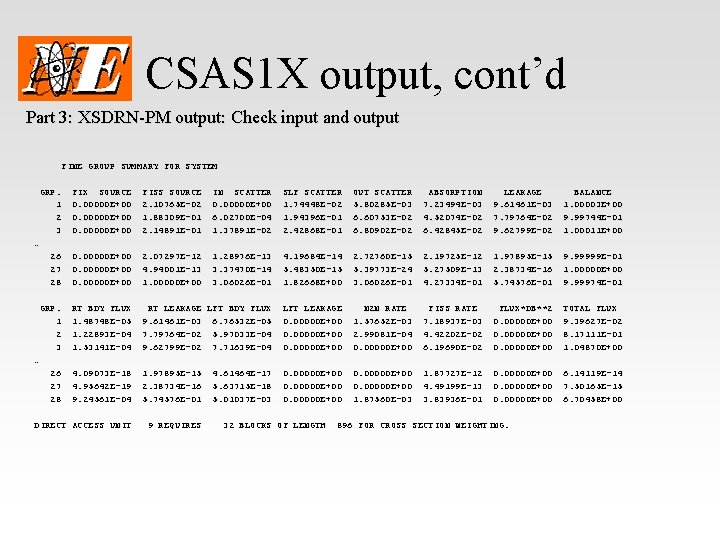
CSAS 1 X output, cont’d Part 3: XSDRN-PM output: Check input and output FINE GROUP SUMMARY FOR SYSTEM GRP. FIX SOURCE FISS SOURCE IN SCATTER SLF SCATTER OUT SCATTER ABSORPTION LEAKAGE BALANCE 1 0. 00000 E+00 2. 10765 E-02 0. 00000 E+00 1. 74448 E-02 5. 80285 E-03 7. 23494 E-03 9. 61461 E-03 1. 00003 E+00 2 0. 00000 E+00 1. 88309 E-01 6. 02700 E-04 1. 94396 E-01 6. 60753 E-02 4. 52074 E-02 7. 79764 E-02 9. 99744 E-01 3 0. 00000 E+00 2. 14891 E-01 1. 37891 E-02 2. 42868 E-01 6. 80902 E-02 6. 42845 E-02 9. 62799 E-02 1. 00011 E+00 … 26 0. 00000 E+00 2. 07297 E-12 1. 28976 E-13 4. 19684 E-14 2. 72760 E-15 2. 19725 E-12 1. 97895 E-15 9. 99999 E-01 27 0. 00000 E+00 4. 94001 E-13 3. 37470 E-14 5. 48350 E-15 5. 39773 E-24 5. 27509 E-13 2. 38734 E-16 1. 00000 E+00 28 0. 00000 E+00 1. 00000 E+00 3. 06026 E-01 1. 82668 E+00 3. 06026 E-01 4. 27334 E-01 5. 74576 E-01 9. 99974 E-01 GRP. RT BDY FLUX RT LEAKAGE LFT BDY FLUX LFT LEAKAGE N 2 N RATE FISS RATE FLUX*DB**2 TOTAL FLUX 1 1. 48748 E-05 9. 61461 E-03 6. 76532 E-05 0. 00000 E+00 1. 57652 E-03 7. 18937 E-03 0. 00000 E+00 9. 39627 E-02 2 1. 22893 E-04 7. 79764 E-02 5. 97033 E-04 0. 00000 E+00 2. 99081 E-04 4. 42202 E-02 0. 00000 E+00 8. 17111 E-01 3 1. 53141 E-04 9. 62799 E-02 7. 71639 E-04 0. 00000 E+00 6. 19690 E-02 0. 00000 E+00 1. 04870 E+00 … 26 4. 09073 E-18 1. 97895 E-15 4. 61464 E-17 0. 00000 E+00 1. 87727 E-12 0. 00000 E+00 6. 14119 E-14 27 4. 95642 E-19 2. 38734 E-16 5. 63715 E-18 0. 00000 E+00 4. 49199 E-13 0. 00000 E+00 7. 50165 E-15 28 9. 24561 E-04 5. 74576 E-01 5. 01037 E-03 0. 00000 E+00 1. 87560 E-03 3. 83936 E-01 0. 00000 E+00 6. 70458 E+00 DIRECT ACCESS UNIT 9 REQUIRES 32 BLOCKS OF LENGTH 896 FOR CROSS SECTION WEIGHTING.
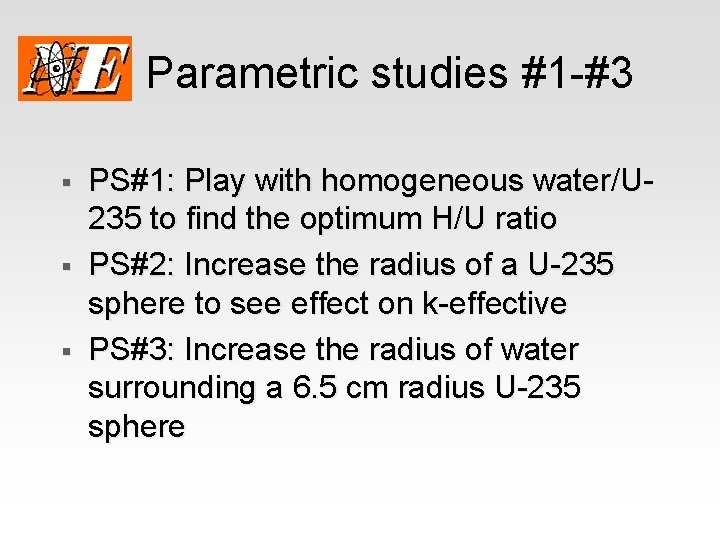
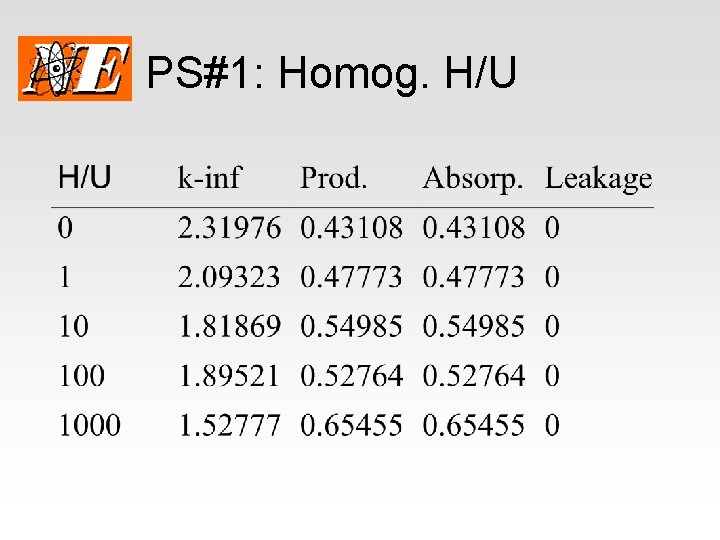
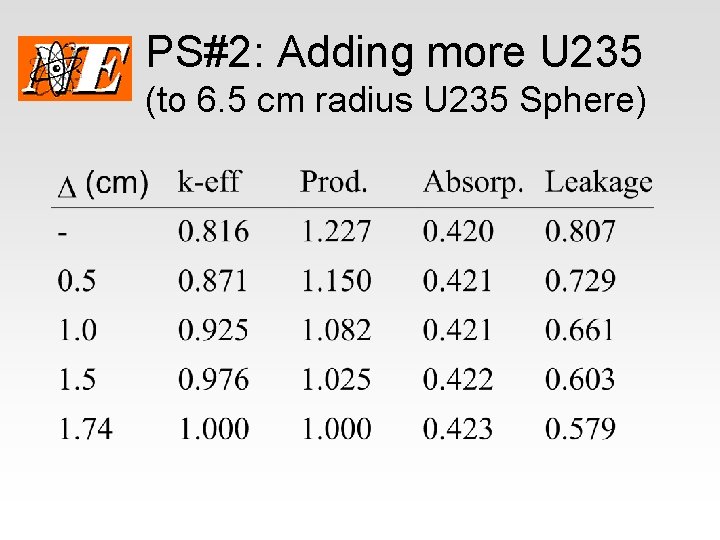
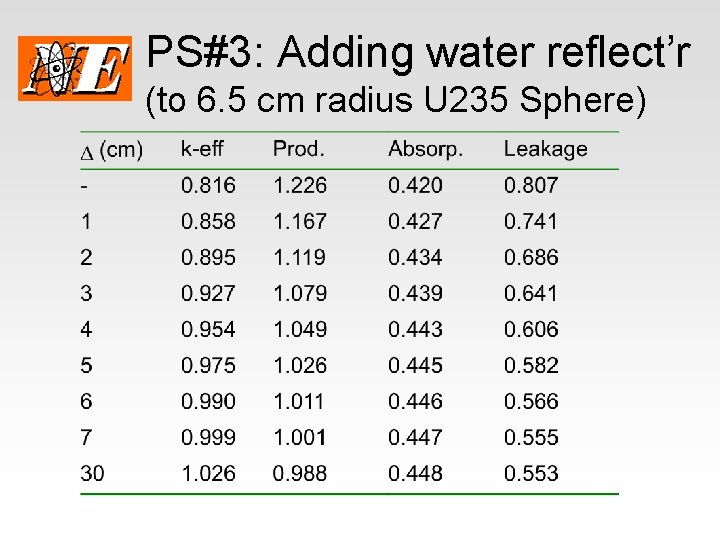
Parametric studies #1 -#3 § § § PS#1: Play with homogeneous water/U 235 to find the optimum H/U ratio PS#2: Increase the radius of a U-235 sphere to see effect on k-effective PS#3: Increase the radius of water surrounding a 6. 5 cm radius U-235 sphere
PS#1: Homog. H/U
PS#2: Adding more U 235 (to 6. 5 cm radius U 235 Sphere)
PS#3: Adding water reflect’r (to 6. 5 cm radius U 235 Sphere)
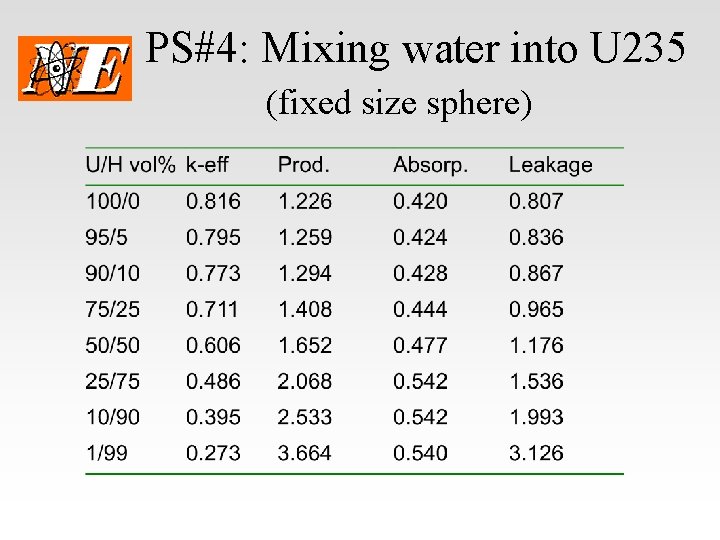
PS#4: Mixing water into U 235 (fixed size sphere)
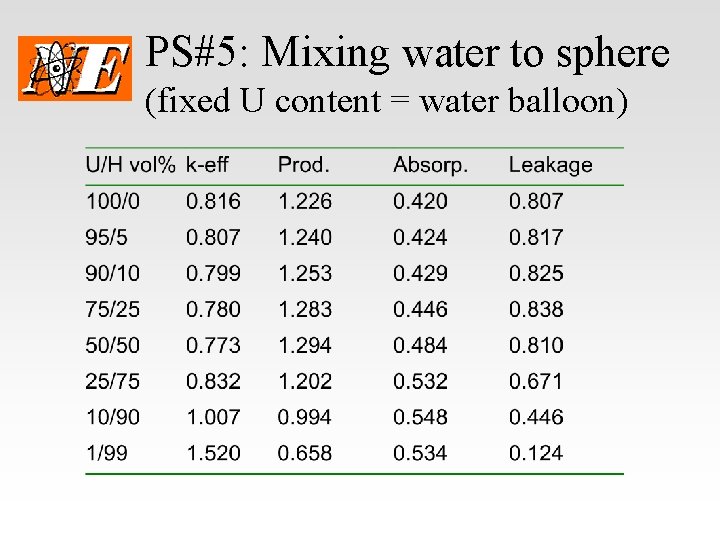
PS#5: Mixing water to sphere (fixed U content = water balloon)
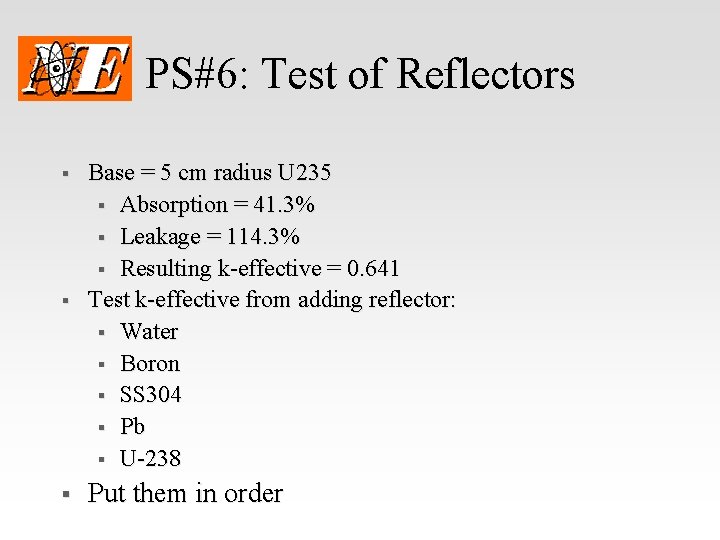
PS#6: Test of Reflectors § § § Base = 5 cm radius U 235 § Absorption = 41. 3% § Leakage = 114. 3% § Resulting k-effective = 0. 641 Test k-effective from adding reflector: § Water § Boron § SS 304 § Pb § U-238 Put them in order
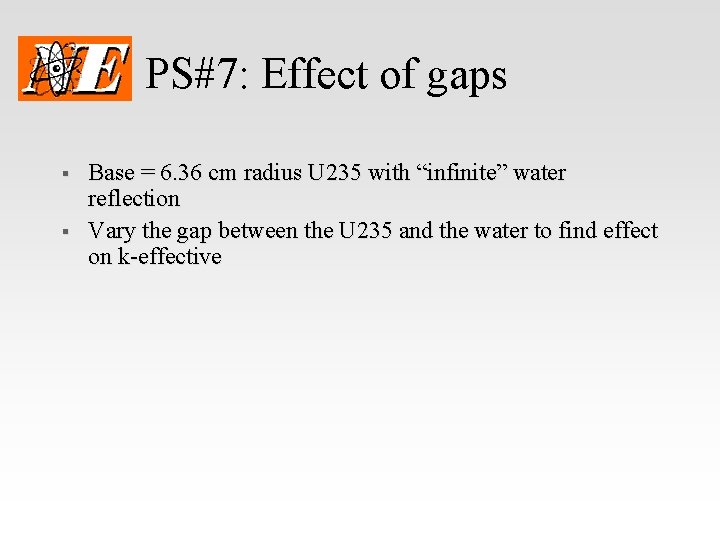
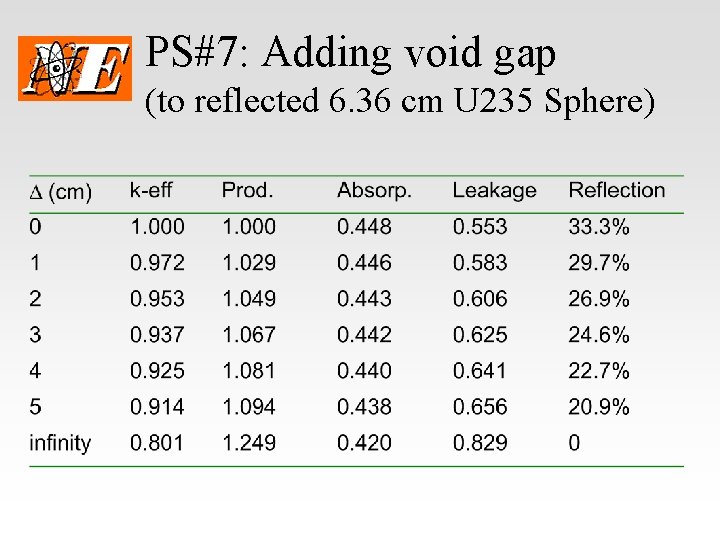
PS#7: Effect of gaps § § Base = 6. 36 cm radius U 235 with “infinite” water reflection Vary the gap between the U 235 and the water to find effect on k-effective
PS#7: Adding void gap (to reflected 6. 36 cm U 235 Sphere)
SCALE Sequence CSAS 25
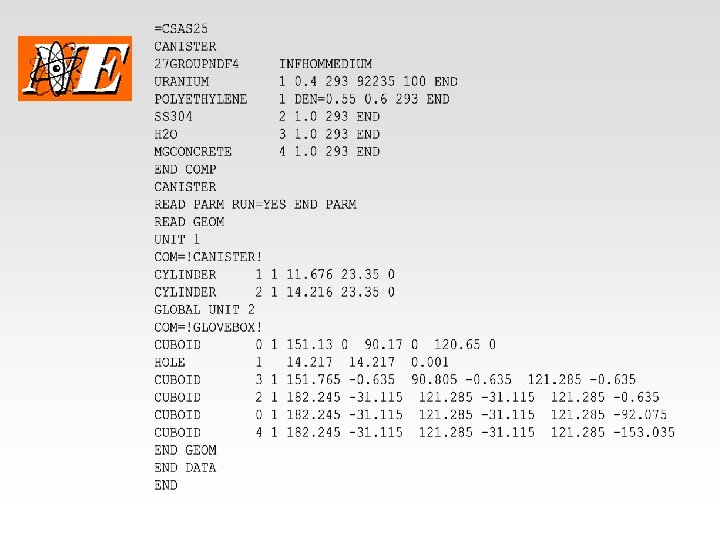
New SCALE features § Use of INFHOMMEDIUM § § § MULTIREGION used before to turn XSDRNPM on INFHOMMEDIUM indicates that our assumption is that the resonance materials appear in large chunks: What we will do for CSAS 25 Use of KENO geometry
CSAS 25 input: KENO geometry § Limited three dimensional description § § § No intersection of surfaces Arranged in “Units”: See manual C 4 Units built from the inside out “Holes” allow for inclusion of units into the overall geometry Two examples: § § Tokaimura accident Parametric study
Fig. 2 -2 results
CTS Tokai input URANYL NITRATE SOURCE 27 GROUPNDF 4 INFHOMMEDIUM SOLNUO 2(NO 3)2 1 370 1. 0 293 92235 18. 8 92238 81. 2 END H 2 O 2 1 END ss 304 3 1 END END COMP URANYL NITRATE SOURCE READ PARM GEN=203 NPG=500 RUN=YES PLT=YES END PARM READ GEOM GLOBAL UNIT 1 Cylinder 1 1 25. 0 +12. 25 -12. 25 Cylinder 3 1 25. 3 +12. 55 -12. 55 cylinder 2 1 27. 8 +12. 55 -12. 55 END GEOM READ BOUNDS ALL=VOID END BOUNDS END DATA
CSAS 25: Where is the answer? § § Search on “best” Gives you the k-effective with uncertainty
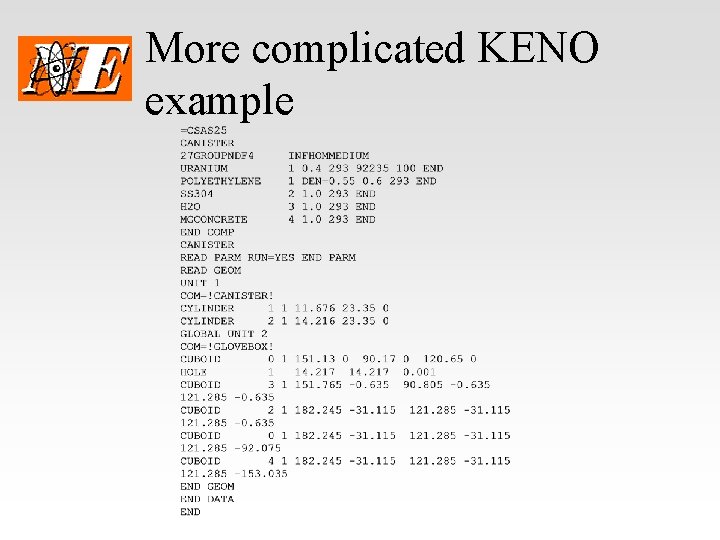
More complicated KENO example
Discussion of Experiments § § Critical “Benchmarks”: Tie codes to reality Static criticality experiments § § § Direct application - Requires good fit to your situation Criticality curves - Typical configurations and materials Validation of computer codes: Finding area of applicability • • § Interpolation “Bracketing” Dynamic criticality experiments § § Fission yields What stops the accident? • • Temperature (metals) Boiling Material ejection Human reaction (very slow)
Important Considerations for Benchmarks § § § Well defined compositions Precise dimensions Regular geometries (for modeling) § Requires some isolation from “rest of the world” = piping, tables, floors, etc.
Nature of Experiments § Critical dimensions § § § Critical spacing of arrays Various material effects § § Height of solutions Radius of spheres Thickness of slabs Reflection Poisons Moderators Inverse multiplication § Approach to critical
Subcritical in-situ Experiments § § Best of all = Test the actual materials, geometry, environment (ANSI/ANS 8. 6) Hard to model all accident conditions § Chernobyl was an in-situ experiment
Objectives Overview of International Handbook of Evaluated Criticality Safety Benchmark Experiments
What? § § § Collection of EVALUATED benchmark critical, subcritical, and (some) alarm placement experiments § Someone did and published the experiment (You hope!) § Someone else (you? ) writes it up and submits to the Benchmark Book § Reviewed § Included in next revision of BB Suitable for reproduction to validate computer code All sorts of fissile materials, absorbers, geometries, interactions, etc.
Who? § § § Sponsored by OECD-NEA Put together by Dr. Blair Briggs of INEL Hundreds of participants world-wide from multiple countries
Why? The purposes of the International Criticality Safety Benchmark Evaluation Project (ICSBEP) Working Group are: 1. Identify and evaluate a comprehensive set of benchmark critical and subcritical experiment data; 2. Verify the data, to the extent possible, by reviewing original and subsequently revised documentation and by talking with experimenters or individuals who were associated with the experiments or the experimental facility; 3. Evaluate the data and quantify overall uncertainties through various types of sensitivity analyses; 4. Compile the data into a standardized format; 5. Perform sample calculations of each experiment with standardized criticality safety neutronics codes; and 6. Formally document the work into a single source of verified and extensively peer reviewed benchmark critical data.
Get it on your computer § § Not a controlled document Can be freely distributed 415 experiments I recommend that you Google it and sign up (not required for this course, but it doesn’t matter)
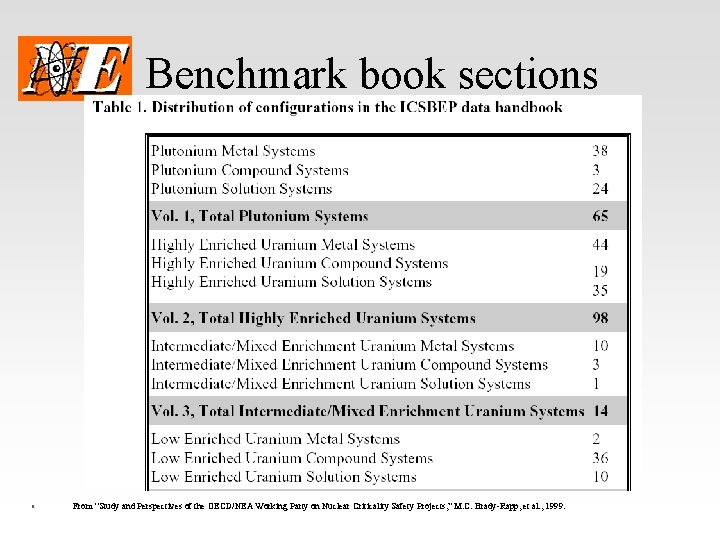
Benchmark book sections § From “Study and Perspectives of the OECD/NEA Working Party on Nuclear Criticality Safety Projects, ” M. C. Brady-Rapp, et al. , 1999.
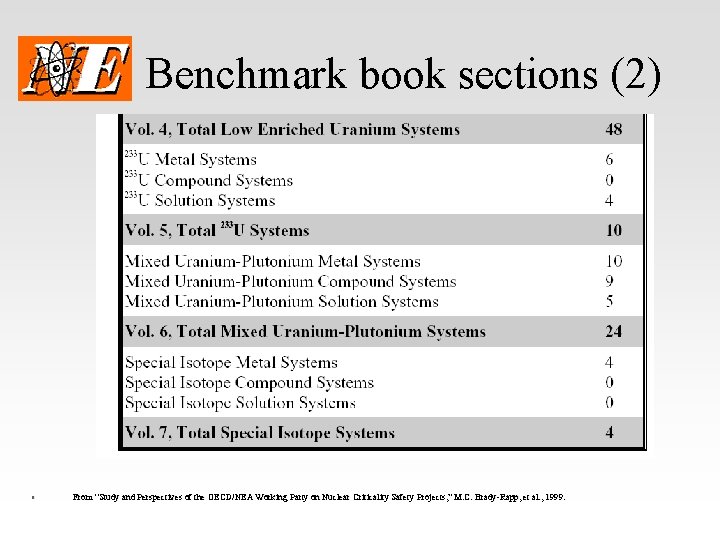
Benchmark book sections (2) § From “Study and Perspectives of the OECD/NEA Working Party on Nuclear Criticality Safety Projects, ” M. C. Brady-Rapp, et al. , 1999.