
LESSON 6 CHAPTER 6 STEP 2 MACRO ENVIRONMENTAL





- Slides: 41
LESSON 6 CHAPTER 6 STEP 2: MACRO ENVIRONMENTAL ANALYSIS PROF. C. IOELE Global Sourcing in the Textile and Apparel Industry 1
Learning objectives PESTS analysis: political, economic, social, technological, and sustainability factors that may directly and indirectly influence global sourcing. Intellectual property rights: trademarks, copyrights, patents, trade secrets Trade barriers: tariffs and quotas, and their effects on the welfare of consumers, domestic suppliers, and governments. Trade agreements and preference programs: how they impact global sourcing. Global Sourcing in the Textile and Apparel Industry 2
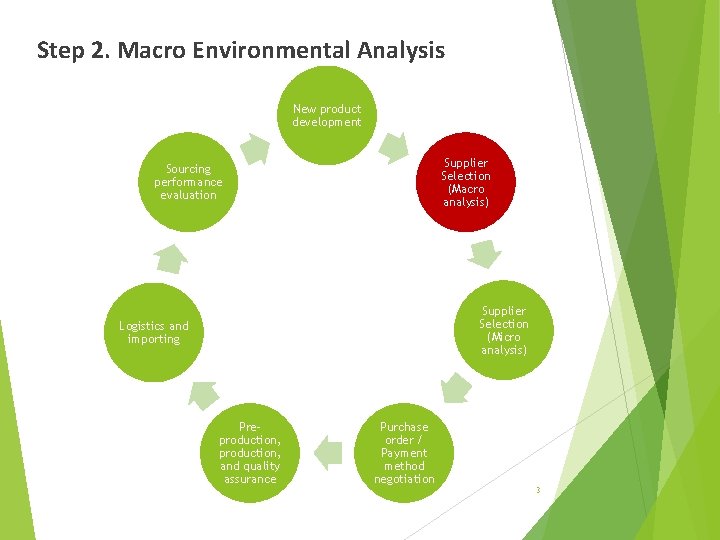
Step 2. Macro Environmental Analysis New product development Supplier Selection (Macro analysis) Sourcing performance evaluation Supplier Selection (Micro analysis) Logistics and importing Preproduction, and quality assurance Purchase order / Payment method negotiation 3
Macro environmental factors 1. PESTS analysis 2. Intellectual property rights 3. Trade barriers and preferences Global Sourcing in the Textile and Apparel Industry 4
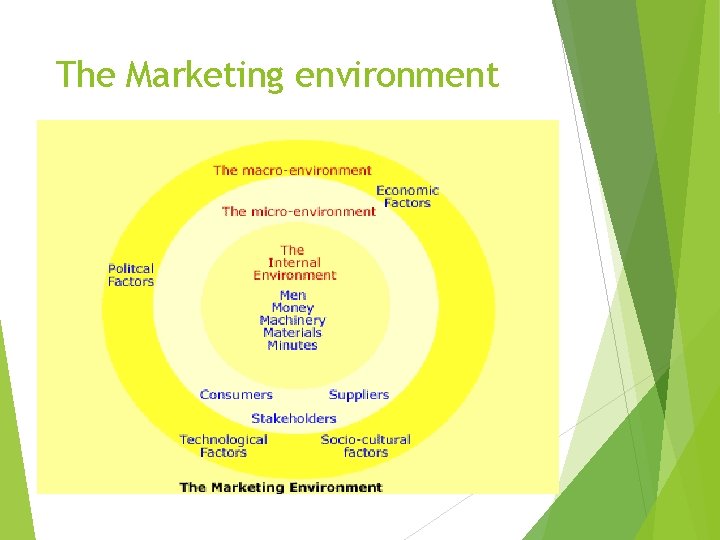
The Marketing environment
Watch. . https: //www. youtube. com/watch? v=GFVKKTwk. ANY PESTLE analysis Global Sourcing in the Textile and Apparel Industry 6
1) PESTS analysis – For new country consideration and more Political environment analysis - Tax policies, trade agreements, import/export regulations, political stability , etc. Economic environment analysis - Currency exchange rates, unemployment rates, inflation rates, etc. Social environment analysis - Work ethics, culture, and the quality of the labor force in the textile and apparel industry, etc. Global Sourcing in the Textile and Apparel Industry 7
PESTS analysis – For new country consideration and more Technological environment analysis - Ease of communication, infrastructure related to air, ocean, and ground transportation, the degree of automation in the textile and apparel industry, etc. Sustainability environment analysis - labor laws, history of labor strikes (recent Cambodia), environmental laws and regulations, building codes (Bangladesh Rana Plaza), etc. Resources: CIA’s World Factbook Global Sourcing in the Textile and Apparel Industry 8
Intellectual property Category of property that includes intangible creations of the human intellect. Global Sourcing in the Textile and Apparel Industry 9
Watch. . https: //www. youtube. com/watch? v=Ah 0 p. Awq. Gq. N 0 Fashion & Intellectual Property Global Sourcing in the Textile and Apparel Industry 10
2) Intellectual Property Rights Sourcers must consider the potential country’s intellectual property right (IPR) enforcement. IPR are the rights given to persons over the creation of their minds. Four major intellectual property rights: (a) trademarks, (b) copyrights, (c) patents, and (d) trade secrets. Global Sourcing in the Textile and Apparel Industry 11
Intellectual Property Rights Trademarks: Name, logo, color, and three-dimensional images that represent the Sourcer’s company /brand. Trademark infringements. Copyrights: Protect drawings, designs, websites, or marketing materials of the Sourcer. Violation of copyrights laws. Patents: Cover specific processes and products that the sourcer may uniquely possess. Trade secrets: Any confidential or classified information that the sourcer may only share with the supplier Global Sourcing in the Textile and Apparel Industry 12
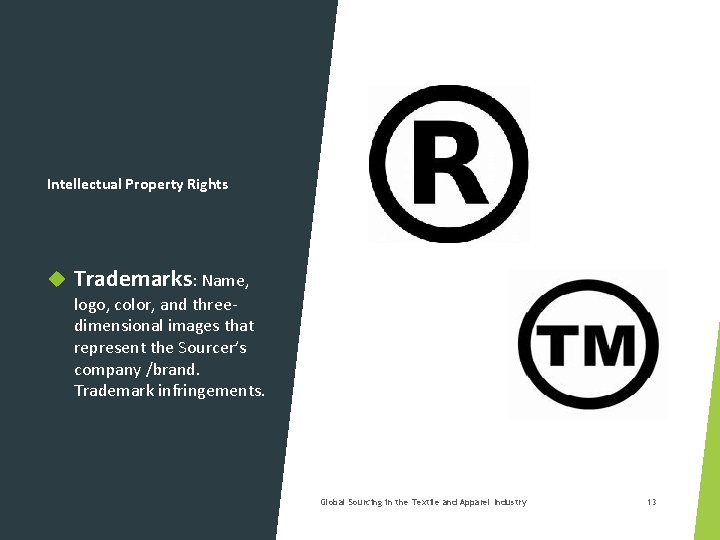
Intellectual Property Rights Trademarks: Name, logo, color, and threedimensional images that represent the Sourcer’s company /brand. Trademark infringements. Global Sourcing in the Textile and Apparel Industry 13
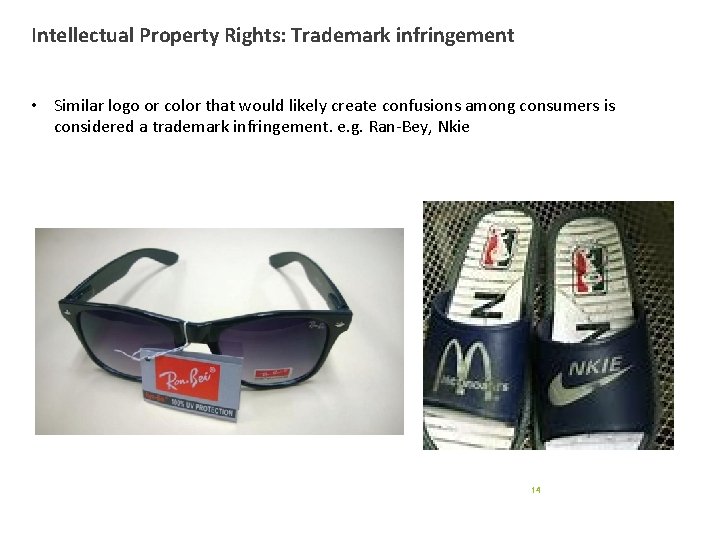
Intellectual Property Rights: Trademark infringement • Similar logo or color that would likely create confusions among consumers is considered a trademark infringement. e. g. Ran-Bey, Nkie 14
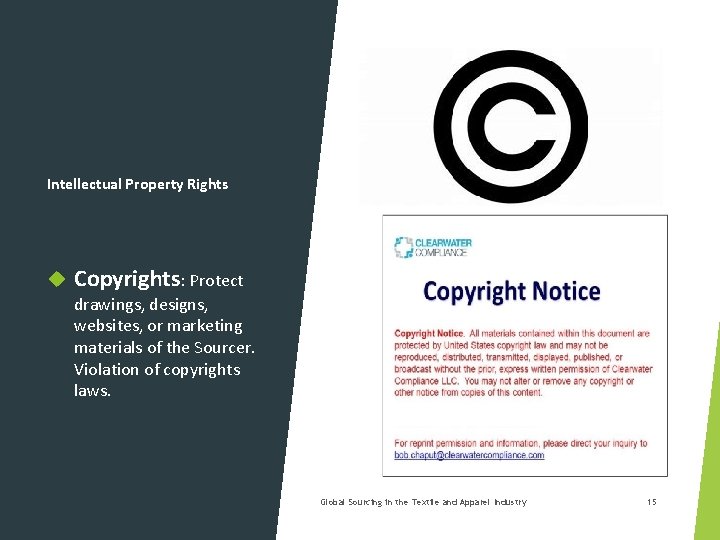
Intellectual Property Rights Copyrights: Protect drawings, designs, websites, or marketing materials of the Sourcer. Violation of copyrights laws. Global Sourcing in the Textile and Apparel Industry 15
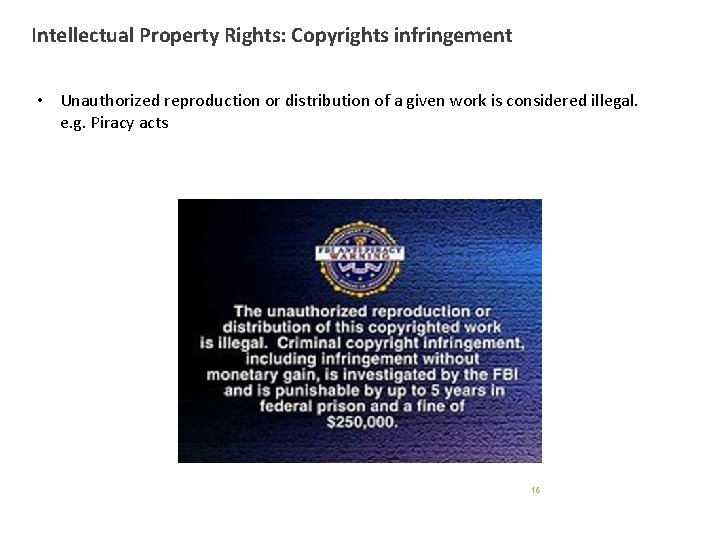
Intellectual Property Rights: Copyrights infringement • Unauthorized reproduction or distribution of a given work is considered illegal. e. g. Piracy acts 16
Intellectual Property Rights Patents: Cover specific processes and products that the Sourcer may uniquely possess. Global Sourcing in the Textile and Apparel Industry 17
Intellectual Property Rights: Patent infringement • Copying a creative idea is illegal. e. g. Louboutin red sole shoes Christian Louboutin wins legal dispute over red soles. Friday, May 18 2018 Paris’ court of appeal has given Christian Louboutin's exclusive rights over his iconic red soles, after a legal battle between the shoe designer and leather goods company Kesslord, which offered similar models in France. “We have adopted a "zero tolerance" policy and have put in place a comprehensive program to deal not only with websites offering fake Christian Louboutin® products, but the sources thereof, the distribution systems, the auction sites and other avenues of trade in the fake products. ” 18
Intellectual Property Rights Trade secrets: Any confidential or classified information that the Sourcer may only share with the supplier Global Sourcing in the Textile and Apparel Industry 19
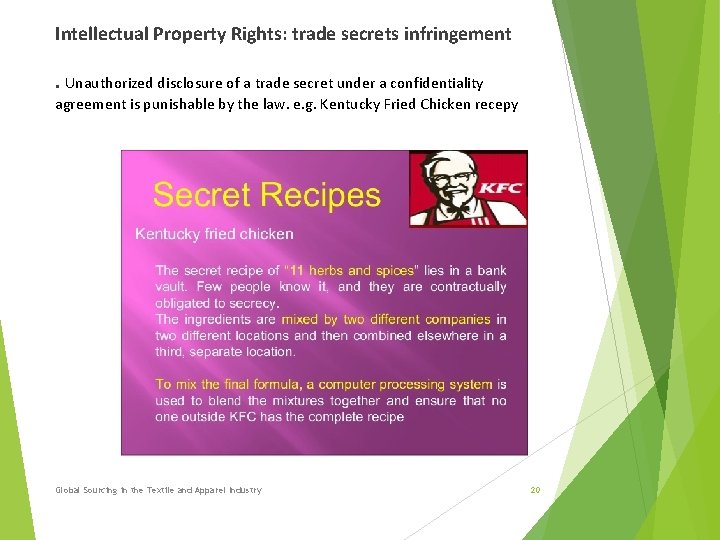
Intellectual Property Rights: trade secrets infringement. Unauthorized disclosure of a trade secret under a confidentiality agreement is punishable by the law. e. g. Kentucky Fried Chicken recepy Global Sourcing in the Textile and Apparel Industry 20
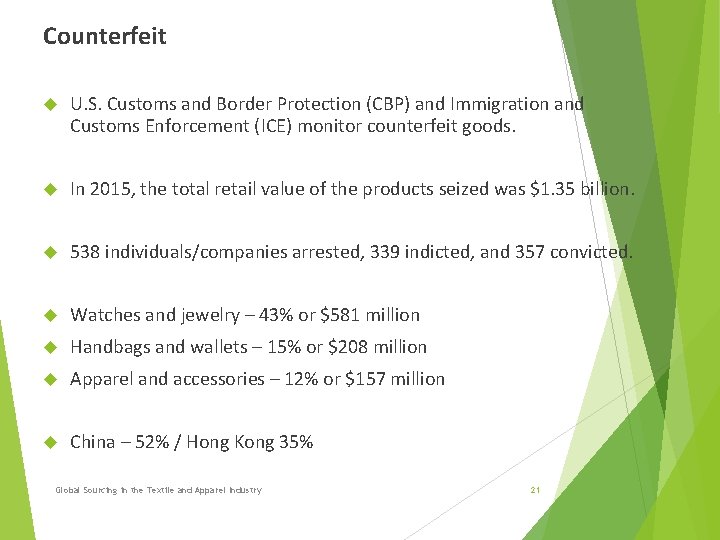
Counterfeit U. S. Customs and Border Protection (CBP) and Immigration and Customs Enforcement (ICE) monitor counterfeit goods. In 2015, the total retail value of the products seized was $1. 35 billion. 538 individuals/companies arrested, 339 indicted, and 357 convicted. Watches and jewelry – 43% or $581 million Handbags and wallets – 15% or $208 million Apparel and accessories – 12% or $157 million China – 52% / Hong Kong 35% Global Sourcing in the Textile and Apparel Industry 21
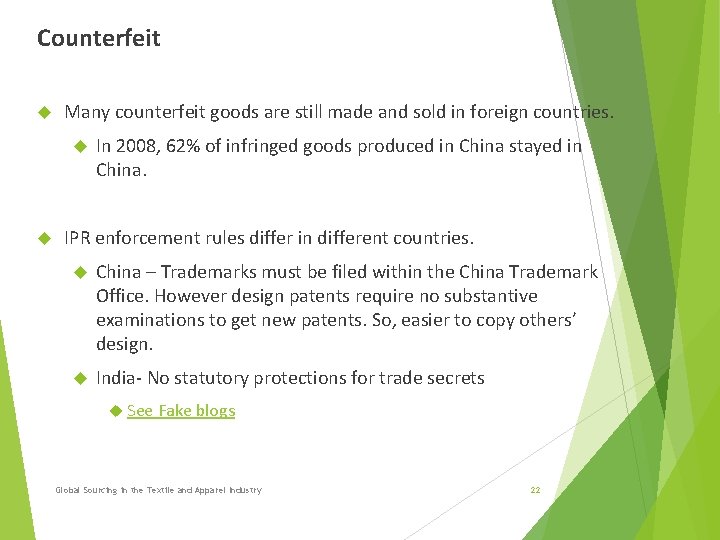
Counterfeit Many counterfeit goods are still made and sold in foreign countries. In 2008, 62% of infringed goods produced in China stayed in China. IPR enforcement rules differ in different countries. China – Trademarks must be filed within the China Trademark Office. However design patents require no substantive examinations to get new patents. So, easier to copy others’ design. India- No statutory protections for trade secrets See Fake blogs Global Sourcing in the Textile and Apparel Industry 22
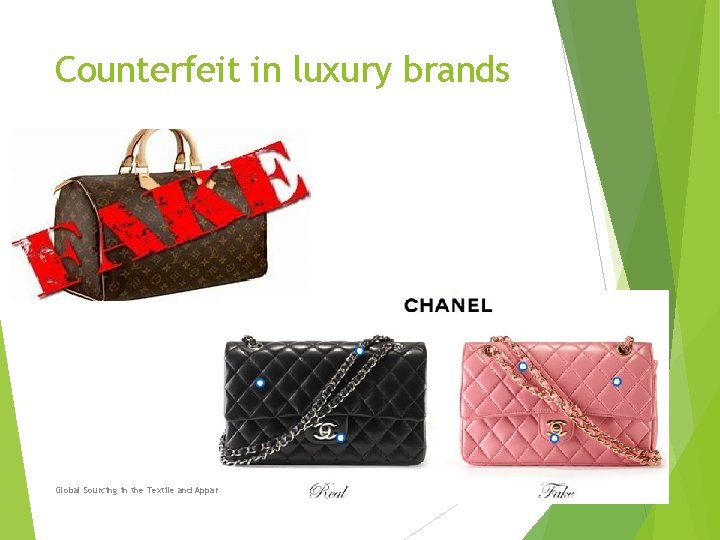
Counterfeit in luxury brands Global Sourcing in the Textile and Apparel Industry 23
Watch. . https: //www. cbp. gov/newsroom/videogallery/2014/02/countering-counterfeits Strategies for turning back fraudulent imports (by the Department of Homeland Security and Border Protection – CBP) Global Sourcing in the Textile and Apparel Industry 24
3) Trade Barriers and Trade Promotion (agreements and preferences) The textile and apparel industry has been a core focus in trade negotiations since the Industrial Revolution. The trade agreements and programs directly affect the Sourcer’s overall costs. Retailers and importers favor trade liberalism with little or no trade barriers. Domestic manufacturers and producers want trade protectionism with more restrictions on imports. Global Sourcing in the Textile and Apparel Industry 25
A. Trade Barriers Tariffs and quotas are two major tools used by many governments today to discourage importing and encourage domestic manufacturing. Tariffs : Duties (or taxes) imposed on goods being imported from foreign countries (HTSUS). Quotas: A physical limit on the quantity of a good that can be imported into a country in a period of time. Global Sourcing in the Textile and Apparel Industry 26
Trade Barriers Trade barriers raise the overall product cost, either through tariffs or quotas. Government gains revenues. This increased price would then reduce the overall demand for such products, while domestic producers may still protect some of their market shares. Global Sourcing in the Textile and Apparel Industry 27
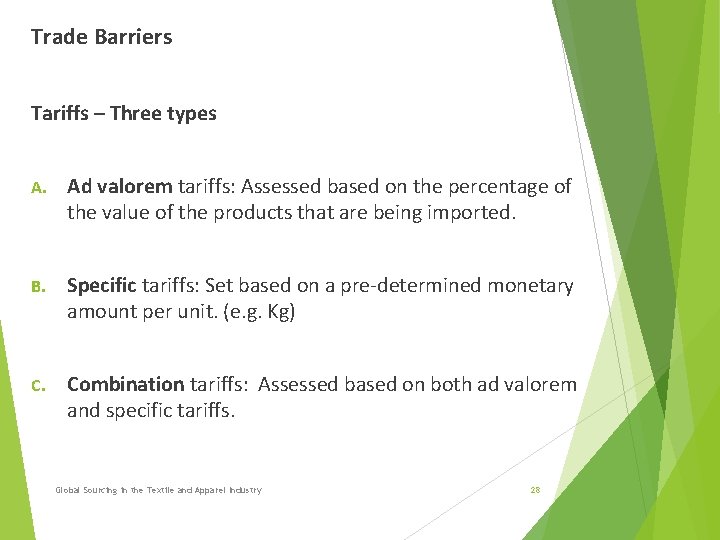
Trade Barriers Tariffs – Three types A. Ad valorem tariffs: Assessed based on the percentage of the value of the products that are being imported. B. Specific tariffs: Set based on a pre-determined monetary amount per unit. (e. g. Kg) C. Combination tariffs: Assessed based on both ad valorem and specific tariffs. Global Sourcing in the Textile and Apparel Industry 28
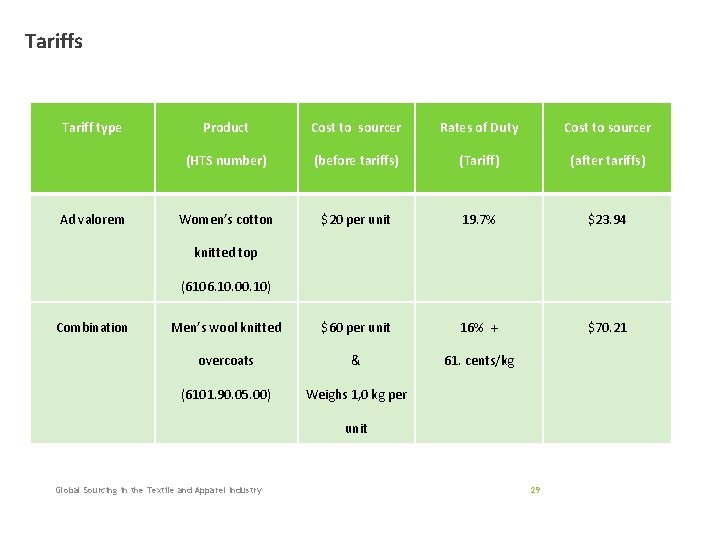
Tariffs Tariff type Ad valorem Product Cost to sourcer Rates of Duty Cost to sourcer (HTS number) (before tariffs) (Tariff) (after tariffs) Women’s cotton $20 per unit 19. 7% $23. 94 Men’s wool knitted $60 per unit 16% + $70. 21 overcoats & 61. cents/kg (6101. 90. 05. 00) Weighs 1, 0 kg per knitted top (6106. 10. 00. 10) Combination unit Global Sourcing in the Textile and Apparel Industry 29
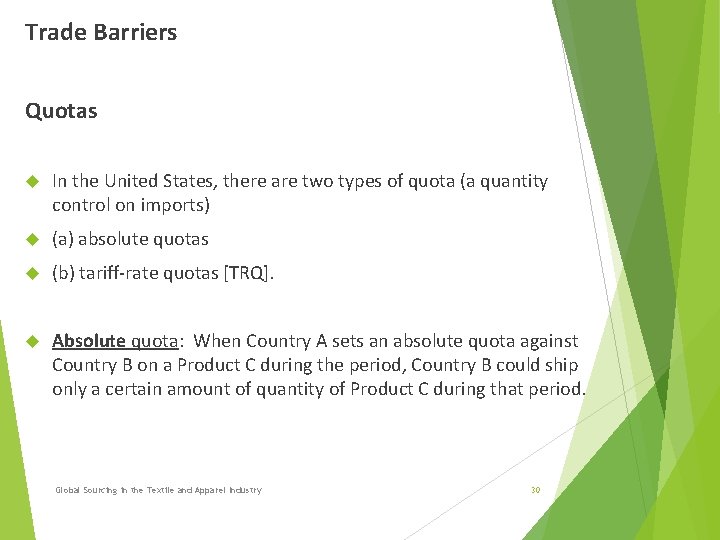
Trade Barriers Quotas In the United States, there are two types of quota (a quantity control on imports) (a) absolute quotas (b) tariff-rate quotas [TRQ]. Absolute quota: When Country A sets an absolute quota against Country B on a Product C during the period, Country B could ship only a certain amount of quantity of Product C during that period. Global Sourcing in the Textile and Apparel Industry 30
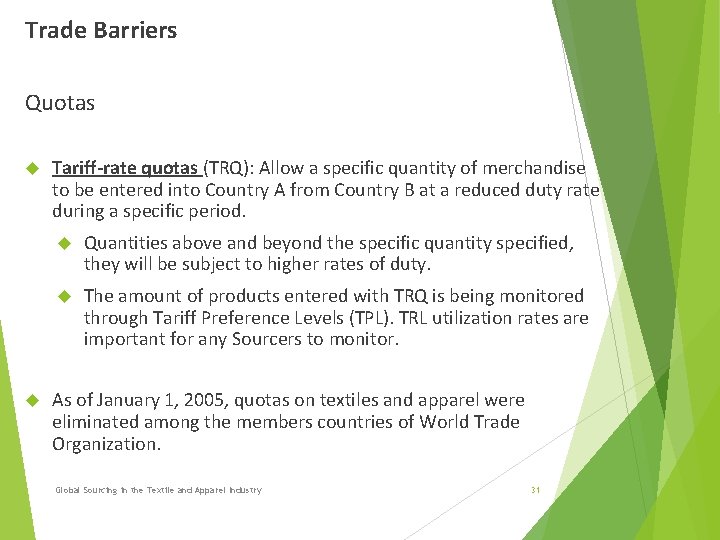
Trade Barriers Quotas Tariff-rate quotas (TRQ): Allow a specific quantity of merchandise to be entered into Country A from Country B at a reduced duty rate during a specific period. Quantities above and beyond the specific quantity specified, they will be subject to higher rates of duty. The amount of products entered with TRQ is being monitored through Tariff Preference Levels (TPL). TRL utilization rates are important for any Sourcers to monitor. As of January 1, 2005, quotas on textiles and apparel were eliminated among the members countries of World Trade Organization. Global Sourcing in the Textile and Apparel Industry 31
B. Trade agreements Free trade agreements (FTA) are negotiated to promote trade among member countries by eliminating or reducing tariff rates and easing government trade rules. Under FTAs, qualified goods would gain “duty-free” access to other FTA member countries, resulting in lower prices for the goods. Each FTA has different rules and conditions. Global Sourcing in the Textile and Apparel Industry 32
Watch. . https: //www. youtube. com/watch? v=65 Uc. Sx_Lr. ZI What Are Free Trade Agreements? Global Sourcing in the Textile and Apparel Industry 33
Trade agreements Free trade agreements FTAs related to textile and apparel trades (Office of Textile and Apparel, 2009): ü Ensure reciprocal market access. ü Most FTAs have the “yarn-forward” rule of origin as a common provision for most textiles and apparel products to be duty-free. ü Have a safeguard mechanism that controls that textile and apparel imports do not cause serious damage to domestic markets, such as sudden drops in price through dumping products at below-the-market price. ü Have policies on illegal transshipment. Transshipment can be illegal if the goods enter the ultimate destination country with a false country of origin. ü Have rules on “short supply”: if raw materials are short of supply or not available, they can be sourced outside the FTA region, but the finished product can still be classified as duty free. Global Sourcing in the Textile and Apparel Industry 34
Trade agreements Free trade agreements As of December 31, 2015, the U. S. has FTAs with 20 countries: Australia, Bahrein, Chile, Colombia, DR-CAFTA (Dominican Republic), Costa Rica, , El Salvador, Guatemala, Honduras, Nicaragua, Israel, Jordan, Korea, Morocco, NAFTA (Canada and Mexico), Oman, Panama, Perù, Singapore. ü 12 countries are bilateral ü 8 are multilateral – NAFTA, CAFTA-DR NAFTA - North American Free Trade Agreement CAFTA-DR – Dominican Republic-Central America Free Trade Agreement Global Sourcing in the Textile and Apparel Industry 35
Watch. . https: //www. youtube. com/watch? v=DHIl_zmmhzg Trade Agreements Global Sourcing in the Textile and Apparel Industry 36
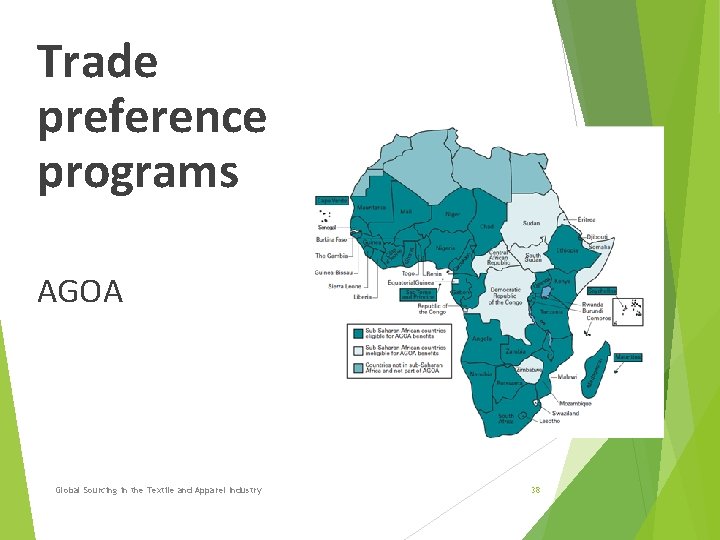
C. Trade preference programs A Trade Preference Program (TPP) is legislated by U. S. Congress and provides duty-free treatment to certain apparel products from designated beneficiary countries that meet the program’s rules. TPPs are designed to allow duty-free entry of apparel from a beneficiary country into the United States if the apparel is cut and assembled in a beneficiary country using U. S. fabrics made of U. S. yarns (Office of Textiles and Apparel, 2012). Currently, the United States offers four TPPs as follows: ü The African Growth and Opportunity Act (AGOA): 26 countries ü The Caribbean Basin Trade Partnership Act (CBTPA): 17 countries ü The Haitian Hemispheric Opportunity Through Partnership for Encouragement Act (HOPE Act): Haiti duty free Global Sourcing in the Textile and Apparel Industry 37
Trade preference programs AGOA Global Sourcing in the Textile and Apparel Industry 38
Trade preference programs Utilization rates of TPPs Perhaps the role of China since the textile and apparel quota elimination in 2005 has played a role in the overall decrease in utilization rates of AGOA and CBTPA. It is very important for sourcing personnel to monitor the trends of trade decreases and/or increases from certain counties and regions. Global Sourcing in the Textile and Apparel Industry 39
For the next class No readings, no assignments. Prepare for Midterm exam, Ch. 1 to 6 (see study guide) Global Sourcing in the Textile and Apparel Industry 40
Learning objectives PESTS analysis: political, economic, social, technological, and sustainability factors that may directly and indirectly influence global sourcing. Intellectual property rights: trademarks, copyrights, patents, trade secrets Trade barriers: tariffs and quotas, and their effects on the welfare of consumers, domestic suppliers, and governments. Trade agreements and preference programs: how they impact global sourcing. Global Sourcing in the Textile and Apparel Industry 41