
Lesson 6 Aims and Hypotheses Aims The first
- Slides: 10
Lesson 6: Aims and Hypotheses
Aims • The first step when conducting research is to decide upon the aim of the study. • An aim is a statement about the purpose of the study and what it intends to find out.
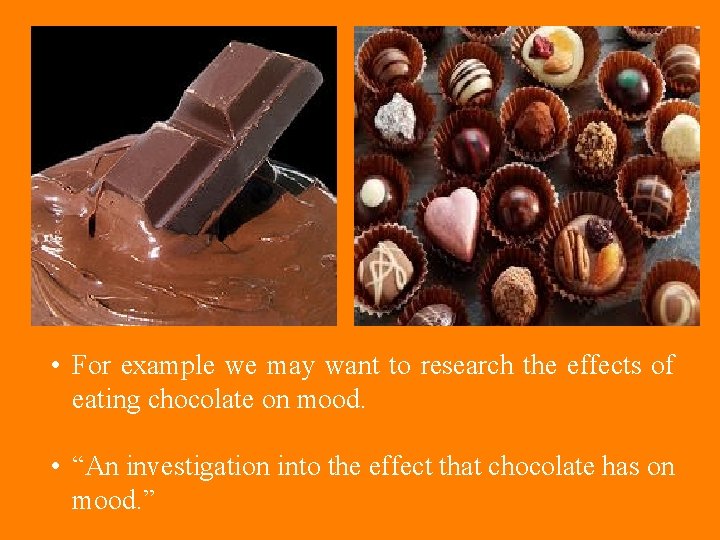
• For example we may want to research the effects of eating chocolate on mood. • “An investigation into the effect that chocolate has on mood. ”
Operationalise the Variables • The second step is to decide upon the IV and the DV and operationalise them. • Operationalisation is defining the variables in such a way as to make them easy to measure.
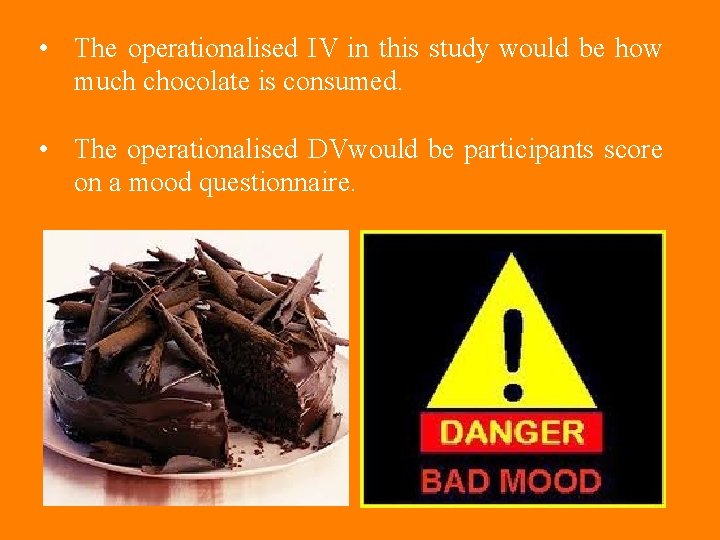
• The operationalised IV in this study would be how much chocolate is consumed. • The operationalised DVwould be participants score on a mood questionnaire.
Hypotheses • The third step is to decide upon an hypothesis and operationalise it. • A hypothesis is a precise, testable statement about the expected outcome of an investigation.
• Null Hypothesis = This states the IV will have no effect on the DV. • Experimental Hypothesis = This predicts that the IV will have an effect on the DV.
• Directional Hypothesis = This states the direction of the predicted difference between conditions. • Non-Directional Hypothesis = Does not state the direction of the predicted differences between conditions.
• Null Hypothesis = Eating 250 g of chocolate will have no affect on the participants’ mood. • Non-Directional Hypothesis = Eating 250 g of chocolate will have an affect on the participants’ mood. • Directional Hypothesis = Eating 250 g of chocolate will mean that participants are significantly more likely to score 80+ on a mood questionnaire.
Pilot Studies • These are small scale preliminary studies that make it possible to trial the procedures and general design of an investigation before spending time and money on a full scale study.