
Lesson 6 2 b Volumes Using Discs Ice
Lesson 6 -2 b Volumes Using Discs
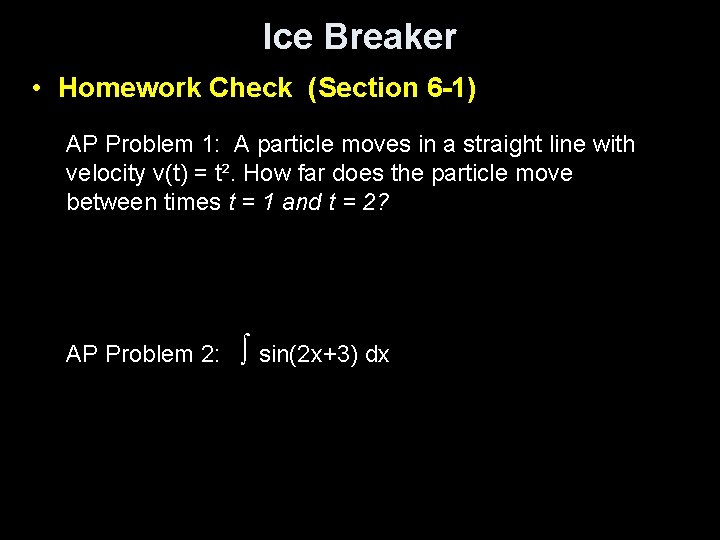
Ice Breaker • Homework Check (Section 6 -1) AP Problem 1: A particle moves in a straight line with velocity v(t) = t². How far does the particle move between times t = 1 and t = 2? AP Problem 2: ∫ sin(2 x+3) dx
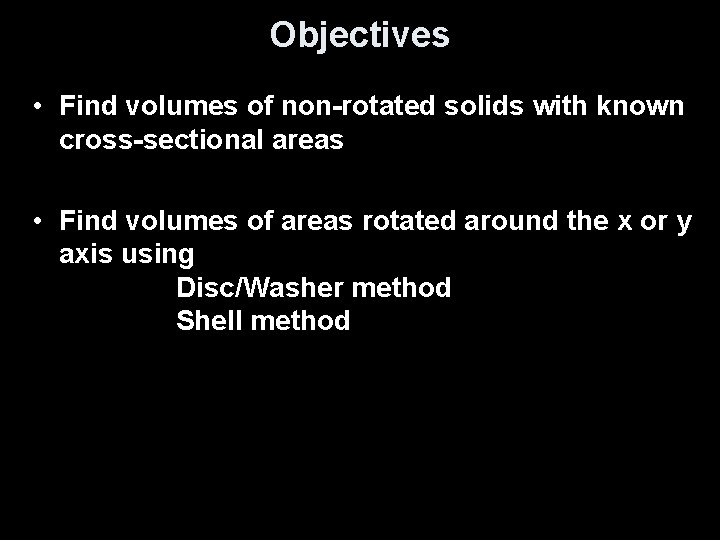
Objectives • Find volumes of non-rotated solids with known cross-sectional areas • Find volumes of areas rotated around the x or y axis using Disc/Washer method Shell method
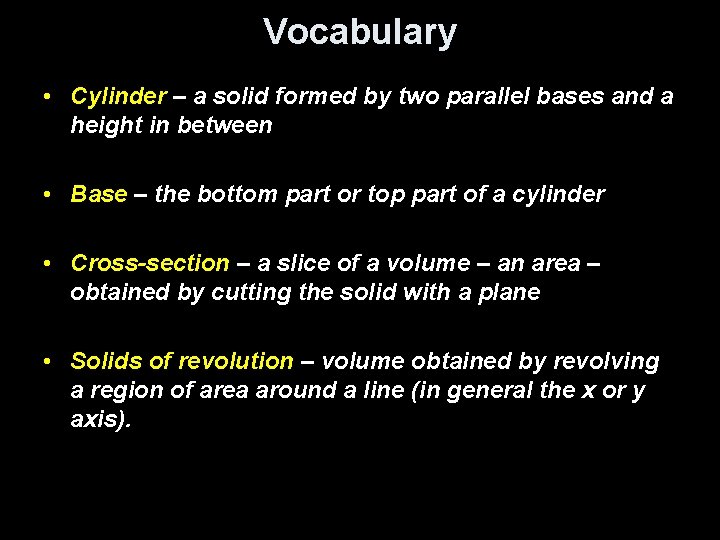
Vocabulary • Cylinder – a solid formed by two parallel bases and a height in between • Base – the bottom part or top part of a cylinder • Cross-section – a slice of a volume – an area – obtained by cutting the solid with a plane • Solids of revolution – volume obtained by revolving a region of area around a line (in general the x or y axis).
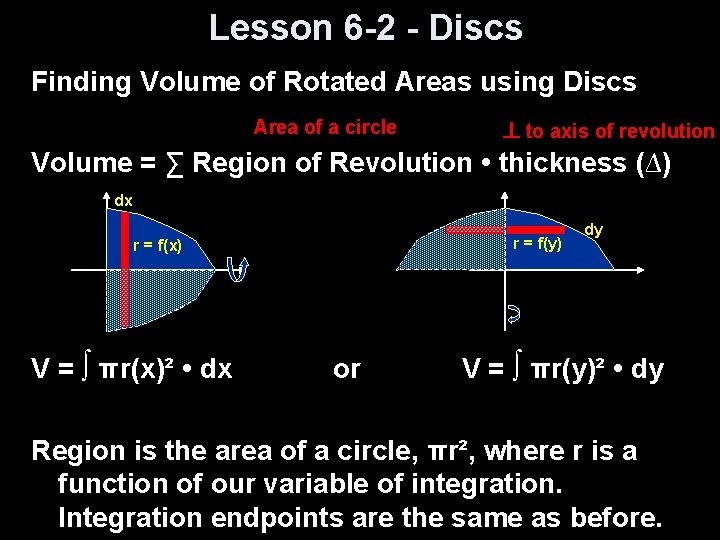
Lesson 6 -2 - Discs Finding Volume of Rotated Areas using Discs Area of a circle ┴ to axis of revolution Volume = ∑ Region of Revolution • thickness (∆) dx r = f(y) r = f(x) V = ∫ πr(x)² • dx or dy V = ∫ πr(y)² • dy Region is the area of a circle, πr², where r is a function of our variable of integration. Integration endpoints are the same as before.
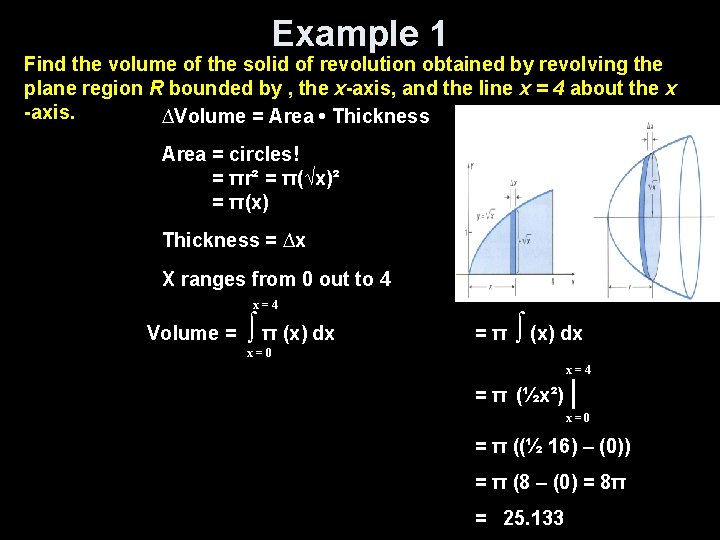
Example 1 Find the volume of the solid of revolution obtained by revolving the plane region R bounded by , the x-axis, and the line x = 4 about the x -axis. ∆Volume = Area • Thickness Area = circles! = πr² = π(√x)² = π(x) Thickness = ∆x X ranges from 0 out to 4 x=4 Volume = ∫ π (x) dx =π ∫ (x) dx x=0 x=4 = π (½x²) | x=0 = π ((½ 16) – (0)) = π (8 – (0) = 8π = 25. 133
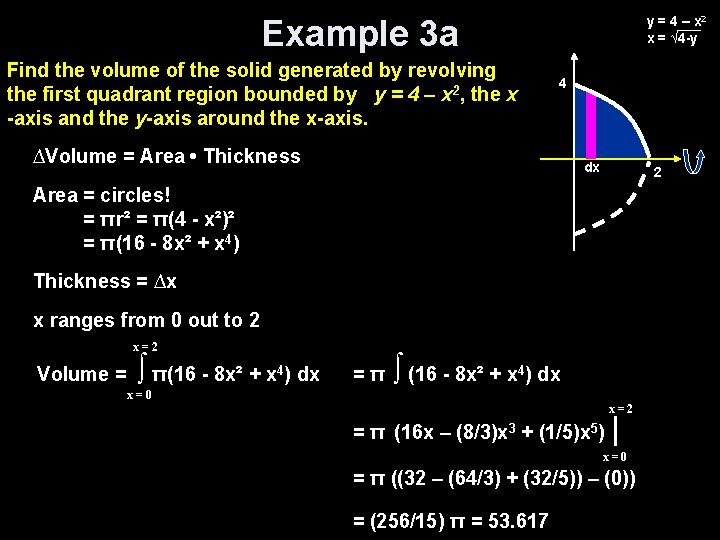
y = 4 – x 2 x = √ 4 -y Example 3 a Find the volume of the solid generated by revolving the first quadrant region bounded by y = 4 – x 2, the x -axis and the y-axis around the x-axis. 4 ∆Volume = Area • Thickness dx 2 Area = circles! = πr² = π(4 - x²)² = π(16 - 8 x² + x 4) Thickness = ∆x x ranges from 0 out to 2 x=2 Volume = ∫ π(16 - 8 x² + x 4) dx =π ∫ (16 - 8 x² + x 4) dx x=0 x=2 = π (16 x – (8/3)x 3 + (1/5)x 5) | x=0 = π ((32 – (64/3) + (32/5)) – (0)) = (256/15) π = 53. 617
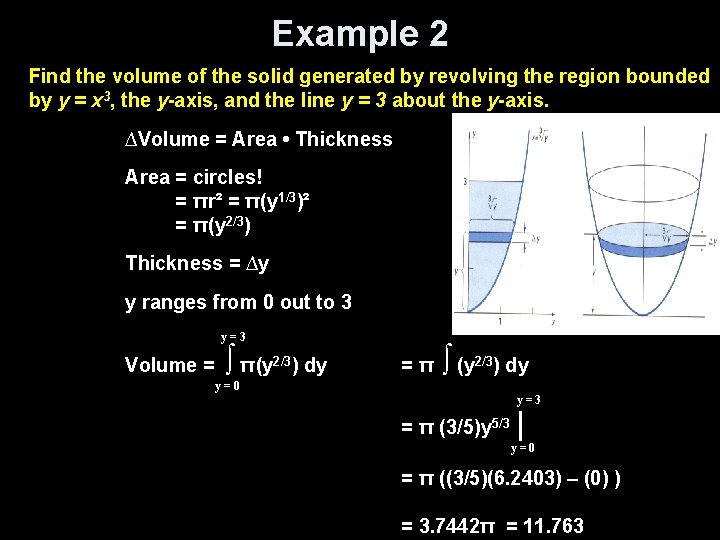
Example 2 Find the volume of the solid generated by revolving the region bounded by y = x 3, the y-axis, and the line y = 3 about the y-axis. ∆Volume = Area • Thickness Area = circles! = πr² = π(y 1/3)² = π(y 2/3) Thickness = ∆y y ranges from 0 out to 3 y=3 Volume = ∫ π(y 2/3) dy =π ∫ (y 2/3) dy y=0 y=3 = π (3/5)y 5/3 | y=0 = π ((3/5)(6. 2403) – (0) ) = 3. 7442π = 11. 763
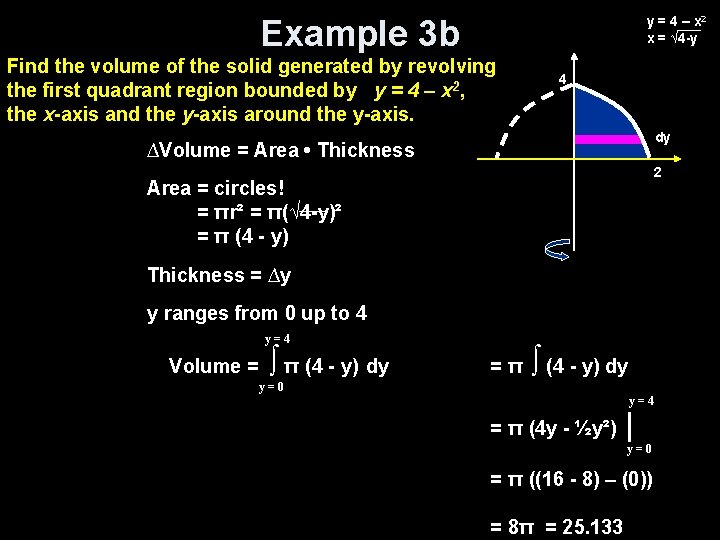
y = 4 – x 2 x = √ 4 -y Example 3 b Find the volume of the solid generated by revolving the first quadrant region bounded by y = 4 – x 2, the x-axis and the y-axis around the y-axis. 4 dy ∆Volume = Area • Thickness 2 Area = circles! = πr² = π(√ 4 -y)² = π (4 - y) Thickness = ∆y y ranges from 0 up to 4 y=4 Volume = ∫ π (4 - y) dy =π ∫ (4 - y) dy y=0 y=4 = π (4 y - ½y²) | y=0 = π ((16 - 8) – (0)) = 8π = 25. 133
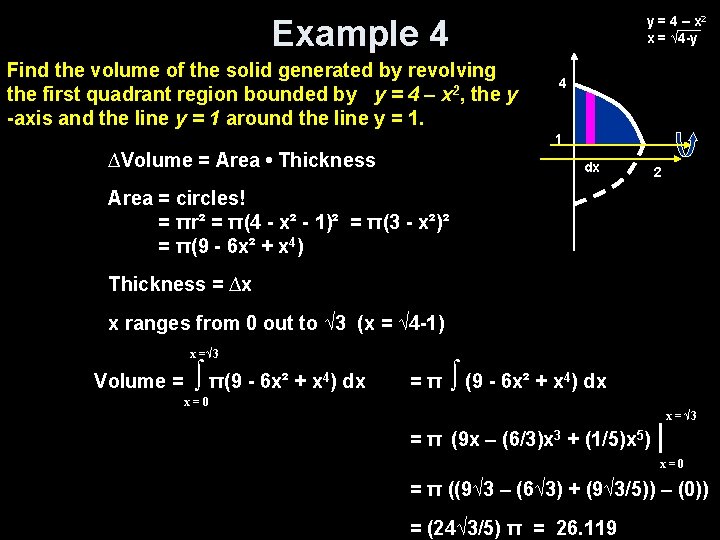
y = 4 – x 2 x = √ 4 -y Example 4 Find the volume of the solid generated by revolving the first quadrant region bounded by y = 4 – x 2, the y -axis and the line y = 1 around the line y = 1. 4 1 ∆Volume = Area • Thickness dx 2 Area = circles! = πr² = π(4 - x² - 1)² = π(3 - x²)² = π(9 - 6 x² + x 4) Thickness = ∆x x ranges from 0 out to √ 3 (x = √ 4 -1) x =√ 3 Volume = ∫ π(9 - 6 x² + x 4) dx =π ∫ (9 - 6 x² + x 4) dx x=0 = π (9 x – (6/3)x 3 + (1/5)x 5) | x = √ 3 x=0 = π ((9√ 3 – (6√ 3) + (9√ 3/5)) – (0)) = (24√ 3/5) π = 26. 119
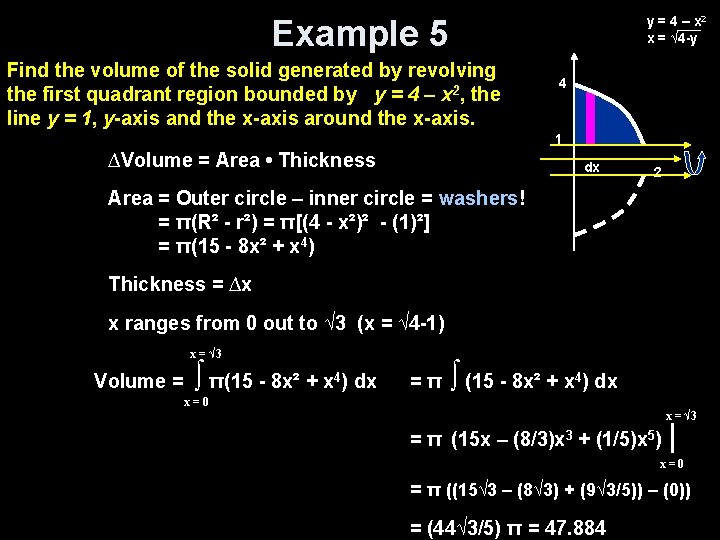
y = 4 – x 2 x = √ 4 -y Example 5 Find the volume of the solid generated by revolving the first quadrant region bounded by y = 4 – x 2, the line y = 1, y-axis and the x-axis around the x-axis. 4 1 ∆Volume = Area • Thickness dx 2 Area = Outer circle – inner circle = washers! = π(R² - r²) = π[(4 - x²)² - (1)²] = π(15 - 8 x² + x 4) Thickness = ∆x x ranges from 0 out to √ 3 (x = √ 4 -1) x = √ 3 Volume = ∫ π(15 - 8 x² + x 4) dx =π ∫ (15 - 8 x² + x 4) dx x=0 x = √ 3 = π (15 x – (8/3)x 3 + (1/5)x 5) | x=0 = π ((15√ 3 – (8√ 3) + (9√ 3/5)) – (0)) = (44√ 3/5) π = 47. 884
In-Class Quiz • Friday • Covering 6 -1 and 6 -2 – Area under and between curves – Volumes • Disc method • Washer method • Know cross-sectional areas (extra-credit)
Summary & Homework • Summary: – – Area between curves is still a height times a width Width is always dx (vertical) or dy (horizontal) Height is the difference between the curves Volume is an Area times a thickness (dy or dx) • Homework: – pg 452 -455, 3, 7, 13, 14, 17
- Slides: 13