
Lesson 6 1 Introduction to Probability Knowledge Objectives
Lesson 6 – 1 Introduction to Probability
Knowledge Objectives • List three methods that can be used to calculate or estimate the chances of an event occurring. • Define simulation. • List the five steps involved in a simulation. • Explain what is meant by independent trials.
Construction Objectives • Use a table of random digits to carry out a simulation. • Given a probability problem, conduct a simulation in order to estimate the probability desired. • Use a calculator or a computer to conduct a simulation of a probability problem.
Vocabulary • Probability model – calculates theoretical probability for a set of circumstances • Probability – describes the pattern of chance outcomes • Simulation – imitation of chance behavior, based on a model that accurately reflects the phenomenon under consideration • Trials – many repetitions of a simulation or experiments • Independent – one repetition does not affect the outcome of another
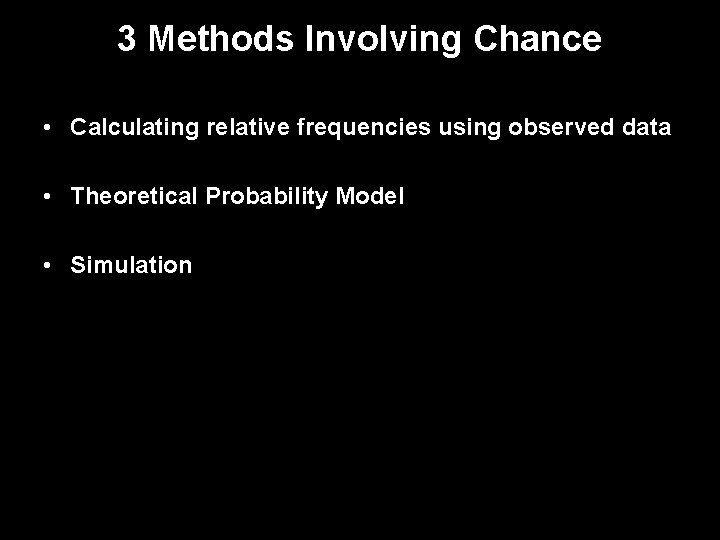
3 Methods Involving Chance • Calculating relative frequencies using observed data • Theoretical Probability Model • Simulation

Simulation • Imitation of chance behavior based on a model that accurately reflects the phenomenon under consideration • Can use our calculator in many ways – Prob. Sim application – Random number generation • Can use a random number table (table b in book)
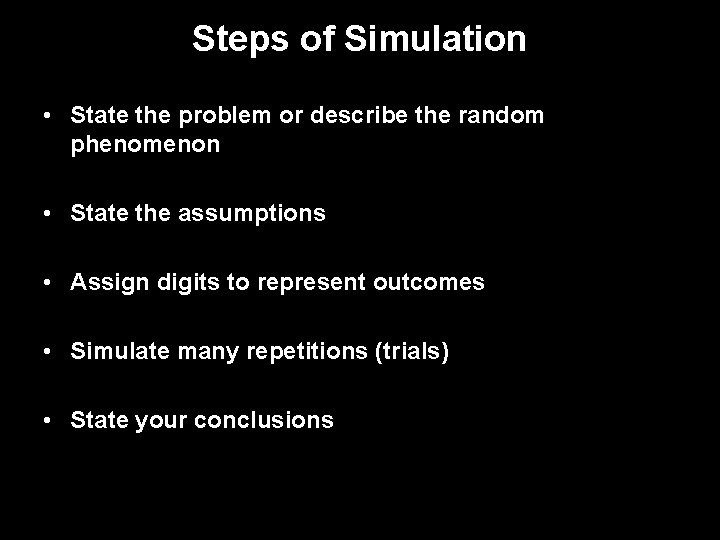
Steps of Simulation • State the problem or describe the random phenomenon • State the assumptions • Assign digits to represent outcomes • Simulate many repetitions (trials) • State your conclusions
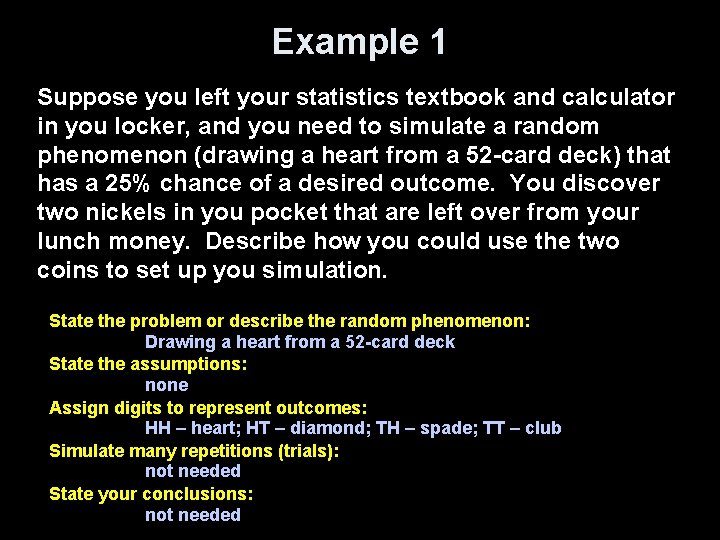
Example 1 Suppose you left your statistics textbook and calculator in you locker, and you need to simulate a random phenomenon (drawing a heart from a 52 -card deck) that has a 25% chance of a desired outcome. You discover two nickels in you pocket that are left over from your lunch money. Describe how you could use the two coins to set up you simulation. State the problem or describe the random phenomenon: Drawing a heart from a 52 -card deck State the assumptions: none Assign digits to represent outcomes: HH – heart; HT – diamond; TH – spade; TT – club Simulate many repetitions (trials): not needed State your conclusions: not needed
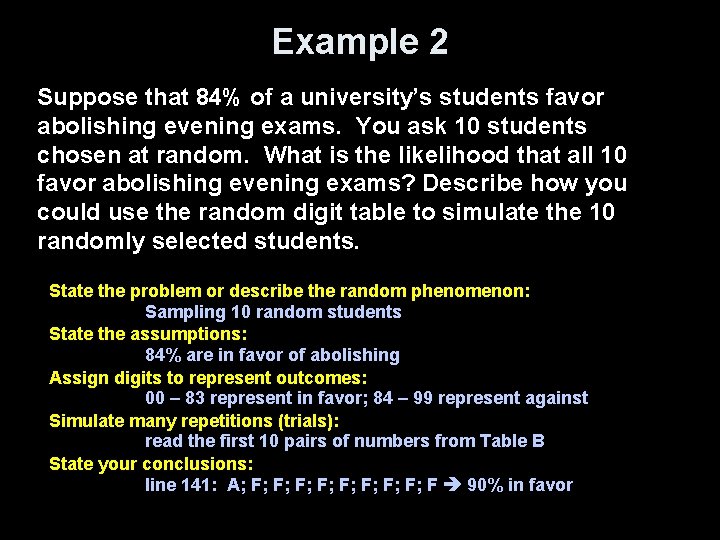
Example 2 Suppose that 84% of a university’s students favor abolishing evening exams. You ask 10 students chosen at random. What is the likelihood that all 10 favor abolishing evening exams? Describe how you could use the random digit table to simulate the 10 randomly selected students. State the problem or describe the random phenomenon: Sampling 10 random students State the assumptions: 84% are in favor of abolishing Assign digits to represent outcomes: 00 – 83 represent in favor; 84 – 99 represent against Simulate many repetitions (trials): read the first 10 pairs of numbers from Table B State your conclusions: line 141: A; F; F; F 90% in favor
Using the TI 83 to Simulate MATH PRB rand. Int(lbound, ubound, number of trials) example: rand. Int(1, 6, 500) STO L 1 generates 500 uniform random numbers between 1 and 6 and stores in L 1
Example 3 Use your calculator to repeat example 2 State the problem or describe the random phenomenon: Sampling 10 random students State the assumptions: 84% are in favor of abolishing Assign digits to represent outcomes: 00 – 83 represent in favor; 84 – 99 represent against Simulate many repetitions (trials): rand. Int(0, 99, 10) State your conclusions: calculator: F; F; A; F 90% in favor
Summary and Homework • Summary – Probability models are used for theoretical probabilities – Observed phenomenon data can give insight – Carefully designed simulation can approximate things • State the problem or describe the random phenomenon • State the assumptions • Assign digits to represent outcomes • Simulate many repetitions (trials) • State your conclusions • Homework – pg 397 6 -1, 4, 5, 8, 15
- Slides: 12