
LESSON 53 CORRESPONDING PARTS OF POLYGONS Do Now


- Slides: 20
LESSON 53 CORRESPONDING PARTS OF POLYGONS Do Now: Define “Corresponding Parts” in your notebook.
Page 256
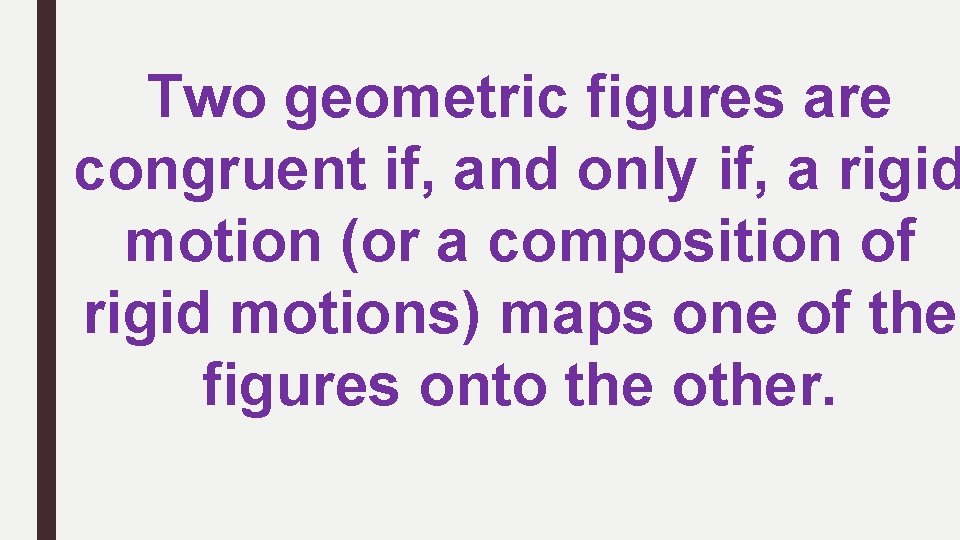
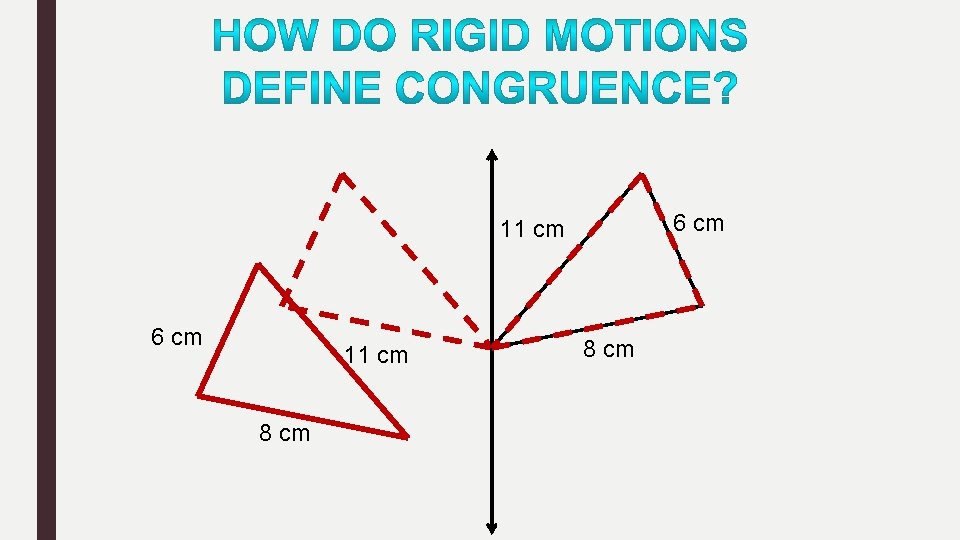
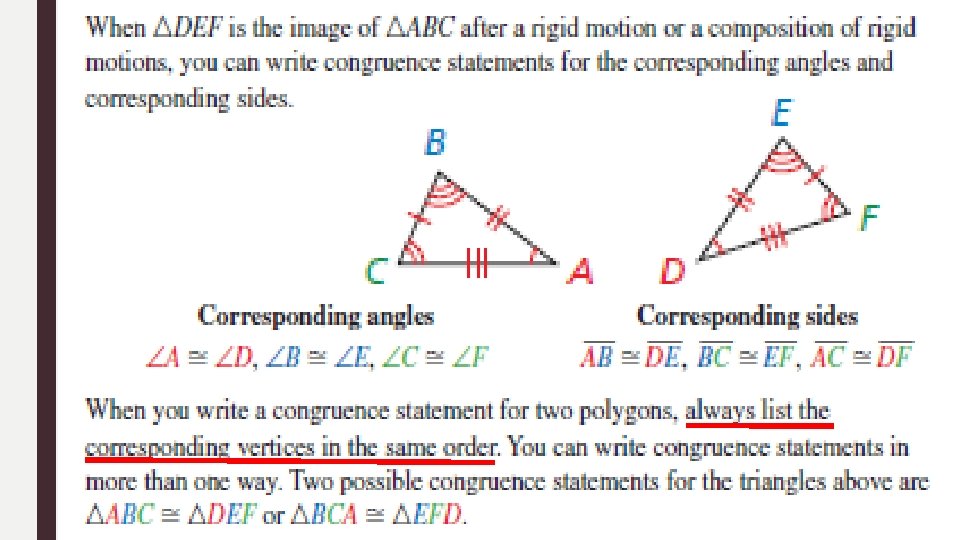
Two geometric figures are congruent if, and only if, a rigid motion (or a composition of rigid motions) maps one of the figures onto the other.
6 cm 11 cm 8 cm
What does corresponding mean?
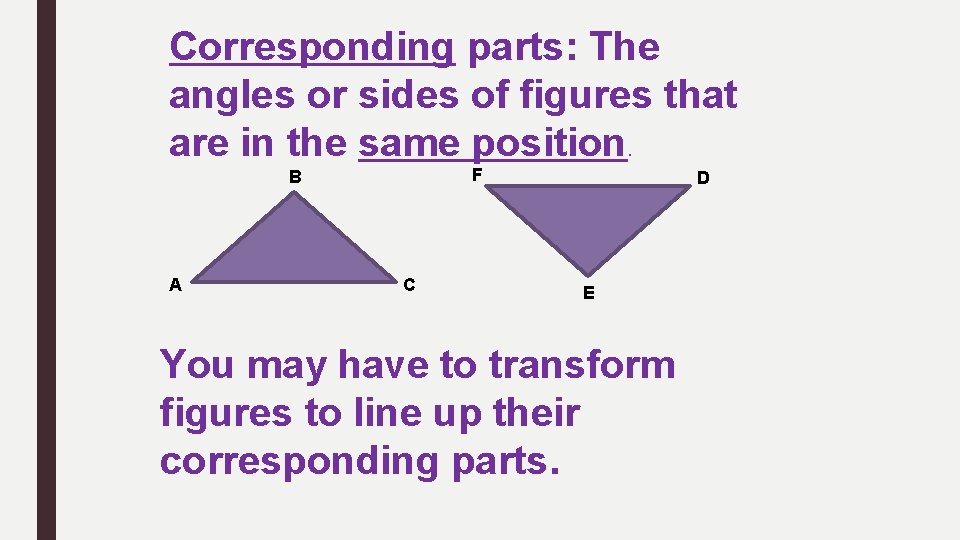
Corresponding parts: The angles or sides of figures that are in the same position. F B A C D E You may have to transform figures to line up their corresponding parts.
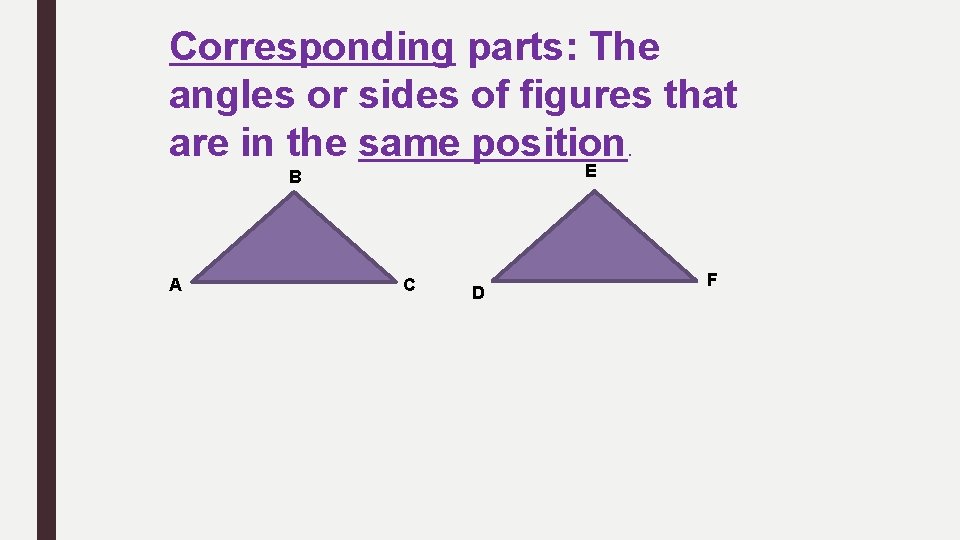
Corresponding parts: The angles or sides of figures that are in the same position. E B A C D F
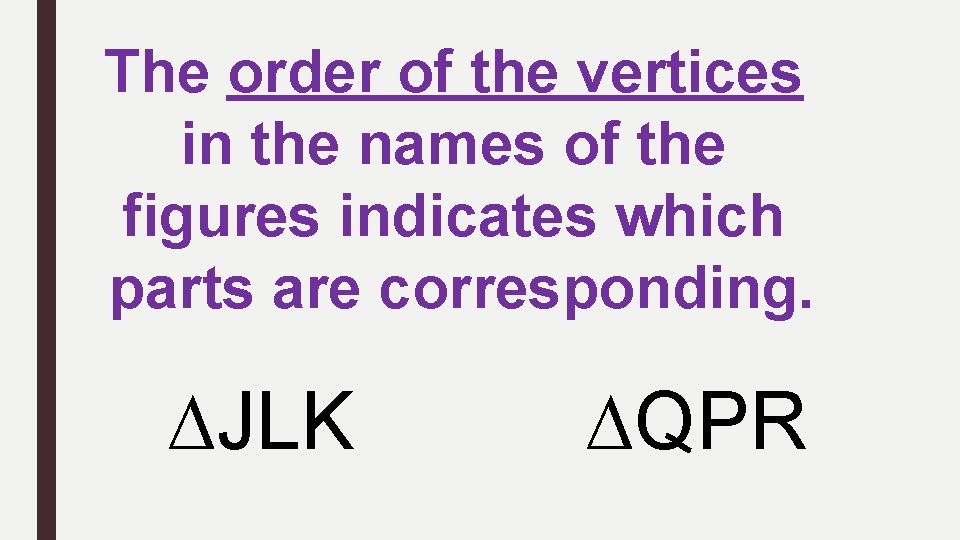
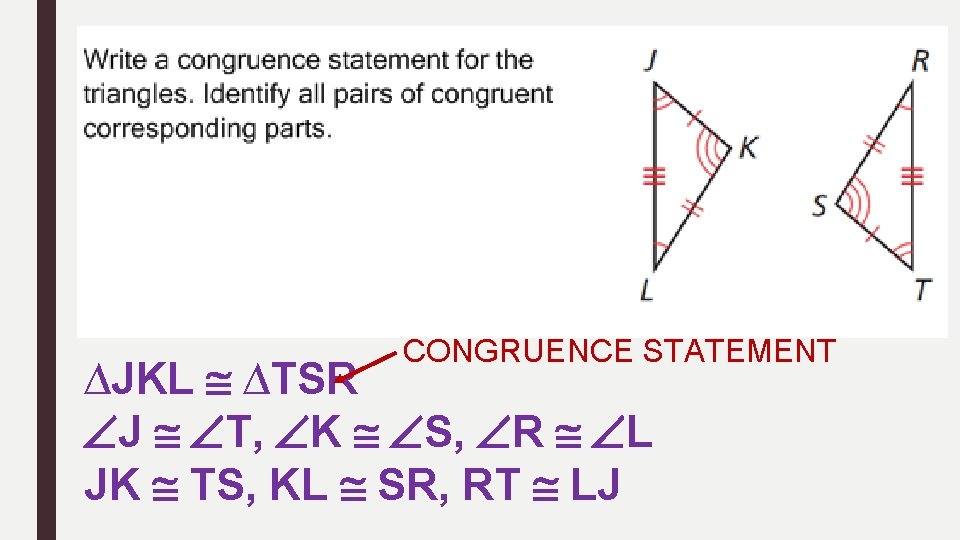
The order of the vertices in the names of the figures indicates which parts are corresponding. ∆JLK ∆QPR
CONGRUENCE STATEMENT ∆JKL ∆TSR J T, K S, R L JK TS, KL SR, RT LJ
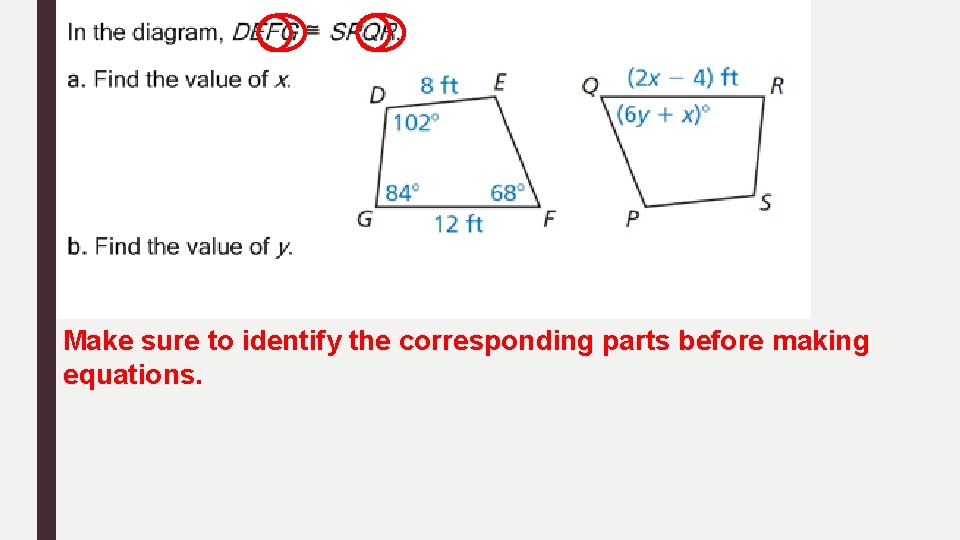
Make sure to identify the corresponding parts before making equations.
Another way to prove figures are congruent is to show all their corresponding parts (sides and angles) are congruent.
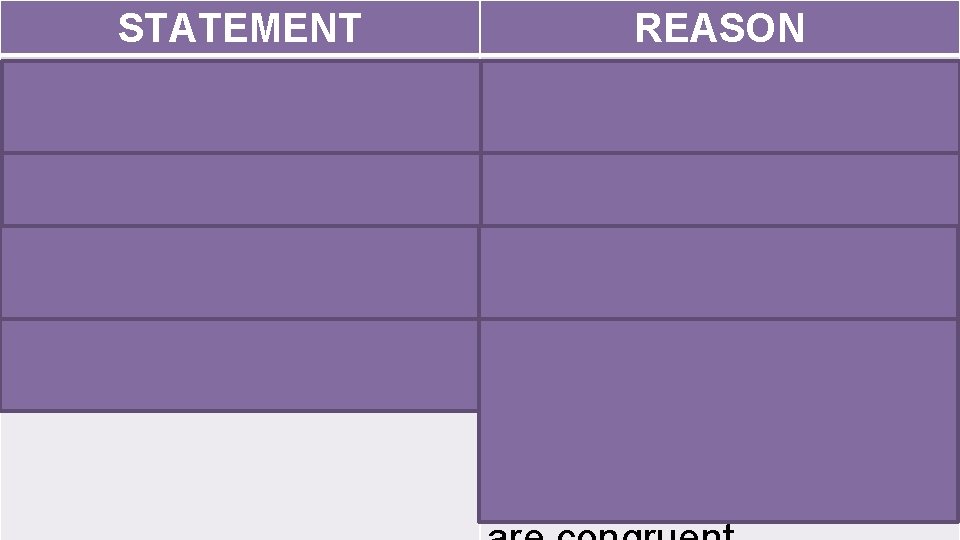
Theorem: If the corresponding parts (angles & sides) of 2 polygons are congruent, then the polygons are congruent.
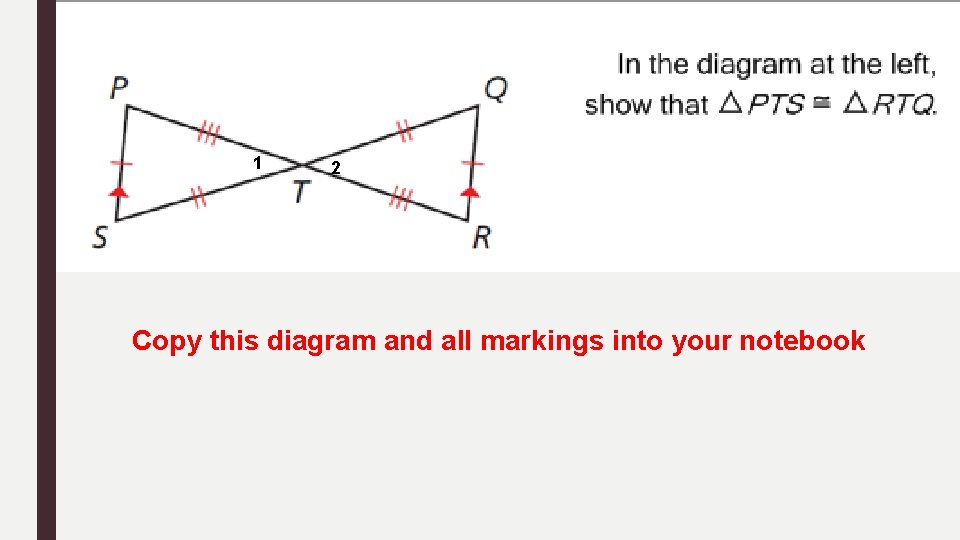
1 2 Copy this diagram and all markings into your notebook
STATEMENT 1. PT RT, QT ST, SP QR, PS // RQ 2. <1 <2 3. <S <Q, <P <R 4. PTS RTQ REASON 1. Given 2. Vertical Angles Theorem 3. Alternate Interior Angles Theorem 4. If the corresponding parts of 2 polygons are congruent, the polygons
HW # 53 page 236 -238/ # 1, 2, 26, 27, 50 page 243 -244/ # 1, 2, 4 -8, 10, 12, 14, 17, 26 -29