
Lesson 52 The Sabbath Day Luke 13 14
Lesson 52 The Sabbath Day Luke 13 -14 Including: The Parable of the Fig Tree Parable of the Great Supper

The Parable of the Fig Tree Certain man = God Fig Tree = The Jewish remnant of Israel was failing to produce righteousness within its season of opportunity Dresser of his vineyard = The Son of God. Vineyard = The world ccccc Luke 13: 6 -9 He granted a final year for the tree to bear fruit, during which time it had to either produce fruit or be removed from the vineyard.

Under A Fig Tree “Under the fig tree” was a common phrase in Israel that indicated peace, security, and prosperity. (2) “Nation shall not lift up a sword against nation, neither shall they learn war any more. But they shall sit every man under his vine and under his fig tree; and none shall make them afraid. ” (Micah 4: 3 -4) Some rabbinical sources suggest that “under the fig tree” is the proper place for personal scripture study and may be synonymous with the phrase “in search of truth” (3) Jesus greeted Nathanael with these words: “Behold an Israelite indeed, in whom is no guile? ” Nathanael said to him, “Whence knowest thou me? Jesus answered and said , “Before that Philip called thee, when thou wast under the fig tree, I saw thee. ” (John 1: 47 -48) Luke 13: 6 -9 (2, 3)
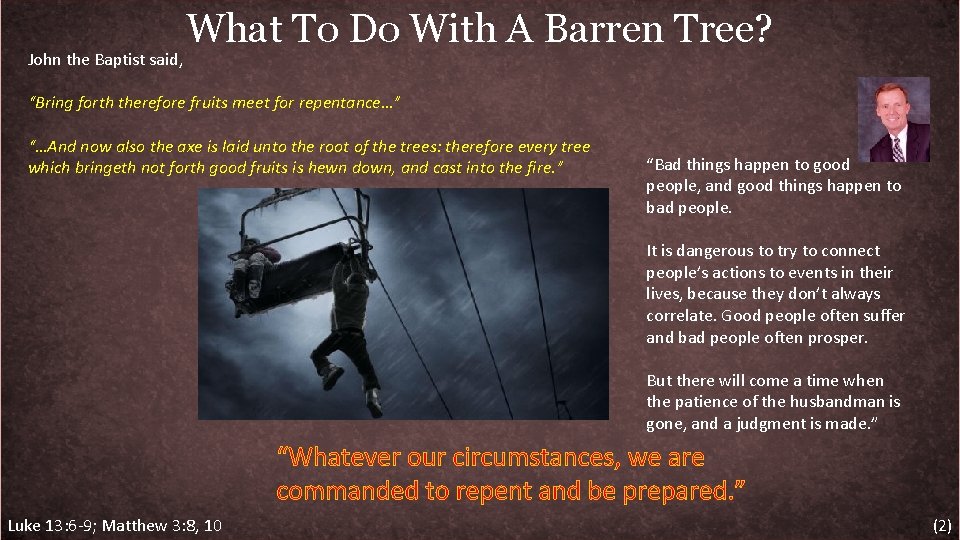
John the Baptist said, What To Do With A Barren Tree? “Bring forth therefore fruits meet for repentance…” “…And now also the axe is laid unto the root of the trees: therefore every tree which bringeth not forth good fruits is hewn down, and cast into the fire. ” “Bad things happen to good people, and good things happen to bad people. It is dangerous to try to connect people’s actions to events in their lives, because they don’t always correlate. Good people often suffer and bad people often prosper. But there will come a time when the patience of the husbandman is gone, and a judgment is made. ” “Whatever our circumstances, we are commanded to repent and be prepared. ” Luke 13: 6 -9; Matthew 3: 8, 10 (2)
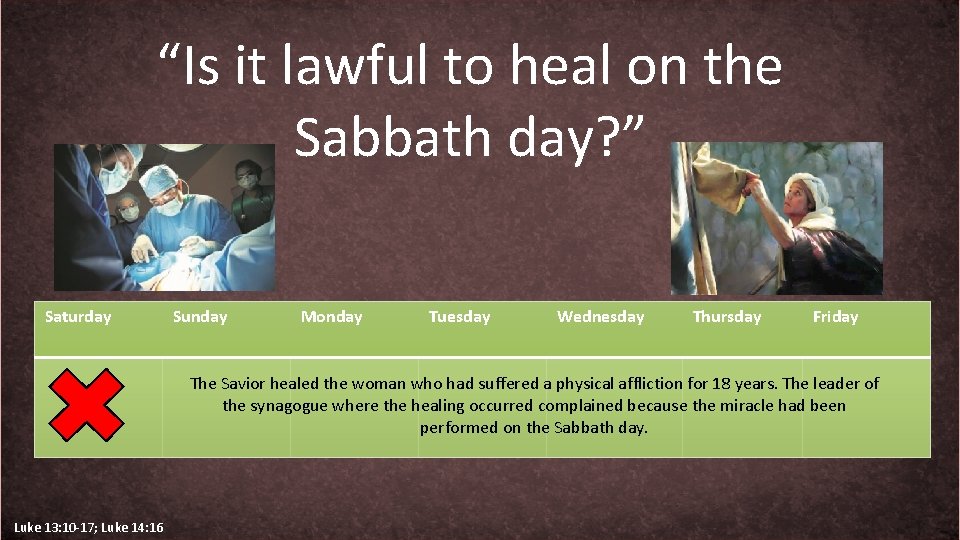
“Is it lawful to heal on the Sabbath day? ” Saturday Sunday Monday Tuesday Wednesday Thursday Friday The Savior healed the woman who had suffered a physical affliction for 18 years. The leader of the synagogue where the healing occurred complained because the miracle had been performed on the Sabbath day. Luke 13: 10 -17; Luke 14: 16
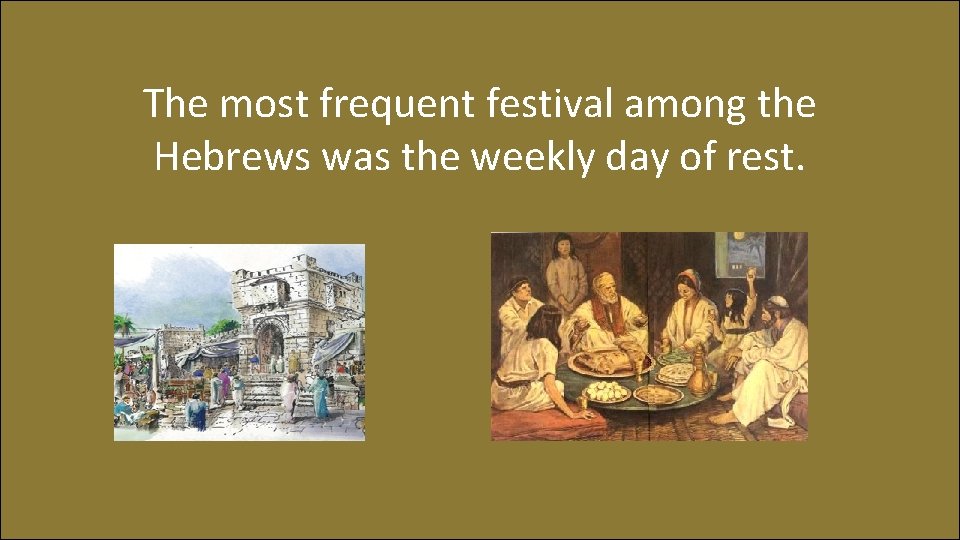
The most frequent festival among the Hebrews was the weekly day of rest.
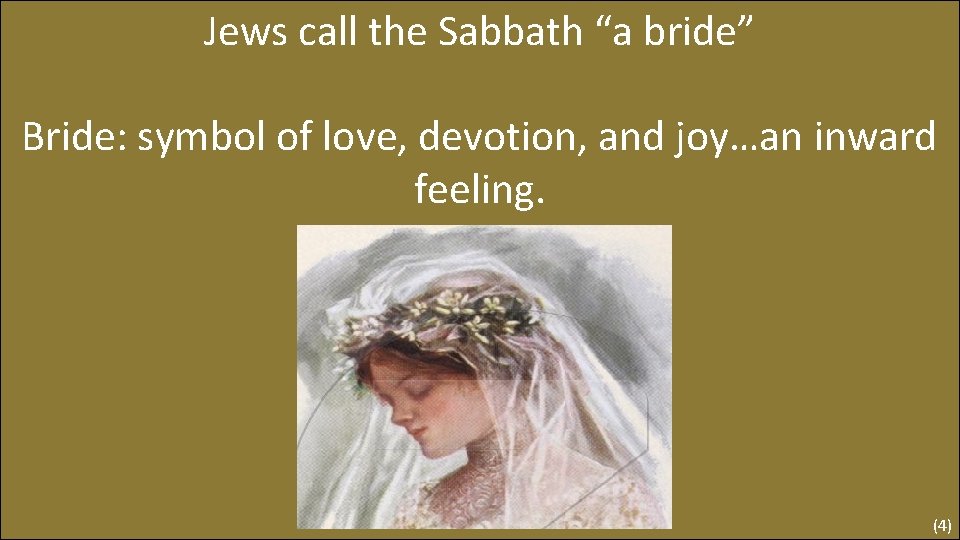
Jews call the Sabbath “a bride” Bride: symbol of love, devotion, and joy…an inward feeling. (4)
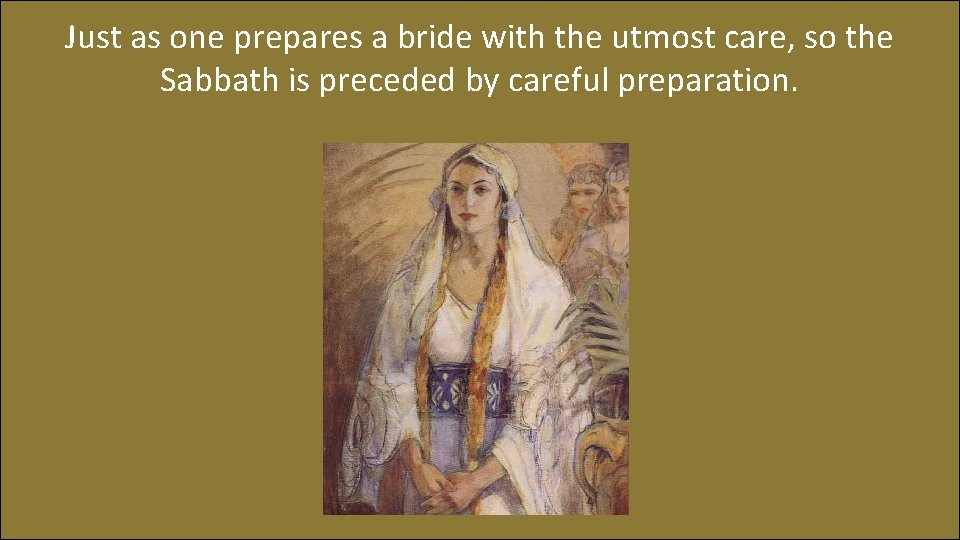
Just as one prepares a bride with the utmost care, so the Sabbath is preceded by careful preparation.
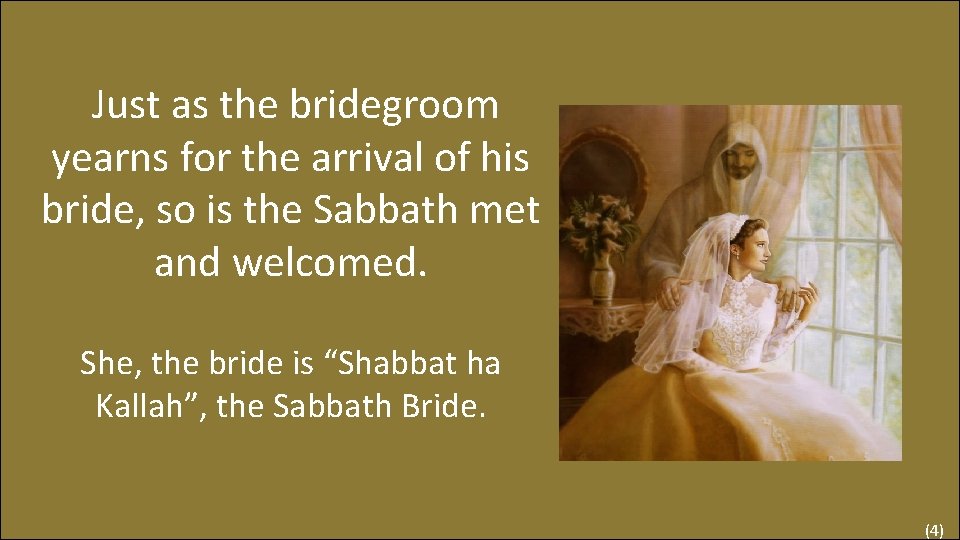
Just as the bridegroom yearns for the arrival of his bride, so is the Sabbath met and welcomed. She, the bride is “Shabbat ha Kallah”, the Sabbath Bride. (4)
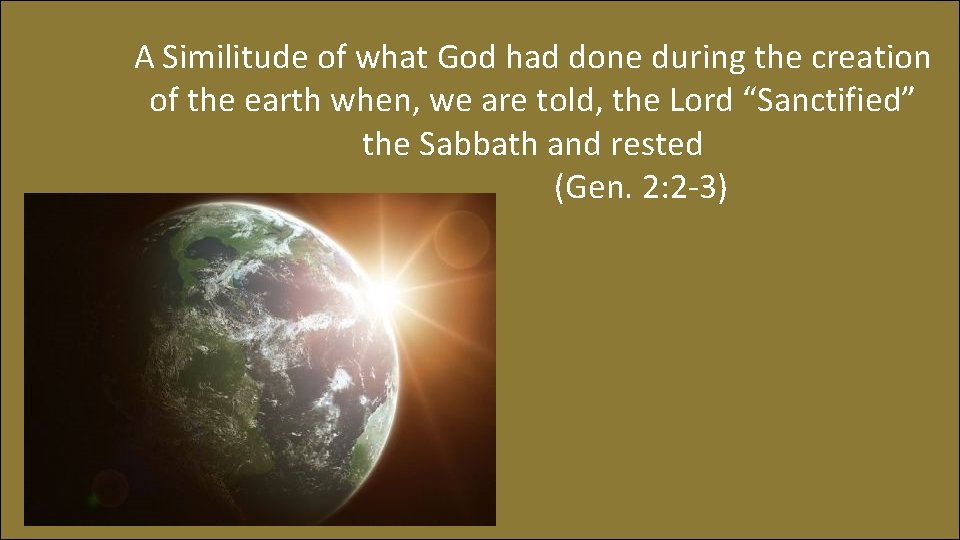
A Similitude of what God had done during the creation of the earth when, we are told, the Lord “Sanctified” the Sabbath and rested (Gen. 2: 2 -3)
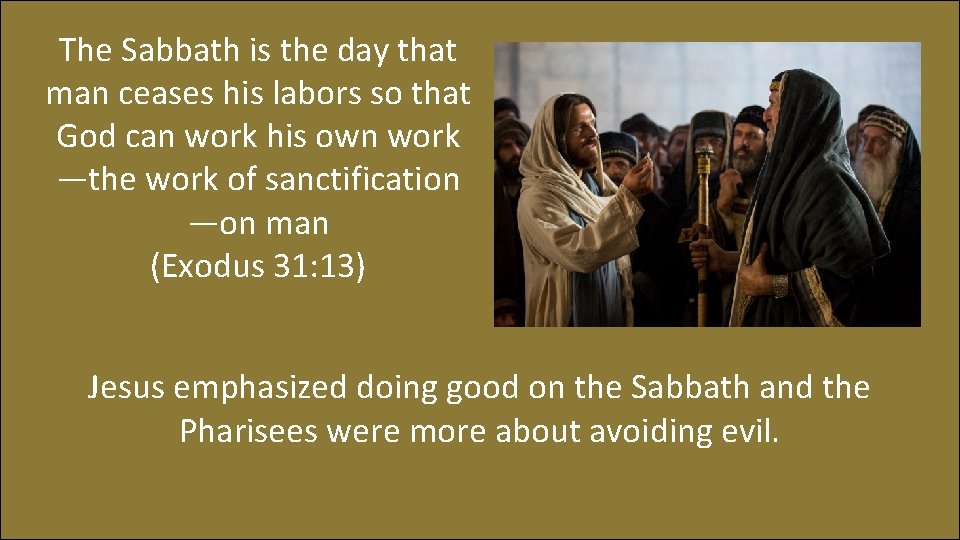
The Sabbath is the day that man ceases his labors so that God can work his own work —the work of sanctification —on man (Exodus 31: 13) Jesus emphasized doing good on the Sabbath and the Pharisees were more about avoiding evil.
For 6 periods of time God created the earth and it’s inhabitants. On the 7 th day he rested…
th The 7 day : A Reward…all previous days were a preparation designed for the sanctification of the sacrament.
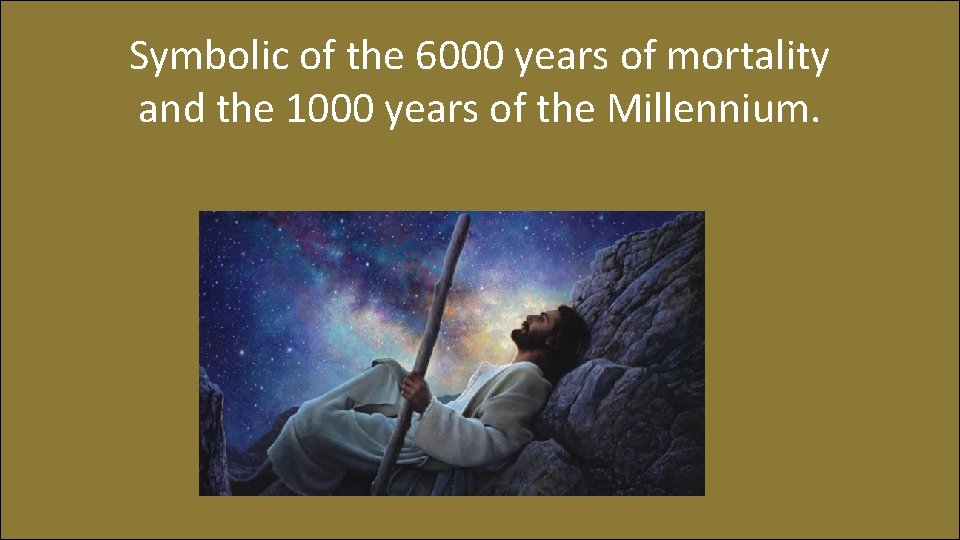
Symbolic of the 6000 years of mortality and the 1000 years of the Millennium.
What will be different in the Millennium? No Satan… So…
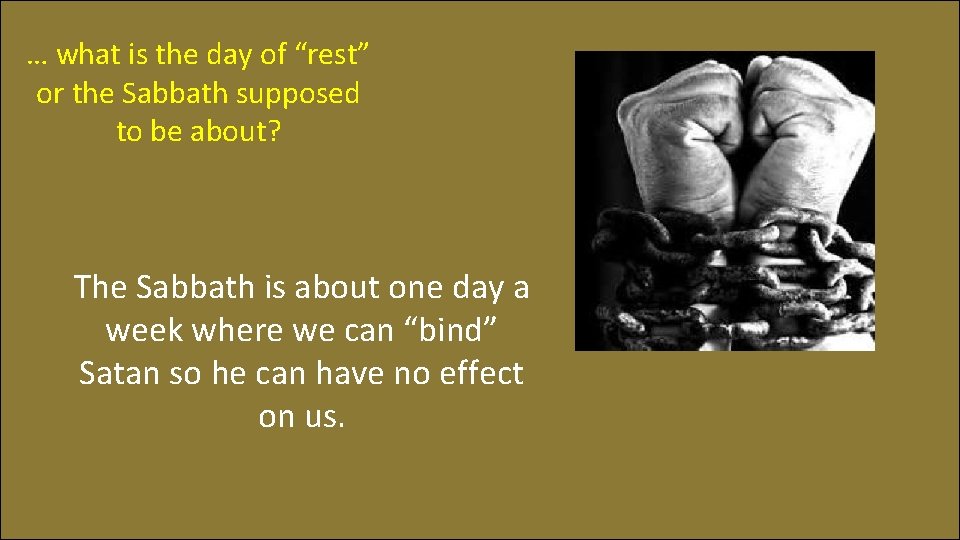
… what is the day of “rest” or the Sabbath supposed to be about? The Sabbath is about one day a week where we can “bind” Satan so he can have no effect on us.
How do we do that? By getting out of the world, so that the world can get out of us. It is a practice of “binding Satan” and removing his influences in our lives.
A Sabbatic Year In addition to the weekly Sabbath, the Lord in mercy prescribed that every seventh year the land was to rest. Leviticus 25: 1 -8
The Sabbaths established by the Lord, whether of days, of years, or of weeks of years, were to be times of refreshing, relief, blessing, bounty, and worship. (5)

Sabbatical ---leaving untilled, your labors—requiring man to exercise faith that God will sustain his people both temporally and spiritually
We are either growing spiritually or we are losing ground We either feed the spirit or it withers and dies.
Of what value has the Sabbath day been to us if we have not grown spiritually?
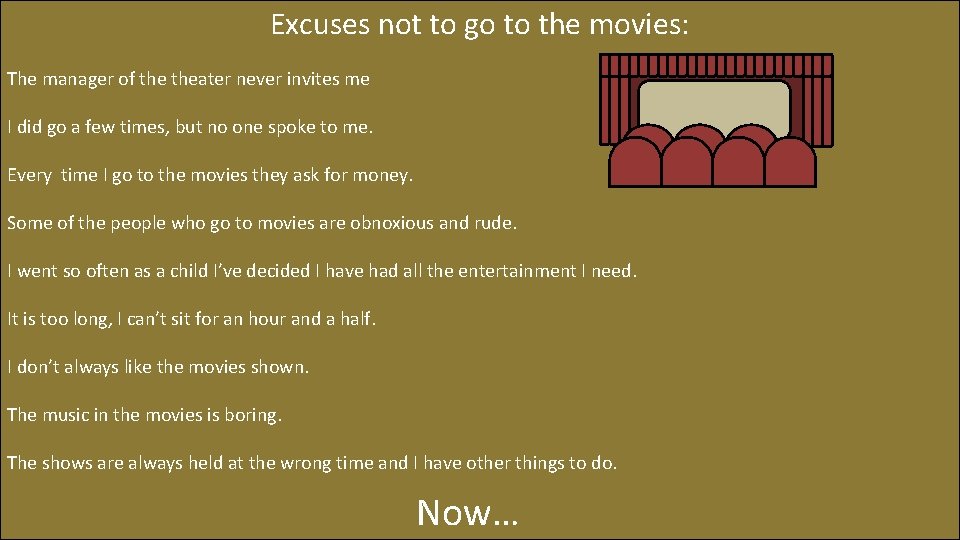
Excuses not to go to the movies: The manager of theater never invites me I did go a few times, but no one spoke to me. Every time I go to the movies they ask for money. Some of the people who go to movies are obnoxious and rude. I went so often as a child I’ve decided I have had all the entertainment I need. It is too long, I can’t sit for an hour and a half. I don’t always like the movies shown. The music in the movies is boring. The shows are always held at the wrong time and I have other things to do. Now…
Excuses not to go to church: The bishop never invites me. I did go a few times, but no one spoke to me. Every time I go to church they ask for money. Not everyone who goes church live up to the high standards of the church. I went so often as a child I’ve decided I have had all lessons I need. It is too long, I can’t sit for an hour and a half I don’t always like what I hear and see there. I don’t like some of the hymns. Church is always held at the wrong time and I have other things to do.
How do we decide what is appropriate for the Sabbath? 1. Can it be done wearing Sunday clothes? 2. Will it take me away from my meetings? 3. Will I be setting a good example for others? 4. Will I stay unspotted from the world?
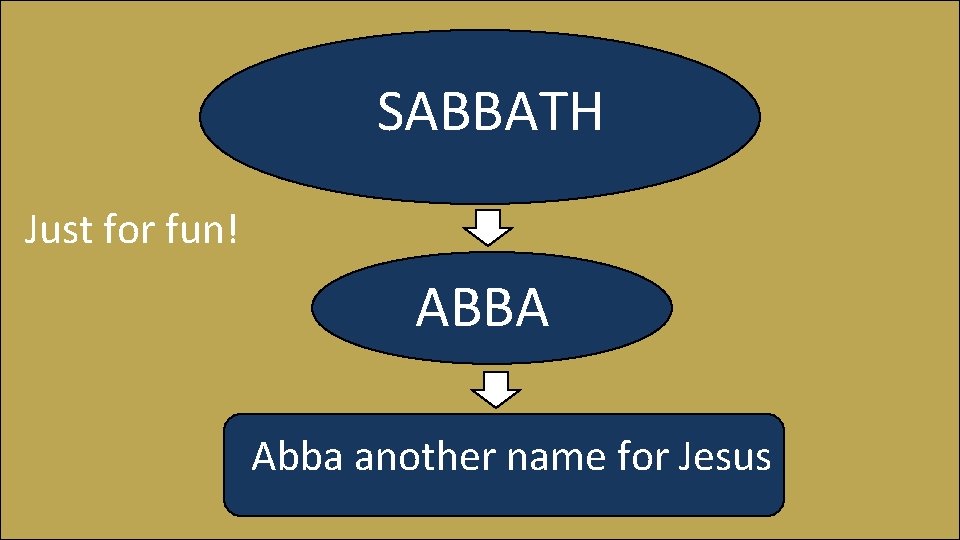
SABBATH Just for fun! ABBA Abba another name for Jesus
Three reasons God has asked us to honor the Sabbath day: 1. The physical need for rest and renewing. 2. The needs for regeneration and the strengthening of our spiritual being 3. Obedience to commandments as an expression of our love for God (6)
Questions to ask yourself each Sabbath day? Have I, this day, learned one new spiritual truth? Have I come one whit closer to understanding and loving my fellowman? Have I resolved anew to become in my words and actions more like Jesus Christ? Have I renewed my solemn covenants with God? Have I kept my mind unhampered by thoughts of violence, financial schemes, petty jealousies, or sordid desires?
Ask Yourself: If Heavenly Father had only the Sabbath days to judge you by… which kingdom would you end up in?
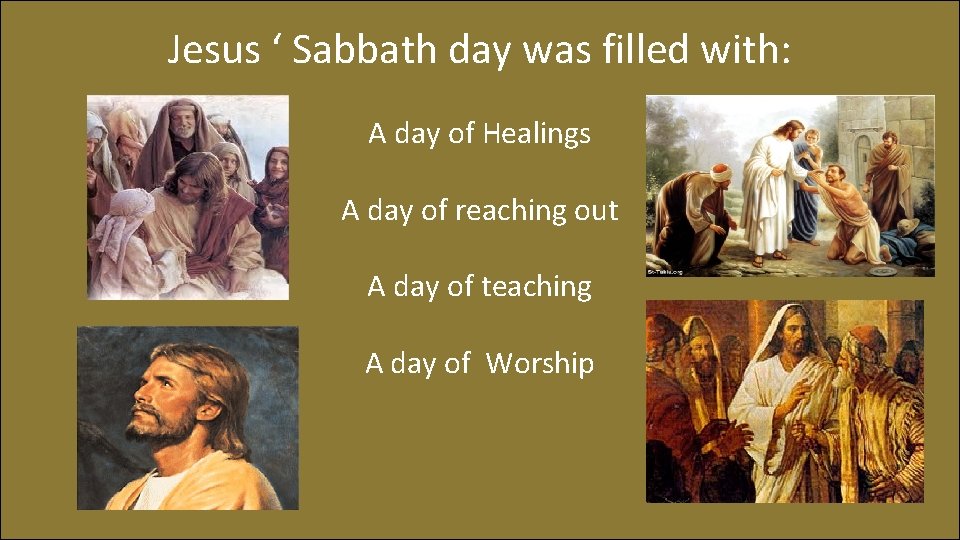
Jesus ‘ Sabbath day was filled with: A day of Healings A day of reaching out A day of teaching A day of Worship
His Invitation Romans 10: 21 Luke 14: 16 -24 Parable of the Great Supper
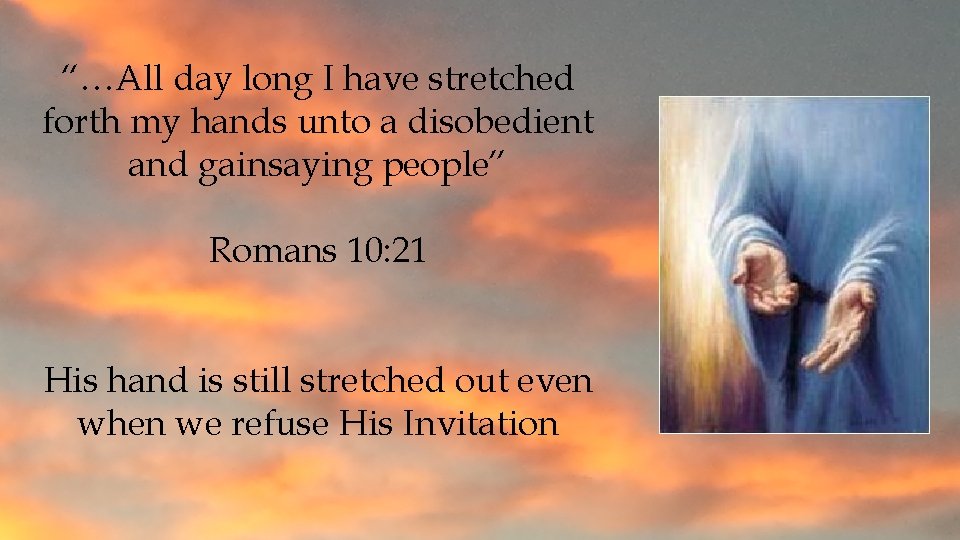
“…All day long I have stretched forth my hands unto a disobedient and gainsaying people” Romans 10: 21 His hand is still stretched out even when we refuse His Invitation
A Certain Man “…Blessed is he that shall eat bread in the kingdom of God. ” Luke 14: 15
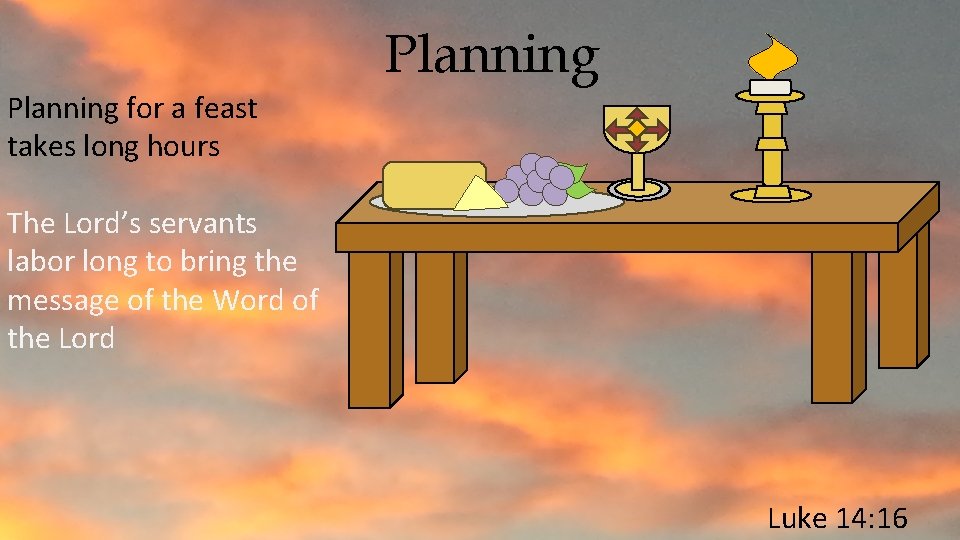
Planning for a feast takes long hours The Lord’s servants labor long to bring the message of the Word of the Lord Luke 14: 16
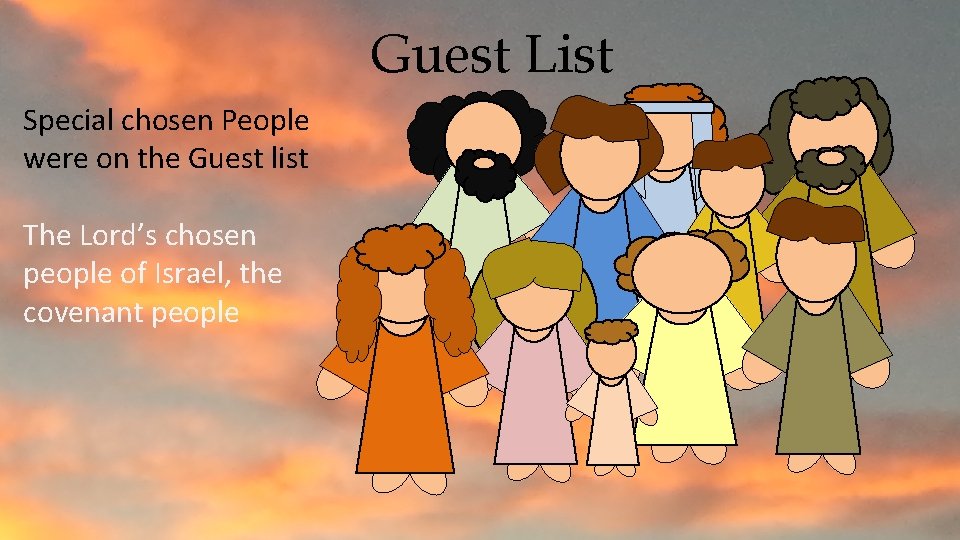
Guest List Special chosen People were on the Guest list The Lord’s chosen people of Israel, the covenant people
An Invitation to the supper (feast. ) was sent out. An Invitation to come unto Christ You are invited “Perhaps there’s only one thing more humiliating than not being invited to a party; inviting people to your party and having them choose not to come…” (2) Luke 14: 17
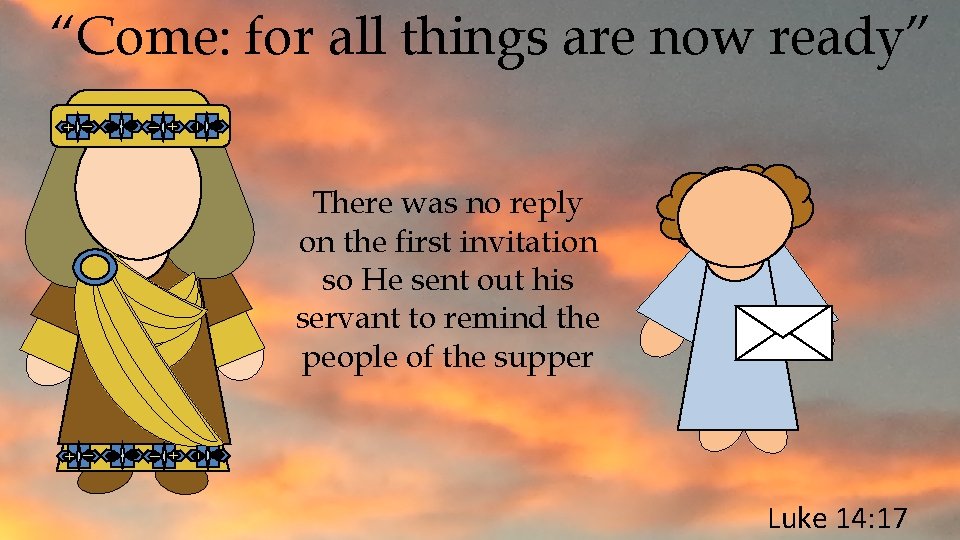
“Come: for all things are now ready” There was no reply on the first invitation so He sent out his servant to remind the people of the supper Luke 14: 17
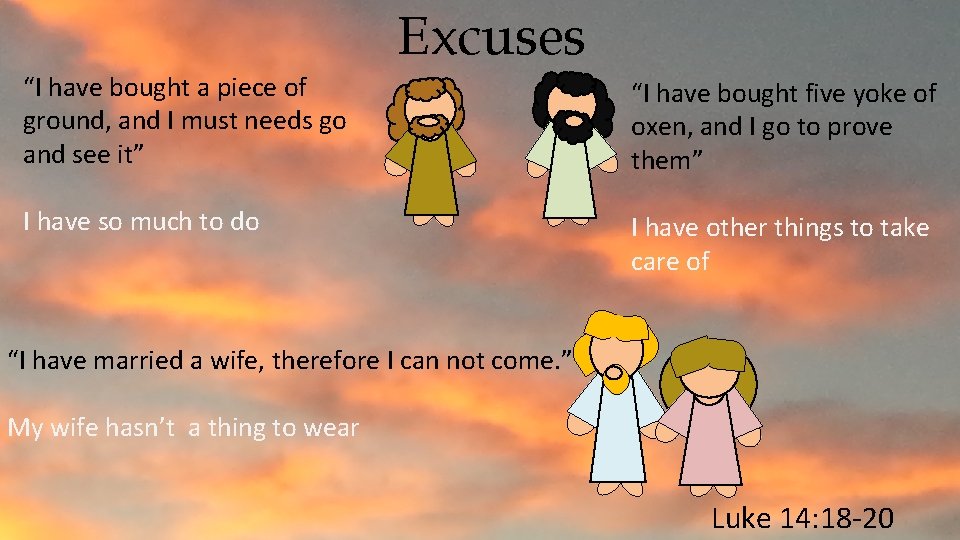
Excuses “I have bought a piece of ground, and I must needs go and see it” “I have bought five yoke of oxen, and I go to prove them” I have so much to do I have other things to take care of “I have married a wife, therefore I can not come. ” My wife hasn’t a thing to wear Luke 14: 18 -20
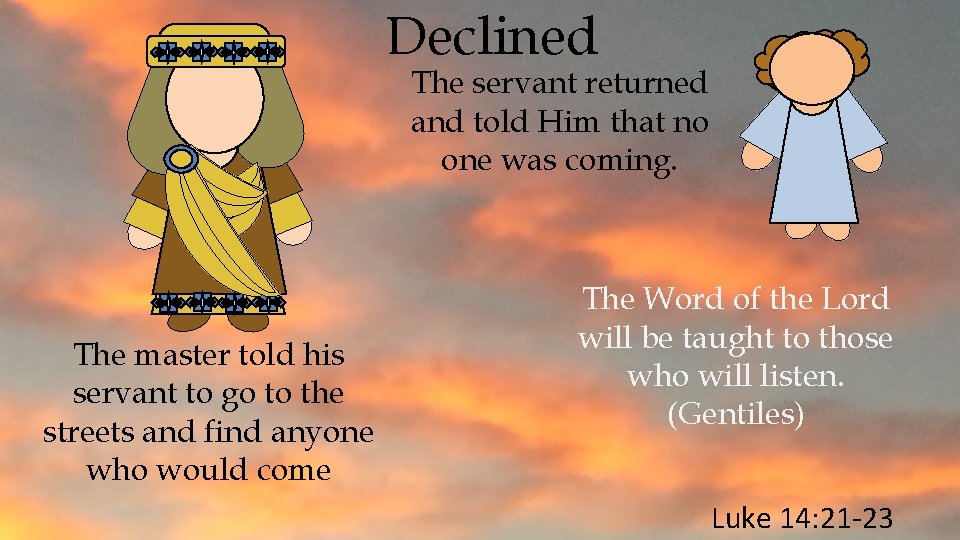
Declined The servant returned and told Him that no one was coming. The master told his servant to go to the streets and find anyone who would come The Word of the Lord will be taught to those who will listen. (Gentiles) Luke 14: 21 -23
“…The gladsome invitation was to be carried to the Gentiles, who were looked upon as spiritually poor, maimed, halt, and blind. And later, even the pagans beyond the walls, strangers in the gates of the holy city, would be bidden to the supper. ” (6)
What should I do? ? Accept the invitation. Don’t let unimportant things or material things, keep you from feasting at the Lord’s table ? Important: Those who found excuses were not going off to sin. Their excuses were not evil, just misplaced priorities
…Even when we refuse his invitations “His hand is stretched out still. ” Isaiah 9: 12, 17, 21
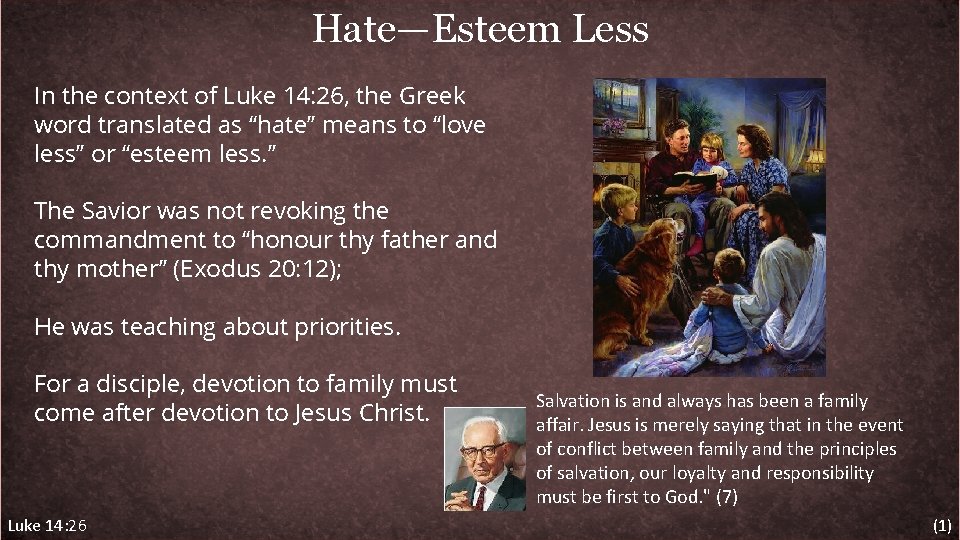
Hate—Esteem Less In the context of Luke 14: 26, the Greek word translated as “hate” means to “love less” or “esteem less. ” The Savior was not revoking the commandment to “honour thy father and thy mother” (Exodus 20: 12); He was teaching about priorities. For a disciple, devotion to family must come after devotion to Jesus Christ. Luke 14: 26 Salvation is and always has been a family affair. Jesus is merely saying that in the event of conflict between family and the principles of salvation, our loyalty and responsibility must be first to God. " (7) (1)
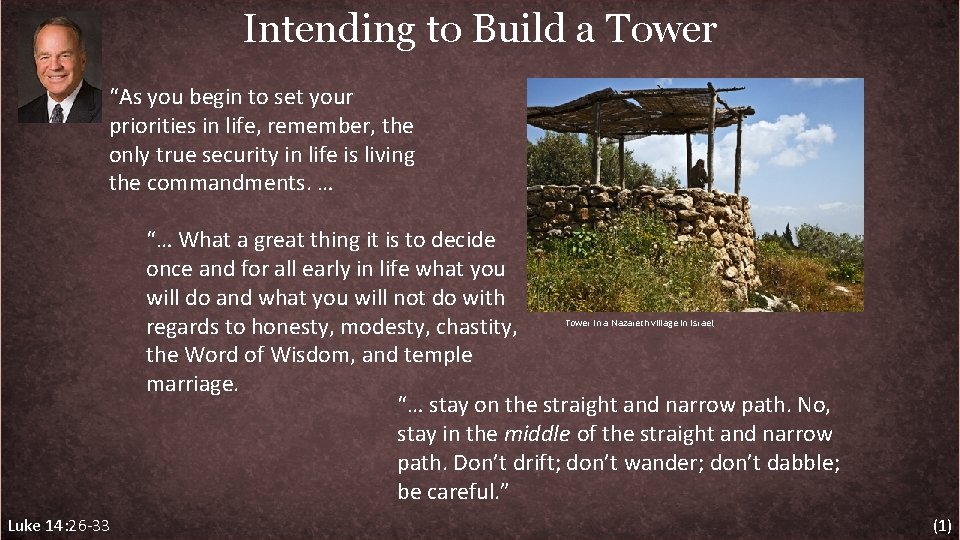
Intending to Build a Tower “As you begin to set your priorities in life, remember, the only true security in life is living the commandments. … “… What a great thing it is to decide once and for all early in life what you will do and what you will not do with regards to honesty, modesty, chastity, the Word of Wisdom, and temple marriage. “… stay on the straight and narrow path. No, stay in the middle of the straight and narrow path. Don’t drift; don’t wander; don’t dabble; be careful. ” Tower in a Nazareth village in Israel, Luke 14: 26 -33 (1)
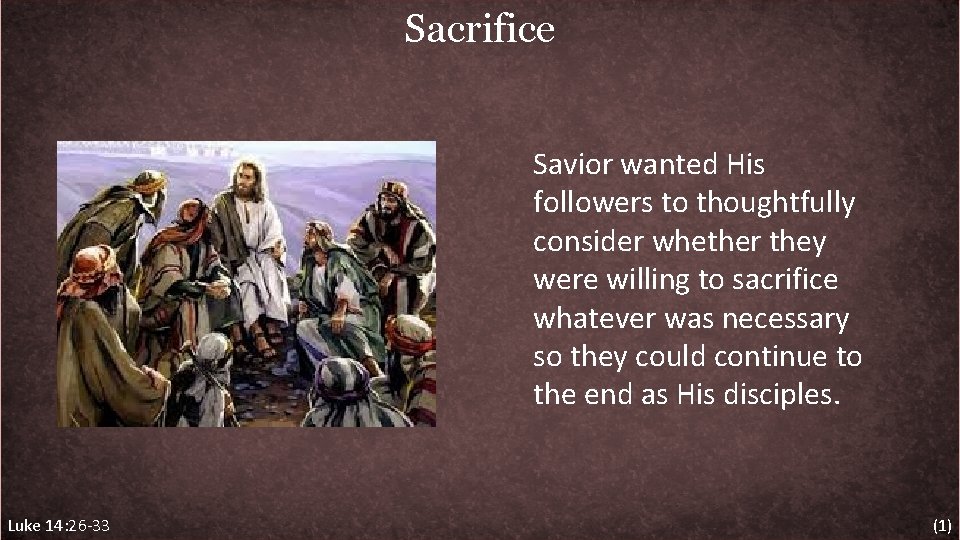
Sacrifice Savior wanted His followers to thoughtfully consider whether they were willing to sacrifice whatever was necessary so they could continue to the end as His disciples. Luke 14: 26 -33 (1)
Sources: Suggested Hymn: #176 Tis Sweet to Sing the Matchless Love Video: Gordon B. Hinckley: Lessons I Learned as a Boy (4: 04) 1. New Testament Institute Student Manual Chapter 17 2. John Bytheway Of Pigs, Pearls and Prodigals p. 138 3. D. Kelly Ogden Where Jesus Walked p. 88 4. Samuel H. Dresner quoted in Essential Judaism: Updated Edition: A Complete Guide to Beliefs, Customs. . . By George Robinson 5. James E. Talmage Jesus the Christ 6. President James E. Faust, Ensign, Nov 1991 p. 475 7. Joseph Fielding Mc. Conkie, Gospel Symbolism [Salt Lake City: Bookcraft, 1999], 23. 8. Elder Larry W. Gibbons “Wherefore, Settle This in Your Hearts, ” Ensign or Liahona, Nov. 2006, 103, 104). Presentation by ©http: //fashionsbylynda. com/blog/
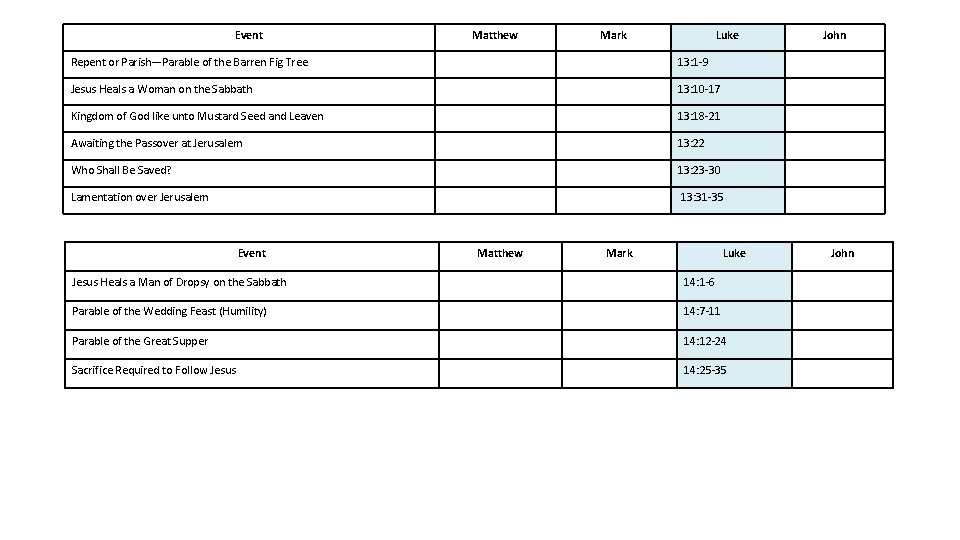
Event Repent or Parish—Parable of the Barren Fig Tree Matthew Jesus Heals a Woman on the Sabbath Mark Luke John 13: 1 -9 13: 10 -17 Kingdom of God like unto Mustard Seed and Leaven 13: 18 -21 Awaiting the Passover at Jerusalem 13: 22 Who Shall Be Saved? 13: 23 -30 Lamentation over Jerusalem 13: 31 -35 Event Matthew Mark Luke John Jesus Heals a Man of Dropsy on the Sabbath 14: 1 -6 Parable of the Wedding Feast (Humility) 14: 7 -11 14: 12 -24 14: 25 -35 Parable of the Great Supper Sacrifice Required to Follow Jesus
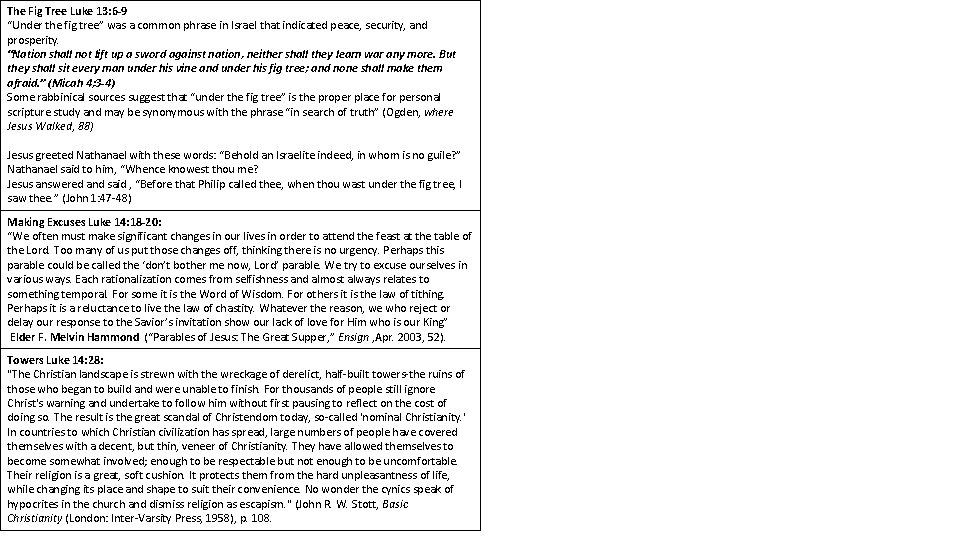
The Fig Tree Luke 13: 6 -9 “Under the fig tree” was a common phrase in Israel that indicated peace, security, and prosperity. “Nation shall not lift up a sword against nation, neither shall they learn war any more. But they shall sit every man under his vine and under his fig tree; and none shall make them afraid. ” (Micah 4; 3 -4) Some rabbinical sources suggest that “under the fig tree” is the proper place for personal scripture study and may be synonymous with the phrase “in search of truth” (Ogden, where Jesus Walked, 88) Jesus greeted Nathanael with these words: “Behold an Israelite indeed, in whom is no guile? ” Nathanael said to him, “Whence knowest thou me? Jesus answered and said , “Before that Philip called thee, when thou wast under the fig tree, I saw thee. ” (John 1: 47 -48) Making Excuses Luke 14: 18 -20: “We often must make significant changes in our lives in order to attend the feast at the table of the Lord. Too many of us put those changes off, thinking there is no urgency. Perhaps this parable could be called the ‘don’t bother me now, Lord’ parable. We try to excuse ourselves in various ways. Each rationalization comes from selfishness and almost always relates to something temporal. For some it is the Word of Wisdom. For others it is the law of tithing. Perhaps it is a reluctance to live the law of chastity. Whatever the reason, we who reject or delay our response to the Savior’s invitation show our lack of love for Him who is our King” Elder F. Melvin Hammond (“Parables of Jesus: The Great Supper, ” Ensign , Apr. 2003, 52). Towers Luke 14: 28: "The Christian landscape is strewn with the wreckage of derelict, half-built towers-the ruins of those who began to build and were unable to finish. For thousands of people still ignore Christ's warning and undertake to follow him without first pausing to reflect on the cost of doing so. The result is the great scandal of Christendom today, so-called 'nominal Christianity. ' In countries to which Christian civilization has spread, large numbers of people have covered themselves with a decent, but thin, veneer of Christianity. They have allowed themselves to become somewhat involved; enough to be respectable but not enough to be uncomfortable. Their religion is a great, soft cushion. It protects them from the hard unpleasantness of life, while changing its place and shape to suit their convenience. No wonder the cynics speak of hypocrites in the church and dismiss religion as escapism. " (John R. W. Stott, Basic Christianity (London: Inter-Varsity Press, 1958), p. 108.

Luke 14: 35 -37 The above example is just another case of scriptural history repeating itself. The pattern goes on and on. In our day as well, there is a corollary to this doctrine of salvation by association. Of necessity, it reveres dead prophets and denies living ones. "'We have Moses and want no Jesus, ' was the ancient cry of the Pharisaic mob; the modern one is, 'We have Jesus and want no Joseph Smith. '" (Contributor, vol. 1 (October 1879 -September 1880), Vol. I. September, 1880 No. 12. 281. )
- Slides: 49