
Lesson 5 Species Interactions Ecological Succession and Population
- Slides: 43
Lesson 5: Species Interactions, Ecological Succession, and Population Control Environmental Science Copyright Grey's Digital Online, LLC 2020 -present (usbiologyteaching. com) 1
Lesson 5. 1 How Do Species Interact?
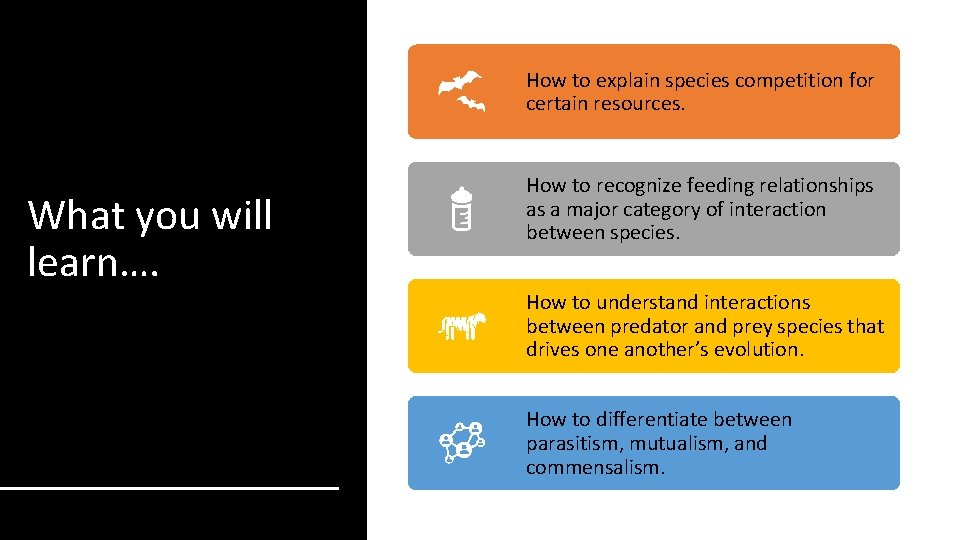
How to explain species competition for certain resources. What you will learn…. How to recognize feeding relationships as a major category of interaction between species. How to understand interactions between predator and prey species that drives one another’s evolution. How to differentiate between parasitism, mutualism, and commensalism.
Interspecific competition Resource partitioning Predation Key Terms Predator Prey Predator-prey relationship Coevolution Parasitism Mutualism commensalism
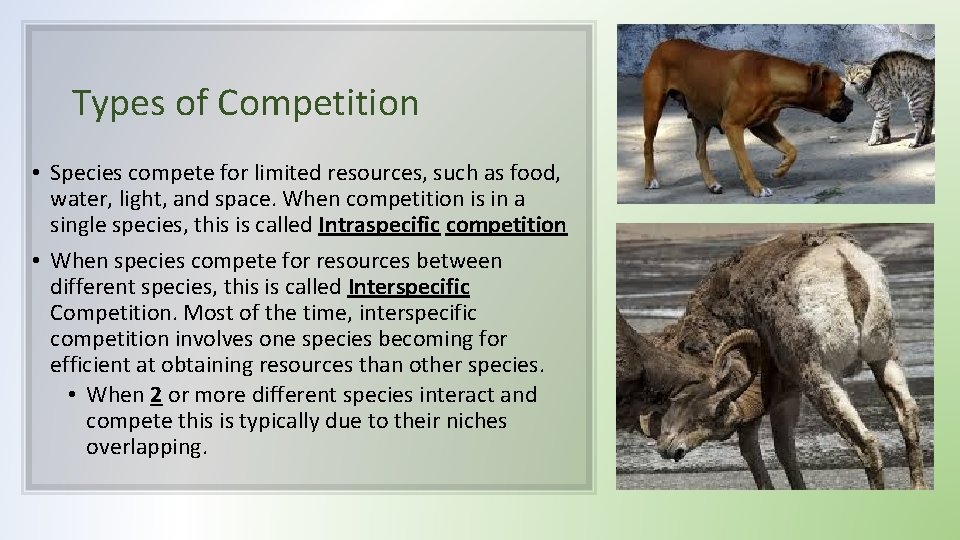
Types of Competition • Species compete for limited resources, such as food, water, light, and space. When competition is in a single species, this is called Intraspecific competition • When species compete for resources between different species, this is called Interspecific Competition. Most of the time, interspecific competition involves one species becoming for efficient at obtaining resources than other species. • When 2 or more different species interact and compete this is typically due to their niches overlapping.
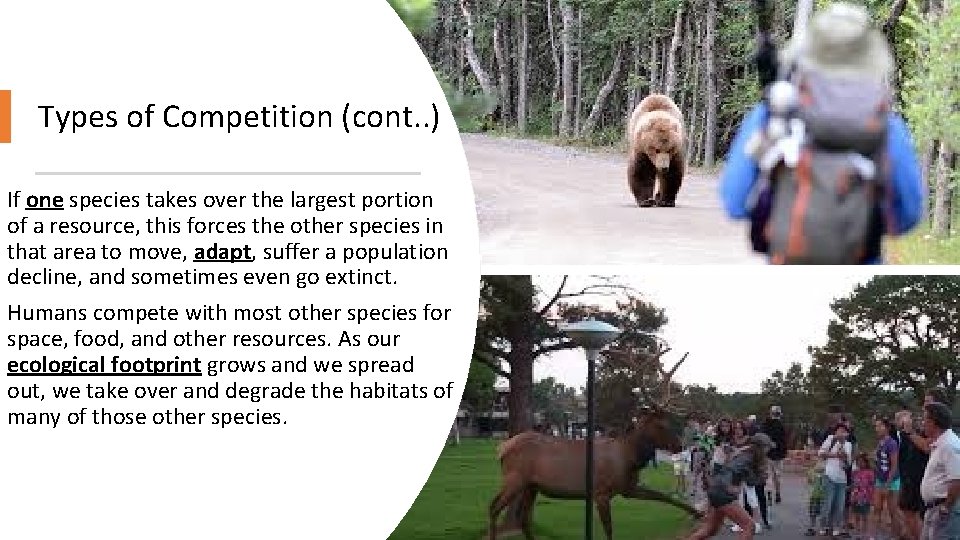
Types of Competition (cont. . ) If one species takes over the largest portion of a resource, this forces the other species in that area to move, adapt, suffer a population decline, and sometimes even go extinct. Humans compete with most other species for space, food, and other resources. As our ecological footprint grows and we spread out, we take over and degrade the habitats of many of those other species.
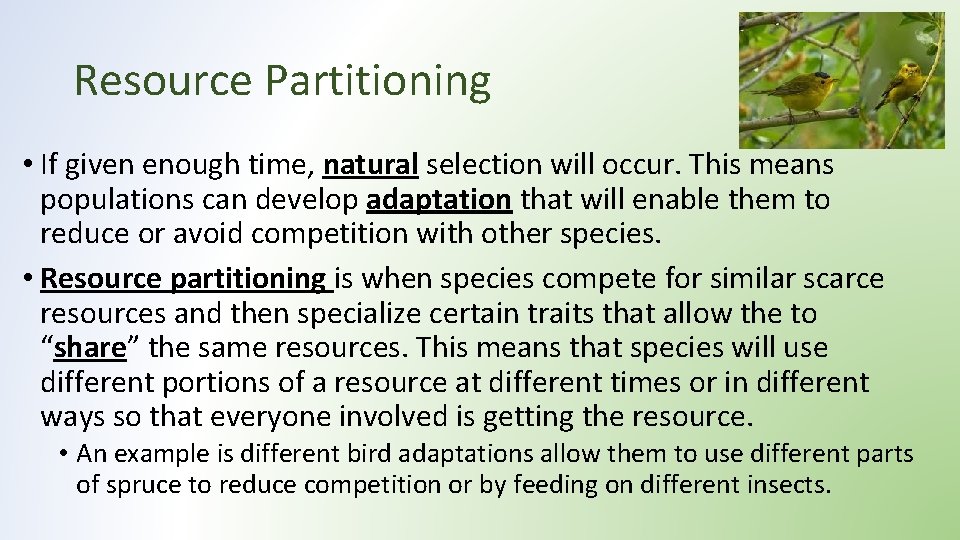
Resource Partitioning • If given enough time, natural selection will occur. This means populations can develop adaptation that will enable them to reduce or avoid competition with other species. • Resource partitioning is when species compete for similar scarce resources and then specialize certain traits that allow the to “share” the same resources. This means that species will use different portions of a resource at different times or in different ways so that everyone involved is getting the resource. • An example is different bird adaptations allow them to use different parts of spruce to reduce competition or by feeding on different insects.
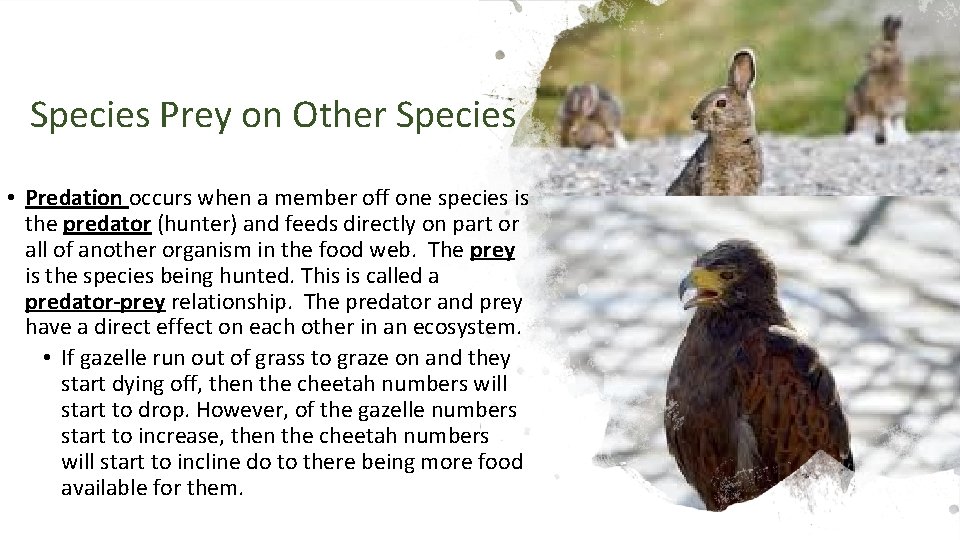
Species Prey on Other Species • Predation occurs when a member off one species is the predator (hunter) and feeds directly on part or all of another organism in the food web. The prey is the species being hunted. This is called a predator-prey relationship. The predator and prey have a direct effect on each other in an ecosystem. • If gazelle run out of grass to graze on and they start dying off, then the cheetah numbers will start to drop. However, of the gazelle numbers start to increase, then the cheetah numbers will start to incline do to there being more food available for them.
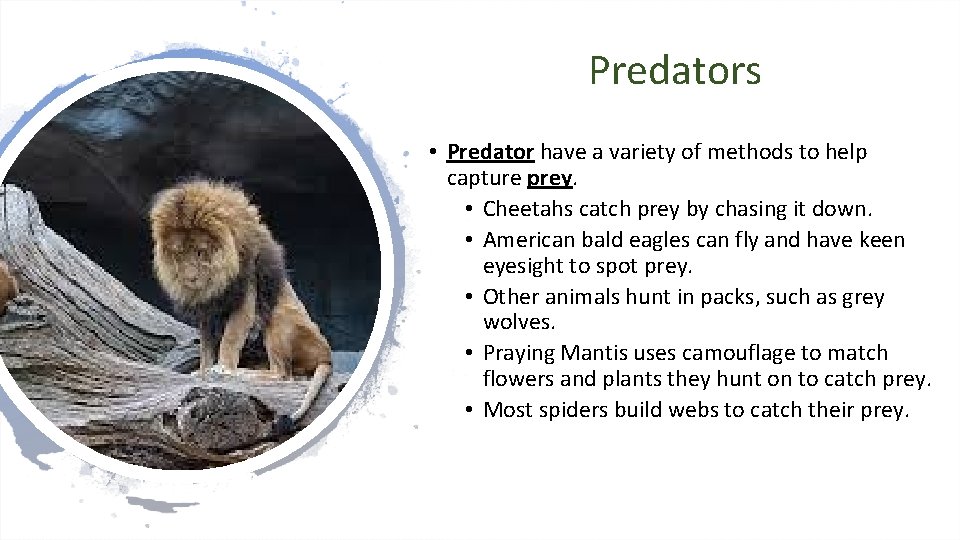
Predators • Predator have a variety of methods to help capture prey. • Cheetahs catch prey by chasing it down. • American bald eagles can fly and have keen eyesight to spot prey. • Other animals hunt in packs, such as grey wolves. • Praying Mantis uses camouflage to match flowers and plants they hunt on to catch prey. • Most spiders build webs to catch their prey.
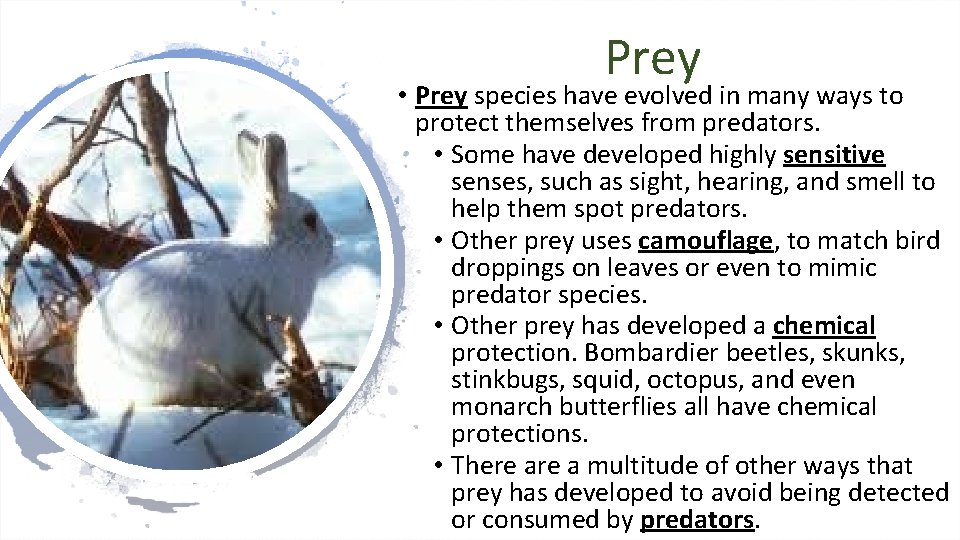
Prey • Prey species have evolved in many ways to protect themselves from predators. • Some have developed highly sensitive senses, such as sight, hearing, and smell to help them spot predators. • Other prey uses camouflage, to match bird droppings on leaves or even to mimic predator species. • Other prey has developed a chemical protection. Bombardier beetles, skunks, stinkbugs, squid, octopus, and even monarch butterflies all have chemical protections. • There a multitude of other ways that prey has developed to avoid being detected or consumed by predators.
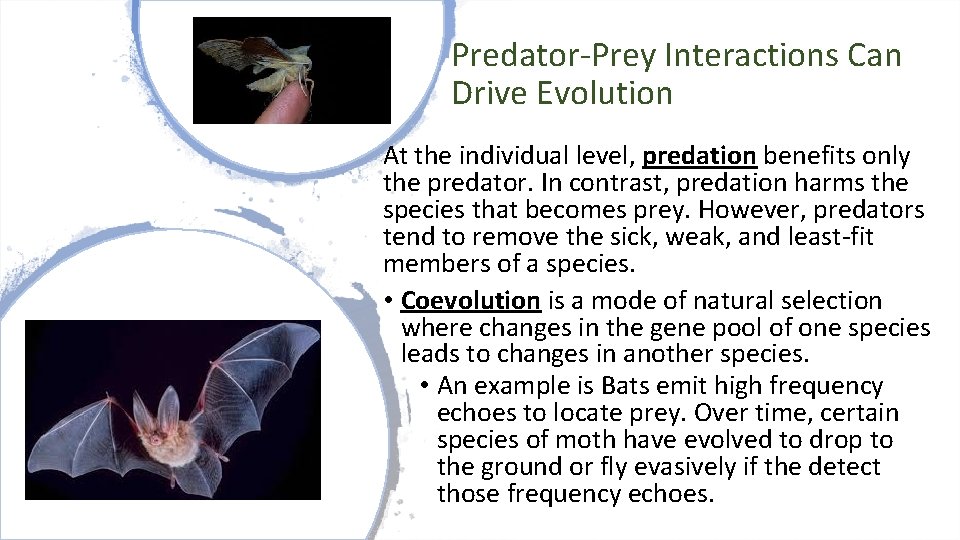
Predator-Prey Interactions Can Drive Evolution At the individual level, predation benefits only the predator. In contrast, predation harms the species that becomes prey. However, predators tend to remove the sick, weak, and least-fit members of a species. • Coevolution is a mode of natural selection where changes in the gene pool of one species leads to changes in another species. • An example is Bats emit high frequency echoes to locate prey. Over time, certain species of moth have evolved to drop to the ground or fly evasively if the detect those frequency echoes.
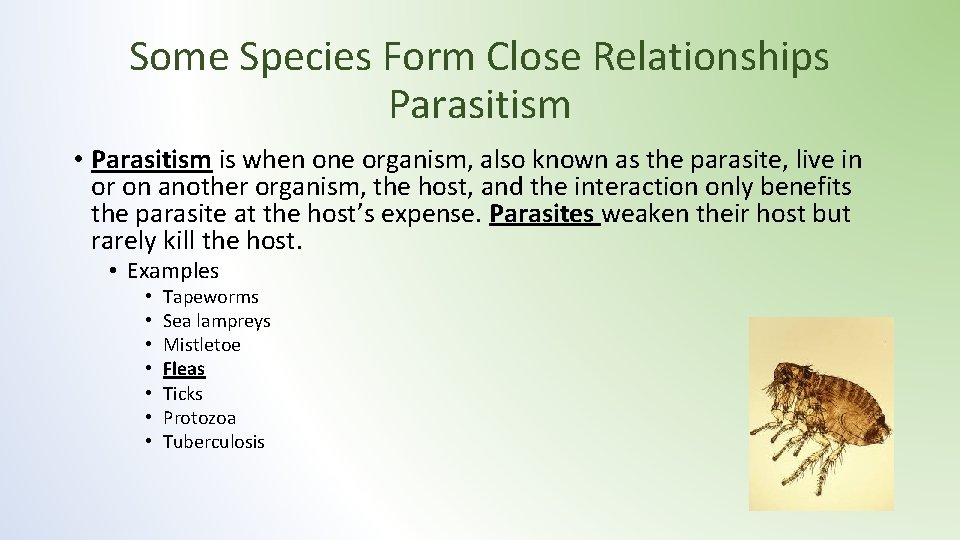
Some Species Form Close Relationships Parasitism • Parasitism is when one organism, also known as the parasite, live in or on another organism, the host, and the interaction only benefits the parasite at the host’s expense. Parasites weaken their host but rarely kill the host. • Examples • • Tapeworms Sea lampreys Mistletoe Fleas Ticks Protozoa Tuberculosis
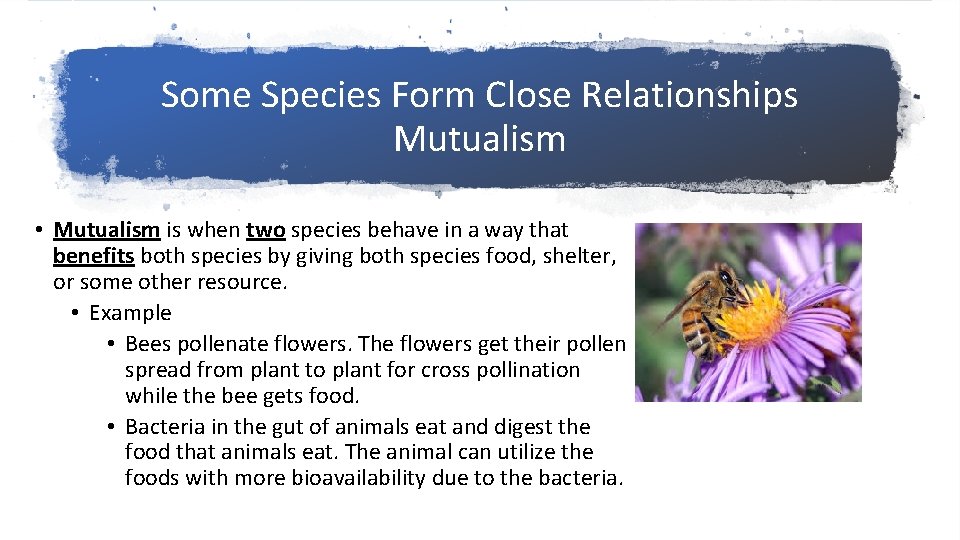
Some Species Form Close Relationships Mutualism • Mutualism is when two species behave in a way that benefits both species by giving both species food, shelter, or some other resource. • Example • Bees pollenate flowers. The flowers get their pollen spread from plant to plant for cross pollination while the bee gets food. • Bacteria in the gut of animals eat and digest the food that animals eat. The animal can utilize the foods with more bioavailability due to the bacteria.
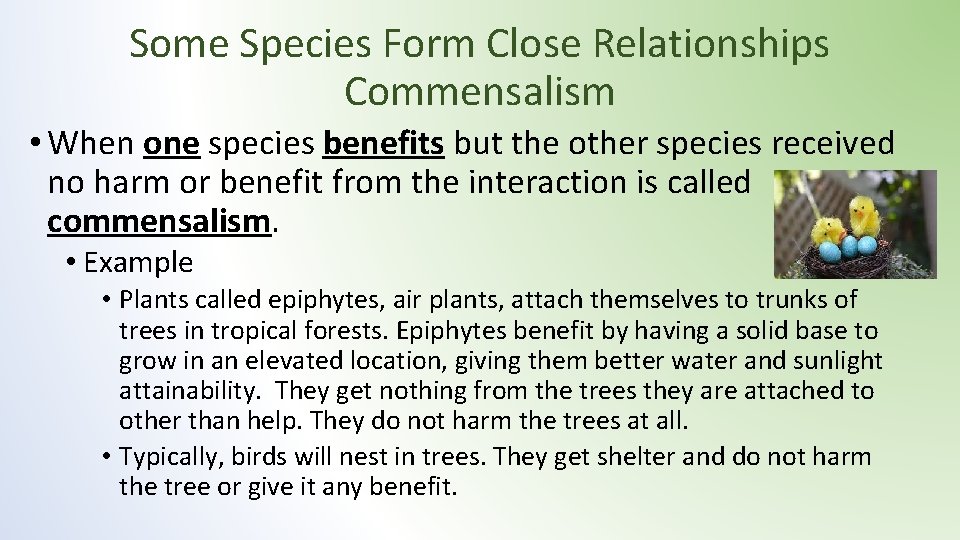
Some Species Form Close Relationships Commensalism • When one species benefits but the other species received no harm or benefit from the interaction is called commensalism. • Example • Plants called epiphytes, air plants, attach themselves to trunks of trees in tropical forests. Epiphytes benefit by having a solid base to grow in an elevated location, giving them better water and sunlight attainability. They get nothing from the trees they are attached to other than help. They do not harm the trees at all. • Typically, birds will nest in trees. They get shelter and do not harm the tree or give it any benefit.
Questions 1. Define resource partitioning and give an example. 1. How could coevolution lead to mimicry? 1. Draw a diagram to describe the coevolution between bats and moths.
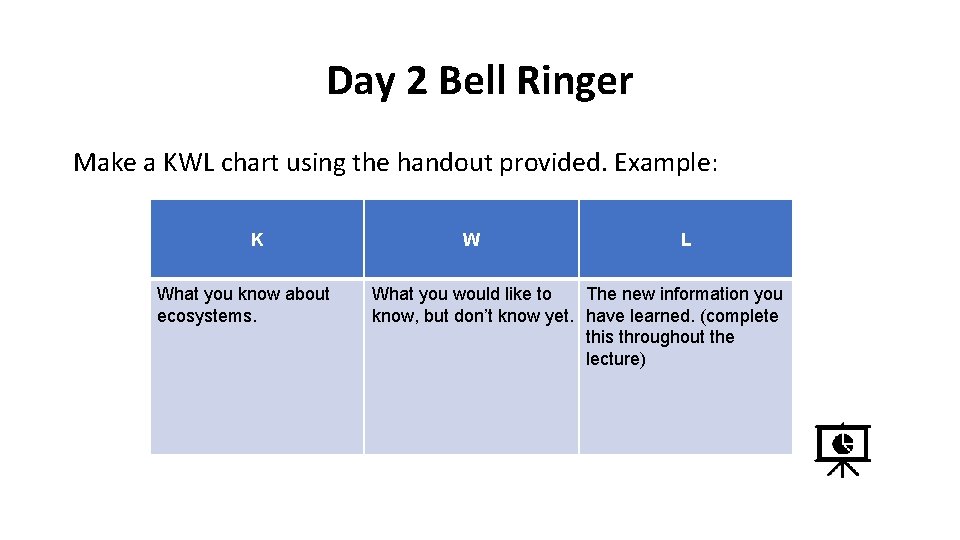
Day 2 Bell Ringer Make a KWL chart using the handout provided. Example: K What you know about ecosystems. W L What you would like to The new information you know, but don’t know yet. have learned. (complete this throughout the lecture)
Lesson 5. 2 How Do Ecosystems Respond to Changing Conditions?
What you will know…. • You will understand how the species composition of a community or ecosystem can change. • You will be able to recognize that living systems are sustained through constant change.
Ecological succession Primary ecological succession Key Terms Secondary ecological succession Inertia Resilience
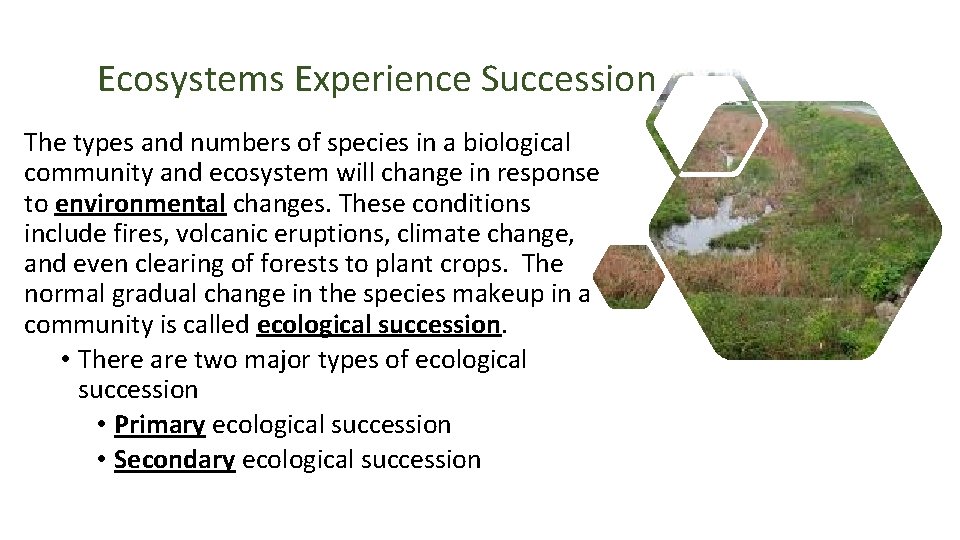
Ecosystems Experience Succession The types and numbers of species in a biological community and ecosystem will change in response to environmental changes. These conditions include fires, volcanic eruptions, climate change, and even clearing of forests to plant crops. The normal gradual change in the species makeup in a community is called ecological succession. • There are two major types of ecological succession • Primary ecological succession • Secondary ecological succession
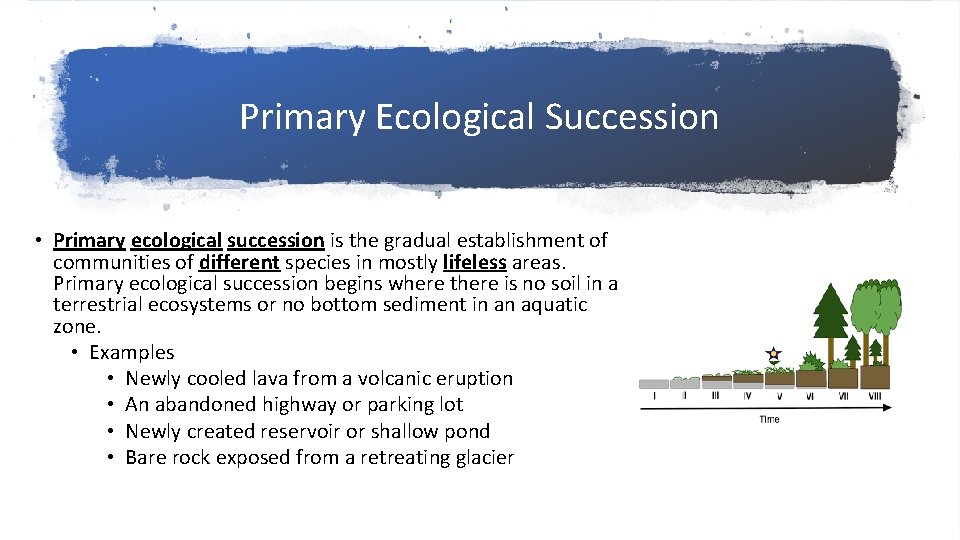
Primary Ecological Succession • Primary ecological succession is the gradual establishment of communities of different species in mostly lifeless areas. Primary ecological succession begins where there is no soil in a terrestrial ecosystems or no bottom sediment in an aquatic zone. • Examples • Newly cooled lava from a volcanic eruption • An abandoned highway or parking lot • Newly created reservoir or shallow pond • Bare rock exposed from a retreating glacier
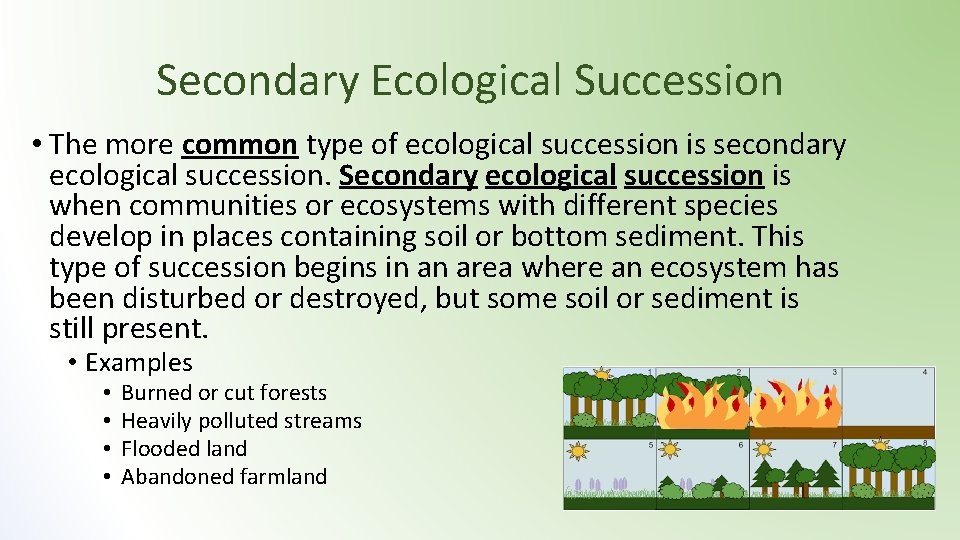
Secondary Ecological Succession • The more common type of ecological succession is secondary ecological succession. Secondary ecological succession is when communities or ecosystems with different species develop in places containing soil or bottom sediment. This type of succession begins in an area where an ecosystem has been disturbed or destroyed, but some soil or sediment is still present. • Examples • • Burned or cut forests Heavily polluted streams Flooded land Abandoned farmland
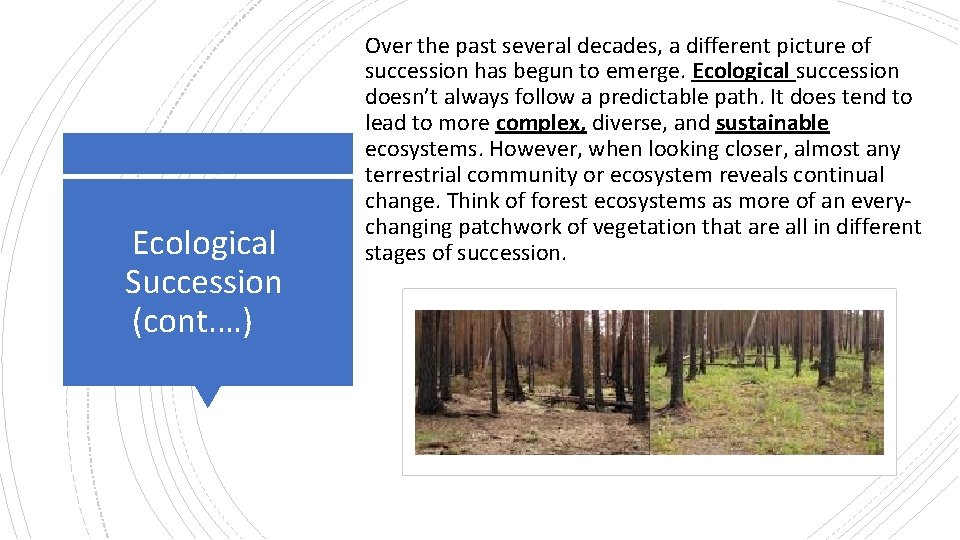
Ecological Succession (cont. …) Over the past several decades, a different picture of succession has begun to emerge. Ecological succession doesn’t always follow a predictable path. It does tend to lead to more complex, diverse, and sustainable ecosystems. However, when looking closer, almost any terrestrial community or ecosystem reveals continual change. Think of forest ecosystems as more of an everychanging patchwork of vegetation that are all in different stages of succession.
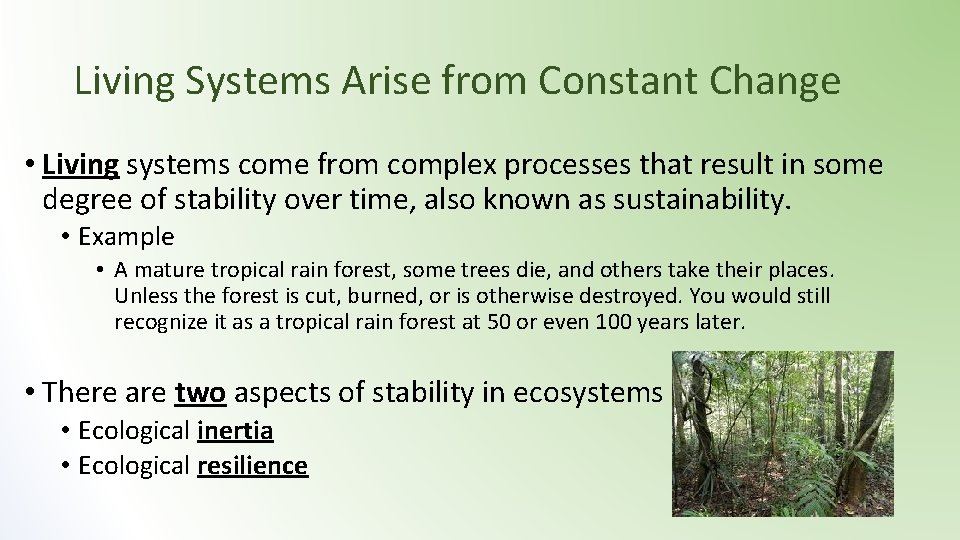
Living Systems Arise from Constant Change • Living systems come from complex processes that result in some degree of stability over time, also known as sustainability. • Example • A mature tropical rain forest, some trees die, and others take their places. Unless the forest is cut, burned, or is otherwise destroyed. You would still recognize it as a tropical rain forest at 50 or even 100 years later. • There are two aspects of stability in ecosystems • Ecological inertia • Ecological resilience
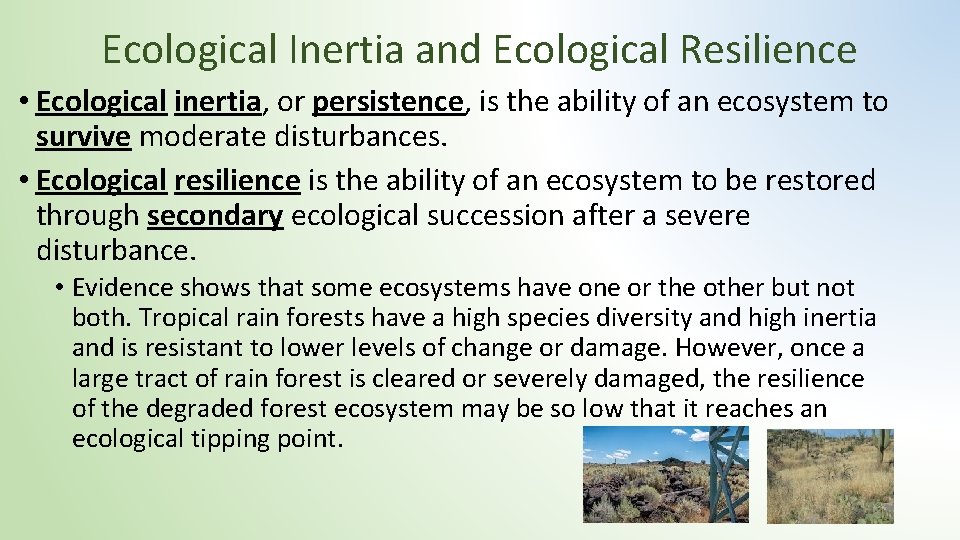
Ecological Inertia and Ecological Resilience • Ecological inertia, or persistence, is the ability of an ecosystem to survive moderate disturbances. • Ecological resilience is the ability of an ecosystem to be restored through secondary ecological succession after a severe disturbance. • Evidence shows that some ecosystems have one or the other but not both. Tropical rain forests have a high species diversity and high inertia and is resistant to lower levels of change or damage. However, once a large tract of rain forest is cleared or severely damaged, the resilience of the degraded forest ecosystem may be so low that it reaches an ecological tipping point.
Questions 1. What is the gradual change in species composition in one given area called? 1. Describe how a rain forest can reach a point when it cannot be restored by secondary ecological succession. 1. Explain how grasslands regenerate quickly after being burned to the ground?
Day 3 Bell Ringer If you could choose how you interact with another species, would you choose parasitism, mutualism, or commensalism? Explain.
Lesson 5. 3 What Limits the Growth of Populations?
What you will know… You will be able to identify the variable that govern changes in population size and the factors that limit population size. You will be able to explain reproductive and survivorship patterns of populations.
Key Terms Population Age structure Range of tolerance Limiting factor Population density Environmental resistance Carrying capacity Population crash R-selected species K-selected species Survivorship curve
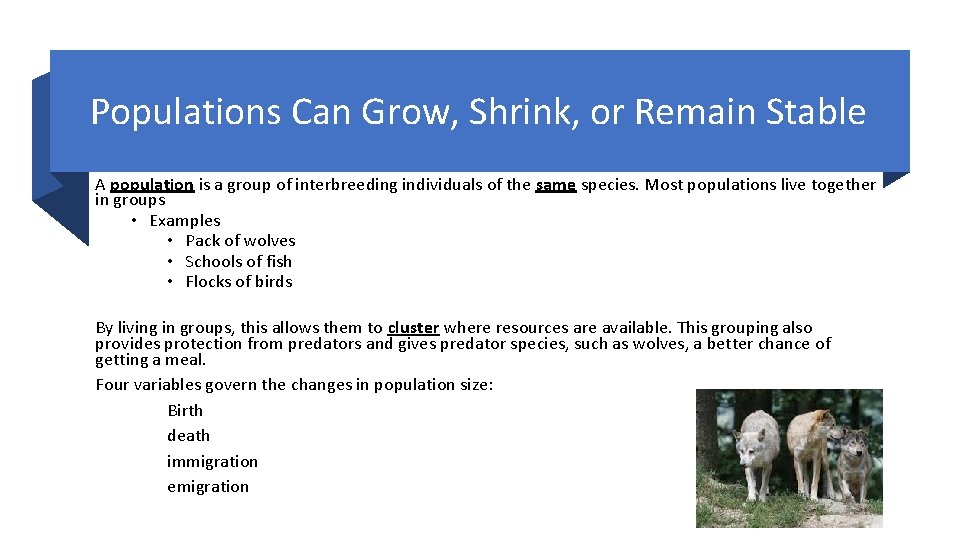
Populations Can Grow, Shrink, or Remain Stable A population is a group of interbreeding individuals of the same species. Most populations live together in groups • Examples • Pack of wolves • Schools of fish • Flocks of birds By living in groups, this allows them to cluster where resources are available. This grouping also provides protection from predators and gives predator species, such as wolves, a better chance of getting a meal. Four variables govern the changes in population size: Birth death immigration emigration
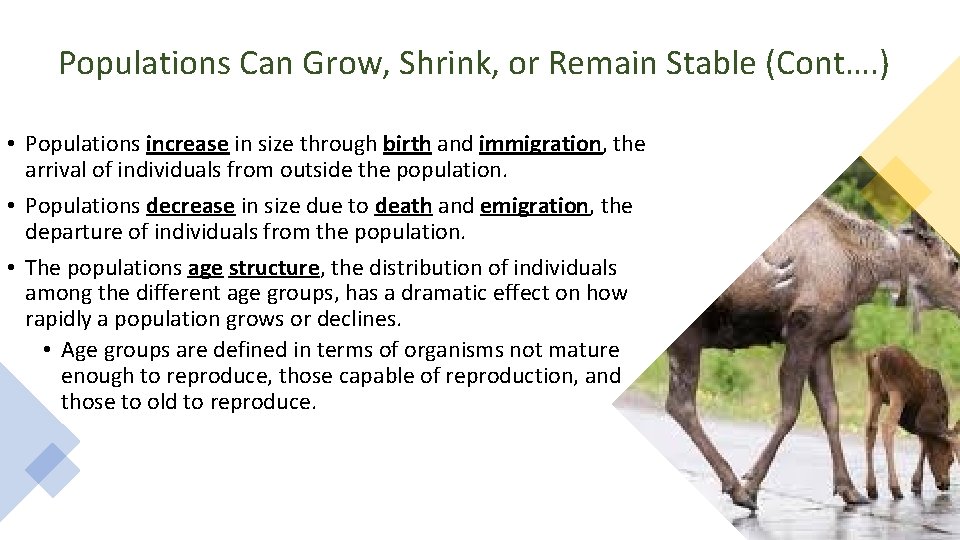
Populations Can Grow, Shrink, or Remain Stable (Cont…. ) • Populations increase in size through birth and immigration, the arrival of individuals from outside the population. • Populations decrease in size due to death and emigration, the departure of individuals from the population. • The populations age structure, the distribution of individuals among the different age groups, has a dramatic effect on how rapidly a population grows or declines. • Age groups are defined in terms of organisms not mature enough to reproduce, those capable of reproduction, and those to old to reproduce.
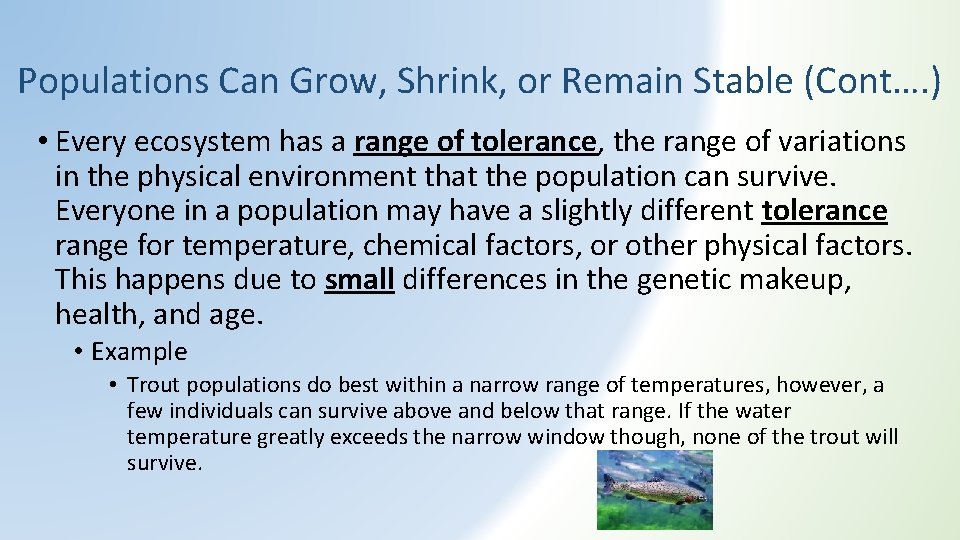
Populations Can Grow, Shrink, or Remain Stable (Cont…. ) • Every ecosystem has a range of tolerance, the range of variations in the physical environment that the population can survive. Everyone in a population may have a slightly different tolerance range for temperature, chemical factors, or other physical factors. This happens due to small differences in the genetic makeup, health, and age. • Example • Trout populations do best within a narrow range of temperatures, however, a few individuals can survive above and below that range. If the water temperature greatly exceeds the narrow window though, none of the trout will survive.
Limits to Population Growth • Chemical and physical factors determine the number of organisms in a population. Sometimes one or more factors, the limiting factors, are more important than other factors in regulating population growth. • On land, precipitation if often a limiting factor. Low precipitation levels in desert ecosystems can limit plant growth in the desert. However, to much rainfall can kill the plants. • In aquatic systems these limiting factors include water temperature, depth, how clear the water is, availability of nutrients, acidity, salinity, and how much oxygen is dissolved in the water. • For example, to much acidity in an aquatic environment can harm some of the organisms.
Limits to Population Growth (Cont. . ) • Density is another factor that affects population sizes. Population density is how many individuals that are in a population within a defined area (square foot, square mile, square inch) or in a defined volume (cubic feet, cubic yards, cubic inches, or gallons). • If a population density increases, density-dependent factors play a more vital role. In more dense populations, parasites and diseases can spread easier, causing a result of higher death rates. • In higher populations though, it is easier for individuals to find mates in order to reproduce. • Drought and climate change are considered density-independent because they can affect the population sizes regardless of density.
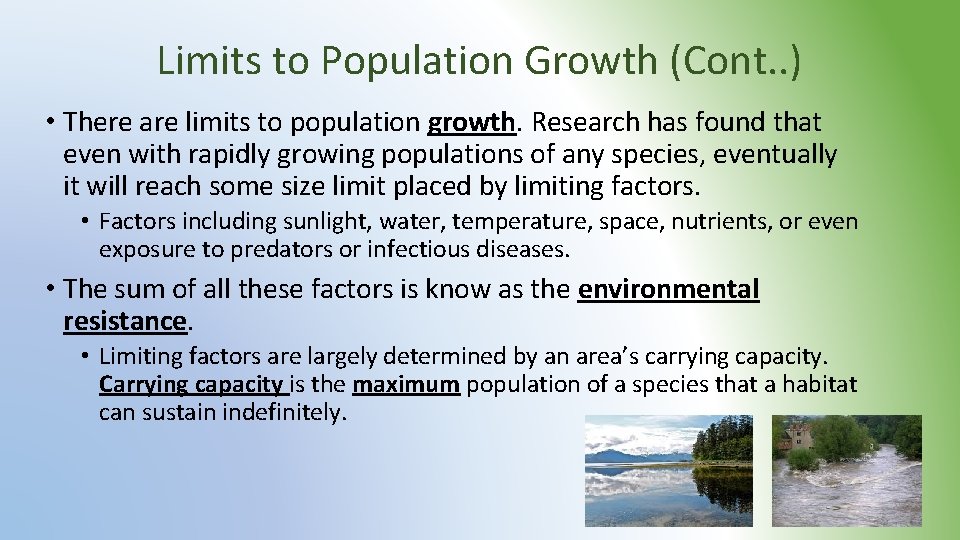
Limits to Population Growth (Cont. . ) • There are limits to population growth. Research has found that even with rapidly growing populations of any species, eventually it will reach some size limit placed by limiting factors. • Factors including sunlight, water, temperature, space, nutrients, or even exposure to predators or infectious diseases. • The sum of all these factors is know as the environmental resistance. • Limiting factors are largely determined by an area’s carrying capacity. Carrying capacity is the maximum population of a species that a habitat can sustain indefinitely.
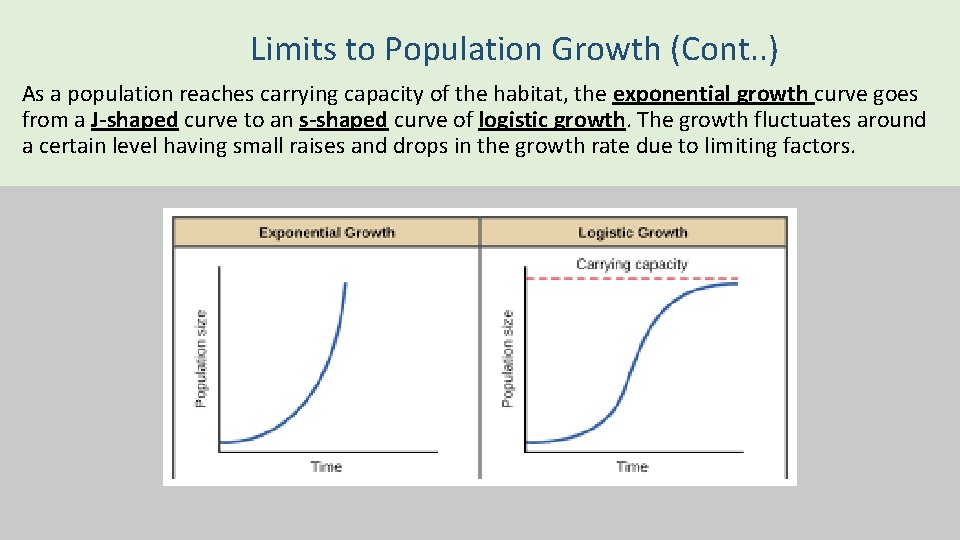
Limits to Population Growth (Cont. . ) As a population reaches carrying capacity of the habitat, the exponential growth curve goes from a J-shaped curve to an s-shaped curve of logistic growth. The growth fluctuates around a certain level having small raises and drops in the growth rate due to limiting factors.
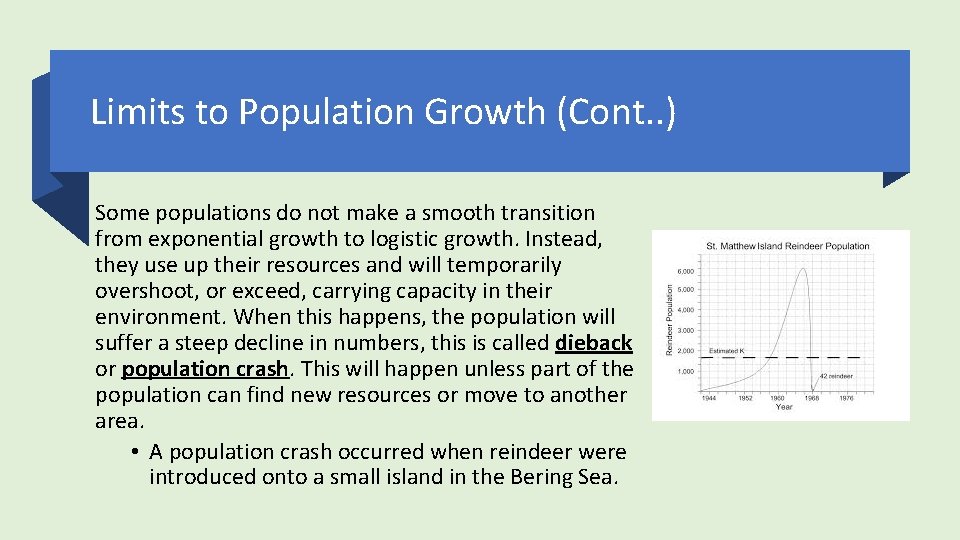
Limits to Population Growth (Cont. . ) Some populations do not make a smooth transition from exponential growth to logistic growth. Instead, they use up their resources and will temporarily overshoot, or exceed, carrying capacity in their environment. When this happens, the population will suffer a steep decline in numbers, this is called dieback or population crash. This will happen unless part of the population can find new resources or move to another area. • A population crash occurred when reindeer were introduced onto a small island in the Bering Sea.
Different Species Have Different Reproductive Patterns • Species vary in their reproductive patterns. Species with a high rate of population increase are called r-selected species. They tend to have a short life span and produce many, unusually small offspring. The parents provide little to no care or protection for the offspring. This includes algae, bacteria, and most insects. R-selected produce large numbers of descendants so a few of them will survive. This continues from generation to generation. • They are opportunist breeders. Since reproduction is so rapid, when an opportunity opens, such as a forest fire or a new habitat opens, they jump in a start reproducing.
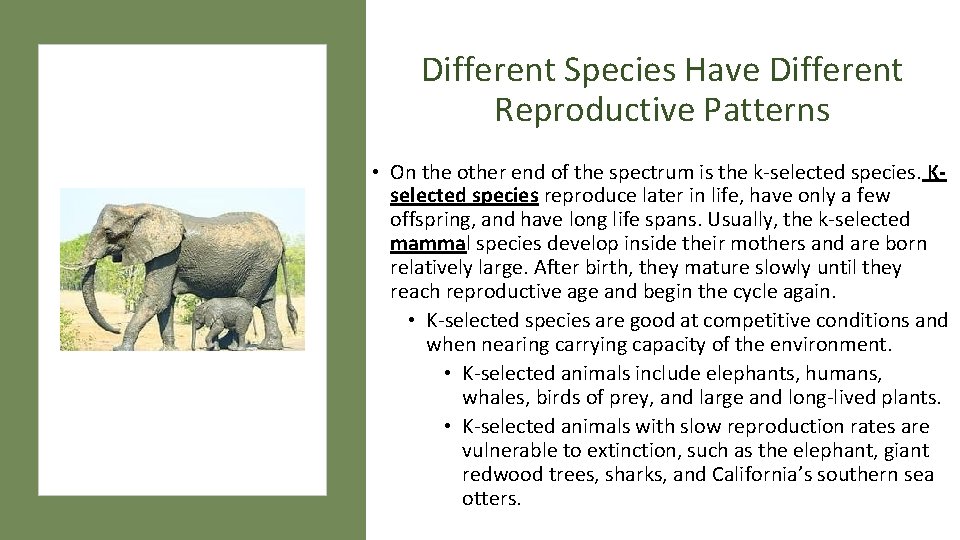
Different Species Have Different Reproductive Patterns • On the other end of the spectrum is the k-selected species. Kselected species reproduce later in life, have only a few offspring, and have long life spans. Usually, the k-selected mammal species develop inside their mothers and are born relatively large. After birth, they mature slowly until they reach reproductive age and begin the cycle again. • K-selected species are good at competitive conditions and when nearing carrying capacity of the environment. • K-selected animals include elephants, humans, whales, birds of prey, and large and long-lived plants. • K-selected animals with slow reproduction rates are vulnerable to extinction, such as the elephant, giant redwood trees, sharks, and California’s southern sea otters.
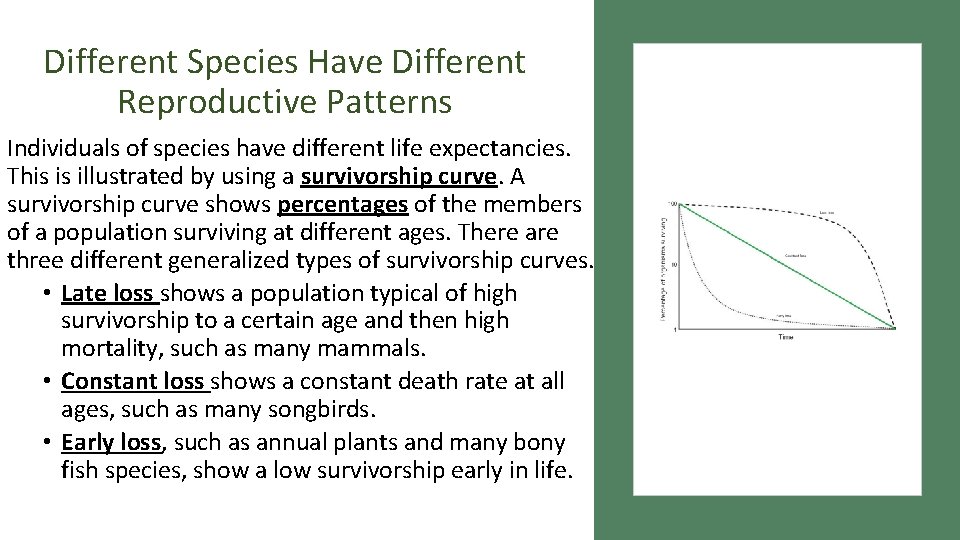
Different Species Have Different Reproductive Patterns Individuals of species have different life expectancies. This is illustrated by using a survivorship curve. A survivorship curve shows percentages of the members of a population surviving at different ages. There are three different generalized types of survivorship curves. • Late loss shows a population typical of high survivorship to a certain age and then high mortality, such as many mammals. • Constant loss shows a constant death rate at all ages, such as many songbirds. • Early loss, such as annual plants and many bony fish species, show a low survivorship early in life.
Day 4 Bell Ringer 1. Which type of ecological succession occurs in an abandoned parking lot? 2. What is the gradual change in species composition in one area called?