
Lesson 5 Refraction Science Physics Key Stage 3
- Slides: 6
Lesson 5 - Refraction Science - Physics - Key Stage 3 Light and Space Miss Wickham
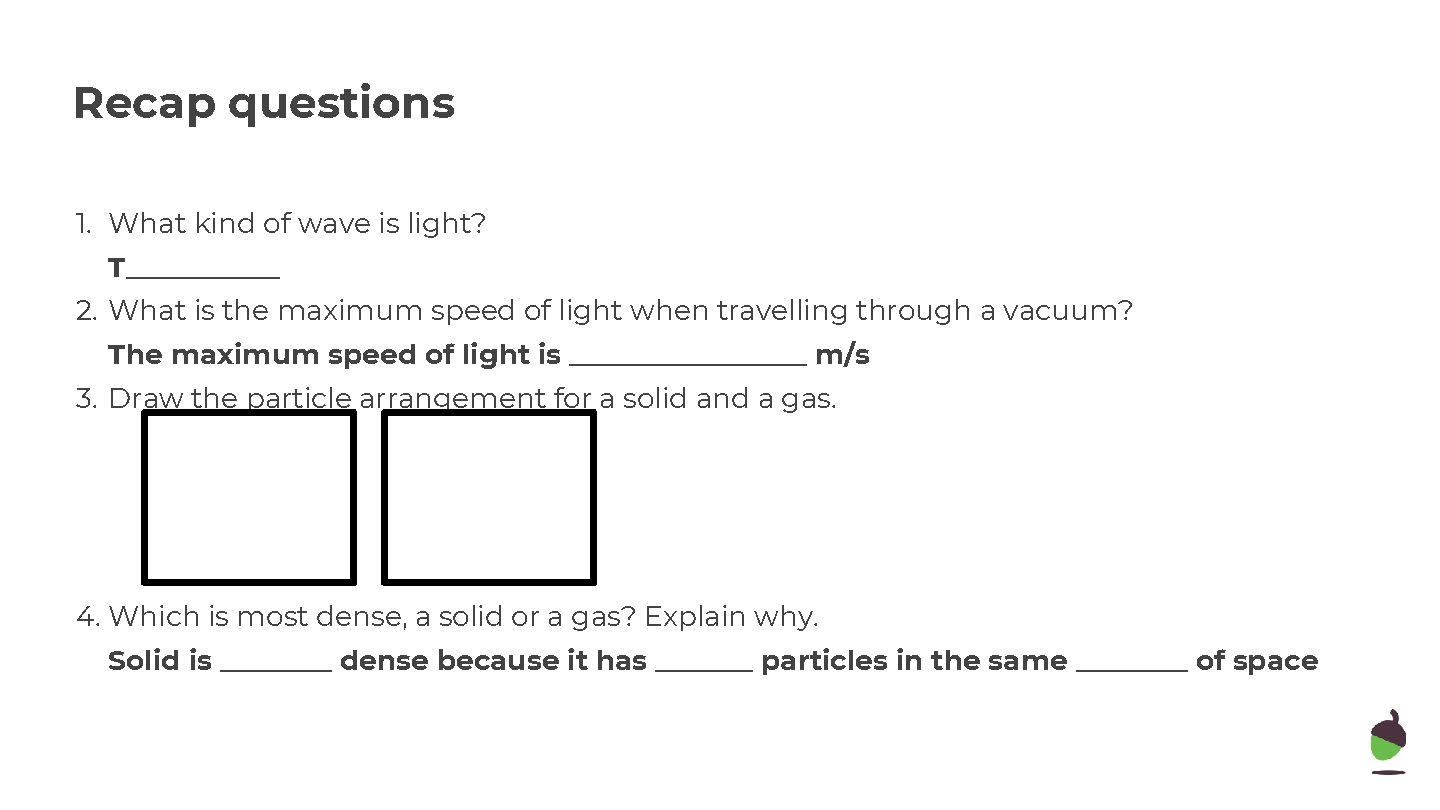
Recap questions 1. What kind of wave is light? T______ 2. What is the maximum speed of light when travelling through a vacuum? The maximum speed of light is _________ m/s 3. Draw the particle arrangement for a solid and a gas. 4. Which is most dense, a solid or a gas? Explain why. Solid is ____ dense because it has _______ particles in the same ____ of space
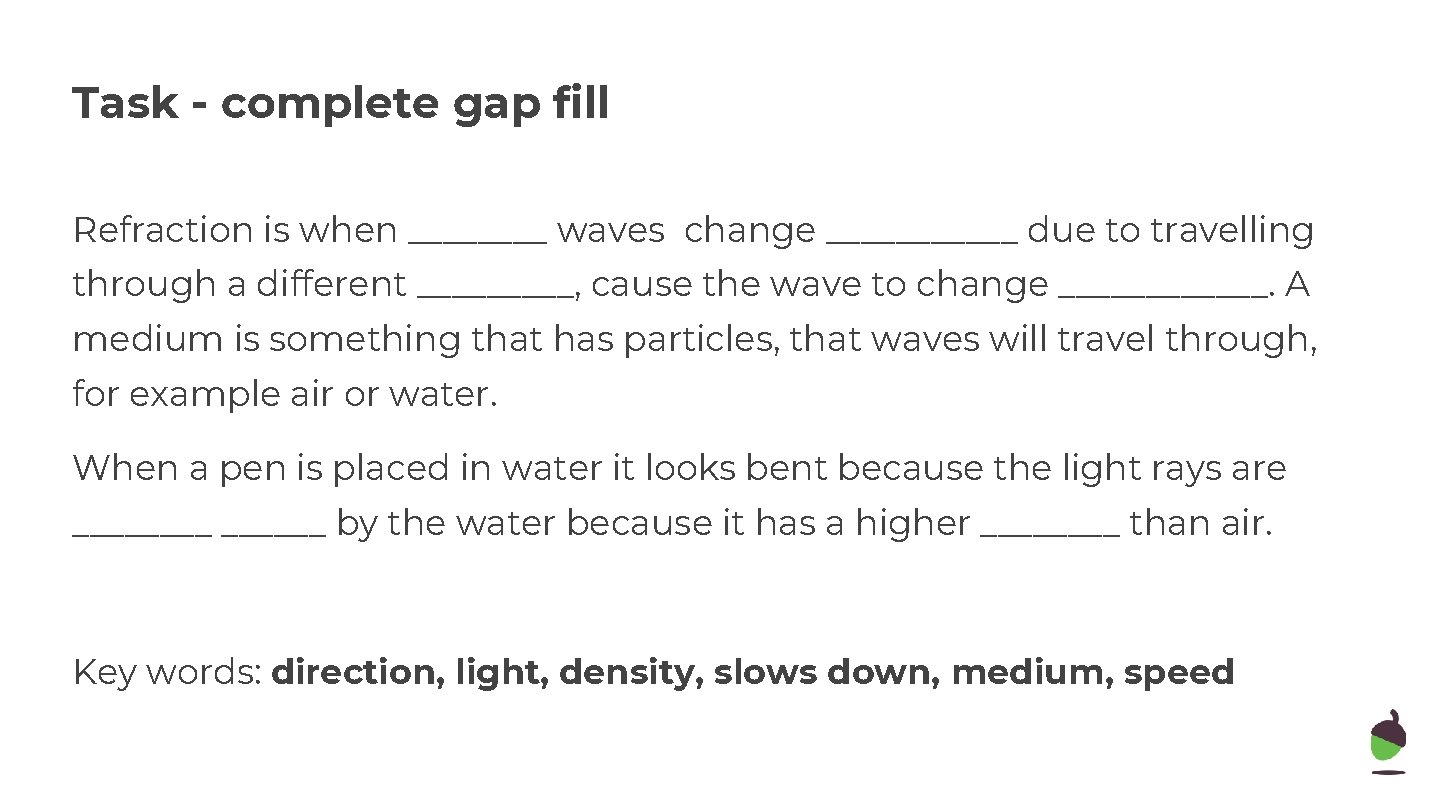
Task - complete gap fill Refraction is when ____ waves change ______ due to travelling through a different _____, cause the wave to change ______. A medium is something that has particles, that waves will travel through, for example air or water. When a pen is placed in water it looks bent because the light rays are ______ by the water because it has a higher ____ than air. Key words: direction, light, density, slows down, medium, speed
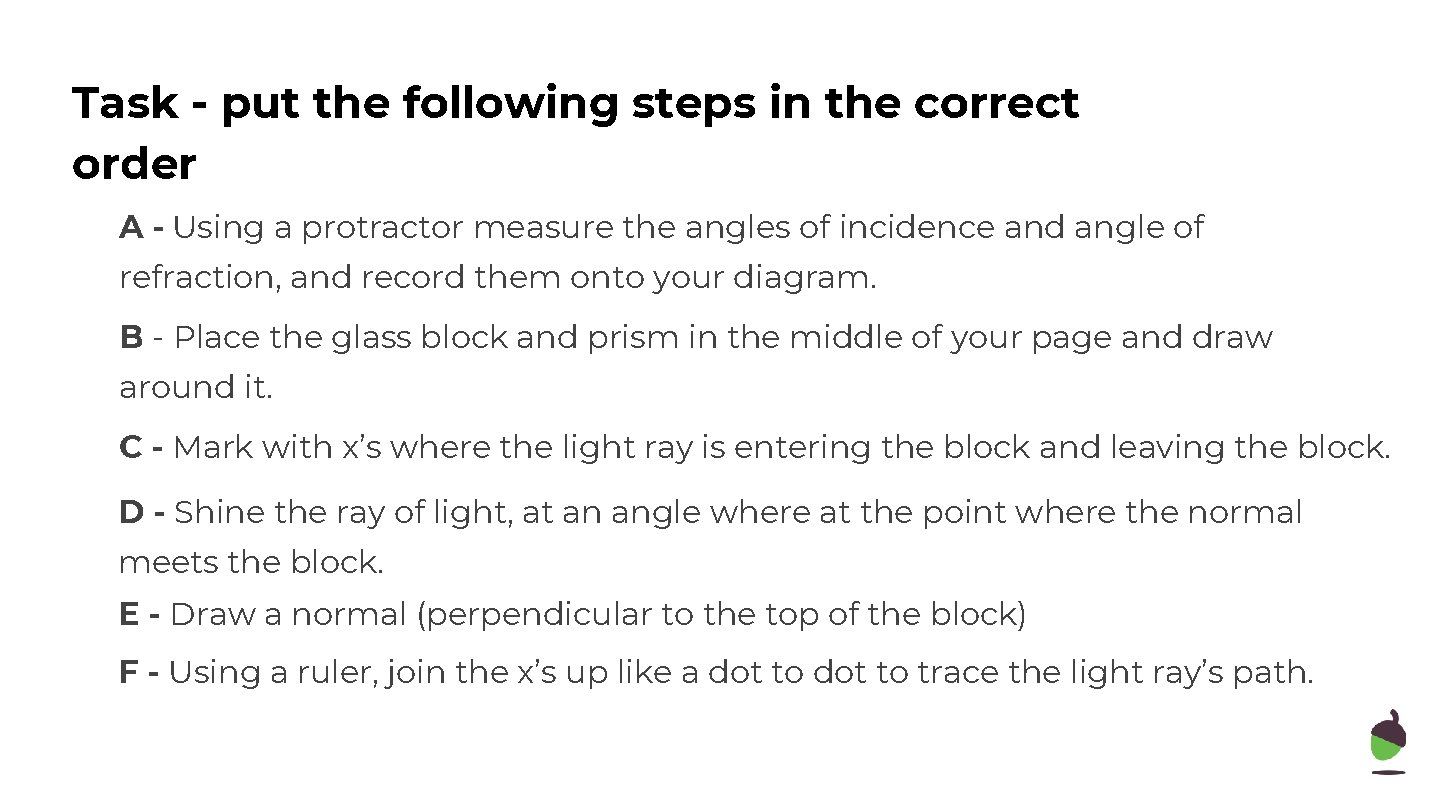
Task - put the following steps in the correct order A - Using a protractor measure the angles of incidence and angle of refraction, and record them onto your diagram. B - Place the glass block and prism in the middle of your page and draw around it. C - Mark with x’s where the light ray is entering the block and leaving the block. D - Shine the ray of light, at an angle where at the point where the normal meets the block. E - Draw a normal (perpendicular to the top of the block) F - Using a ruler, join the x’s up like a dot to trace the light ray’s path.
1. Describe what happens to the light ray as it travelled from the air into the glass block and then from the glass block back into the air. 2. Explain why the light ray changes direction in the way that it does as it travels from the air to through the glass and back into the air. Key words: normal line, angle of reflection, angle of incidence, speed, direction, density
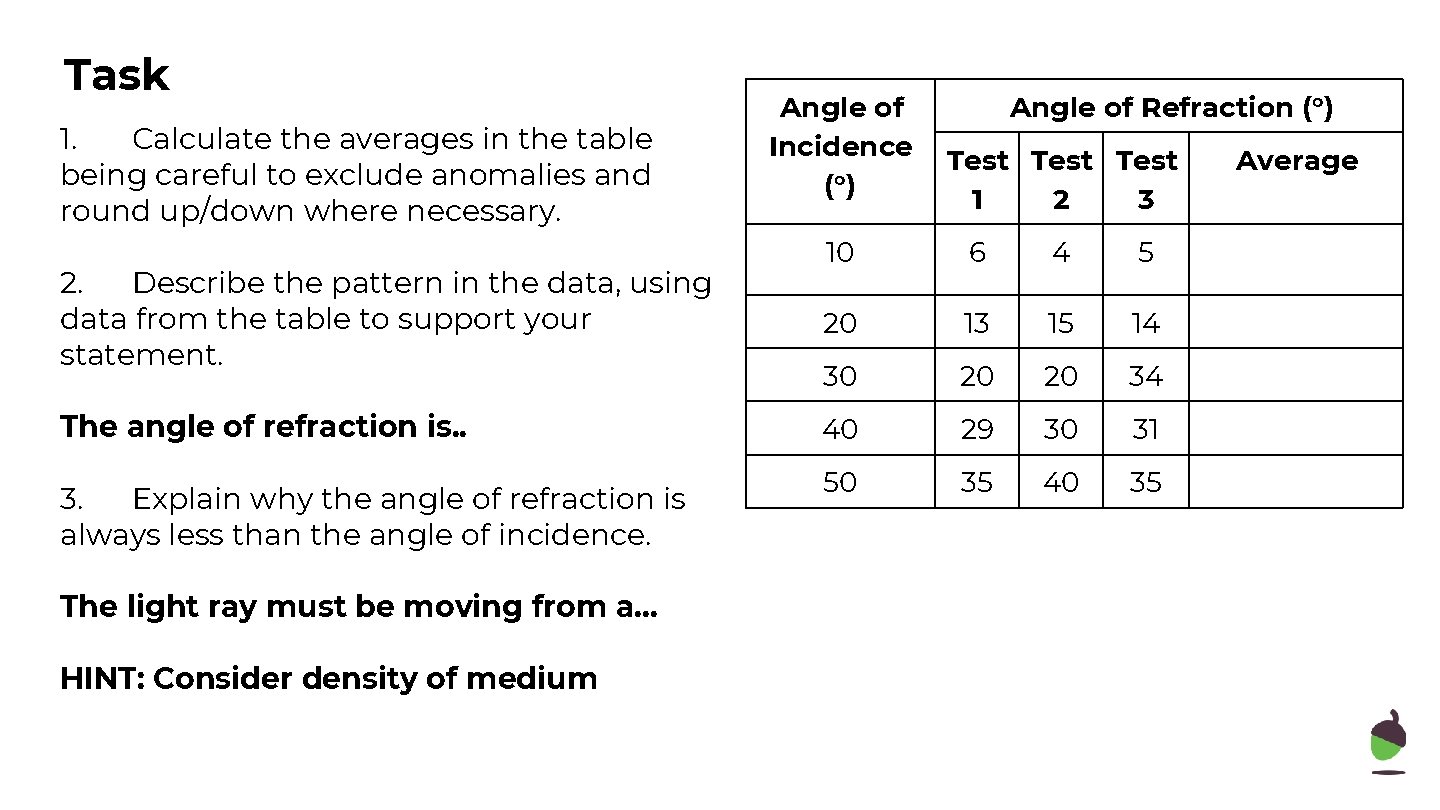
Task 1. Calculate the averages in the table being careful to exclude anomalies and round up/down where necessary. Angle of Incidence (°) Angle of Refraction (°) Test 1 2 3 2. Describe the pattern in the data, using data from the table to support your statement. 10 6 4 5 20 13 15 14 30 20 20 34 The angle of refraction is. . 40 29 30 31 50 35 40 35 3. Explain why the angle of refraction is always less than the angle of incidence. The light ray must be moving from a. . . HINT: Consider density of medium Average