
Lesson 5 More Theorems About Lines and Planes
Lesson 5 More Theorems About Lines and Planes
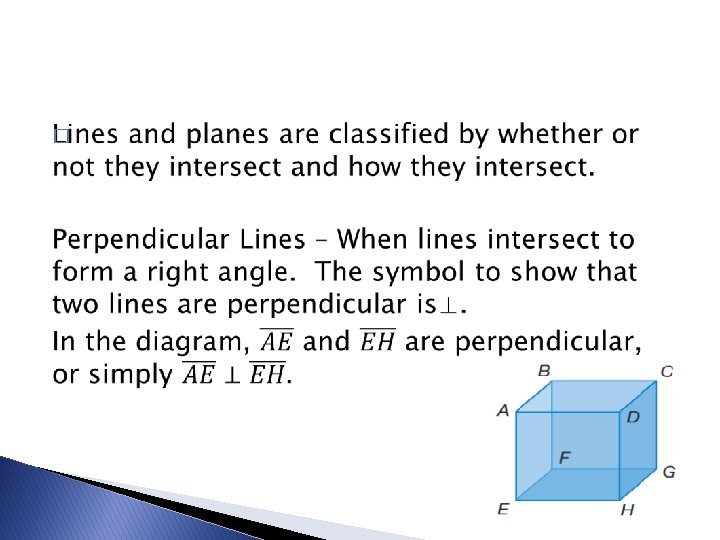
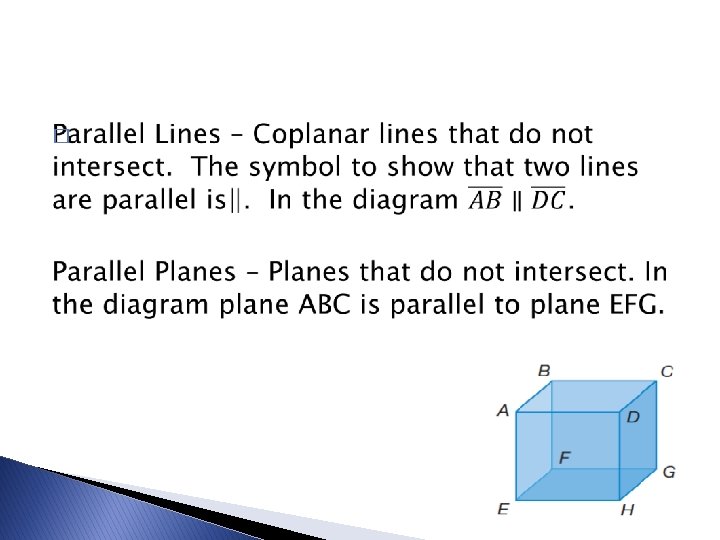


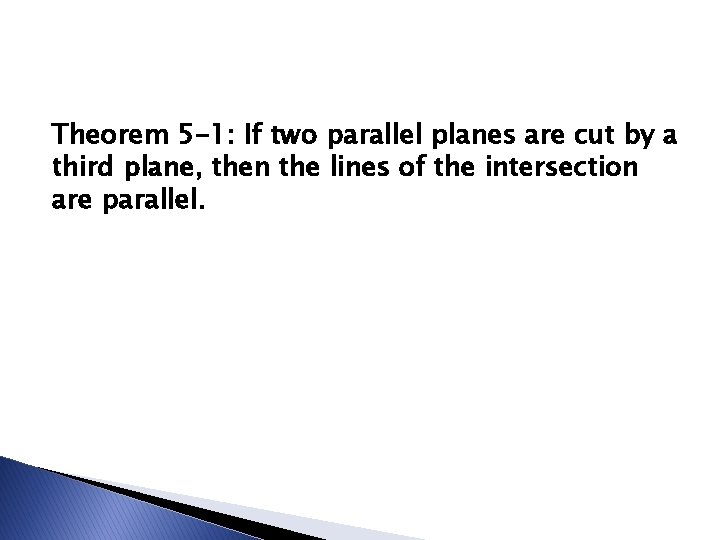
Theorem 5 -1: If two parallel planes are cut by a third plane, then the lines of the intersection are parallel.
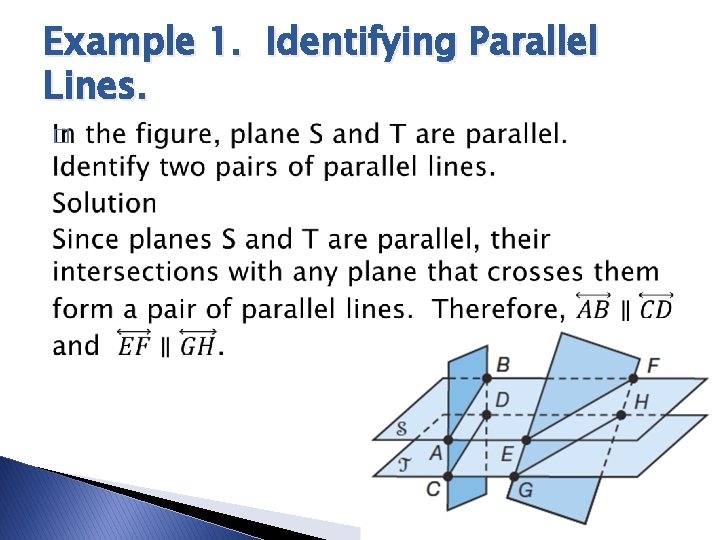
Example 1. Identifying Parallel Lines. �
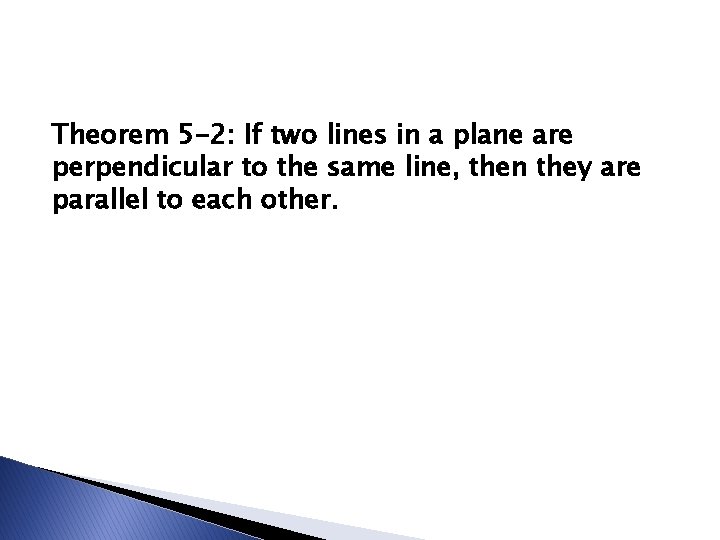
Theorem 5 -2: If two lines in a plane are perpendicular to the same line, then they are parallel to each other.
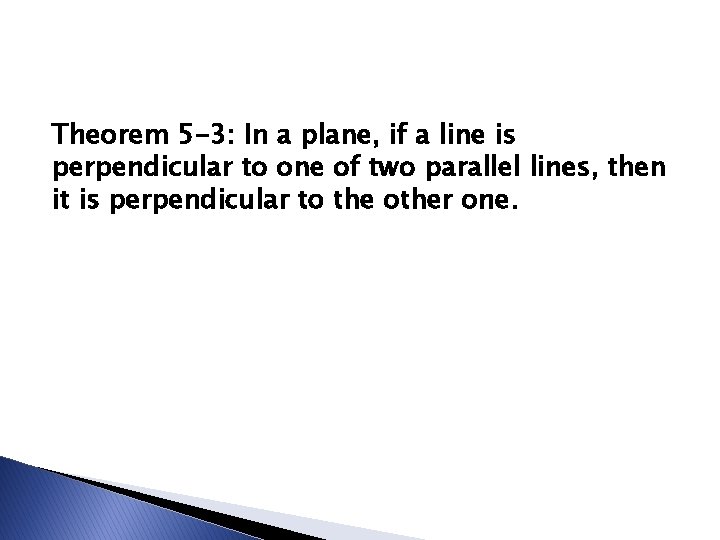
Theorem 5 -3: In a plane, if a line is perpendicular to one of two parallel lines, then it is perpendicular to the other one.
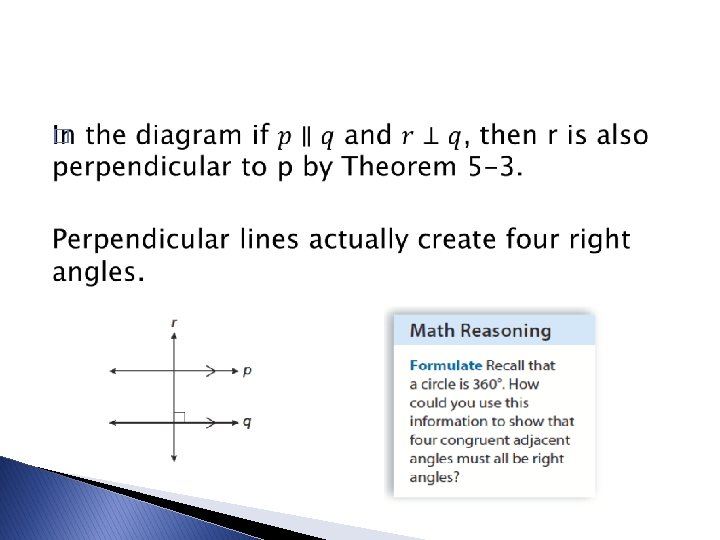
Theorem 5 -4: If two lines are perpendicular, then they form congruent adjacent angles.
Theorem 5 -5: If two lines form congruent adjacent angles, then they are perpendicular.
Theorem 5 -6: All right angles are congruent.
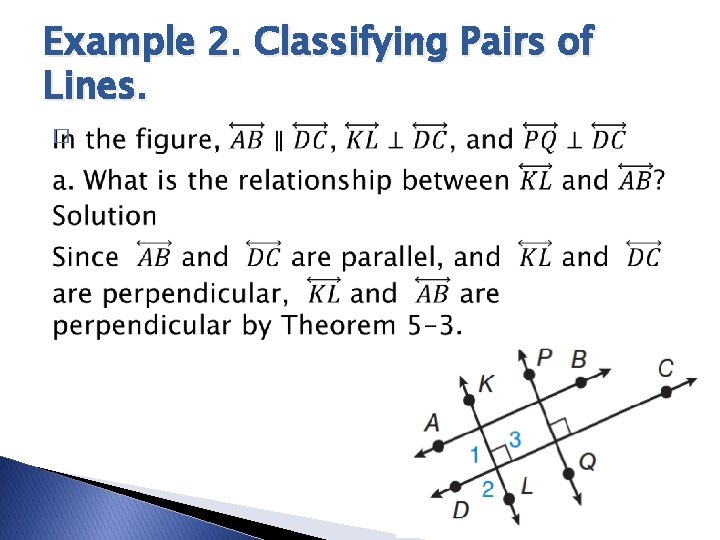
Example 2. Classifying Pairs of Lines. �
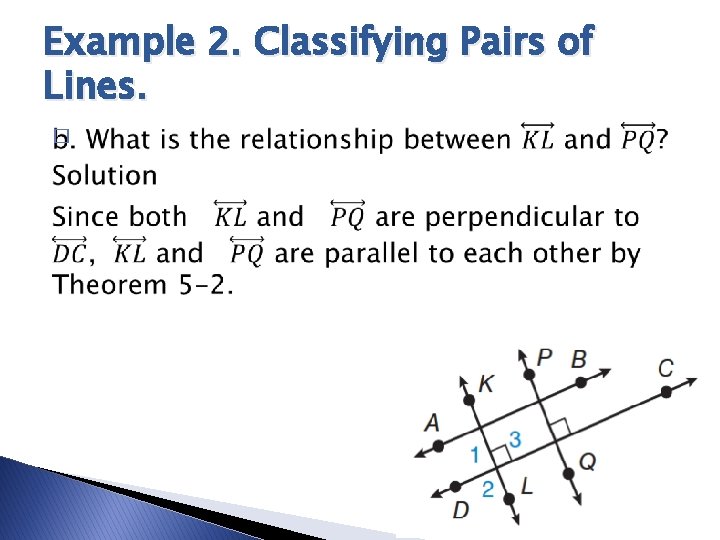
Example 2. Classifying Pairs of Lines. �
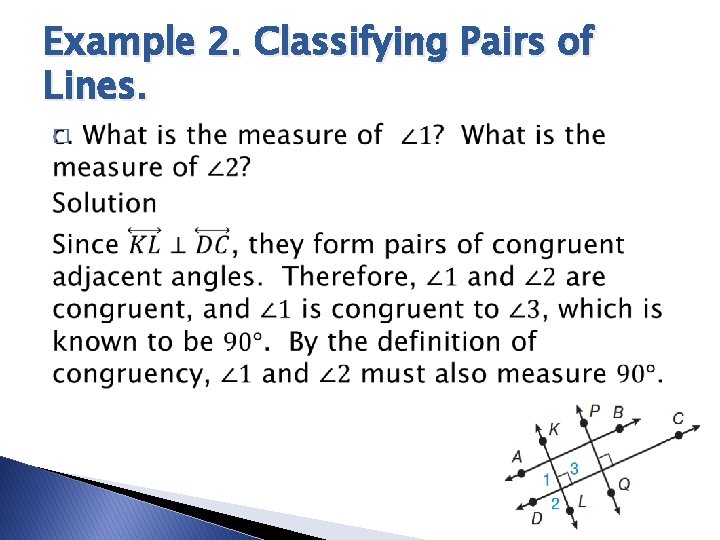
Example 2. Classifying Pairs of Lines. �
Postulate 10: The Parallel Postulate – Through a point not on a line, there exists exactly one line through the point that is parallel to the line.
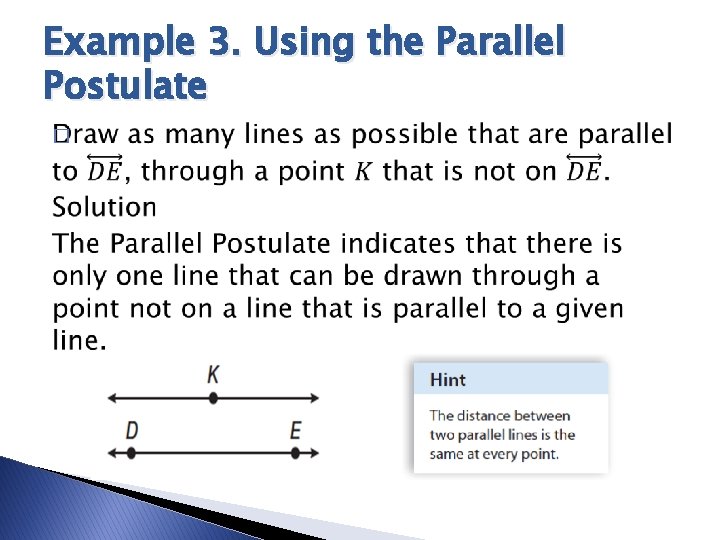
Example 3. Using the Parallel Postulate �
Theorem 5 -7: Transitive Property of Parallel Lines – If two lines are parallel to the same line, then they are parallel to one another.
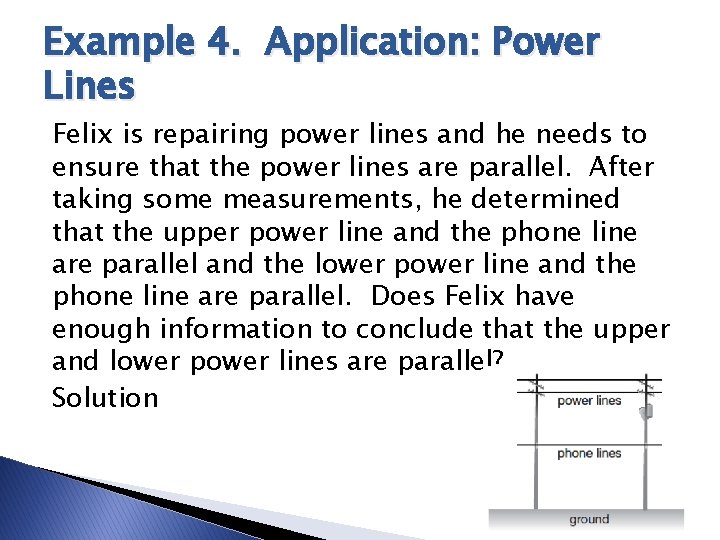
Example 4. Application: Power Lines Felix is repairing power lines and he needs to ensure that the power lines are parallel. After taking some measurements, he determined that the upper power line and the phone line are parallel and the lower power line and the phone line are parallel. Does Felix have enough information to conclude that the upper and lower power lines are parallel? Solution
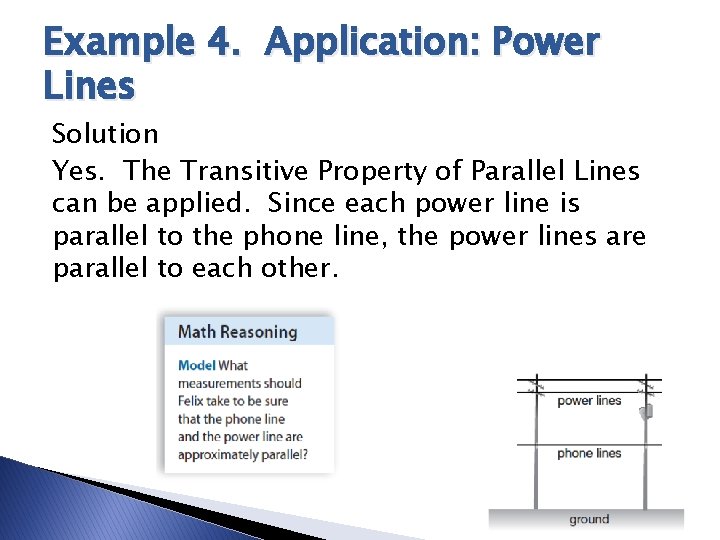
Example 4. Application: Power Lines Solution Yes. The Transitive Property of Parallel Lines can be applied. Since each power line is parallel to the phone line, the power lines are parallel to each other.

You Try!!!! �

Assignment Page 30 Lesson Practice a-f (Ask Mr. Heintz) Page 31 Practice 1 -30 (Do the starred ones first)
- Slides: 25