
Lesson 5 Methods of Analysis Unit 1 Science




- Slides: 32
Lesson 5 - Methods of Analysis Unit 1 - Science, Engineering, and Technology
Think Like An Engineer • Imagine you are engineers. You are getting ready to develop a new form of technology related to transportation. Write down any issues or considerations (speed, safety, pollution, etc) your table can come up with in 3 minutes.
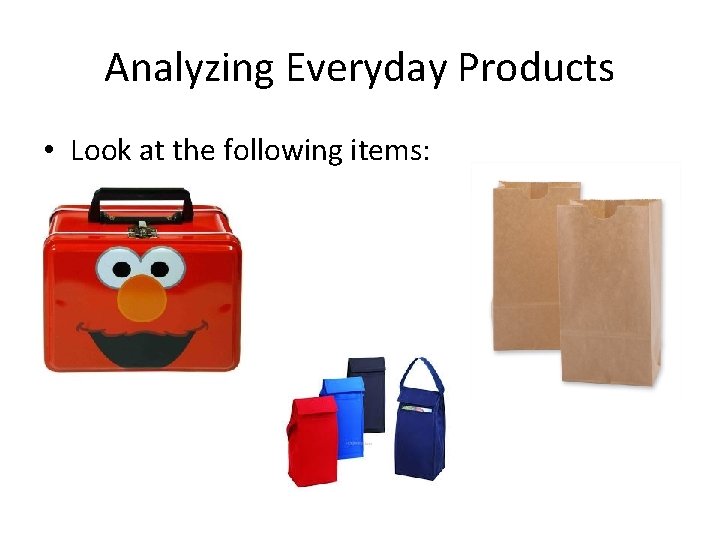
Analyzing Everyday Products • Look at the following items:
Analyzing Everyday Products • The bags and lunch boxes are examples of technology. What are some of the favorable effects of carrying lunch in each type of bag?
Analyzing Everyday Products • The bags and lunch boxes are examples of technology. What are some of the favorable effects of carrying lunch in each type of bag? – Paper bags are cheaper and lighter. The vinyl bags can be cleaned and reused. The lunch boxes keep your food from being squished.
Analyzing Everyday Products • The bags and lunch boxes are examples of technology. What are some of the favorable effects of carrying lunch in each type of bag? – Paper bags are cheaper and lighter. The vinyl bags can be cleaned and reused. The lunch boxes keep your food from being squished. • What are some unfavorable effects of carrying lunch in each type of bag?
Analyzing Everyday Products • What are some unfavorable effects of carrying lunch in each type of bag? – Paper bags can rip. Metal lunch boxes are bulky. Vinyl bags need to be cleaned.
Trade-Offs • I will give each table an example of everyday technology. I want you to come up with a trade-off for your technology. The examples are: cell phones, televisions, cars, computers, airplanes, e-reader.
Making Decisions in Technology Virtual Lab • We are going to compare different technologies for producing portable light with this virtual lab. We will do this to apply methods of analysis to make decisions about technology.
Introduction • Welcome to the lesson, "Methods of Analysis. " In this lesson, we will learn about some ways to make decisions about technology. • EQ: How can we evaluate technology? • The vocabulary terms for this lesson are tradeoff, risk-benefit analysis, life-cycle analysis, and Pugh charts.
Vocabulary • The vocabulary terms for this lesson are trade-off, riskbenefit analysis, life-cycle analysis, and Pugh charts. – Trade-off: The giving up of one thing in return for another, often applied to the engineering design process. – Risk-benefit analysis: The comparison of the risks and benefits of a decision or product. – Life cycle analysis: The evaluation of the materials and energy used for the manufacture, transportation, sale, use, and disposal of a technology. – Pugh chart: A table used to compare the features of multiple items, such as technological products or solutions.
Effects of Technology • What are the four ways to classify the effects of a technology?
Effects of Technology • What are the four ways to classify the effects of a technology? – Expected: favorable and unfavorable – Unexpected: favorable and unfavorable
Effects of Technology • What are the four ways to classify the effects of a technology? – Expected: favorable and unfavorable – Unexpected: favorable and unfavorable • Define the term trade-off.
Effects of Technology • What are the four ways to classify the effects of a technology? – Expected: favorable and unfavorable – Unexpected: favorable and unfavorable • Define the term trade-off. – The term trade-off means accepting a risk in exchange for a benefit, or giving up one benefit to obtain another.
Effects of Technology • What are the four ways to classify the effects of a technology? – Expected: favorable and unfavorable – Unexpected: favorable and unfavorable • Define the term trade-off. – The term trade-off means accepting a risk in exchange for a benefit, or giving up one benefit to obtain another. • When evaluating technology, how are trade-offs related to the ways the effects of technology are classified?
Effects of Technology • Define the term trade-off. – The term trade-off means accepting a risk in exchange for a benefit, or giving up one benefit to obtain another. • When evaluating technology, how are trade-offs related to the ways the effects of technology are classified? – When evaluating a technology, a trade-off would be accepting an unfavorable effect in order to gain a favorable effect of a particular technology, or giving up one favorable effect in order to get a different favorable effect.
Effects of Technology • When evaluating technology, how are trade-offs related to the ways the effects of technology are classified? – When evaluating a technology, a trade-off would be accepting an unfavorable effect in order to gain a favorable effect of a particular technology, or giving up one favorable effect in order to get a different favorable effect. • Which two categories of effects can be analyzed as a part of “brainstorm solutions” step of the engineering design process?
Effects of Technology • Which two categories of effects can be analyzed as a part of “brainstorm solutions” step of the engineering design process? – The “brainstorm solutions” stage of the engineering design process occurs before a prototype is tested or evaluated. Therefore, only the expected favorable and expected unfavorable effects of a technology can be analyzed at that stage. Unexpected favorable and unfavorable effects are not revealed until a prototype is developed and tested, or until the technology is put into use.
Life Cycle Analysis • Look on page 69 at the Life Cycle of a Television. Can someone read the caption for the first part of the life cycle?
Life Cycle Analysis • Look on page 69 at the Life Cycle of a Television. Can someone read the caption for the first part of the life cycle? • What does this caption mean and how does the picture help explain this part of the life cycle of a television?
Life Cycle Analysis • Look on page 69 at the Life Cycle of a Television. Can someone read the caption for the first part of the life cycle? • What does this caption mean and how does the picture help explain this part of the life cycle of a television? • Let’s do the same with the second and third steps of the life cycle.
Pugh Charts • What is the function of a Pugh chart?
Pugh Charts • What is the function of a Pugh chart? – A Pugh chart compares different technologies based on their features.
Pugh Charts • What is the function of a Pugh chart? – A Pugh chart compares different technologies based on their features. • How might a consumer use a Pugh chart?
Pugh Charts • What is the function of a Pugh chart? – A Pugh chart compares different technologies based on their features. • How might a consumer use a Pugh chart? – A consumer could use a Pugh chart to select a technological product to buy, because it would clearly show which options contained the features most useful to the consumer.
Why It Matters • The use of large vehicles to build coral reefs is an unexpected positive effect of these technologies. Can you think of any trade-offs associated with disposing these large vehicles in this way?
Why It Matters • The use of large vehicles to build coral reefs is an unexpected positive effect of these technologies. Can you think of any trade-offs associated with disposing these large vehicles in this way? – The metals in the vehicle would not be used for recycling.
Why It Matters • The use of large vehicles to build coral reefs is an unexpected positive effect of these technologies. Can you think of any trade-offs associated with disposing these large vehicles in this way? – The metals in the vehicle would not be used for recycling. • How does this method of disposing large vehicles affect the life cycle analysis of these products? With your table, write your answer on a halfsheet of paper and we’ll discuss your answers.
Summary • New technologies have both intended and unintended effects. • For example, new medicines are developed to treat diseases. However, the medicines may have some unintended side effects. • A trade-off occurs when someone accepts a negative consequence in order to achieve a desirable result. For example, farmers pay greater energy costs in order to be able to farm more land in less time.
Summary • Life-cycle analysis is the evaluation of the materials and energy used in the manufacture, transportation, sale, use, and disposal of a technology. Scientists, engineers, and manufacturers use life-cycle analysis to improve the development process. • Pugh charts compare the risks and benefits of various technology choices. This tool helps people make informed choices about trade-offs. • Methods of analysis provide people with the opportunity to predict the effects of a technology, to make informed decisions, and to improve technological designs.
Tonight’s Homework • For tonight’s homework, you will make a three-panel flip chart. On the front flaps, write the following terms: risk-benefit analysis, life cycle analysis, and Pugh chart. Under each flap, record information about each method of analysis and give an example of how you would use each method.