
Lesson 5 Evaluation on Globalization International Trade Organisations
Lesson 5 Evaluation on Globalization International Trade Organisations
Concept of Globalization

Class Activity (9) – Part I Positive Impacts of Globalization & Part II Criticism against Globalization Form groups to respond to the questions and case illustrations
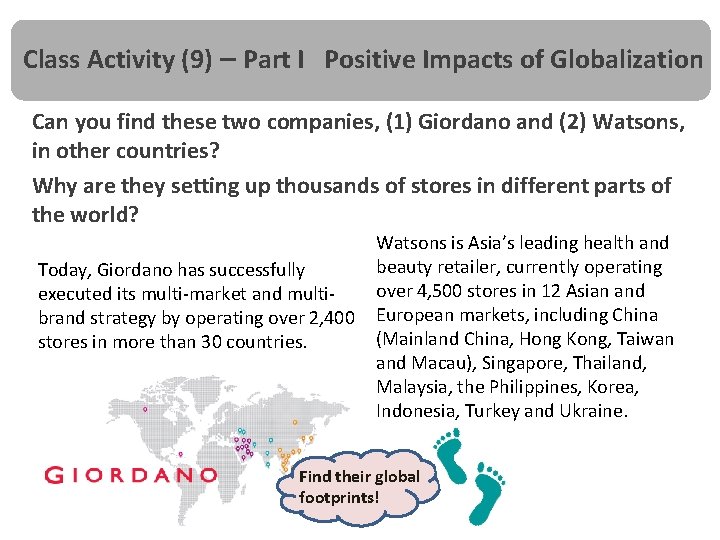
Class Activity (9) – Part I Positive Impacts of Globalization Can you find these two companies, (1) Giordano and (2) Watsons, in other countries? Why are they setting up thousands of stores in different parts of the world? Today, Giordano has successfully executed its multi-market and multibrand strategy by operating over 2, 400 stores in more than 30 countries. Watsons is Asia’s leading health and beauty retailer, currently operating over 4, 500 stores in 12 Asian and European markets, including China (Mainland China, Hong Kong, Taiwan and Macau), Singapore, Thailand, Malaysia, the Philippines, Korea, Indonesia, Turkey and Ukraine. Find their global footprints!
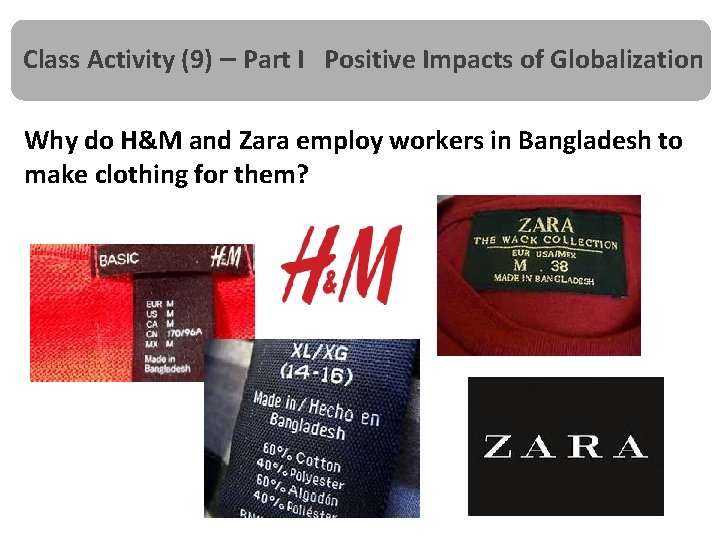
Class Activity (9) – Part I Positive Impacts of Globalization Why do H&M and Zara employ workers in Bangladesh to make clothing for them?
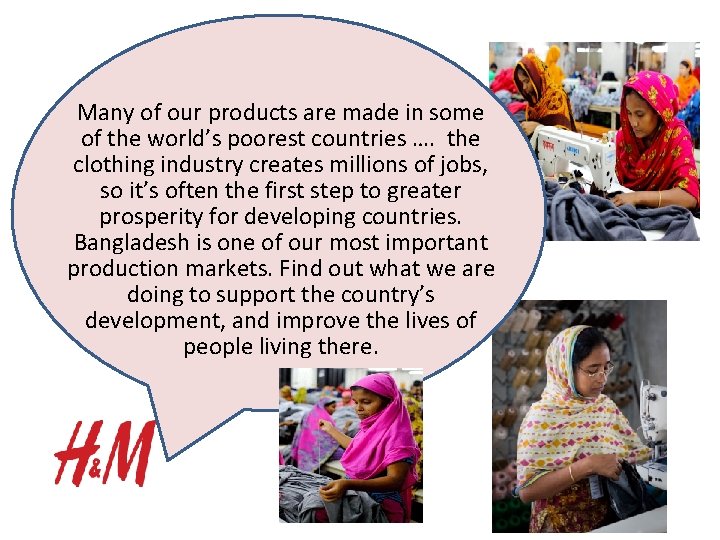
Many of our products are made in some of the world’s poorest countries …. the clothing industry creates millions of jobs, so it’s often the first step to greater prosperity for developing countries. Bangladesh is one of our most important production markets. Find out what we are doing to support the country’s development, and improve the lives of people living there.
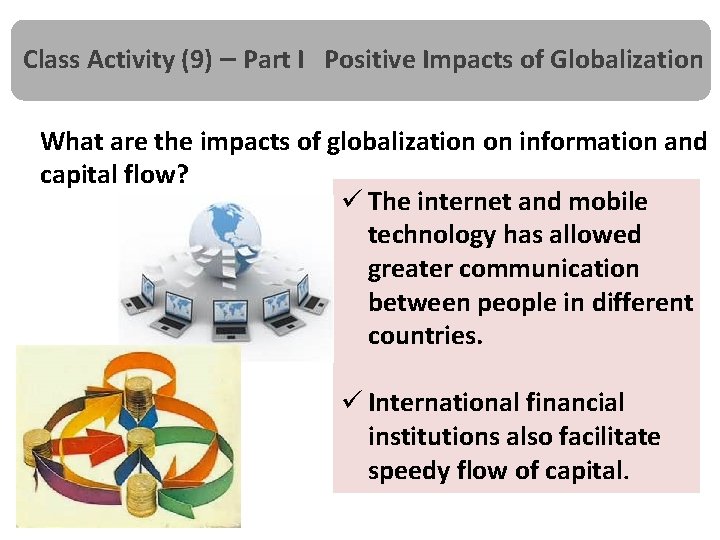
Class Activity (9) – Part I Positive Impacts of Globalization What are the impacts of globalization on information and capital flow? ü The internet and mobile technology has allowed greater communication between people in different countries. ü International financial institutions also facilitate speedy flow of capital.
Class Activity (9) – Part I A Summary of the Positive Impacts of Globalization More business opportunities to access worldwide markets Allow global sourcing of resources, e. g. Li & Fung Create employment opportunities, e. g. H&M Freer flow of capital and information
Class Activity (9) – Part II Criticisms again Globalization How about criticism?
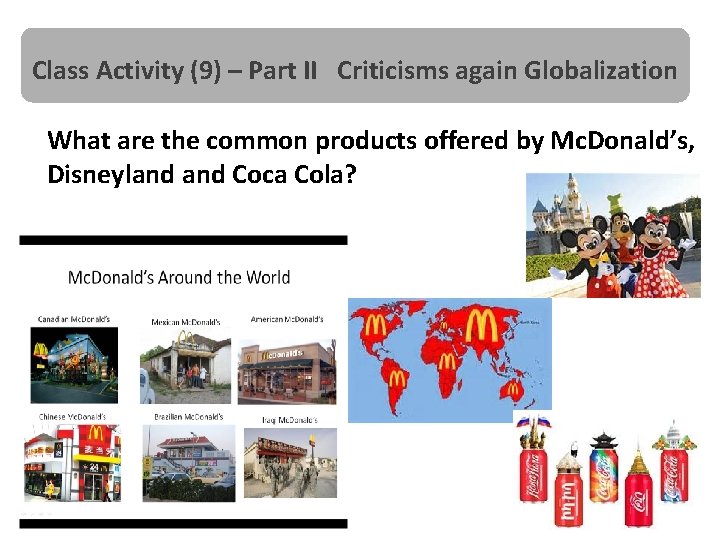
Class Activity (9) – Part II Criticisms again Globalization What are the common products offered by Mc. Donald’s, Disneyland Coca Cola?
Class Activity (9) – Part II Criticisms again Globalization Explain the negative impact of globalization from the case below – “Chinese Imports and Contraband Make Bolivia’s Textile Trade a Casualty of Globalization” Domestic manufacturing in Bolivia has been crushed by the influx of cheap foreign goods, mainly from China. Bolivian products cannot compete in the global market because of the small scale production, the strict labor law which keeps labor cost high, and the frequent political unrest which hurt competitiveness by raising costs. The Bolivian economy is reliant on raw material extraction, and its trade deficit keeps widening. Although the government is making an effort to raise tariffs and create state-owned companies to save jobs, globalization seems to have caused more bad than good in Bolivia. (Source: https: //www. globalpolicy. org)
Class Activity (9) – Part II Criticisms again Globalization Why are there fair trade coffee beans in Starbucks?
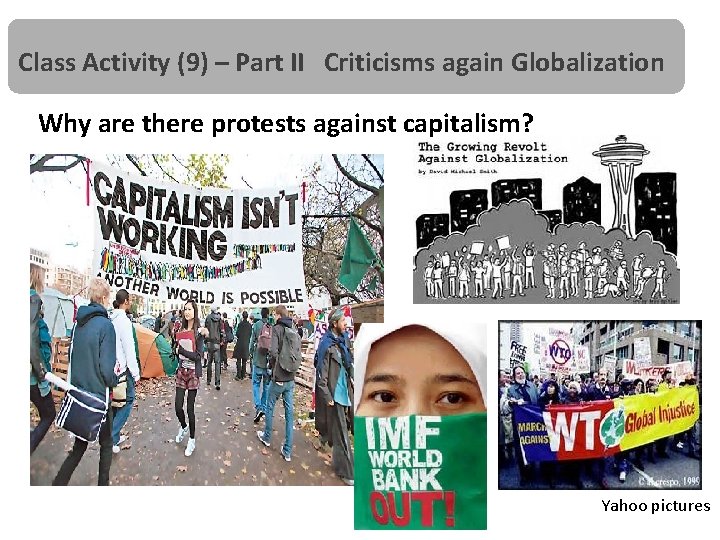
Class Activity (9) – Part II Criticisms again Globalization Why are there protests against capitalism? Yahoo pictures
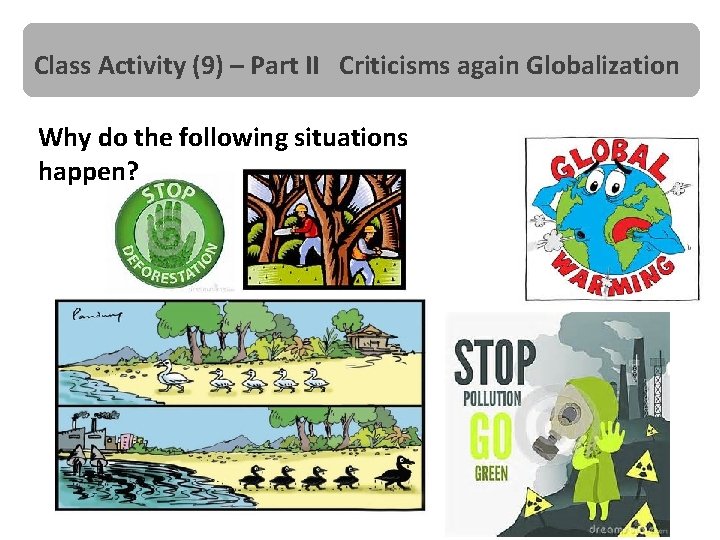
Class Activity (9) – Part II Criticisms again Globalization Why do the following situations happen?
Class Activity (9) – Part II A Summary of the Criticisms against Globalization Invasion of local culture Reducing employment opportunities for domestic workforce Greater economic fluctuation and market volatility due to higher interdependence among countries Increased poverty: larger income gap between rich and poor Contamination of environment and depletion of resources
Key International Trade Organisations With globalization and more frequent international trades, organisations that promote free and fair trade, establish trading rules and resolve disputes play an important role in global business world. Key international trade organisations include: 1. The World Trade Organisation (WTO) 2. Asia-Pacific Economic Cooperation (APEC) 3. International Monetary Fund (IMF) 4. Association of Southeast Asian Nations (ASEAN)
Key International Trade Organisations World Trade Organisation (WTO) ü provides a forum for negotiating agreements aimed at reducing obstacles to international trade and ensuring a level playing field for all, thus contributing to economic growth and development. ü provides a legal and institutional framework for the implementation and monitoring of these agreements, as well as for settling disputes arising from their interpretation and application.
Key International Trade Organisations Functions: Administering WTO trade agreements Forum for trade negotiations Handling trade disputes Monitoring national trade policies Technical assistance and training for developing countries ü Cooperation with other international organizations ü ü ü
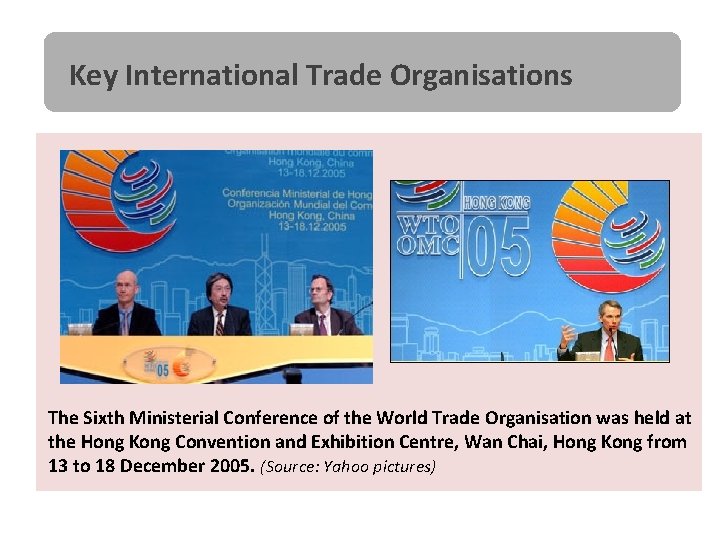
Key International Trade Organisations The Sixth Ministerial Conference of the World Trade Organisation was held at the Hong Kong Convention and Exhibition Centre, Wan Chai, Hong Kong from 13 to 18 December 2005. (Source: Yahoo pictures)
Key International Trade Organisations Asia-Pacific Economic Cooperation (APEC) ü is the premier Asia-Pacific economic forum with a primary goal of supporting sustainable economic growth and prosperity in the Asia-Pacific region. ü united to build a dynamic and harmonious Asia. Pacific community by championing free and open trade and investment
Key International Trade Organisations Asia-Pacific Economic Cooperation (APEC) ü promoting and accelerating regional economic integration, encouraging economic and technical cooperation, enhancing human security ü facilitating a favorable and sustainable business environment.
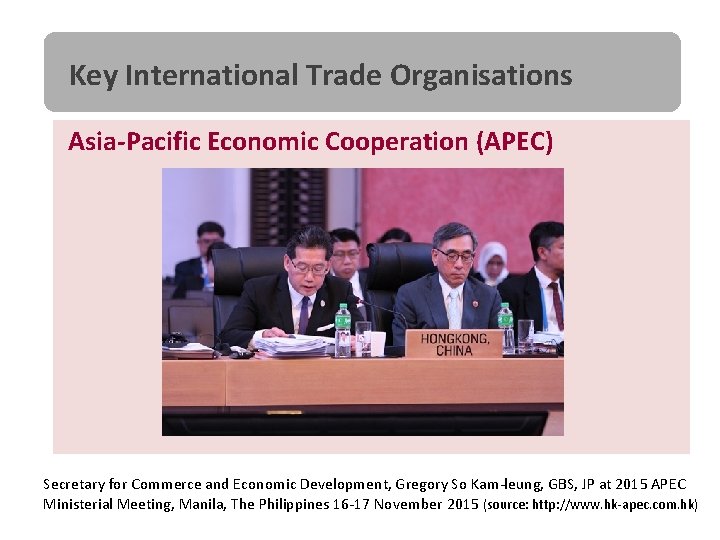
Key International Trade Organisations Asia-Pacific Economic Cooperation (APEC) Secretary for Commerce and Economic Development, Gregory So Kam-leung, GBS, JP at 2015 APEC Ministerial Meeting, Manila, The Philippines 16 -17 November 2015 (source: http: //www. hk-apec. com. hk)
Key International Trade Organisations International Monetary Fund (IMF) Functions: ü foster global monetary cooperation ü monitor global financial developments and secure financial stability ü facilitate international trade, promote high employment and sustainable economic growth
Key International Trade Organisations International Monetary Fund (IMF) Functions: ü provide technical advice and training ü provide short-term loans to countries that are unable to meet their financial obligations ü alleviate poverty in developing economies
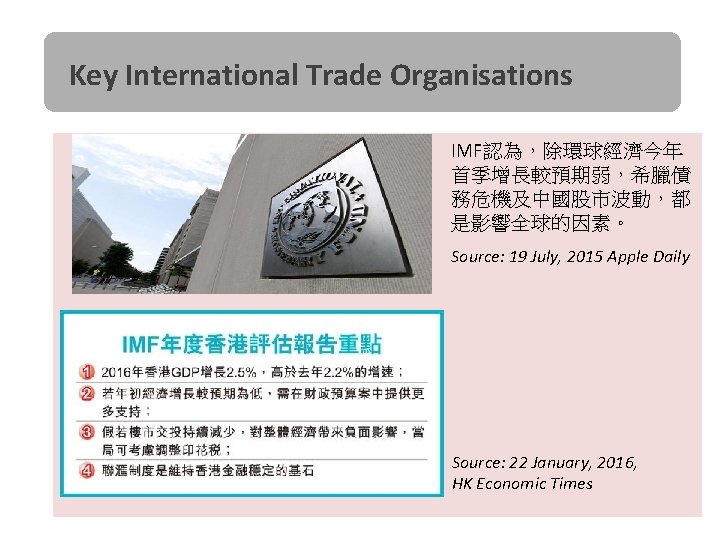
Key International Trade Organisations IMF認為,除環球經濟今年 首季增長較預期弱,希臘債 務危機及中國股市波動,都 是影響全球的因素。 Source: 19 July, 2015 Apple Daily Source: 22 January, 2016, HK Economic Times
Key International Trade Organisations The Association of Southeast Asian Nations (ASEAN) ü to accelerate the economic growth, social progress and cultural development in the region ü to strengthen the foundation for a prosperous and peaceful community of Southeast Asian Nations ü promote active collaboration and mutual assistance for raising of the living standards of their peoples
Extended Learning Activity -Other Key International Trade Organisations What are the primary functions of other international trade organisations? Find them out! EU, World Bank, OECD ……

END
- Slides: 31