
Lesson 5 Christianity Part 2 Characteristics of Korean


- Slides: 10
Lesson 5: Christianity (基督敎) Part 2: Characteristics of Korean Christianity
Study Contents Christianity, Nationalism and Modernization Characteristics of Korean Christianity
Christianity, Nationalism and Modernization Many Korean Christians converted by the first Protestant missionaries were converted to more than the religion from the West. They were also converted to many of the secular values, beliefs, and assumptions of the modern world which those missionaries also brought to Korea. Early Christian reformers such as Yun Chi-ho (1865 -1945) and So Chae-pil (1866 -1951) argued that Christianity, modernization and national independence went hand in hand. Statue of So Chae-pil in the front of the South Korean embassy in Washington, D. C.
Christianity, Nationalism and Modernization cont’d The rapid expansion of Christianity was occurring at the same time that the nation of Korea was rapidly losing its independence to Japanese imperialism. Many Korean Christians became involved in nationalistic, anti-Japanese politics. On March l, 1919, 33 prominent Koreans issued a public statement denouncing Japanese colonial rule and asserting the Korean people’s desire for independence. Sixteen of those signers were Christian. In addition to nationalism, Christianity has been identified in Korea with the West, and with modernization. And this is one of the reasons why many young and educated Koreans have been attracted to Christianity. After liberation, both Catholic and Protestant churches further heightened their visibility and their reputation for modernity by assuming a leadership role in the democratization battles of the 1970 s and the 1980 s.
Characteristics of Korean Christianity As is the case with Buddhism, Korean Christianity appears to have been influenced by the culture in which it has been transplanted, especially by shamanism. Critics say that many Korean Christians, who are not interested in the social gospel, seek a modern alternative to the shamanistic pursuit of wealth and health in Christianity. (祈福信仰) Confucianism has left its mark as well. Although women far outnumber men in Korean churches, a majority of leadership positions are still held by men. Besides shamanistic and Confucian influences on Korean churches, Korean theologians, particularly Protestant theologians, have begun producing Korean theologies.
Characteristics of Korean Christianity cont’d Minjung (民衆) theology is a Korean version of Latin American liberation theology, without its Marxist underpinnings. It represents a theological assertion of resistance to dictatorship and unbridled capitalism and, as such, is more popular in the faculty clubs of theological seminaries than in the pulpits of churches. Only a little more than a century after the first Protestant missionary arrived in Korea, not only is Korea no longer the object of foreign missionary endeavors, Korean churches, both Catholic and Protestant, now send their own missionaries overseas. There is no doubt that Christianity has established a formidable and permanent presence in Korea. Christianity, both Catholic and Protestant, will continue to play an important role in the religious, political, and cultural life of South Korea, so much so that anyone who wishes to understand contemporary Korea must first understand Korean Christianity.
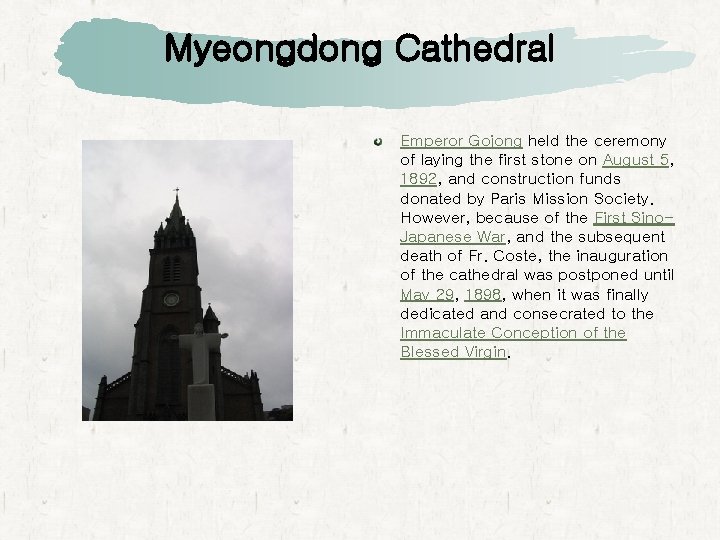
Myeongdong Cathedral Emperor Gojong held the ceremony of laying the first stone on August 5, 1892, and construction funds donated by Paris Mission Society. However, because of the First Sino. Japanese War, and the subsequent death of Fr. Coste, the inauguration of the cathedral was postponed until May 29, 1898, when it was finally dedicated and consecrated to the Immaculate Conception of the Blessed Virgin.
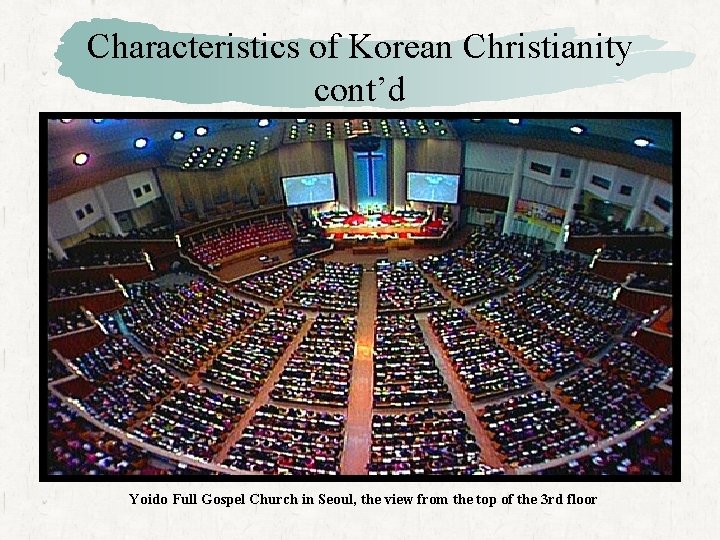
Characteristics of Korean Christianity cont’d Yoido Full Gospel Church in Seoul, claims to have the largest congregation of any single church in the entire world, about 750, 000
Characteristics of Korean Christianity cont’d Yoido Full Gospel Church in Seoul, the view from the top of the 3 rd floor
End of Lesson 5 – Part 2