
Lesson 5 6 Bayes Rule on CD Objectives
Lesson 5 - 6 Bayes’ Rule (on CD)
Objectives • Use the Rule of Total Probability • Use Bayes’s Rule to Compute Probabilities
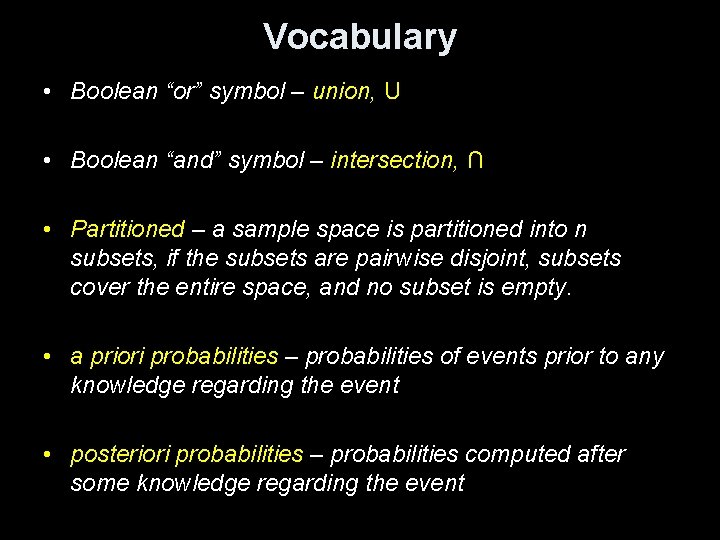
Vocabulary • Boolean “or” symbol – union, U • Boolean “and” symbol – intersection, ∩ • Partitioned – a sample space is partitioned into n subsets, if the subsets are pairwise disjoint, subsets cover the entire space, and no subset is empty. • a priori probabilities – probabilities of events prior to any knowledge regarding the event • posteriori probabilities – probabilities computed after some knowledge regarding the event
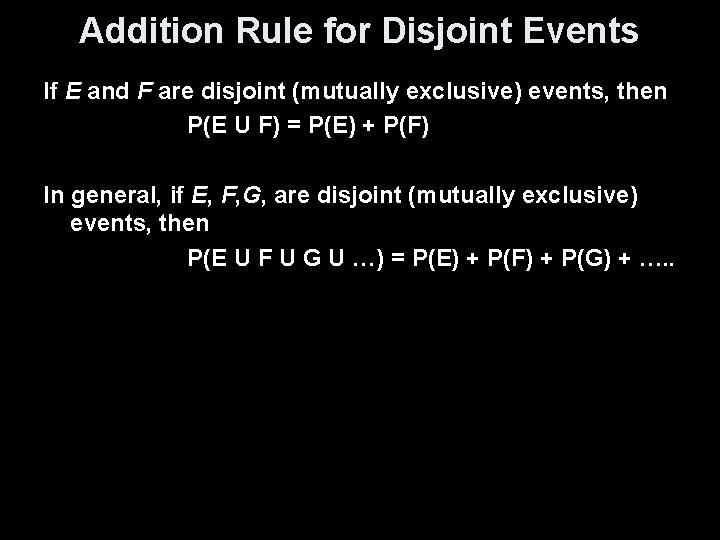
Addition Rule for Disjoint Events If E and F are disjoint (mutually exclusive) events, then P(E U F) = P(E) + P(F) In general, if E, F, G, are disjoint (mutually exclusive) events, then P(E U F U G U …) = P(E) + P(F) + P(G) + …. .
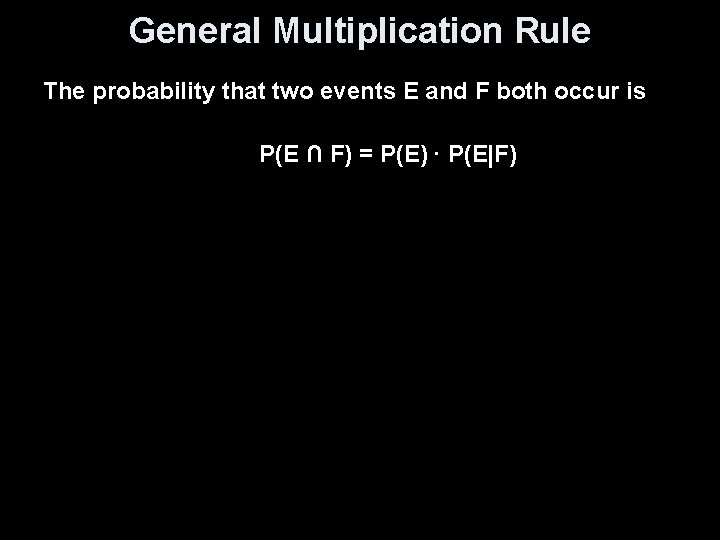
General Multiplication Rule The probability that two events E and F both occur is P(E ∩ F) = P(E) ∙ P(E|F)
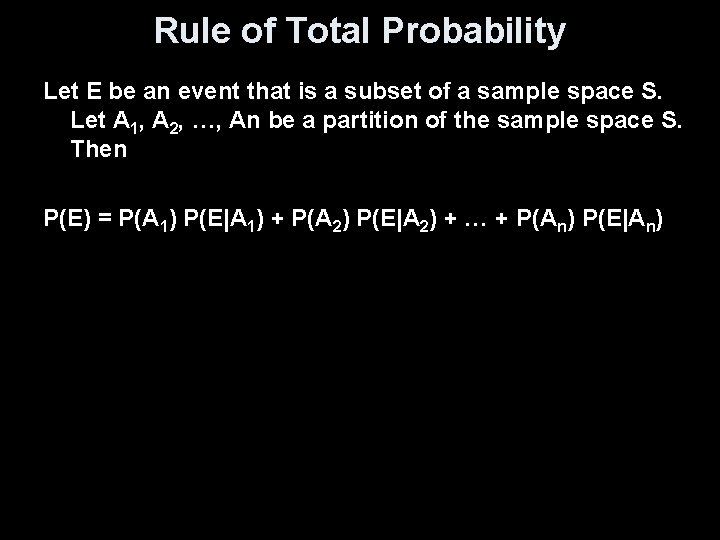
Rule of Total Probability Let E be an event that is a subset of a sample space S. Let A 1, A 2, …, An be a partition of the sample space S. Then P(E) = P(A 1) P(E|A 1) + P(A 2) P(E|A 2) + … + P(An) P(E|An)
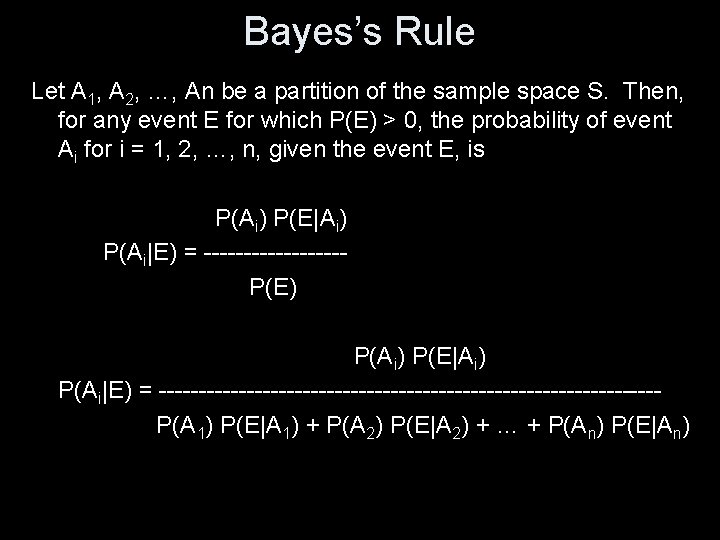
Bayes’s Rule Let A 1, A 2, …, An be a partition of the sample space S. Then, for any event E for which P(E) > 0, the probability of event Ai for i = 1, 2, …, n, given the event E, is P(Ai) P(E|Ai) P(Ai|E) = ---------P(E) P(Ai) P(E|Ai) P(Ai|E) = -------------------------------P(A 1) P(E|A 1) + P(A 2) P(E|A 2) + … + P(An) P(E|An)
Summary and Homework • Summary – Stratified and cluster sampling are different – Convenience sampling results are generally suspect • Homework – on CD pg 9: 7 -9, 13 -16
- Slides: 8