
Lesson 5 3 Independence and the Multiplication Rule
- Slides: 8
Lesson 5 - 3 Independence and the Multiplication Rule
Objectives • Understand independence • Use the Multiplication Rule for independent events • Compute at-least probabilities
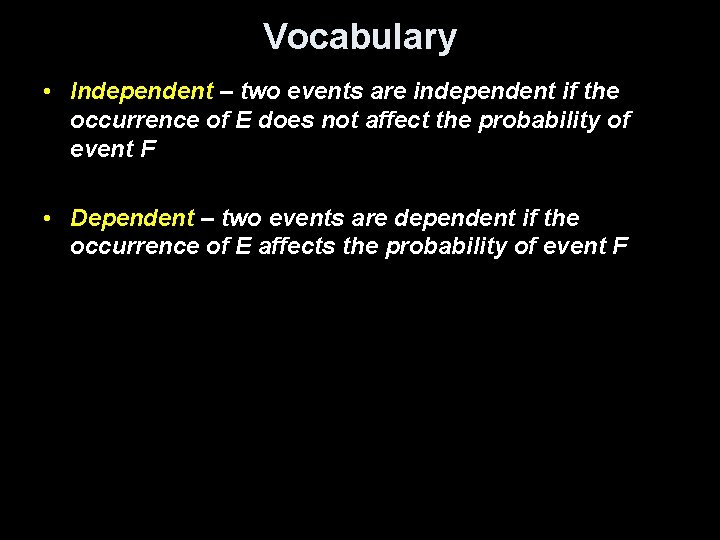
Vocabulary • Independent – two events are independent if the occurrence of E does not affect the probability of event F • Dependent – two events are dependent if the occurrence of E affects the probability of event F
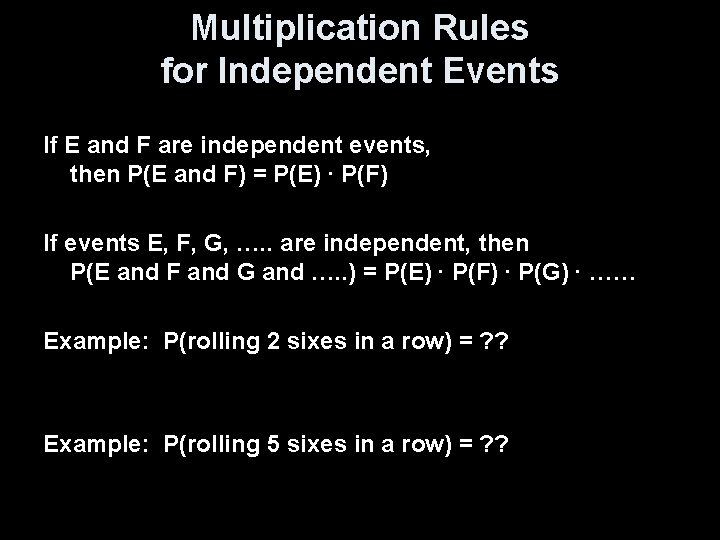
Multiplication Rules for Independent Events If E and F are independent events, then P(E and F) = P(E) ∙ P(F) If events E, F, G, …. . are independent, then P(E and F and G and …. . ) = P(E) ∙ P(F) ∙ P(G) ∙ …… Example: P(rolling 2 sixes in a row) = ? ? Example: P(rolling 5 sixes in a row) = ? ?
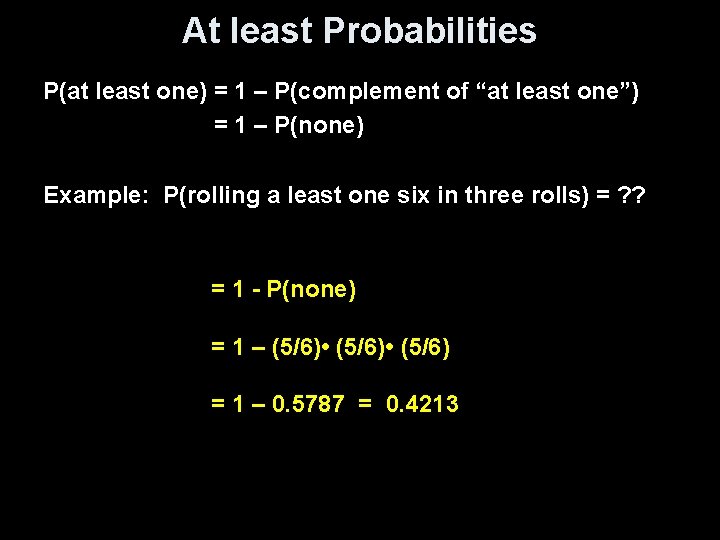
At least Probabilities P(at least one) = 1 – P(complement of “at least one”) = 1 – P(none) Example: P(rolling a least one six in three rolls) = ? ? = 1 - P(none) = 1 – (5/6) • (5/6) = 1 – 0. 5787 = 0. 4213
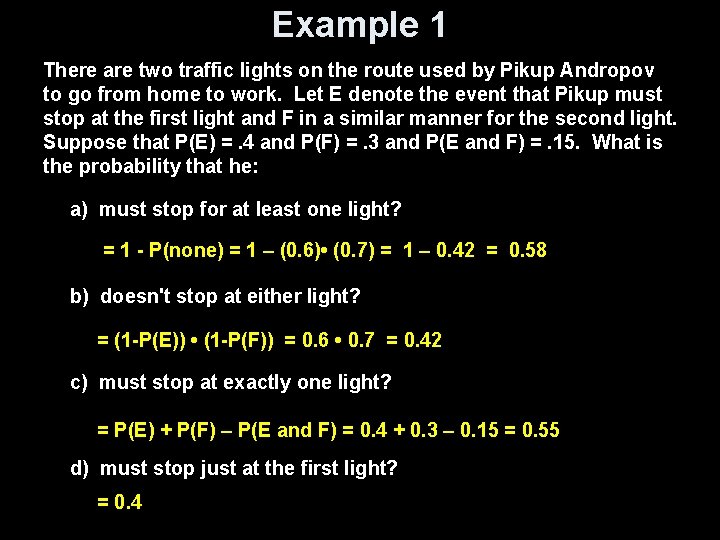
Example 1 There are two traffic lights on the route used by Pikup Andropov to go from home to work. Let E denote the event that Pikup must stop at the first light and F in a similar manner for the second light. Suppose that P(E) =. 4 and P(F) =. 3 and P(E and F) =. 15. What is the probability that he: a) must stop for at least one light? = 1 - P(none) = 1 – (0. 6) • (0. 7) = 1 – 0. 42 = 0. 58 b) doesn't stop at either light? = (1 -P(E)) • (1 -P(F)) = 0. 6 • 0. 7 = 0. 42 c) must stop at exactly one light? = P(E) + P(F) – P(E and F) = 0. 4 + 0. 3 – 0. 15 = 0. 55 d) must stop just at the first light? = 0. 4
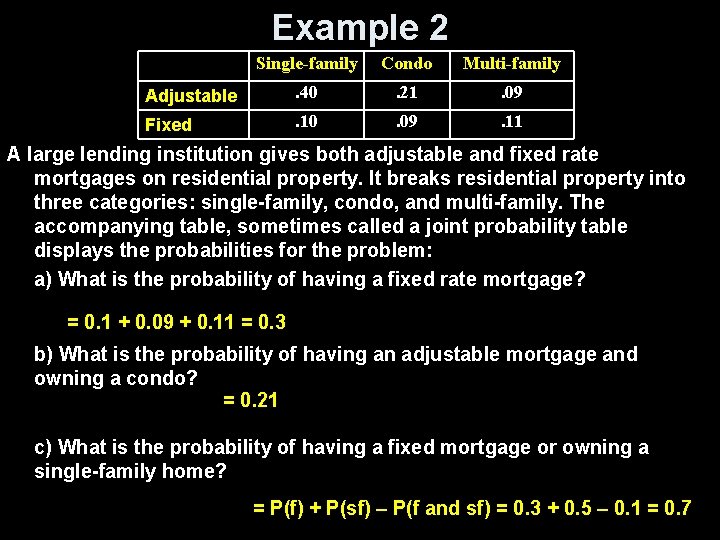
Example 2 Single-family Condo Multi-family Adjustable . 40 . 21 . 09 Fixed . 10 . 09 . 11 A large lending institution gives both adjustable and fixed rate mortgages on residential property. It breaks residential property into three categories: single-family, condo, and multi-family. The accompanying table, sometimes called a joint probability table displays the probabilities for the problem: a) What is the probability of having a fixed rate mortgage? = 0. 1 + 0. 09 + 0. 11 = 0. 3 b) What is the probability of having an adjustable mortgage and owning a condo? = 0. 21 c) What is the probability of having a fixed mortgage or owning a single-family home? = P(f) + P(sf) – P(f and sf) = 0. 3 + 0. 5 – 0. 1 = 0. 7
Summary and Homework • Summary – Disjoint events are not necessarily independent – The Multiplication Rule applies to independent events, the probabilities are multiplied to calculate an “and” probability – Probabilities obey many different rules • • • Probabilities must be between 0 and 1 The sum of the probabilities for all the outcomes must be 1 The Complement Rule The Addition Rule (and the General Addition Rule) The Multiplication Rule • Homework – pg 282 - 283: 11, 12, 17, 19, 23