
Lesson 46 Trigonometric Functions IB Math SL 1
Lesson 46 – Trigonometric Functions IB Math SL 1 - Santowski 1/22/2022 IB Math SL 1 - Santowski 1
Lesson Objectives n Make the connection between angles in standard position and sinusoidal functions n Graph and analyze a periodic function n Introduce transformations of periodic functions 1/22/2022 IB Math SL 1 - Santowski 2

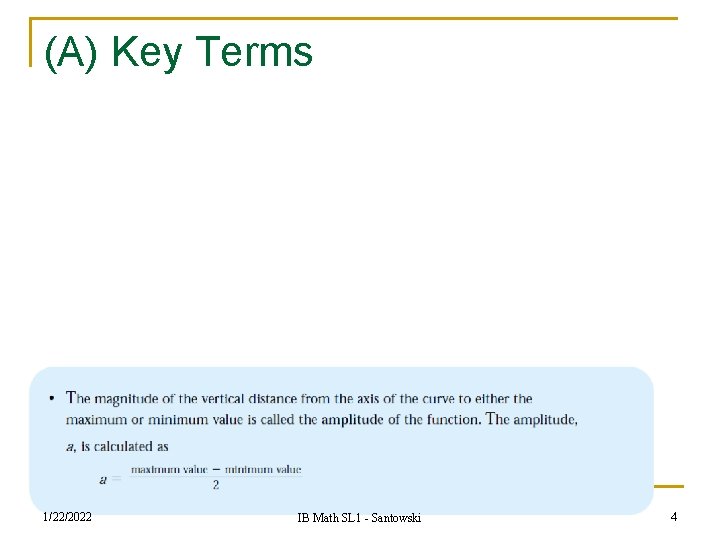
(A) Key Terms Related to Periodic Functions n Define the following key terms that relate to trigonometric functions: n (a) period (b) amplitude (c) axis of the curve (or equilibrium axis) n n 1/22/2022 IB Math SL 1 - Santowski 3
(A) Key Terms 1/22/2022 IB Math SL 1 - Santowski 4

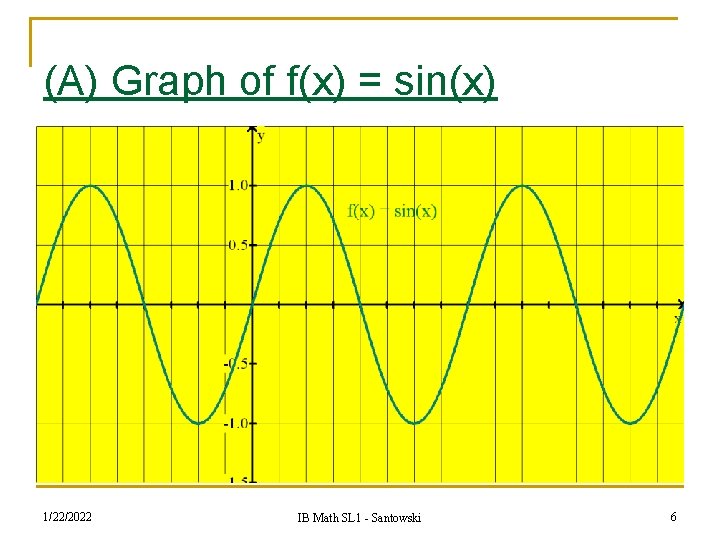
(A) Graph of f(x) = sin(x) n We can use our knowledge of angles on Cartesian plane and our knowledge of the trig ratios of special angles to create a list of points to generate a graph of f(x) = sin(x) n See link at http: //www. univie. ac. at/future. media/moe/galerie/fun 2. html#sincostan 1/22/2022 IB Math SL 1 - Santowski 5
(A) Graph of f(x) = sin(x) 1/22/2022 IB Math SL 1 - Santowski 6
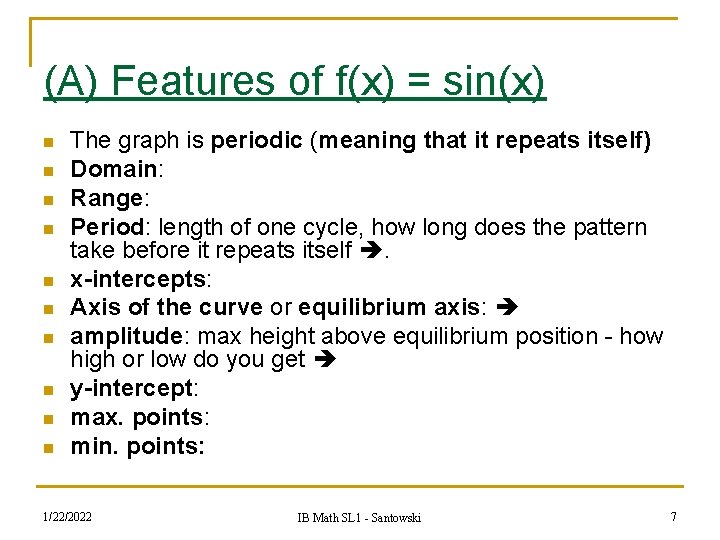
(A) Features of f(x) = sin(x) n n n n n The graph is periodic (meaning that it repeats itself) Domain: Range: Period: length of one cycle, how long does the pattern take before it repeats itself . x-intercepts: Axis of the curve or equilibrium axis: amplitude: max height above equilibrium position - how high or low do you get y-intercept: max. points: min. points: 1/22/2022 IB Math SL 1 - Santowski 7
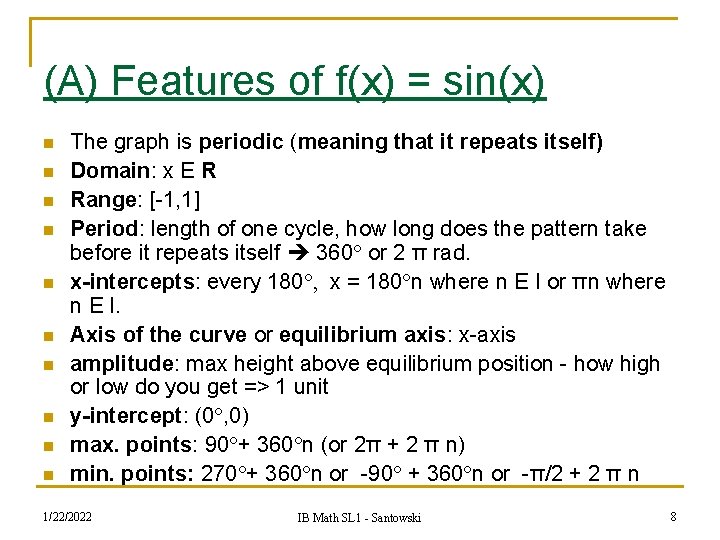
(A) Features of f(x) = sin(x) n n n n n The graph is periodic (meaning that it repeats itself) Domain: x E R Range: [-1, 1] Period: length of one cycle, how long does the pattern take before it repeats itself 360° or 2 π rad. x-intercepts: every 180°, x = 180°n where n E I or πn where n E I. Axis of the curve or equilibrium axis: x-axis amplitude: max height above equilibrium position - how high or low do you get => 1 unit y-intercept: (0°, 0) max. points: 90°+ 360°n (or 2π + 2 π n) min. points: 270°+ 360°n or -90° + 360°n or -π/2 + 2 π n 1/22/2022 IB Math SL 1 - Santowski 8
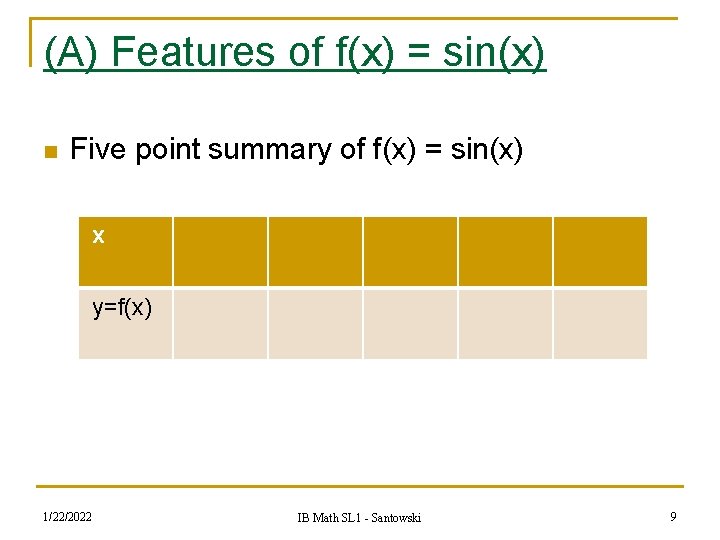
(A) Features of f(x) = sin(x) n Five point summary of f(x) = sin(x) x y=f(x) 1/22/2022 IB Math SL 1 - Santowski 9
(B) Graph of f(x) = cos(x) n We can use our knowledge of angles on Cartesian plane and our knowledge of the trig ratios of special angles to create a list of points to generate a graph of f(x) = cos(x) n See link at http: //www. univie. ac. at/future. media/moe/galerie/fun 2. html#sincostan 1/22/2022 IB Math SL 1 - Santowski 10
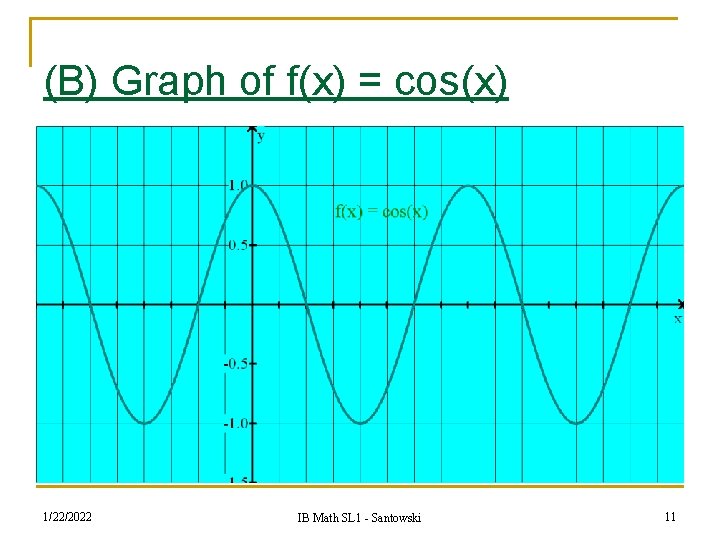
(B) Graph of f(x) = cos(x) 1/22/2022 IB Math SL 1 - Santowski 11
(B) Features of f(x) = cos(x) n n n n n The graph is periodic Domain: Range: Period: length of one cycle, how long does the pattern take before it repeats itself . x-intercepts: Axis of the curve or equilibrium axis: amplitude: max height above equilibrium position - how high or low do you get y-intercept: max. points: min. points: 1/22/2022 IB Math SL 1 - Santowski 12
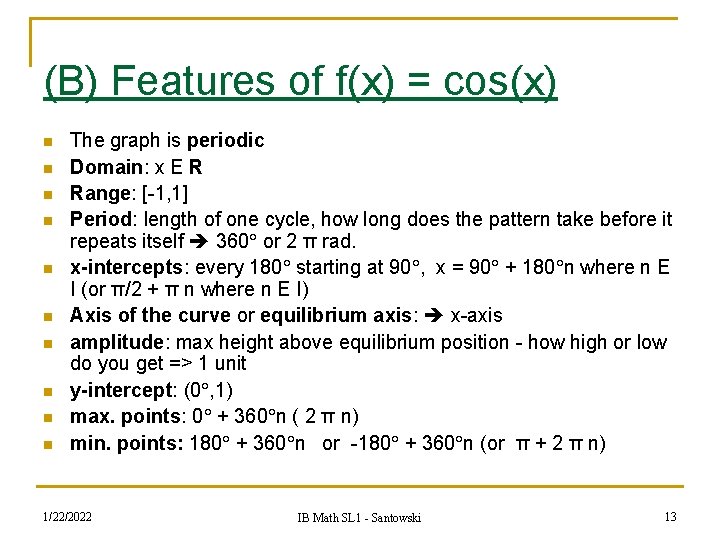
(B) Features of f(x) = cos(x) n n n n n The graph is periodic Domain: x E R Range: [-1, 1] Period: length of one cycle, how long does the pattern take before it repeats itself 360° or 2 π rad. x-intercepts: every 180° starting at 90°, x = 90° + 180°n where n E I (or π/2 + π n where n E I) Axis of the curve or equilibrium axis: x-axis amplitude: max height above equilibrium position - how high or low do you get => 1 unit y-intercept: (0°, 1) max. points: 0° + 360°n ( 2 π n) min. points: 180° + 360°n or -180° + 360°n (or π + 2 π n) 1/22/2022 IB Math SL 1 - Santowski 13
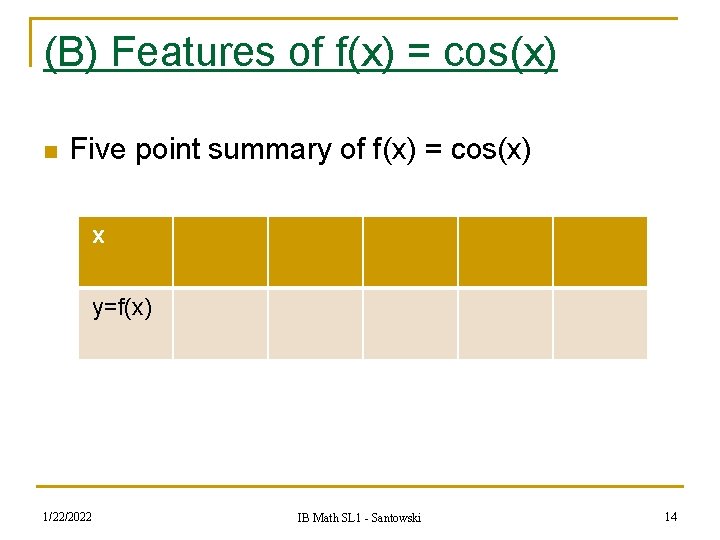
(B) Features of f(x) = cos(x) n Five point summary of f(x) = cos(x) x y=f(x) 1/22/2022 IB Math SL 1 - Santowski 14
(C) Graph of f(x) = tan(x) n We can use our knowledge of angles on Cartesian plane and our knowledge of the trig ratios of special angles to create a list of points to generate a graph of f(x) = tan(x) n See link at http: //www. univie. ac. at/future. media/moe/galerie/fun 2. html#sincostan 1/22/2022 IB Math SL 1 - Santowski 15
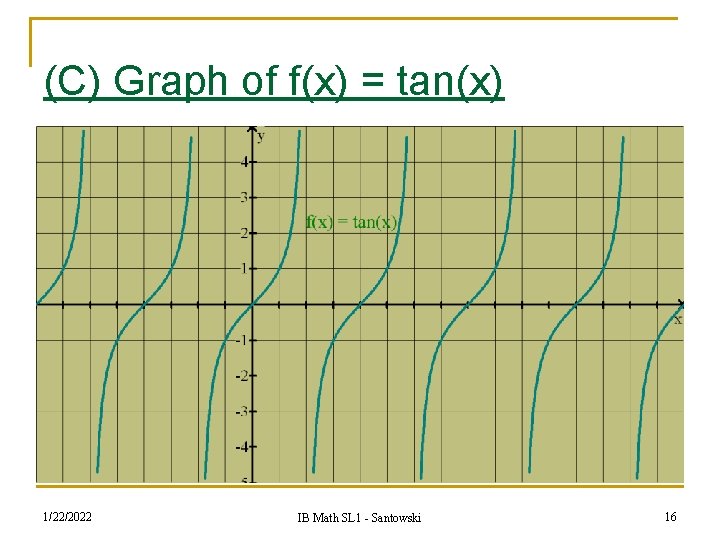
(C) Graph of f(x) = tan(x) 1/22/2022 IB Math SL 1 - Santowski 16
(C) Features of f(x) = tan(x) n n n n n The graph is periodic Domain: Asymptotes: Range: Period: length of one cycle, how long does the pattern take before it repeats itself x-intercepts: amplitude: max height above equilibrium position - how high or low do you get y-intercept: max. points: min. points: 1/22/2022 IB Math SL 1 - Santowski 17
(C) Features of f(x) = tan(x) n n n n n The graph is periodic Domain: x E R where x cannot equal 90°, 270°, 450°, or basically 90° + 180°n where n E I Asymptotes: every 180° starting at 90° Range: x E R Period: length of one cycle, how long does the pattern take before it repeats itself = 180° or π rad. x-intercepts: x = 0°, 180°, 360°, or basically 180°n where n E I or x = πn amplitude: max height above equilibrium position - how high or low do you get => none as it stretches on infinitely y-intercept: (0°, 0) max. points: none min. points: none 1/22/2022 IB Math SL 1 - Santowski 18
(C) Features of f(x) = tan(x) n Five point summary of f(x) = tan(x) x y=f(x) 1/22/2022 IB Math SL 1 - Santowski 19
(D) Internet Links n Unit Circle and Trigonometric Functions sin(x), cos(x), tan(x) from Analyze. Math n Relating the unit circle with the graphs of sin, cos, tan from Maths Online 1/22/2022 IB Math SL 1 - Santowski 20
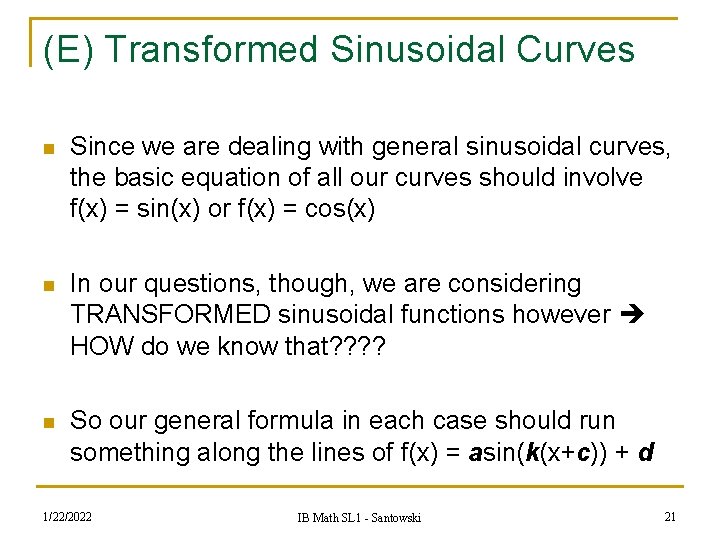
(E) Transformed Sinusoidal Curves n Since we are dealing with general sinusoidal curves, the basic equation of all our curves should involve f(x) = sin(x) or f(x) = cos(x) n In our questions, though, we are considering TRANSFORMED sinusoidal functions however HOW do we know that? ? n So our general formula in each case should run something along the lines of f(x) = asin(k(x+c)) + d 1/22/2022 IB Math SL 1 - Santowski 21
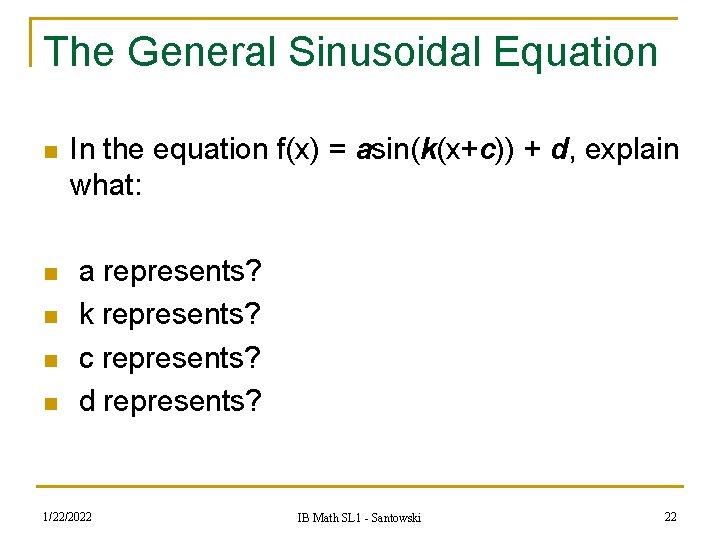
The General Sinusoidal Equation n n In the equation f(x) = asin(k(x+c)) + d, explain what: a represents? k represents? c represents? d represents? 1/22/2022 IB Math SL 1 - Santowski 22
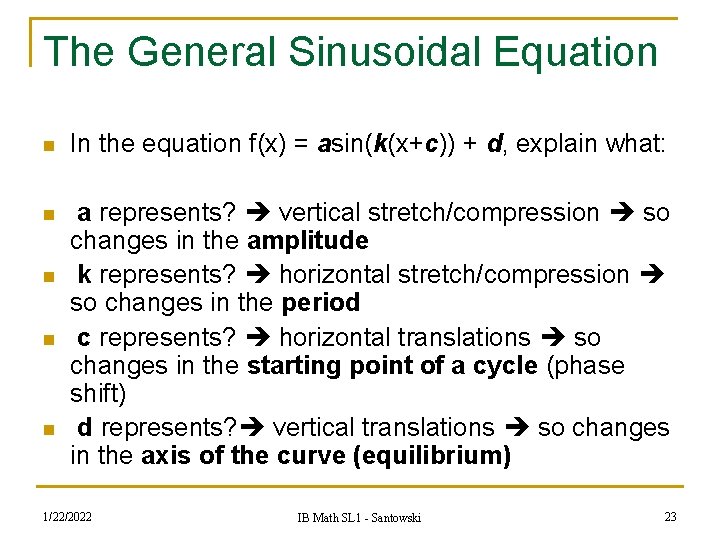
The General Sinusoidal Equation n In the equation f(x) = asin(k(x+c)) + d, explain what: n a represents? vertical stretch/compression so changes in the amplitude k represents? horizontal stretch/compression so changes in the period c represents? horizontal translations so changes in the starting point of a cycle (phase shift) d represents? vertical translations so changes in the axis of the curve (equilibrium) n n n 1/22/2022 IB Math SL 1 - Santowski 23
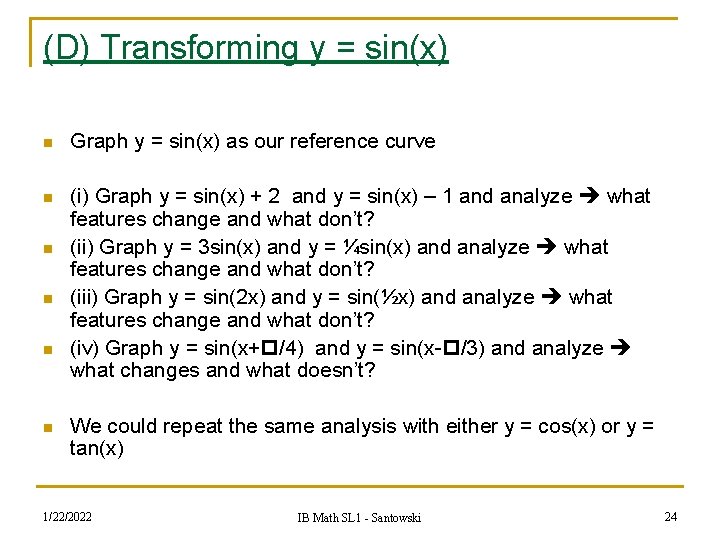
(D) Transforming y = sin(x) n Graph y = sin(x) as our reference curve n (i) Graph y = sin(x) + 2 and y = sin(x) – 1 and analyze what features change and what don’t? (ii) Graph y = 3 sin(x) and y = ¼sin(x) and analyze what features change and what don’t? (iii) Graph y = sin(2 x) and y = sin(½x) and analyze what features change and what don’t? (iv) Graph y = sin(x+ /4) and y = sin(x- /3) and analyze what changes and what doesn’t? n n We could repeat the same analysis with either y = cos(x) or y = tan(x) 1/22/2022 IB Math SL 1 - Santowski 24
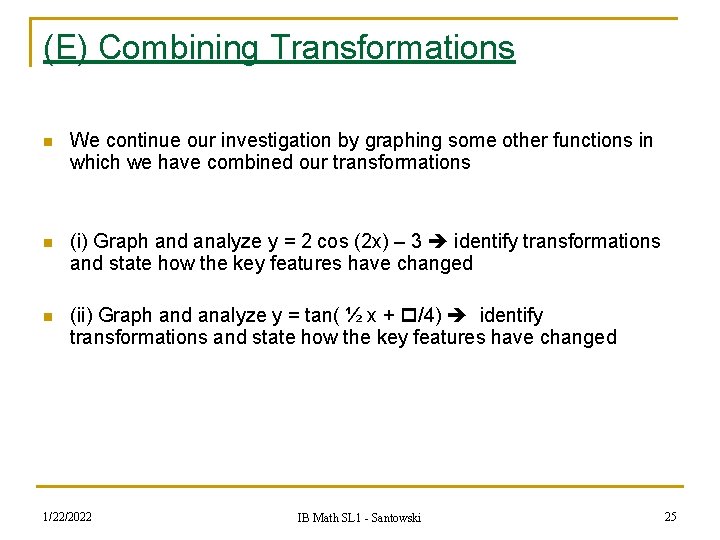
(E) Combining Transformations n We continue our investigation by graphing some other functions in which we have combined our transformations n (i) Graph and analyze y = 2 cos (2 x) – 3 identify transformations and state how the key features have changed n (ii) Graph and analyze y = tan( ½ x + /4) identify transformations and state how the key features have changed 1/22/2022 IB Math SL 1 - Santowski 25
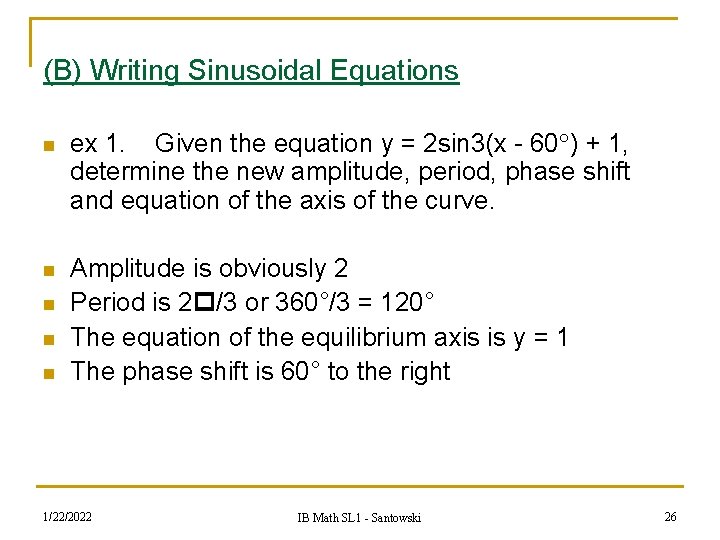
(B) Writing Sinusoidal Equations n ex 1. Given the equation y = 2 sin 3(x - 60°) + 1, determine the new amplitude, period, phase shift and equation of the axis of the curve. n Amplitude is obviously 2 Period is 2 /3 or 360°/3 = 120° The equation of the equilibrium axis is y = 1 The phase shift is 60° to the right n n n 1/22/2022 IB Math SL 1 - Santowski 26
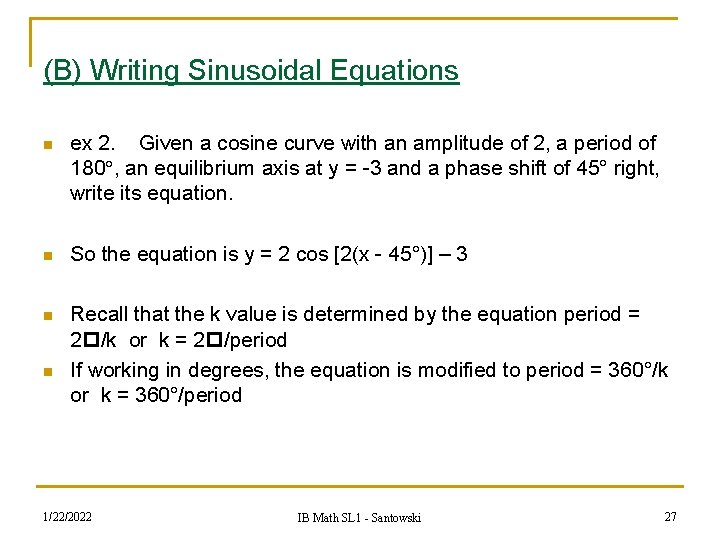
(B) Writing Sinusoidal Equations n ex 2. Given a cosine curve with an amplitude of 2, a period of 180°, an equilibrium axis at y = -3 and a phase shift of 45° right, write its equation. n So the equation is y = 2 cos [2(x - 45°)] – 3 n Recall that the k value is determined by the equation period = 2 /k or k = 2 /period If working in degrees, the equation is modified to period = 360°/k or k = 360°/period n 1/22/2022 IB Math SL 1 - Santowski 27
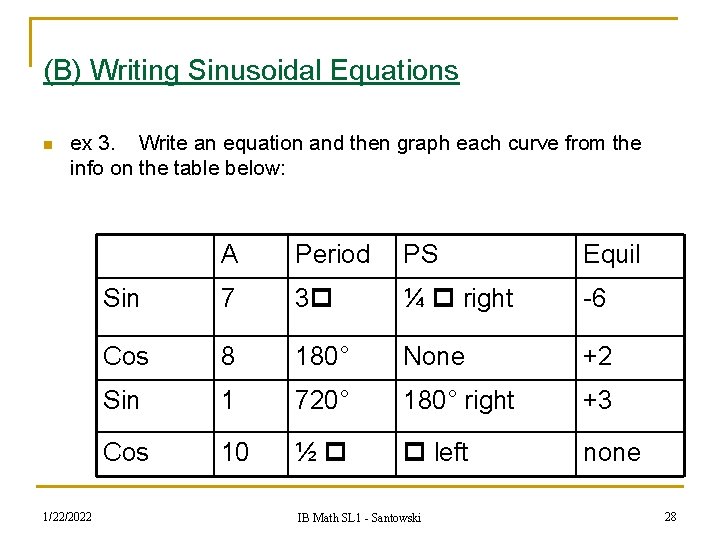
(B) Writing Sinusoidal Equations n ex 3. Write an equation and then graph each curve from the info on the table below: 1/22/2022 A Period PS Equil Sin 7 3 ¼ right -6 Cos 8 180° None +2 Sin 1 720° 180° right +3 Cos 10 ½ left none IB Math SL 1 - Santowski 28
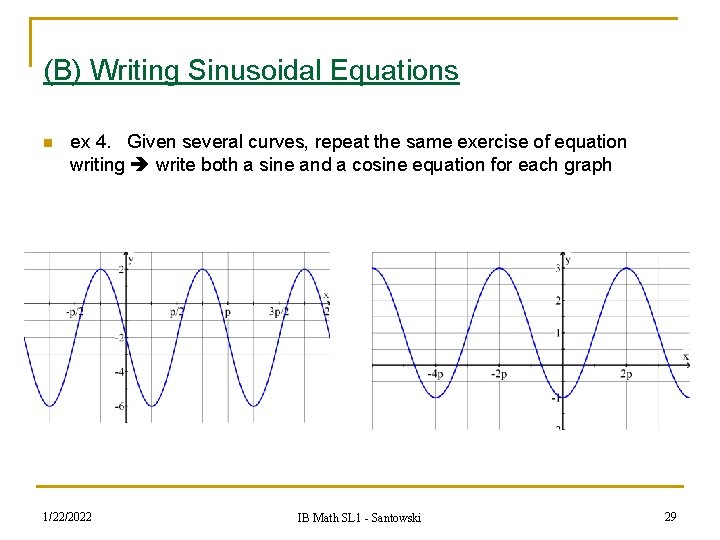
(B) Writing Sinusoidal Equations n ex 4. Given several curves, repeat the same exercise of equation writing write both a sine and a cosine equation for each graph 1/22/2022 IB Math SL 1 - Santowski 29
(E) Homework n n Nelson text, Section 5. 2, p 420, Q 1 -6 eol, 11, 12, 15 -19 Section 5. 6, p 455, Q 1 -10 eol, 11, 13, 18 Nelson text, page 464, Q 8, 9, 10, 12, 13 -19 1/22/2022 IB Math SL 1 - Santowski 30
- Slides: 30