
Lesson 4 The Engineering Design Process Unit 1
- Slides: 66
Lesson 4 - The Engineering Design Process Unit 1 - Science, Technology, and Engineering
Classroom Technology Hunt • With a partner, search the classroom for examples of technology. Write down the list in your notebook. You have 3 minutes!
Classroom Technology Hunt • With a partner, search the classroom for examples of technology. Write down the list in your notebook. You have 3 minutes! • Next, classify each technology as simple or complex.
Classroom Technology Hunt • With a partner, search the classroom for examples of technology. Write down the list in your notebook. You have 3 minutes! • Next, classify each technology as simple or complex. • Let’s share our lists!
What is Technology? • How do new products come about?
What is Technology? • How do new products come about? • Sometimes new products are the result of new technology that was developed for a different purpose.
What is Technology? • How do new products come about? • Sometimes new products are the result of new technology that was developed for a different purpose. • But when engineers study this new technology, they notice additional capabilities, such as a way to improve an existing product or to make an entirely new product.
What is Technology? • How do new products come about? • Sometimes new products are the result of new technology that was developed for a different purpose. • But when engineers study this new technology, they notice additional capabilities, such as a way to improve an existing product or to make an entirely new product. • Why might you choose to redesign a product?
What is Technology? • But when engineers study this new technology, they notice additional capabilities, such as a way to improve an existing product or to make an entirely new product. • Why might you choose to redesign a product? – Because the product has flaws or it doesn’t do the job it was intended to do.
What is Technology? • How do new products come about? • Sometimes new products are the result of new technology that was developed for a different purpose. • But when engineers study this new technology, they notice additional capabilities, such as a way to improve an existing product or to make an entirely new product. • If you like to ride mountain bikes you know that there are many different types and styles to choose from.
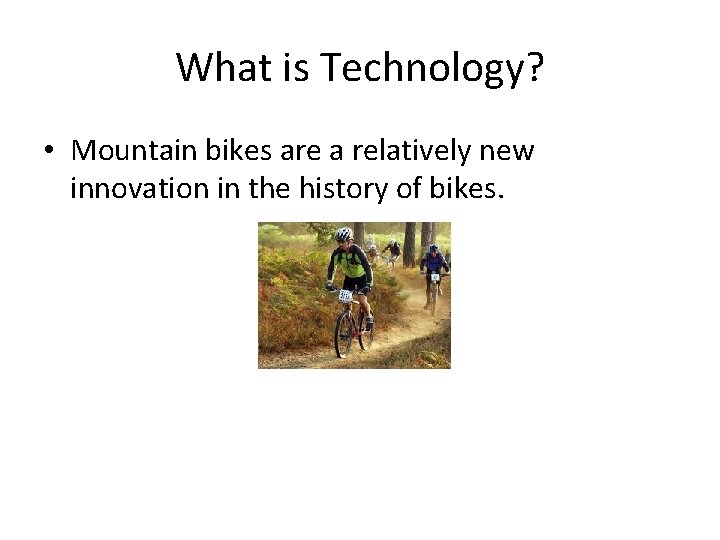
What is Technology? • Mountain bikes are a relatively new innovation in the history of bikes.
What is Technology? • Mountain bikes are a relatively new innovation in the history of bikes. • In the 1970 s, a group of bike riders used a motorbike frame to develop custom bicycles to ride off road.
What is Technology? • Mountain bikes are a relatively new innovation in the history of bikes. • In the 1970 s, a group of bike riders used a motorbike frame to develop custom bicycles to ride off road. • The bikers experimented with different technology from several types of bikes.
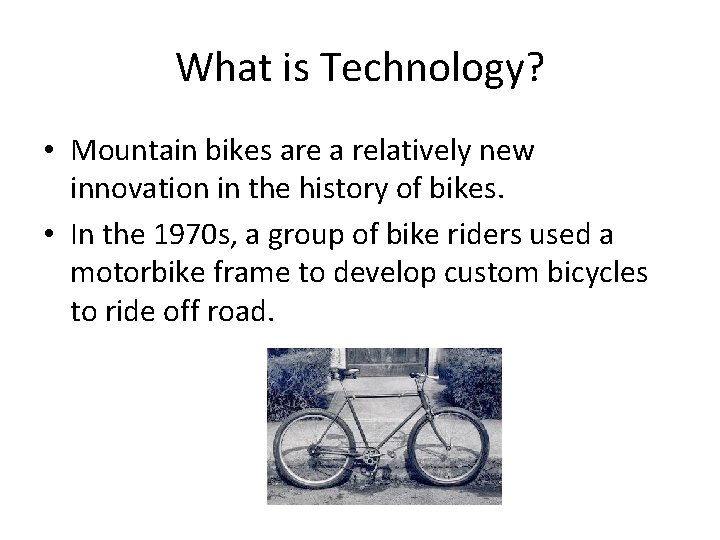
What is Technology? • Mountain bikes are a relatively new innovation in the history of bikes. • In the 1970 s, a group of bike riders used a motorbike frame to develop custom bicycles to ride off road. • The bikers experimented with different technology from several types of bikes. • Eventually they used these prototypes to make what today we call the mountain bike.
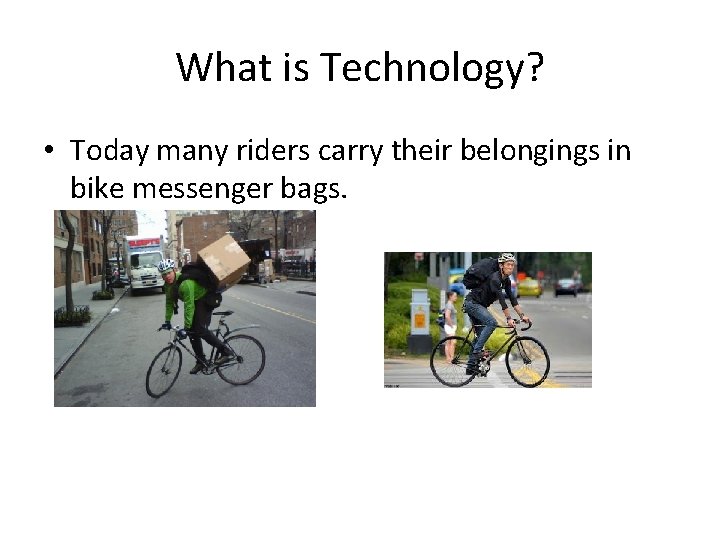
What is Technology? • Today many riders carry their belongings in bike messenger bags.
What is Technology? • Today many riders carry their belongings in bike messenger bags. • How did messenger bags become so popular?
What is Technology? • Today many riders carry their belongings in bike messenger bags. • How did messenger bags become so popular? • Some people believe these bags were modeled after similar bags used by telephone workers to carry tools up to the top of telephone poles. The rugged bags were designed for easy access.
What is Technology? • Today many riders carry their belongings in bike messenger bags. • How did messenger bags become so popular? • Some people believe these bags were modeled after similar bags used by telephone workers to carry tools up to the top of telephone poles. The rugged bags were designed for easy access. • Bicycle messengers quickly adopted these bags for their own purposes.
Introduction • Some people believe these bags were modeled after similar bags used by telephone workers to carry tools up to the top of telephone poles. The rugged bags were designed for easy access. • Bicycle messengers quickly adopted these bags for their own purposes. • As bicycle traffic in cities grew, companies began to design messenger bags to make them even more stylish.
Introduction • Some people believe these bags were modeled after similar bags used by telephone workers to carry tools up to the top of telephone poles. The rugged bags were designed for easy access. • Bicycle messengers quickly adopted these bags for their own purposes. • As bicycle traffic in cities grew, companies began to design messenger bags to make them even more stylish. • Carbon fibers were originally developed for the aerospace industry, not for bicycles.
Introduction • Bicycle messengers quickly adopted these bags for their own purposes. • As bicycle traffic in cities grew, companies began to design messenger bags to make them even more stylish. • Carbon fibers were originally developed for the aerospace industry, not for bicycles. • However, strong, lightweight materials such as carbon fibers have the right properties that bicycle manufacturers are always looking for to make superior performing bike frames.
Introduction • Welcome to the lesson, "Engineering Design Process. " In this lesson, we will find out about technology and learn about the process used to develop new technology. • EQ: What is the engineering design process? • The vocabulary words for this lesson are engineering, technology, and prototype.
Vocabulary • Engineering: The application of science and mathematics to solve real-life problems. • Technology: The application of science for practical purposes; the use of tools, machines, materials, and processes to meet human needs. • Prototype: A test model of a product. • Trade-off: The giving up of one thing in return for another, often applied to the engineering design process.
Painting in the Park • When you think of technology, you probably think of high-tech examples, like computers.
Types of Technology • Other than zippers, what are two examples of simple technology?
Types of Technology • Other than zippers, what are two examples of simple technology? – Can opener, wheelbarrow, etc.
Types of Technology • Other than zippers, what are two examples of simple technology? – Can opener, wheelbarrow, etc. • A company develops a new medicine to treat cancer. The medicine contains chemicals found in certain rainforest plants. Why would this medicine be considered a technology?
Types of Technology • Other than zippers, what are two examples of simple technology? – Can opener, wheelbarrow, etc. • A company develops a new medicine to treat cancer. The medicine contains chemicals found in certain rainforest plants. Why would this medicine be considered a technology? – The medicine has been manufactured by people, solves an everyday problem (how to treat cancer), and relies on scientific understanding of the chemical makeup of plants.
Types of Technology • Technology can be a product, a tool, a manufactured material, or a process. It may be hard to think that a process can be a form of technology. Think of smelting. Smelting is a process used to extract metals from rocks. During smelting, metal-containing rocks are typically heated to the point of melting, which allows the metals to be separated from other minerals. The discovery of smelting changed human societies, as it led to the development of metal tools and weapons. All nations did not develop metal tools and weapons at the same time, so smelting affected world history. The metal products are types of technology, but the smelting process is also technology.
Constraints • What are two constraints an engineer might have to consider when designing a push lawn mower?
Constraints • What are two constraints an engineer might have to consider when designing a push lawn mower? – Safety regulations, the mower’s weight, etc.
Constraints • What are two constraints an engineer might have to consider when designing a push lawn mower? – Safety regulations, the mower’s weight, etc. • To reduce the weight of a lawn mower, an engineer decides to do a lightweight metal such as aluminum for the engine block, even though this will make the machine less sturdy. What is this change an example of?
Constraints • What are two constraints an engineer might have to consider when designing a push lawn mower? – Safety regulations, the mower’s weight, etc. • To reduce the weight of a lawn mower, an engineer decides to do a lightweight metal such as aluminum for the engine block, even though this will make the machine less sturdy. What is this change an example of? – A trade-off
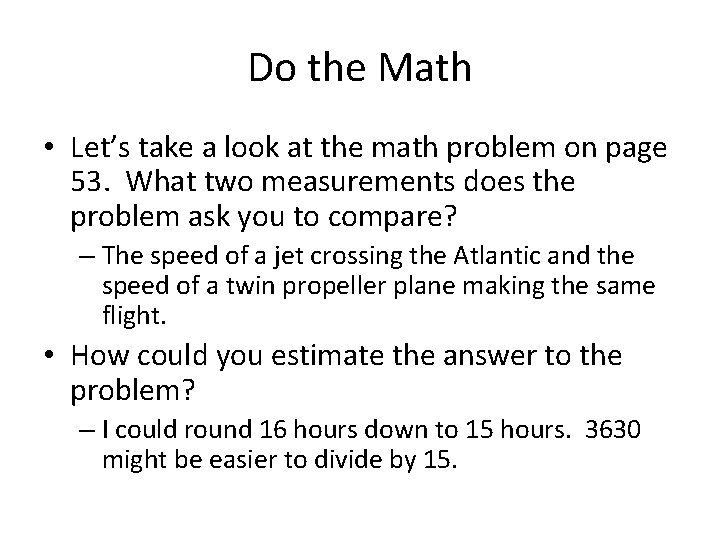
Do the Math • Let’s take a look at the math problem on page 53. What two measurements does the problem ask you to compare?
Do the Math • Let’s take a look at the math problem on page 53. What two measurements does the problem ask you to compare? – The speed of a jet crossing the Atlantic and the speed of a twin propeller plane making the same flight.
Do the Math • Let’s take a look at the math problem on page 53. What two measurements does the problem ask you to compare? – The speed of a jet crossing the Atlantic and the speed of a twin propeller plane making the same flight. • How could you estimate the answer to the problem?
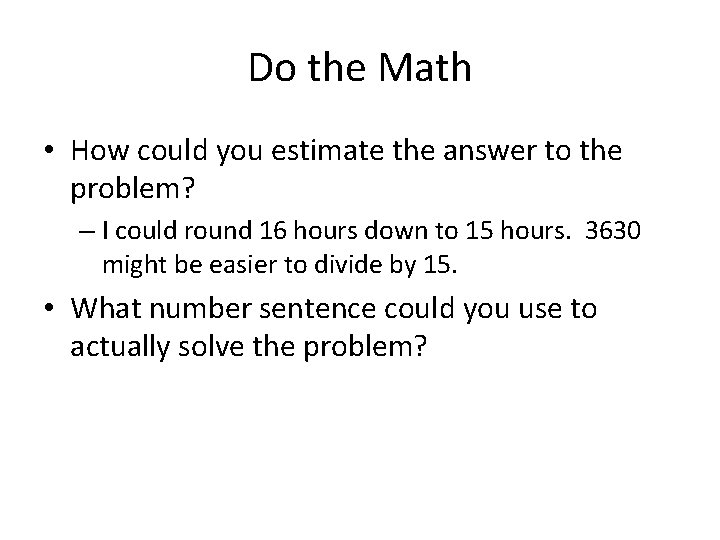
Do the Math • Let’s take a look at the math problem on page 53. What two measurements does the problem ask you to compare? – The speed of a jet crossing the Atlantic and the speed of a twin propeller plane making the same flight. • How could you estimate the answer to the problem? – I could round 16 hours down to 15 hours. 3630 might be easier to divide by 15.
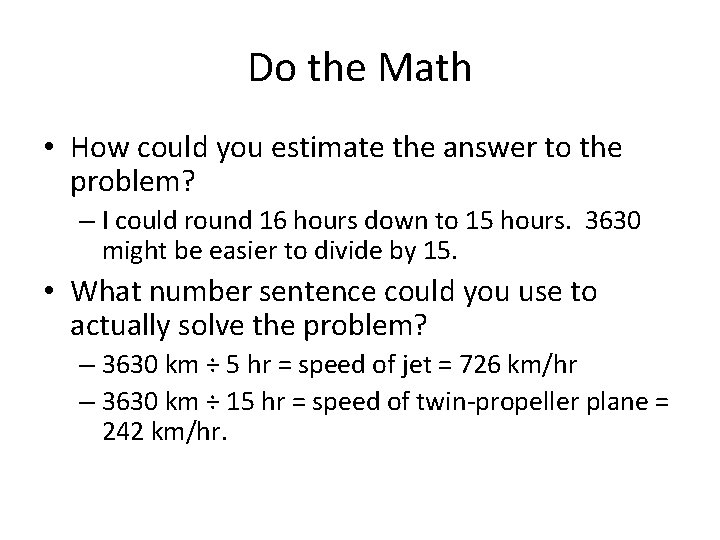
Do the Math • How could you estimate the answer to the problem? – I could round 16 hours down to 15 hours. 3630 might be easier to divide by 15. • What number sentence could you use to actually solve the problem?
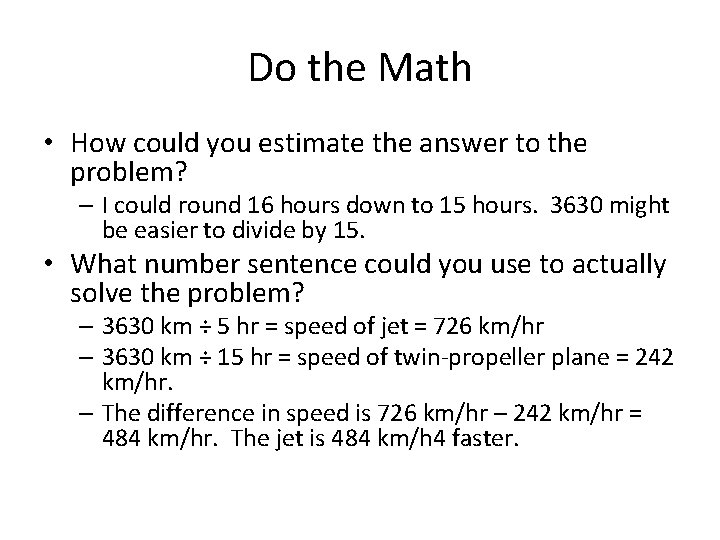
Do the Math • How could you estimate the answer to the problem? – I could round 16 hours down to 15 hours. 3630 might be easier to divide by 15. • What number sentence could you use to actually solve the problem? – 3630 km ÷ 5 hr = speed of jet = 726 km/hr – 3630 km ÷ 15 hr = speed of twin-propeller plane = 242 km/hr.
Do the Math • How could you estimate the answer to the problem? – I could round 16 hours down to 15 hours. 3630 might be easier to divide by 15. • What number sentence could you use to actually solve the problem? – 3630 km ÷ 5 hr = speed of jet = 726 km/hr – 3630 km ÷ 15 hr = speed of twin-propeller plane = 242 km/hr. – The difference in speed is 726 km/hr – 242 km/hr = 484 km/hr. The jet is 484 km/h 4 faster.
Thinking Methodically • Let’s read the section on “Thinking Methodically” again on page 54. What sentences or phrases in the section can help you understand the meaning of methodical?
Thinking Methodically • Let’s read the section on “Thinking Methodically” again on page 54. What sentences or phrases in the section can help you understand the meaning of methodical? – The phrase “they have thought about the entire process from start to finish. ”
Thinking Methodically • Let’s read the section on “Thinking Methodically” again on page 54. What sentences or phrases in the section can help you understand the meaning of methodical? – The phrase “they have thought about the entire process from start to finish. ” • Based on these context clues, come up with a definition of methodical with your table.
Thinking Methodically • Based on these context clues, come up with a definition of methodical with your table.
Thinking Methodically • Based on these context clues, come up with a definition of methodical with your table. • Dictionary definition: – Following a method; characterized by method and orderliness • Vocabulary. com
Engineering Design Process • Look at the flow chart on pages 56 -57. What should you do, if after conducting research, you still do not have enough information to begin brainstorming solutions?
Engineering Design Process • Look at the flow chart on pages 56 -57. What should you do, if after conducting research, you still do not have enough information to begin brainstorming solutions? – You conduct more research.
Engineering Design Process • Look at the flow chart on pages 56 -57. What should you do, if after conducting research, you still do not have enough information to begin brainstorming solutions? – You conduct more research. • What should you do if your prototype doesn’t show promise?
Engineering Design Process • Look at the flow chart on pages 56 -57. What should you do, if after conducting research, you still do not have enough information to begin brainstorming solutions? – You conduct more research. • What should you do if your prototype doesn’t show promise? – You should return to the brainstorming stage.
Engineering Design Process • When a new technology is first designed, does it usually work right away?
Engineering Design Process • When a new technology is first designed, does it usually work right away? – No. New designs usually have flaws.
Engineering Design Process • When a new technology is first designed, does it usually work right away? – No. New designs usually have flaws. • How are flaws in a design identified and fixed?
Engineering Design Process • When a new technology is first designed, does it usually work right away? – No. New designs usually have flaws. • How are flaws in a design identified and fixed? – Through testing a prototype and revising the design
Engineering Design Process • When a new technology is first designed, does it usually work right away? – No. New designs usually have flaws. • How are flaws in a design identified and fixed? – Through testing a prototype and revising the design • Does the engineering design process always result in a perfect, finished prototype?
Engineering Design Process • When a new technology is first designed, does it usually work right away? – No. New designs usually have flaws. • How are flaws in a design identified and fixed? – Through testing a prototype and revising the design • Does the engineering design process always result in a perfect, finished prototype? – No. It’s possible that, even after several revisions, the prototype will not succeed in solving the problem you identified.
Summary • Technology is everywhere. • Eyeglasses, toothbrushes, tennis shoes, televisions, and cell phones are all examples of technology in everyday life. • Technology is used to solve problems, and it changes over time through new inventions that are the result of engineering. • Science is the foundation for engineering. • Engineering solves problems, which results in technology. • Technology is the product of the engineering process.
Summary • The same skills are used in scientific investigation and the engineering process. They include research, modeling, using mathematics, using computers, creativity, teamwork, and communication. • The engineering design process has several important steps. The steps include identifying the problem, researching the problem, brainstorming solutions, selecting a solution, building a prototype, testing and evaluating the prototype, redesigning the prototype to improve it, and communicating the results. • The actual engineering process is not simple. It involves many decisions and changes in direction.
You Decide • In each corner of the classroom, there will be an aspect of the Engineering Design Process. We will read through the following scenarios and after each one, you need to move to the corner that best describes the concept illustrated in the scenario.
You Decide • Scenario #1: An engineer decides to make a bike frame out of titanium metal instead of steel. Titanium is just as strong as steel, but much more lightweight. However, titanium is also more expensive. The bike will be lighter, but cost more.
You Decide • Scenario #1: An engineer decides to make a bike frame out of titanium metal instead of steel. Titanium is just as strong as steel, but much more lightweight. However, titanium is also more expensive. The bike will be lighter, but cost more. – Trade-off
You Decide • Scenario #2: An engineer builds a chair from plans she has drawn. She tests the chair, and then makes changes to improve it.
You Decide • Scenario #2: An engineer builds a chair from plans she has drawn. She tests the chair, and then makes changes to improve it. – Prototype
You Decide • Scenario #3: An engineer is designing a lightweight bag for people who travel frequently. She finds the bag cannot be wider than 18 inches or it will not fit into the overhead compartment on an airplane.
You Decide • Scenario #3: An engineer is designing a lightweight bag for people who travel frequently. She finds the bag cannot be wider than 18 inches or it will not fit into the overhead compartment on an airplane. – Constraint
You Decide • Scenario #4: An engineer develops a new type of waterproof fabric from plastic fibers. The fabric could be used to make a variety of products, from rain jackets to inflatable boats.
You Decide • Scenario #4: An engineer develops a new type of waterproof fabric from plastic fibers. The fabric could be used to make a variety of products, from rain jackets to inflatable boats. – Technology