
Lesson 4 The Cold War Divides the World
- Slides: 16
Lesson 4 The Cold War Divides the World
Setting the Stage • Following World War II, the world’s nations were grouped politically into three “worlds. ” The first was the industrialized capitalist nations, including the United States and its allies. The second was the Communist nations led by the Soviet Union. The Third World consisted of developing nations, often newly independent, who were not aligned with either superpower. These nonaligned countries provided yet another arena for competition between the Cold War superpowers.
Fighting for the Third World • The Third World nations were located in Latin America, Asia, and Africa. • They were economically poor and politically unstable. • This was largely due to a long history of colonialism. • They also suffered from ethnic conflicts and lack of technology and education. • Each needed a political and economic system around which to build its society. • Soviet-style communism and U. S. -style free-market democracy were the main choices
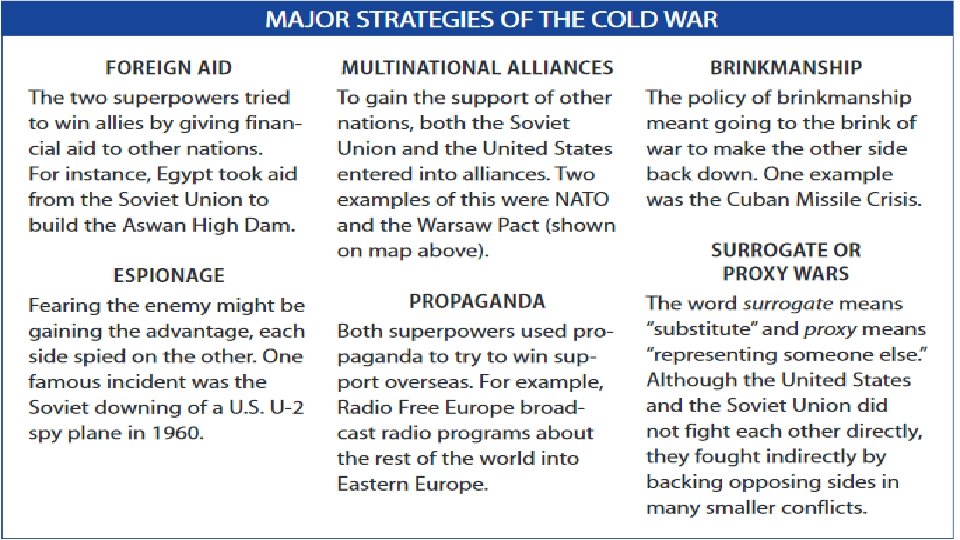
Association of Nonaligned Nations • Other developing nations also needed assistance. They became important players in the Cold War competition between the United States, the Soviet Union, and later, China. • But not all Third World countries wished to play a role in the Cold War. For example, India vowed to remain neutral. Indonesia, a populous island nation in Southeast Asia, also struggled to stay uninvolved. • In 1955, it hosted many leaders from Asia and Africa at the Bandung Conference. They met to form what they called a “third force” of independent countries, or nonaligned nations. • Some nations, such as India and Indonesia, maintained their neutrality. Others took sides with the superpowers or played competing sides against each other. • For example, Egypt first accepted Soviet aid to help build the Aswan High Dam and Soviet weapons for its conflicts with Israel. Later, Egypt switched allegiance to the United States following the 1973 Yom Kippur War
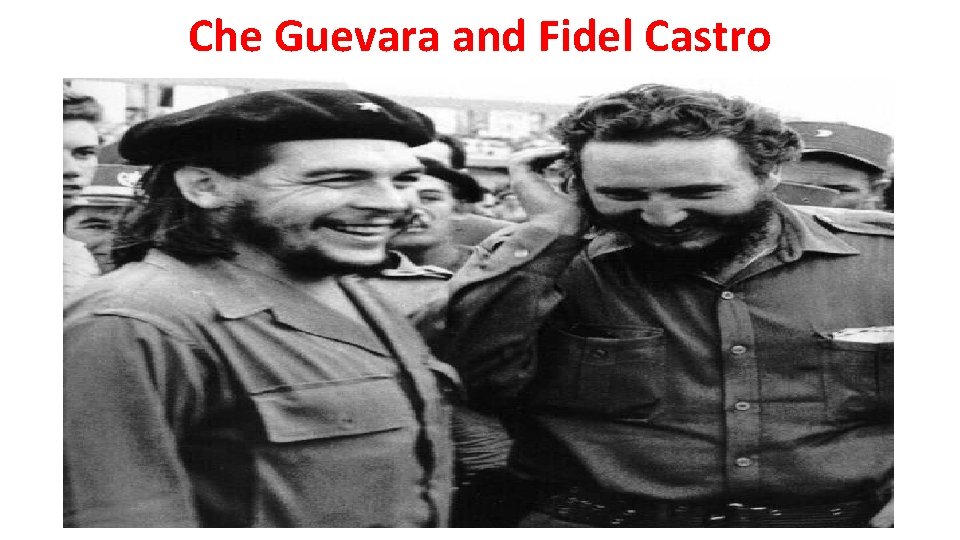
Fidel Castro and the Cuban Revolution • In the 1950 s, Cuba was ruled by an unpopular dictator, Fulgencio Batista, who had U. S. support. • Cuban resentment led to a popular revolution, which overthrew Batista in January 1959. • A young lawyer named Fidel Castro led that revolution. At first, many people praised Castro for bringing social reforms to Cuba (free education and healthcare) and improving the economy. • Yet Castro was a harsh dictator. He suspended elections, jailed or executed his opponents, and tightly controlled the press. • Castro nationalized U. S. -owned sugar mills and refineries. In response, President Eisenhower ordered an embargo on all trade with Cuba. Castro then turned to the Soviets for economic and military aid
Che Guevara and Fidel Castro • Insert Picture of Cuban Revolution
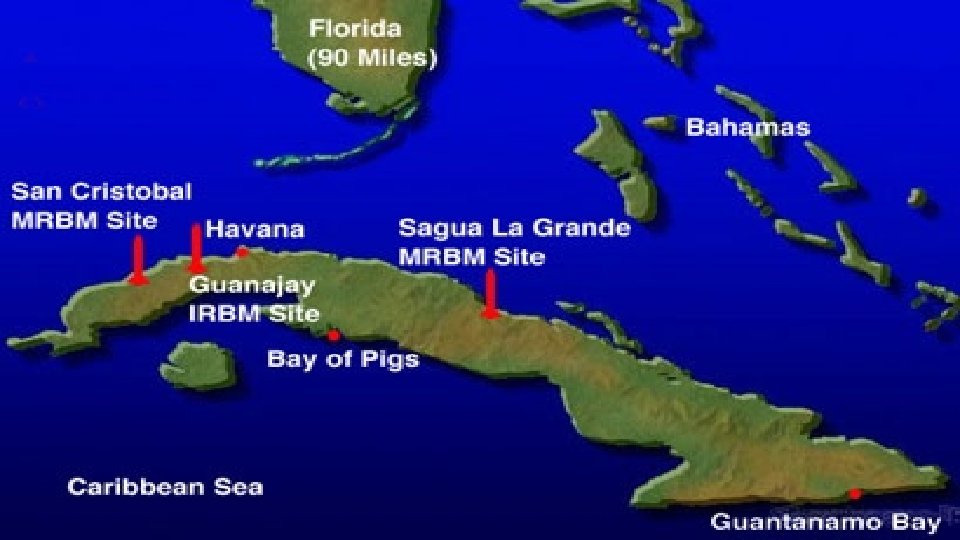
The Bay of Pigs Invasion • President John F. Kennedy and the U. S. Government attempted to bring down the communist regime in Cuba by supporting an invasion attempt by Cuban exiles who were trained by the U. S. military. • In 1960, the CIA began to train anti-Castro Cuban exiles. In April 1961, they invaded, landing in southwestern Cuba at the Bay of Pigs. However, the United States did not provide the hoped-for air support. • The Bay of Pigs Invasion quickly ended in failure when Castro’s forces captured the invaders. • Fidel Castro’s popularity in Cuba soared after defeating the U. S. sponsored invasion. • The U. S. reacted by imposing a trade embargo on Cuba that remains in effect today.
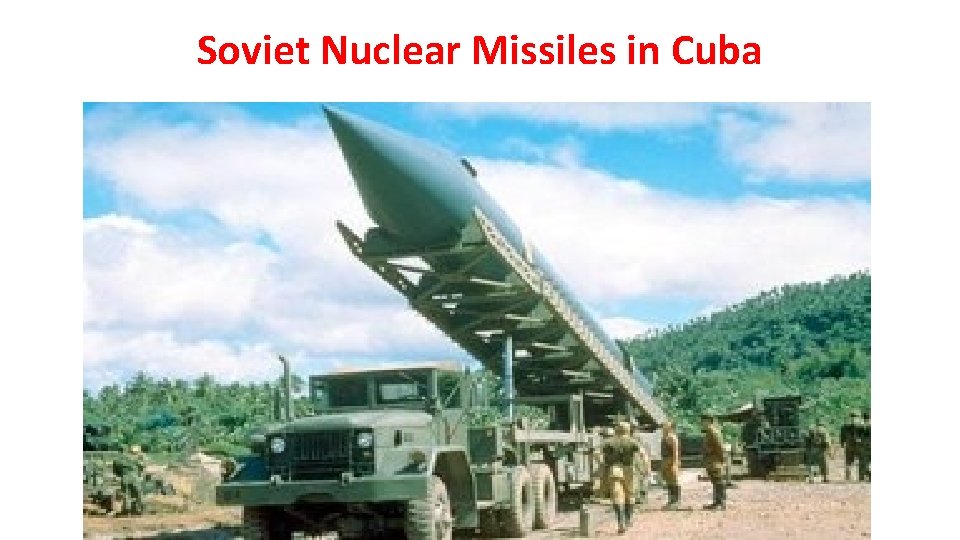
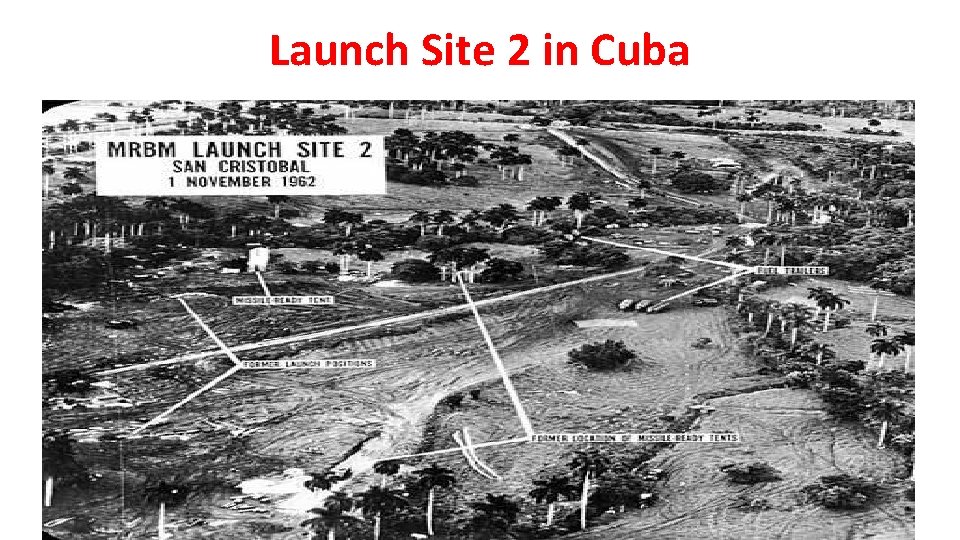
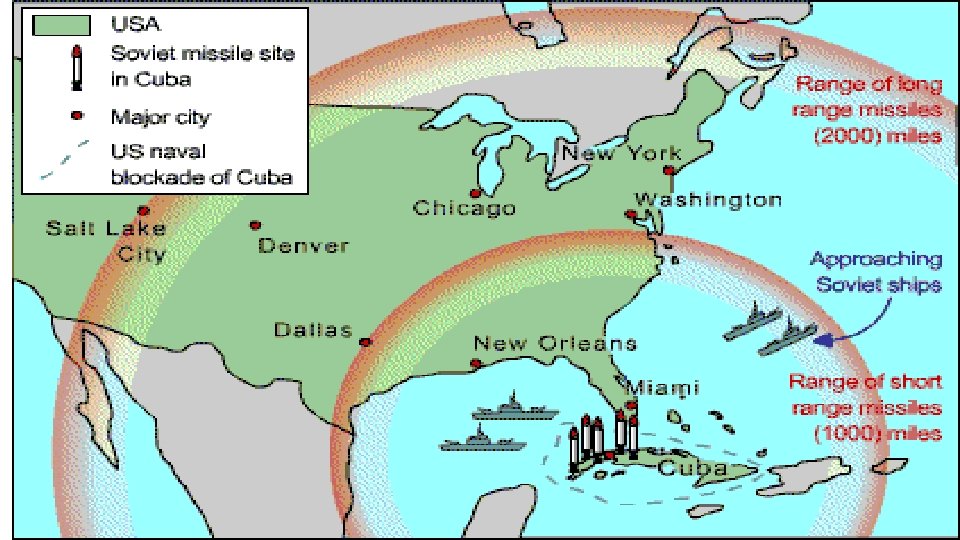
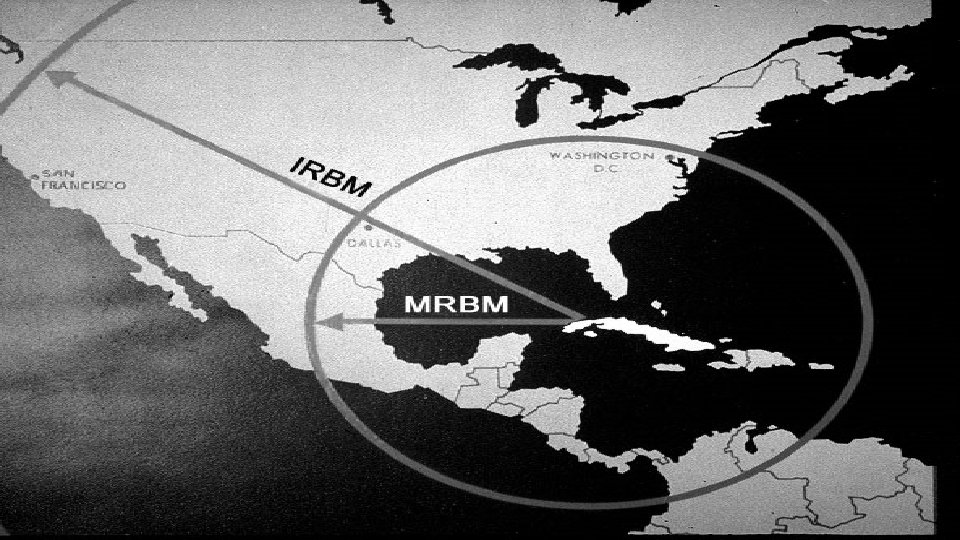
The Cuban Missile Crisis • The failed Bay of Pigs invasion convinced Soviet leader Nikita Khrushchev that the United States would not resist Soviet expansion in Latin America. • So, in July 1962, Khrushchev secretly began to build 42 missile sites in Cuba. In October, an American spy plane discovered the sites. • President John F. Kennedy declared that missiles so close to the U. S. mainland were a threat. He demanded their removal and also announced a naval blockade of Cuba. • Castro protested that his country was being used as a pawn and that he did not intend for Cuba to get involved in the Cold War. But Castro and Cuba were deeply involved. • Kennedy’s demand for the removal of Soviet missiles put the United States and the Soviet Union on a nuclear collision course. People around the world feared nuclear war. Fortunately, Khrushchev agreed to remove the missiles in return for a U. S. promise not to invade Cuba.
Soviet Nuclear Missiles in Cuba
Launch Site 2 in Cuba
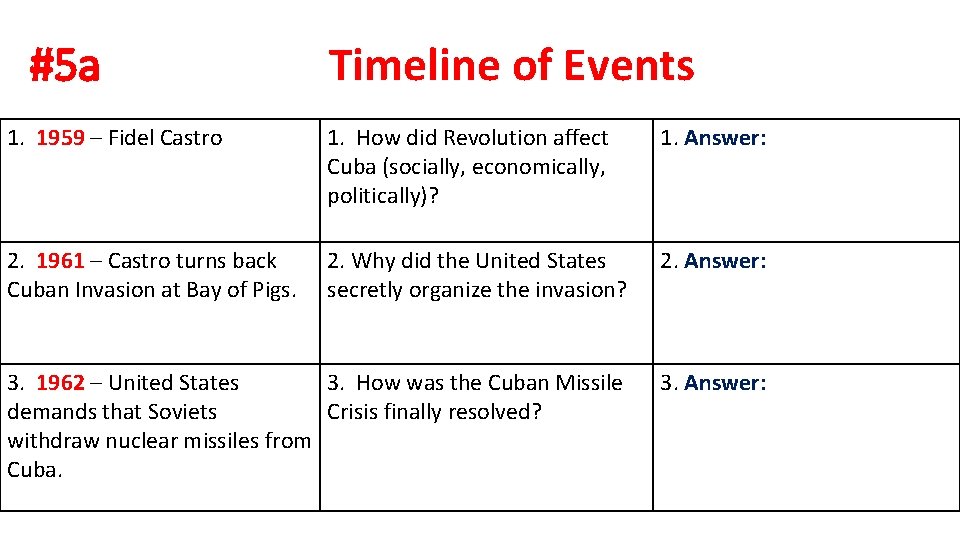
#5 a Timeline of Events 1. 1959 – Fidel Castro 1. How did Revolution affect Cuba (socially, economically, politically)? 1. Answer: 2. 1961 – Castro turns back Cuban Invasion at Bay of Pigs. 2. Why did the United States secretly organize the invasion? 2. Answer: 3. 1962 – United States 3. How was the Cuban Missile demands that Soviets Crisis finally resolved? withdraw nuclear missiles from Cuba. 3. Answer:
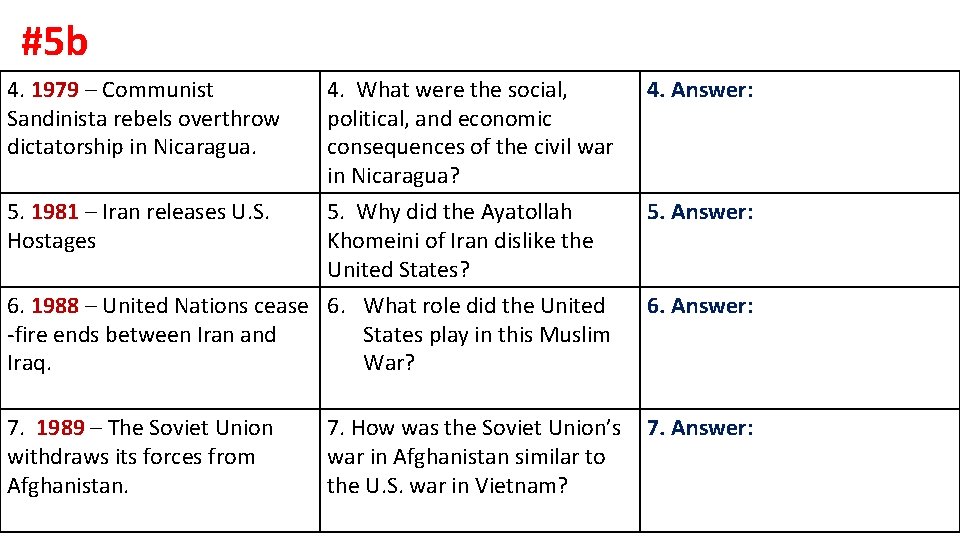
#5 b 4. 1979 – Communist Sandinista rebels overthrow dictatorship in Nicaragua. 4. What were the social, political, and economic consequences of the civil war in Nicaragua? 5. 1981 – Iran releases U. S. 5. Why did the Ayatollah Hostages Khomeini of Iran dislike the United States? 6. 1988 – United Nations cease 6. What role did the United -fire ends between Iran and States play in this Muslim Iraq. War? 4. Answer: 7. 1989 – The Soviet Union withdraws its forces from Afghanistan. 7. Answer: 7. How was the Soviet Union’s war in Afghanistan similar to the U. S. war in Vietnam? 5. Answer: 6. Answer: