
Lesson 4 Tangible and Intangible Cultural Heritage Memory
Lesson 4 Tangible and Intangible Cultural Heritage. Memory and Identity Aims and Topics • To examine the different meanings of the concept of cultural property; • To consider the relevance of socio-anthropological meaning of cultural heritage; • To consider the relationship between cultural heritage and memory and identity of a community.
An uncertain concept…a different use… The concept of «cultural heritage» is referred – generally and mostly – to the idea of material heritage; it happens in almost every language, especially in the West of the world. It is reflected in the different expressions used: «it is to be mentioned English often prefer to use the word cultural property, Italians that one of beni culturali, German the expression denkmal (monuments), Chinese cultural relics André Desvallées, Cent quarante termes muséologiques ou petit glossaire de l’exposition, in Manuel de muséographie. Petit guide à l’usage des responsable de musée, Séguier, Biarritz, 1988, pag.
Cultural objects…Cult and Obsession… The idea of cultural objects derives from the idea of cult and from the linkage between patrimonial fact and religious fact. In the Latin language the word reliquae is linked to the idea of relics: «relics, of saints or heroes, or objects belonged to them, to which the faithfuls devote a cult» (J. P. Babelon-A. Chastel, La notion de patrimoine, Liana Levi, Paris, 1994) This idea emerges within the christian conceptualization of time – linear, from the Creation to the Apocalypse – and it determines a particular relevance to the matter of real and universe.
Cultural Objects and the French Revolution Enlightment posed the idea of a complete rupture of the Christian idea of time: introducing the faith in the human power to build and transform its destiny, the idea of a progressive concept of time, the relevance of the past to know and define time, present and past. French Revolution determined on one hand the idea of a complete destruction of the past relics, in particular religious, but on the other hand the idea of preserve and manage these relics as a testify of past and an element of national identity. Cultural objects are considered and preserved as elements and testifies of the past: a tangible proof of a time which existed and now doesn’t exist more.

The idea of historic monument There is a difference between monument and historic monument: monument is a creation of contemporary age for the memory; historic monument is a creation of the past for the memory of contemporary age. The concept of historic monument recollects the idea of sacral devotion, transforming it in the idea of a laic devotion. The concept of monument is deeply related to the idea of relics. Historic monuments contain an exceptional power of evocation of past, something like magic, because monuments and relics are objects survived to the destruction and – in this way – they contain something miraculous.
Monument and Memory The relevance of memory is linked to the power of memory: this biologic and psychologic function allows the man to register informations: both biographic, intellectual and affective, giving him the power to establish an element of continuity through the life and the existence. Cultural objects represent the madeleine described by Proust in his famous Recherche. These objects of memory allow to establish a contact with the past. Progressively, the extension of the concept of monument has been reduced to a certain series of objects, managed and protected. Today the danger is to produce an excessively enlargement of the meaning of cultural heritage.
The conceptualization of the intangible cultural heritage Two theoretical perspectives The undirect perspective In this perspective the most relevant authors approach the matter without unity and observing mostly the aims and purposes of the cultural heritage for the society. …some examples… Bernard Deloche, Le musée virtuel. Vers une éthique de nouvelles images, Presses Universitaires de France, collection «Questions actuelles» , Paris, 2001; Jacques Hainard, Objets prétextes, objets manupulés, Musée d’ethnographie de Neuchâtel, Suisse, Neuchâtel, 1984; Id. , Temps perdu, temps retrouvé. Voir les choses au présent, Musée d’ethnographie de Neuchâtel, Suisse, Neuchâtel, 1985; George-Henri Rivière, La Muséologie selon George-Henri Rivière. Cours de muséologie/Textes et temoignages, Dunod, Paris, 1989; André Desvallées, La muséologie et les catégories de patrimoine immatériel, 2004 Nouvelle Muséologie
Intangible Cultural Heritage The undirect approach The linkage between cultural objects and memory – introducing some important elements of innovation – brought also a risk of fetishism. «Fetishism is defined as the separation of the content from the support, and the excess of valorization of the latter. If conservation of the support is important to transmitt an object, it can’t have more importance than the content, without a risk of ideological drift[…]A society, as a person, to survive, have to forget, to concentrate its informations in an efficient way: excess of memory paralyzes a creative activity (Nietzsche). Today, we can observe – on the contrary – a strange transformation of the support in an object to contemplate, till the point we forget informations it brought, in a sort of fossilization» (Bernard Deloche).
Intangible cultural heritage The double purpose of the museum The mouvement of Nouvelle Muséologie points out another kind of risk of paralysis, linked to the purpose of museum: «The justification of the traditional museum is double: the defunctionalised object is to contemplate because of its aesthetic, historic, affective, value; but on the other hand this same object is sacralized and becomes an element of the mental structure of a society[…]A[ sort of obsession of the past, will be substituted in the structure of a society unable to create[…]Counsciousness is impossible without memory, but if the whole richness of civilization depends on this cumulative memory, its creativity depends on its capacity to pass over the past» (Hugues De Varine, Le musée au service de l’homme et du développment, 1969).
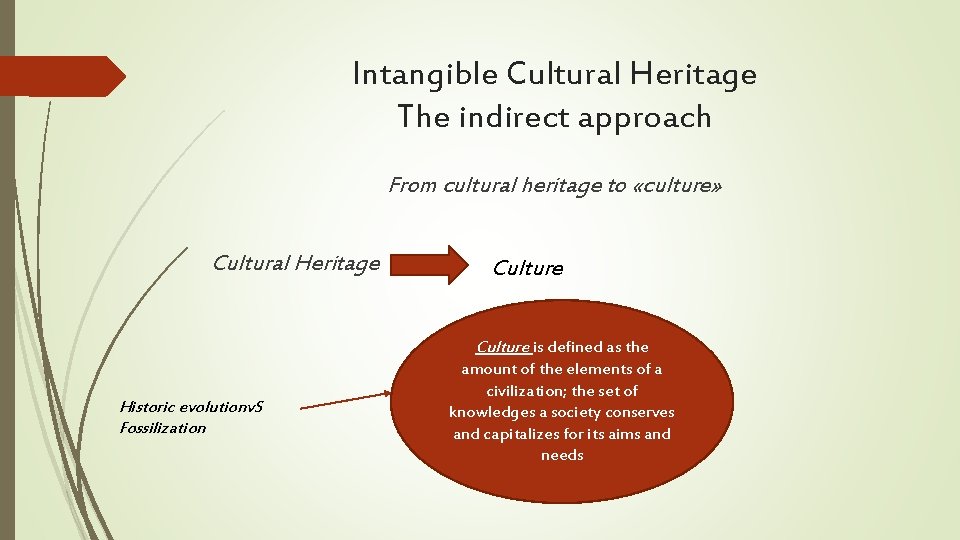
Intangible Cultural Heritage The indirect approach From cultural heritage to «culture» Cultural Heritage Culture is defined as the Historic evolutionv. S Fossilization amount of the elements of a civilization; the set of knowledges a society conserves and capitalizes for its aims and needs
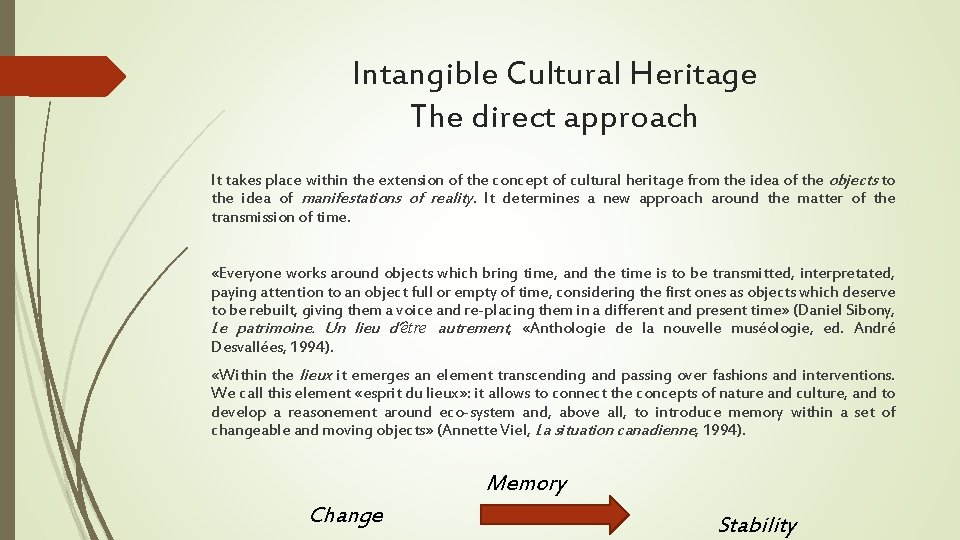
Intangible Cultural Heritage The direct approach It takes place within the extension of the concept of cultural heritage from the idea of the objects to the idea of manifestations of reality. It determines a new approach around the matter of the transmission of time. «Everyone works around objects which bring time, and the time is to be transmitted, interpretated, paying attention to an object full or empty of time, considering the first ones as objects which deserve to be rebuilt, giving them a voice and re-placing them in a different and present time» (Daniel Sibony, Le patrimoine. Un lieu d’être autrement, «Anthologie de la nouvelle muséologie, ed. André Desvallées, 1994). «Within the lieux it emerges an element transcending and passing over fashions and interventions. We call this element «esprit du lieux» : it allows to connect the concepts of nature and culture, and to develop a reasonement around eco-system and, above all, to introduce memory within a set of changeable and moving objects» (Annette Viel, La situation canadienne, 1994). Memory Change Stability
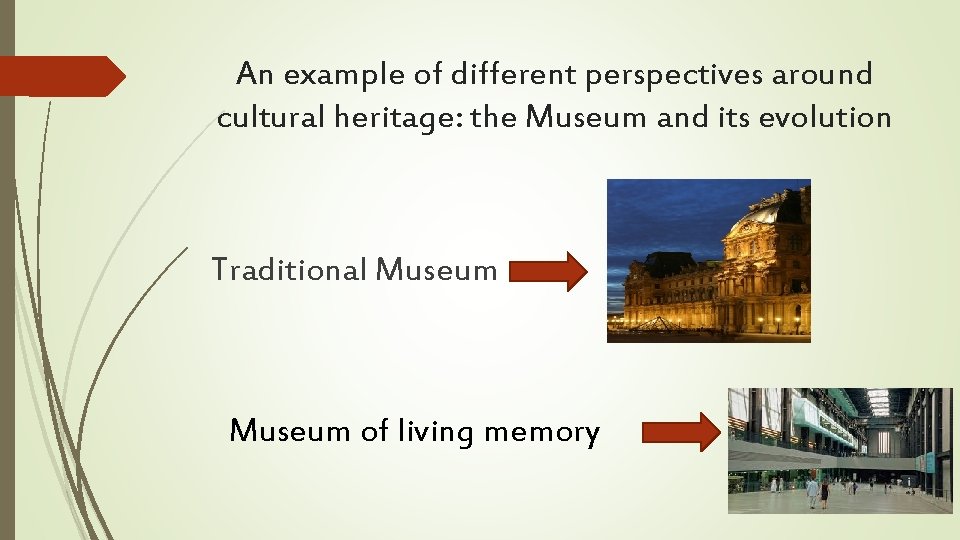
An example of different perspectives around cultural heritage: the Museum and its evolution Traditional Museum of living memory
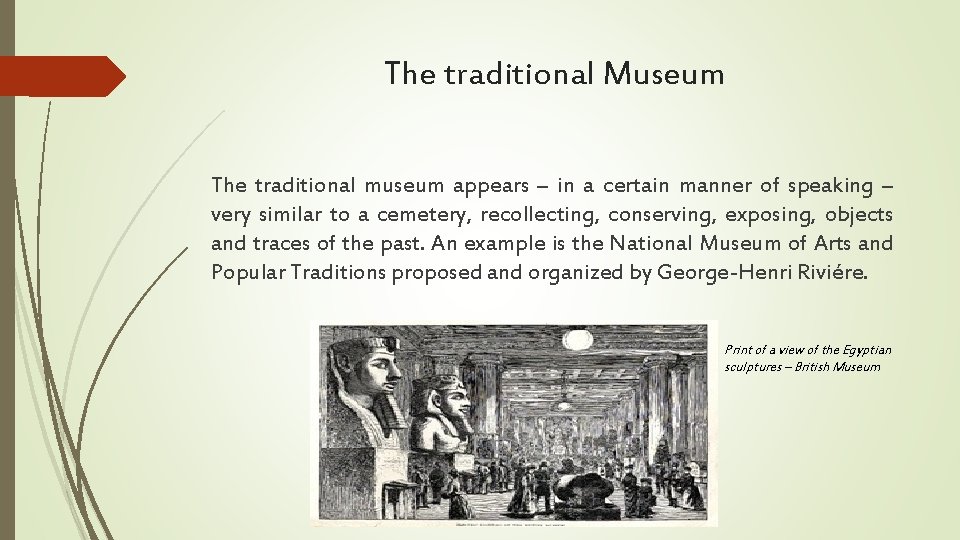
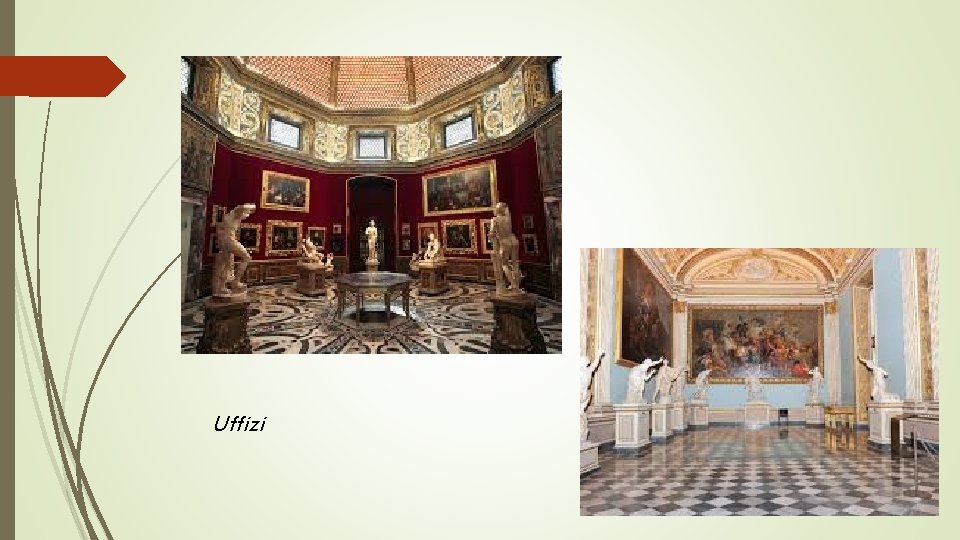
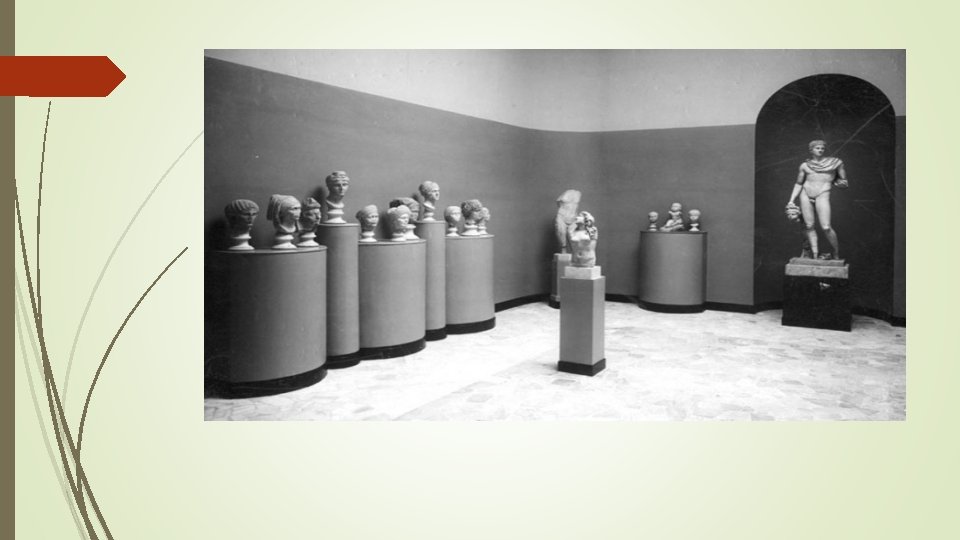
The traditional Museum The traditional museum appears – in a certain manner of speaking – very similar to a cemetery, recollecting, conserving, exposing, objects and traces of the past. An example is the National Museum of Arts and Popular Traditions proposed and organized by George-Henri Riviére. Print of a view of the Egyptian sculptures – British Museum
The Museum of living memory In this case the museum offers the same objects but proposed and organized in a different manner, and with different aims and purposes: they represent a source to develope a creative sense of the time and an active perception of the life. It takes place against the idea of the traditional museum: in the opinion of Jean-Philippe Pierron, the traditional museum gives us the perception of a completed and closed time, in an excess of memory which – at last – doesn’t allow the creative action. Visiting a traditional museum becomes – in this way – visiting a sort of «have been» which allows the perception of «going to be» .
Uffizi
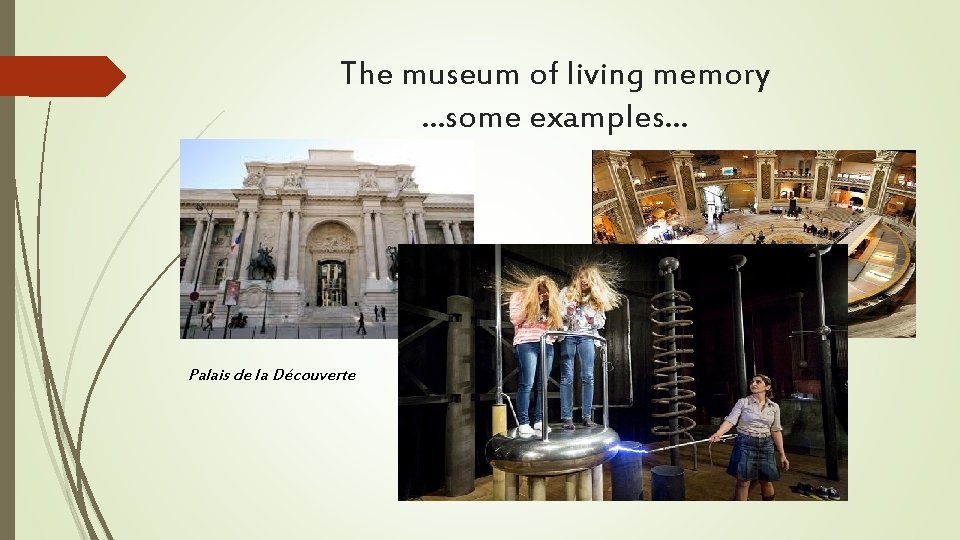
The museum of living memory …some examples… Palais de la Découverte
Écomusée du Creusot
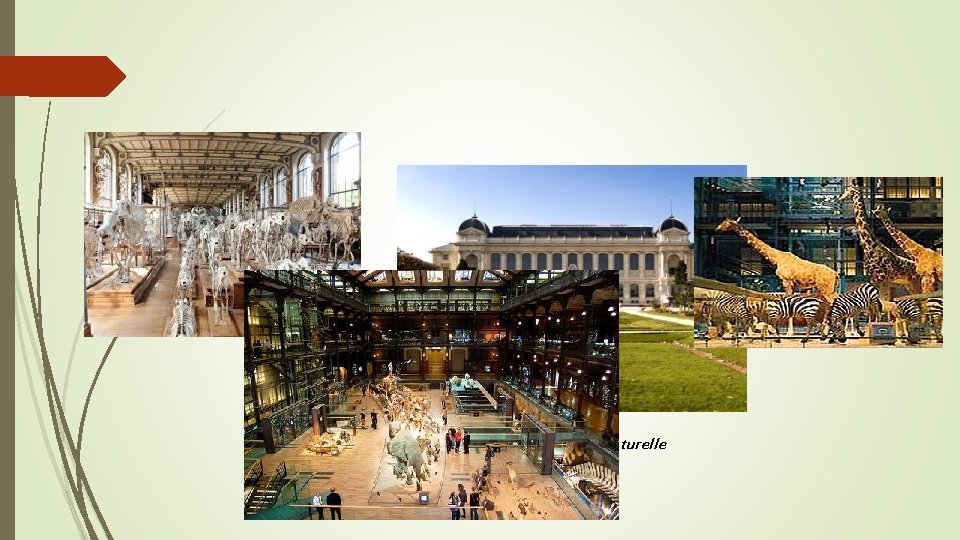
Musée National d’Histoire Naturelle
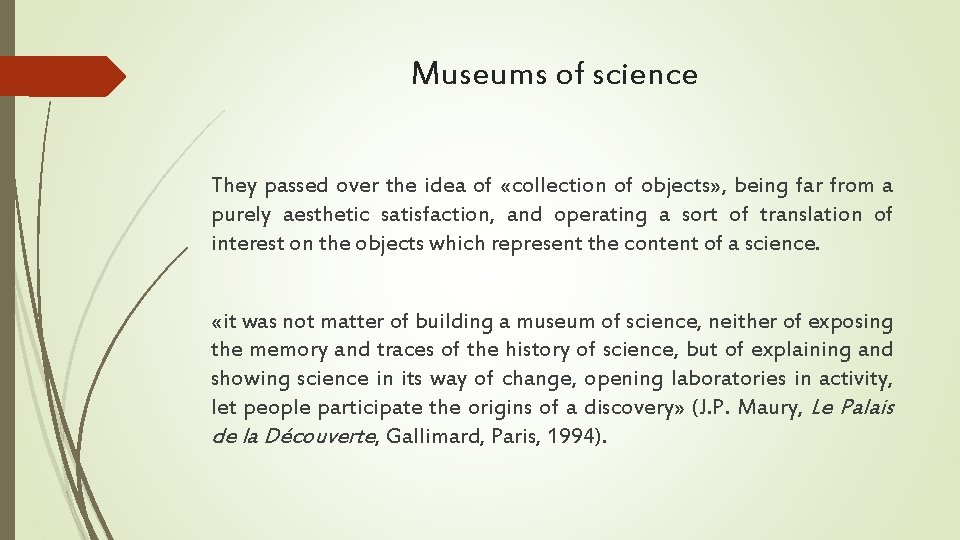
Museums of science They passed over the idea of «collection of objects» , being far from a purely aesthetic satisfaction, and operating a sort of translation of interest on the objects which represent the content of a science. «it was not matter of building a museum of science, neither of exposing the memory and traces of the history of science, but of explaining and showing science in its way of change, opening laboratories in activity, let people participate the origins of a discovery» (J. P. Maury, Le Palais de la Découverte, Gallimard, Paris, 1994).
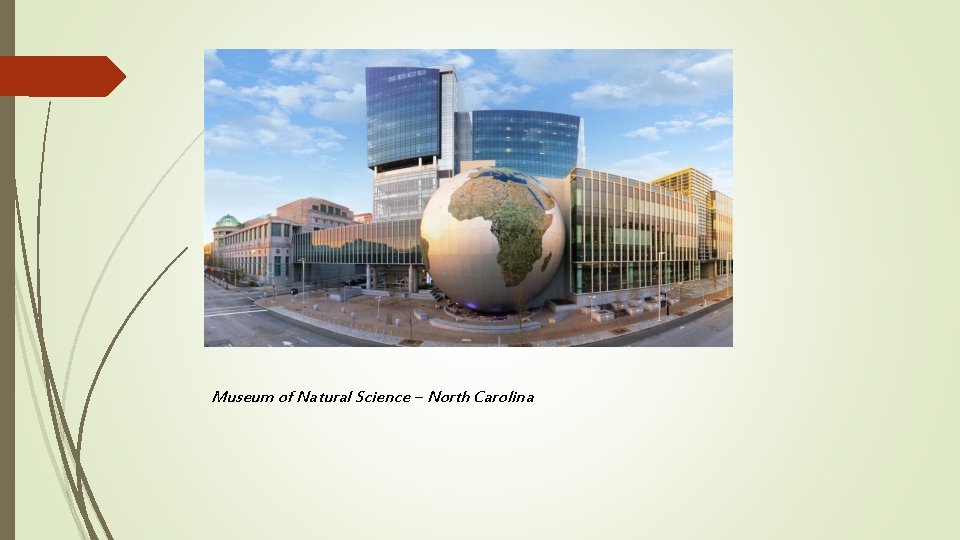
Museum of Natural Science – North Carolina
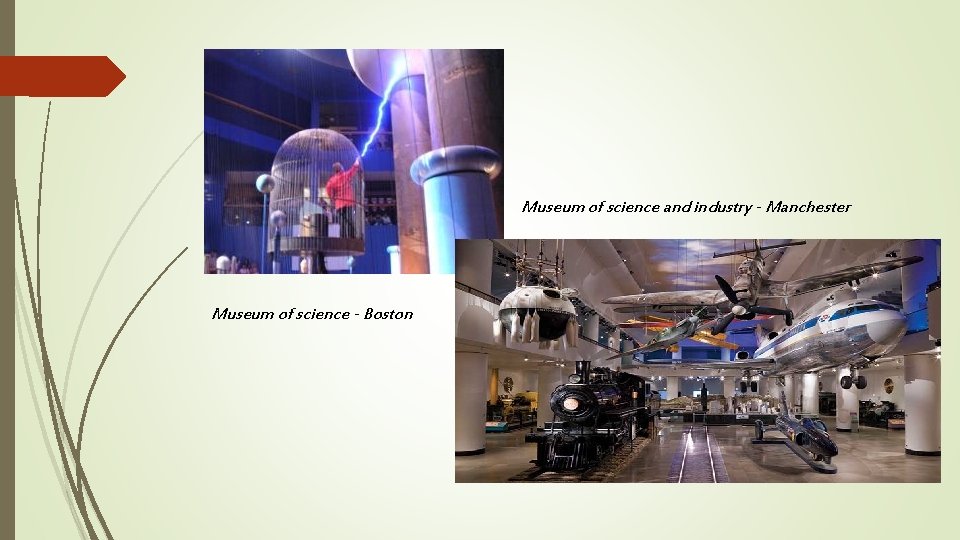
Museum of science and industry - Manchester Museum of science - Boston
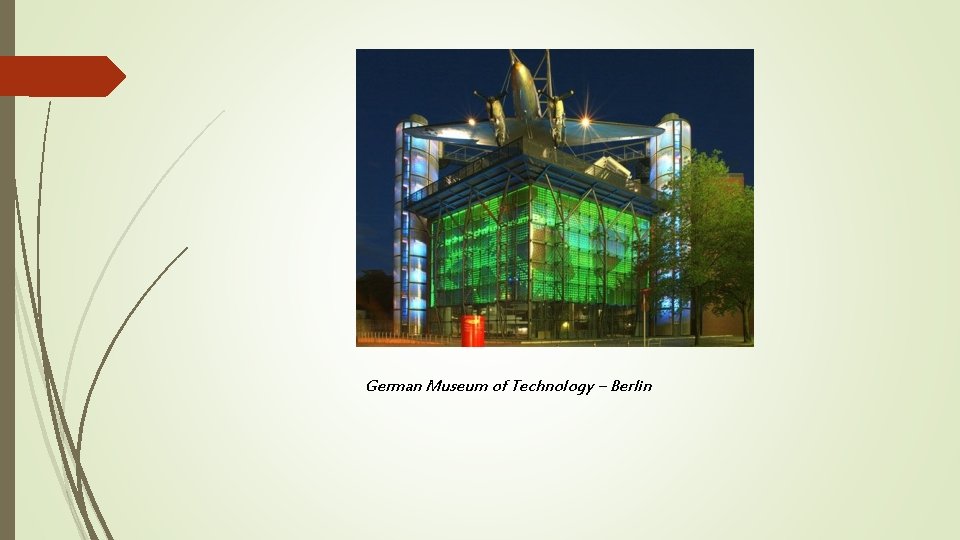
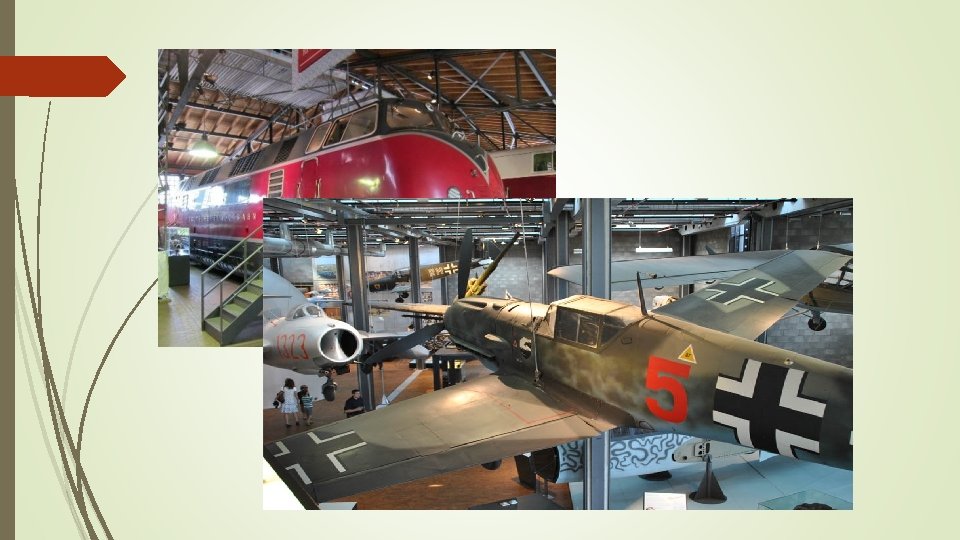
German Museum of Technology – Berlin
The museum and the intangible cultural heritage The emergence of the idea of intangible cultural heritage defines the new role of the museum. In the definition of the ICOM (2004): «the museum is a permanent institution, without a lucratif purpose, at the service of society and its development, open to the public and developing researches around material testifies of human life and human environment, and them conserving, and exposing for the purposes of study, education, aesthetic and intellectual satisfaction» .
The idea of a complete Thesaurus In the idea of Zbynek Stransky (Muséologie. Introduction aux études, 1995), the Thesaurus recollects everything existing, both concret and abstract, real or virtual, know or un-known, but not belonging to world of living people[…]It contains also things which can’t be transported and so are reproduced»
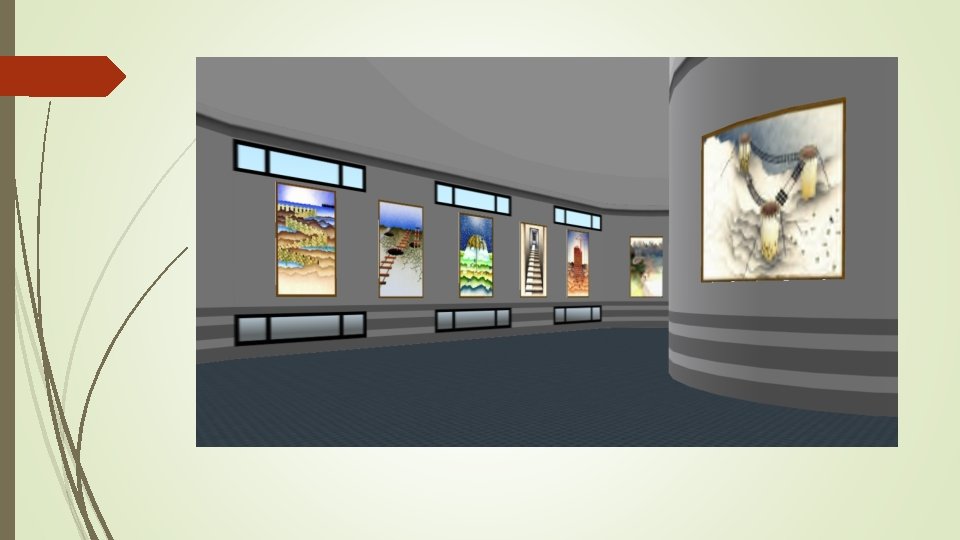
The virtual Suiseki Museum
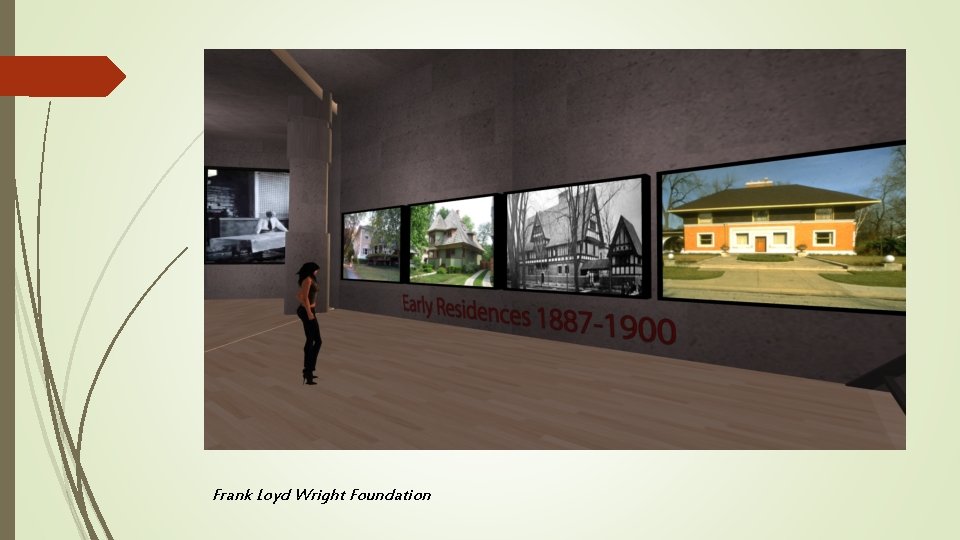
Frank Loyd Wright Foundation
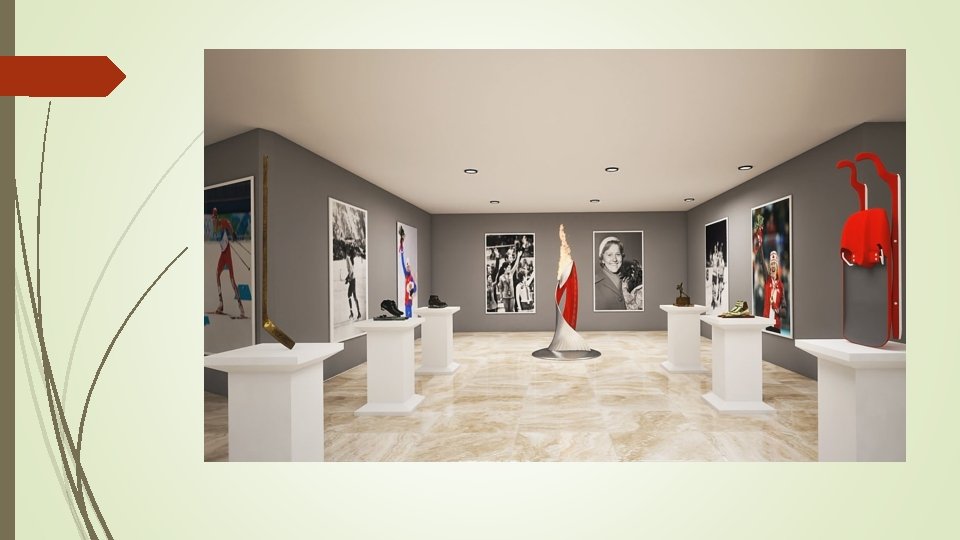
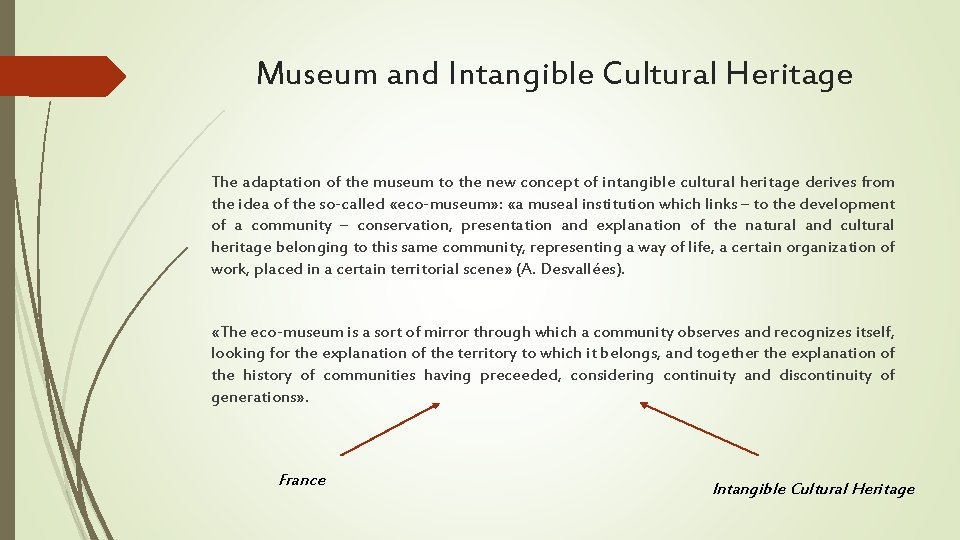
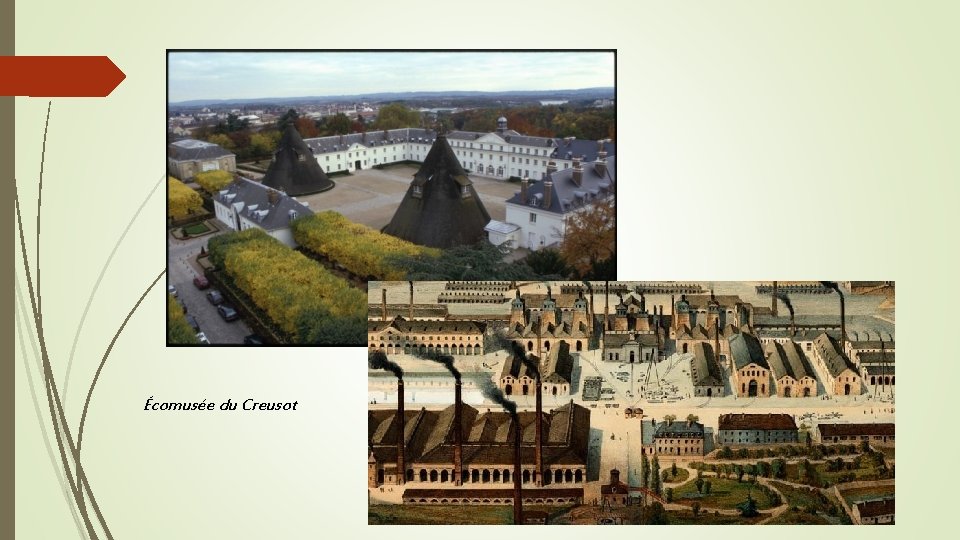
Museum and Intangible Cultural Heritage The adaptation of the museum to the new concept of intangible cultural heritage derives from the idea of the so-called «eco-museum» : «a museal institution which links – to the development of a community – conservation, presentation and explanation of the natural and cultural heritage belonging to this same community, representing a way of life, a certain organization of work, placed in a certain territorial scene» (A. Desvallées). «The eco-museum is a sort of mirror through which a community observes and recognizes itself, looking for the explanation of the territory to which it belongs, and together the explanation of the history of communities having preceeded, considering continuity and discontinuity of generations» . France Intangible Cultural Heritage
Museum and Intangible Cultural Heritage Aims and purposes To preserve the identity of a community in front of and against the globalization To create a relationship between history, memory and present life of a community To preserve and present all the values which constitute the structure of a community To create a «place of sociability» where cultural expressions of a community can be presented and studied

The concept of Intangible Cultural Heritage Traditional point of view, refusing the idea to open the concept of cultural heritage to other and different objects, especially «immaterial» A new perspectiv e, especially proposed by South-American countries, requiring to recognize the concept of «intangible cultural heritage»
The first steps towards the recognition of an intangible cultural heritage Unesco Recommendation 15 November 1989, around the protection of traditional and popular culture: «traditional and popular culture is the amount of the creations of a community, based on its tradition, expressed by a group or a community, and recognized as coherent to the aims of the community, produced as expression of cultural and social identity, through the oral transmission of rules and values. These expression contemplate language, music, literature, dance, games, mythology, rites, fashions, architecture etc. »
The intangible cultural heritage The protection of cultural diversity The most relevant aim – within the protection and recognition of an intangible cultural heritage – is to preserve the cultural diversity. In the words of Koichiro Matsuura – Director of Unesco – in the opening speech of 2002, year devoted to the matter of cultural diversity – the protection of cultural diversity is an aim placed against the uniformization of global world: «to consider a cultural heritage, to preserve it like a treasure left by our fathers, and to preserve for our next generations, is a proof of wisdom. It is not only a mean of peace, but also an instrument of development»
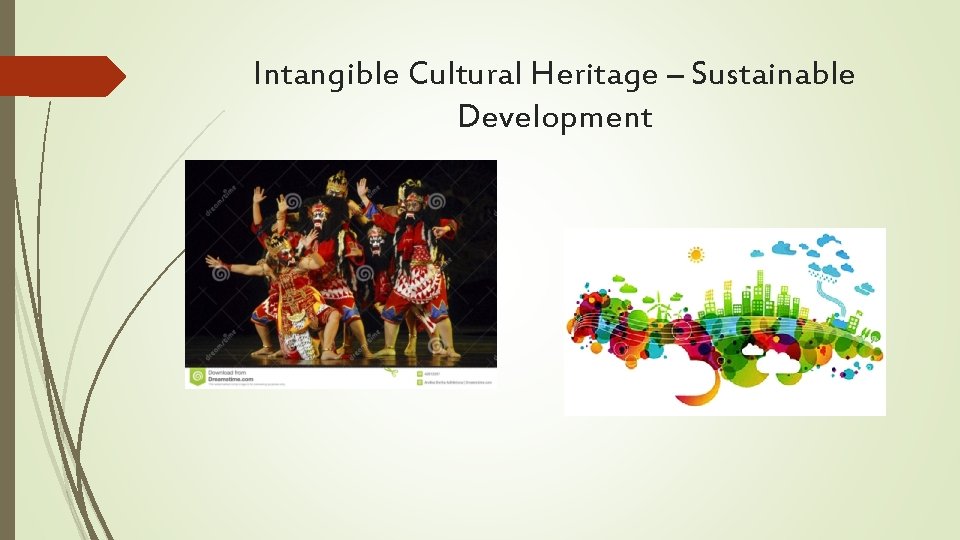
Intangible Cultural Heritage – Sustainable Development
Intangible Cultural Heritage Definitions In the words of Koichiro Matsuura, «cultural heritage» represents the spirit of a community, in its values, actions, works, institutions, monuments and sites» . The question: How can a definition of cultural heritage ethnocentric and linked to an idea conceptualized in the Western part of the world be adapted to a globalized and immaterial idea? A possible answer, given by Hampaté Ba: «when an old man dies in Africa, he is a burning library»
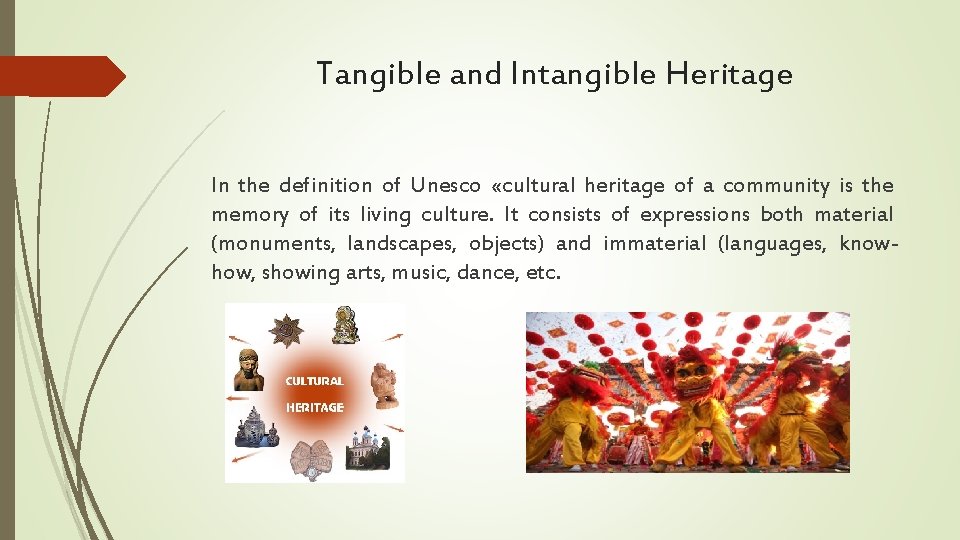
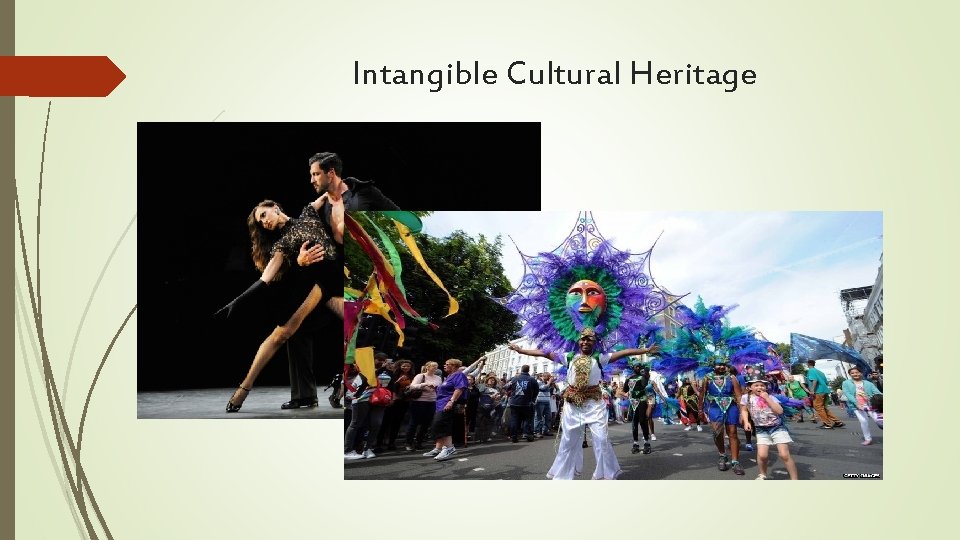
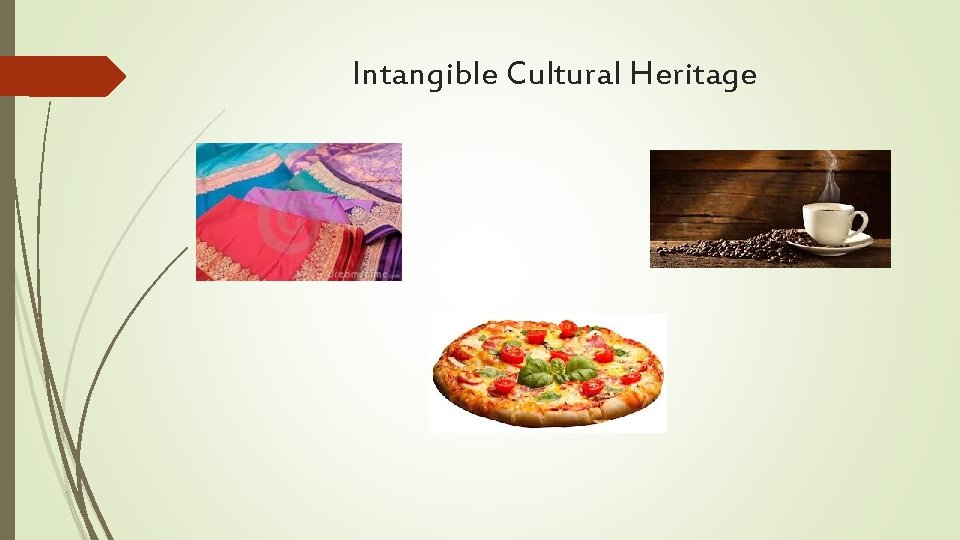
Tangible and Intangible Heritage In the definition of Unesco «cultural heritage of a community is the memory of its living culture. It consists of expressions both material (monuments, landscapes, objects) and immaterial (languages, knowhow, showing arts, music, dance, etc.
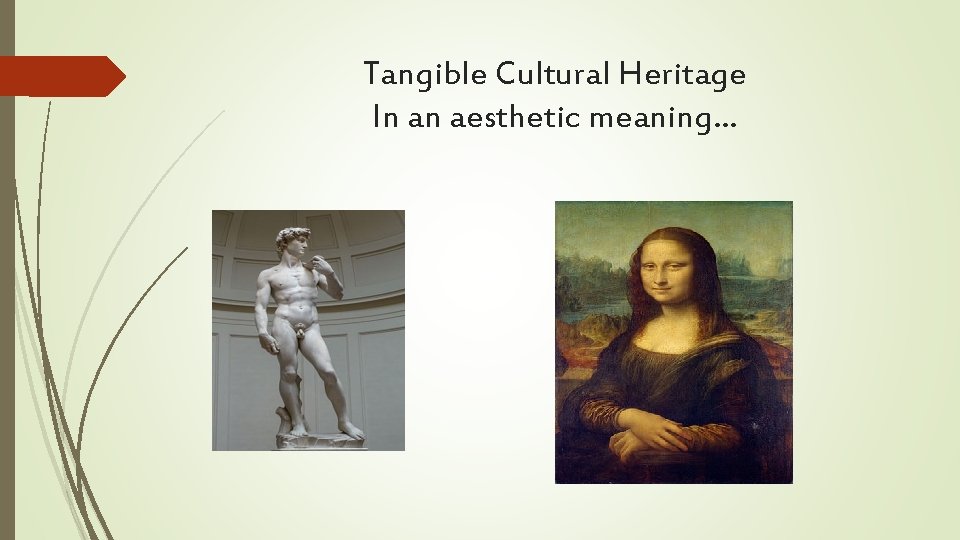
Tangible Cultural Heritage In an aesthetic meaning…
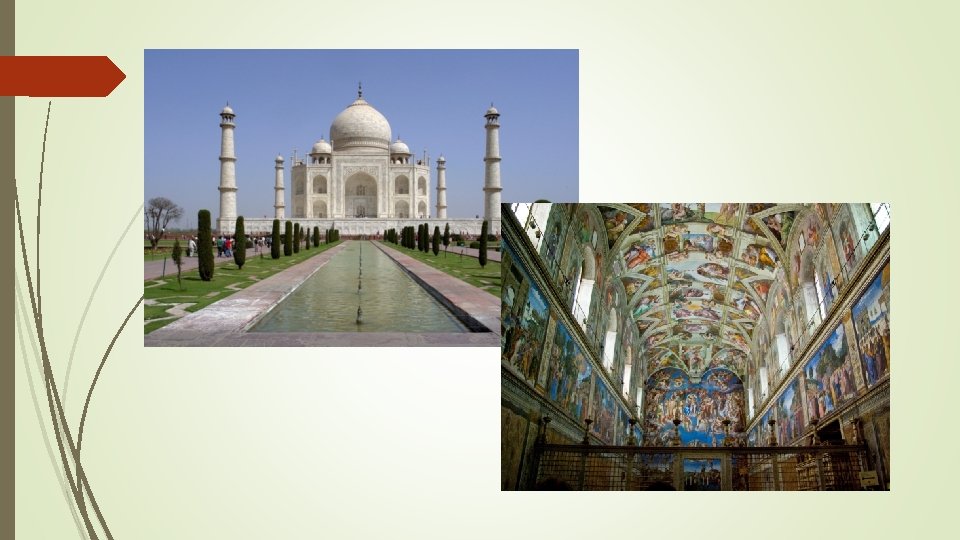
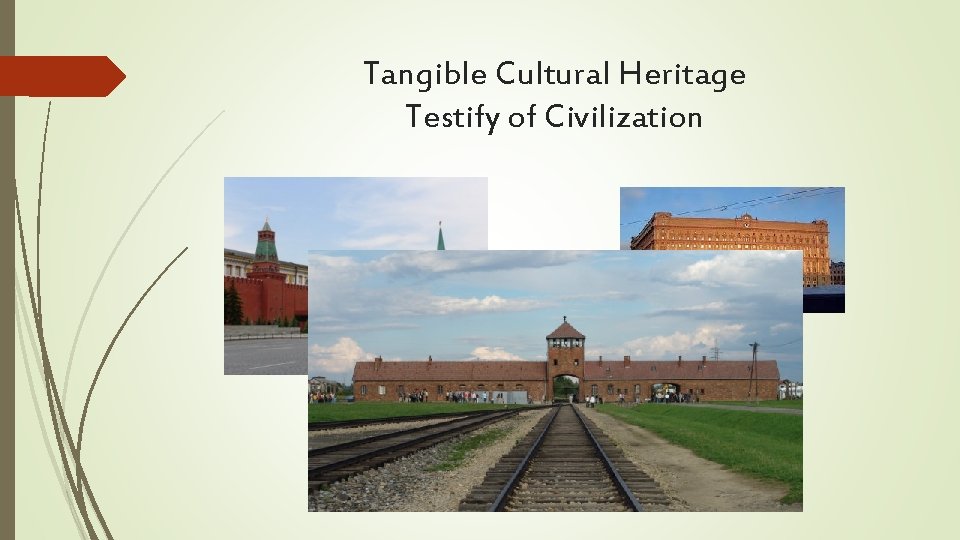
Tangible Cultural Heritage Testify of Civilization
Intangible Cultural Heritage
Intangible Cultural Heritage
Intangible Cultural Heritage Definition Unesco Convention for the Safeguard of the Intangible Cultural Heritage – 17 October 2003 1. The “intangible cultural heritage” means the practices, representations, expressions, knowledge, skills – as well as the instruments, objects, artefacts and cultural spaces associated therewith – that communities, groups and, in some cases, individuals recognize as part of their cultural heritage. This intangible cultural heritage, transmitted from generation to generation, is constantly recreated by communities and groups in response to their environment, their interaction with nature and their history, and provides them with a sense of identity and continuity, thus promoting respect for cultural diversity and human creativity. For the purposes of this Convention, consideration will be given solely to such intangible cultural heritage as is compatible with existing international human rights instruments, as well as with the requirements of mutual respect among communities, groups and individuals, and of sustainable development.
Intangible Cultural Heritage The result of a process Intangible Cultural Heritage hasn’t a body Intangible Cultural Heritage is the result of a process of action The protection regards the process and the action creating the object or the product and not the product itself. Or, better, process and products are in a symbiothic relationship The values recognized and protected are the elements which define the product as important It establish a relationship between memory, present life and creative action for the future It represents an element of a holistic and dynamic system of cultural heritage
Intangible Cultural Heritage …some risks… Folklorization Marginalization Fossilization
- Slides: 47