
Lesson 4 Lines Angles Vertical Angles WarmUp 1

- Slides: 10
Lesson 4 Lines & Angles Vertical Angles
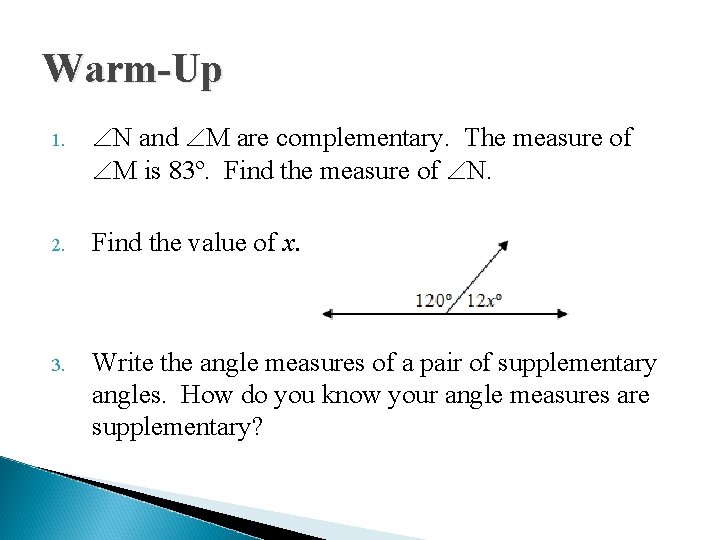
Warm-Up 1. N and M are complementary. The measure of M is 83º. Find the measure of N. 2. Find the value of x. 3. Write the angle measures of a pair of supplementary angles. How do you know your angle measures are supplementary?
Vertical Angles Target: Understand apply the properties of vertical angles.
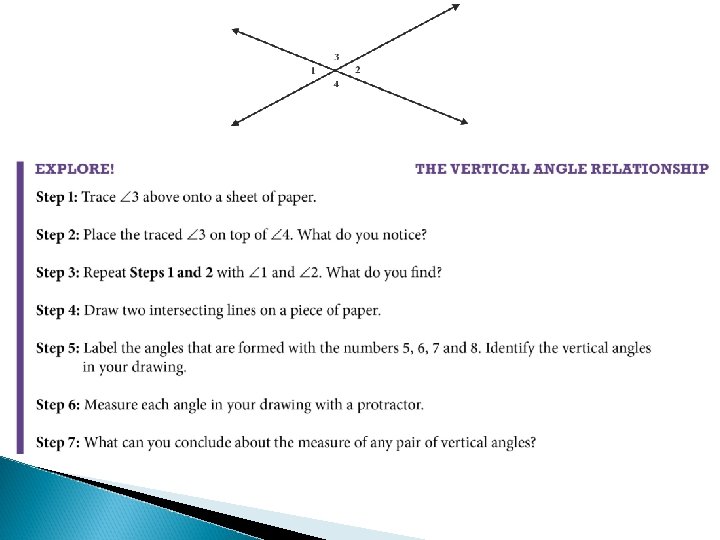
Vocabulary � Vertical � Linear Angles: Nonadjacent angles formed by two intersecting lines. Pair: Two adjacent angles whose non-common sides are opposite rays.
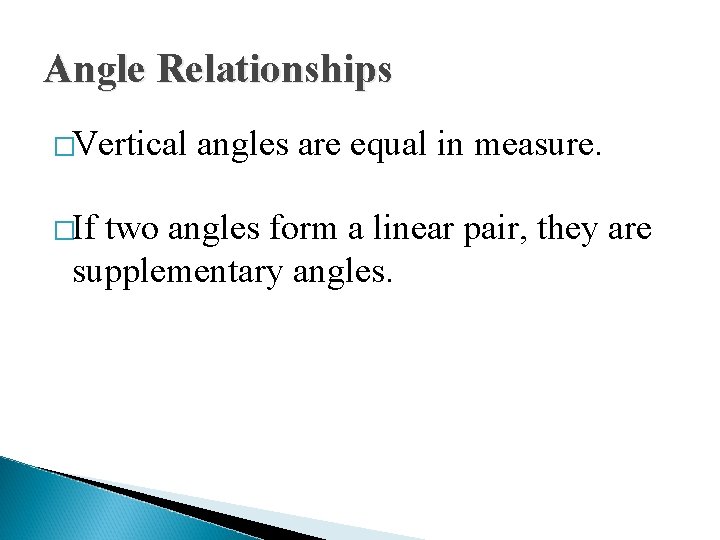
Angle Relationships �Vertical �If angles are equal in measure. two angles form a linear pair, they are supplementary angles.
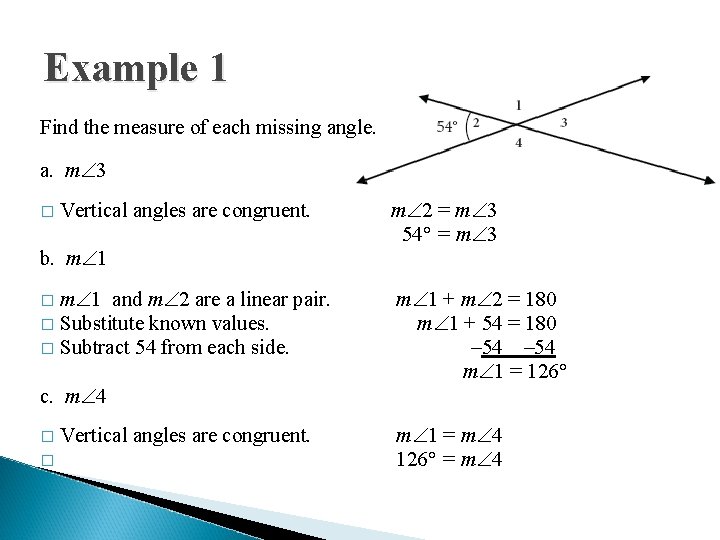
Example 1 Find the measure of each missing angle. a. m 3 � Vertical angles are congruent. m 2 = m 3 54° = m 3 b. m 1 and m 2 are a linear pair. � Substitute known values. � Subtract 54 from each side. � m 1 + m 2 = 180 m 1 + 54 = 180 – 54 m 1 = 126° c. m 4 � � Vertical angles are congruent. m 1 = m 4 126° = m 4
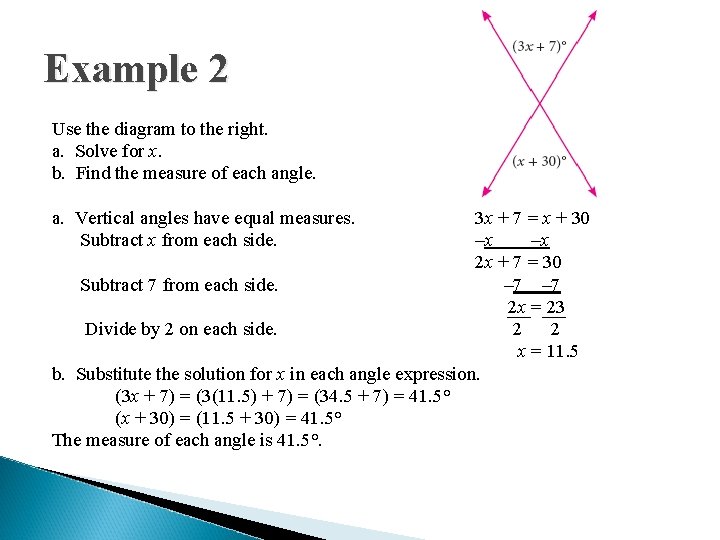
Example 2 Use the diagram to the right. a. Solve for x. b. Find the measure of each angle. a. Vertical angles have equal measures. Subtract x from each side. 3 x + 7 = x + 30 –x –x 2 x + 7 = 30 Subtract 7 from each side. – 7 2 x = 23 Divide by 2 on each side. 2 2 x = 11. 5 b. Substitute the solution for x in each angle expression. (3 x + 7) = (3(11. 5) + 7) = (34. 5 + 7) = 41. 5° (x + 30) = (11. 5 + 30) = 41. 5° The measure of each angle is 41. 5°.
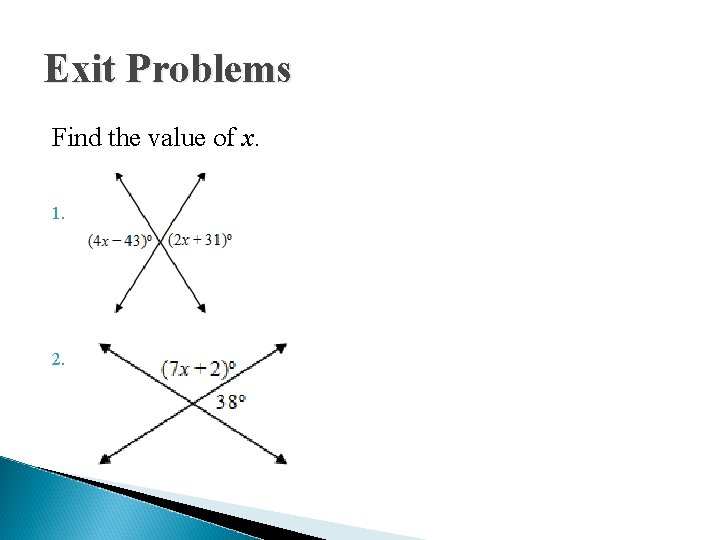
Exit Problems Find the value of x. 1. 2.
Communication Prompt � Why do you think equation-solving is one of the most important mathematical skills?