
Lesson 4 Intrinsic and Extrinsic Semiconductor 2 Jyoti

- Slides: 17
Lesson 4 Intrinsic and Extrinsic Semiconductor (2) Jyoti Patel
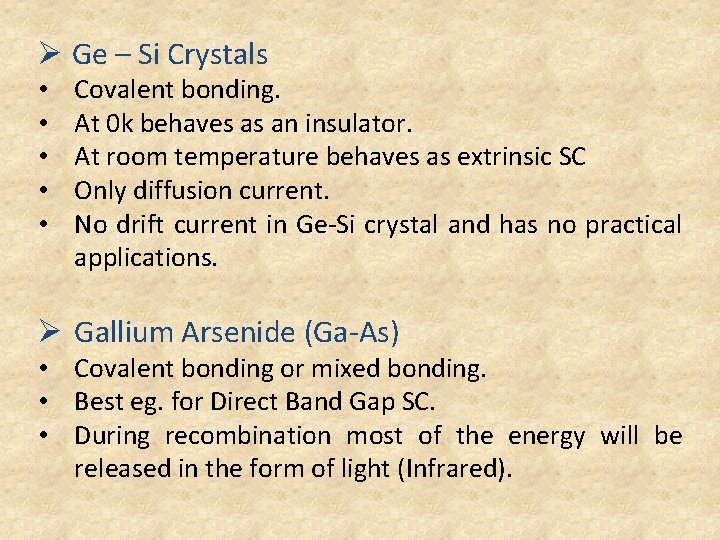
Ø Ge – Si Crystals • • • Covalent bonding. At 0 k behaves as an insulator. At room temperature behaves as extrinsic SC Only diffusion current. No drift current in Ge-Si crystal and has no practical applications. Ø Gallium Arsenide (Ga-As) • Covalent bonding or mixed bonding. • Best eg. for Direct Band Gap SC. • During recombination most of the energy will be released in the form of light (Infrared).
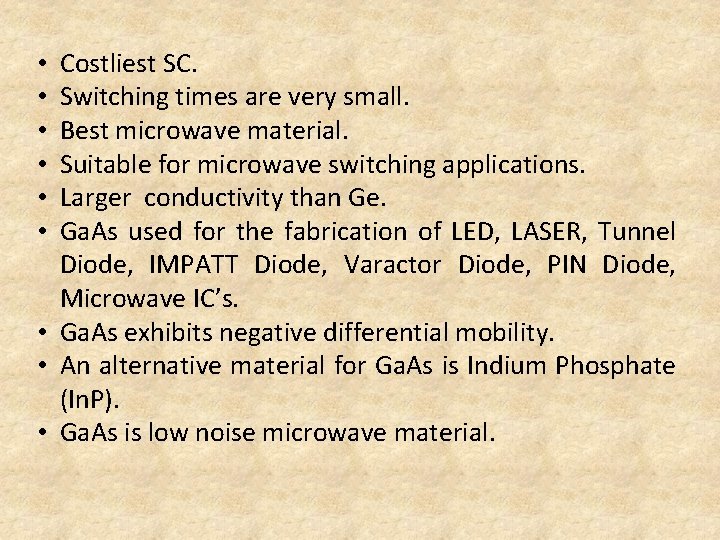
Costliest SC. Switching times are very small. Best microwave material. Suitable for microwave switching applications. Larger conductivity than Ge. Ga. As used for the fabrication of LED, LASER, Tunnel Diode, IMPATT Diode, Varactor Diode, PIN Diode, Microwave IC’s. • Ga. As exhibits negative differential mobility. • An alternative material for Ga. As is Indium Phosphate (In. P). • Ga. As is low noise microwave material. • • •
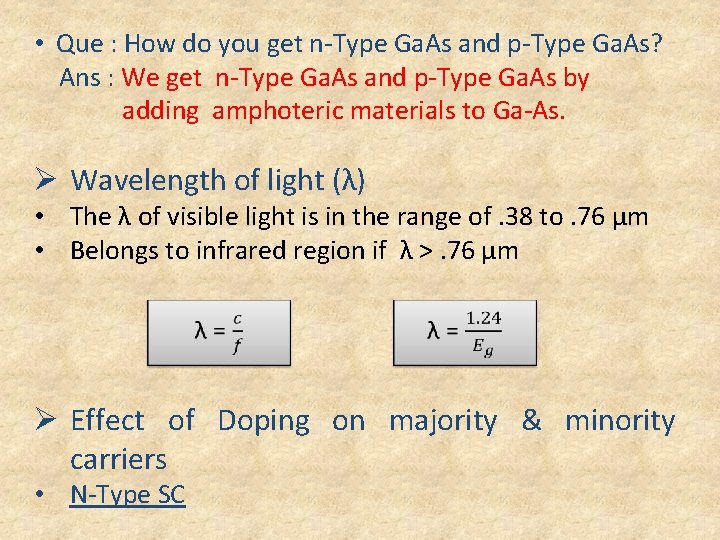
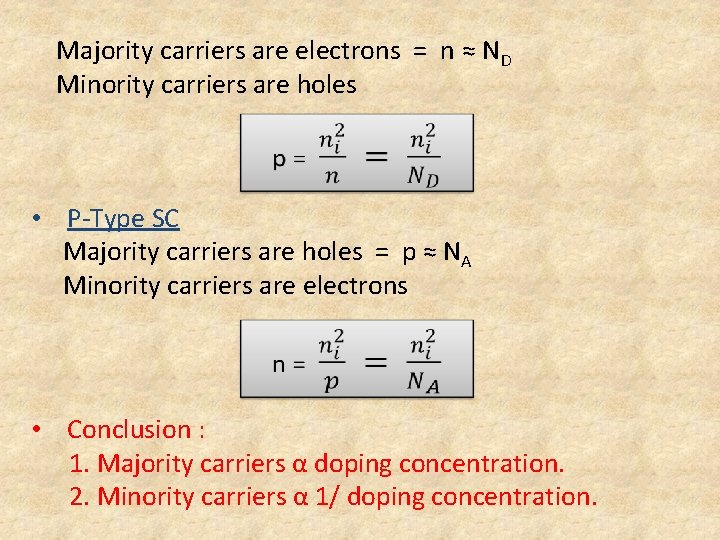
• Que : How do you get n-Type Ga. As and p-Type Ga. As? Ans : We get n-Type Ga. As and p-Type Ga. As by adding amphoteric materials to Ga-As. Ø Wavelength of light (λ) • The λ of visible light is in the range of. 38 to. 76 µm • Belongs to infrared region if λ >. 76 µm Ø Effect of Doping on majority & minority carriers • N-Type SC
Majority carriers are electrons = n ≈ ND Minority carriers are holes • P-Type SC Majority carriers are holes = p ≈ NA Minority carriers are electrons • Conclusion : 1. Majority carriers α doping concentration. 2. Minority carriers α 1/ doping concentration.
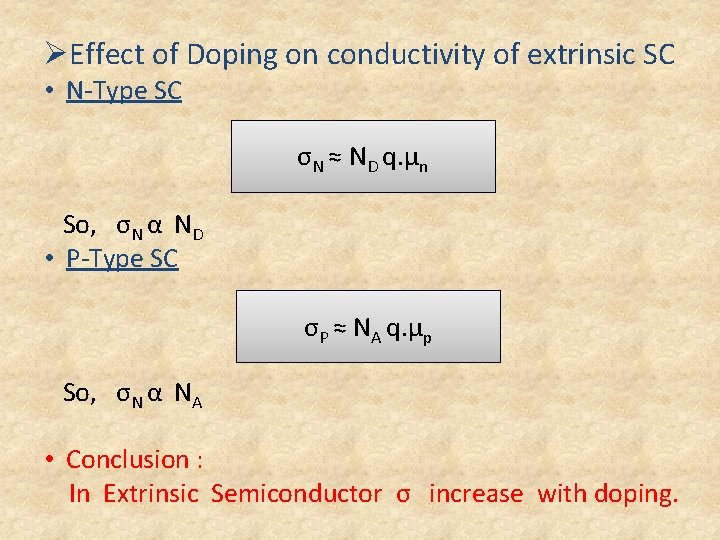
ØEffect of Doping on conductivity of extrinsic SC • N-Type SC σN ≈ ND q. µn So, σN α ND • P-Type SC σP ≈ NA q. µp So, σN α NA • Conclusion : In Extrinsic Semiconductor σ increase with doping.
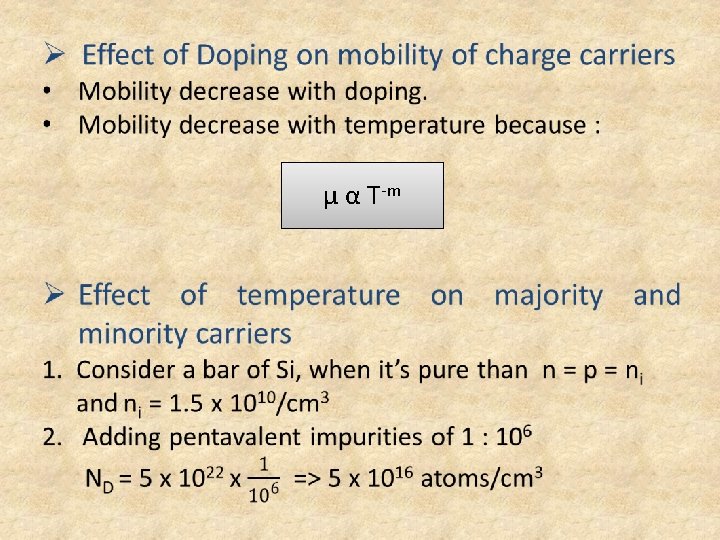
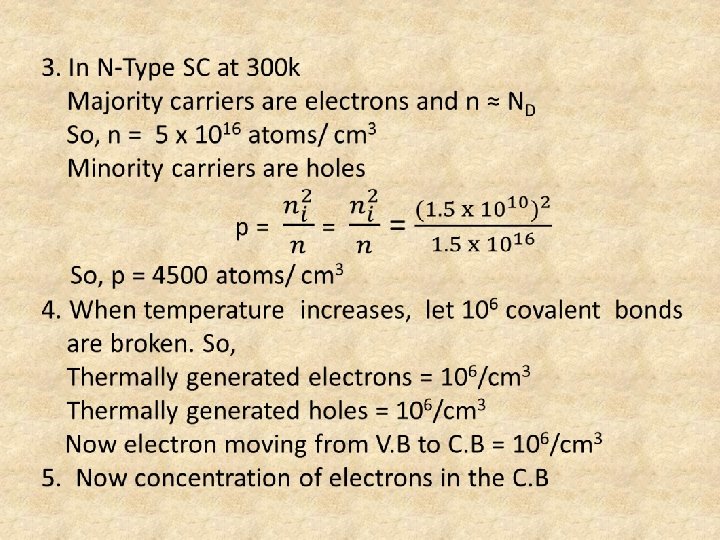
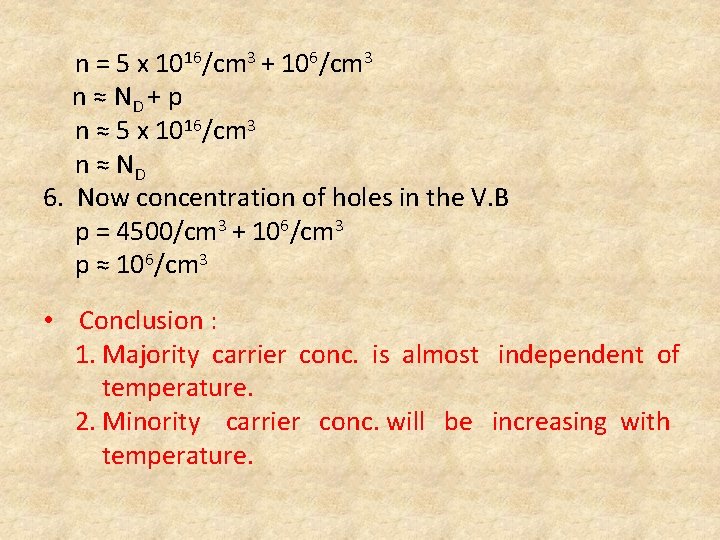
n = 5 x 10¹⁶/cm 3 + 106/cm 3 n ≈ ND + p n ≈ 5 x 10¹⁶/cm 3 n ≈ ND 6. Now concentration of holes in the V. B p = 4500/cm 3 + 106/cm 3 p ≈ 106/cm 3 • Conclusion : 1. Majority carrier conc. is almost independent of temperature. 2. Minority carrier conc. will be increasing with temperature.
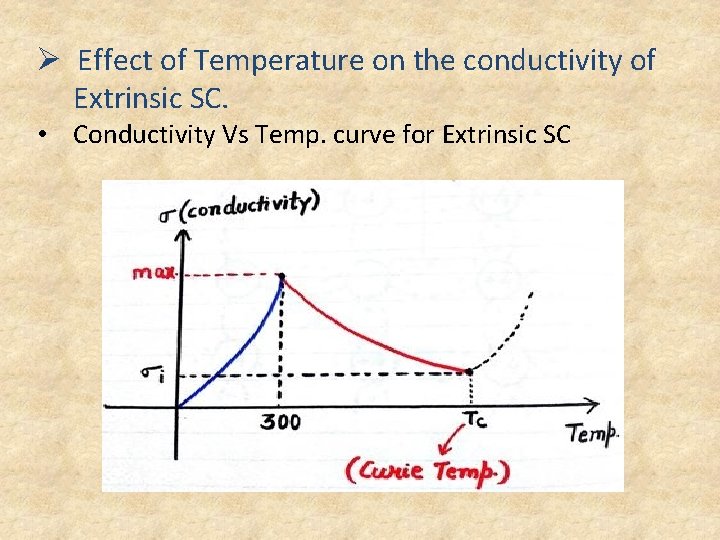
Ø Effect of Temperature on the conductivity of Extrinsic SC. • Conductivity Vs Temp. curve for Extrinsic SC
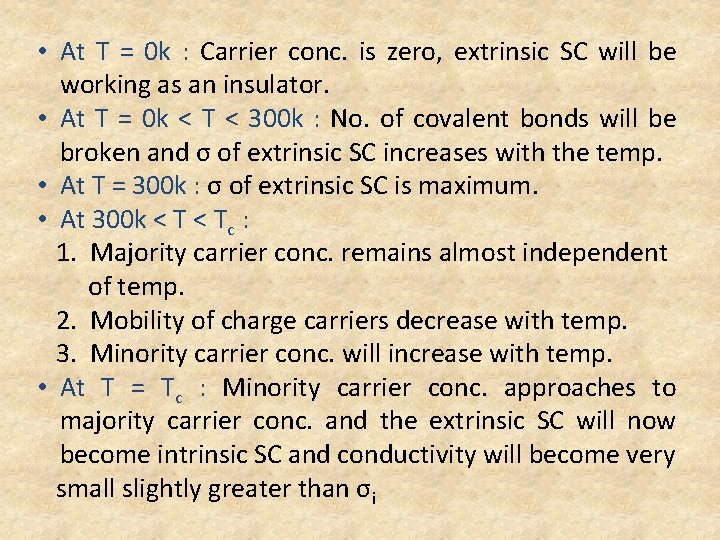
• At T = 0 k : Carrier conc. is zero, extrinsic SC will be working as an insulator. • At T = 0 k < T < 300 k : No. of covalent bonds will be broken and σ of extrinsic SC increases with the temp. • At T = 300 k : σ of extrinsic SC is maximum. • At 300 k < Tc : 1. Majority carrier conc. remains almost independent of temp. 2. Mobility of charge carriers decrease with temp. 3. Minority carrier conc. will increase with temp. • At T = Tc : Minority carrier conc. approaches to majority carrier conc. and the extrinsic SC will now become intrinsic SC and conductivity will become very small slightly greater than σi
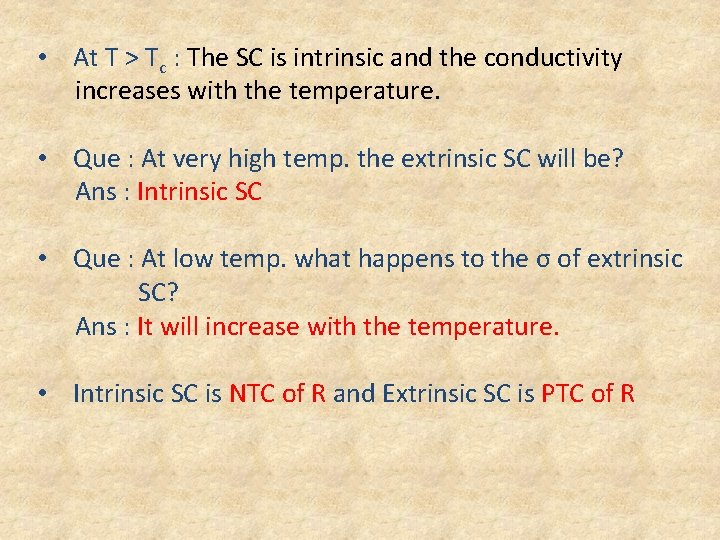
• At T > Tc : The SC is intrinsic and the conductivity increases with the temperature. • Que : At very high temp. the extrinsic SC will be? Ans : Intrinsic SC • Que : At low temp. what happens to the σ of extrinsic SC? Ans : It will increase with the temperature. • Intrinsic SC is NTC of R and Extrinsic SC is PTC of R
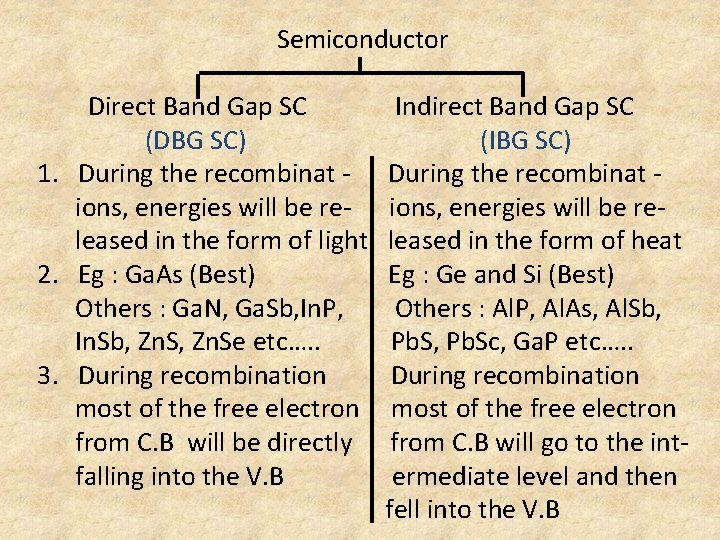
Semiconductor Direct Band Gap SC (DBG SC) 1. During the recombinat ions, energies will be released in the form of light. 2. Eg : Ga. As (Best) Others : Ga. N, Ga. Sb, In. P, In. Sb, Zn. Se etc…. . 3. During recombination most of the free electron from C. B will be directly falling into the V. B Indirect Band Gap SC (IBG SC) During the recombinat ions, energies will be released in the form of heat Eg : Ge and Si (Best) Others : Al. P, Al. As, Al. Sb, Pb. Sc, Ga. P etc…. . During recombination most of the free electron from C. B will go to the intermediate level and then fell into the V. B
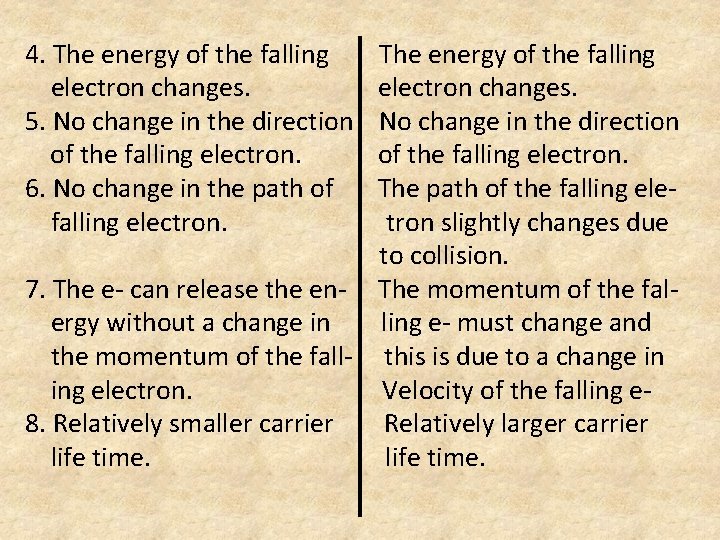
4. The energy of the falling electron changes. 5. No change in the direction of the falling electron. 6. No change in the path of falling electron. The energy of the falling electron changes. No change in the direction of the falling electron. The path of the falling eletron slightly changes due to collision. 7. The e- can release the en- The momentum of the falergy without a change in ling e- must change and the momentum of the fall- this is due to a change in ing electron. Velocity of the falling e 8. Relatively smaller carrier Relatively larger carrier life time.
Thanks For Watching