
LESSON 4 FORMATION OF OUR SOLAR SYSTEM Our
- Slides: 64
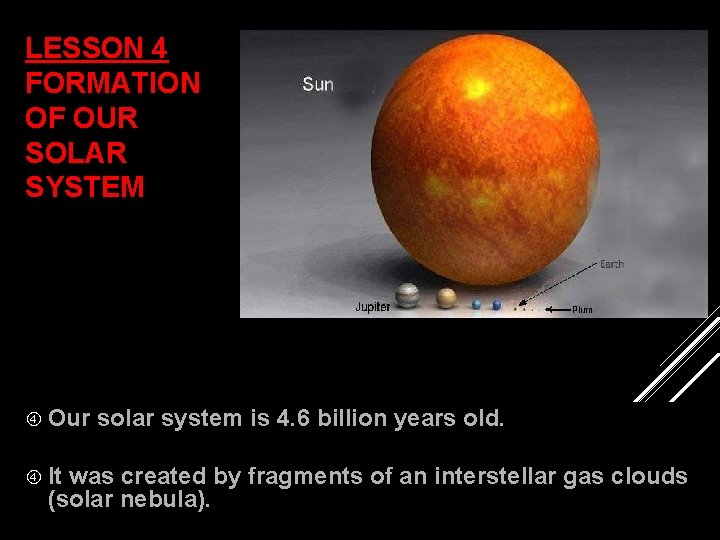
LESSON 4 FORMATION OF OUR SOLAR SYSTEM Our It solar system is 4. 6 billion years old. was created by fragments of an interstellar gas clouds (solar nebula).
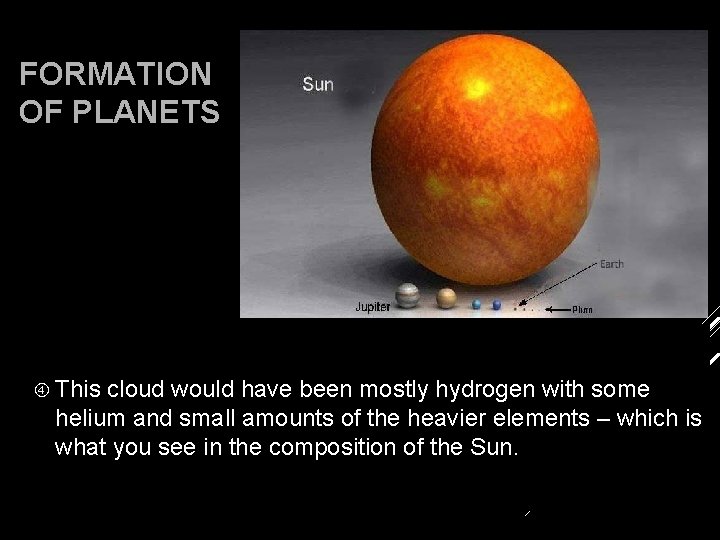
FORMATION OF PLANETS This cloud would have been mostly hydrogen with some helium and small amounts of the heavier elements – which is what you see in the composition of the Sun.
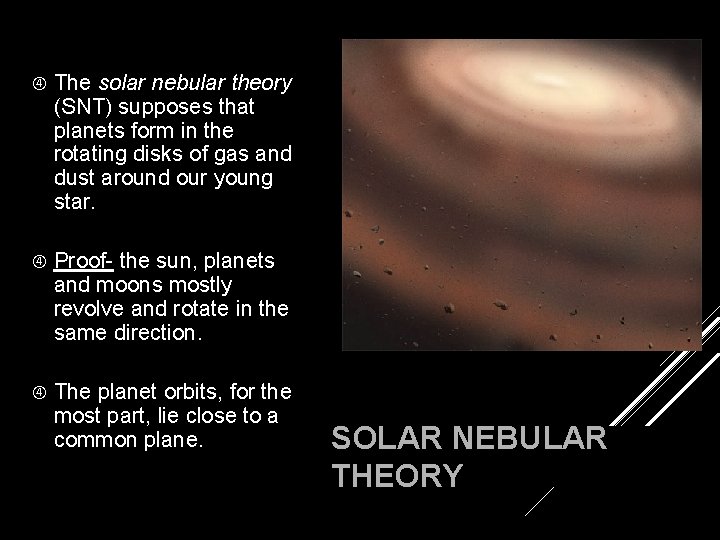
The solar nebular theory (SNT) supposes that planets form in the rotating disks of gas and dust around our young star. Proof- the sun, planets and moons mostly revolve and rotate in the same direction. The planet orbits, for the most part, lie close to a common plane. SOLAR NEBULAR THEORY
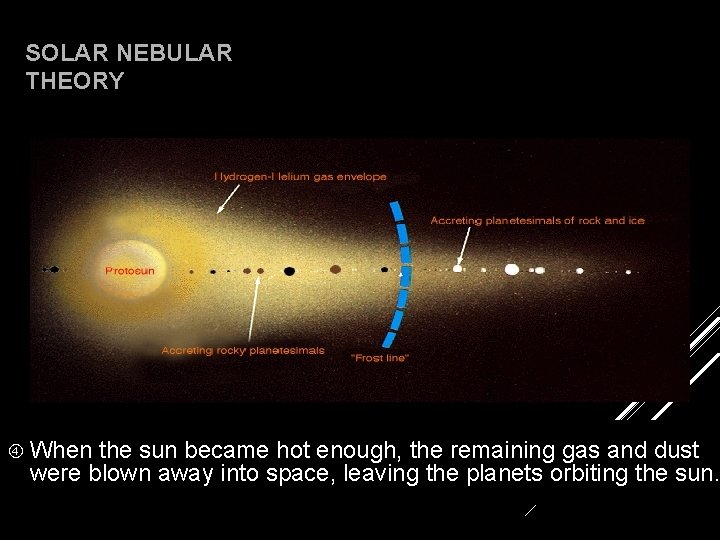
SOLAR NEBULAR THEORY When the sun became hot enough, the remaining gas and dust were blown away into space, leaving the planets orbiting the sun.
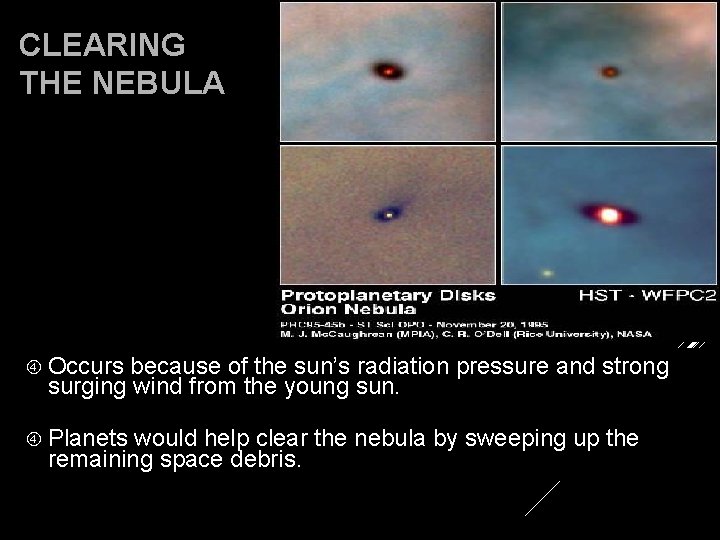
CLEARING THE NEBULA Occurs because of the sun’s radiation pressure and strong surging wind from the young sun. Planets would help clear the nebula by sweeping up the remaining space debris.
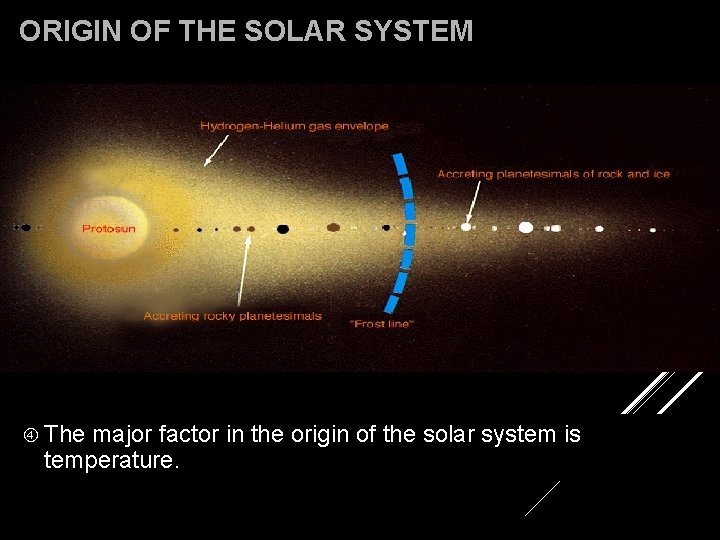
ORIGIN OF THE SOLAR SYSTEM The major factor in the origin of the solar system is temperature.
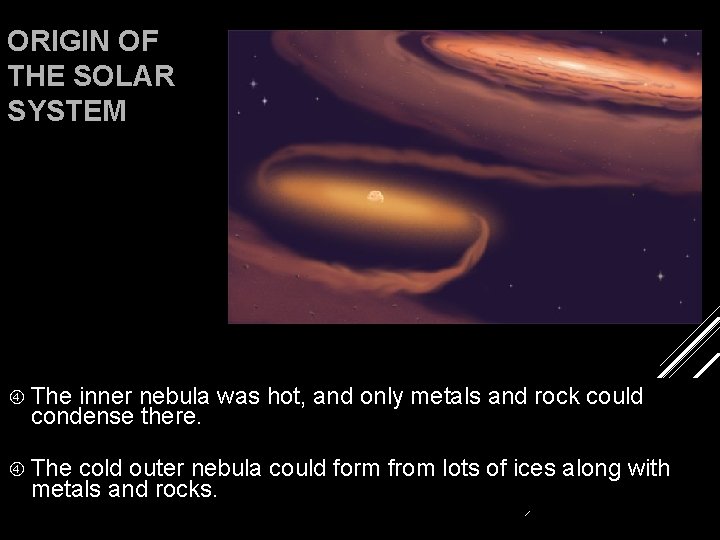
ORIGIN OF THE SOLAR SYSTEM The inner nebula was hot, and only metals and rock could condense there. The cold outer nebula could form from lots of ices along with metals and rocks.
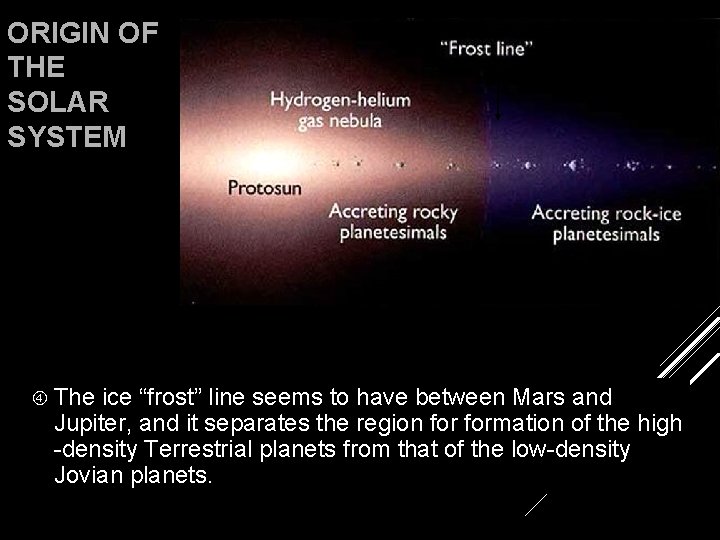
ORIGIN OF THE SOLAR SYSTEM The ice “frost” line seems to have between Mars and Jupiter, and it separates the region formation of the high -density Terrestrial planets from that of the low-density Jovian planets.
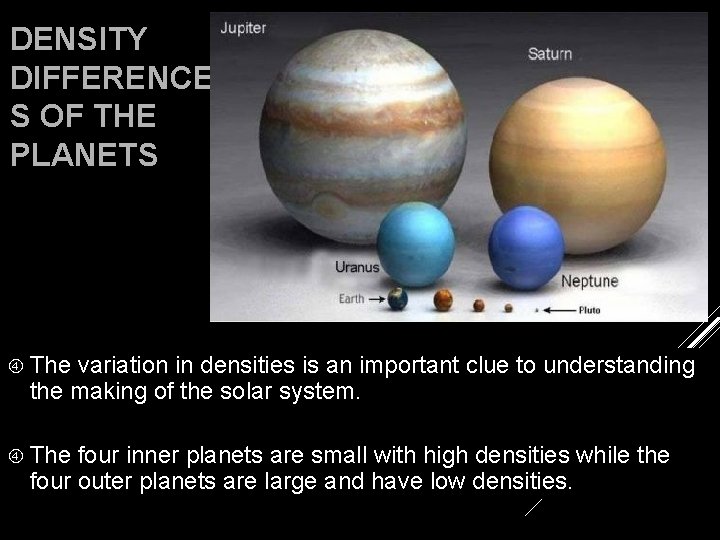
DENSITY DIFFERENCE S OF THE PLANETS The variation in densities is an important clue to understanding the making of the solar system. The four inner planets are small with high densities while the four outer planets are large and have low densities.
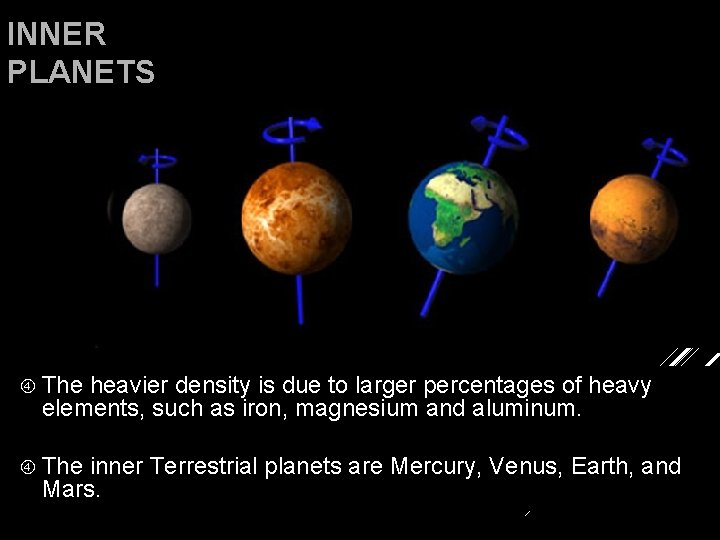
INNER PLANETS The heavier density is due to larger percentages of heavy elements, such as iron, magnesium and aluminum. The inner Terrestrial planets are Mercury, Venus, Earth, and Mars.
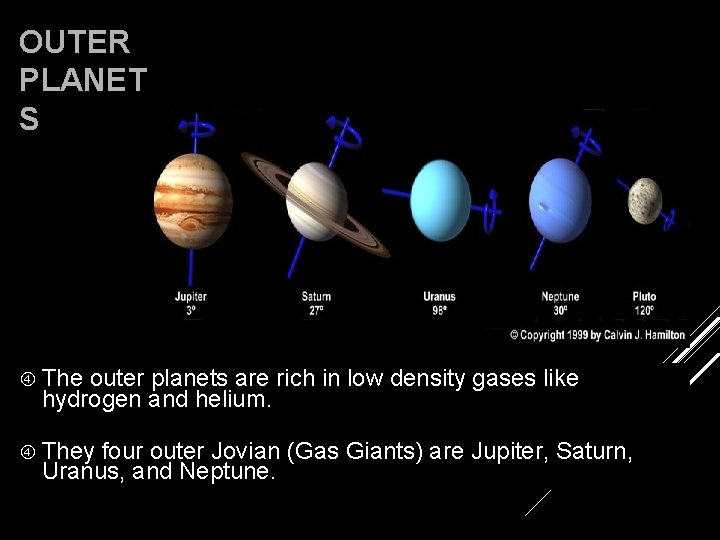
OUTER PLANET S The outer planets are rich in low density gases like hydrogen and helium. They four outer Jovian (Gas Giants) are Jupiter, Saturn, Uranus, and Neptune.
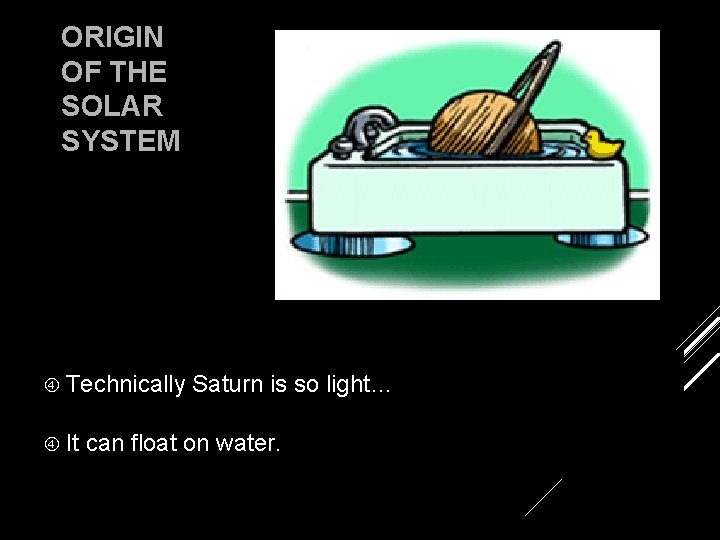
ORIGIN OF THE SOLAR SYSTEM Technically Saturn is so light… It can float on water.
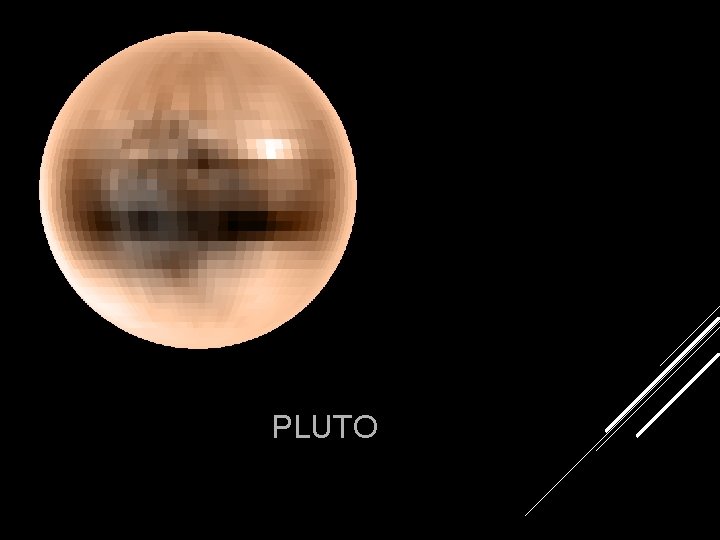
PLUTO
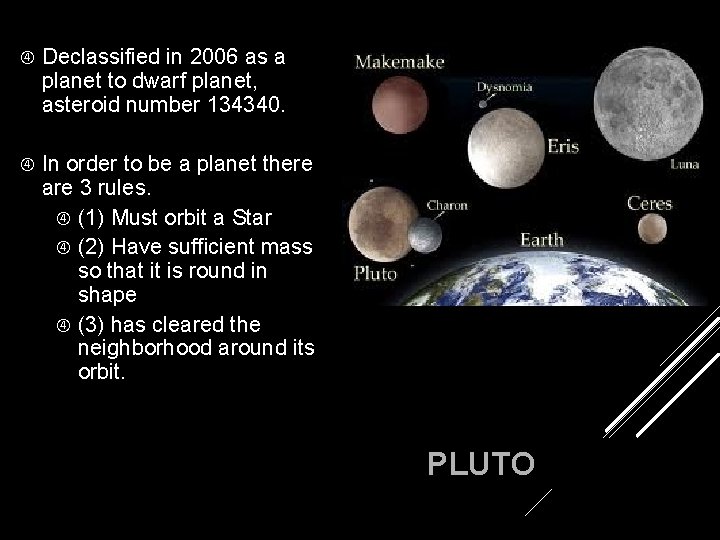
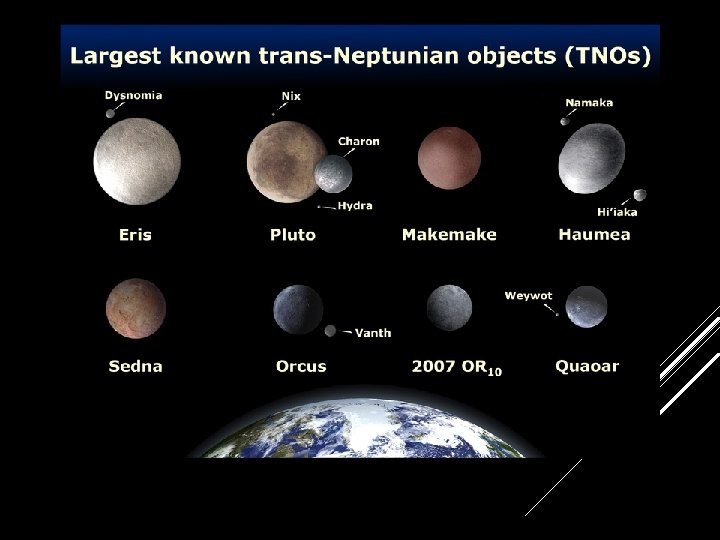
Declassified in 2006 as a planet to dwarf planet, asteroid number 134340. In order to be a planet there are 3 rules. (1) Must orbit a Star (2) Have sufficient mass so that it is round in shape (3) has cleared the neighborhood around its orbit. PLUTO
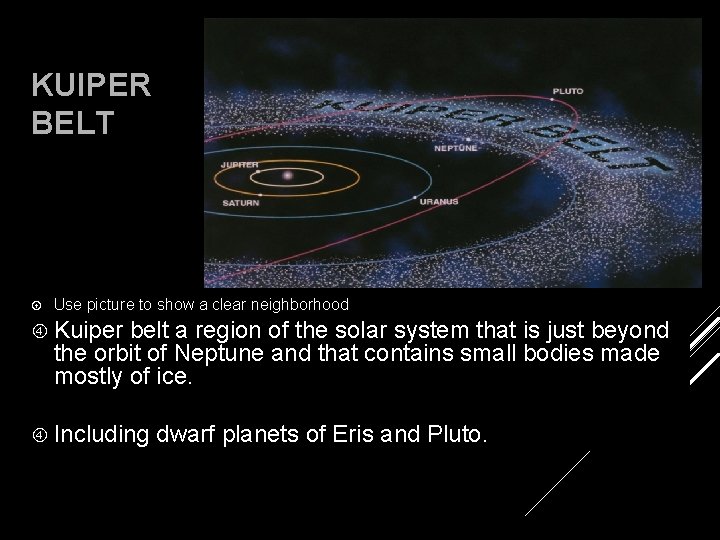
KUIPER BELT Use picture to show a clear neighborhood Kuiper belt a region of the solar system that is just beyond the orbit of Neptune and that contains small bodies made mostly of ice. Including dwarf planets of Eris and Pluto.
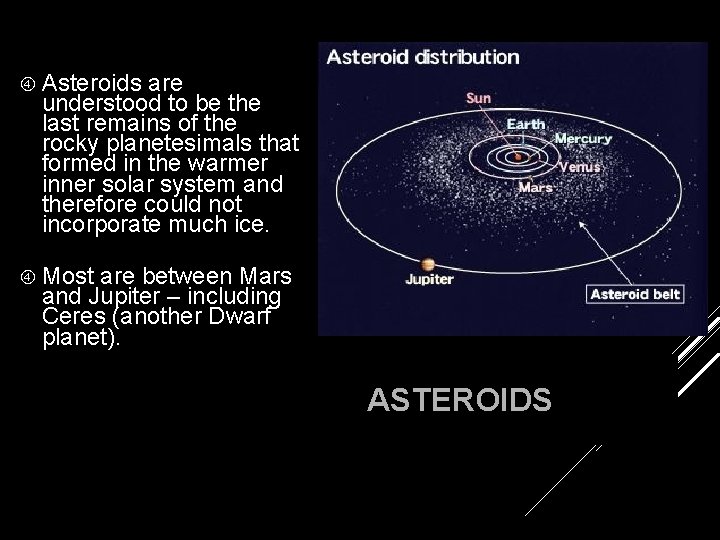
Asteroids are understood to be the last remains of the rocky planetesimals that formed in the warmer inner solar system and therefore could not incorporate much ice. Most are between Mars and Jupiter – including Ceres (another Dwarf planet). ASTEROIDS
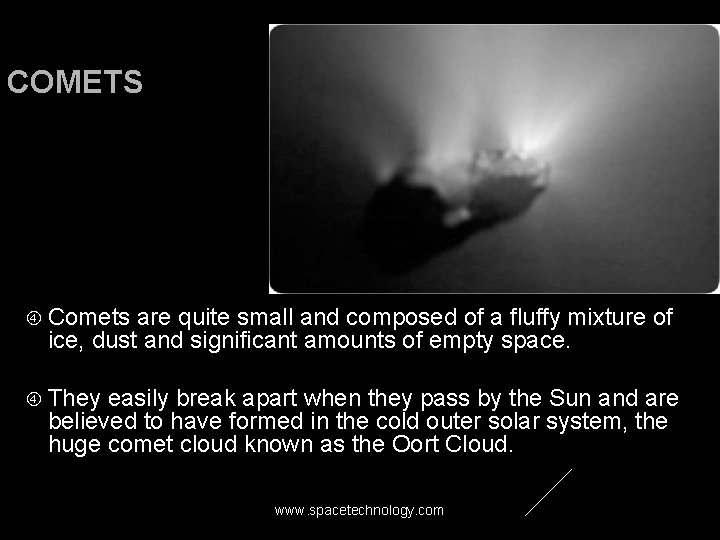
COMETS Comets are quite small and composed of a fluffy mixture of ice, dust and significant amounts of empty space. They easily break apart when they pass by the Sun and are believed to have formed in the cold outer solar system, the huge comet cloud known as the Oort Cloud. www. spacetechnology. com
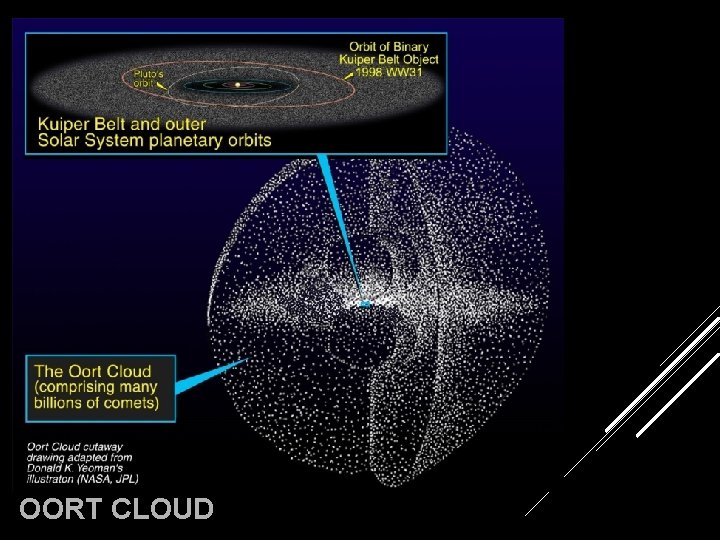
OORT CLOUD
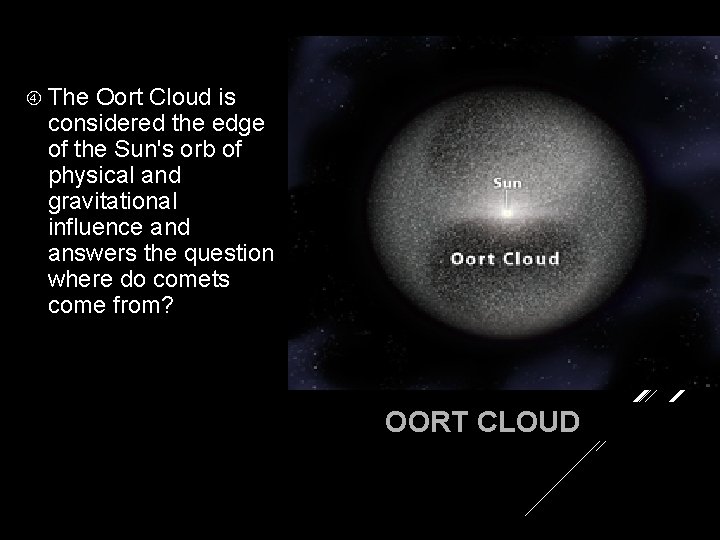
The Oort Cloud is considered the edge of the Sun's orb of physical and gravitational influence and answers the question where do comets come from? OORT CLOUD
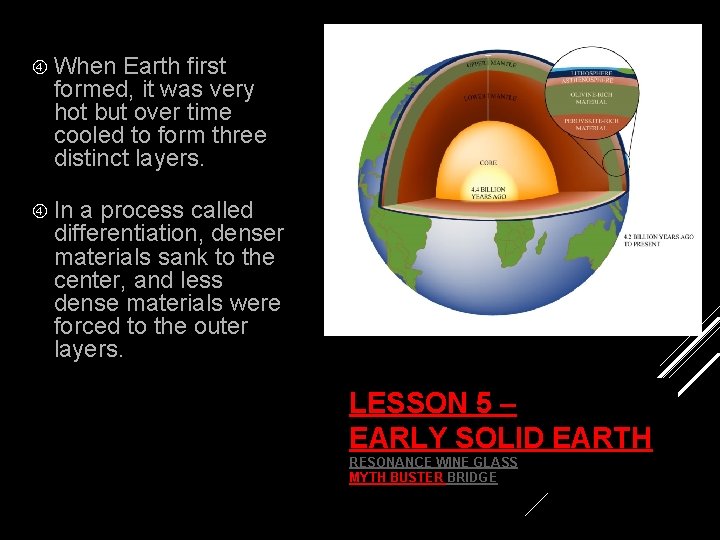
When Earth first formed, it was very hot but over time cooled to form three distinct layers. In a process called differentiation, denser materials sank to the center, and less dense materials were forced to the outer layers. LESSON 5 – EARLY SOLID EARTH RESONANCE WINE GLASS MYTH BUSTER BRIDGE
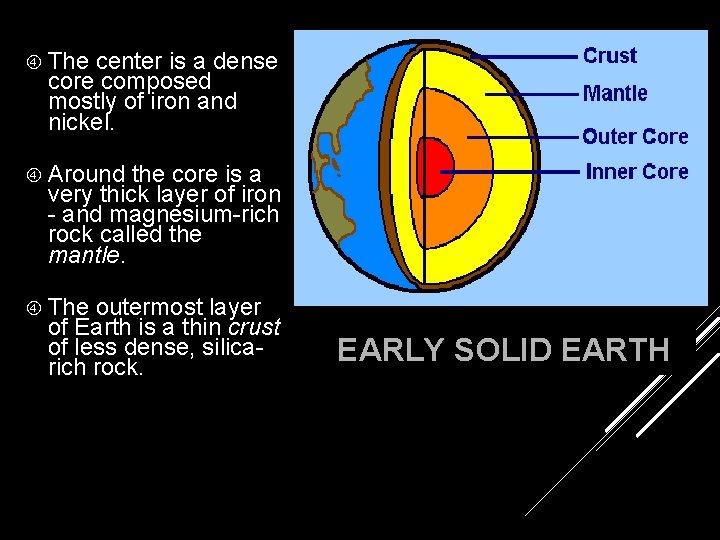
The center is a dense core composed mostly of iron and nickel. Around the core is a very thick layer of iron - and magnesium-rich rock called the mantle. The outermost layer of Earth is a thin crust of less dense, silicarich rock. EARLY SOLID EARTH
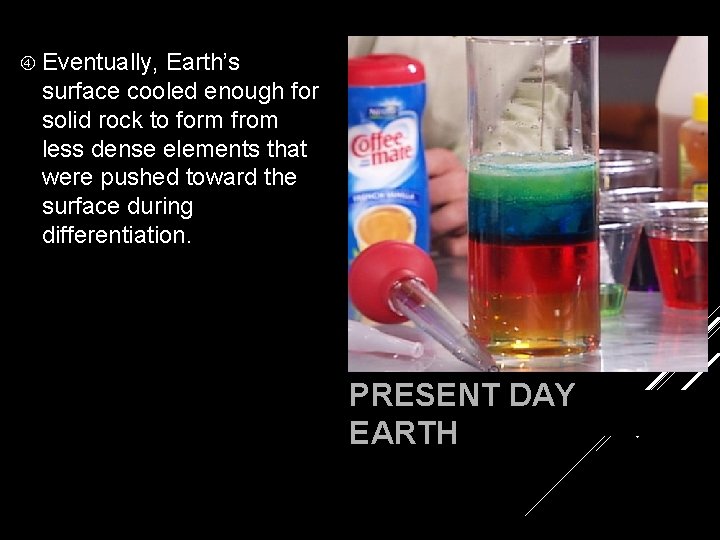
Eventually, Earth’s surface cooled enough for solid rock to form from less dense elements that were pushed toward the surface during differentiation. PRESENT DAY EARTH
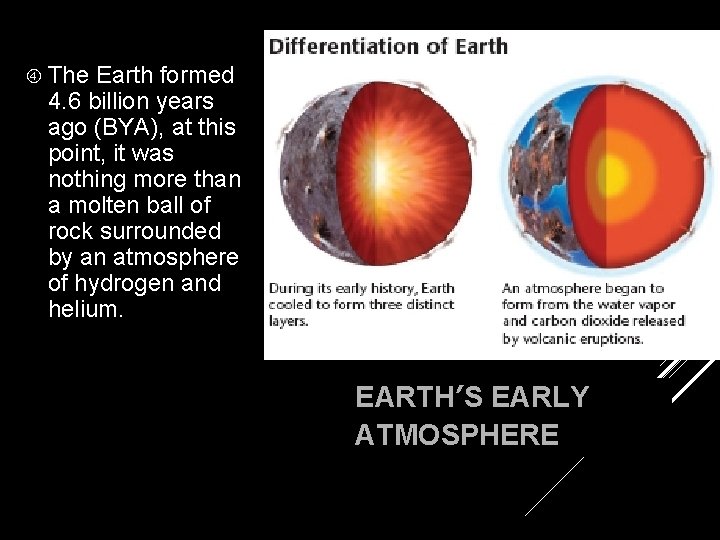
The Earth formed 4. 6 billion years ago (BYA), at this point, it was nothing more than a molten ball of rock surrounded by an atmosphere of hydrogen and helium. EARTH’S EARLY ATMOSPHERE
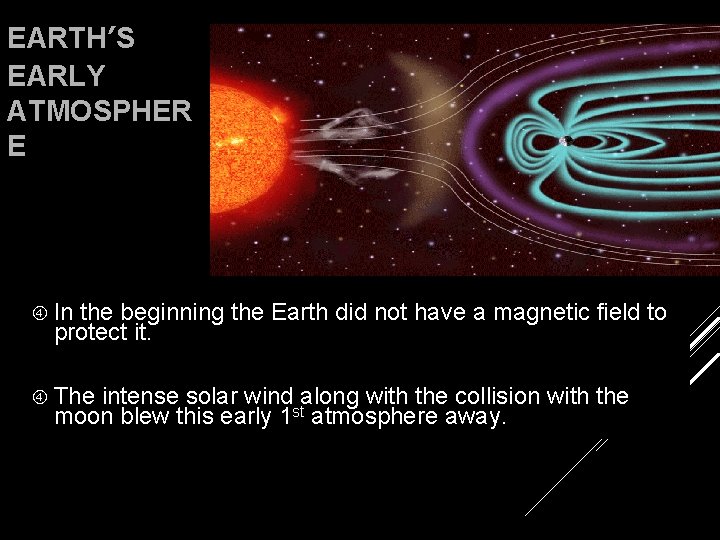
EARTH’S EARLY ATMOSPHER E In the beginning the Earth did not have a magnetic field to protect it. The intense solar wind along with the collision with the moon blew this early 1 st atmosphere away.
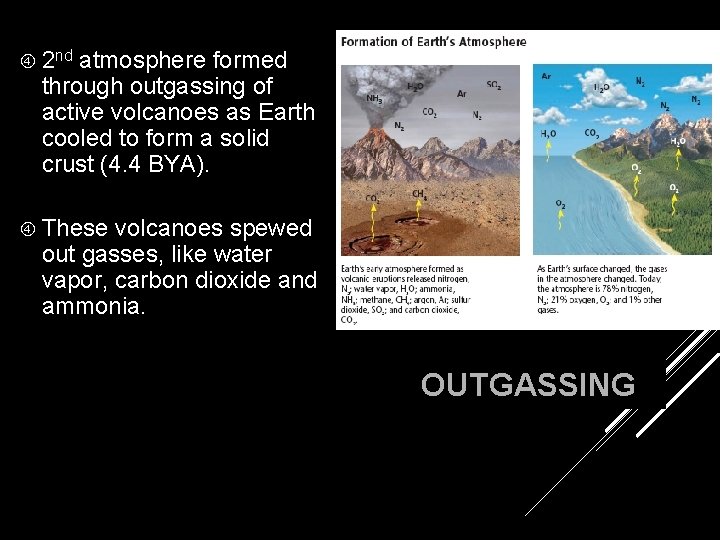
2 nd atmosphere formed through outgassing of active volcanoes as Earth cooled to form a solid crust (4. 4 BYA). These volcanoes spewed out gasses, like water vapor, carbon dioxide and ammonia. OUTGASSING
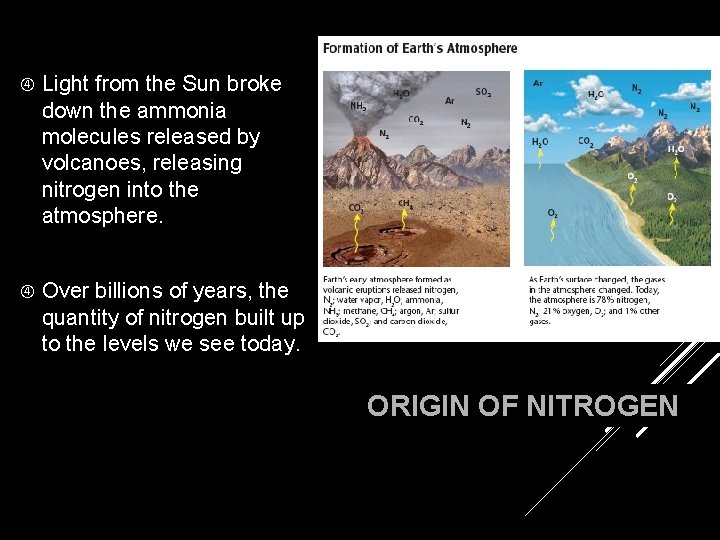
Light from the Sun broke down the ammonia molecules released by volcanoes, releasing nitrogen into the atmosphere. Over billions of years, the quantity of nitrogen built up to the levels we see today. ORIGIN OF NITROGEN
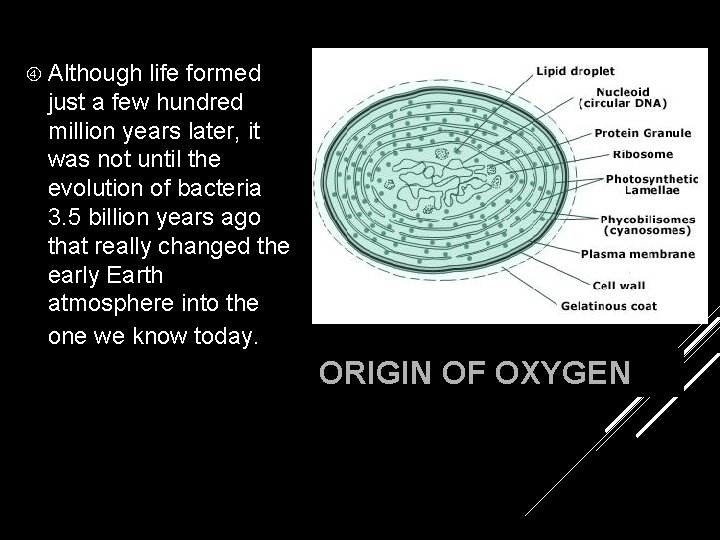
Although life formed just a few hundred million years later, it was not until the evolution of bacteria 3. 5 billion years ago that really changed the early Earth atmosphere into the one we know today. ORIGIN OF OXYGEN
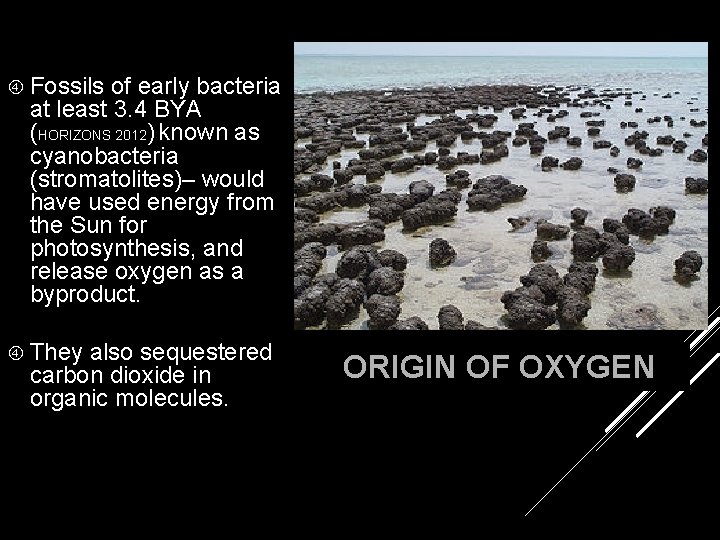
Fossils of early bacteria at least 3. 4 BYA (HORIZONS 2012) known as cyanobacteria (stromatolites)– would have used energy from the Sun for photosynthesis, and release oxygen as a byproduct. They also sequestered carbon dioxide in organic molecules. ORIGIN OF OXYGEN
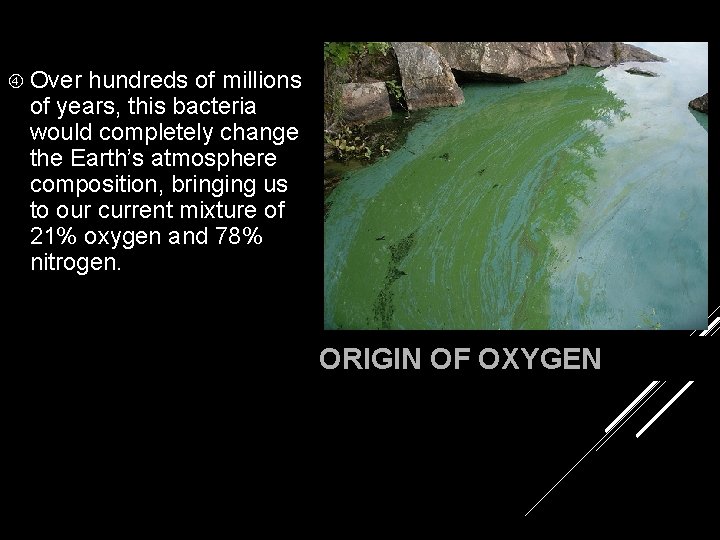
Over hundreds of millions of years, this bacteria would completely change the Earth’s atmosphere composition, bringing us to our current mixture of 21% oxygen and 78% nitrogen. ORIGIN OF OXYGEN
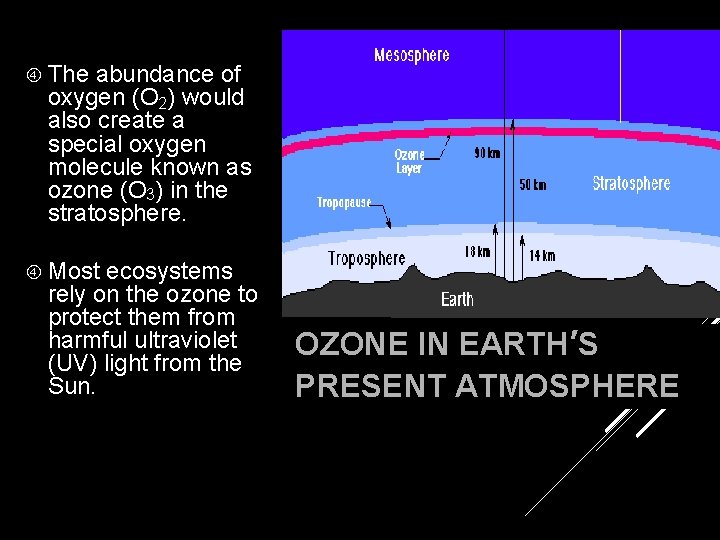
The abundance of oxygen (O 2) would also create a special oxygen molecule known as ozone (O 3) in the stratosphere. Most ecosystems rely on the ozone to protect them from harmful ultraviolet (UV) light from the Sun. OZONE IN EARTH’S PRESENT ATMOSPHERE
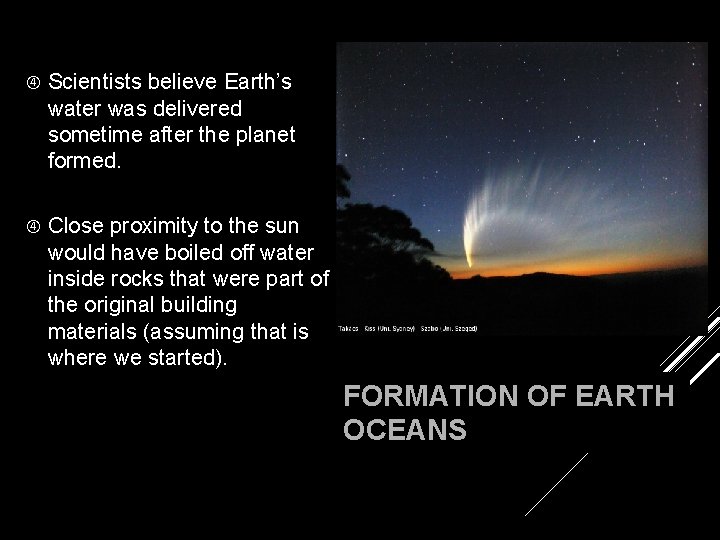
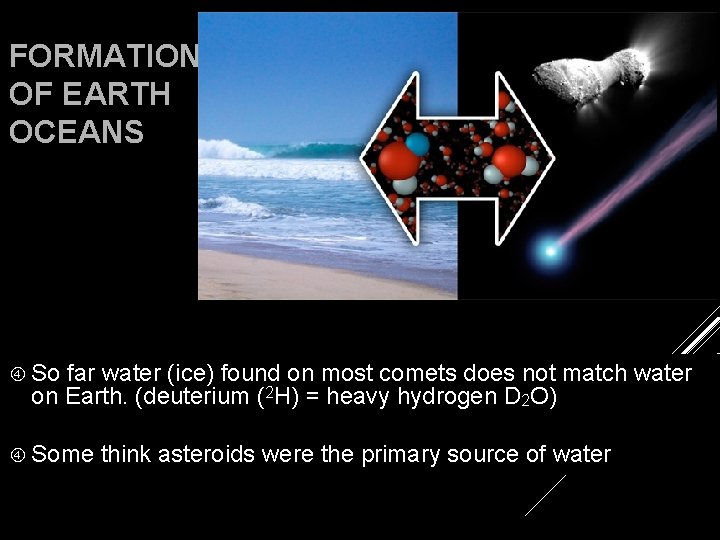
Scientists believe Earth’s water was delivered sometime after the planet formed. Close proximity to the sun would have boiled off water inside rocks that were part of the original building materials (assuming that is where we started). FORMATION OF EARTH OCEANS
FORMATION OF EARTH OCEANS So far water (ice) found on most comets does not match water on Earth. (deuterium (2 H) = heavy hydrogen D 2 O) Some think asteroids were the primary source of water
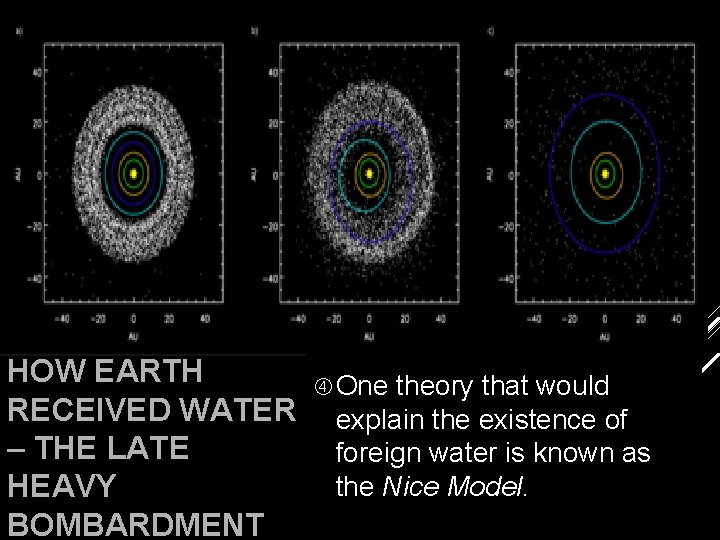
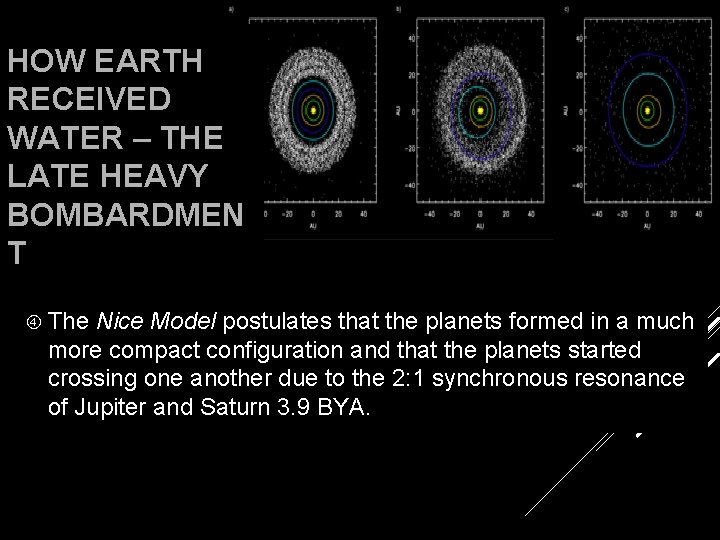
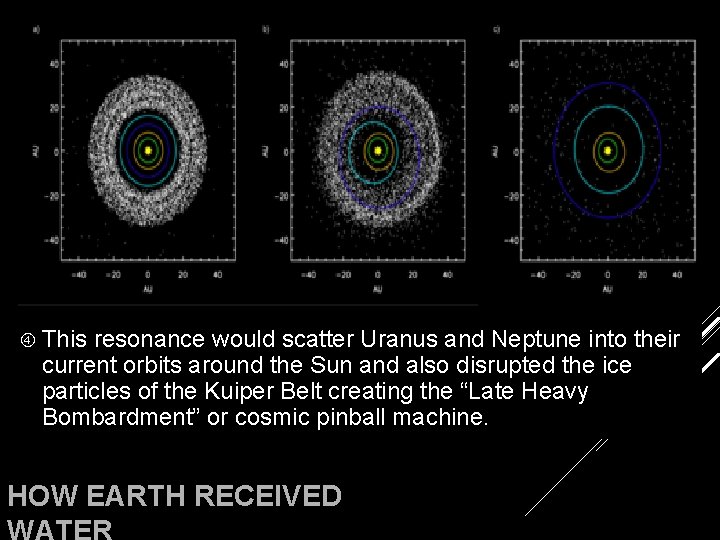
HOW EARTH RECEIVED WATER – THE LATE HEAVY BOMBARDMENT One theory that would explain the existence of foreign water is known as the Nice Model.
HOW EARTH RECEIVED WATER – THE LATE HEAVY BOMBARDMEN T The Nice Model postulates that the planets formed in a much more compact configuration and that the planets started crossing one another due to the 2: 1 synchronous resonance of Jupiter and Saturn 3. 9 BYA.
This resonance would scatter Uranus and Neptune into their current orbits around the Sun and also disrupted the ice particles of the Kuiper Belt creating the “Late Heavy Bombardment” or cosmic pinball machine. HOW EARTH RECEIVED
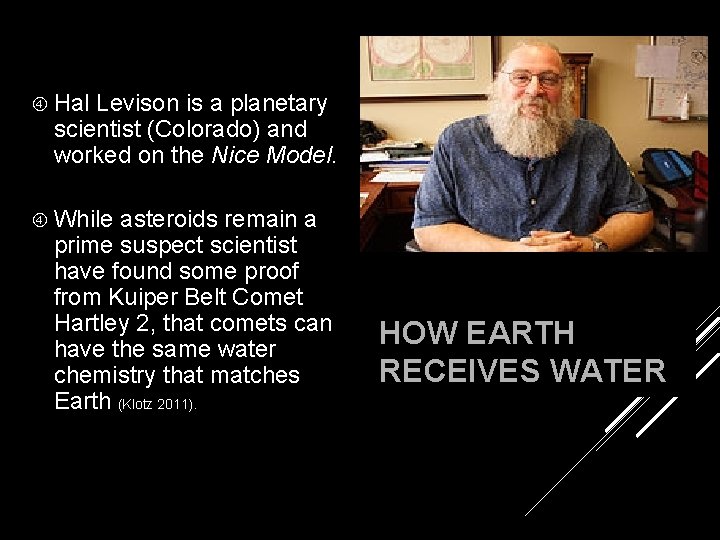
Hal Levison is a planetary scientist (Colorado) and worked on the Nice Model. While asteroids remain a prime suspect scientist have found some proof from Kuiper Belt Comet Hartley 2, that comets can have the same water chemistry that matches Earth (Klotz 2011). HOW EARTH RECEIVES WATER
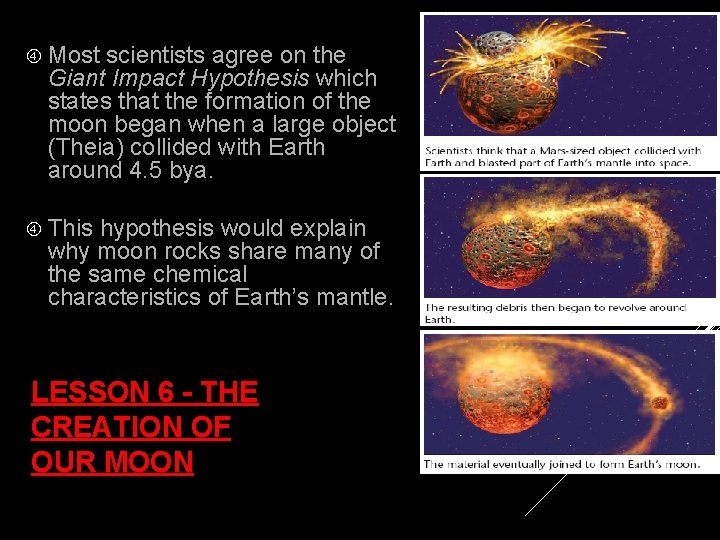
Most scientists agree on the Giant Impact Hypothesis which states that the formation of the moon began when a large object (Theia) collided with Earth around 4. 5 bya. This hypothesis would explain why moon rocks share many of the same chemical characteristics of Earth’s mantle. LESSON 6 - THE CREATION OF OUR MOON
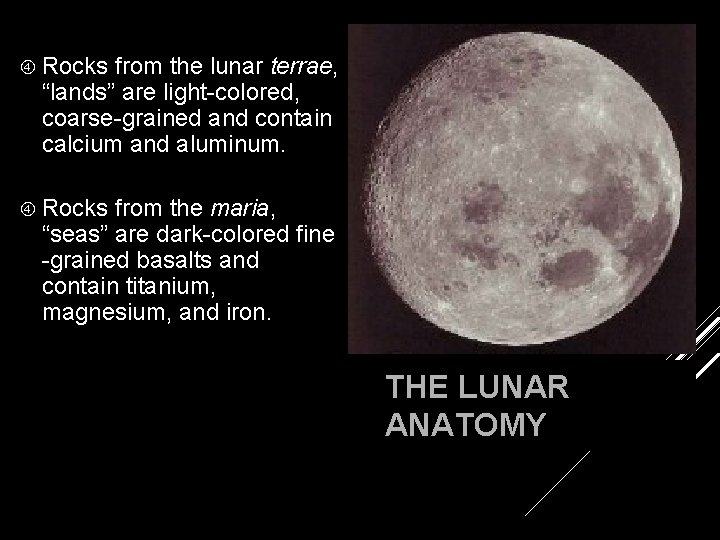
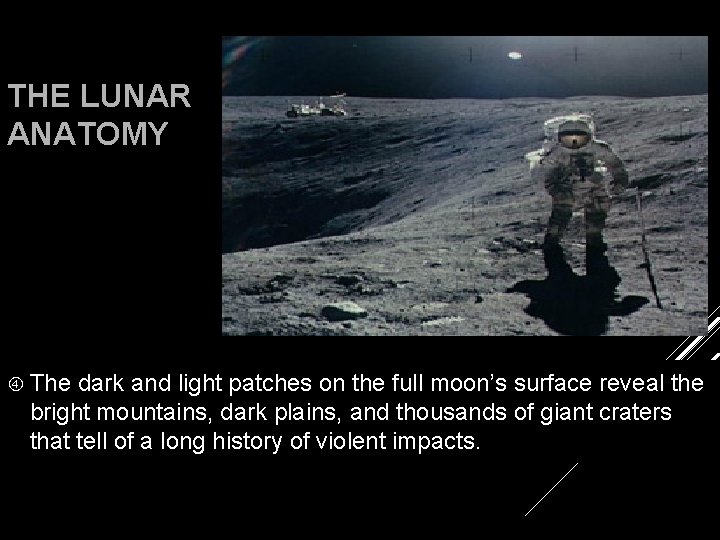
Rocks from the lunar terrae, “lands” are light-colored, coarse-grained and contain calcium and aluminum. Rocks from the maria, “seas” are dark-colored fine -grained basalts and contain titanium, magnesium, and iron. THE LUNAR ANATOMY
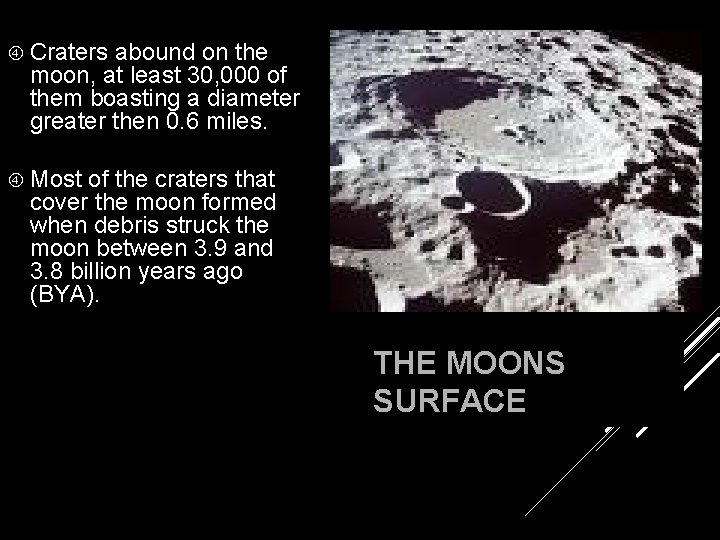
Craters abound on the moon, at least 30, 000 of them boasting a diameter greater then 0. 6 miles. Most of the craters that cover the moon formed when debris struck the moon between 3. 9 and 3. 8 billion years ago (BYA). THE MOONS SURFACE
THE LUNAR ANATOMY The dark and light patches on the full moon’s surface reveal the bright mountains, dark plains, and thousands of giant craters that tell of a long history of violent impacts.
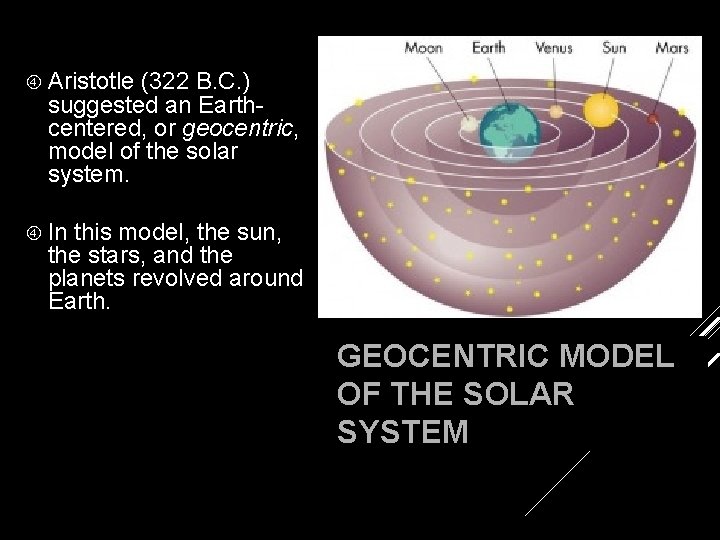
Aristotle (322 B. C. ) suggested an Earthcentered, or geocentric, model of the solar system. In this model, the sun, the stars, and the planets revolved around Earth. GEOCENTRIC MODEL OF THE SOLAR SYSTEM
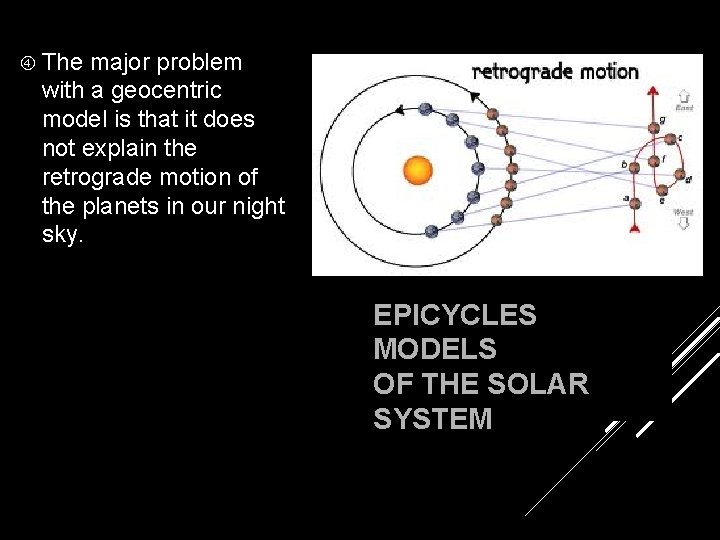
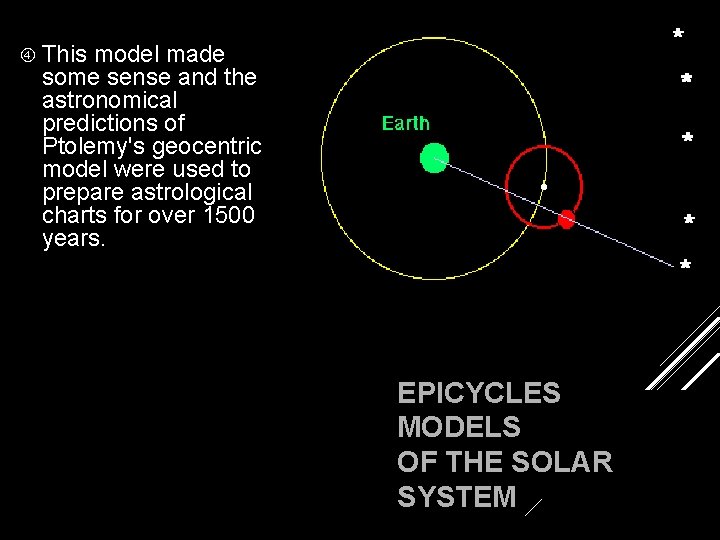
The major problem with a geocentric model is that it does not explain the retrograde motion of the planets in our night sky. EPICYCLES MODELS OF THE SOLAR SYSTEM
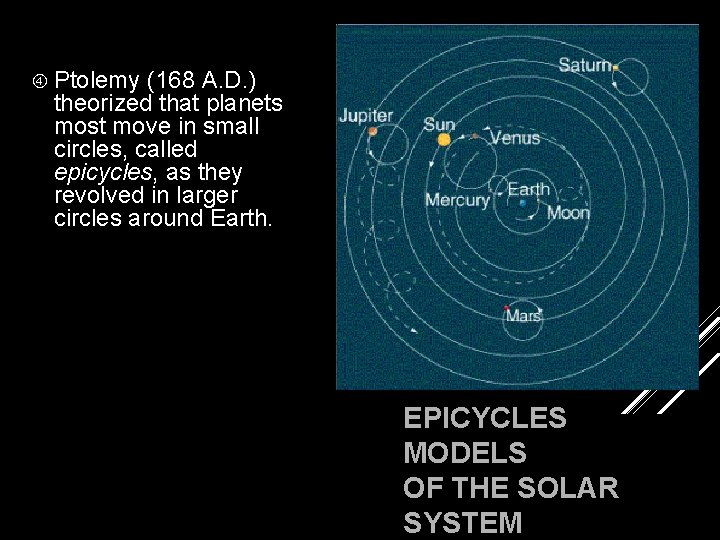
Ptolemy (168 A. D. ) theorized that planets most move in small circles, called epicycles, as they revolved in larger circles around Earth. EPICYCLES MODELS OF THE SOLAR SYSTEM
This model made some sense and the astronomical predictions of Ptolemy's geocentric model were used to prepare astrological charts for over 1500 years. EPICYCLES MODELS OF THE SOLAR SYSTEM
CHECK FOR UNDERSTANDING What is the Geocentric Model of the solar system and who created it? What does epicycles refer to? What is the anatomy of the moon?
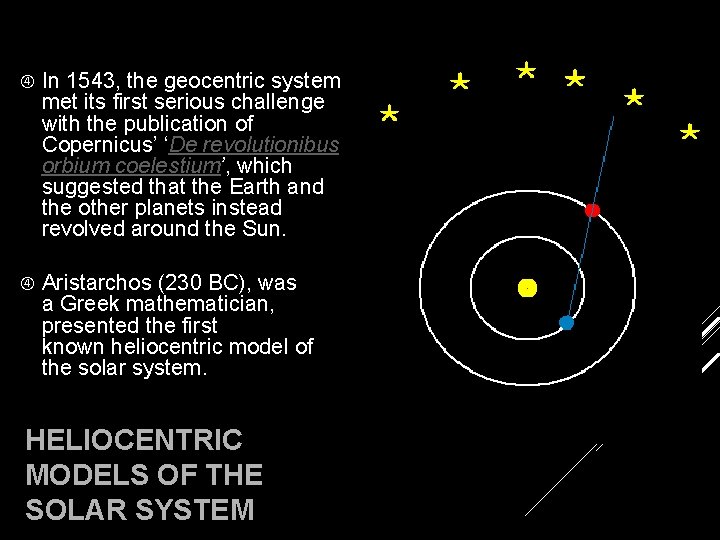
In 1543, the geocentric system met its first serious challenge with the publication of Copernicus’ ‘De revolutionibus orbium coelestium’, which suggested that the Earth and the other planets instead revolved around the Sun. Aristarchos (230 BC), was a Greek mathematician, presented the first known heliocentric model of the solar system. HELIOCENTRIC MODELS OF THE SOLAR SYSTEM
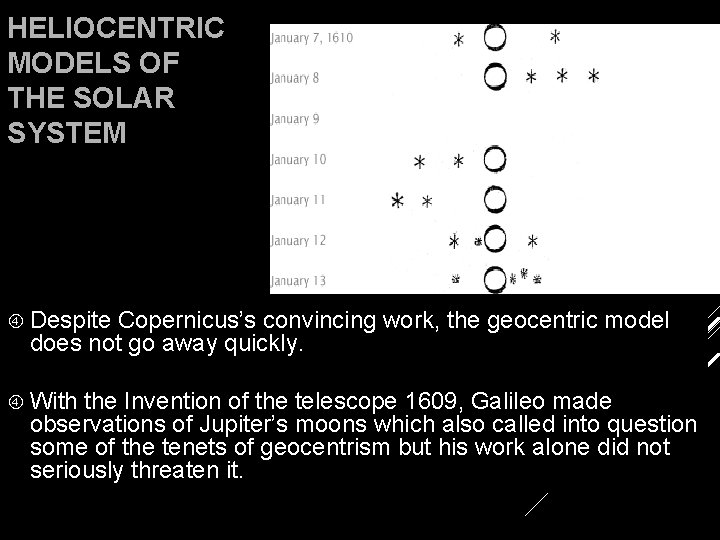
HELIOCENTRIC MODELS OF THE SOLAR SYSTEM Despite Copernicus’s convincing work, the geocentric model does not go away quickly. With the Invention of the telescope 1609, Galileo made observations of Jupiter’s moons which also called into question some of the tenets of geocentrism but his work alone did not seriously threaten it.
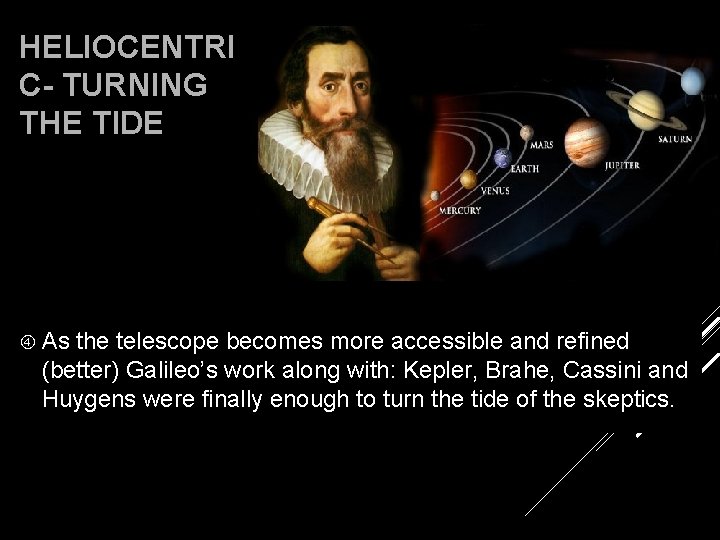
HELIOCENTRI C- TURNING THE TIDE Kepler As the telescope becomes more accessible and refined (better) Galileo’s work along with: Kepler, Brahe, Cassini and Huygens were finally enough to turn the tide of the skeptics.
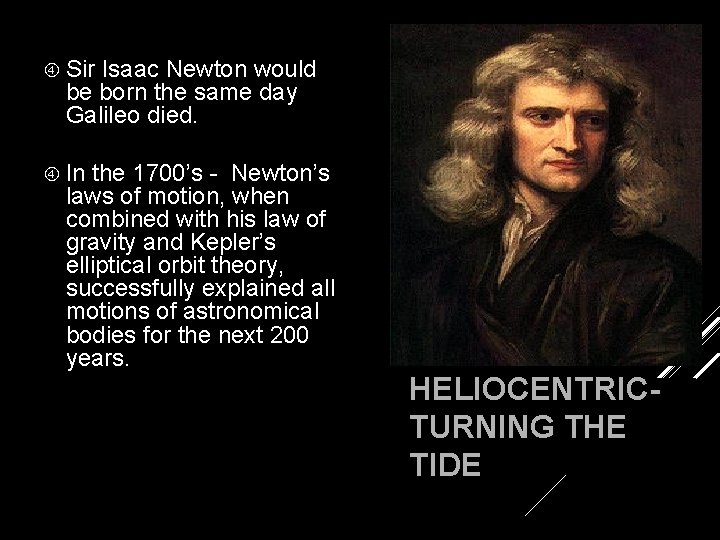
Sir Isaac Newton would be born the same day Galileo died. In the 1700’s - Newton’s laws of motion, when combined with his law of gravity and Kepler’s elliptical orbit theory, successfully explained all motions of astronomical bodies for the next 200 years. HELIOCENTRICTURNING THE TIDE
In 1758 the Catholic Church dropped the general prohibition of books advocating heliocentrism from the Index of Forbidden Books. In 1822 Pope Pius VII approved a decree by the Sacred Congregation of the Inquisition to allow the printing of heliocentric books in Rome. OPPOSITION TO HELIOCENTRISM WANES
CHECK FOR UNDERSTANDING What is the Heliocentric Model of the solar system and who created it? What significant findings did Newton and Kepler discover?
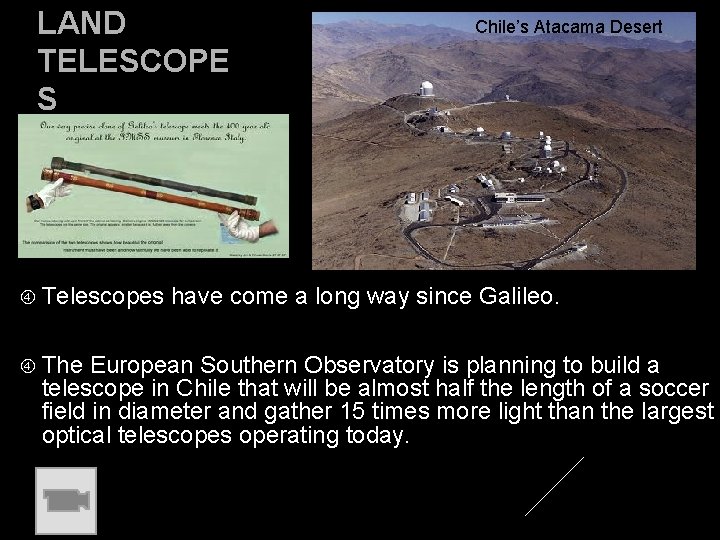
LAND TELESCOPE S Chile’s Atacama Desert Telescopes have come a long way since Galileo. The European Southern Observatory is planning to build a telescope in Chile that will be almost half the length of a soccer field in diameter and gather 15 times more light than the largest optical telescopes operating today.
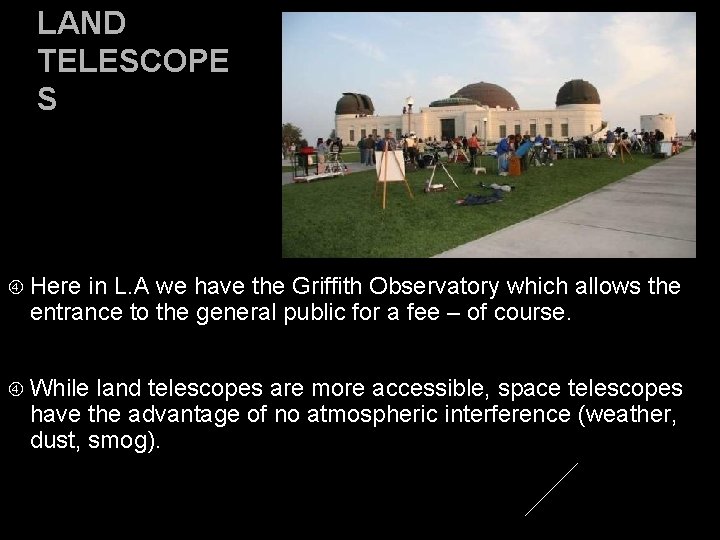
LAND TELESCOPE S Here in L. A we have the Griffith Observatory which allows the entrance to the general public for a fee – of course. While land telescopes are more accessible, space telescopes have the advantage of no atmospheric interference (weather, dust, smog).
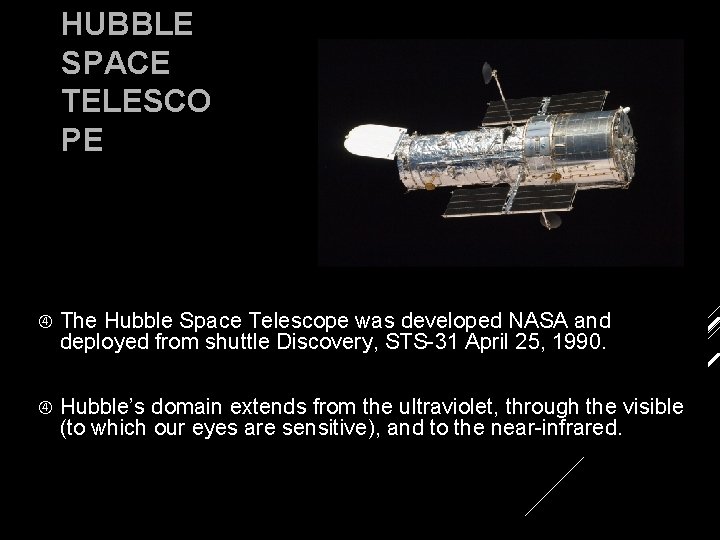
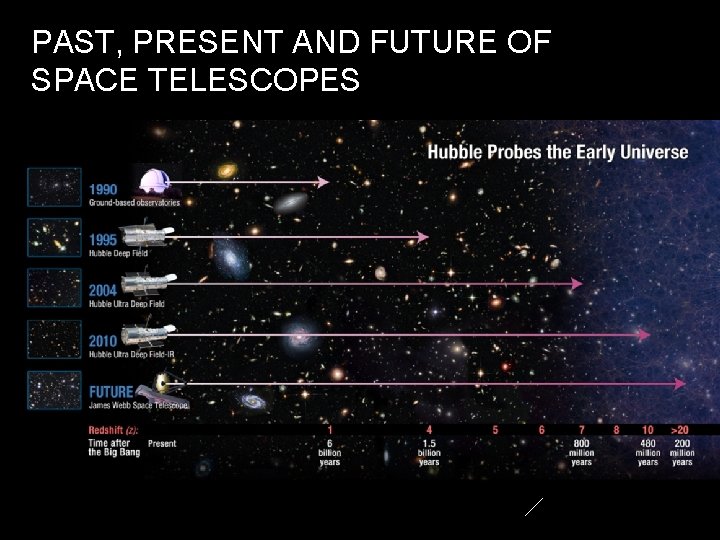
HUBBLE SPACE TELESCO PE The Hubble Space Telescope was developed NASA and deployed from shuttle Discovery, STS-31 April 25, 1990. Hubble’s domain extends from the ultraviolet, through the visible (to which our eyes are sensitive), and to the near-infrared.
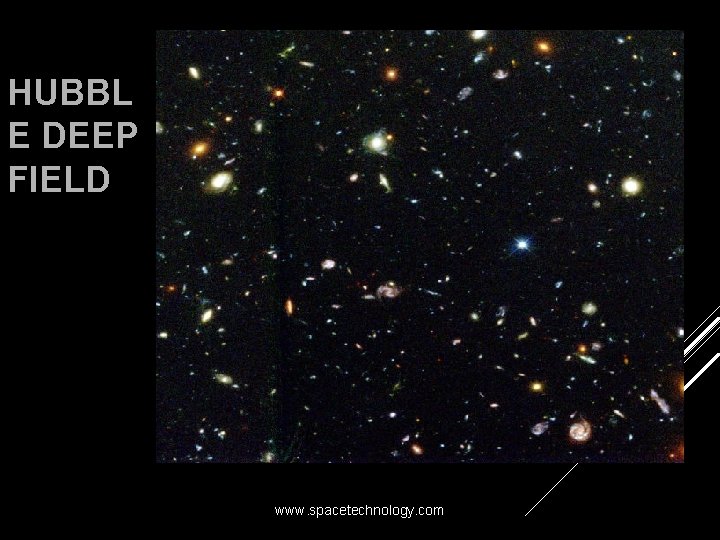
HUBBL E DEEP FIELD www. spacetechnology. com
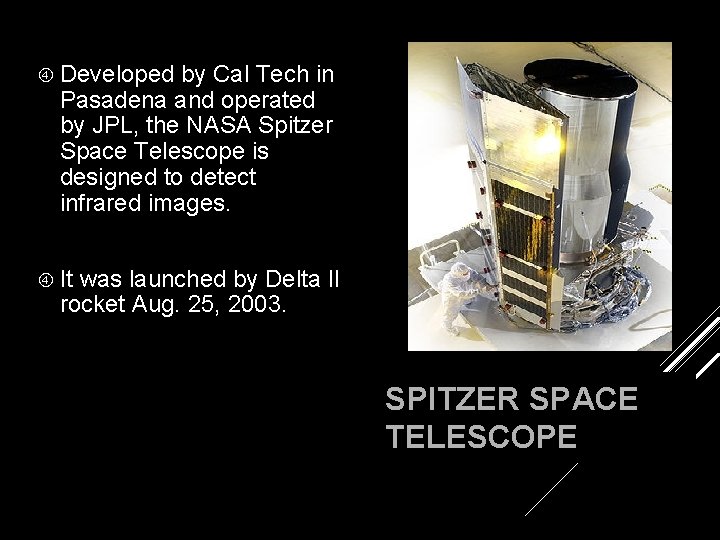
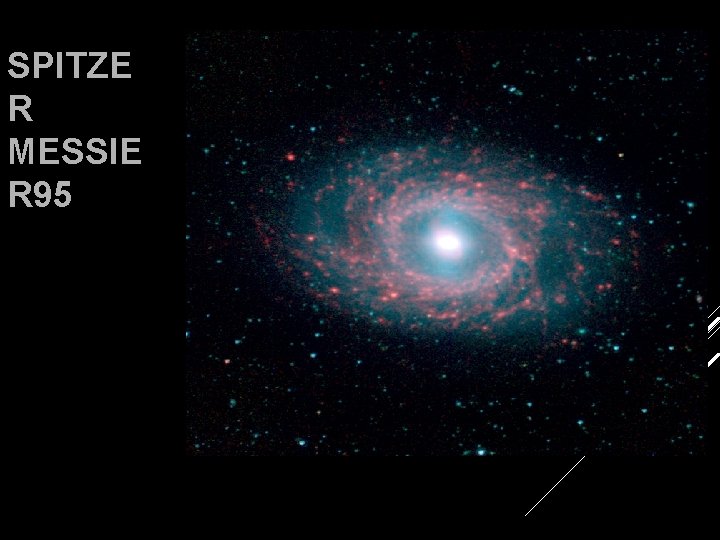
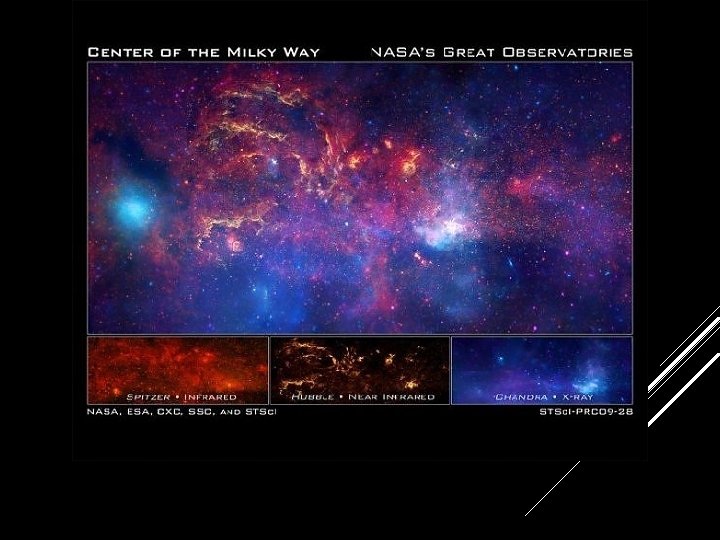
Developed by Cal Tech in Pasadena and operated by JPL, the NASA Spitzer Space Telescope is designed to detect infrared images. It was launched by Delta II rocket Aug. 25, 2003. SPITZER SPACE TELESCOPE
SPITZE R MESSIE R 95
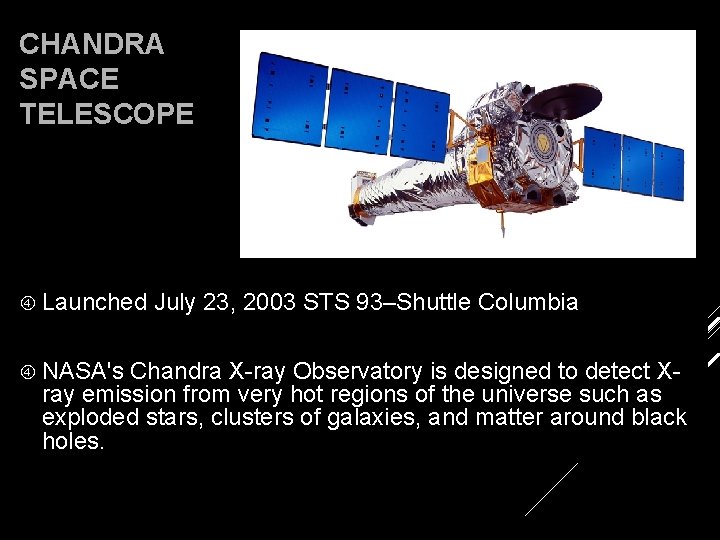
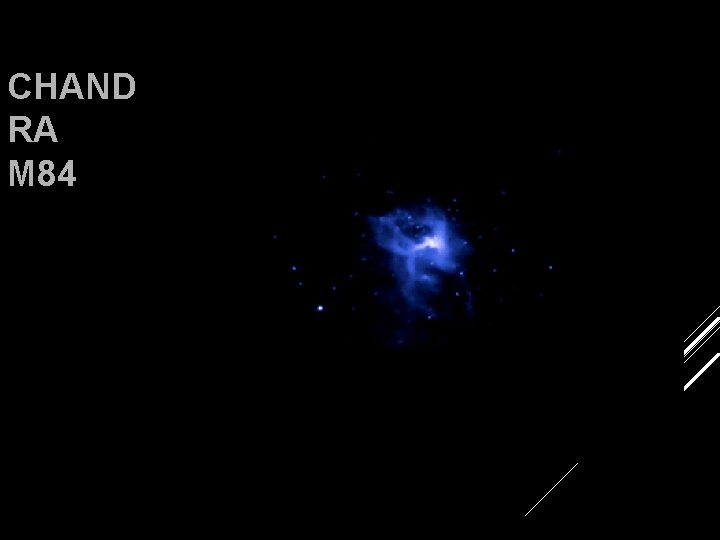
CHANDRA SPACE TELESCOPE Launched July 23, 2003 STS 93–Shuttle Columbia NASA's Chandra X-ray Observatory is designed to detect X- ray emission from very hot regions of the universe such as exploded stars, clusters of galaxies, and matter around black holes.
CHAND RA M 84
PAST, PRESENT AND FUTURE OF SPACE TELESCOPES
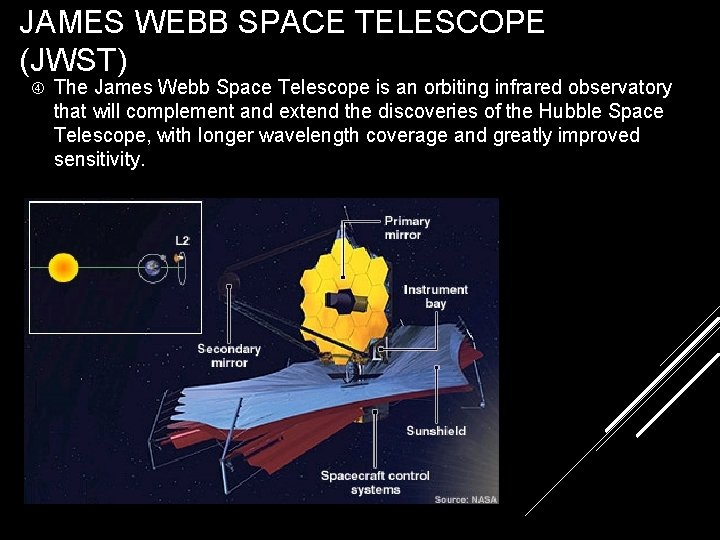
JAMES WEBB SPACE TELESCOPE (JWST) The James Webb Space Telescope is an orbiting infrared observatory that will complement and extend the discoveries of the Hubble Space Telescope, with longer wavelength coverage and greatly improved sensitivity.
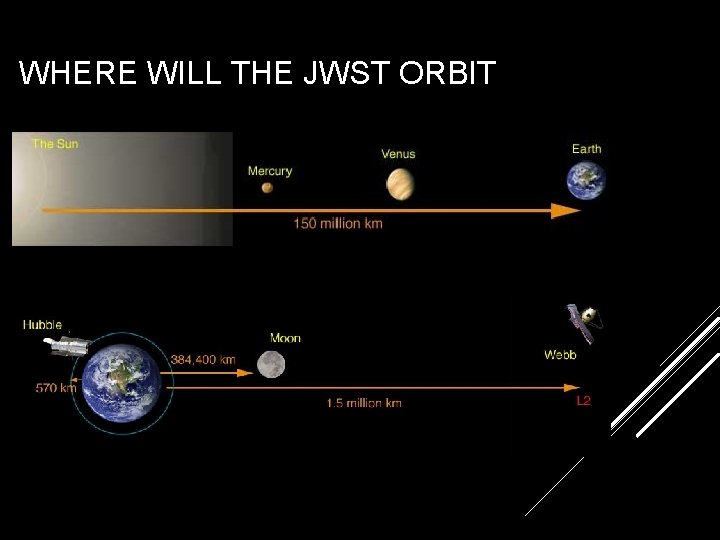
WHERE WILL THE JWST ORBIT