
Lesson 4 Creating a Preliminary Outline 1 Now







- Slides: 43
Lesson 4 Creating a Preliminary Outline 1
Now that you have taken notes on wildlife preserves, you will rearrange your notes by the kind of information they convey … and create a heading for each group. 2
Which of the following organizational structures works best for your report on wildlife preserves? Order of Understanding ~ This might work since a reader should know what a wildlife preserve is before he or she learns anything else about it. Question Headings, General to Specific, or Categorization could also work well for this topic. Which structure works best? What do you think? 3
While other organizational structures could work, for this lesson, we’ll use Question Headings for your outline on Wildlife Preserves. 4
First, Group Your Notes Once you have completed all of your notes on Source 1, find notes that are related by the kind of information they convey and group them together. 5
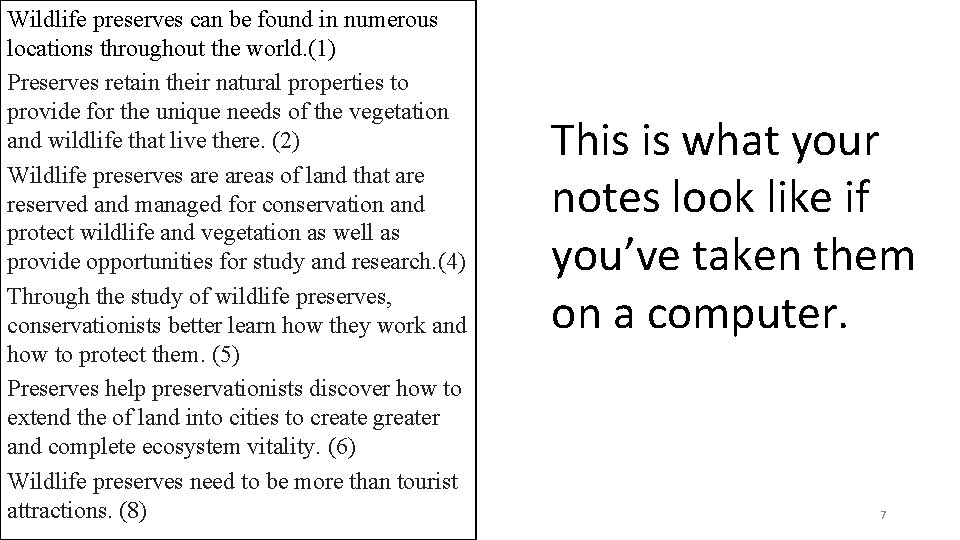
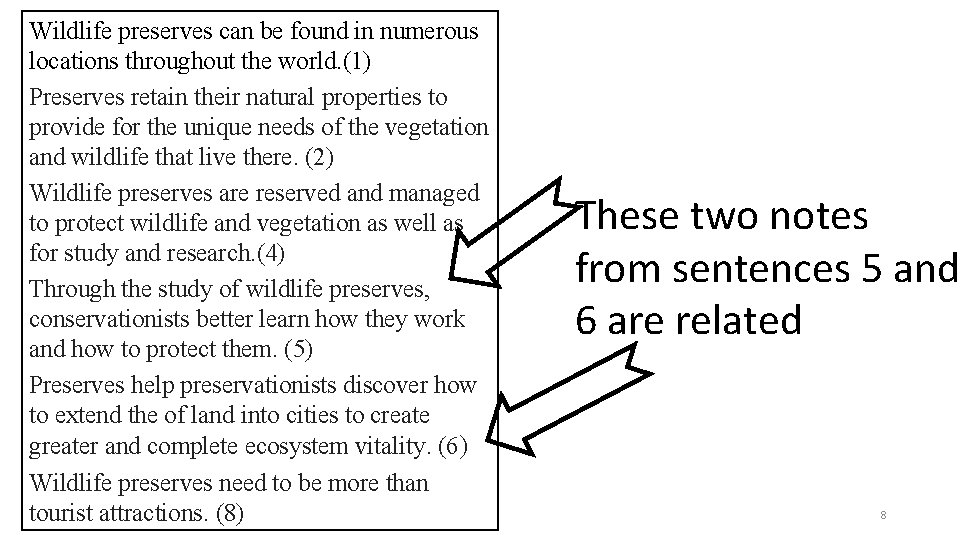
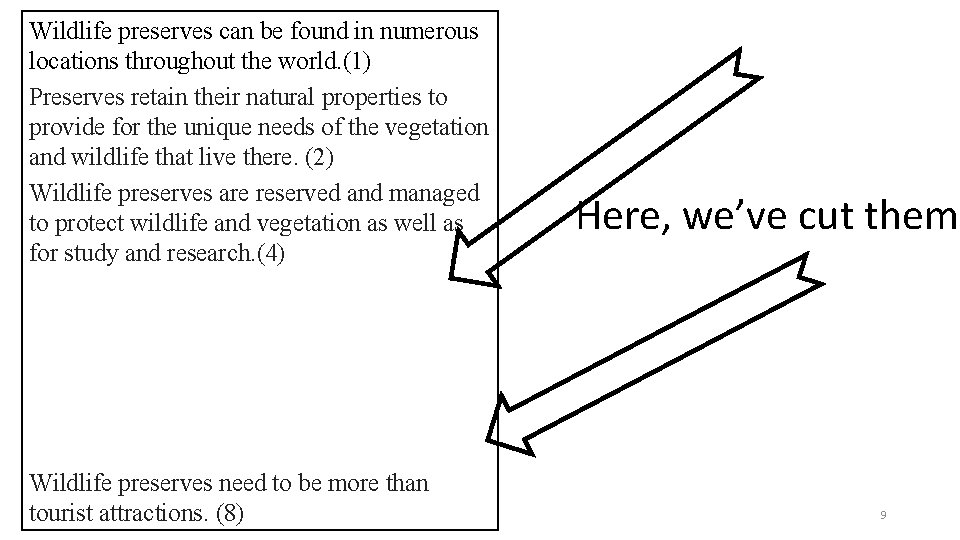
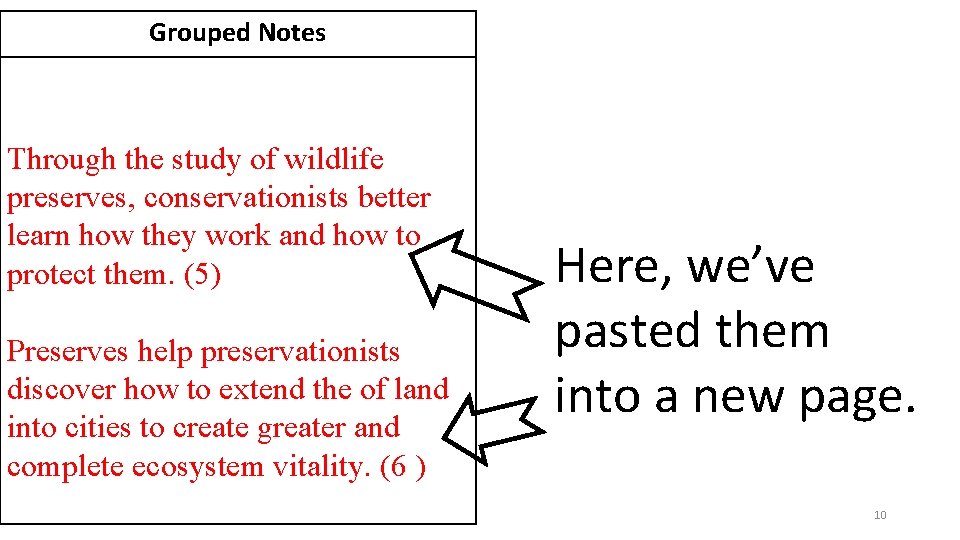
If you took notes on the computer, all you have to do is cut and paste the notes as you rearrange them on to a separate page. An example of notes taken on the computer being grouped is on the next slides. 6
Wildlife preserves can be found in numerous locations throughout the world. (1) Preserves retain their natural properties to provide for the unique needs of the vegetation and wildlife that live there. (2) Wildlife preserves areas of land that are reserved and managed for conservation and protect wildlife and vegetation as well as provide opportunities for study and research. (4) Through the study of wildlife preserves, conservationists better learn how they work and how to protect them. (5) Preserves help preservationists discover how to extend the of land into cities to create greater and complete ecosystem vitality. (6) Wildlife preserves need to be more than tourist attractions. (8) This is what your notes look like if you’ve taken them on a computer. 7
Wildlife preserves can be found in numerous locations throughout the world. (1) Preserves retain their natural properties to provide for the unique needs of the vegetation and wildlife that live there. (2) Wildlife preserves are reserved and managed to protect wildlife and vegetation as well as for study and research. (4) Through the study of wildlife preserves, conservationists better learn how they work and how to protect them. (5) Preserves help preservationists discover how to extend the of land into cities to create greater and complete ecosystem vitality. (6) Wildlife preserves need to be more than tourist attractions. (8) These two notes from sentences 5 and 6 are related 8
Wildlife preserves can be found in numerous locations throughout the world. (1) Preserves retain their natural properties to provide for the unique needs of the vegetation and wildlife that live there. (2) Wildlife preserves are reserved and managed to protect wildlife and vegetation as well as for study and research. (4) Through the study of wildlife preserves, conservationists better learn how they work and how to protect them. (5) Preserves help preservationists discover how to extend the of land into cities to create greater and complete ecosystem vitality. (6) Wildlife preserves need to be more than tourist attractions. (8) Here, we’ve cut them 9
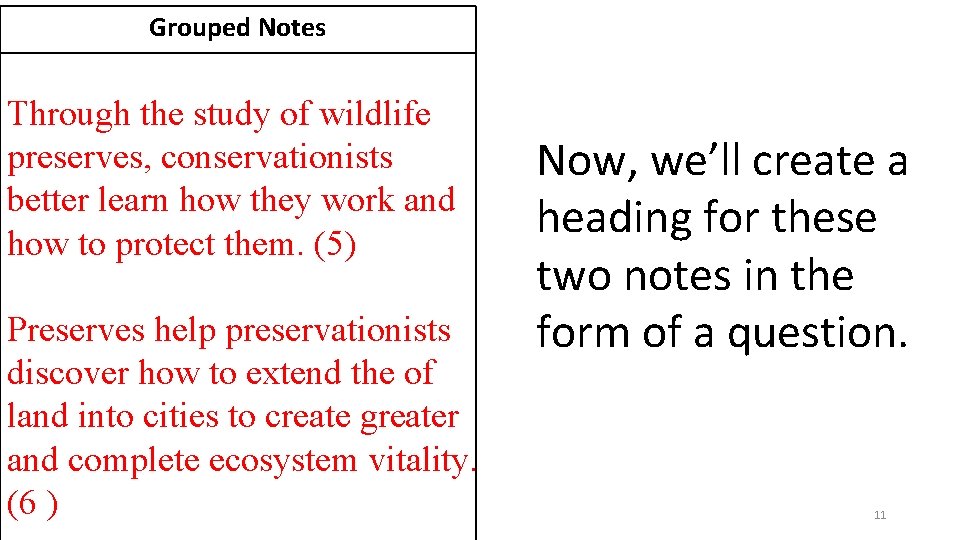
Grouped Notes Through the study of wildlife preserves, conservationists better learn how they work and how to protect them. (5) Preserves help preservationists discover how to extend the of land into cities to create greater and complete ecosystem vitality. (6 ) Here, we’ve pasted them into a new page. 10
Grouped Notes Through the study of wildlife preserves, conservationists better learn how they work and how to protect them. (5) Preserves help preservationists discover how to extend the of land into cities to create greater and complete ecosystem vitality. (6 ) Now, we’ll create a heading for these two notes in the form of a question. 11
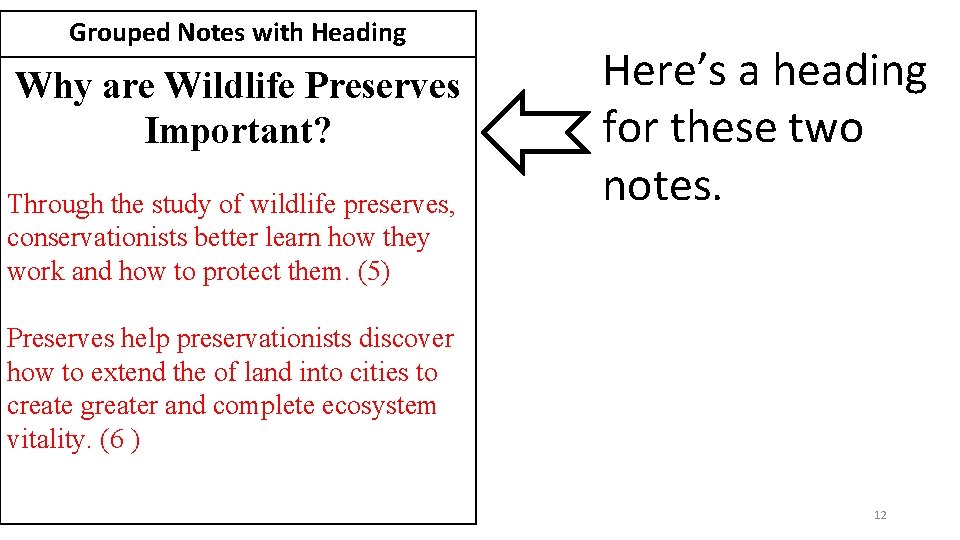
Grouped Notes with Heading Why are Wildlife Preserves Important? Through the study of wildlife preserves, conservationists better learn how they work and how to protect them. (5) Here’s a heading for these two notes. Preserves help preservationists discover how to extend the of land into cities to create greater and complete ecosystem vitality. (6 ) 12
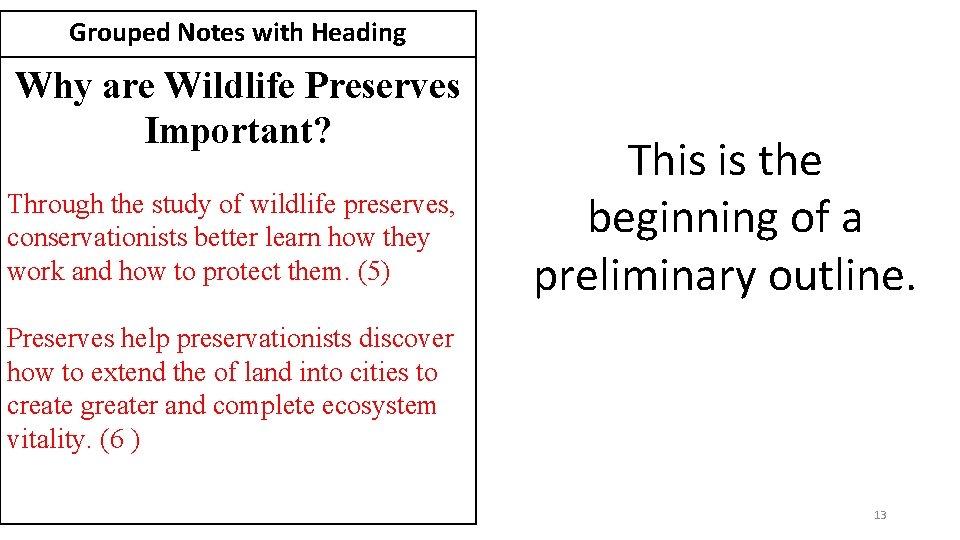
Grouped Notes with Heading Why are Wildlife Preserves Important? Through the study of wildlife preserves, conservationists better learn how they work and how to protect them. (5) This is the beginning of a preliminary outline. Preserves help preservationists discover how to extend the of land into cities to create greater and complete ecosystem vitality. (6 ) 13
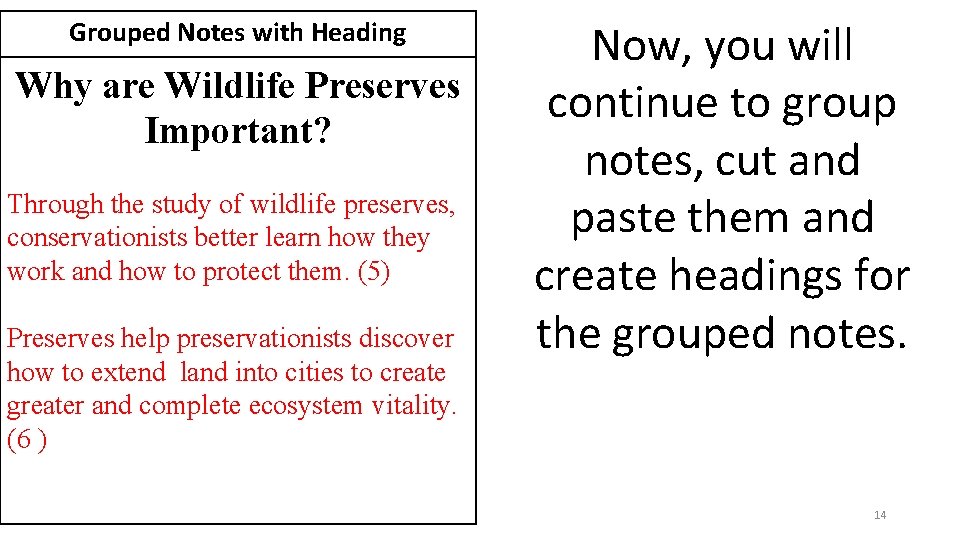
Grouped Notes with Heading Why are Wildlife Preserves Important? Through the study of wildlife preserves, conservationists better learn how they work and how to protect them. (5) Preserves help preservationists discover how to extend land into cities to create greater and complete ecosystem vitality. (6 ) Now, you will continue to group notes, cut and paste them and create headings for the grouped notes. 14
If you took notes by hand, 15
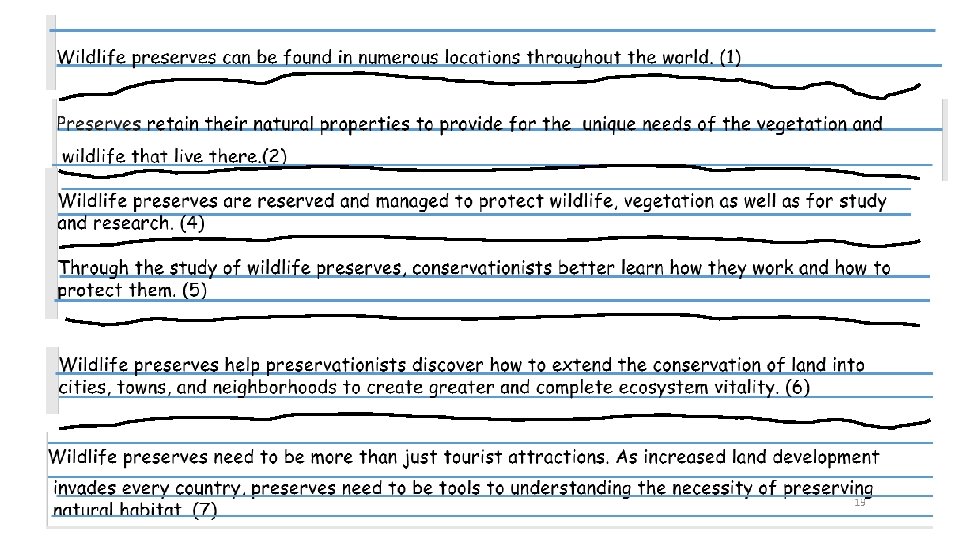
If you took notes by hand, you must first tear the notes into separate pieces so they look something like the notes on the next slide. 16
17
and then put them into piles that would have the same heading. 18
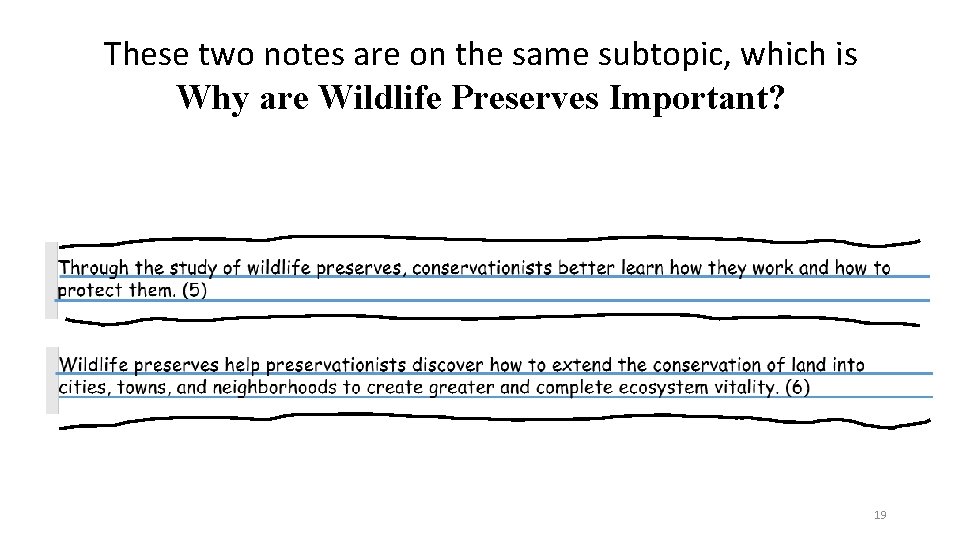
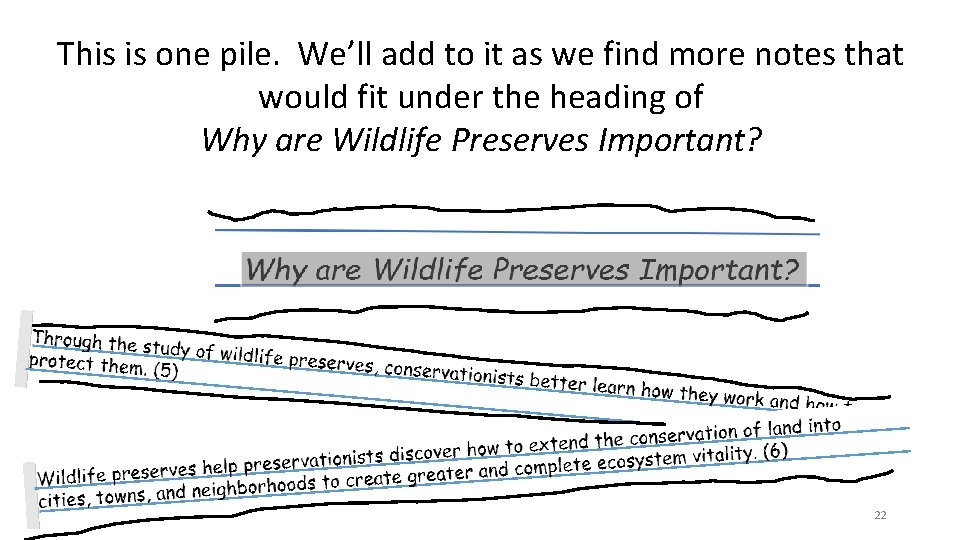
These two notes are on the same subtopic, which is Why are Wildlife Preserves Important? 19
So, we’ll make up a heading for these two notes on another piece of paper. 20
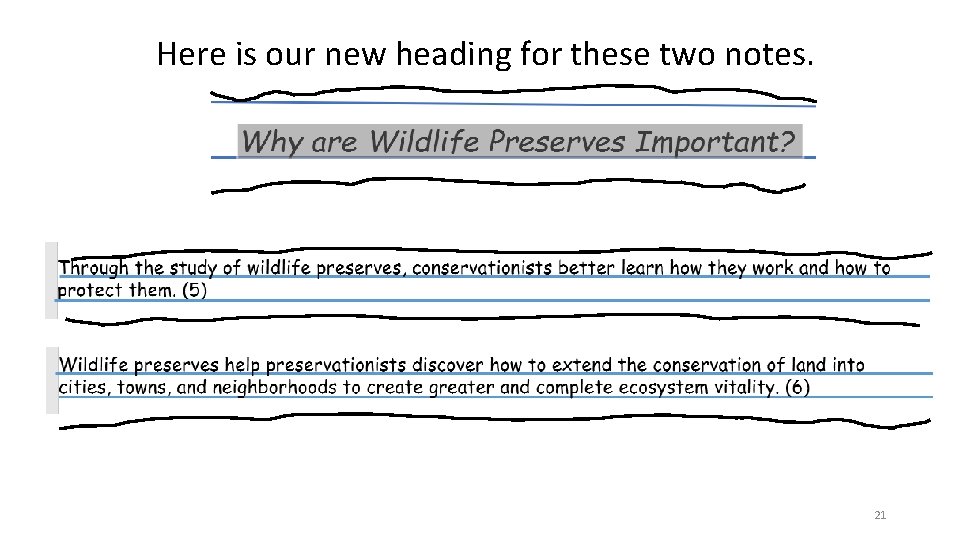
Here is our new heading for these two notes. 21
This is one pile. We’ll add to it as we find more notes that would fit under the heading of Why are Wildlife Preserves Important? 22
After you have taken more notes and created more piles, 23
After you have taken more notes and created more piles, arrange the piles in the most logical order. 24
Your first pile of notes with its heading should be something that catches the interest of your readers. This is called a hook. 25
Your first heading with its group of notes should be something that catches the interest of your readers. This is called a hook. THE HOOK is used to catch the reader’s attention. 26
a hook: Here are some possible techniques: 27
a hook: Here are some possible techniques: 1. Opening with an unusual detail: "National Wildlife Refuges are responsible for saving 280 threatened or endangered species. ” 28
a hook: Here are some possible techniques: 1. Opening with an unusual detail: "National Wildlife Refuges are responsible for saving 280 threatened or endangered species. ” 2. Opening with a strong statement: “Urban development kills. ” 29
a hook: Here are some possible techniques: 1. Opening with an unusual detail: "National Wildlife Refuges are responsible for saving 280 threatened or endangered species. ” 2. Opening with a strong statement: “Urban development kills. ” 3. Opening with a quotation: “In wilderness lies the preservation of the world. ” – Thoreau 30
a hook: Here are some possible techniques: 1. Opening with an unusual detail: "National Wildlife Refuges are responsible for saving 280 threatened or endangered species. ” 2. Opening with a strong statement: “Urban development kills. ” 3. Opening with a quotation: “In wilderness lies the preservation of the world. ” – Thoreau 4. Opening with an anecdote (a little story related to the topic): An anecdote can provide an amusing and attention-getting opening if it is short and to the point. “In the novel SCAT, a teacher risks her life and job in order to keep a wildlife preserve 31 safe from intruders. ”
5. Opening with a statistic or fact: ”Wildlife preserves are home to 700 species of birds, 220 species of mammals, 250 reptile and amphibian species and more than 1000 species of fish. ” 32
5. Opening with a statistic or fact: ”Wildlife preserves are home to 700 species of birds, 220 species of mammals, 250 reptile and amphibian species and more than 1000 species of fish. ” 6. Opening with a invitation to imagine: "Imagine a world in which every living thing is valued. “ 33
5. Opening with a statistic or fact: ”Wildlife preserves are home to 700 species of birds, 220 species of mammals, 250 reptile and amphibian species and more than 1000 species of fish. ” 6. Opening with a invitation to imagine: "Imagine a world in which every living thing is valued. “ 7. Opening with an exaggeration or outrageous statement: "The whole world watched as the new construction devoured the last of our natural wildlife. “ 34
5. Opening with a statistic or fact: ”Wildlife preserves are home to 700 species of birds, 220 species of mammals, 250 reptile and amphibian species and more than 1000 species of fish. ” 6. Opening with a invitation to imagine: "Imagine a world in which every living thing is valued. “ 7. Opening with an exaggeration or outrageous statement: "The whole world watched as the new construction devoured the last of our natural wildlife. “ 8. Opening with an unusual statement: “What is man without the beasts? If all the beasts were gone, men would die from a great loneliness of spirit. For whatever happens to the beasts, soon happens to man. All things are connected. ” - Chief Seattle 35
Now, create a preliminary outline with the notes you have taken by grouping your notes and creating question headings. 36
Examine an Exemplar Outline. Now that you have finished your preliminary outline, look at a sample preliminary outline on the next slides. 37
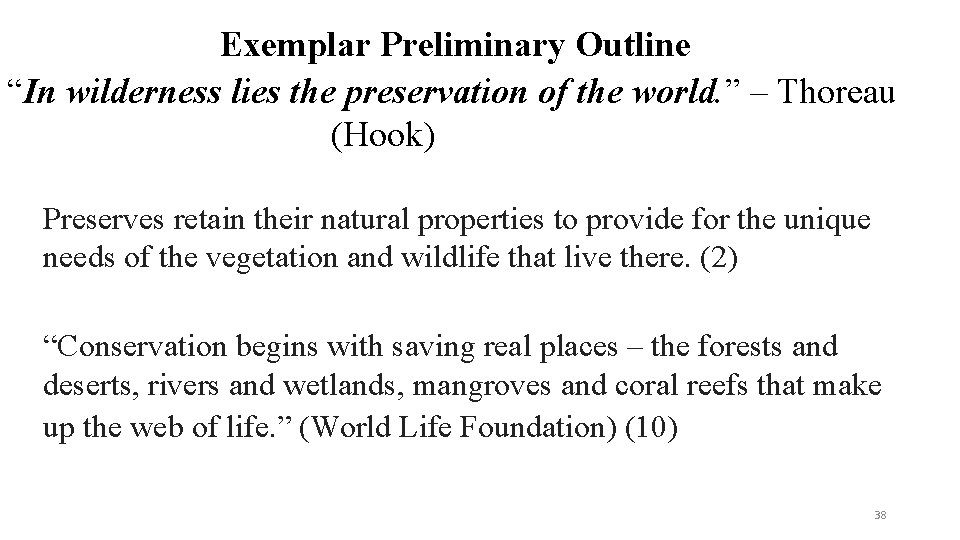
Exemplar Preliminary Outline “In wilderness lies the preservation of the world. ” – Thoreau (Hook) Preserves retain their natural properties to provide for the unique needs of the vegetation and wildlife that live there. (2) “Conservation begins with saving real places – the forests and deserts, rivers and wetlands, mangroves and coral reefs that make up the web of life. ” (World Life Foundation) (10) 38
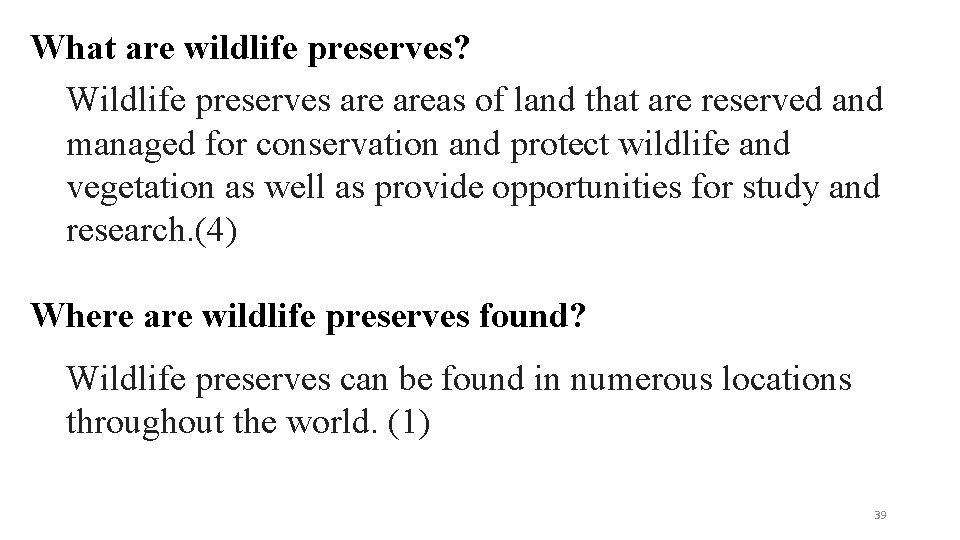
What are wildlife preserves? Wildlife preserves areas of land that are reserved and managed for conservation and protect wildlife and vegetation as well as provide opportunities for study and research. (4) Where are wildlife preserves found? Wildlife preserves can be found in numerous locations throughout the world. (1) 39
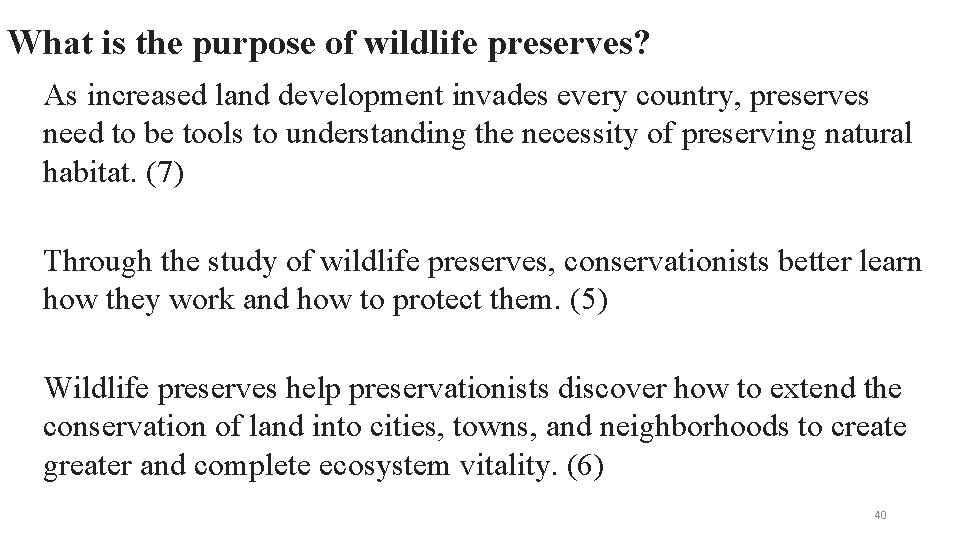
What is the purpose of wildlife preserves? As increased land development invades every country, preserves need to be tools to understanding the necessity of preserving natural habitat. (7) Through the study of wildlife preserves, conservationists better learn how they work and how to protect them. (5) Wildlife preserves help preservationists discover how to extend the conservation of land into cities, towns, and neighborhoods to create greater and complete ecosystem vitality. (6) 40
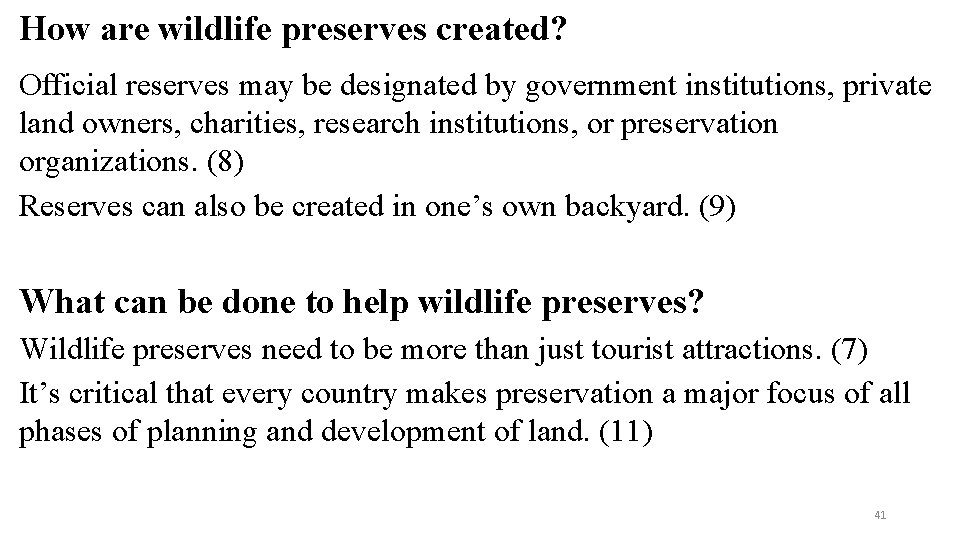
How are wildlife preserves created? Official reserves may be designated by government institutions, private land owners, charities, research institutions, or preservation organizations. (8) Reserves can also be created in one’s own backyard. (9) What can be done to help wildlife preserves? Wildlife preserves need to be more than just tourist attractions. (7) It’s critical that every country makes preservation a major focus of all phases of planning and development of land. (11) 41
Now that you have examined an exemplar preliminary outline, revise your own outline. 42
Now that you have examined an exemplar preliminary outline, revise your own outline. You may not copy the exemplar outline word for word, but you can use parts of it and borrow ideas and phrases. 43