
Lesson 4 5 Apply SSS and SAS to

- Slides: 17
Lesson 4 -5 Apply SSS and SAS to solve problems Prove Triangles congruent by using SSS and SAS
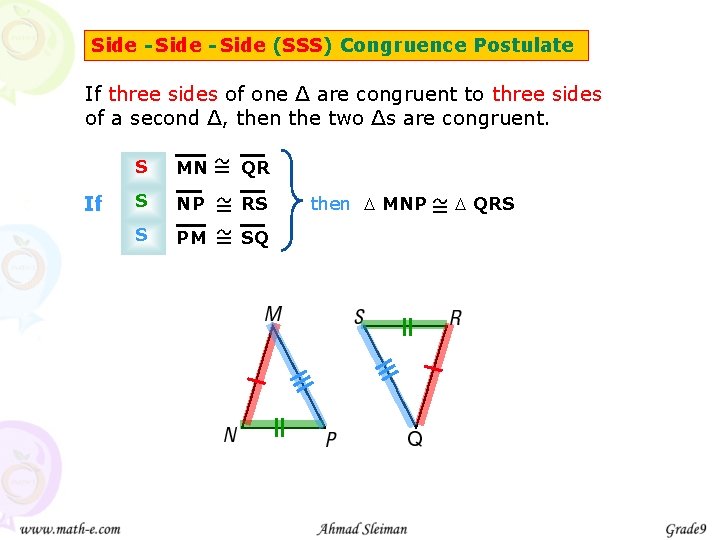
Side - Side (SSS) Congruence Postulate If three sides of one ∆ are congruent to three sides of a second ∆, then the two ∆s are congruent. If S Side MN QR S Side NP RS S Side PM SQ then MNP QRS
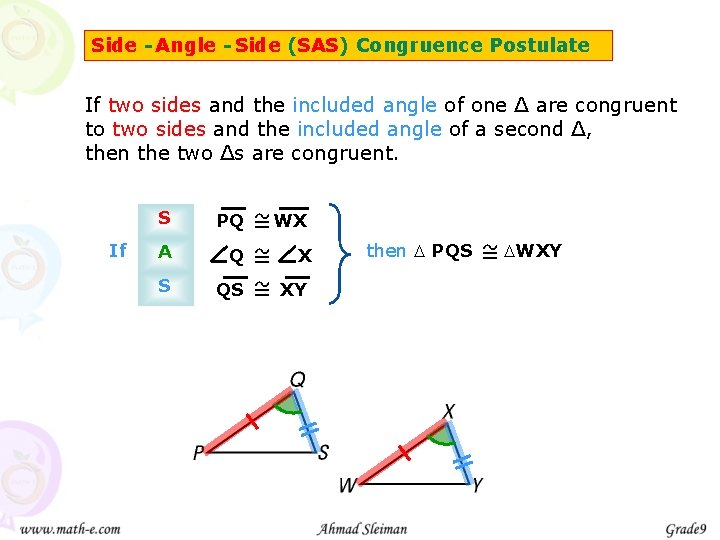
Side - Angle - Side (SAS) Congruence Postulate If two sides and the included angle of one ∆ are congruent to two sides and the included angle of a second ∆, then the two ∆s are congruent. S Side If Angle A S Side PQ WX Q X QS XY then PQS WXY
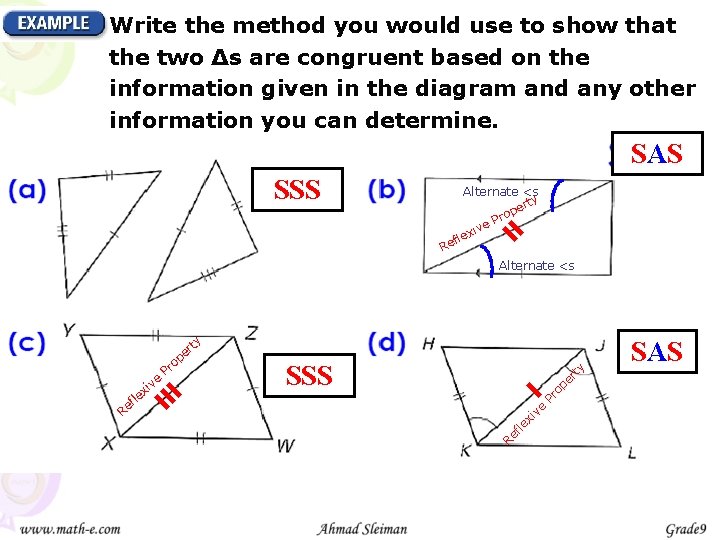
Write the method you would use to show that the two ∆s are congruent based on the information given in the diagram and any other information you can determine. SAS SSS Alternate <s y ert p o r e. P v i x fle Re Alternate <s ty xi ve Pr op er ty SSS fle P SAS Re fle e R ve xi er p ro
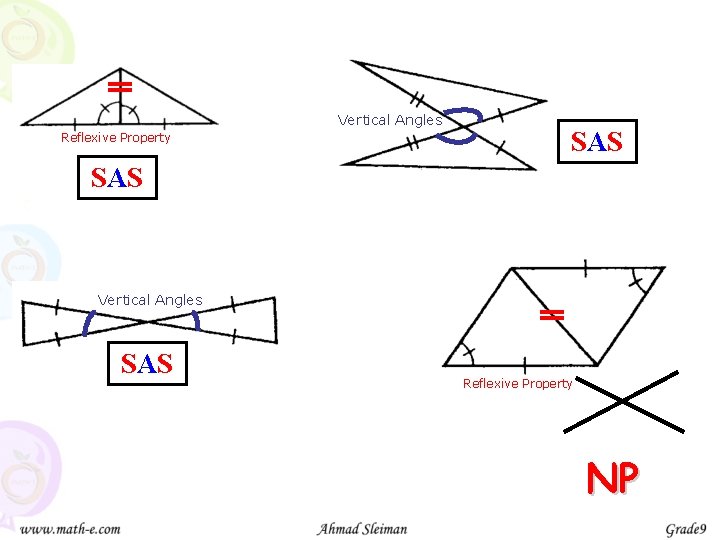
Vertical Angles Reflexive Property SAS Vertical Angles SAS Reflexive Property NP
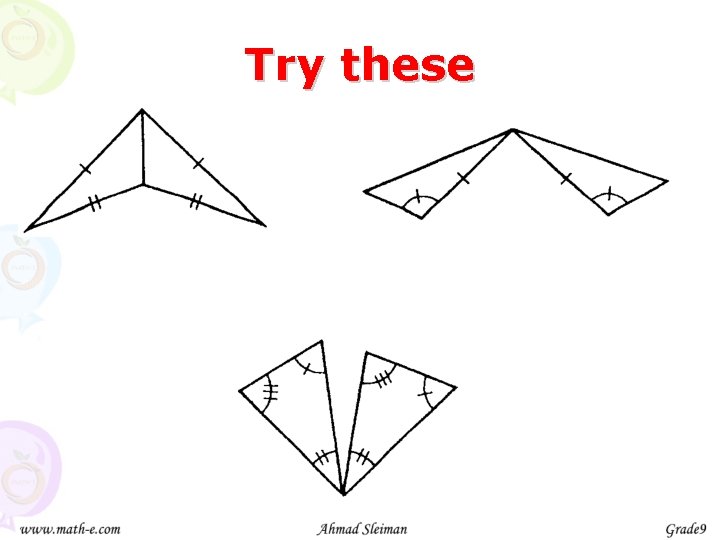
Try these
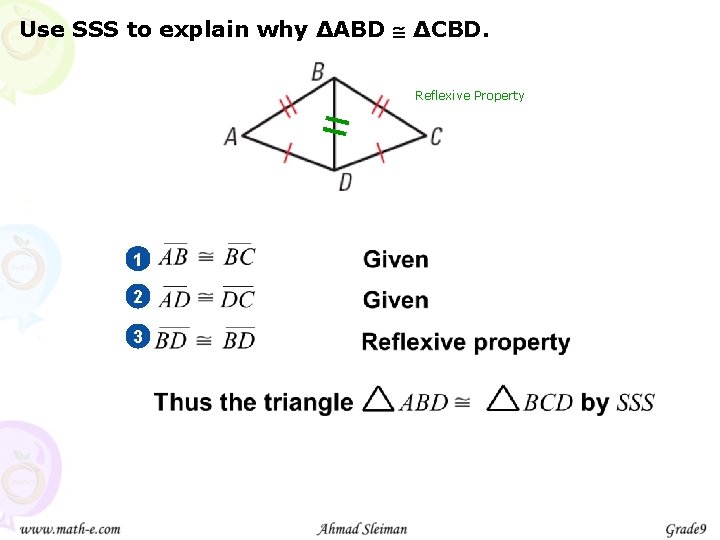
Use SSS to explain why ∆ABD ∆CBD. Reflexive Property 1 2 3
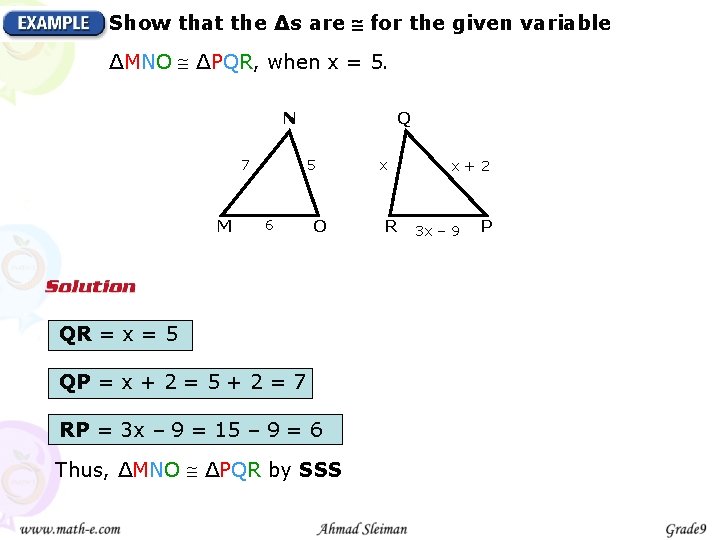
Show that the ∆s are for the given variable ∆MNO ∆PQR, when x = 5. N 7 M Q 5 6 O QR = x = 5 QP = x + 2 = 5 + 2 = 7 RP = 3 x – 9 = 15 – 9 = 6 Thus, ∆MNO ∆PQR by SSS x R x+2 3 x – 9 P
Homework (1) Page 253 – 254 #s: 2, 3, 5, 6, 8, 9, 11, 12, 14, and 15
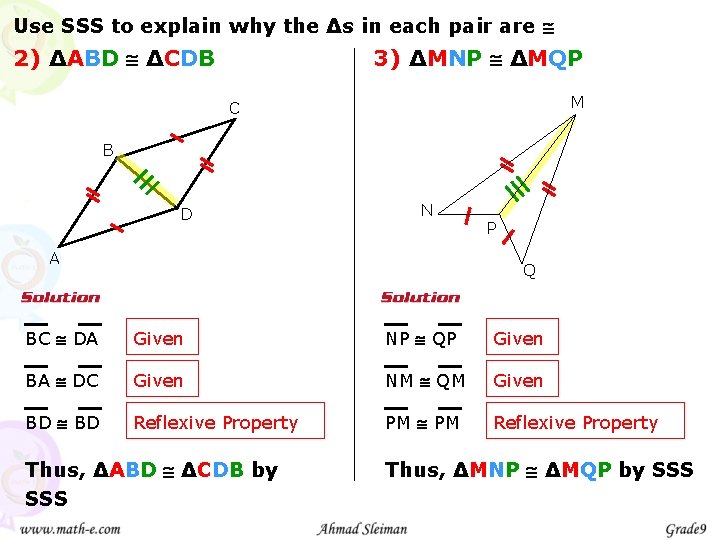
Use SSS to explain why the ∆s in each pair are 2) ∆ABD ∆CDB 3) ∆MNP ∆MQP M C B D N A P Q BC DA Given NP QP Given BA DC Given NM QM Given BD Reflexive Property PM Reflexive Property Thus, ∆ABD ∆CDB by SSS Thus, ∆MNP ∆MQP by SSS
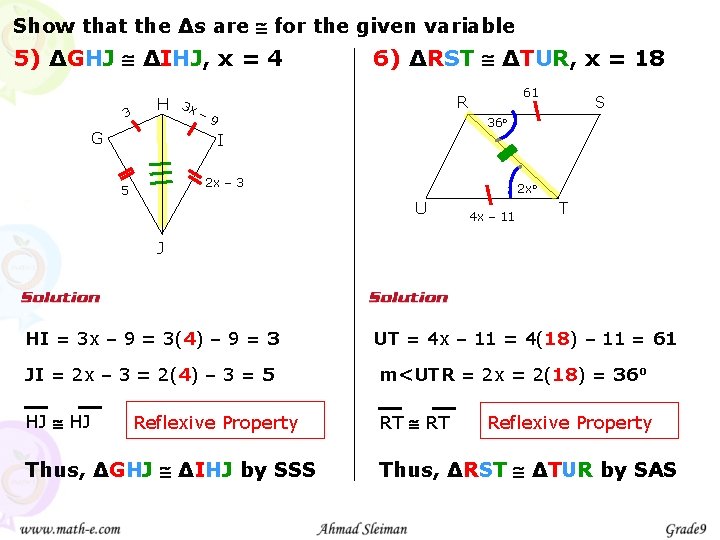
Show that the ∆s are for the given variable 5) ∆GHJ ∆IHJ, x = 4 3 H G 3 x 6) ∆RST ∆TUR, x = 18 61 R – 9 S 36 o I 2 x – 3 5 2 xo U 4 x – 11 T J HI = 3 x – 9 = 3(4) – 9 = 3 UT = 4 x – 11 = 4(18) – 11 = 61 JI = 2 x – 3 = 2(4) – 3 = 5 m<UTR = 2 x = 2(18) = 36 o HJ RT RT Reflexive Property Thus, ∆GHJ ∆IHJ by SSS Reflexive Property Thus, ∆RST ∆TUR by SAS
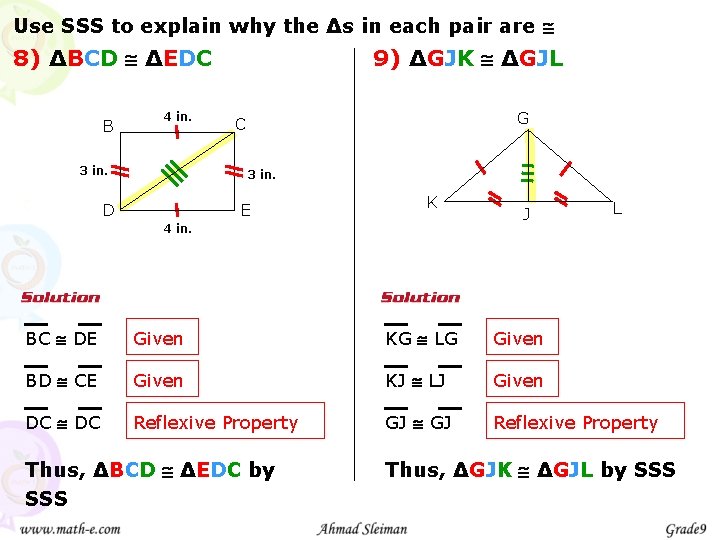
Use SSS to explain why the ∆s in each pair are 8) ∆BCD ∆EDC B 4 in. 3 in. 9) ∆GJK ∆GJL G C 3 in. D E K 4 in. J L BC DE Given KG LG Given BD CE Given KJ LJ Given DC Reflexive Property GJ Reflexive Property Thus, ∆BCD ∆EDC by SSS Thus, ∆GJK ∆GJL by SSS
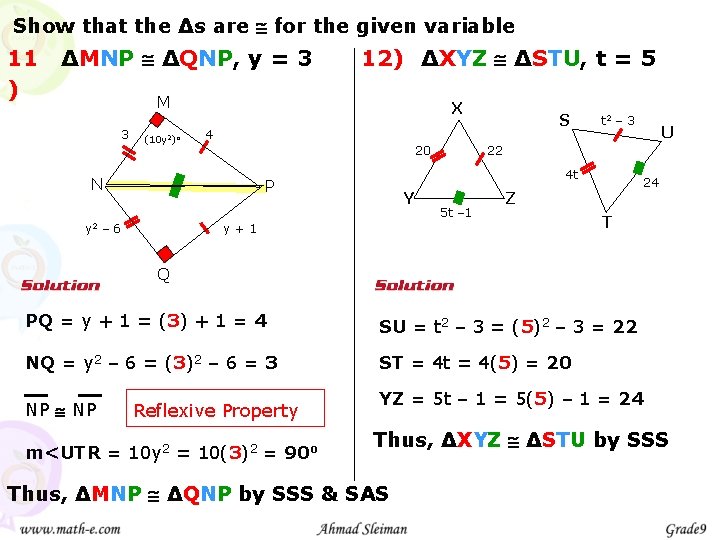
Show that the ∆s are for the given variable 11 ) ∆MNP ∆QNP, y = 3 12) ∆XYZ ∆STU, t = 5 M 3 (10 y 2)o X 4 20 N t 2 – 3 Y U 22 4 t P y 2 – 6 S 5 t – 1 24 Z y+1 T Q PQ = y + 1 = (3) + 1 = 4 SU = t 2 – 3 = (5)2 – 3 = 22 NQ = y 2 – 6 = (3)2 – 6 = 3 ST = 4 t = 4(5) = 20 NP Reflexive Property m<UTR = 10 y 2 = 10(3)2 = 90 o YZ = 5 t – 1 = 5(5) – 1 = 24 Thus, ∆XYZ ∆STU by SSS Thus, ∆MNP ∆QNP by SSS & SAS
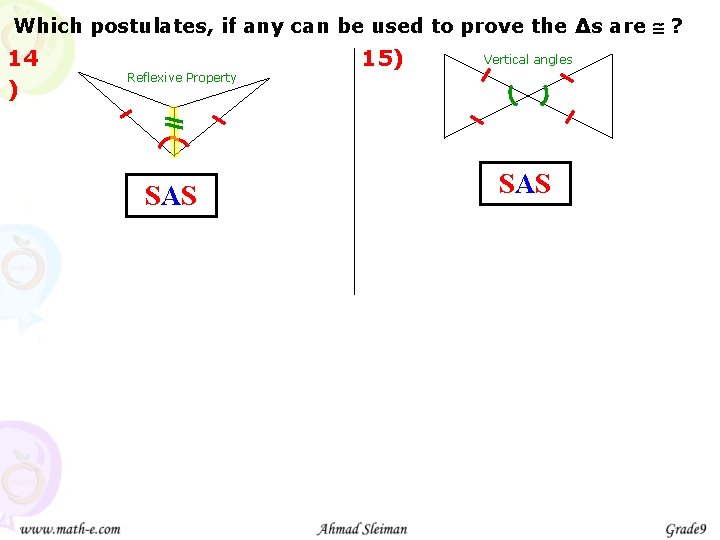
Which postulates, if any can be used to prove the ∆s are ? 14 ) Reflexive Property SAS 15) Vertical angles SAS
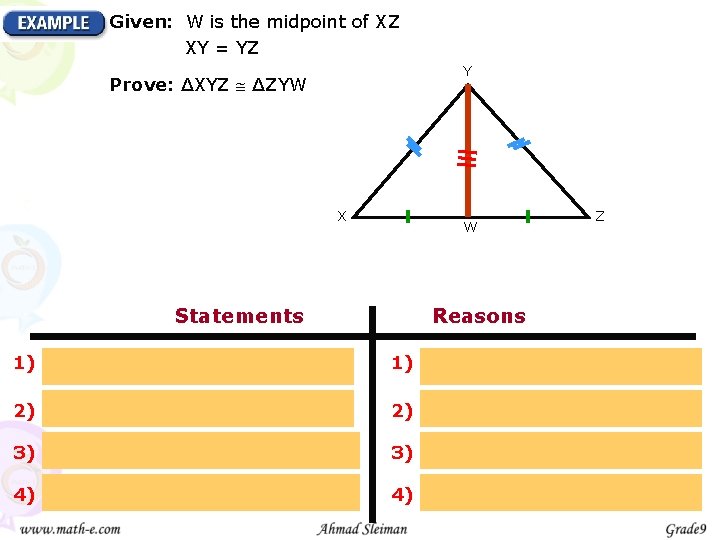
Given: W is the midpoint of XZ XY = YZ Y Prove: ∆XYZ ∆ZYW X Statements W Z Reasons 1) XW = ZW 1) Def. of midpoint 2) XY = YZ 2) Given 3) YW = YW 3) Reflexive property 4) ∆XYZ ∆ZYW 4) SSS Congruence
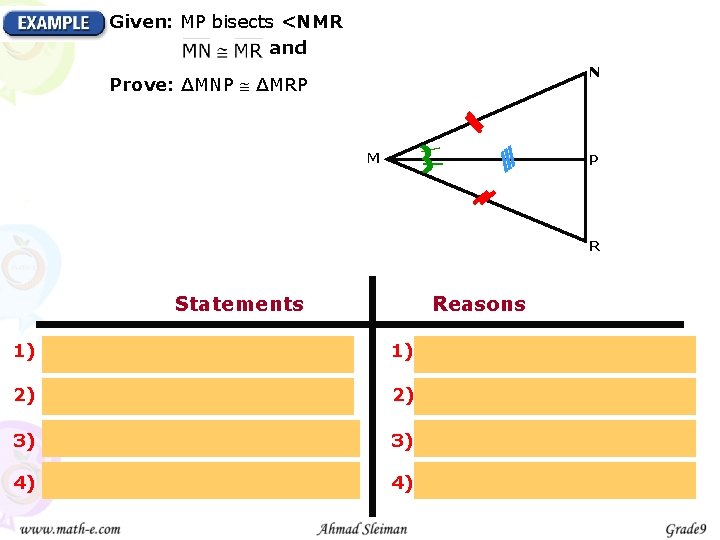
Given: MP bisects <NMR and N Prove: ∆MNP ∆MRP M P R Statements Reasons 1) m<NMP = m<RMP 1) Def. of < bisector 2) 2) Given 3) MP = MP 3) Reflexive property 4) ∆MNP ∆MRP 4) SAS Congruence
Homework(2) Page 254 – 256 #s: 7, 13, 28, 29, and 30