
Lesson 4 5 359 B C Philip II

Lesson 4
5
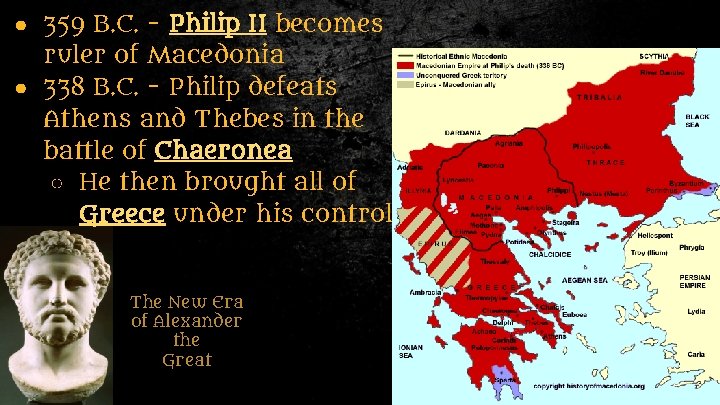
● 359 B. C. - Philip II becomes ruler of Macedonia ● 338 B. C. - Philip defeats Athens and Thebes in the battle of Chaeronea ○ He then brought all of Greece under his control The New Era of Alexander the Great
• • Greek city-states rebelled shortly after the assassination of Philip II. Alexander used both diplomacy and his military to re-unite the citystates for a military campaign against the Persian Empire. Alexander defeats Darius III of Persia, and continues on his conquest to rule the world. Alexander combined Greek and Persian culture to create a “Hellenistic culture”. Alexander died under mysterious circumstances at the age of 32. His empire was broken into three sections by his generals, but the Greeks never reclaim their former glory.
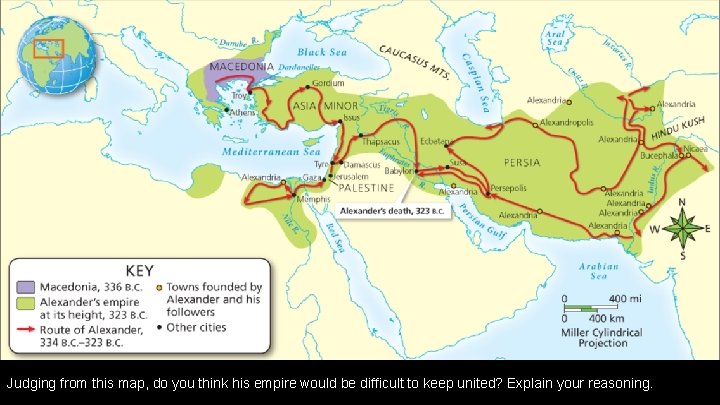
● He was assassinated (the murder of a public figure, usually for political reasons) ○ His son, Alexander the Great, takes the throne ● He conquered the Persian empire, won victories in Asia Minor, Egypt, captured Babylon, conquering lands as far east as India ○ Returning to Babylon, Alexander, age 32, died from a sudden fever The New Era of Alexander the Great Judging from this map, do you think his empire would be difficult to keep united? Explain your reasoning.
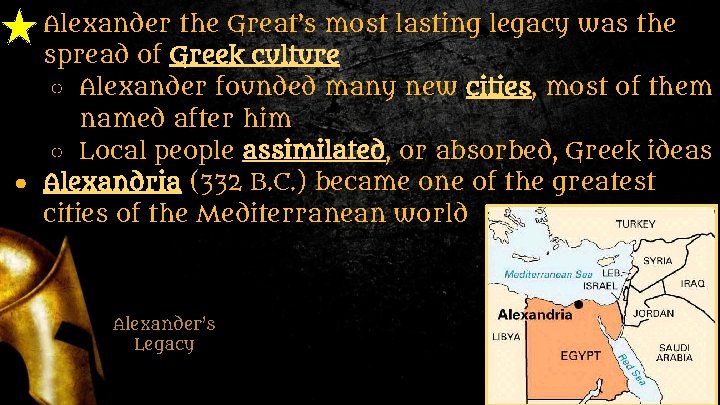
● Alexander the Great’s most lasting legacy was the spread of Greek culture ○ Alexander founded many new cities, most of them named after him ○ Local people assimilated, or absorbed, Greek ideas ● Alexandria (332 B. C. ) became one of the greatest cities of the Mediterranean world Alexander’s Legacy
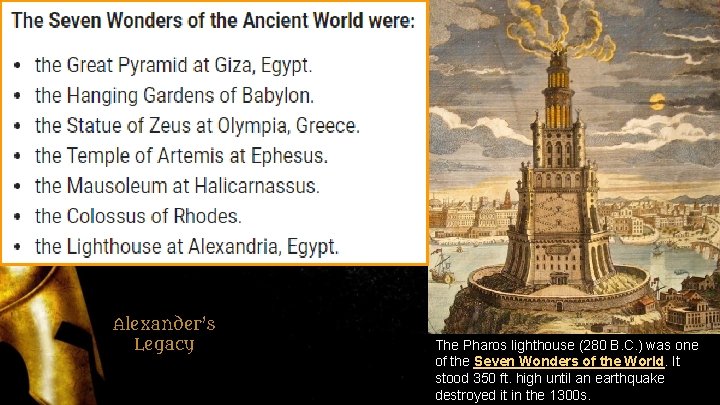
○ Located in Egypt on the sea lanes between Europe and Asia, Alexandria became known for its size, huge Pharos lighthouse, and the Museum, a learning center with a famous library Alexander’s Legacy The Pharos lighthouse (280 B. C. ) was one of the Seven Wonders of the World. It stood 350 ft. high until an earthquake destroyed it in the 1300 s.
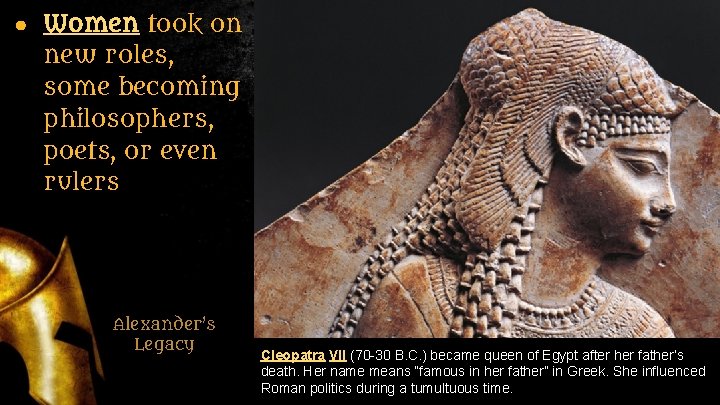
● Women took on new roles, some becoming philosophers, poets, or even rulers Alexander’s Legacy Cleopatra VII (70 -30 B. C. ) became queen of Egypt after her father’s death. Her name means “famous in her father” in Greek. She influenced Roman politics during a tumultuous time.

Hellenistic Arts & Sciences
- Slides: 9