
Lesson 4 3 Population Growth Catalyst Vocabulary Terms
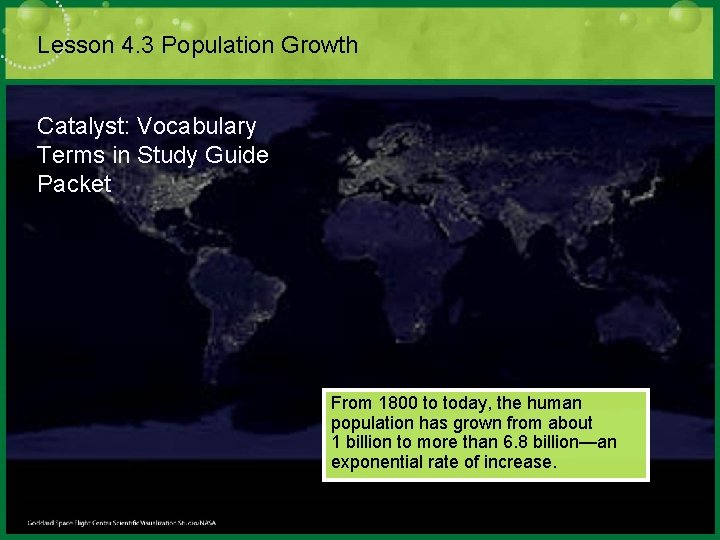
Lesson 4. 3 Population Growth Catalyst: Vocabulary Terms in Study Guide Packet From 1800 to today, the human population has grown from about 1 billion to more than 6. 8 billion—an exponential rate of increase.
Lesson 4. 3 Population Growth Factors that Determine Population • Populations increase when more individuals enter the population than leave it. • What vocabulary term refers to the arrival of individuals from a given area? • Populations decrease when more individuals leave the populations than enter it. • What vocabulary term refers to the departure of individuals from a given area?
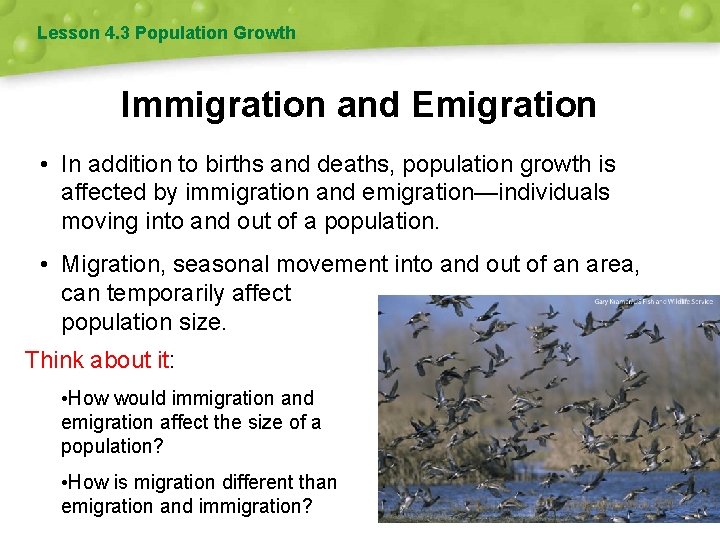
Lesson 4. 3 Population Growth Immigration and Emigration • In addition to births and deaths, population growth is affected by immigration and emigration—individuals moving into and out of a population. • Migration, seasonal movement into and out of an area, can temporarily affect population size. Think about it: • How would immigration and emigration affect the size of a population? • How is migration different than emigration and immigration?
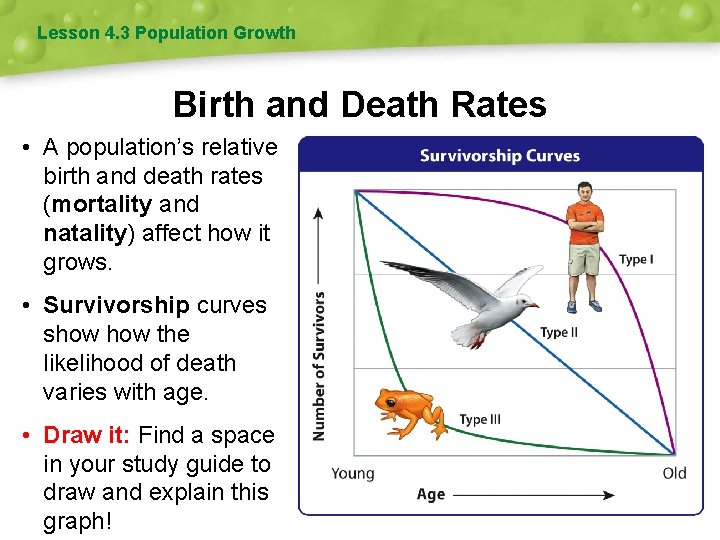
Lesson 4. 3 Population Growth Birth and Death Rates • A population’s relative birth and death rates (mortality and natality) affect how it grows. • Survivorship curves show the likelihood of death varies with age. • Draw it: Find a space in your study guide to draw and explain this graph!
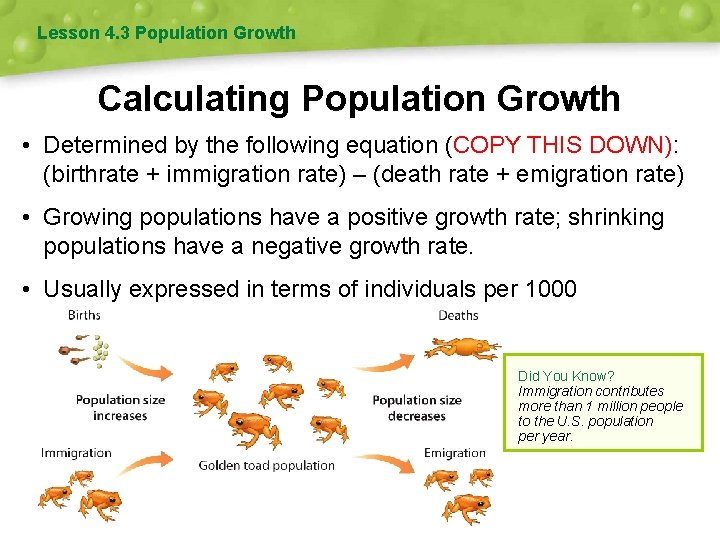
Lesson 4. 3 Population Growth Calculating Population Growth • Determined by the following equation (COPY THIS DOWN): (birthrate + immigration rate) – (death rate + emigration rate) • Growing populations have a positive growth rate; shrinking populations have a negative growth rate. • Usually expressed in terms of individuals per 1000 Did You Know? Immigration contributes more than 1 million people to the U. S. population per year.
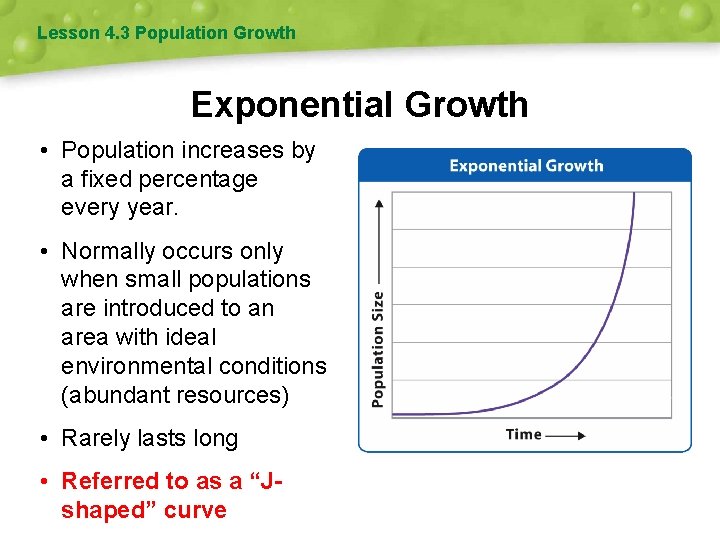
Lesson 4. 3 Population Growth Exponential Growth • Population increases by a fixed percentage every year. • Normally occurs only when small populations are introduced to an area with ideal environmental conditions (abundant resources) • Rarely lasts long • Referred to as a “Jshaped” curve
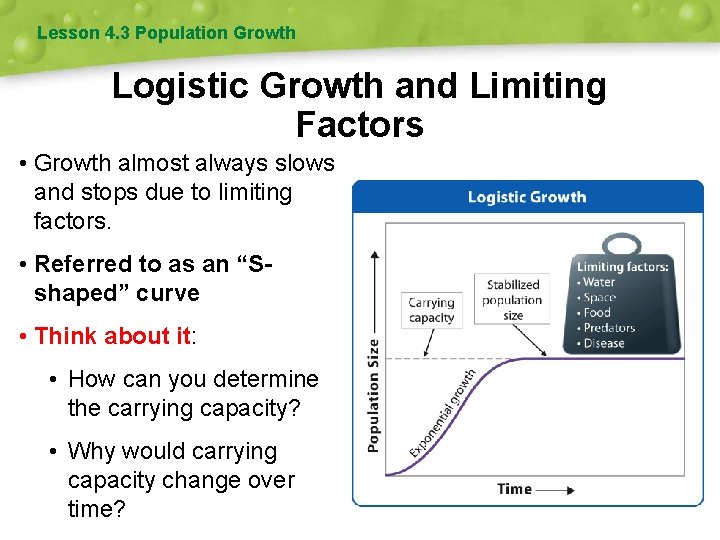
Lesson 4. 3 Population Growth Logistic Growth and Limiting Factors • Growth almost always slows and stops due to limiting factors. • Referred to as an “Sshaped” curve • Think about it: • How can you determine the carrying capacity? • Why would carrying capacity change over time?
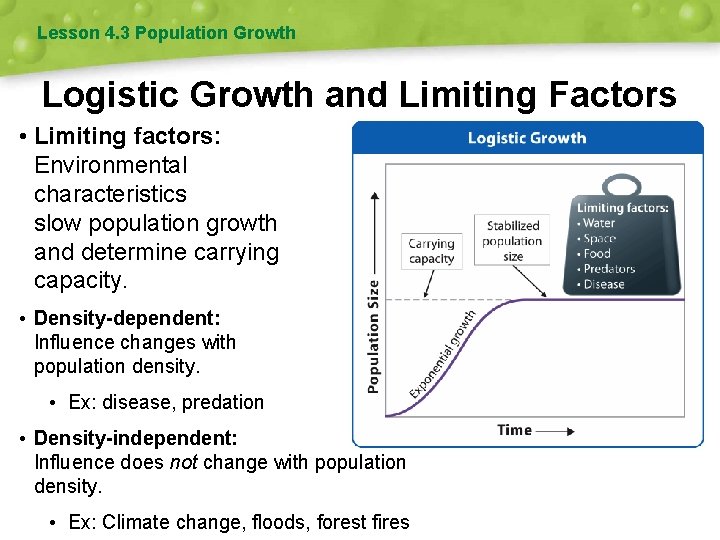
Lesson 4. 3 Population Growth Logistic Growth and Limiting Factors • Limiting factors: Environmental characteristics slow population growth and determine carrying capacity. • Density-dependent: Influence changes with population density. • Ex: disease, predation • Density-independent: Influence does not change with population density. • Ex: Climate change, floods, forest fires
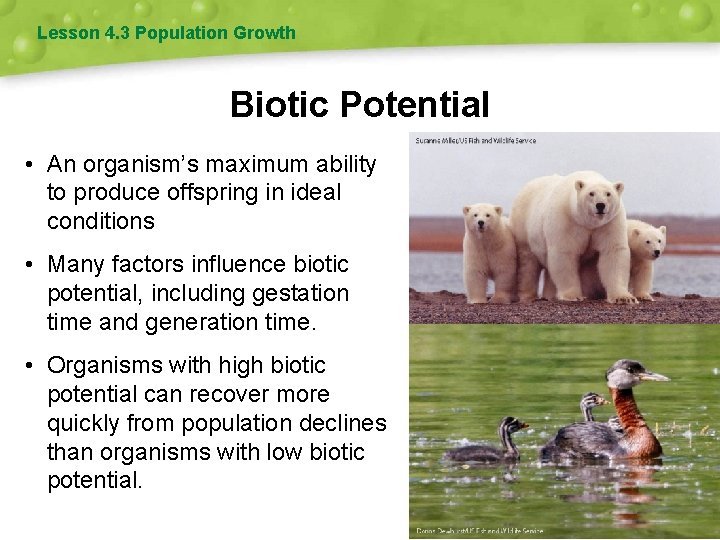
Lesson 4. 3 Population Growth Biotic Potential • An organism’s maximum ability to produce offspring in ideal conditions • Many factors influence biotic potential, including gestation time and generation time. • Organisms with high biotic potential can recover more quickly from population declines than organisms with low biotic potential.
Biology of the Flu Epidemics • What is an epidemic? What examples have you heard? • Why do they arise? Where do they start? • How do we control them? • How do viruses move from person to person? • How could we prevent a virus from infecting a person?
- Slides: 10