
LESSON 39 AND THE HEARTS OF THE CHILDREN



- Slides: 41
LESSON 39: “AND THE HEARTS OF THE CHILDREN SHALL TURN TO THEIR FATHERS” Priesthood ordinances for our ancestors
Joseph Smith’s Concern with the Dead D&C 137 (1836) 1. The heavens were opened upon us, and I beheld the celestial kingdom of God, and the glory thereof, whether in the body or out I cannot tell. 6. And marveled how it was that he had obtained an inheritance in that kingdom, seeing that he had departed this life before the Lord had set his hand to gather Israel the second time, and had not been baptized for the remission of sins. 7. Thus came the voice of the Lord unto me, saying: All who have died without a knowledge of this gospel, who would have received it if they had been permitted to tarry, shall be heirs of the celestial kingdom of God; 8. Also all that shall die henceforth without a knowledge of it, who would have received it with all their hearts, shall be heirs of that kingdom; 9. For I, the Lord, will judge all men according to their works, according to the desire of their hearts. 10. And I also beheld that all children who die before they arrive at the years of accountability are saved in the celestial kingdom of heaven.
Joseph Smith – Ordinances for the Dead “But how are they to become saviors on Mount Zion? By building their temples, erecting their baptismal fonts, and going forth and receiving all the ordinances, baptisms, confirmations, washings, anointings, ordinations and sealing powers upon their heads, in behalf of all their progenitors who are dead, … The Saints have not too much time to save and redeem their dead. ” - Jan 20, 1844 in History of the Church 6: 184 “When the House is done, baptismal font erected and finished and the worthy are washed, anointed, endowed, and ordained kings and priests, which must be done in this life, when the place is prepared you must go through all the ordinances of the house of the Lord, so that you who have any dead friends must go through all the ordinances for them the same as for yourselves. ” - April 8, 1844 in Journal of Wilford Woodruff 2: 361 -362
TEMPLE WORK FROM BRIGHAM YOUNG TO WILFORD WOODRUFF See: Bennett (2005) "Line upon Line, Precept upon Precept": Reflections on the 1877 Commencement of the Performance of Endowments and Sealings for the Dead. " BYU Studies 44(3)
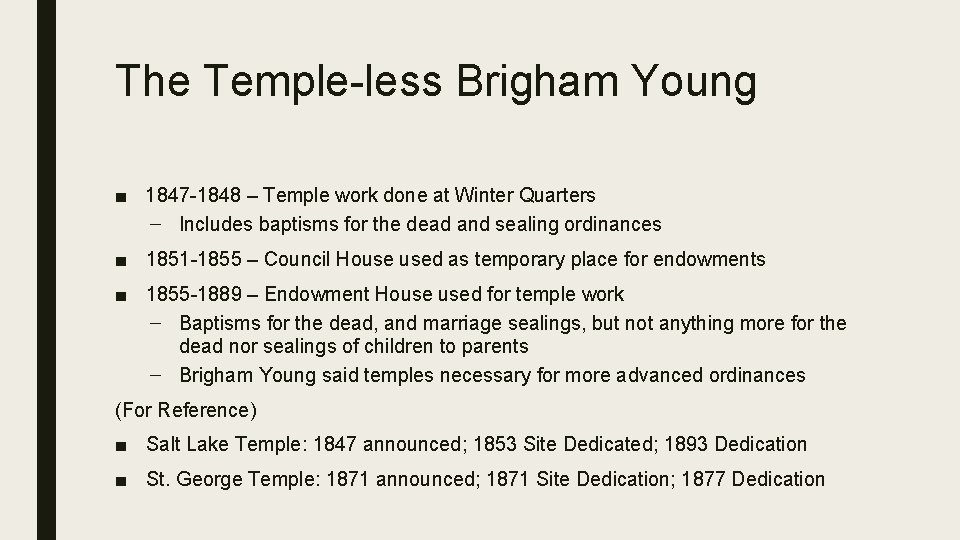
The Temple-less Brigham Young ■ 1847 -1848 – Temple work done at Winter Quarters – Includes baptisms for the dead and sealing ordinances ■ 1851 -1855 – Council House used as temporary place for endowments ■ 1855 -1889 – Endowment House used for temple work – Baptisms for the dead, and marriage sealings, but not anything more for the dead nor sealings of children to parents – Brigham Young said temples necessary for more advanced ordinances (For Reference) ■ Salt Lake Temple: 1847 announced; 1853 Site Dedicated; 1893 Dedication ■ St. George Temple: 1871 announced; 1871 Site Dedication; 1877 Dedication
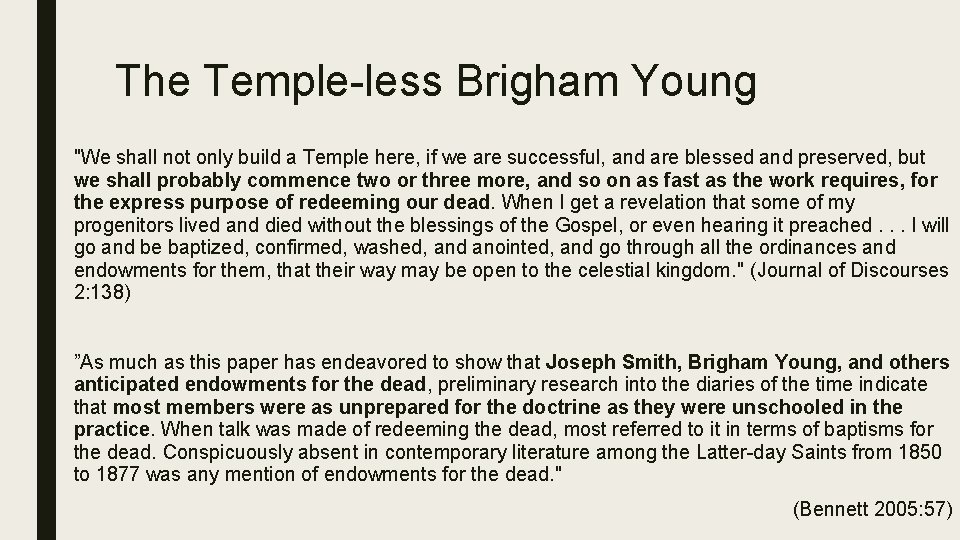
The Temple-less Brigham Young "We shall not only build a Temple here, if we are successful, and are blessed and preserved, but we shall probably commence two or three more, and so on as fast as the work requires, for the express purpose of redeeming our dead. When I get a revelation that some of my progenitors lived and died without the blessings of the Gospel, or even hearing it preached. . . I will go and be baptized, confirmed, washed, and anointed, and go through all the ordinances and endowments for them, that their way may be open to the celestial kingdom. " (Journal of Discourses 2: 138) ”As much as this paper has endeavored to show that Joseph Smith, Brigham Young, and others anticipated endowments for the dead, preliminary research into the diaries of the time indicate that most members were as unprepared for the doctrine as they were unschooled in the practice. When talk was made of redeeming the dead, most referred to it in terms of baptisms for the dead. Conspicuously absent in contemporary literature among the Latter-day Saints from 1850 to 1877 was any mention of endowments for the dead. " (Bennett 2005: 57)
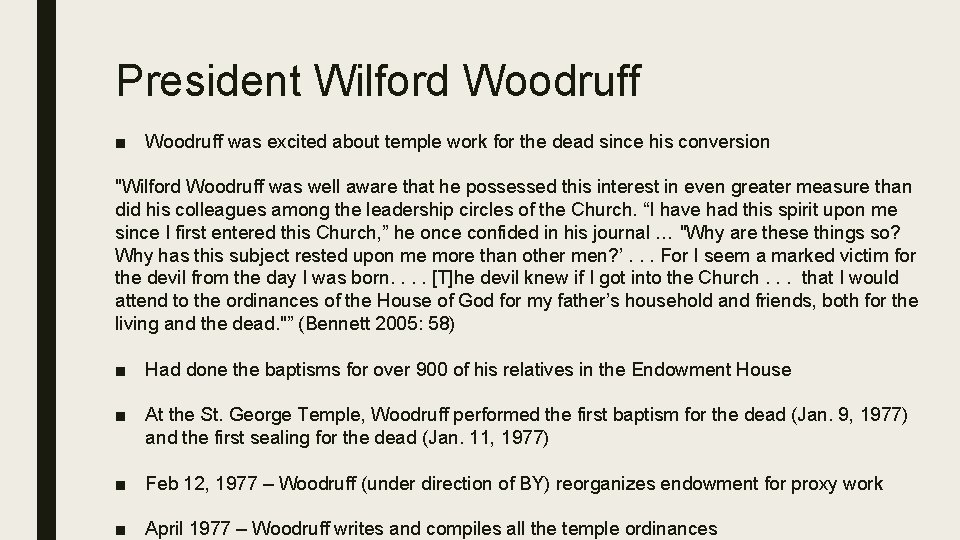
President Wilford Woodruff ■ Woodruff was excited about temple work for the dead since his conversion "Wilford Woodruff was well aware that he possessed this interest in even greater measure than did his colleagues among the leadership circles of the Church. “I have had this spirit upon me since I first entered this Church, ” he once confided in his journal … "Why are these things so? Why has this subject rested upon me more than other men? ’. . . For I seem a marked victim for the devil from the day I was born. . [T]he devil knew if I got into the Church. . . that I would attend to the ordinances of the House of God for my father’s household and friends, both for the living and the dead. "” (Bennett 2005: 58) ■ Had done the baptisms for over 900 of his relatives in the Endowment House ■ At the St. George Temple, Woodruff performed the first baptism for the dead (Jan. 9, 1977) and the first sealing for the dead (Jan. 11, 1977) ■ Feb 12, 1977 – Woodruff (under direction of BY) reorganizes endowment for proxy work ■ April 1977 – Woodruff writes and compiles all the temple ordinances
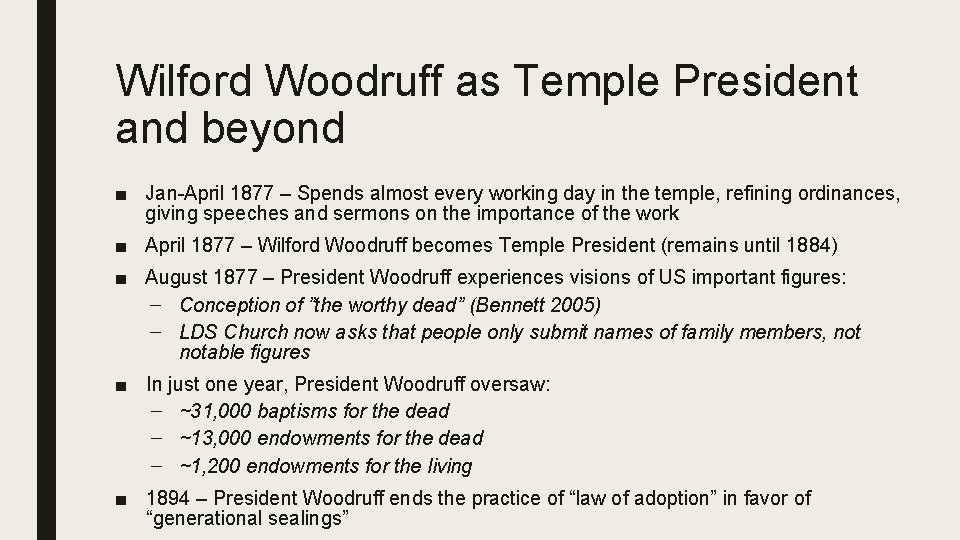
Wilford Woodruff as Temple President and beyond ■ Jan-April 1877 – Spends almost every working day in the temple, refining ordinances, giving speeches and sermons on the importance of the work ■ April 1877 – Wilford Woodruff becomes Temple President (remains until 1884) ■ August 1877 – President Woodruff experiences visions of US important figures: – Conception of ”the worthy dead” (Bennett 2005) – LDS Church now asks that people only submit names of family members, notable figures ■ In just one year, President Woodruff oversaw: – ~31, 000 baptisms for the dead – ~13, 000 endowments for the dead – ~1, 200 endowments for the living ■ 1894 – President Woodruff ends the practice of “law of adoption” in favor of “generational sealings”
PRESIDENT JOSEPH F. SMITH AND MISSIONARY WORK TO THE DEAD D&C 138 See also: Mary Jane Woodger, “From Obscurity to Scripture: Joseph F. Smith's Vision of the Redemption of the Dead, ” in You Shall Have My Word: Exploring the Text of the Doctrine and Covenants, ed. Scott C. Esplin, Richard O. Cowan, and Rachel Cope (Provo, UT: Religious Studies Center; Salt Lake City: Deseret Book, 2012), 234– 54.
Christ preaches to the dead 1 Peter 3: 13. And who is he that will harm you, if ye be followers of that which is good? 14. But and if ye suffer for righteousness’ sake, happy are ye: and be not afraid of their terror, neither be troubled; 17. For it is better, if the will of God be so, that ye suffer for well doing, than for evil doing. 18. For Christ also hath once suffered for sins, the just for the unjust, that he might bring us to God, being put to death in the flesh, but quickened by the Spirit: 19. By which also he went and preached unto the spirits in prison; 20. Which sometime were disobedient, when once the longsuffering of God waited in the days of Noah, while the ark was a preparing, wherein few, that is, eight souls were saved by water.
1 Peter 3 8. Finally, be ye all of one mind, having compassion one of another, love as brethren, be pitiful, be courteous: 9. Not rendering evil for evil, or railing for railing: but contrariwise blessing; knowing that ye are thereunto called, that ye should inherit a blessing. 10. For he that will love life, and see good days, let him refrain his tongue from evil, and his lips that they speak no guile: 11. Let him eschew evil, and do good; let him seek peace, and ensue it. 12. For the eyes of the Lord are over the righteous, and his ears are open unto their prayers: but the face of the Lord is against them that do devil. 13. And who is he that will harm you, if ye be followers of that which is good? 14. But and if ye suffer for righteousness’ sake, happy are ye: and be not afraid of their terror, 15. But sanctify the Lord God in your hearts: and be ready always to give an answer to every man that asketh you a reason of the hope that is in you with meekness and fear: 16. Having a good conscience; that, whereas they speak evil of you, as of evildoers, they may be ashamed that falsely accuse your good conversation in Christ. 17. For it is better, if the will of God be so, that ye suffer for well doing, than for evil doing. 18. For Christ also hath once suffered for sins, the just for the unjust, that he might bring us to God, being put to death in the flesh, but quickened by the Spirit: 19. By which also he went and preached unto the spirits in prison; 20. Which sometime were disobedient, when once the longsuffering of God waited in the days of Noah, while the ark was a preparing, wherein few, that is, eight souls were saved by water.
1 Peter 4 1. Forasmuch then as Christ hath suffered for us in the flesh, arm yourselves likewise with the same mind: for he that hath suffered in the flesh hath ceased from sin; 2. That he no longer should live the rest of his time in the flesh to the lusts of men, but to the will of God. 3. For the time past of our life may suffice us to have wrought the will of the Gentiles, when we walked in lasciviousness, lusts, excess of wine revellings, banquetings, and abominable idolatries: 4. Wherein they think it strange that ye run not with them to the same excess of riot, speaking evil of you: 5. Who shall give account to him that is ready to judge the quick and the dead. 6. For for this cause was the gospel preached also to them that are dead, that they might be judged according to men in the flesh, but live according to God in the spirit. 7. But the end of all things is at hand: be ye therefore sober, and watch unto prayer. 8. And above all things have fervent charity among yourselves: for charity shall cover the multitude of sins. 9. Use hospitality one to another without grudging. 10. As every man hath received the gift, even so minister the same one to another, as good stewards of the manifold grace of God. 11. If any man speak, let him speak as the oracles of God; if any man minister, let him do it as of the ability which God giveth: that God in all things may be glorified through Jesus Christ, to whom be praise and dominion for ever and ever. Amen.
Context of President Joseph F. Smith’s Revelation from 1 Peter “Death haunted mankind in 1918. The Great War, known today as World War I, was in the process of claiming more than nine million lives. That staggering figure paled in comparison with the number of people slain in even less time by a global influenza pandemic. Worldwide the virus reaped a grim harvest of perhaps fifty million souls. It killed more than 195, 000 Americans in October 1918, the deadliest month in American history, the month the Lord revealed Doctrine and Covenants 138. The "pervasiveness and ubiquity of death were overwhelming, " yet it is hard to grasp for those of us who live distant from what witnesses themselves could hardly imagine and what cultural historians have described as creating a terrible, gnawing emptiness in tens of thousands of families mourning the losses of loved ones whose bodies were never recovered from the war's devastation or whose families were wiped out by disease. ” - Steven Harper, Making Sense of the Doctrine and Covenants 2008
Context of President Joseph F. Smith’s Revelation from 1 Peter “In the midst of the dead and dying was Joseph F. Smith, president of the Church. His life's experiences equipped him to grasp the enormity of death and its implications. His father, Hyrum, had been brutally shot to death when Joseph was five. Not many years later he lost his mother, "the sweetest soul that ever lived, " he wrote, "when I was only a boy. " Death marked his life. His first child, Mercy Josephine, died at age two, leaving Joseph "vacant, lonely, desolate, deserted. " His beloved eldest son died unexpectedly in January 1918, creating what President Smith called "my overwhelming burden of grief. " Between these untimely deaths, President Smith buried a wife and eleven other children. He tasted deeply the bitterness of death. As general conference neared in October 1918, President Smith himself was less than two months from the end of his own mortality. Unwell, he surprised the Saints by appearing at conference on October 4. He spoke briefly, saying, "I have dwelt in the spirit of prayer, of supplication, of faith and of determination; and I have had my communications with the Spirit of the Lord continuously. " Indeed he had. Just the day before, the Lord had given him the revelation recorded now in Doctrine and Covenants 138. After conference he dictated it to his son Joseph Fielding Smith. ”
D&C 138 (1918) 11 As I pondered over these things which are written, the eyes of my understanding were opened, and the Spirit of the Lord rested upon me, and I saw the hosts of the dead, both small and great. 12 And there were gathered together in one place an innumerable company of the spirits of the just, who had been faithful in the testimony of Jesus while they lived in mortality; 18 While this vast multitude waited and conversed, rejoicing in the hour of their deliverance from the chains of death, the Son of God appeared, declaring liberty to the captives who had been faithful; 19 And there he preached to them the everlasting gospel, the doctrine of the resurrection and the redemption of mankind from the fall, and from individual sins on conditions of repentance. 20 But unto the wicked he did not go, and among the ungodly and the unrepentant who had defiled themselves while in the flesh, his voice was not raised; 21 Neither did the rebellious who rejected the testimonies and the warnings of the ancient prophets behold his presence, nor look upon his face. 22 Where these were, darkness reigned, but among the righteous there was peace; 23 And the saints rejoiced in their redemption, and bowed the knee and acknowledged the Son of God as their Redeemer and Deliverer from death and the chains of hell. 24 Their countenances shone, and the radiance from the presence of the Lord rested upon them, and they sang praises unto his holy name.
D&C 138 (1918) 25 I marveled, for I understood that the Savior spent about three years in his ministry among the Jews and those of the house of Israel, endeavoring to teach them the everlasting gospel and call them unto repentance; 29 And as I wondered, my eyes were opened, and my understanding quickened, and I perceived that the Lord went not in person among the wicked and the disobedient who had rejected the truth, to teach them; 26 And yet, notwithstanding his mighty works, and miracles, and proclamation of the truth, in great power and authority, there were but few who hearkened to his voice, and rejoiced in his presence, and received salvation at his hands. 30 But behold, from among the righteous, he organized his forces and appointed messengers, clothed with power and authority, and commissioned them to go forth and carry the light of the gospel to them that were in darkness, even to all the spirits of men; and thus was the gospel preached to the dead. 27 But his ministry among those who were dead was limited to the brief time intervening between the crucifixion and his resurrection; 32 Thus was the gospel preached to those who had died in their sins, without a knowledge of the truth, or in transgression, having rejected the prophets. 28 And I wondered at the words of Peter— wherein he said that the Son of God preached unto the spirits in prison, who sometime were disobedient, when once the long-suffering of God waited in the days of Noah—and how it was possible for him to preach to those spirits and 33 These were taught faith in God, repentance from sin, vicarious baptism for the remission of sins, the gift of the Holy Ghost by the laying on of hands, 34 And all other principles of the gospel that were necessary for them to know in order to qualify themselves that they might be judged according to
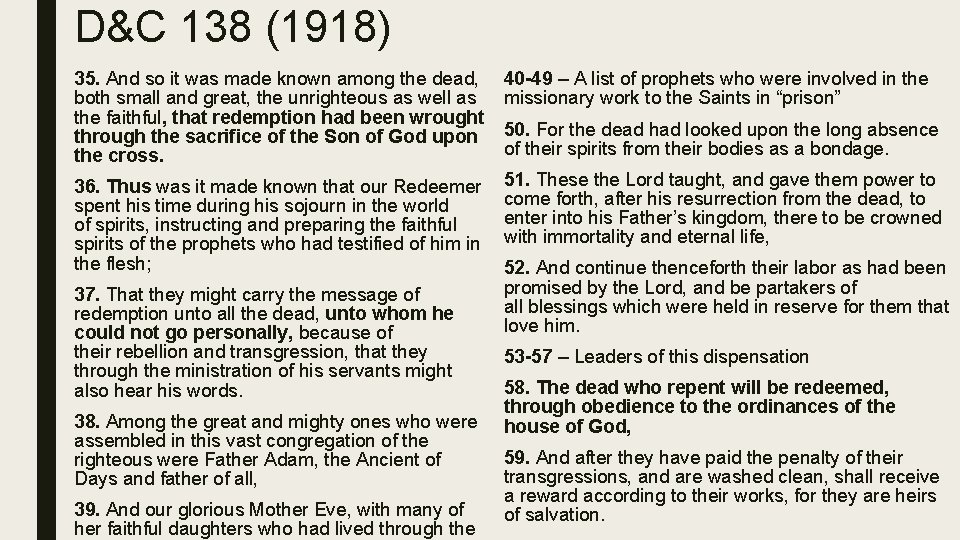
D&C 138 (1918) 35. And so it was made known among the dead, both small and great, the unrighteous as well as the faithful, that redemption had been wrought through the sacrifice of the Son of God upon the cross. 40 -49 – A list of prophets who were involved in the missionary work to the Saints in “prison” 36. Thus was it made known that our Redeemer spent his time during his sojourn in the world of spirits, instructing and preparing the faithful spirits of the prophets who had testified of him in the flesh; 51. These the Lord taught, and gave them power to come forth, after his resurrection from the dead, to enter into his Father’s kingdom, there to be crowned with immortality and eternal life, 37. That they might carry the message of redemption unto all the dead, unto whom he could not go personally, because of their rebellion and transgression, that they through the ministration of his servants might also hear his words. 38. Among the great and mighty ones who were assembled in this vast congregation of the righteous were Father Adam, the Ancient of Days and father of all, 39. And our glorious Mother Eve, with many of her faithful daughters who had lived through the 50. For the dead had looked upon the long absence of their spirits from their bodies as a bondage. 52. And continue thenceforth their labor as had been promised by the Lord, and be partakers of all blessings which were held in reserve for them that love him. 53 -57 – Leaders of this dispensation 58. The dead who repent will be redeemed, through obedience to the ordinances of the house of God, 59. And after they have paid the penalty of their transgressions, and are washed clean, shall receive a reward according to their works, for they are heirs of salvation.
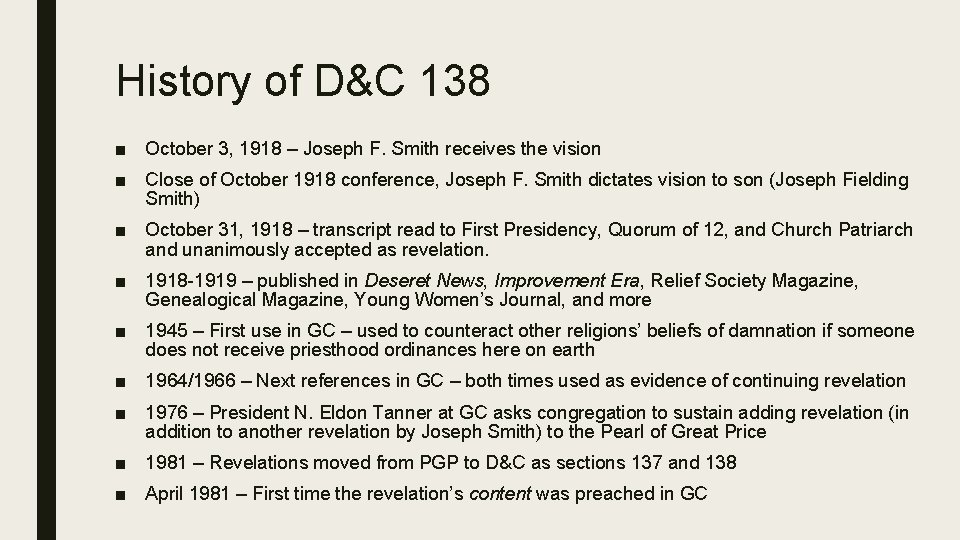
History of D&C 138 ■ October 3, 1918 – Joseph F. Smith receives the vision ■ Close of October 1918 conference, Joseph F. Smith dictates vision to son (Joseph Fielding Smith) ■ October 31, 1918 – transcript read to First Presidency, Quorum of 12, and Church Patriarch and unanimously accepted as revelation. ■ 1918 -1919 – published in Deseret News, Improvement Era, Relief Society Magazine, Genealogical Magazine, Young Women’s Journal, and more ■ 1945 – First use in GC – used to counteract other religions’ beliefs of damnation if someone does not receive priesthood ordinances here on earth ■ 1964/1966 – Next references in GC – both times used as evidence of continuing revelation ■ 1976 – President N. Eldon Tanner at GC asks congregation to sustain adding revelation (in addition to another revelation by Joseph Smith) to the Pearl of Great Price ■ 1981 – Revelations moved from PGP to D&C as sections 137 and 138 ■ April 1981 – First time the revelation’s content was preached in GC
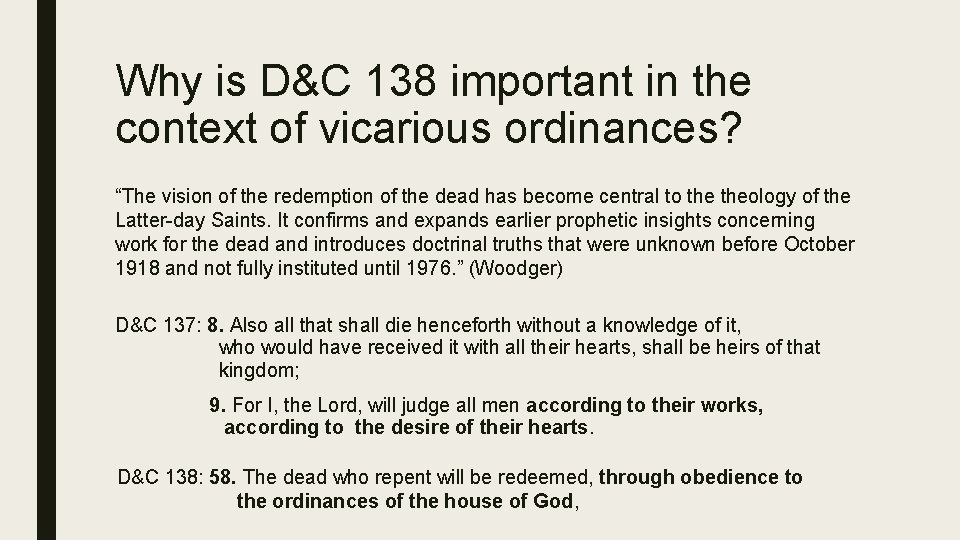
Why is D&C 138 important in the context of vicarious ordinances? “The vision of the redemption of the dead has become central to theology of the Latter-day Saints. It confirms and expands earlier prophetic insights concerning work for the dead and introduces doctrinal truths that were unknown before October 1918 and not fully instituted until 1976. ” (Woodger) D&C 137: 8. Also all that shall die henceforth without a knowledge of it, who would have received it with all their hearts, shall be heirs of that kingdom; 9. For I, the Lord, will judge all men according to their works, according to the desire of their hearts. D&C 138: 58. The dead who repent will be redeemed, through obedience to the ordinances of the house of God,
TODAY’S ATTITUDE TOWARDS TEMPLE WORK
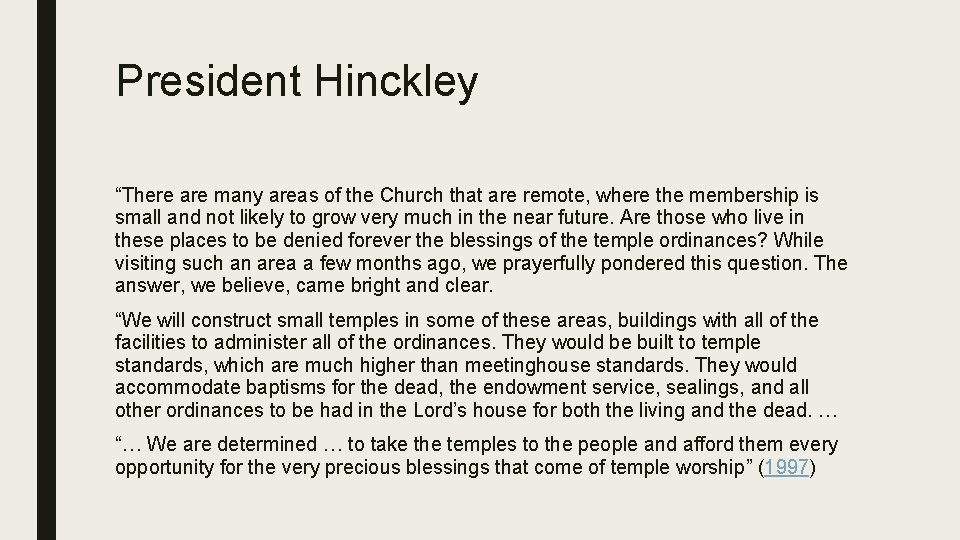
President Hinckley “There are many areas of the Church that are remote, where the membership is small and not likely to grow very much in the near future. Are those who live in these places to be denied forever the blessings of the temple ordinances? While visiting such an area a few months ago, we prayerfully pondered this question. The answer, we believe, came bright and clear. “We will construct small temples in some of these areas, buildings with all of the facilities to administer all of the ordinances. They would be built to temple standards, which are much higher than meetinghouse standards. They would accommodate baptisms for the dead, the endowment service, sealings, and all other ordinances to be had in the Lord’s house for both the living and the dead. … “… We are determined … to take the temples to the people and afford them every opportunity for the very precious blessings that come of temple worship” (1997)
President Boyd K. Packer “I know that I shall see this great-grandfather beyond the veil, and my grandfather, and my father. And I know that I shall there also meet those of my ancestors who lived when the fulness of the gospel was not upon the earth; those who lived and died without ever hearing His name, nor having the invitation to be baptized. I say that no point of doctrine sets this church apart from the other claimants as this one does. Save for it, we would, with all of the others, have to accept the clarity with which the New Testament declares baptism to be essential and then admit that most of the human family could never have it. But we have the revelations. We have those sacred ordinances. ” - “The Redemption of the Dead”, Nov. 1975
POSSIBLE EXTRA SLIDES?
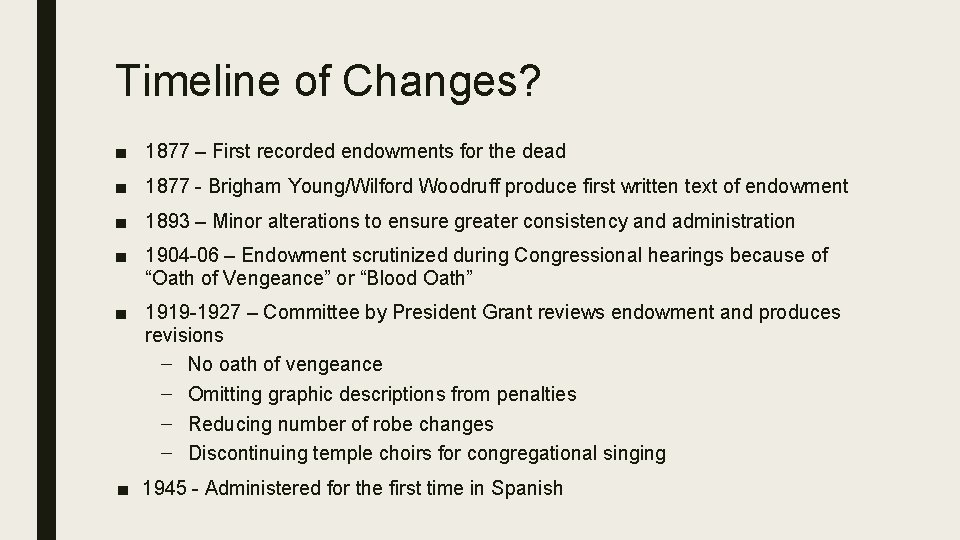
Timeline of Changes? ■ 1877 – First recorded endowments for the dead ■ 1877 - Brigham Young/Wilford Woodruff produce first written text of endowment ■ 1893 – Minor alterations to ensure greater consistency and administration ■ 1904 -06 – Endowment scrutinized during Congressional hearings because of “Oath of Vengeance” or “Blood Oath” ■ 1919 -1927 – Committee by President Grant reviews endowment and produces revisions – No oath of vengeance – Omitting graphic descriptions from penalties – Reducing number of robe changes – Discontinuing temple choirs for congregational singing ■ 1945 - Administered for the first time in Spanish
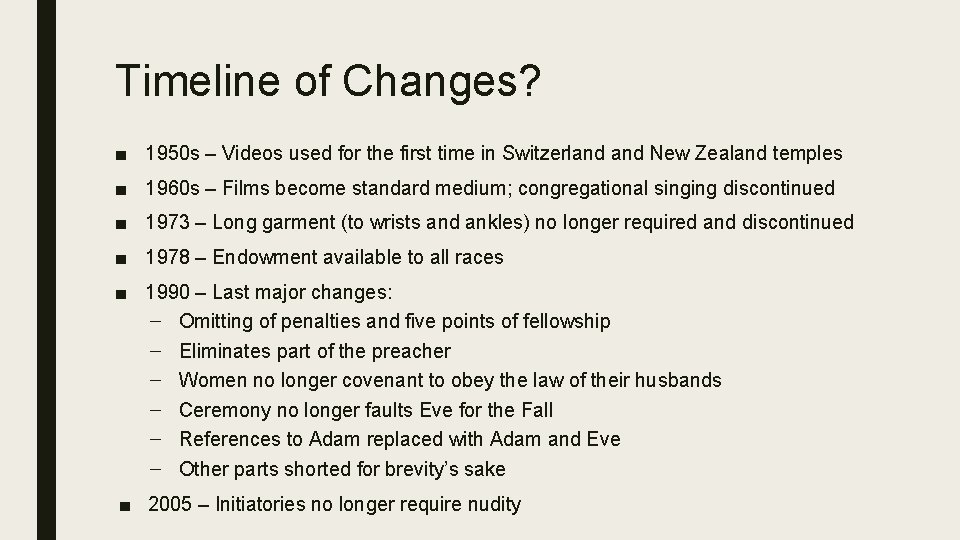
Timeline of Changes? ■ 1950 s – Videos used for the first time in Switzerland New Zealand temples ■ 1960 s – Films become standard medium; congregational singing discontinued ■ 1973 – Long garment (to wrists and ankles) no longer required and discontinued ■ 1978 – Endowment available to all races ■ 1990 – Last major changes: – Omitting of penalties and five points of fellowship – Eliminates part of the preacher – Women no longer covenant to obey the law of their husbands – Ceremony no longer faults Eve for the Fall – References to Adam replaced with Adam and Eve – Other parts shorted for brevity’s sake ■ 2005 – Initiatories no longer require nudity
Regular Revelation vs. Canonized Revelation? “As religious scholar Trever R. Anderson describes, “Latter-day Saints view the words of the Prophet and Apostles as the words of God, yet canonized scripture still stands on a higher plane. Canonization of a revelation or vision validates its authority, prominence, and doctrinal power. ” By being canonized, this 1918 vision “was elevated from obscure Church history to central core doctrine. ”” (Woodger) “[I]n 1966, Elder Spencer W. Kimball spoke of continuing revelation, and merely said, “The visions of Wilford Woodruff and Joseph F. Smith would certainly be on a par with the visions of Peter and Paul. ” Elder Kimball then declared that the vision of the redemption of the dead a “most comprehensive” example of the revelation available to Latter-day Saints. ” (Woodger)
What do non-Mormons make of: The prophecy of Elijah? Turning the hearts? ■ Often accepted as fulfilled by John the Baptist OR Elijah on the Mount of Transfiguration (Luke 1: 16 -17; Matthew 17) ■ Compare to Luke 1: 17 - "to turn the hearts of the parents to their children and the disobedient to the wisdom of the righteous--to make ready a people prepared for the Lord” ■ Often accepted as a symbolic return of Elijah’s purpose, rather than Elijah himself. May or may not be completed in multiple visits or callings. ■ Jews find this prophecy unfulfilled. Continue to leave a seat for Elijah at feasts. ■ General turning of the hearts to each other – relates to the social justice nature of Malachi’s teachings
What do Mormons make of: The prophecy of Elijah? ■ Fulfilled in 1836 when Elijah restored the keys to Joseph Smith in the Kirtland Temple. D&C 110: 13 After this vision had closed, another great and glorious vision burst upon us; for Elijah the prophet, who was taken to heaven without tasting death, stood before us, and said: 14 Behold, the time has fully come, which was spoken of by the mouth of Malachi—testifying that he [Elijah] should be sent, before the great and dreadful day of the Lord come— 15 To turn the hearts of the fathers to the children, and the children to the fathers, lest the whole earth be smitten with a curse— 16 Therefore, the keys of this dispensation are committed into your hands; and by this ye may know that the great and dreadful day of the Lord is near, even at the doors. Turning the hearts? “Now, the word turn here should be translated bind, or seal. But what is the object of this important mission? or how is it to be fulfilled? The keys are to be delivered, the spirit of Elijah is to come … and the Saints to come up as saviors on Mount Zion. But how are they to become saviors on Mount Zion? By building their temples, erecting their baptismal fonts, and going forth and receiving all the … ordinations and sealing powers upon their heads, in behalf of all their progenitors who are dead and redeem that they may come forth in the first resurrection …; and herein is the chain that binds the hearts of the fathers to the children and the children to the fathers, which fulfills the mission of Elijah. ”
Sin vs. Transgressions vs. Mistakes? Article of Faith 2 - We believe that men will be punished for their own sins, and not for Adam’s transgression. D&C 138: 32 – Thus was the gospel preached to those who had died in their sins, without a knowledge of the truth, or in transgression, having rejected the prophets. Elder Oaks seems to put transgression and sin together to contrast against mistakes
Law of Adoption and Sealings? ”Furthermore, a great many “adoptions” were performed in which faithful living men, their wives, and children were sealed not to their own ancestral families—for fear that they had rejected the gospel—but to leading General Authorities, living or dead. … The overriding principle was that family salvation lay in the keys and powers of the priesthood. Such priesthood adoptions had occurred frequently in Nauvoo and even more so at Winter Quarters and in the Salt Lake Valley. These adoptions had also had a social impact, and they often dictated social spheres of influence and one’s circle of friends and associates. For instance, those adopted into Brigham Young’s family lived close together and often shared resources. There was an expectation that in return for the spiritual blessings that came through adoption to Brigham Young, the adopted families would give physical help and assistance where needed. Although it eventually proved a failure as a social principle of organization, the law of adoption was emphasized at this time as a sealing practice among both the living and the dead. Between 1877 and 1894, thousands of living persons chose to be adopted into the families of general authorities or of temple presidents, living or dead. Many sought adoption into Joseph Smith’s family. 109 In St. George a great many were adopted to Elder Erastus Snow, the area’s long-standing and beloved Apostle-leader. 110 It is estimated that between 1877 and 1893, slightly over 13, 000 such adoptions occurred. ” (63 -4)
WHY ORDINANCES?
Why Ordinances? “One way a millennial might phrase the challenging question is this: “Are you really telling me that Mother Teresa has to have her temple work done, or she can’t get into heaven? ” For many of us, just to be in the temple, is to feel the beauty of the holy, as the Psalmist wrote. Some of us have experienced first-hand that what transpires in the temple is “real, ” because it is “discernible. ” But not all of us. And so we need to find an explanatory framework, or a language appropriate to every person in every age and culture. So they can hear the gospel in ways that resonate with them. ” Terryl Givens, 2017, Worship the Lord in the Beauty of Holiness: Why a Temple?
Articles of Faith 3 We believe that through the Atonement of Christ, all mankind may be saved, by obedience to the laws and ordinances of the Gospel. 4 We believe that the first principles and ordinances of the Gospel are: first, Faith in the Lord Jesus Christ; second, Repentance; third, Baptism by immersion for the remissionof sins; fourth, Laying on of hands for the gift of the Holy Ghost. 5 We believe that a man must be called of God, by prophecy, and by the laying on of hands by those who are in authority, to preach the Gospel and administer in the ordinances thereof.
From Joseph Smith “The question is frequently asked, ‘Can we not be saved without going through with all those ordinances, etc. ? ’ I would answer, No, not the fullness of salvation. Jesus said, ‘There are many mansions in my Father’s house, and I will go and prepare a place for you. ’ [See John 14: 2. ] House here named should have been translated kingdom; and any person who is exalted to the highest mansion has to abide a celestial law, and the whole law too. ” (from a speech given by JS in Jan 1844 - Nauvoo) “Could we read and comprehend all that has been written from the days of Adam, on the relation of man to God angels in a future state, we should know very little about it. Reading the experience of others, or the revelation given to them, can never give us a comprehensive view of our condition and true relation to God. Knowledge of these things can only be obtained by experience through the ordinances of God set forth for that purpose. Could you gaze into heaven five minutes, you would know more than you would by reading all that ever was written on the subject. … I assure the Saints that truth … can and may be known through the revelations of God in the way of His ordinances, and in answer to prayer. ” (From a speech given by JS in Oct 1843 in Nauvoo)
From Elder Christofferson Oct. 2015 – Why the Church? "The Church can build and operate temples, houses of the Lord, where vital ordinances and covenants may be administered. Joseph Smith stated that God’s objective in gathering His people in any age is 'to build unto the Lord a house whereby He [can] reveal unto His people the ordinances of His house and the glories of His kingdom, and teach the people the way of salvation; for there are certain ordinances and principles that, when they are taught and practiced, must be done in a place or house built for that purpose. ' "If one believes that all roads lead to heaven or that there are no particular requirements for salvation, he or she will see no need for proclaiming the gospel or for ordinances and covenants in redeeming either the living or the dead. But we speak not just of immortality but also of eternal life, and for that the gospel path and gospel covenants are essential. And the Savior needs a church to make them available to all of God’s children—both the living and the dead. "
From Elder Dennis Neuenschwander Ensign Aug 2001 – Ordinances and Covenants As personal participation in ordinances loses significance, the importance of divine authority also becomes less significant. If this is true, then one baptism is as good as another. Indeed, many churches accept the baptisms performed by other churches as valid. Consequently, the concept of divine authority and the importance of properly administered ordinances as requirements of salvation are greatly diminished. There is a corollary observation. The more claim a church has on antiquity and apostolic authority, the more prominent the emphasis on sacred ordinances and upon divine authority to perform them. … The Church of Jesus Christ of Latter-day Saints also claims an ancient origin and thereby places exceptional importance both on the role of ordinances and covenants and on the necessity of divine authority to administer them. The third article of faith teaches, “We believe that through the Atonement of Christ, all mankind may be saved, by obedience to the laws and ordinances of the Gospel. ” 4 Sacred ordinances and the divine authority to administer them did not begin with the Restoration
First – Come to Know God First, through personal participation in sacred gospel ordinances we come to know God. I refer to the 84 th section of the Doctrine and Covenants, in which we read: “And this greater priesthood administereth the gospel and holdeth the key of the mysteries of the kingdom, even the key of the knowledge of God. “Therefore, in the ordinances thereof, the power of godliness is manifest. “And without the ordinances thereof, and the authority of the priesthood, the power of godliness is not manifest unto men in the flesh. ” Elder Dennis Neuenschwander
Second– Covenants Second, sacred gospel ordinances are the gateway to solemn covenants with God. Ordinances and covenants can hardly be understood apart from each other. By ordinances we enter into covenants, and by covenants we receive the ordinances. Though there may be ordinances that do not have an associated covenant—such as the blessing and naming of children, anointing of the sick, or blessings of comfort—there is no eternal covenant that is not connected to an ordinance. Our important steps toward God are introduced by sacred ordinances and are governed by the conditions of the covenants associated with those ordinances. Elder Dennis Neuenschwander
Third– Endowment of Divine Power Third, sacred ordinances provide an endowment of divine power in our lives. In His conversation with Pilate, the Savior said, “My kingdom is not of this world. ” 17 Numerous scriptures teach us that there is natural enmity between the world and the kingdom of God. One of the things that set the kingdom of God apart is the sense of the holy that exists therein. The world can have a sense only of the secular. Worthy participation in sacred gospel ordinances changes our lives and brings blessings and power to us that we would otherwise not enjoy. The power of the Atonement itself is unlocked by sacred gospel ordinances that are performed under the keys of the priesthood. Remission of sins is extended through the ordinance of baptism. Confirmation brings with it the promise of the constant companionship of the Holy Ghost. Elder Dennis Neuenschwander
Why Ordinances? Paul writes, reassuringly, that “neither death, nor life, nor angels, nor rulers, nor things present, nor things to come, nor powers, nor height, nor depth, nor anything else in all creation, will be able to separate us from the love of God in Christ Jesus our Lord. ”[6] But something, apparently, can separate us from his presence — else salvation would be both universal and automatic. Sealing powers may here be seen as real ways of employing and controlling actual powers or spiritual forces that counteract those effects of dissolution and fracture, forming durable bonds that connect individuals to each other and to God. In spite of the best efforts of the most earnest human individuals, marriages fail, friendships fade, and family ties falter. For Joseph Smith, the priesthood provided access to real heavenly powers that effected powerful connections durable enough to survive the deleterious results of sin, of death, or of time. Terryl Givens, 2017, Worship the Lord in the Beauty of Holiness: Why a Temple?
Why Ordinances? So in sum, in the LDS view, sacramental covenants are not a prerequisite to salvation — they are constitutive of salvation. They are indispensable, not because of their status as a hoop to jump through; but because they are the strategy wise heavenly parents have devised to nurture us and draw us into the most durable forms of loving association that we can find in this universe so coldly indifferent to human needs and longing. This is the sense in which Mormons believe that “a covenant is a special relationship with the Lord into which a person or a group may enter” (my emphasis). [19] And this special relationship is one in which, from the beginning of time, Heavenly Parents envisioned as available to the entire human race — not a fortunate few. Terryl Givens, 2017, Worship the Lord in the Beauty of Holiness: Why a Temple?