
Lesson 32 Investigating Exponential Models Growth and Decay
- Slides: 27
Lesson 32 - Investigating Exponential Models - Growth and Decay Math 2 Honors - Santowski 12/20/2021 Math 2 Honors - Santowski 1
(A) Growth Curves n certain organisms like bacteria and other unicellular organisms have growth curves that can be characterized by exponential functions n their growth is said to be exponential since they duplicate at regular intervals n to derive a formula for exponential growth, consider the following for a two hour doubling period 12/20/2021 Math 2 Honors - Santowski 2
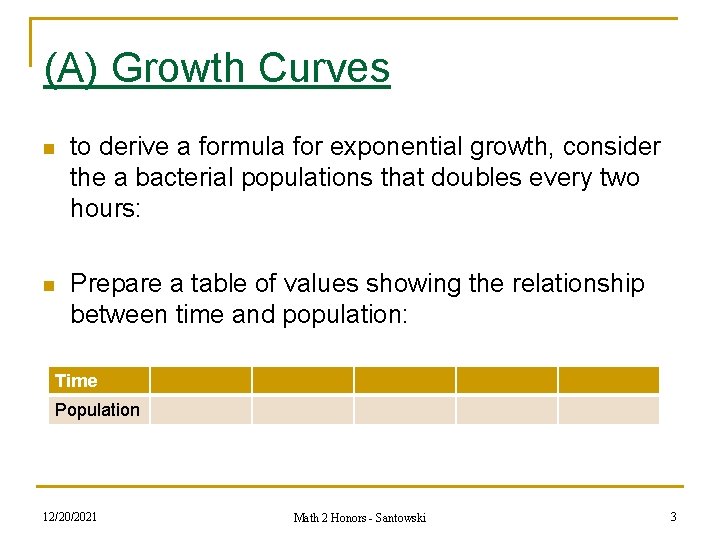
(A) Growth Curves n to derive a formula for exponential growth, consider the a bacterial populations that doubles every two hours: n Prepare a table of values showing the relationship between time and population: Time Population 12/20/2021 Math 2 Honors - Santowski 3
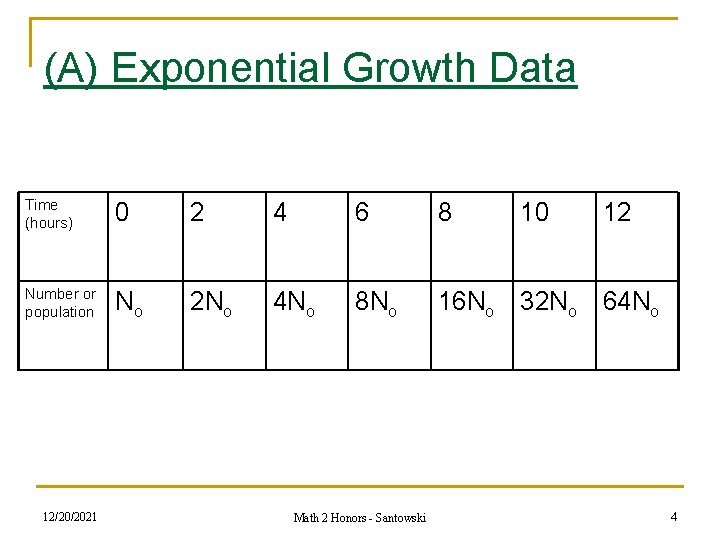
(A) Exponential Growth Data Time (hours) 0 2 4 6 8 Number or population No 2 No 4 No 8 No 16 No 32 No 64 No 12/20/2021 Math 2 Honors - Santowski 10 12 4
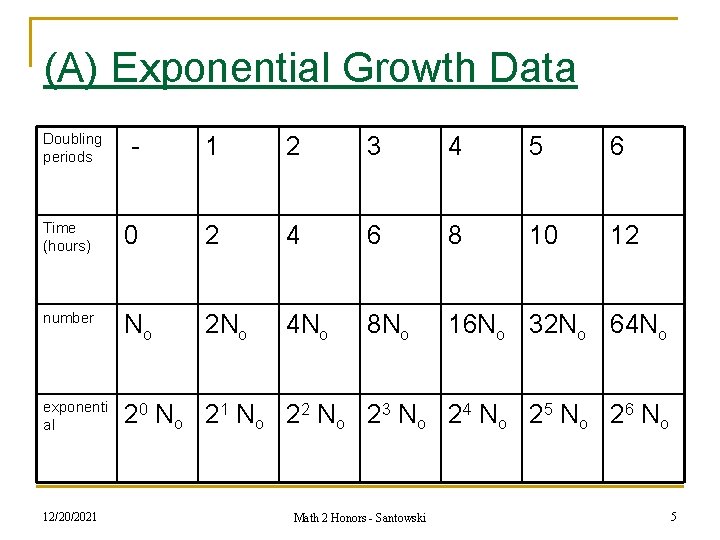
(A) Exponential Growth Data Doubling periods - 1 2 3 4 5 6 Time (hours) 0 2 4 6 8 10 12 number No 2 No 4 No 8 No 16 No 32 No 64 No exponenti al 20 N o 21 N o 22 N o 23 N o 24 N o 25 N o 26 N o 12/20/2021 Math 2 Honors - Santowski 5
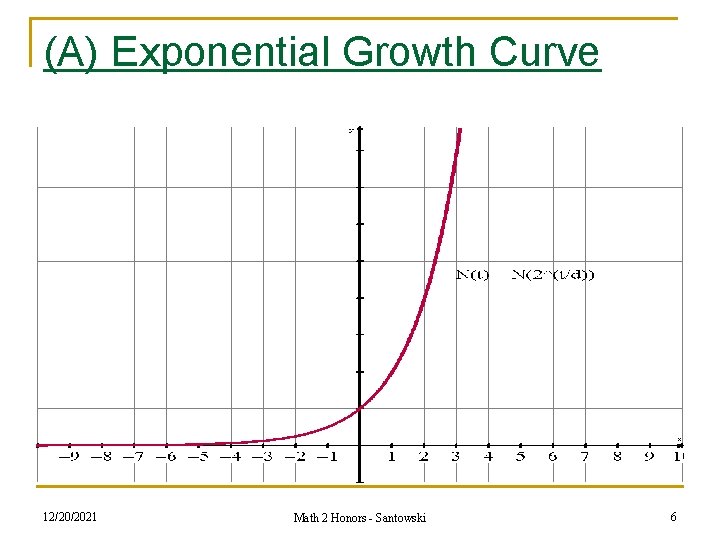
(A) Exponential Growth Curve 12/20/2021 Math 2 Honors - Santowski 6
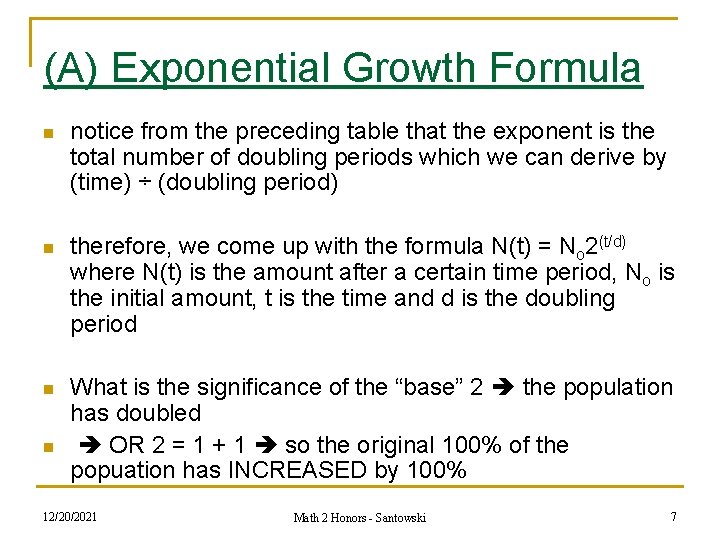
(A) Exponential Growth Formula n notice from the preceding table that the exponent is the total number of doubling periods which we can derive by (time) ÷ (doubling period) n therefore, we come up with the formula N(t) = No 2(t/d) where N(t) is the amount after a certain time period, No is the initial amount, t is the time and d is the doubling period n What is the significance of the “base” 2 the population has doubled OR 2 = 1 + 1 so the original 100% of the popuation has INCREASED by 100% n 12/20/2021 Math 2 Honors - Santowski 7
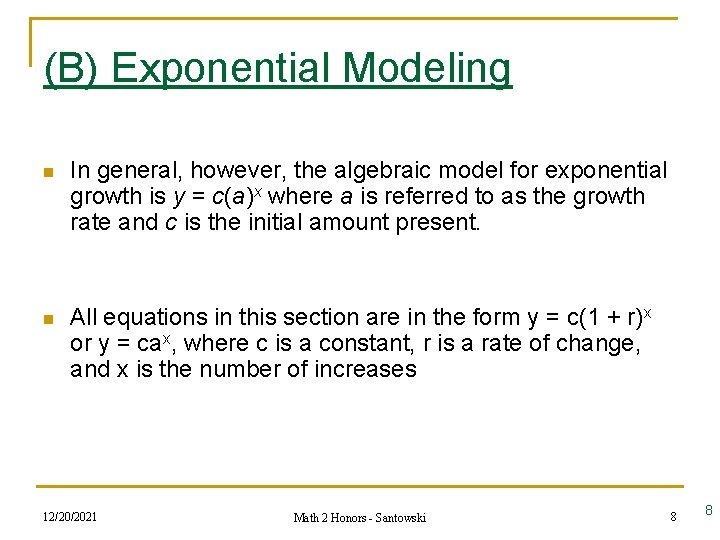
(B) Exponential Modeling n In general, however, the algebraic model for exponential growth is y = c(a)x where a is referred to as the growth rate and c is the initial amount present. n All equations in this section are in the form y = c(1 + r)x or y = cax, where c is a constant, r is a rate of change, and x is the number of increases 12/20/2021 Math 2 Honors - Santowski 8 8
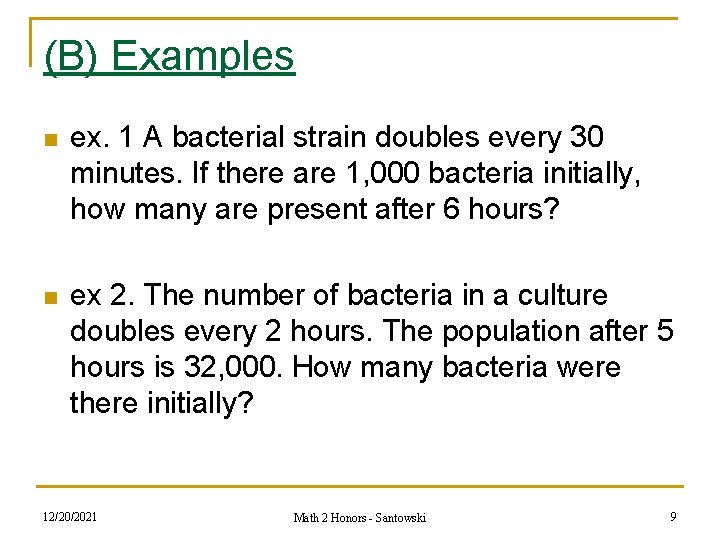
(B) Examples n ex. 1 A bacterial strain doubles every 30 minutes. If there are 1, 000 bacteria initially, how many are present after 6 hours? n ex 2. The number of bacteria in a culture doubles every 2 hours. The population after 5 hours is 32, 000. How many bacteria were there initially? 12/20/2021 Math 2 Honors - Santowski 9
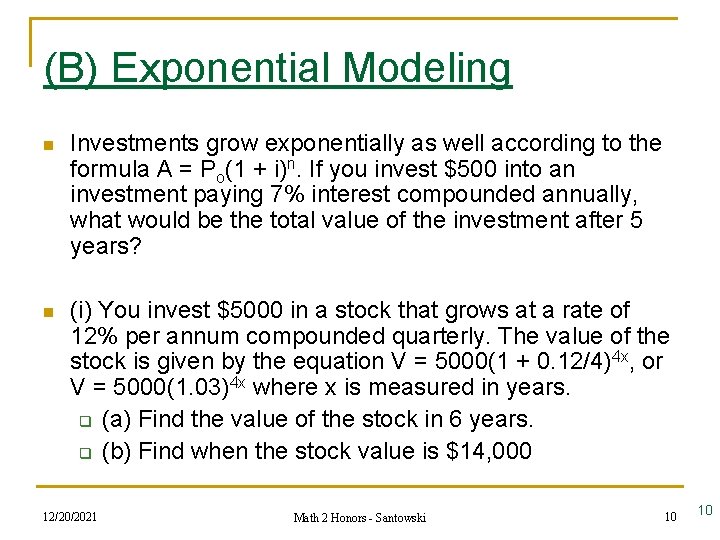
(B) Exponential Modeling n Investments grow exponentially as well according to the formula A = Po(1 + i)n. If you invest $500 into an investment paying 7% interest compounded annually, what would be the total value of the investment after 5 years? n (i) You invest $5000 in a stock that grows at a rate of 12% per annum compounded quarterly. The value of the stock is given by the equation V = 5000(1 + 0. 12/4)4 x, or V = 5000(1. 03)4 x where x is measured in years. q (a) Find the value of the stock in 6 years. q (b) Find when the stock value is $14, 000 12/20/2021 Math 2 Honors - Santowski 10 10
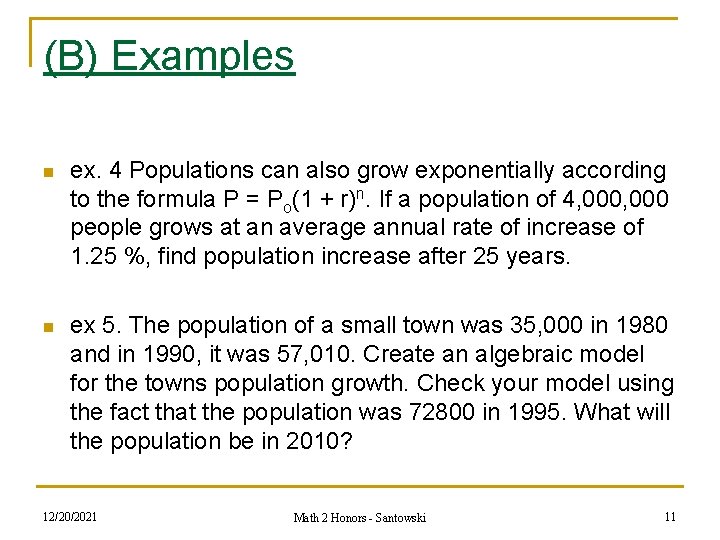
(B) Examples n ex. 4 Populations can also grow exponentially according to the formula P = Po(1 + r)n. If a population of 4, 000 people grows at an average annual rate of increase of 1. 25 %, find population increase after 25 years. n ex 5. The population of a small town was 35, 000 in 1980 and in 1990, it was 57, 010. Create an algebraic model for the towns population growth. Check your model using the fact that the population was 72800 in 1995. What will the population be in 2010? 12/20/2021 Math 2 Honors - Santowski 11
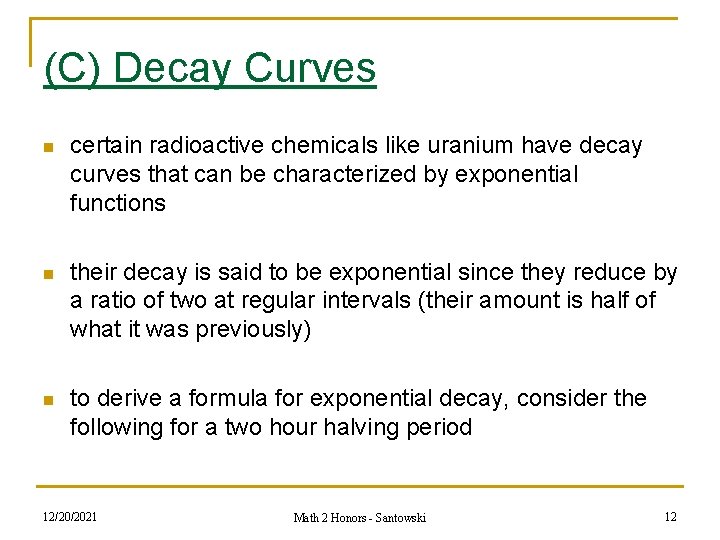
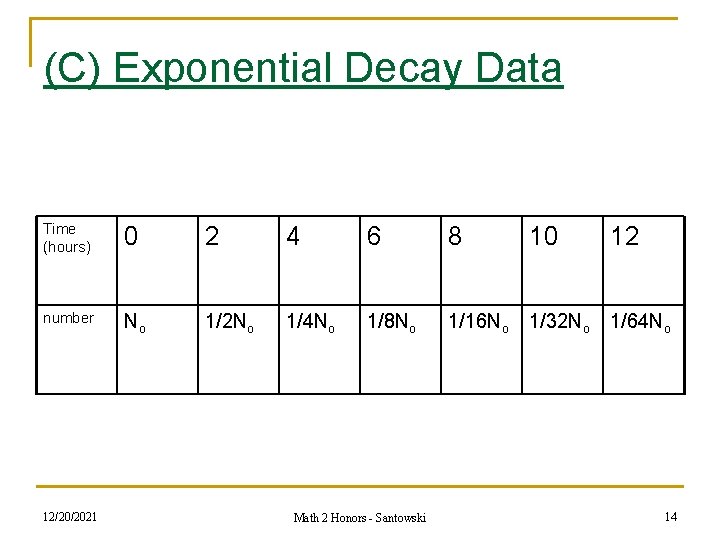
(C) Decay Curves n certain radioactive chemicals like uranium have decay curves that can be characterized by exponential functions n their decay is said to be exponential since they reduce by a ratio of two at regular intervals (their amount is half of what it was previously) n to derive a formula for exponential decay, consider the following for a two hour halving period 12/20/2021 Math 2 Honors - Santowski 12
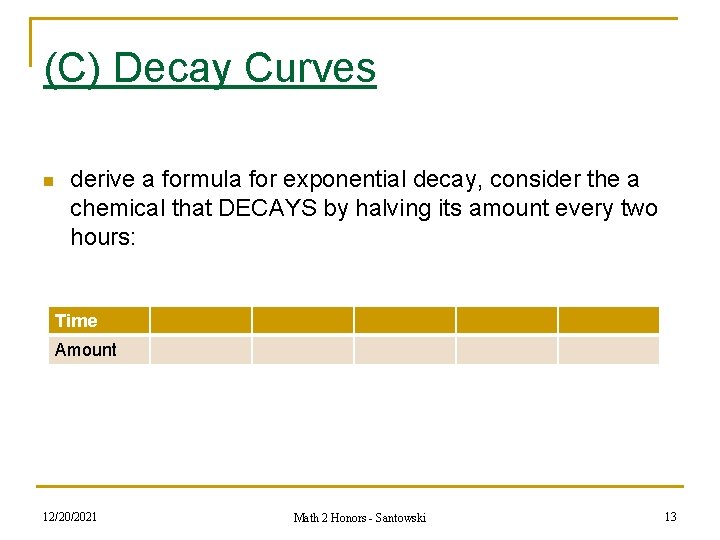
(C) Decay Curves n derive a formula for exponential decay, consider the a chemical that DECAYS by halving its amount every two hours: Time Amount 12/20/2021 Math 2 Honors - Santowski 13
(C) Exponential Decay Data Time (hours) 0 2 4 6 8 10 12 number No 1/2 No 1/4 No 1/8 No 1/16 No 1/32 No 1/64 No 12/20/2021 Math 2 Honors - Santowski 14
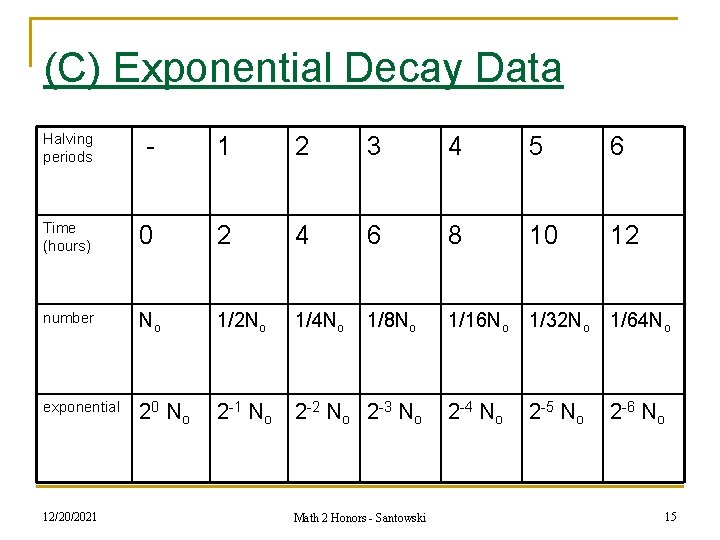
(C) Exponential Decay Data Halving periods - 1 2 3 4 5 6 Time (hours) 0 2 4 6 8 10 12 number No 1/2 No 1/4 No 1/8 No 1/16 No 1/32 No 1/64 No exponential 20 N o 2 -1 No 2 -2 No 2 -3 No 2 -4 No 2 -5 No 2 -6 No 12/20/2021 Math 2 Honors - Santowski 15
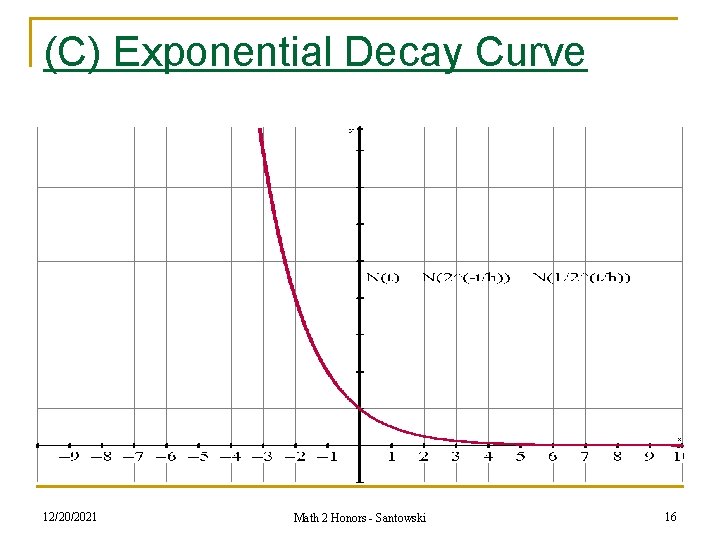
(C) Exponential Decay Curve 12/20/2021 Math 2 Honors - Santowski 16
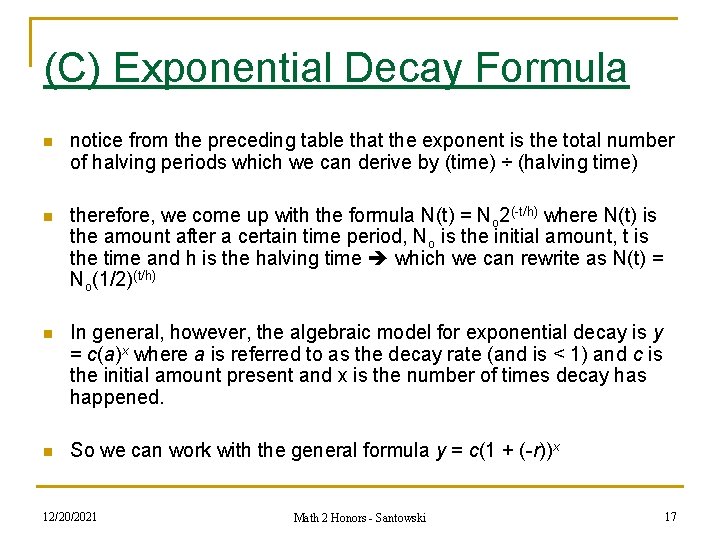
(C) Exponential Decay Formula n notice from the preceding table that the exponent is the total number of halving periods which we can derive by (time) ÷ (halving time) n therefore, we come up with the formula N(t) = No 2(-t/h) where N(t) is the amount after a certain time period, No is the initial amount, t is the time and h is the halving time which we can rewrite as N(t) = No(1/2)(t/h) n In general, however, the algebraic model for exponential decay is y = c(a)x where a is referred to as the decay rate (and is < 1) and c is the initial amount present and x is the number of times decay has happened. n So we can work with the general formula y = c(1 + (-r))x 12/20/2021 Math 2 Honors - Santowski 17
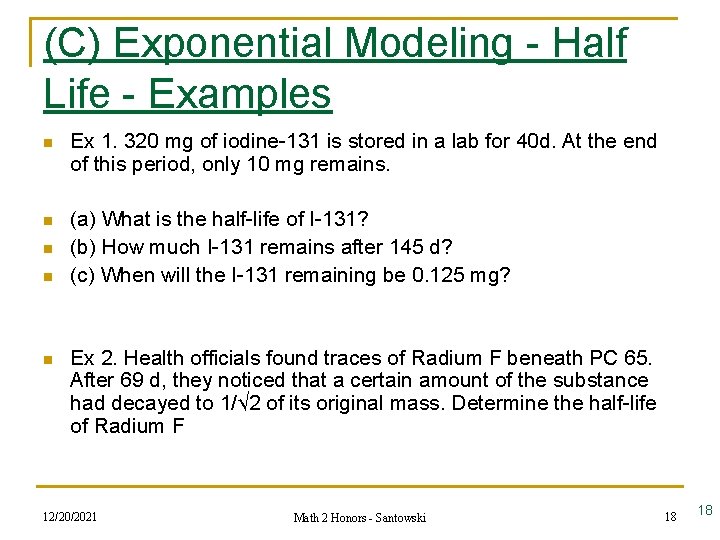
(C) Exponential Modeling - Half Life - Examples n Ex 1. 320 mg of iodine-131 is stored in a lab for 40 d. At the end of this period, only 10 mg remains. n (a) What is the half-life of I-131? (b) How much I-131 remains after 145 d? (c) When will the I-131 remaining be 0. 125 mg? n n n Ex 2. Health officials found traces of Radium F beneath PC 65. After 69 d, they noticed that a certain amount of the substance had decayed to 1/√ 2 of its original mass. Determine the half-life of Radium F 12/20/2021 Math 2 Honors - Santowski 18 18
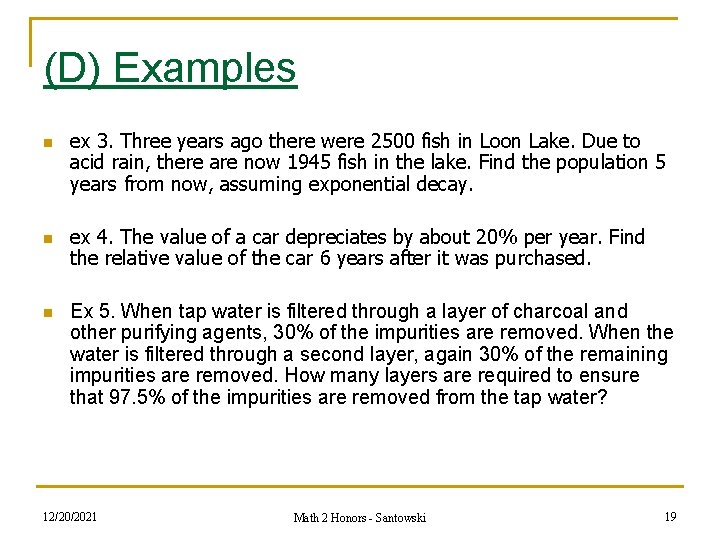
(D) Examples n n n ex 3. Three years ago there were 2500 fish in Loon Lake. Due to acid rain, there are now 1945 fish in the lake. Find the population 5 years from now, assuming exponential decay. ex 4. The value of a car depreciates by about 20% per year. Find the relative value of the car 6 years after it was purchased. Ex 5. When tap water is filtered through a layer of charcoal and other purifying agents, 30% of the impurities are removed. When the water is filtered through a second layer, again 30% of the remaining impurities are removed. How many layers are required to ensure that 97. 5% of the impurities are removed from the tap water? 12/20/2021 Math 2 Honors - Santowski 19
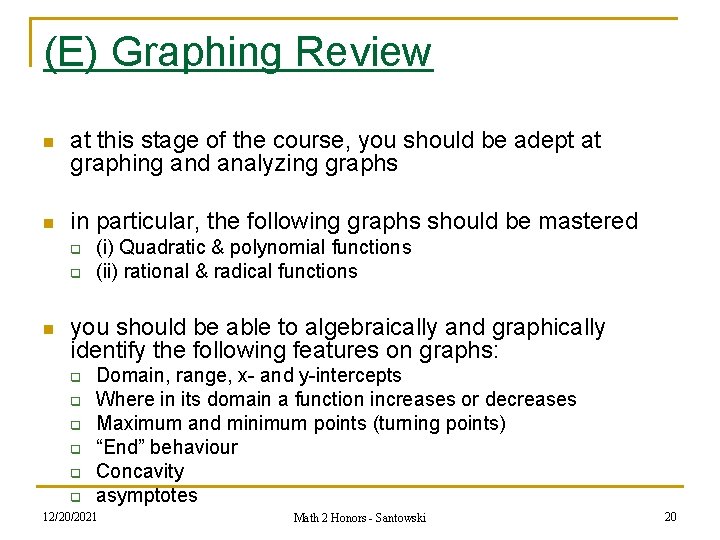
(E) Graphing Review n at this stage of the course, you should be adept at graphing and analyzing graphs n in particular, the following graphs should be mastered q q n (i) Quadratic & polynomial functions (ii) rational & radical functions you should be able to algebraically and graphically identify the following features on graphs: q q q Domain, range, x- and y-intercepts Where in its domain a function increases or decreases Maximum and minimum points (turning points) “End” behaviour Concavity asymptotes 12/20/2021 Math 2 Honors - Santowski 20
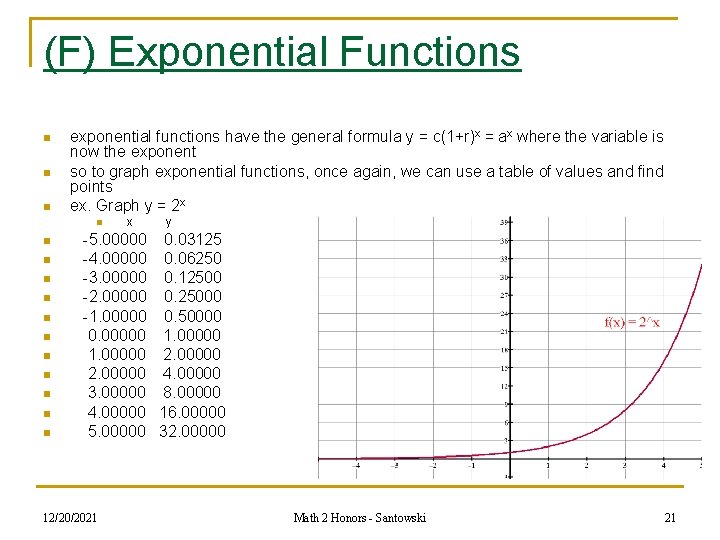
(F) Exponential Functions n n n exponential functions have the general formula y = c(1+r)x = ax where the variable is now the exponent so to graph exponential functions, once again, we can use a table of values and find points ex. Graph y = 2 x n n n x y -5. 00000 0. 03125 -4. 00000 0. 06250 -3. 00000 0. 12500 -2. 00000 0. 25000 -1. 00000 0. 50000 0. 00000 1. 00000 2. 00000 4. 00000 3. 00000 8. 00000 4. 00000 16. 00000 5. 00000 32. 00000 12/20/2021 Math 2 Honors - Santowski 21
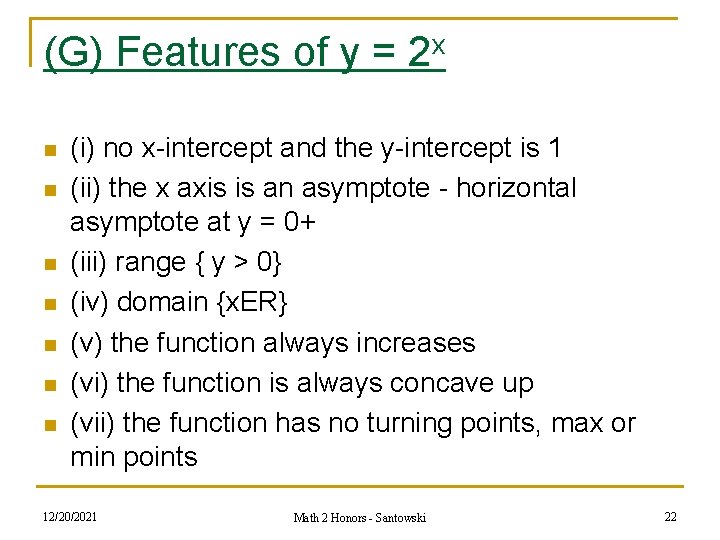
(G) Features of y = 2 x n n n n (i) no x-intercept and the y-intercept is 1 (ii) the x axis is an asymptote - horizontal asymptote at y = 0+ (iii) range { y > 0} (iv) domain {x. ER} (v) the function always increases (vi) the function is always concave up (vii) the function has no turning points, max or min points 12/20/2021 Math 2 Honors - Santowski 22
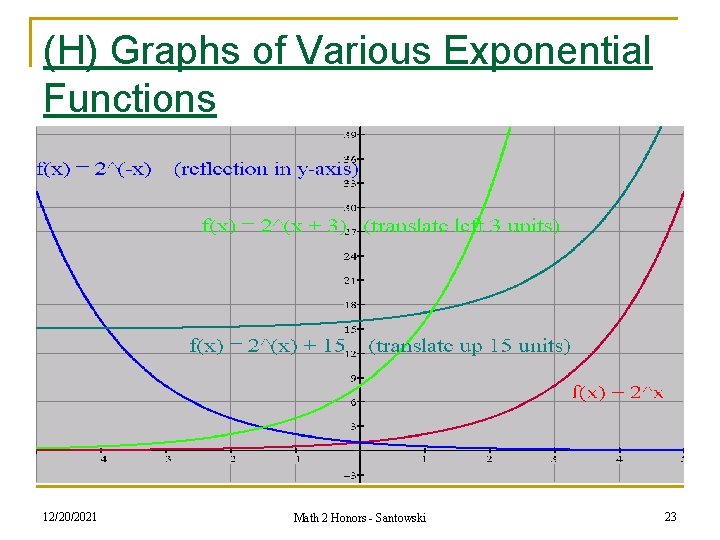
(H) Graphs of Various Exponential Functions 12/20/2021 Math 2 Honors - Santowski 23
(I) Transformed Exponential Graphs n n n As seen in the previous slide, the graph maintains the same “shape” or characteristics when transformed Depending on the transformations, the various key features (domain, range, intercepts, asymptotes) will change So if f(x) = 2 x for y = a f(b(x+c)) + d what features change and HOW? 12/20/2021 Math 2 Honors - Santowski 24
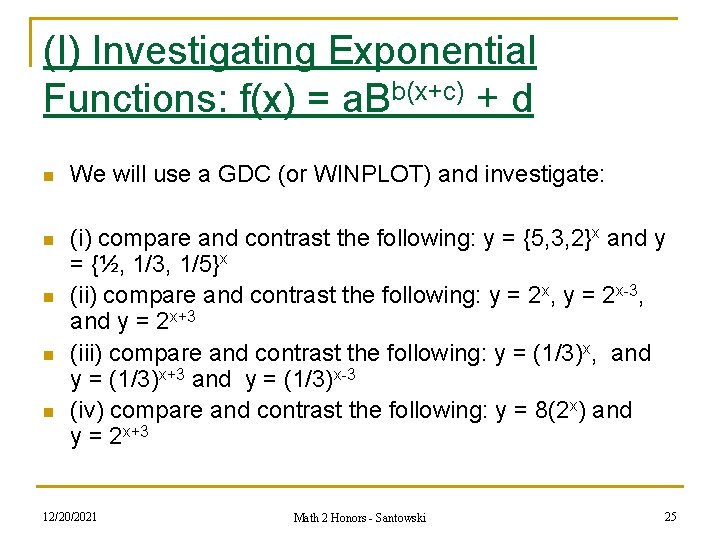
(I) Investigating Exponential Functions: f(x) = a. Bb(x+c) + d n We will use a GDC (or WINPLOT) and investigate: n (i) compare and contrast the following: y = {5, 3, 2}x and y = {½, 1/3, 1/5}x (ii) compare and contrast the following: y = 2 x, y = 2 x-3, and y = 2 x+3 (iii) compare and contrast the following: y = (1/3)x, and y = (1/3)x+3 and y = (1/3)x-3 (iv) compare and contrast the following: y = 8(2 x) and y = 2 x+3 n n n 12/20/2021 Math 2 Honors - Santowski 25
(J) Further Investigation – Internet Tutorial n n Go to this link from Analyze. Math and work through the tutorial on transformed exponential functions Consider how y = ax changes i. e. the range, asymptotes, increasing/decreasing nature of the function, shifting and reflecting 12/20/2021 Math 2 Honors - Santowski 26
(K) Homework n n n HW p. 358 # 27, 31, 35, 37, 38, 41, 42 -48, 51, 53 p. 367 # 14 -19, 24 -29, 31, 33, 35, 37, 49, 53 12/20/2021 Math 2 Honors - Santowski 27