
Lesson 3 Resultant Forces Physics KS 3 Forces

- Slides: 34
Lesson 3 - Resultant Forces Physics - KS 3 Forces and Motion Mrs Wolstenholme 1
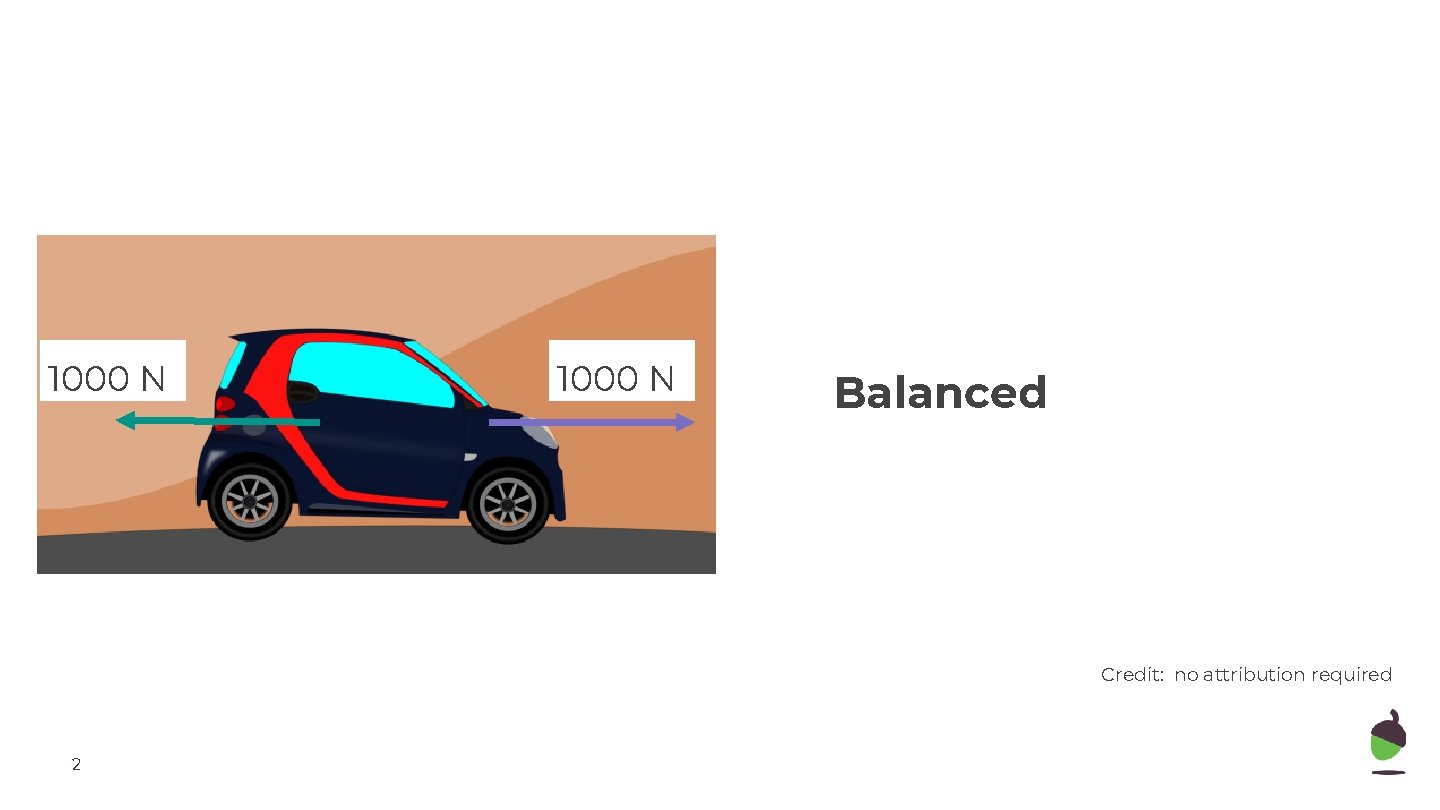
1000 N Balanced Credit: no attribution required 2
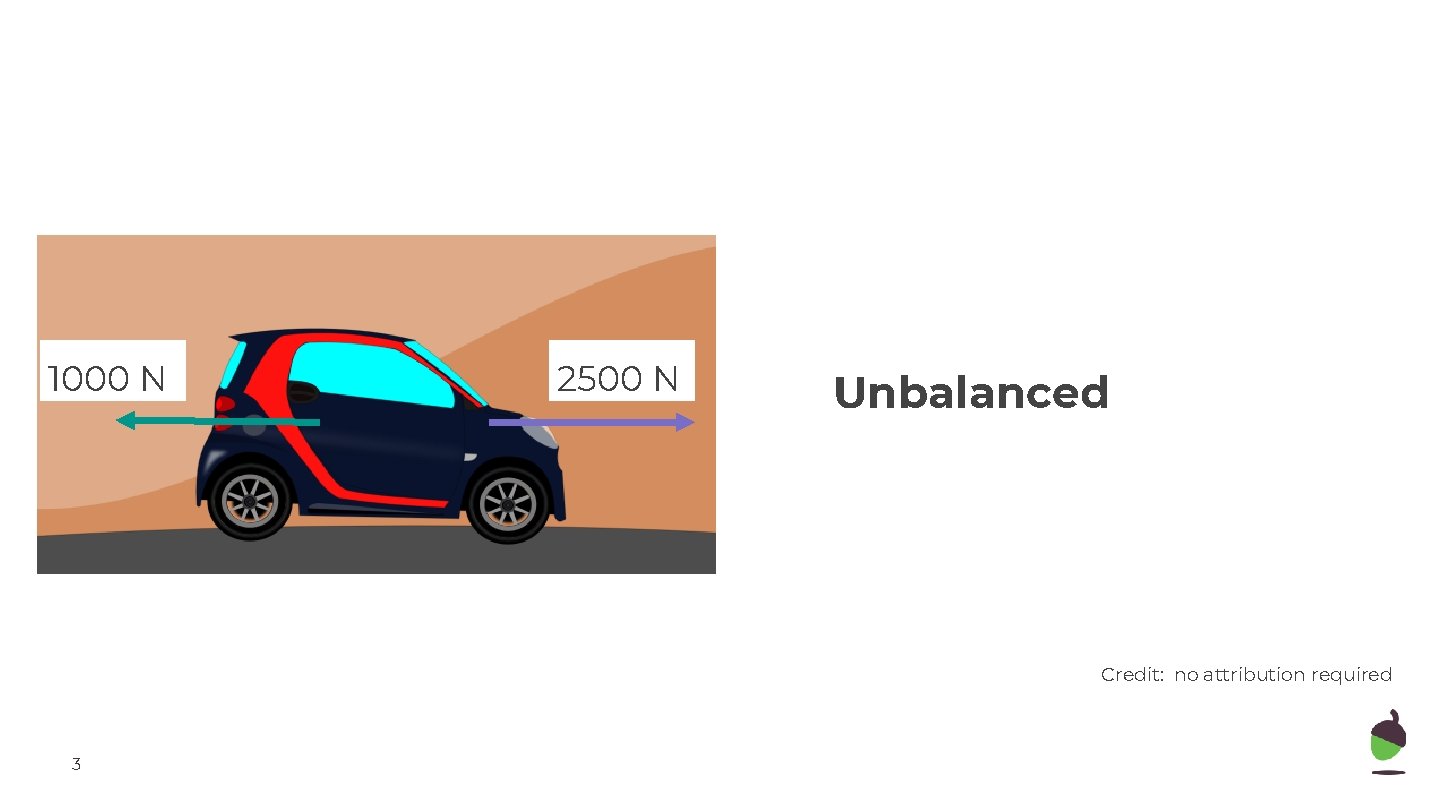
1000 N 2500 N Unbalanced Credit: no attribution required 3
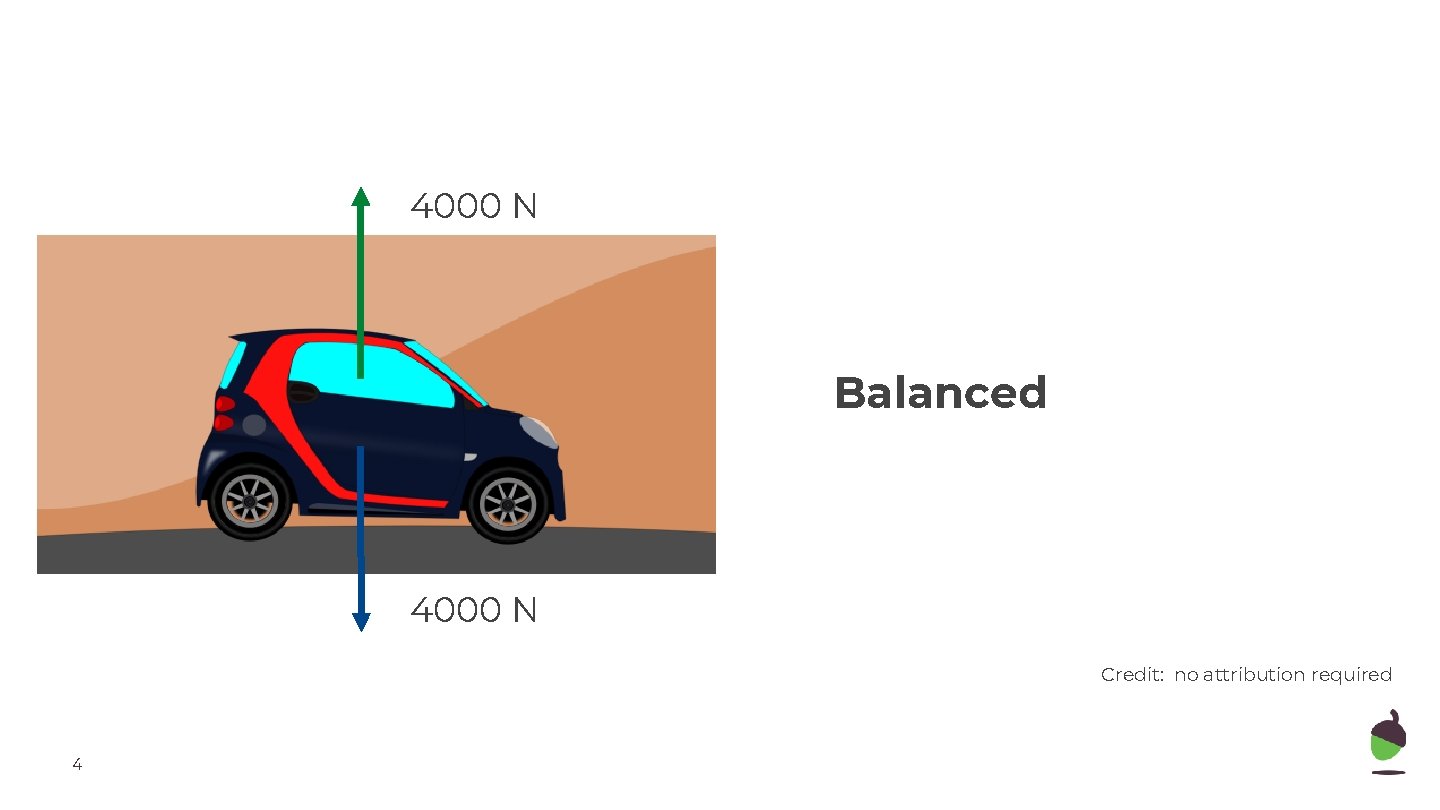
4000 N Balanced 4000 N Credit: no attribution required 4
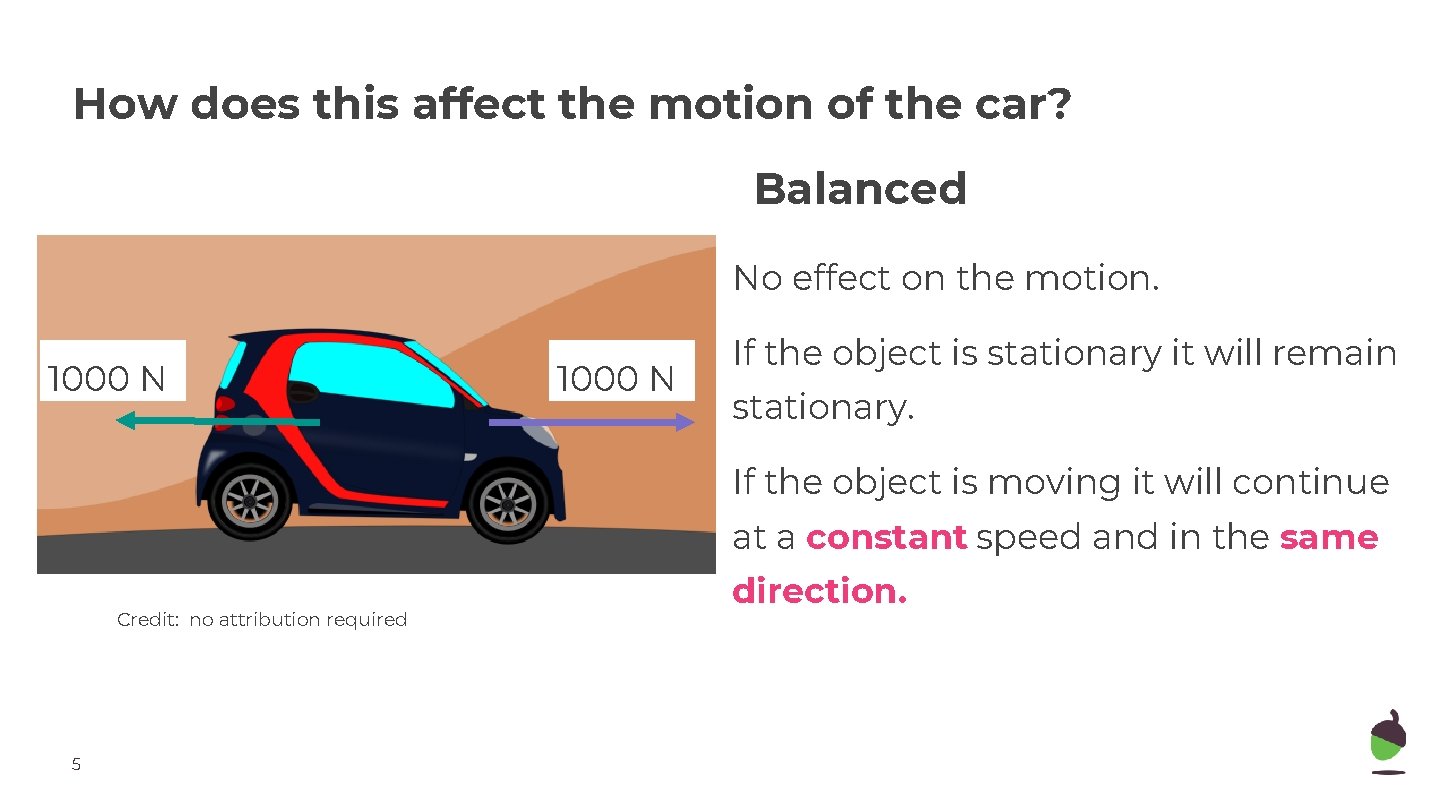
How does this affect the motion of the car? Balanced No effect on the motion. 1000 N If the object is stationary it will remain stationary. If the object is moving it will continue at a constant speed and in the same Credit: no attribution required 5 direction.
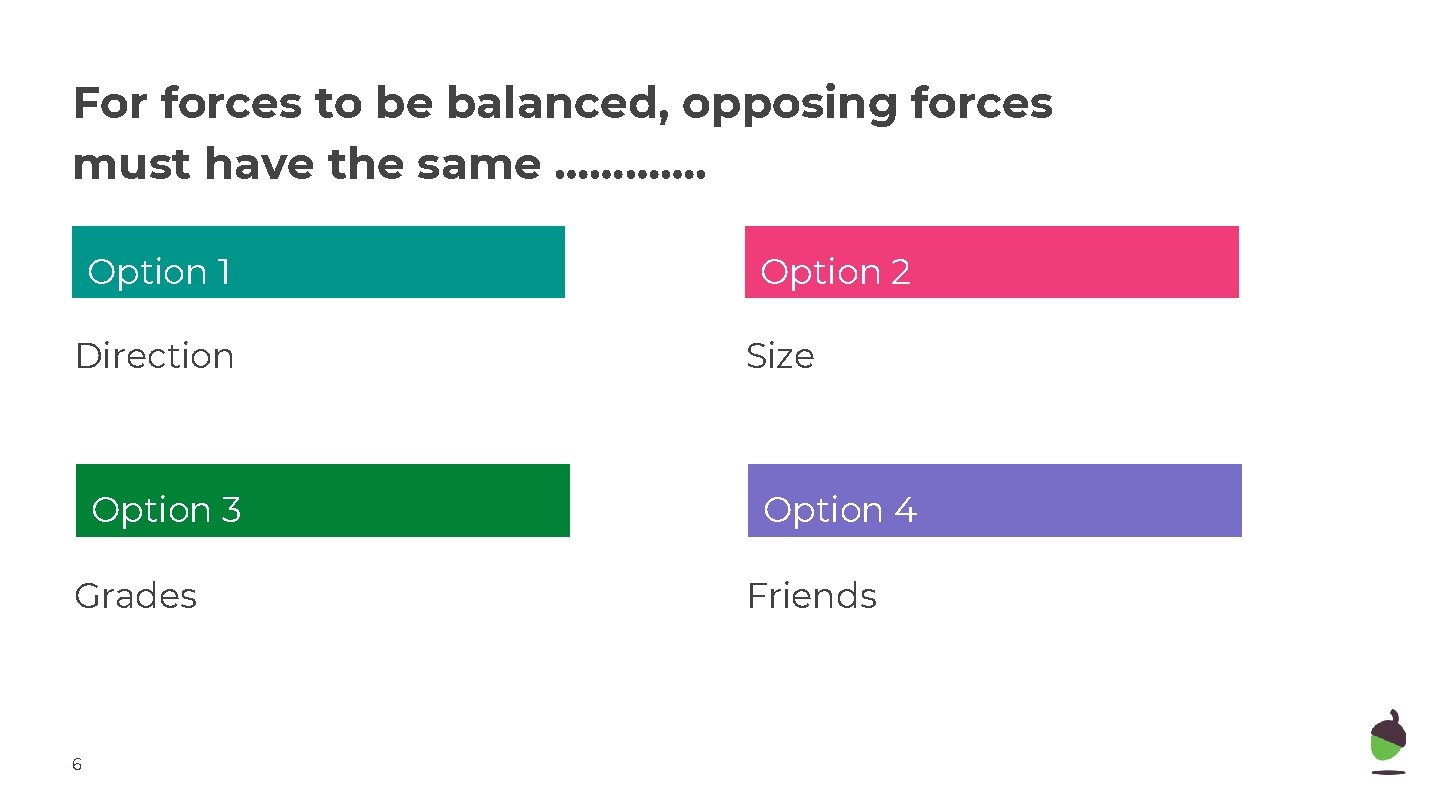
For forces to be balanced, opposing forces must have the same …………. Option 1 Direction Option 3 Grades 6 Option 2 Size Option 4 Friends
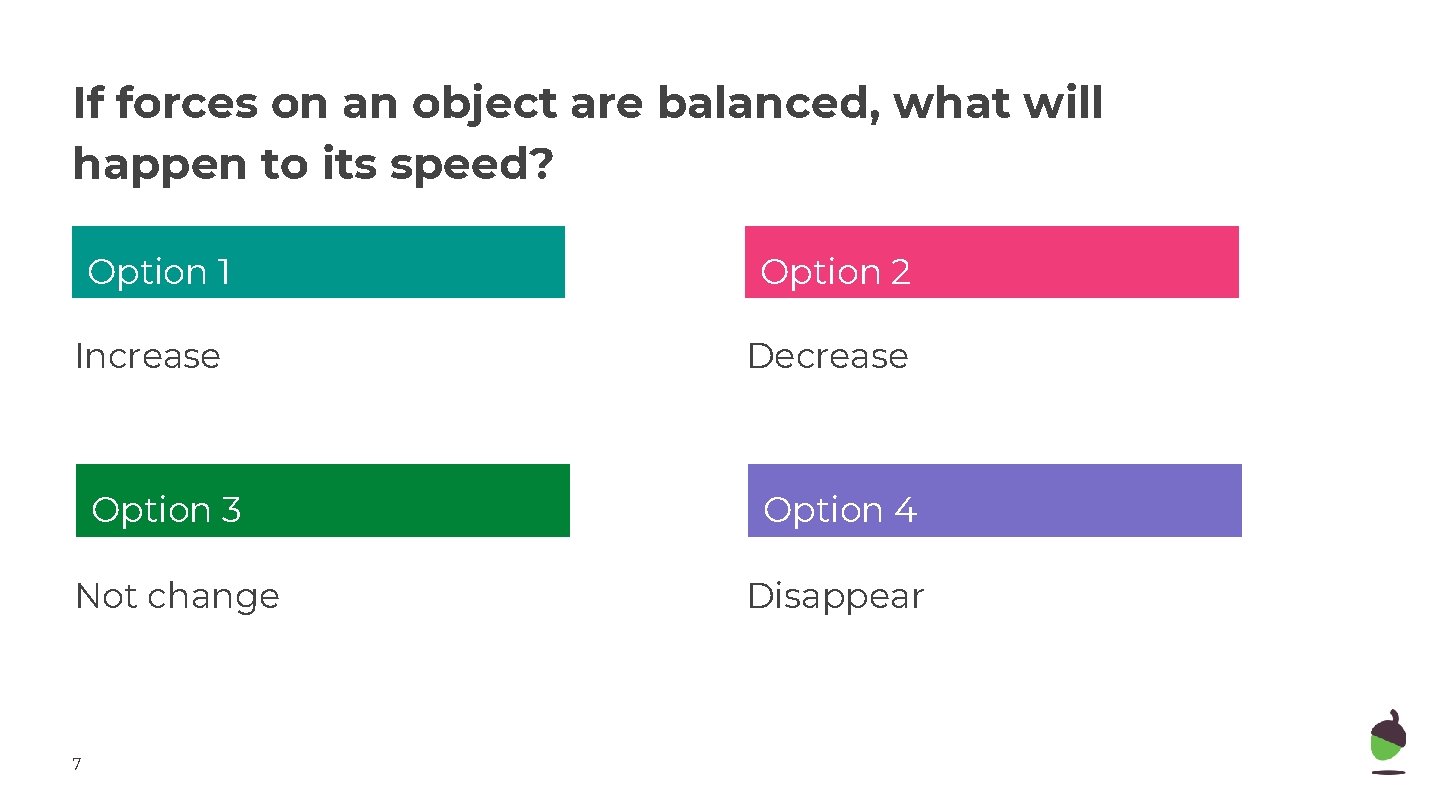
If forces on an object are balanced, what will happen to its speed? Option 1 Option 2 Increase Decrease Option 3 Option 4 Not change Disappear 7
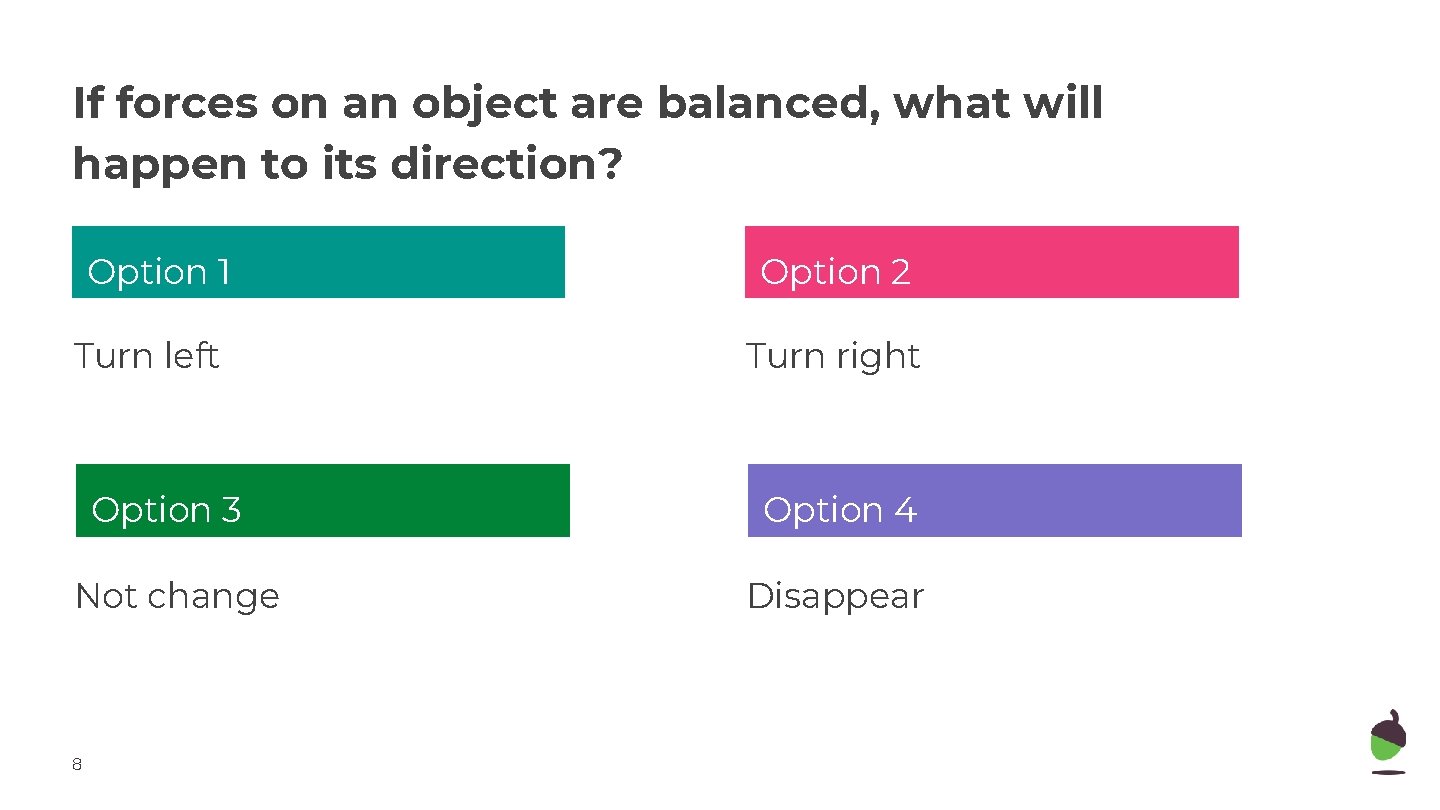
If forces on an object are balanced, what will happen to its direction? Option 1 Option 2 Turn left Turn right Option 3 Option 4 Not change Disappear 8
A person rides a bike at a constant speed in a straight line. What can we say about the forces? Option 1 The forces are balanced. Option 3 There are exactly 1000 forces. 9 Option 2 The forces are unbalanced. Option 4 There are no forces.
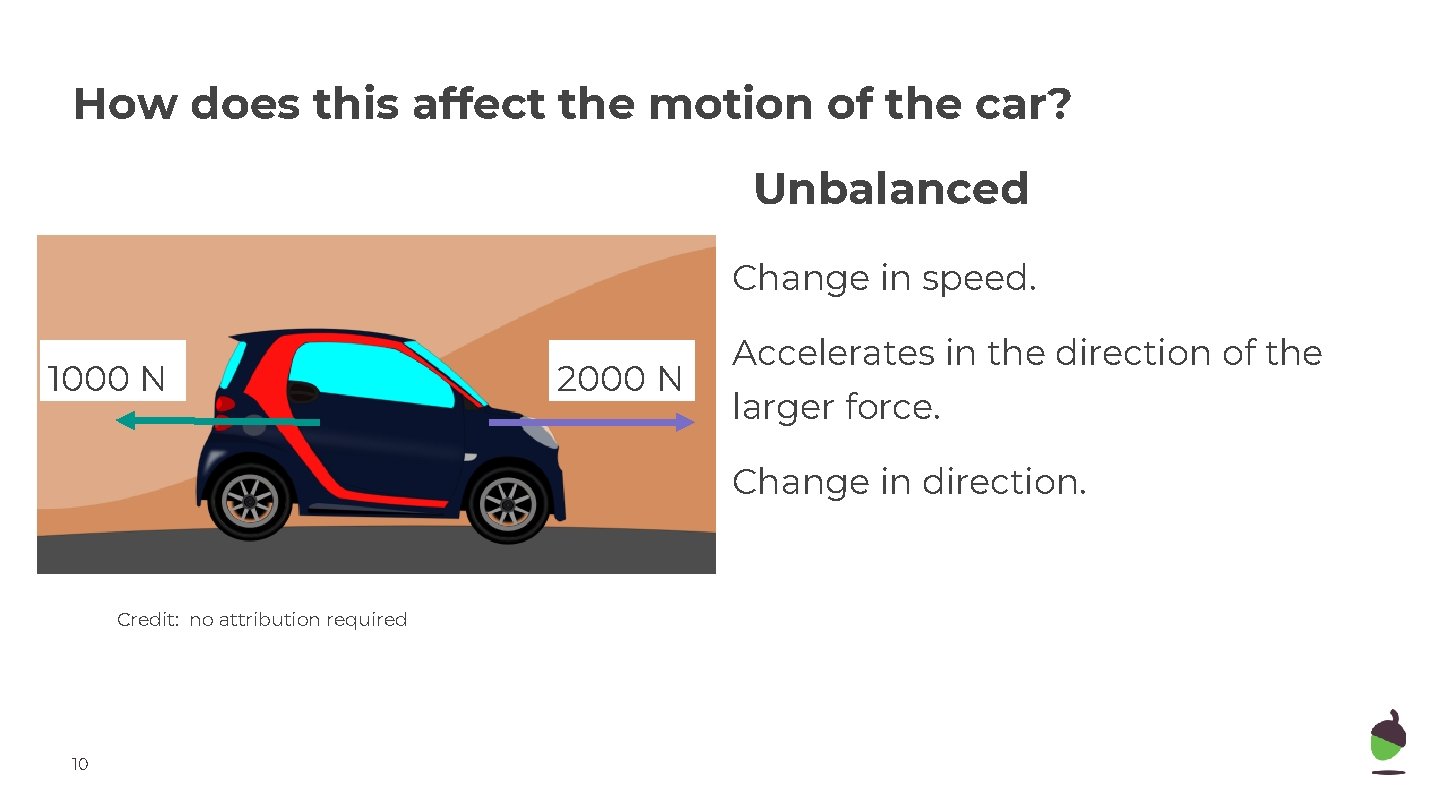
How does this affect the motion of the car? Unbalanced Change in speed. 1000 N 2000 N Accelerates in the direction of the larger force. Change in direction. Credit: no attribution required 10
For forces to be unbalanced, opposing forces must have be ………. . Option 1 The same direction Option 3 Different sizes 11 Option 2 The same size Option 4 Friends
If forces on an object are unbalanced, what could happen to its speed? (2 answers) Option 1 Option 2 Increase Decrease Option 3 Option 4 Not change Disappear 12
If forces on an object are unbalanced, what could happen to its direction? Option 1 Get larger Option 2 Change Option 3 Option 4 Not change Disappear 13
A person accelerates as they ride a bike in a straight line. What can we say about the forces? Option 1 The forces are balanced. Option 3 There are exactly 1000 forces. 14 Option 2 The forces are unbalanced. Option 4 There are no forces.
A person rides a bike at constant speed and turns left. What can we say about the forces? Option 1 The forces are balanced. Option 3 There are exactly 1000 forces. 15 Option 2 The forces are unbalanced. Option 4 There are no forces.
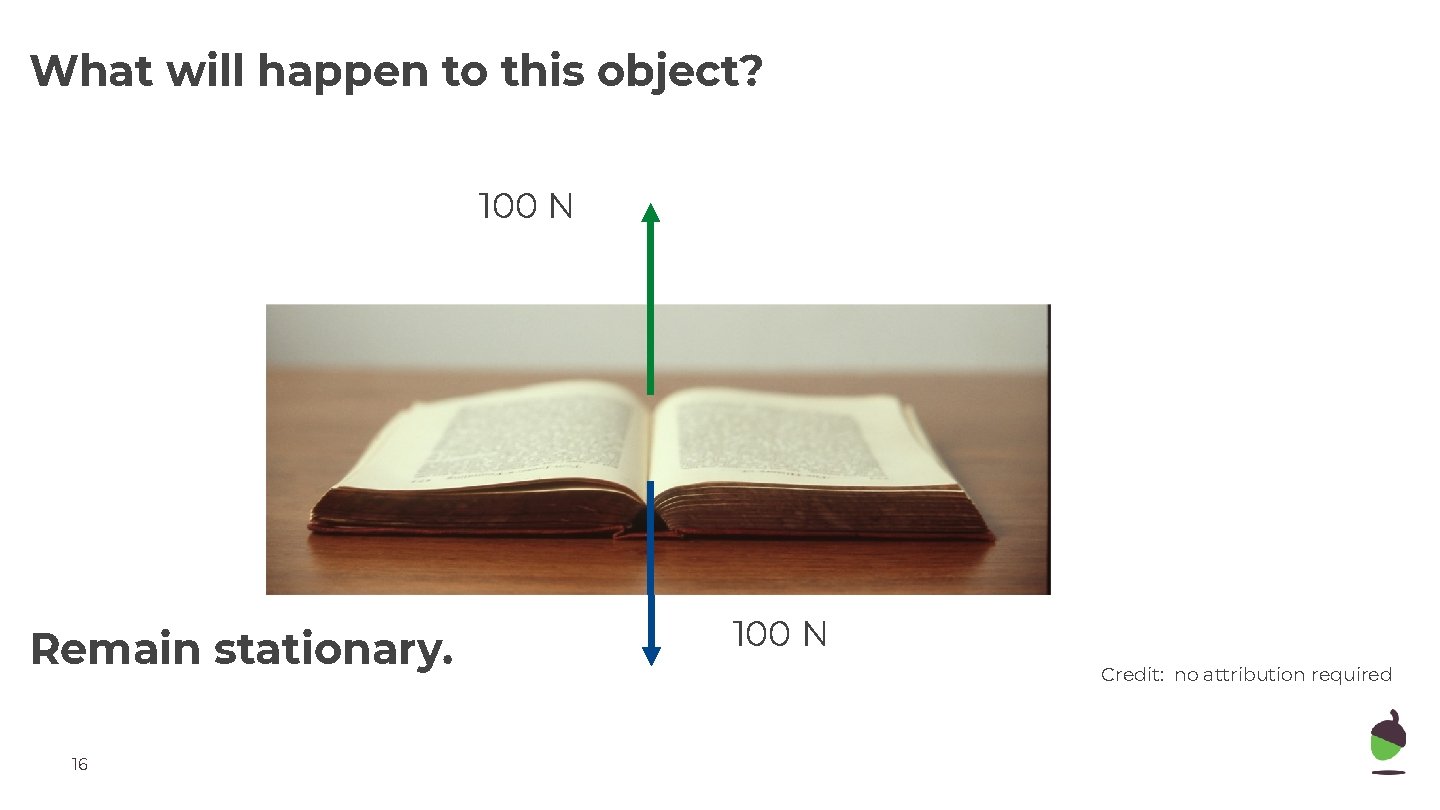
What will happen to this object? 100 N Remain stationary. 16 100 N Credit: no attribution required
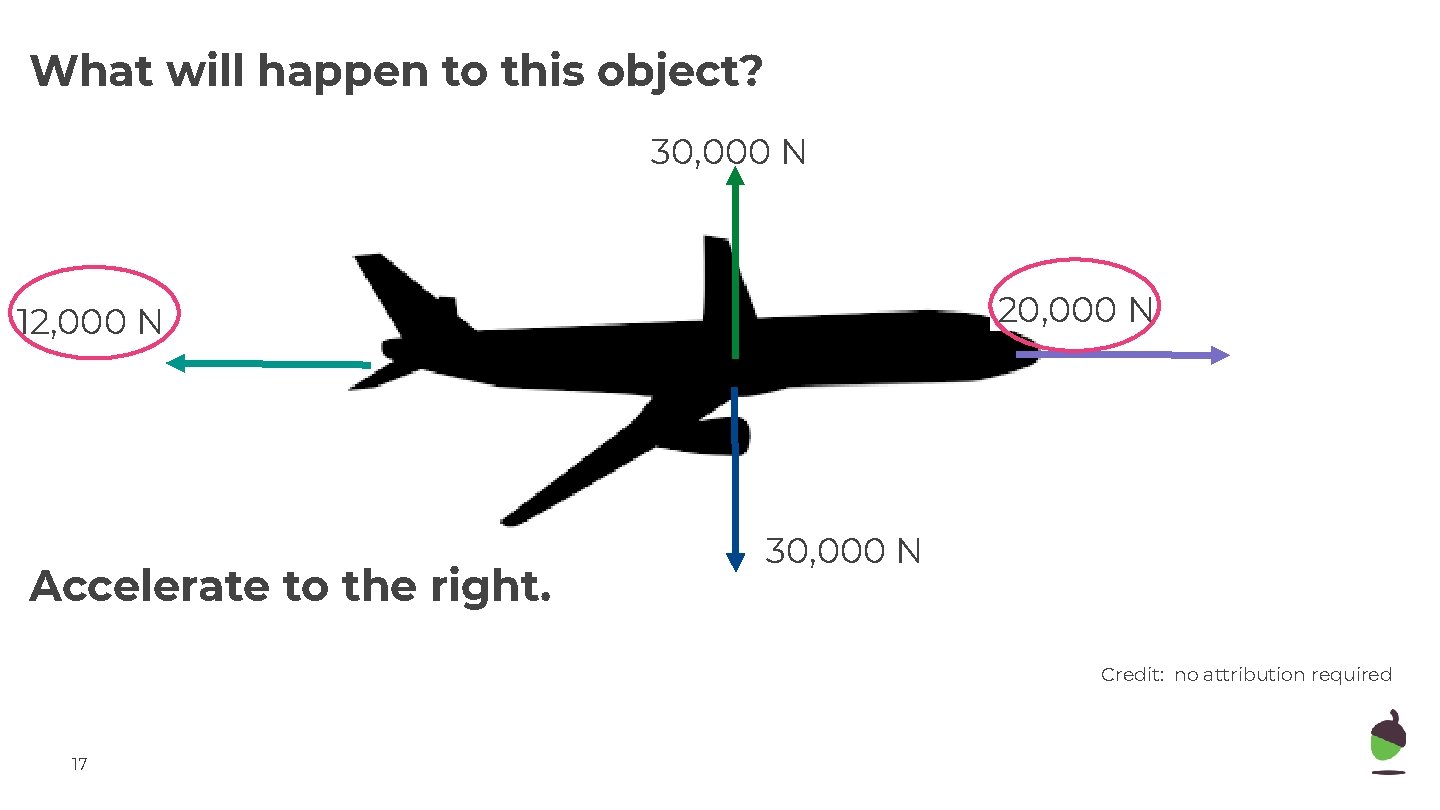
What will happen to this object? 30, 000 N 20, 000 N 12, 000 N Accelerate to the right. 30, 000 N Credit: no attribution required 17
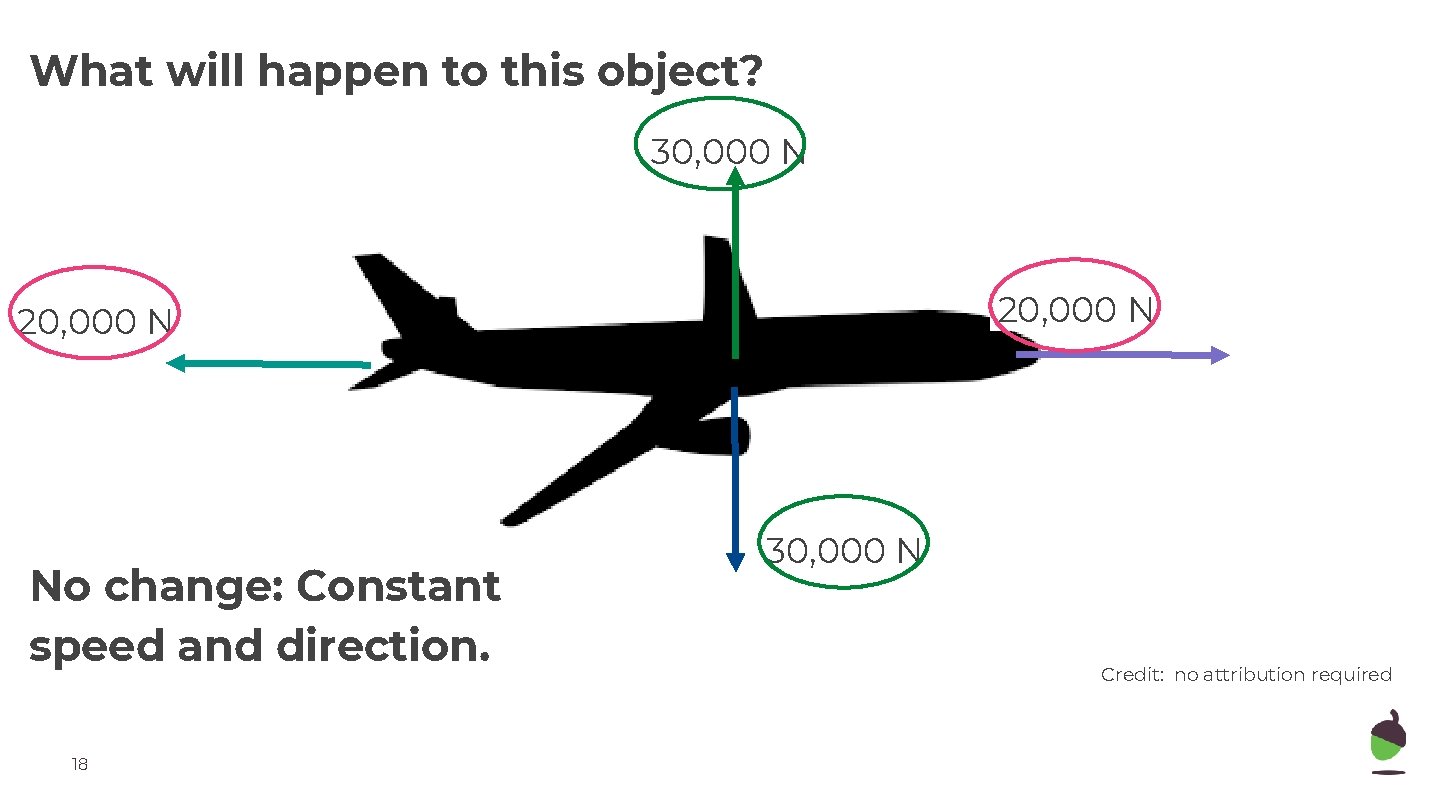
What will happen to this object? 30, 000 N 20, 000 N No change: Constant speed and direction. 18 30, 000 N Credit: no attribution required
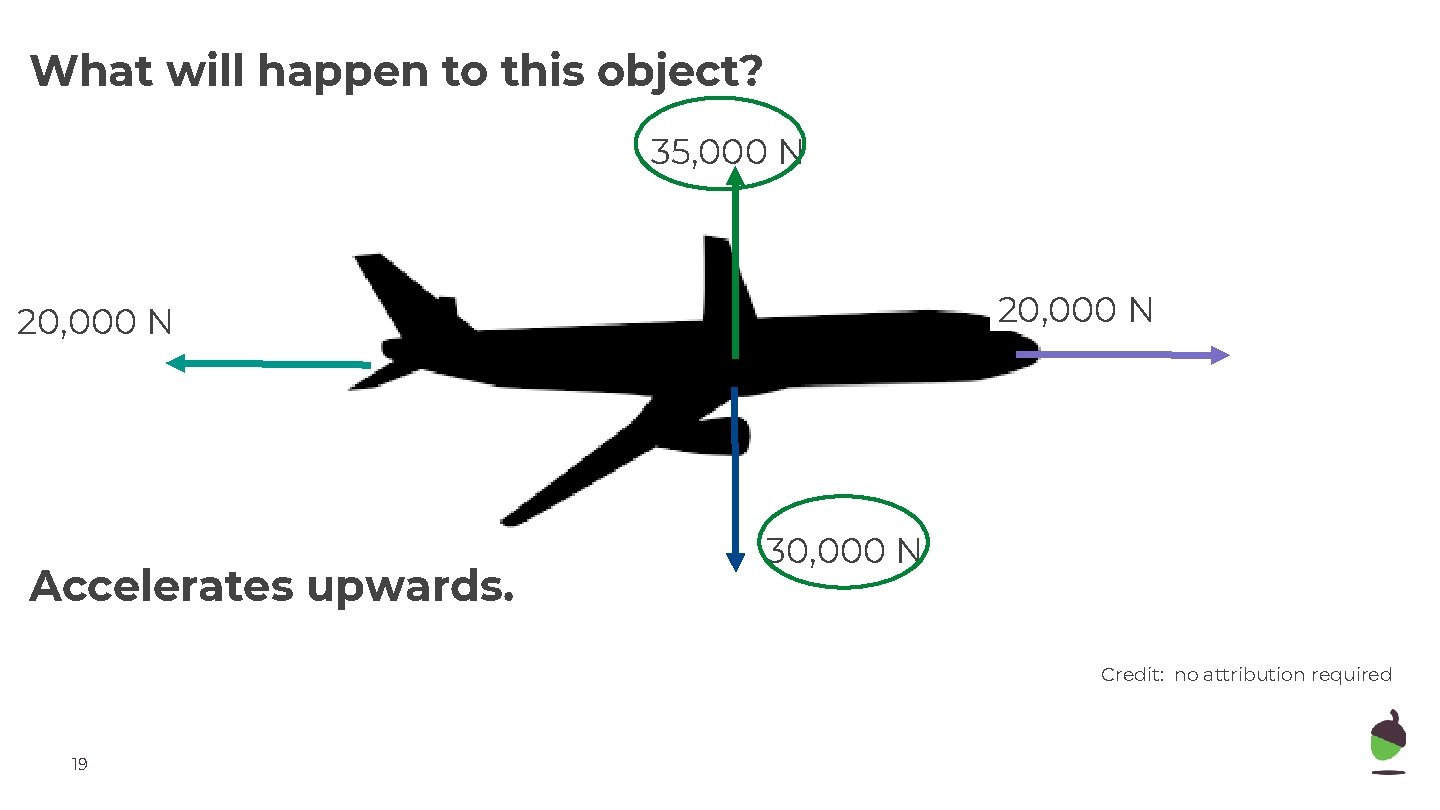
What will happen to this object? 35, 000 N 20, 000 N Accelerates upwards. 30, 000 N Credit: no attribution required 19
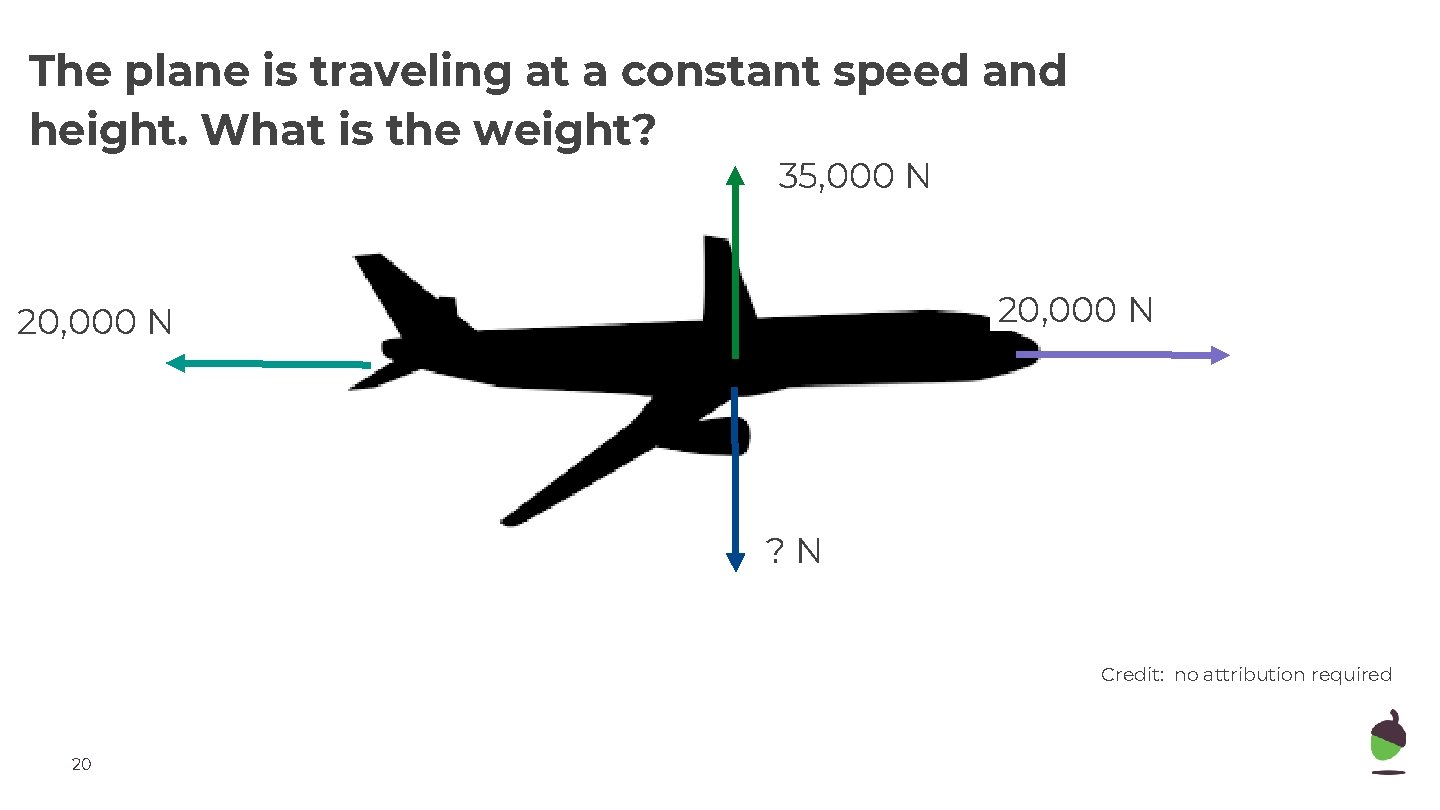
The plane is traveling at a constant speed and height. What is the weight? 35, 000 N 20, 000 N ? N Credit: no attribution required 20
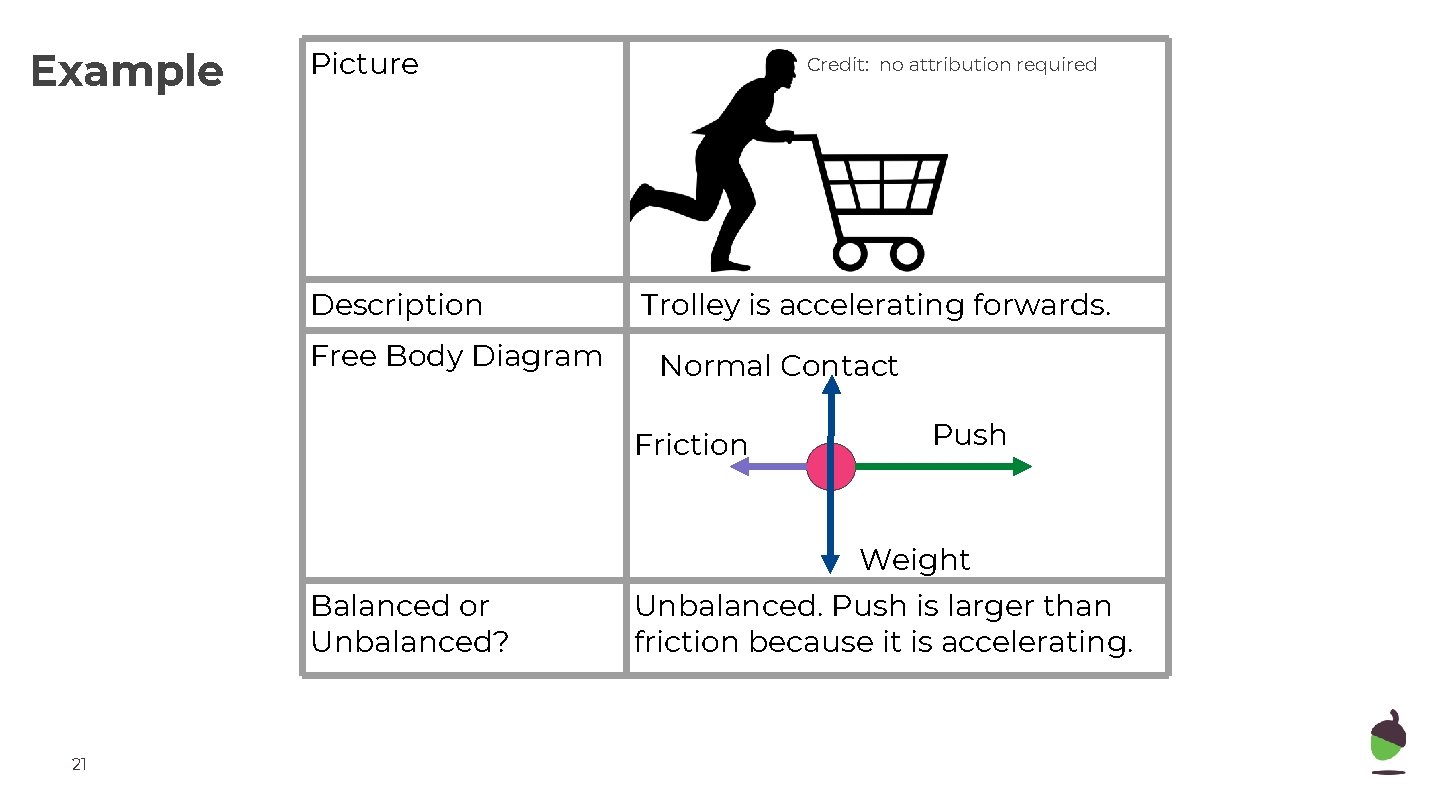
Example Picture Description Free Body Diagram Credit: no attribution required Trolley is accelerating forwards. Normal Contact Friction Push Weight Balanced or Unbalanced? 21 Unbalanced. Push is larger than friction because it is accelerating.
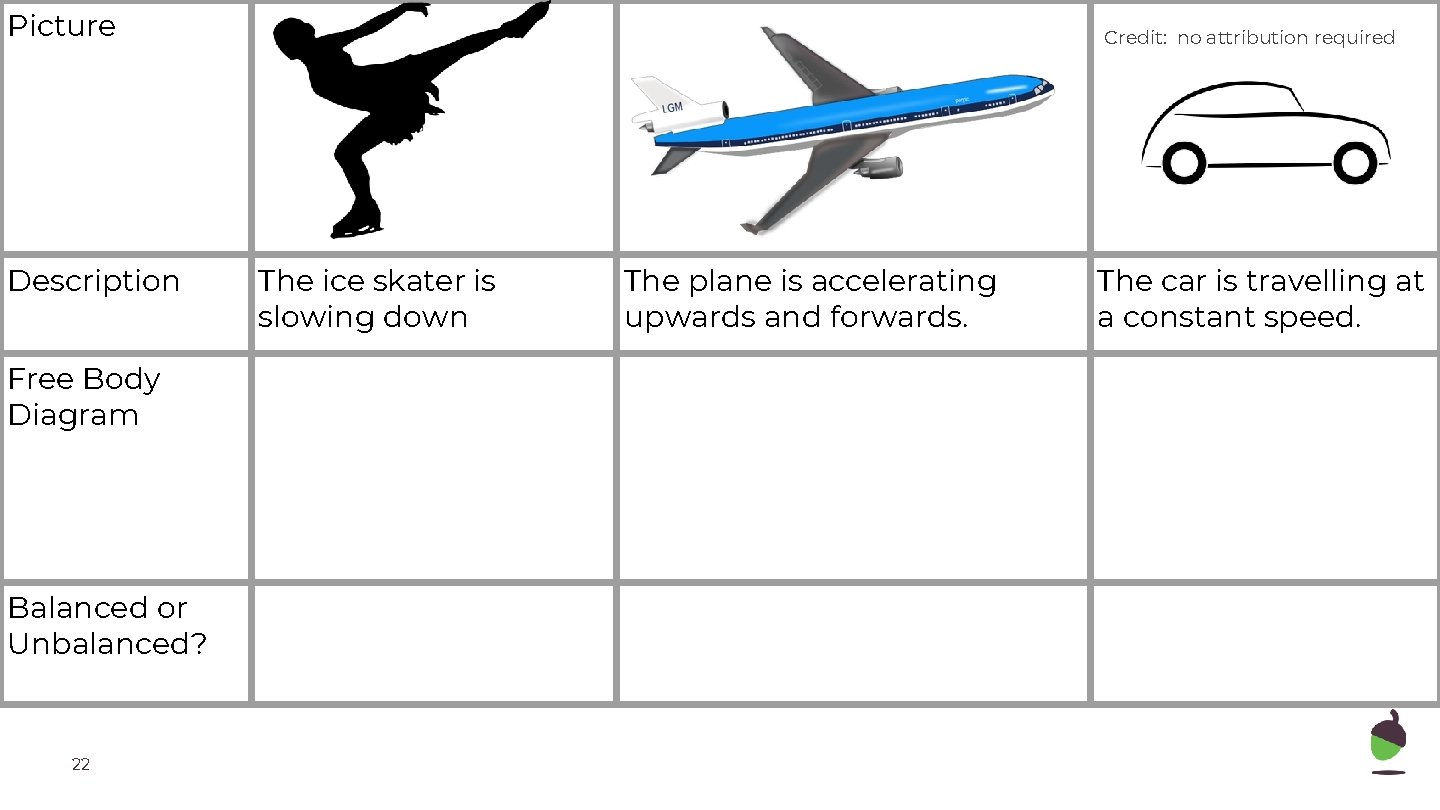
Picture Description Free Body Diagram Balanced or Unbalanced? 22 Credit: no attribution required The ice skater is slowing down The plane is accelerating upwards and forwards. The car is travelling at a constant speed.
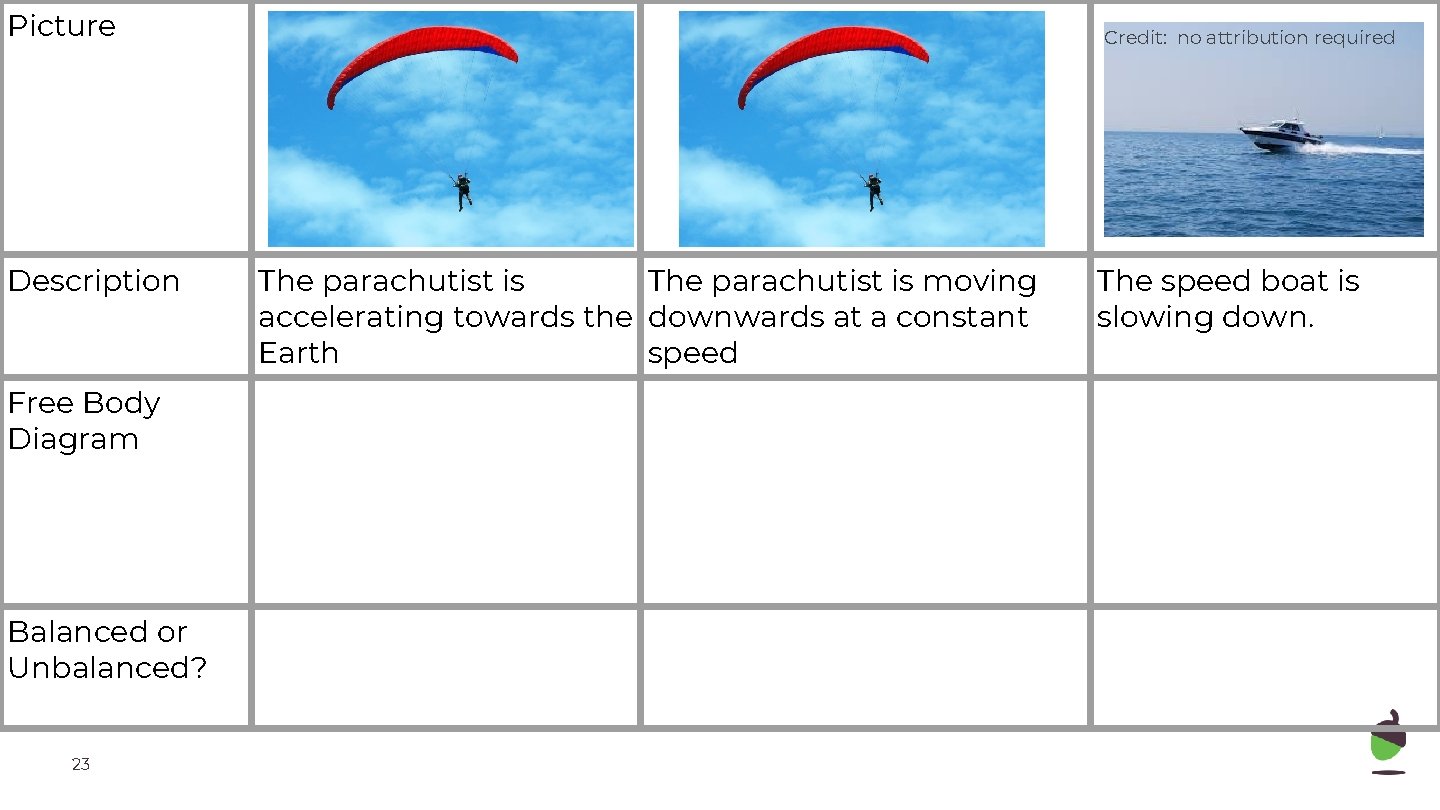
Picture Description Free Body Diagram Balanced or Unbalanced? 23 Credit: no attribution required The parachutist is moving accelerating towards the downwards at a constant Earth speed The speed boat is slowing down.
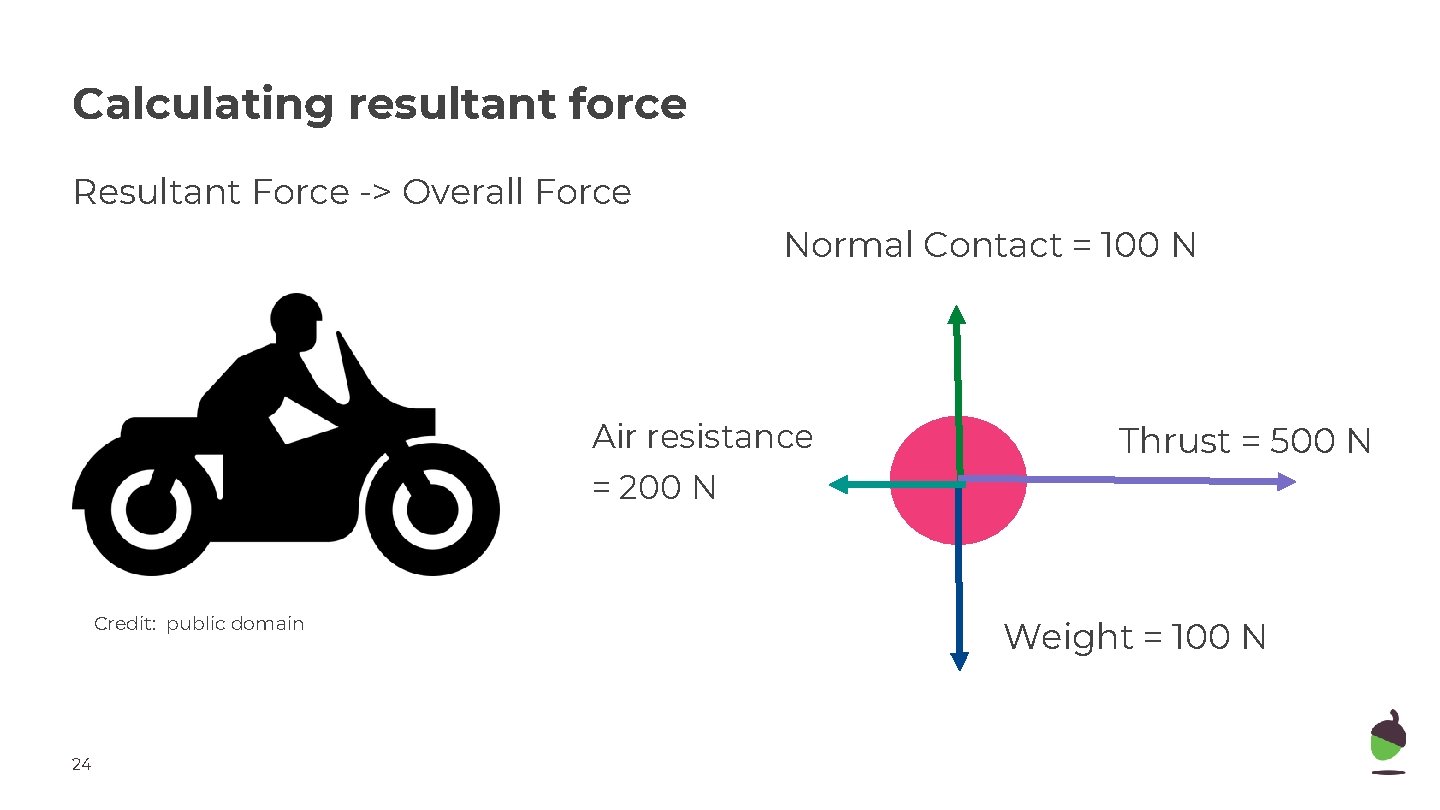
Calculating resultant force Resultant Force -> Overall Force Normal Contact = 100 N Air resistance = 200 N Credit: public domain 24 Thrust = 500 N Weight = 100 N
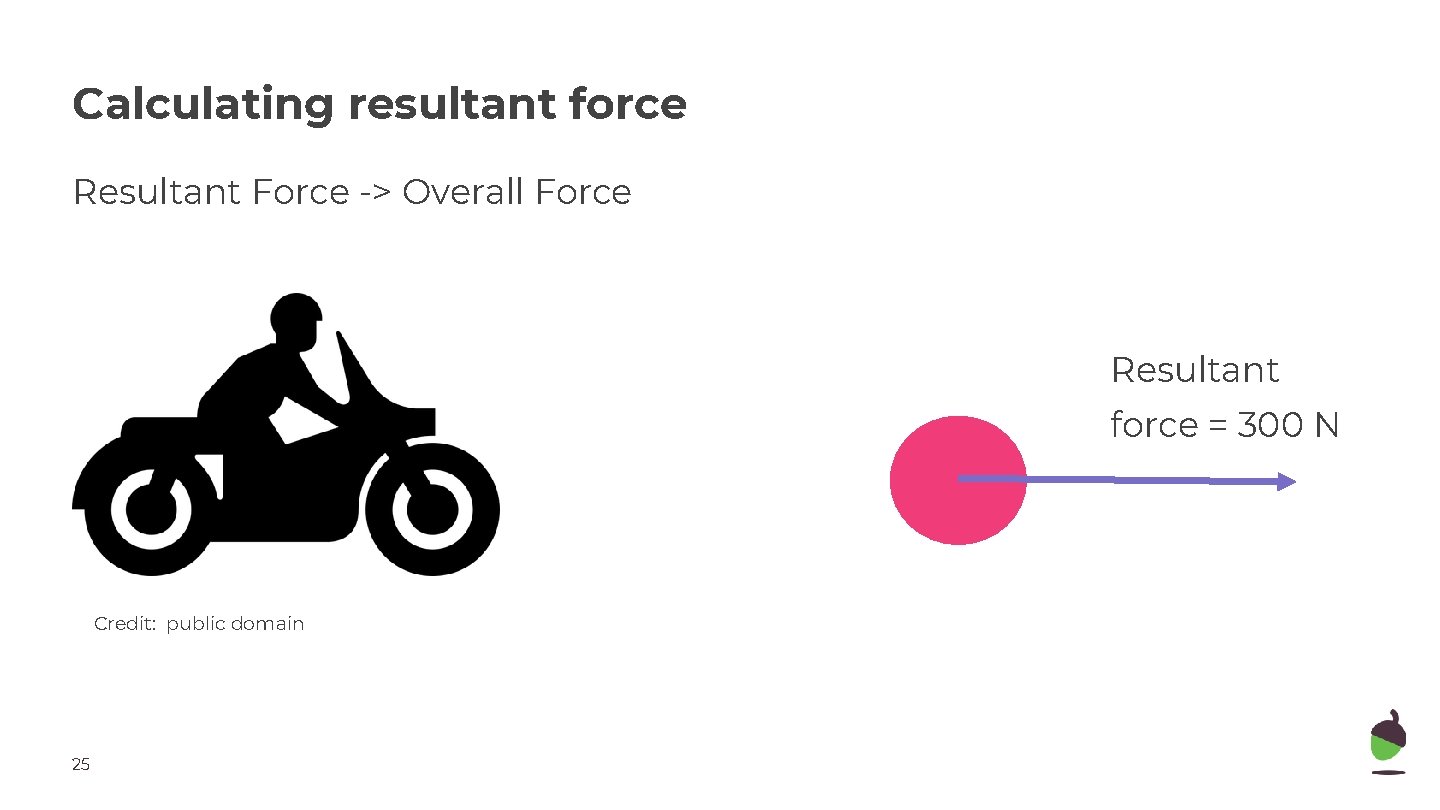
Calculating resultant force Resultant Force -> Overall Force Resultant force = 300 N Credit: public domain 25
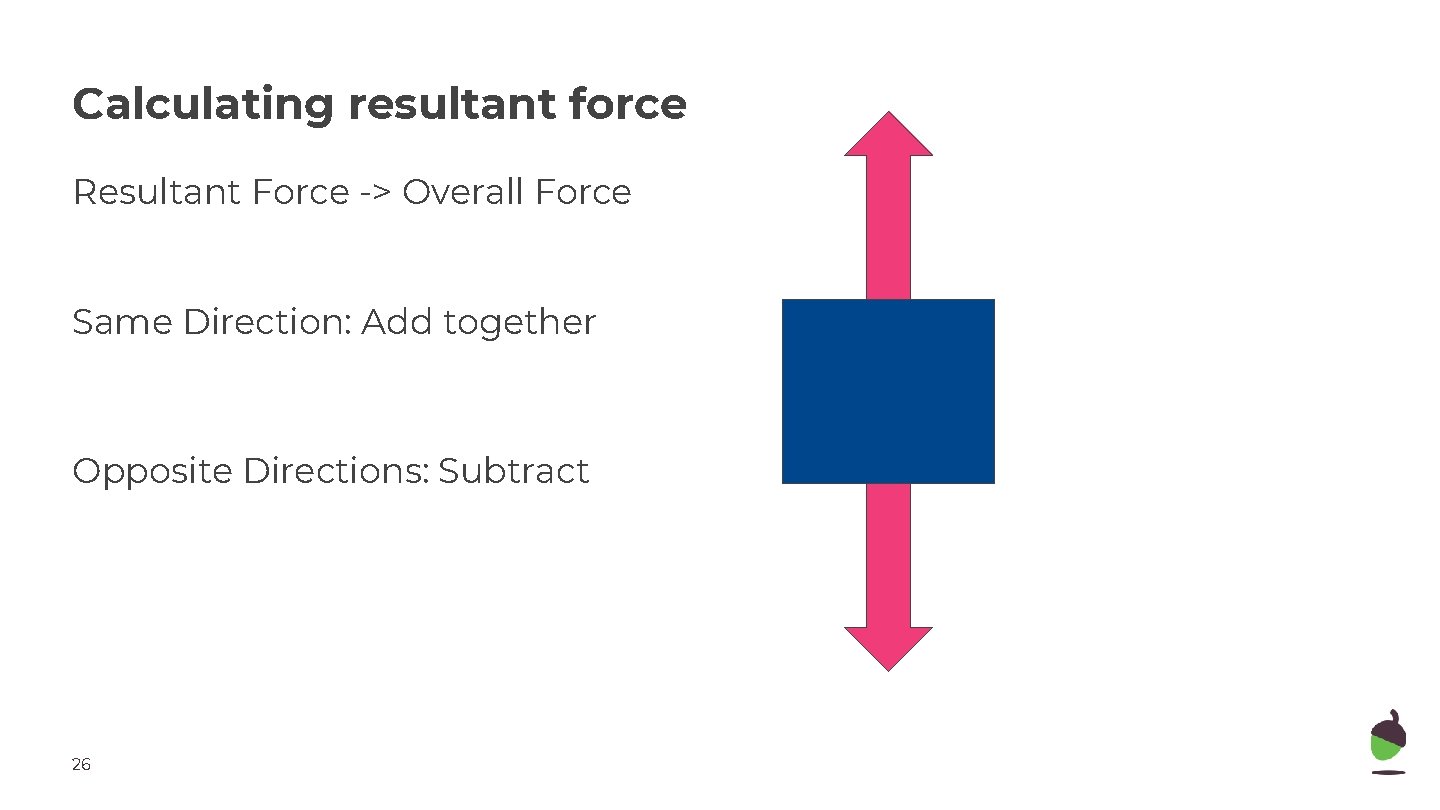
Calculating resultant force Resultant Force -> Overall Force Same Direction: Add together Opposite Directions: Subtract 26
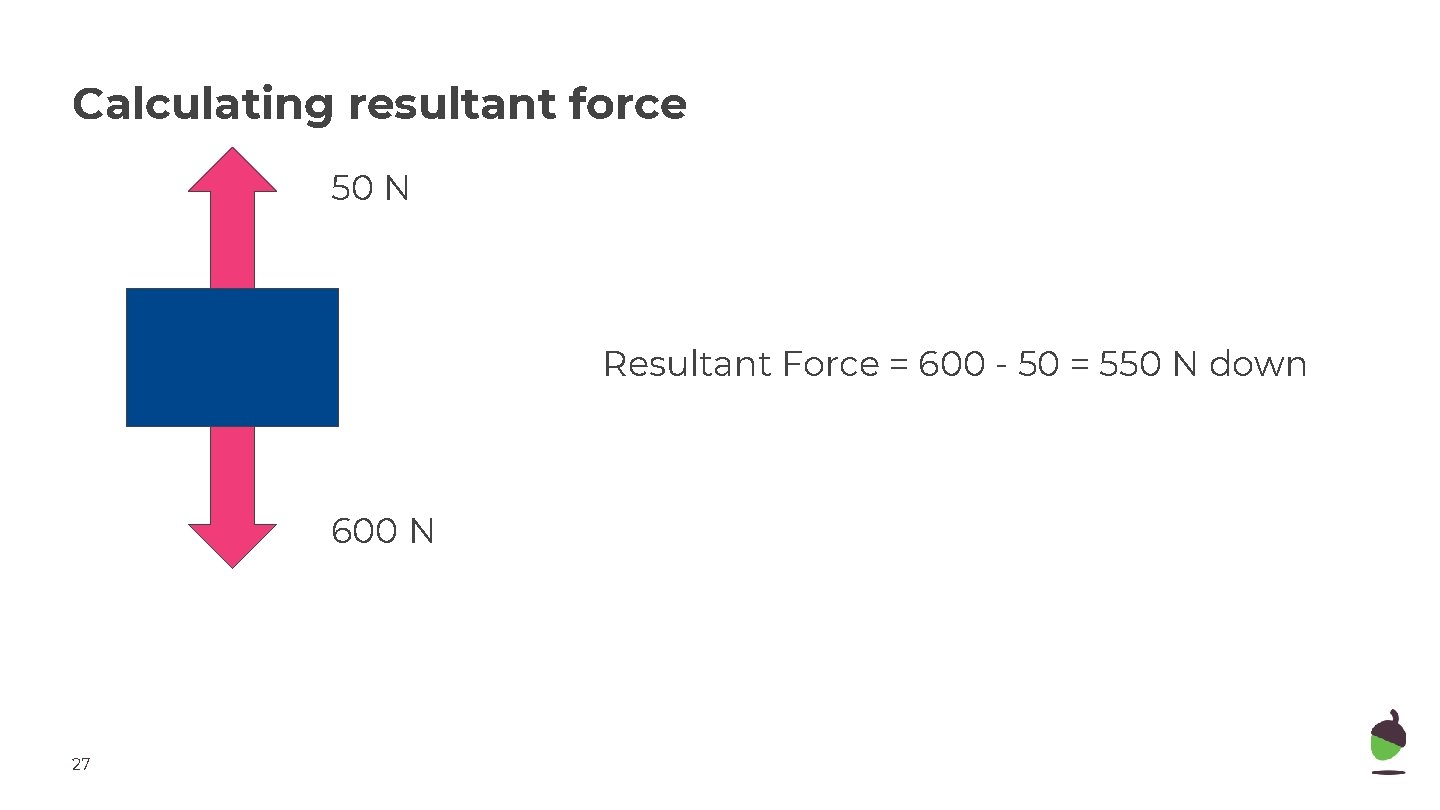
Calculating resultant force 50 N Resultant Force = 600 - 50 = 550 N down 600 N 27
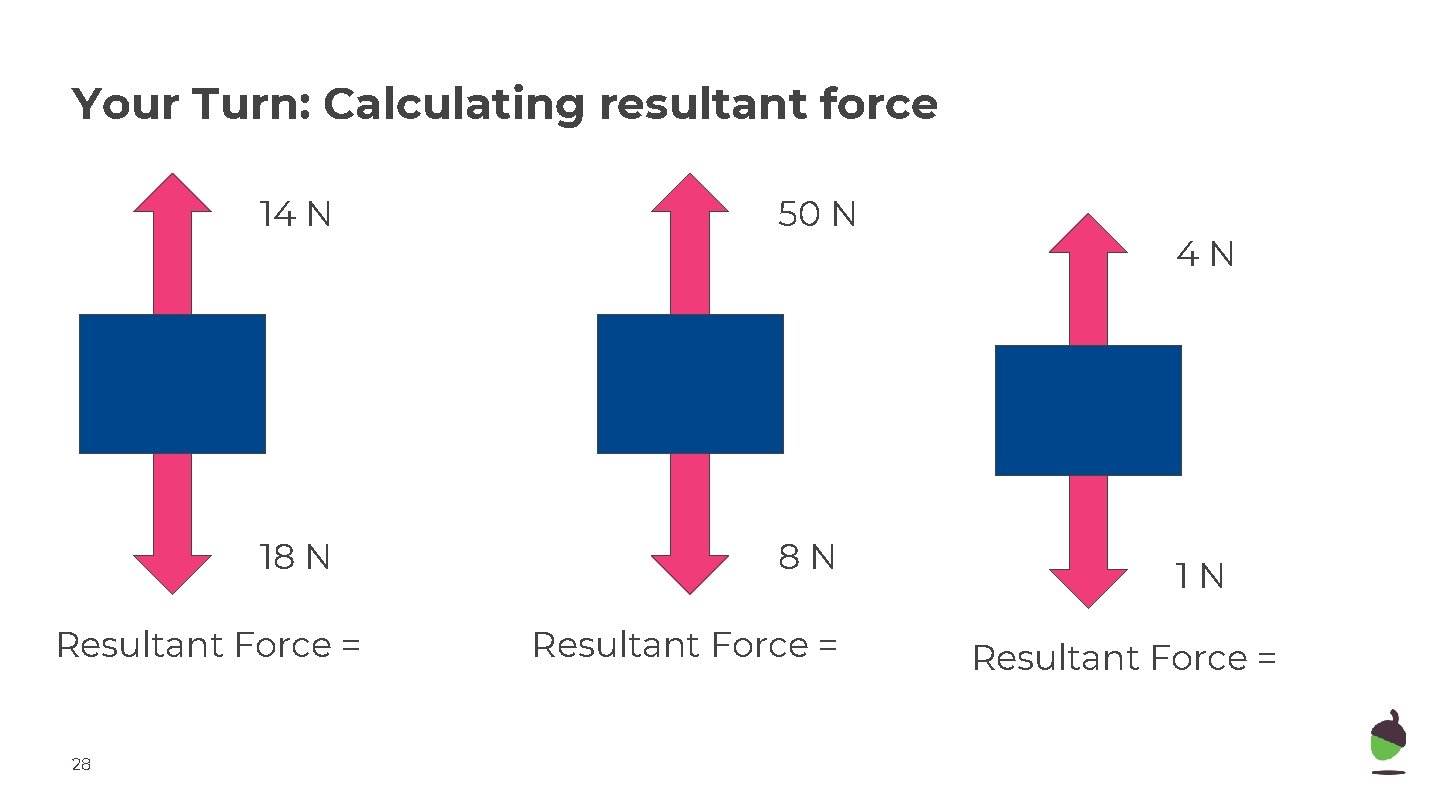
Your Turn: Calculating resultant force 14 N 50 N 18 N 8 N Resultant Force = 28 Resultant Force = 4 N 1 N Resultant Force =
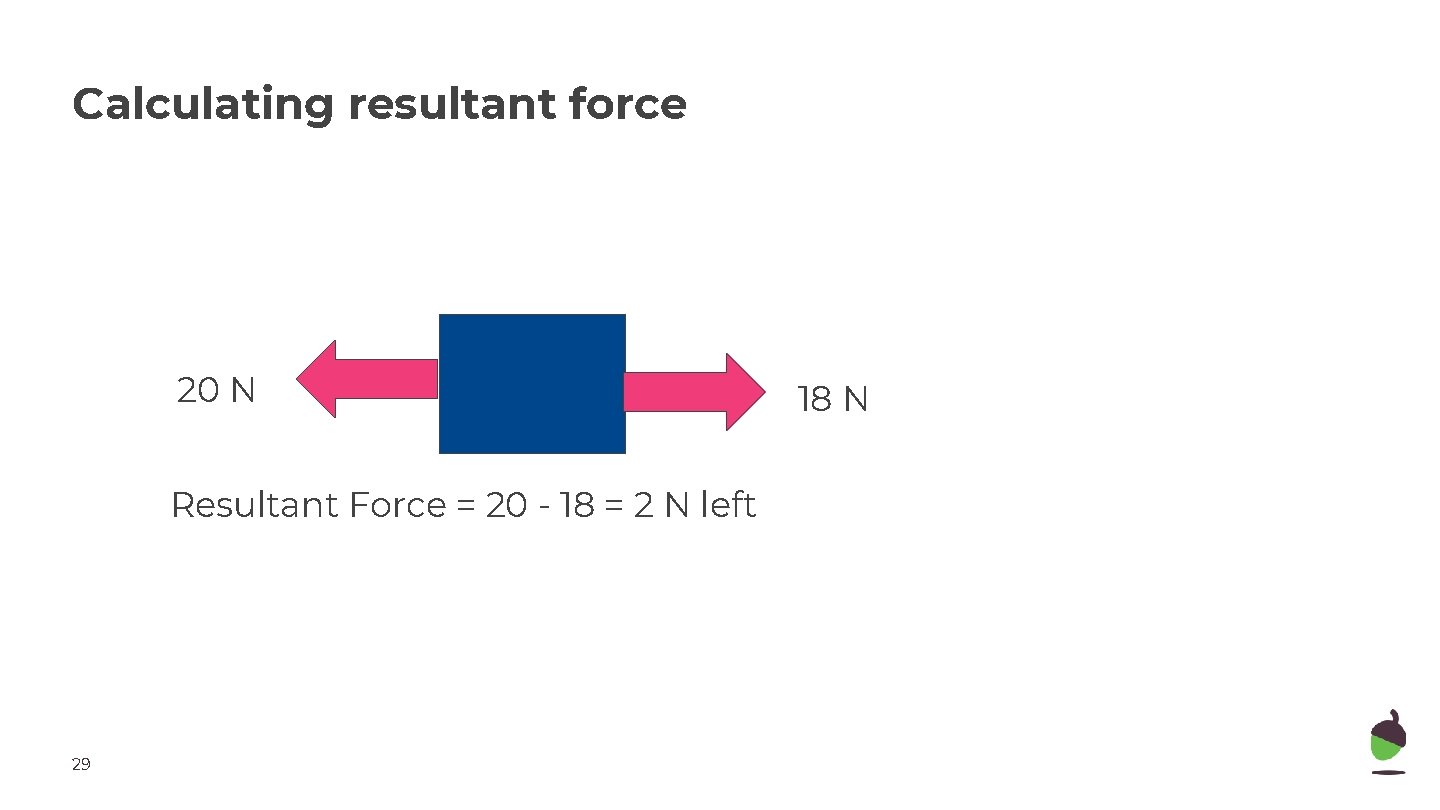
Calculating resultant force 20 N Resultant Force = 20 - 18 = 2 N left 29 18 N
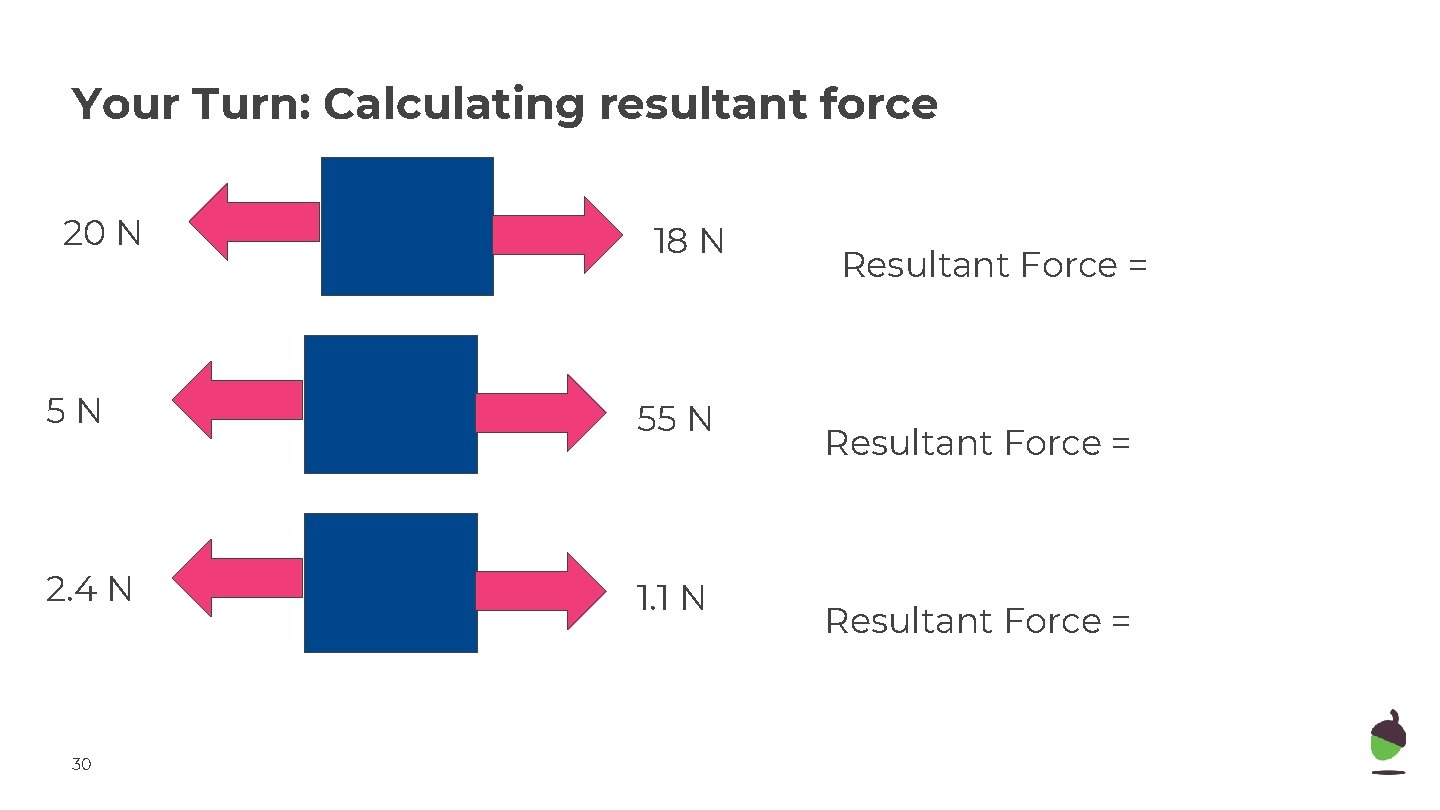
Your Turn: Calculating resultant force 20 N 18 N 5 N 55 N 2. 4 N 1. 1 N 30 Resultant Force =
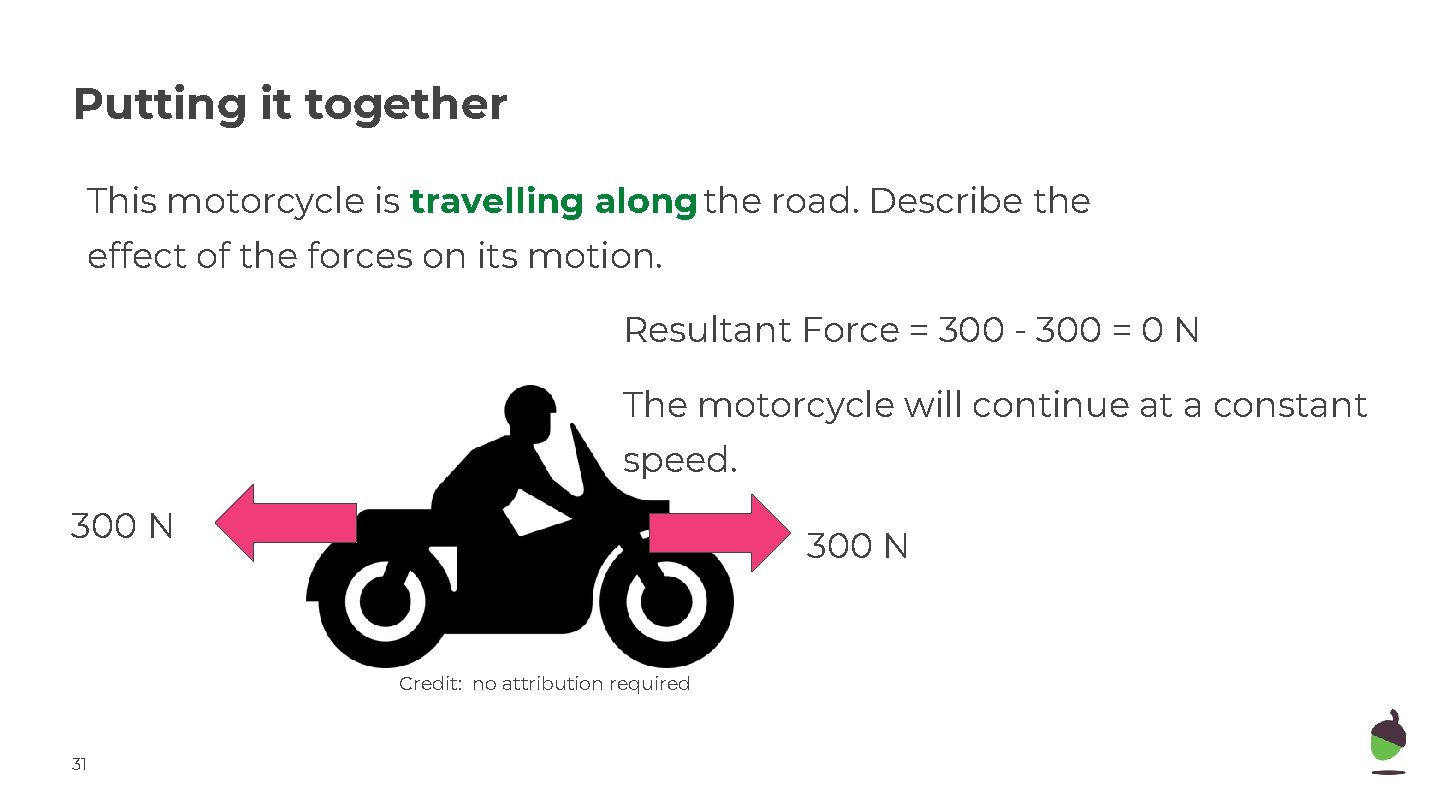
Putting it together This motorcycle is travelling along the road. Describe the effect of the forces on its motion. Resultant Force = 300 - 300 = 0 N The motorcycle will continue at a constant speed. 300 N Credit: no attribution required 31
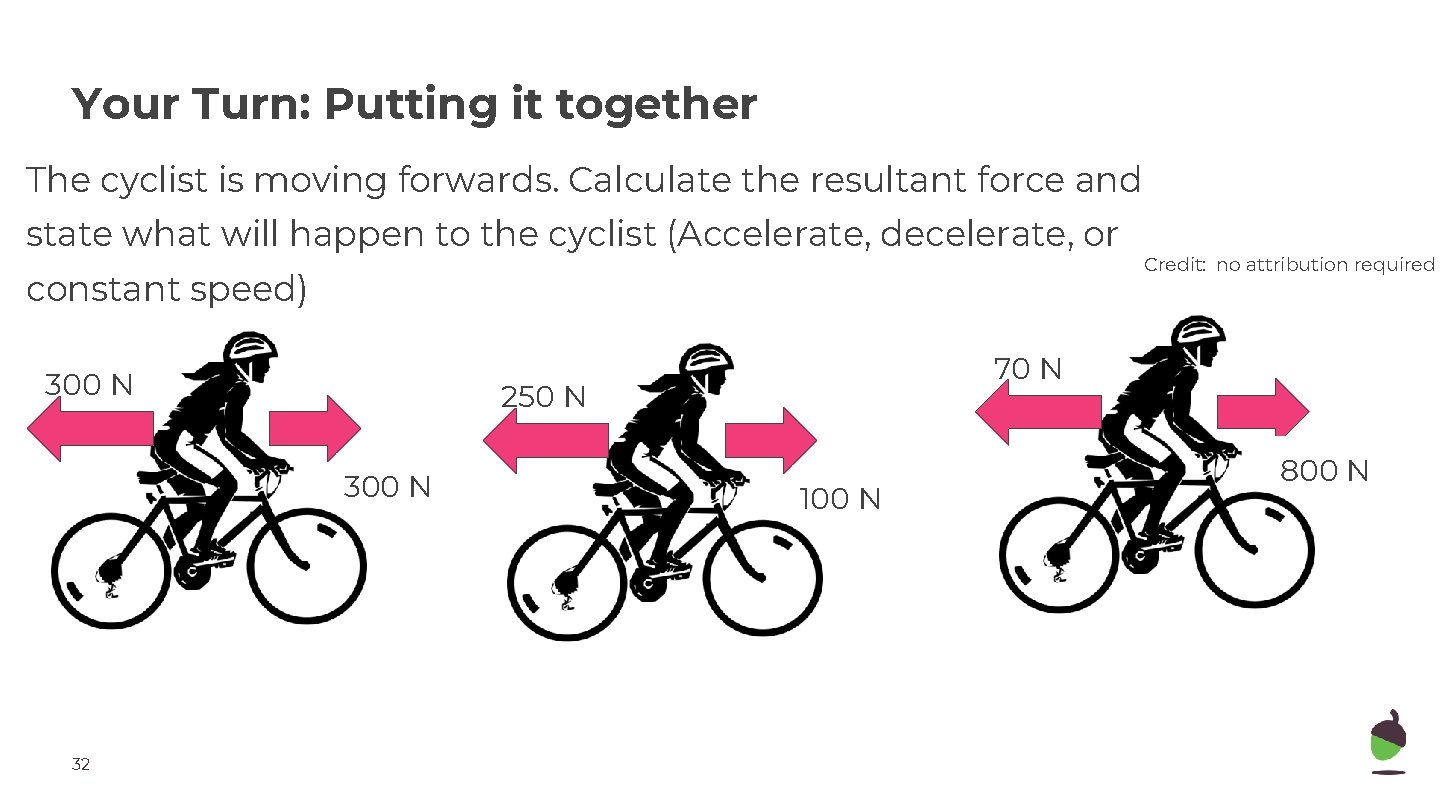
Your Turn: Putting it together The cyclist is moving forwards. Calculate the resultant force and state what will happen to the cyclist (Accelerate, decelerate, or constant speed) 300 N 32 70 N 250 N 300 N Credit: no attribution required 100 N 800 N
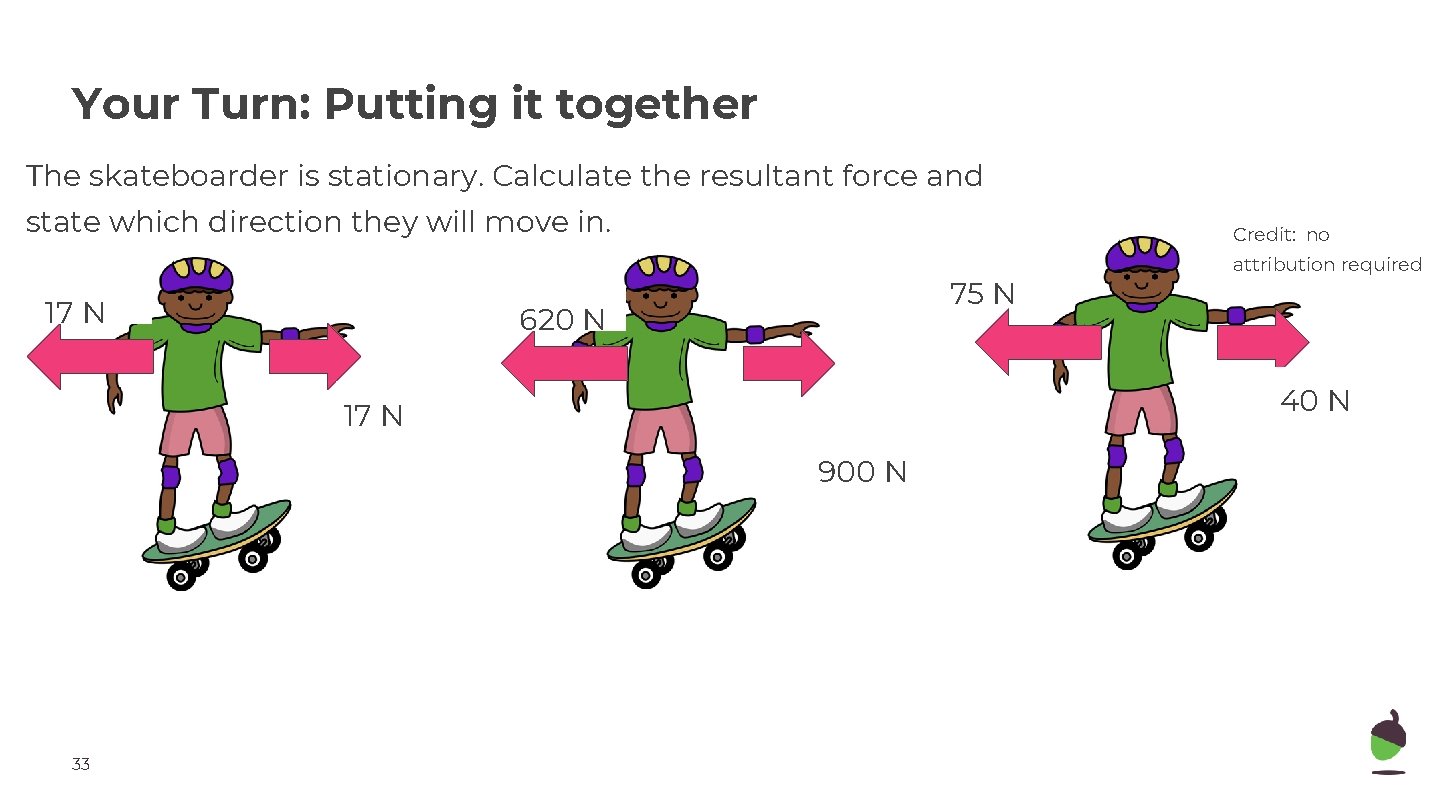
Your Turn: Putting it together The skateboarder is stationary. Calculate the resultant force and state which direction they will move in. 17 N Credit: no 75 N 620 N 40 N 17 N 900 N 33 attribution required
Well Done!