
Lesson 3 Properties of Ionic Compounds Learning Objectives
Lesson 3 Properties of Ionic Compounds Learning Objectives: 1. Recall the properties of ionic compounds. 2. Describe the lattice structure of ionic compounds. 3. Explain how electrostatic forces between ions affect the melting and boiling points of ionic compounds. 4. Explain why ionic compounds conduct electricity when dissolved or molten but not when solid.

Demo: Properties of Ionic Compounds • We are going to investigate the following properties: – Melting point – Electrical conductivity – Malleability
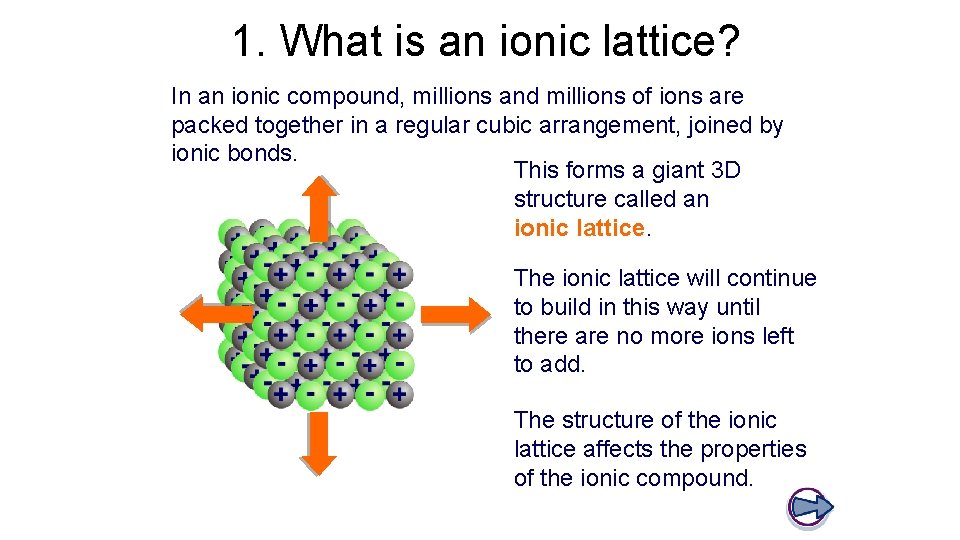
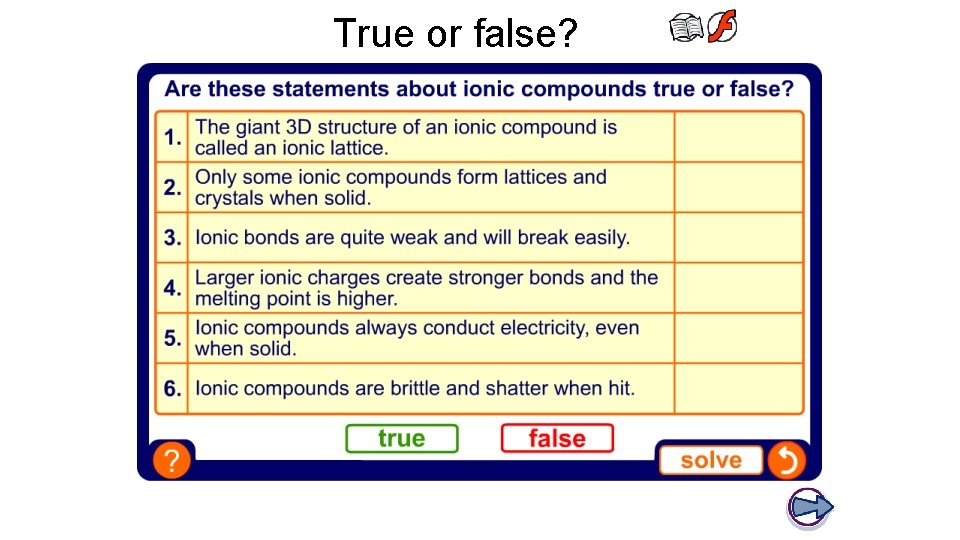
1. What is an ionic lattice? In an ionic compound, millions and millions of ions are packed together in a regular cubic arrangement, joined by ionic bonds. This forms a giant 3 D structure called an ionic lattice. The ionic lattice will continue to build in this way until there are no more ions left to add. The structure of the ionic lattice affects the properties of the ionic compound.
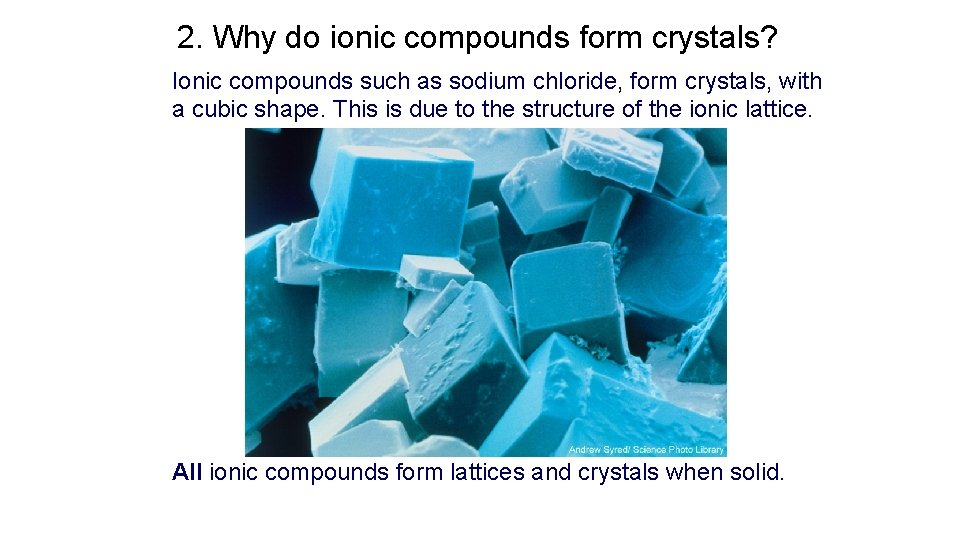
2. Why do ionic compounds form crystals? Ionic compounds such as sodium chloride, form crystals, with a cubic shape. This is due to the structure of the ionic lattice. All ionic compounds form lattices and crystals when solid.
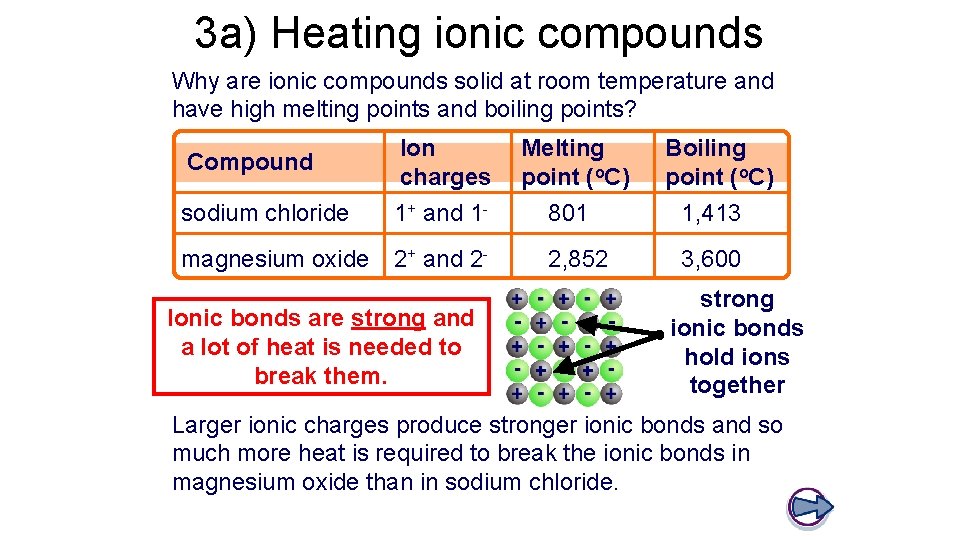
3 a) Heating ionic compounds Why are ionic compounds solid at room temperature and have high melting points and boiling points? Compound Ion charges Melting point (o. C) sodium chloride 1+ and 1 - 801 1, 413 magnesium oxide 2+ and 2 - 2, 852 3, 600 Ionic bonds are strong and a lot of heat is needed to break them. Boiling point (o. C) strong ionic bonds hold ions together Larger ionic charges produce stronger ionic bonds and so much more heat is required to break the ionic bonds in magnesium oxide than in sodium chloride.
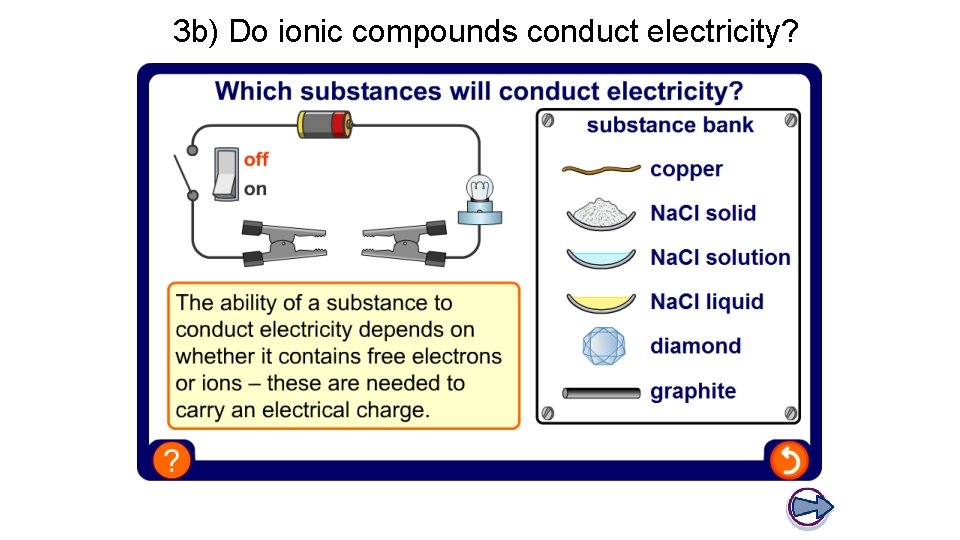
3 b) Do ionic compounds conduct electricity?
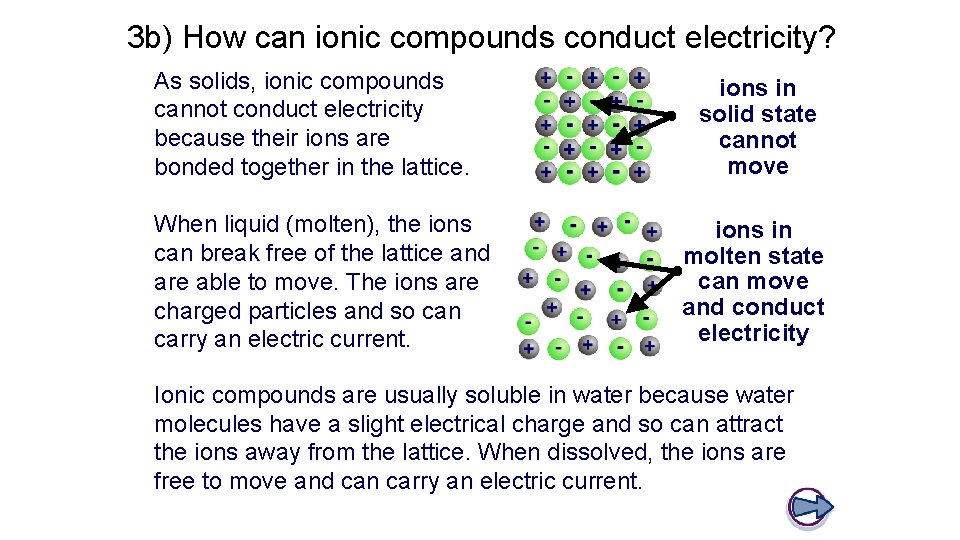
3 b) How can ionic compounds conduct electricity? As solids, ionic compounds cannot conduct electricity because their ions are bonded together in the lattice. When liquid (molten), the ions can break free of the lattice and are able to move. The ions are charged particles and so can carry an electric current. ions in solid state cannot move ions in molten state can move and conduct electricity Ionic compounds are usually soluble in water because water molecules have a slight electrical charge and so can attract the ions away from the lattice. When dissolved, the ions are free to move and can carry an electric current.
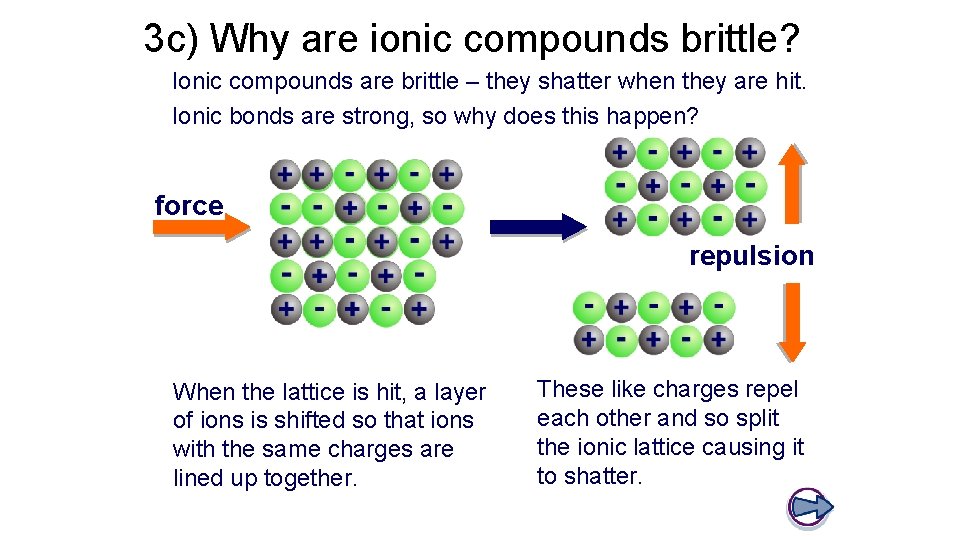
3 c) Why are ionic compounds brittle? Ionic compounds are brittle – they shatter when they are hit. Ionic bonds are strong, so why does this happen? force repulsion When the lattice is hit, a layer of ions is shifted so that ions with the same charges are lined up together. These like charges repel each other and so split the ionic lattice causing it to shatter.
True or false?
- Slides: 9