
Lesson 3 PRODUCTION COST PRODUCTION COST Learning Objectives
Lesson 3 PRODUCTION COST
PRODUCTION COST Learning Objectives • Understand explain that minimizing cost is a superior way of making profit rather than raising price. • Distinguish between explicit and implicit costs and explain why true production cost must include both types. • Distinguish between total cost, total fixed cost and total variable cost and how they are derived. • Distinguish between the relationship between total costs and variable costs and the relationship between the TC, TFC and TVC compared to the ATC, AFC and AVC. • Calculate the MC using the change in TC or the change in TVC. • Explain the relationship between the MC and both the ATC and AVC. • Explain the relationship between cost and output. • Distinguish between the law of diminishing marginal returns and compare it to the concept of returns to scale. • Relate both production theories to the short run and long run ATC. • Explain why the optimum scale should be at least cost and justify firms’ unwillingness to produce at this level of output.
3. 1 IMPORTANCE OF COST • One way for firms to make more profit is to raise price. However it’s often not a good way to do so. Why? • A better way is to cut cost. Why?
3. 1. 1 Nature of Costs: explicit and implicit Most costs are explicit or out-of-pocket costs. They include workers’ wages, rent for the landlord, costs of raw materials like steel and cement from suppliers, interest paid to the bank for loan taken, PUB charges and income taxes and levies paid to the government. Other costs are implicit or opportunity cost. Implicit costs must be imputed. Both explicit and implicit costs must be counted. To exclude implicit costs is to underestimate the true cost of business.
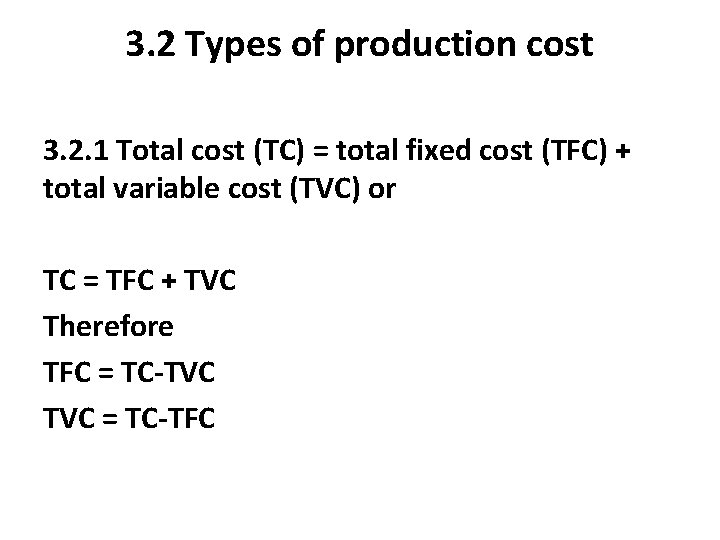
3. 2 Types of production cost 3. 2. 1 Total cost (TC) = total fixed cost (TFC) + total variable cost (TVC) or TC = TFC + TVC Therefore TFC = TC-TVC = TC-TFC
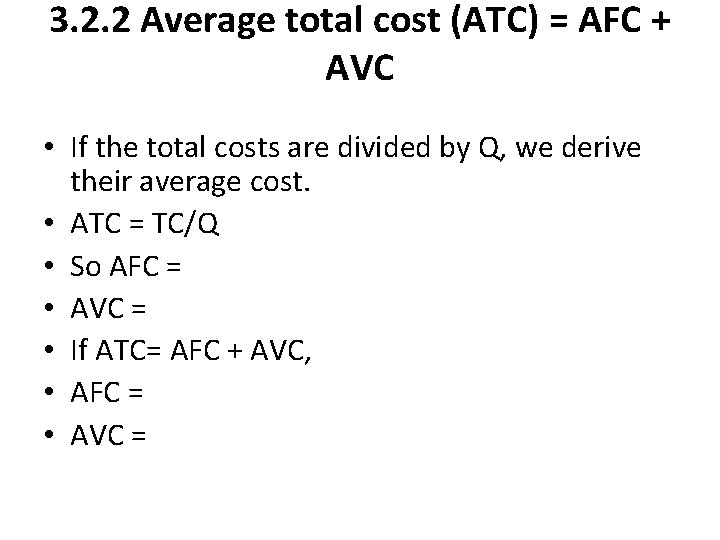
3. 2. 2 Average total cost (ATC) = AFC + AVC • If the total costs are divided by Q, we derive their average cost. • ATC = TC/Q • So AFC = • AVC = • If ATC= AFC + AVC, • AFC = • AVC =
3. 3 Relationships of different cost curves • The relationships of the various cost curves are logical mathematical relationships and can be expressed graphically in Fig shown in the notes given in Page _____
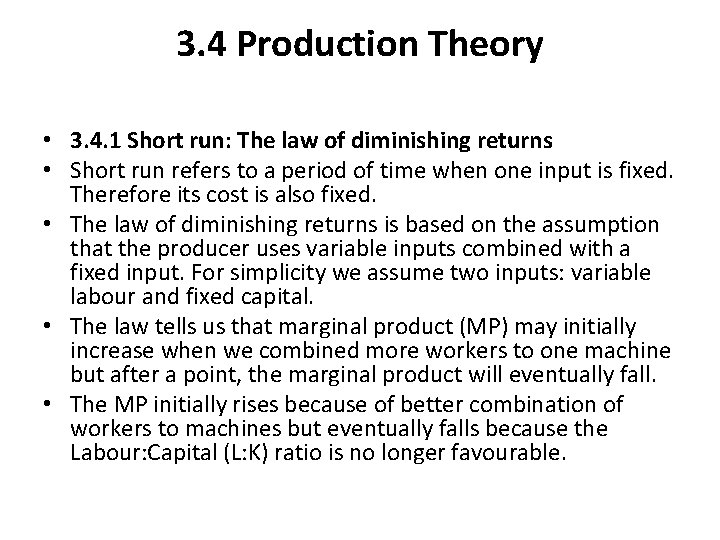
3. 4 Production Theory • 3. 4. 1 Short run: The law of diminishing returns • Short run refers to a period of time when one input is fixed. Therefore its cost is also fixed. • The law of diminishing returns is based on the assumption that the producer uses variable inputs combined with a fixed input. For simplicity we assume two inputs: variable labour and fixed capital. • The law tells us that marginal product (MP) may initially increase when we combined more workers to one machine but after a point, the marginal product will eventually fall. • The MP initially rises because of better combination of workers to machines but eventually falls because the Labour: Capital (L: K) ratio is no longer favourable.
3. 4. 2 Relationship between costs and output (or product) • • Output(Product) Total output Marginal output Average output Types of Cost total Cost marginal cost average cost
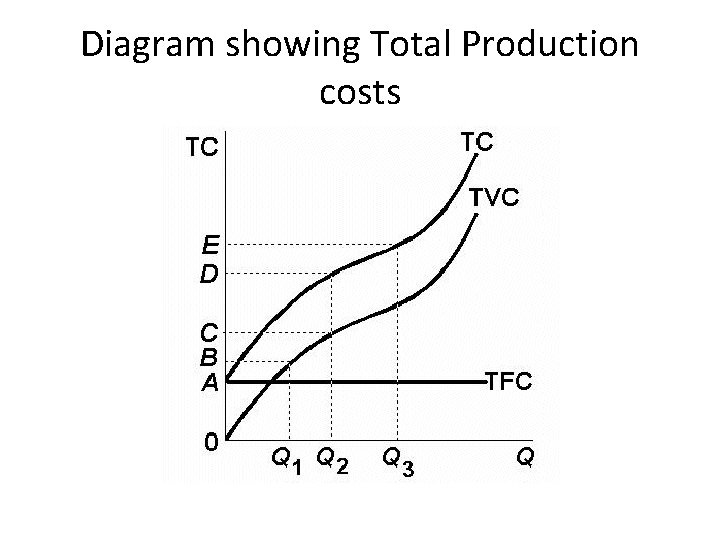
Diagram showing Total Production costs
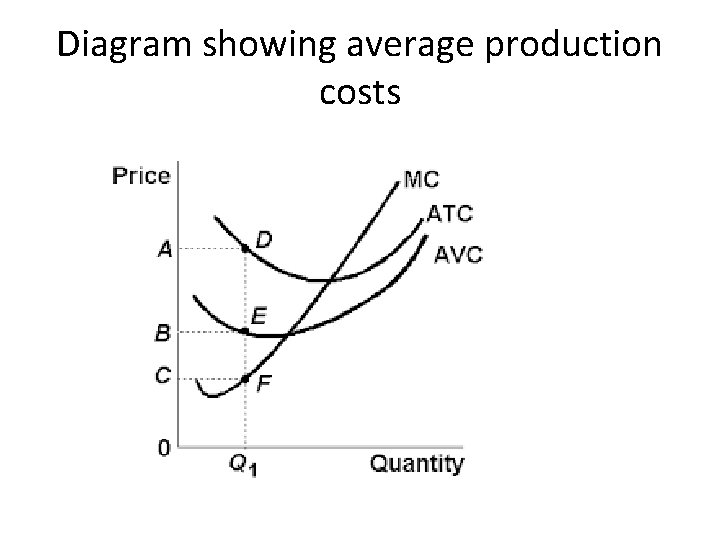
Diagram showing average production costs
3. 5 Long run: returns to scale • The long run refers to a period of time when all inputs are variable. Suppose the producer doubles all inputs in production, what are the possibilities? • Stage 3 : Output may more than double. This is known as increasing returns to scale. Increasing returns to scale can be explained by the presence of economies of scale, the advantages of operating on a bigger scale. • Stage 2 Output may be double. This is known as constant returns to scale. Constant returns to scale can be explained by economies of scale being equally offset by diseconomies of scale. • Stage 3 : Output may less than double. This is known as decreasing returns to scale. Decreasing returns to scale can be explained by the presence of diseconomies of scale, the disadvantages of operating on too big a scale.
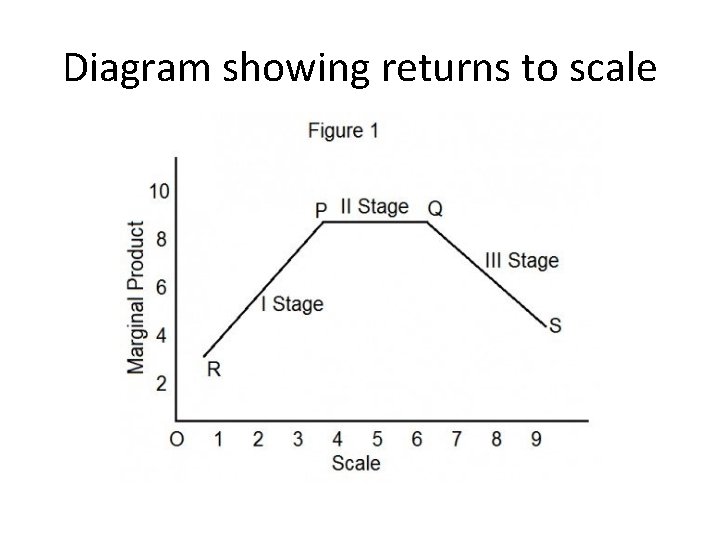
Diagram showing returns to scale
EXERCISE AND ASSIGNMENT 1. If this theory of returns to scale is illustrated using the LRATC, how will the curve look like? Draw and explain. Hint: beginning with increasing returns, then constant returns and finally when output increases further with diminishing returns to scale but expressed in terms of cost. 2. Ideally the firm should produce at the level of output where ATC curve is at its lowest because this is its most efficient output. Explain why it usually doesn’t do so. Hint: think of demand for its goods or services.
- Slides: 14