
LESSON 3 Pages 16 35 in AMSCO Book
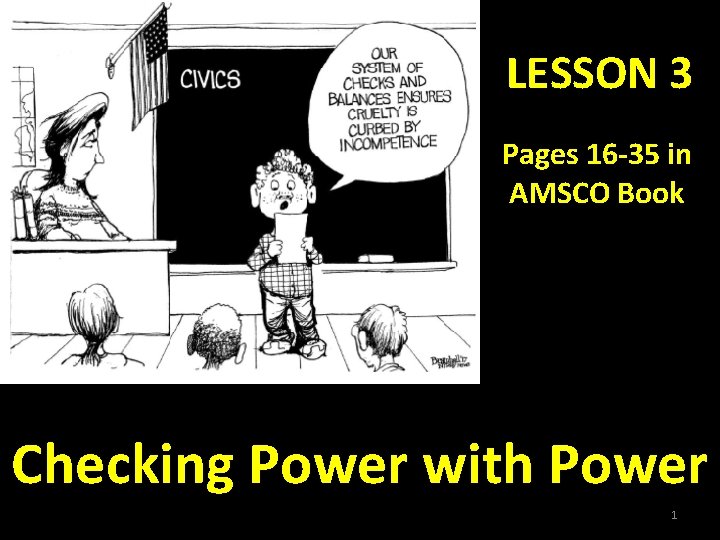
LESSON 3 Pages 16 -35 in AMSCO Book Checking Power with Power 1
STUDENTS WILL KNOW THAT: 1. Different aspects of the U. S. Constitution as well as the debate between the Federalists and Anti-Federalists in Federalist No. 10 and Brutus No. 1 reflect the tension between the broad participatory model and the more filtered participation of the pluralist and elite models. 2. Madison’s arguments in Federalist No. 10 focused on the superiority of a large republic in controlling the “mischiefs of faction, ” delegating authority to elected representatives and dispersing power between the states and national government. 3. Anti-Federalist writings, including Brutus No. 1, adhered to popular democratic theory that emphasized the benefits of a small, decentralized republic while warning of the dangers to personal liberty from a large, centralized government. 4. Federalist No. 51 explains how constitutional provisions of separation of powers and checks and balances control abuses by majorities. 5. The powers allocated to Congress, the president, and the courts demonstrate the separation of powers and checks and balances features of the U. S. Constitution. 6. Multiple access points for stakeholders and institutions to influence public policy flows from the separation of powers and checks and balances. 7. Impeachment, removal, and other legal actions taken against public officials deemed to have abused their power reflect the purpose of checks and balances. 2

• Different aspects of the U. S. Constitution as well as the debate between the Federalists and Anti-Federalists in Federalist No. 10 and Brutus No. 1 reflect the tension between the broad participatory model and the more filtered participation of the pluralist and elite models. 3
HOW WOULD THIS NEW CONSTITUTION FIX THE OLD “CONSTITUTION”? • Madison was concerned that government would be controlled by majority or minority factions >> factions best controlled by a large republic – Minority can be suppressed by majority rule; Majority is more difficult to control • Constitution is a supreme and binding law that both grants power to the government and limits the power of the government 5
FEDERALIST #10 • Source of contention – property – “But the most common and durable source of factions has been the various and unequal distribution of property. Those who hold and those who are without property have ever formed distinct interests in society. ” – Those that have it want to keep it (and get more) – Those that don’t have it, want it (and the Founding Fathers didn’t want to lose their property) • Factions are inevitable, but can be controlled with a large republic – “…the smaller the number of individuals composing a majority, and the smaller the compass within which they are placed, the more easily will they concert and execute their plans of oppression. Extend the sphere, and you take in a greater variety of parties and interests; you make it less probable that a majority of the whole will have a common motive to invade the rights of other citizens. ” 6
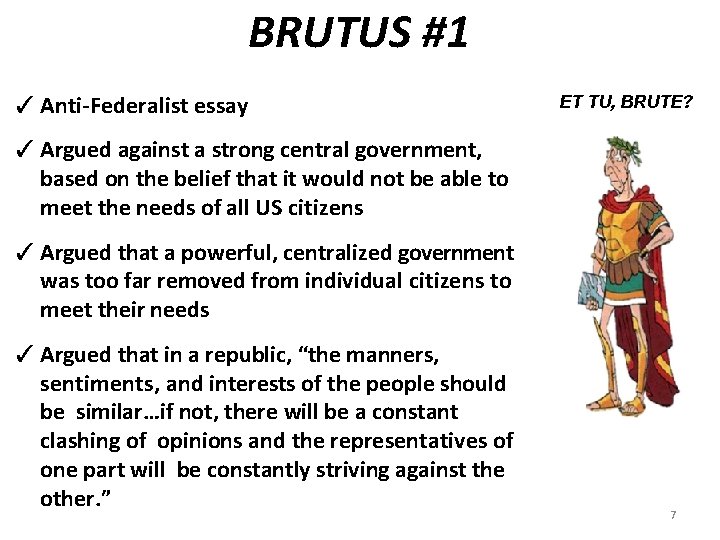
BRUTUS #1 ✓ Anti-Federalist essay ET TU, BRUTE? ✓ Argued against a strong central government, based on the belief that it would not be able to meet the needs of all US citizens ✓ Argued that a powerful, centralized government was too far removed from individual citizens to meet their needs ✓ Argued that in a republic, “the manners, sentiments, and interests of the people should be similar…if not, there will be a constant clashing of opinions and the representatives of one part will be constantly striving against the other. ” 7
FEDERALIST #51 • “In framing a government which is to be administered by men over men the great difficulty lies in this: You must first enable the government to control the governed; and in the next place oblige it to control itself. ” • “If men were angels no government would be necessary. If angels were to govern men, neither external nor internal controls on government would be necessary. ” 8
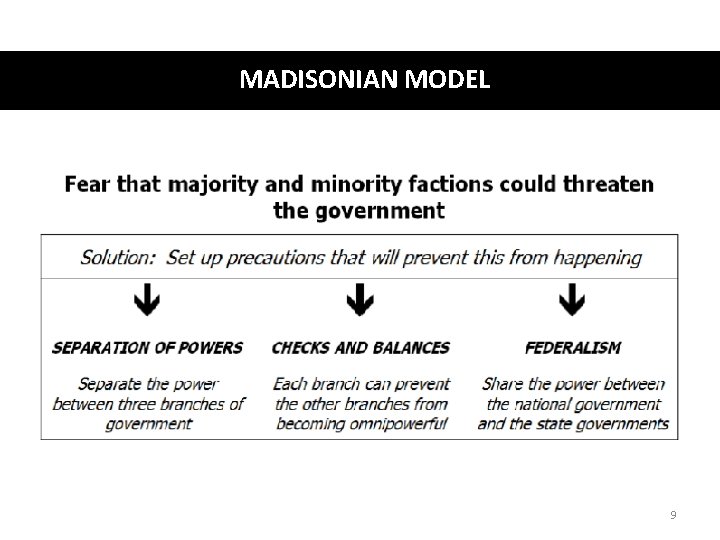
MADISONIAN MODEL 9

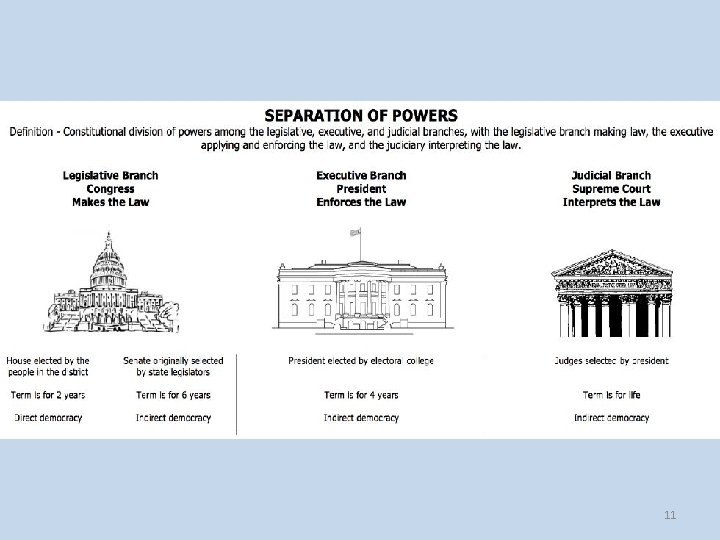
WHAT WAS ONE OF MADISON'S THREE AUXILIARY PRECAUTIONS TO PREVENT TYRANNY? SEPARATION OF POWERS • Allocation of constitutional authority to each of the three branches of the national government • To Madison, tyranny was government that controlled all 3 branches of government >> division of power among the legislative, executive, and judicial branches • Colonial experiences, e. g. excessive power in state legislatures >> need for strong executive • Danger of one branch combining forces with another branch >> checks and balances 10
11
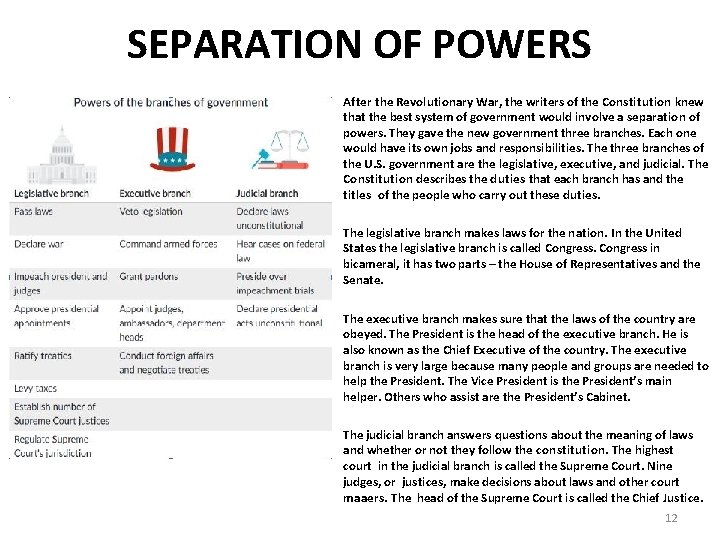
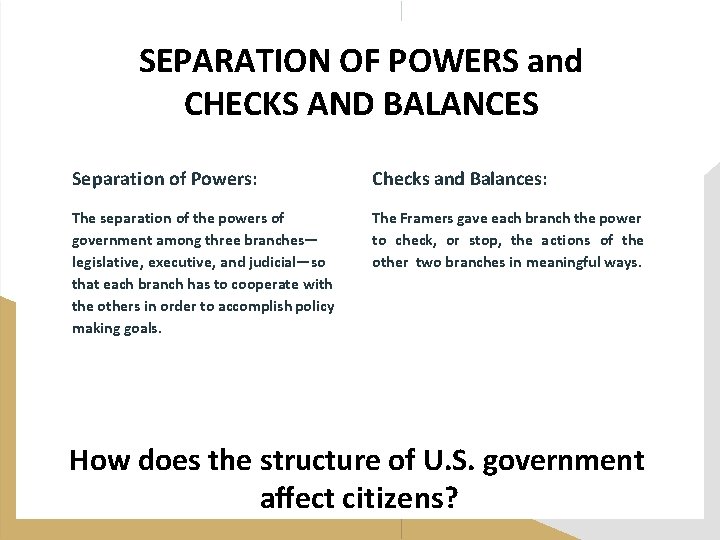
SEPARATION OF POWERS After the Revolutionary War, the writers of the Constitution knew that the best system of government would involve a separation of powers. They gave the new government three branches. Each one would have its own jobs and responsibilities. The three branches of the U. S. government are the legislative, executive, and judicial. The Constitution describes the duties that each branch has and the titles of the people who carry out these duties. The legislative branch makes laws for the nation. In the United States the legislative branch is called Congress in bicameral, it has two parts – the House of Representatives and the Senate. The executive branch makes sure that the laws of the country are obeyed. The President is the head of the executive branch. He is also known as the Chief Executive of the country. The executive branch is very large because many people and groups are needed to help the President. The Vice President is the President’s main helper. Others who assist are the President’s Cabinet. The judicial branch answers questions about the meaning of laws and whether or not they follow the constitution. The highest court in the judicial branch is called the Supreme Court. Nine judges, or justices, make decisions about laws and other court maaers. The head of the Supreme Court is called the Chief Justice. 12
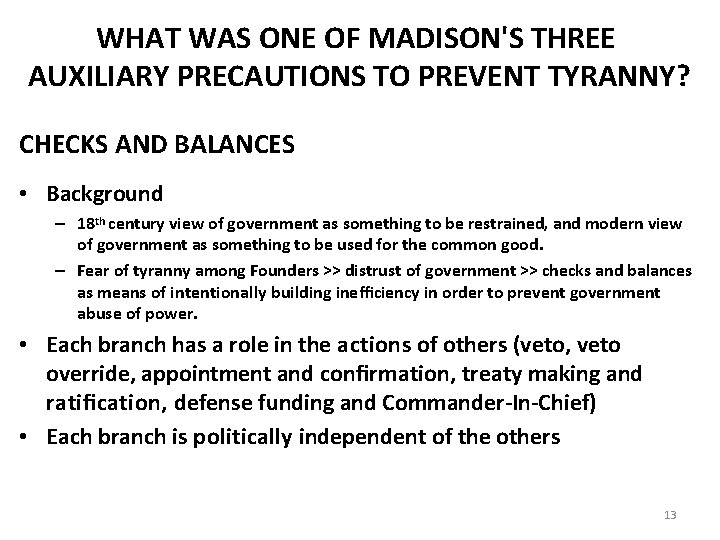
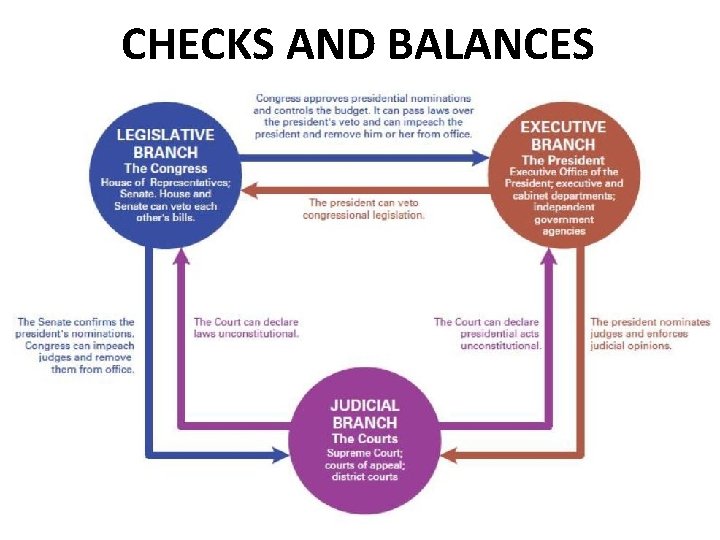
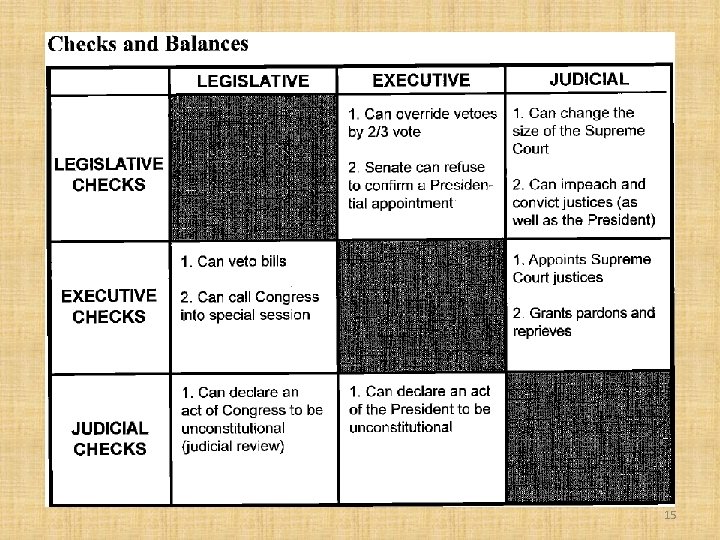
WHAT WAS ONE OF MADISON'S THREE AUXILIARY PRECAUTIONS TO PREVENT TYRANNY? CHECKS AND BALANCES • Background – 18 th century view of government as something to be restrained, and modern view of government as something to be used for the common good. – Fear of tyranny among Founders >> distrust of government >> checks and balances as means of intentionally building inefficiency in order to prevent government abuse of power. • Each branch has a role in the actions of others (veto, veto override, appointment and confirmation, treaty making and ratification, defense funding and Commander-In-Chief) • Each branch is politically independent of the others 13
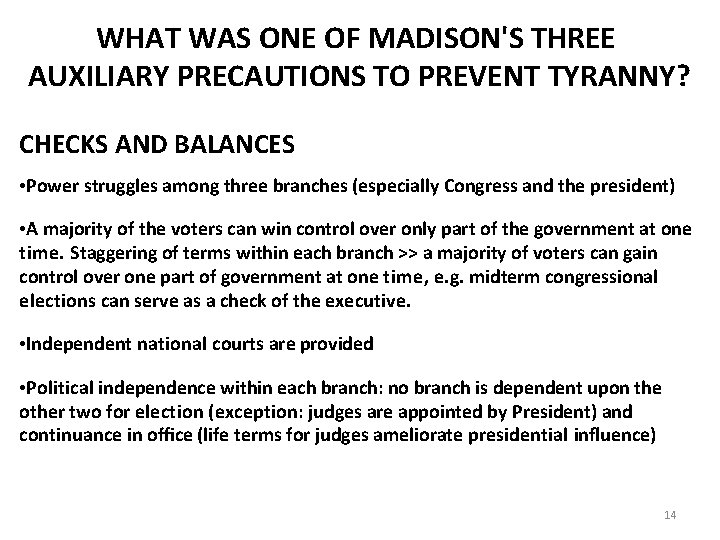
WHAT WAS ONE OF MADISON'S THREE AUXILIARY PRECAUTIONS TO PREVENT TYRANNY? CHECKS AND BALANCES • Power struggles among three branches (especially Congress and the president) • A majority of the voters can win control over only part of the government at one time. Staggering of terms within each branch >> a majority of voters can gain control over one part of government at one time, e. g. midterm congressional elections can serve as a check of the executive. • Independent national courts are provided • Political independence within each branch: no branch is dependent upon the other two for election (exception: judges are appointed by President) and continuance in office (life terms for judges ameliorate presidential influence) 14
CHECKS AND BALANCES
15
SEPARATION OF POWERS and CHECKS AND BALANCES Separation of Powers: Checks and Balances: The separation of the powers of government among three branches— legislative, executive, and judicial—so that each branch has to cooperate with the others in order to accomplish policy making goals. The Framers gave each branch the power to check, or stop, the actions of the other two branches in meaningful ways. How does the structure of U. S. government affect citizens?
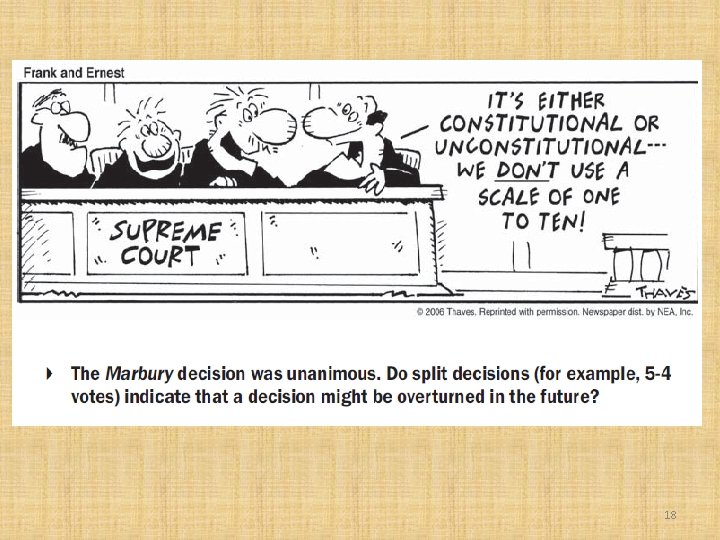
JUDICIAL REVIEW MARBURY V. MADISON (1803) • Framers did not specifically provide for judicial review • Court could not enforce an unconstitutional law (Section 13 of Judiciary Act) • Chief Justice John Marshall reasoned that judges should interpret the Constitution, not the President or Congress • Judicial review became established due to this case • A single person may challenge an existing law through judicial hearings • Effects – Litigation sometimes trumps legislation as a way to make public policy • D. C. v. Heller (2008) - protects an individual's right to possess a firearm for traditionally lawful purposes- irrespective of service in a state militia - did exist • Mc. Donald v. Chicago (2010) - Second Amendment applies to the individual states because it is a fundamental freedom. 14 th 17 Amendment makes it applicable to the states (selective incorporation).
18
Quote Throw down! • You will be shown a quote and you must decide WHO SAID THIS? – The Anti-Federalists or the Federalists • You will work in groups, and write the answer on your white board • Do not show other groups. • You will reveal your answer on the count of three.
Quote #1: • “When the government fears the people, there is liberty. When the people fear the government, there is tyranny. ” • Who said it?
Quote #1 ANSWER • Who said it? • ANTI-FEDERALISTS
Quote #2: • “It must be by this time evident to all men… that (the Articles of Confederation) is a system so radically vicious and unsound as to admit…. an entire change. ” • Who said it?
Quote #2 ANSWER • Who said it? • FEDERALISTS
Quote #3: • “Our country is too large to have all affairs directed by a single government. ” • Who said it?
Quote #3 ANSWER • Who said it? • ANTI-FEDERALISTS
Quote #4: • “I consider the foundation of the Constitution as laid on this ground – that all powers not delegated (given) to the United States by the Constitution, nor prohibited by it to the states, are reserved to the states, or to the people…. ” • Who said it?
Quote #4 ANSWER • Who said it? • ANTI-FEDERALIST
Quote #5: • “The powers contained in the constitution…. ought to be construed liberally in advancement of the public good. ” • Who said it?
Quote #5 ANSWER • Who said it? • FEDERALISTS
Quote #6: • “The small landowners are the most precious part of the state. ” • Who said it?
Quote #6 ANSWER • Who said it? • ANTI-FEDERALISTS
Quote #7: • "I had rather be a free citizen of the small republic of Massachuseas, than an oppressed subject of the great American empire. " • Who said it?
Quote #7 ANSWER • Who said it? • ANTI-FEDERALISTS
Quote #8: • "I had rather be a free citizen of the small republic of Massachuseas, than an oppressed subject of the great American empire. " • Who said it?
Quote #8 ANSWER • Who said it? • ANTI-FEDERALISTS
Quote #9: • “Among the numerous advantages promised by a well-constructed Union, none deserves to be more accurately developed than its tendency to break and control the violence of faction. ” • Who said it?
Quote #9 ANSWER • Who said it? • FEDERALISTS
Quote #10: • “An elective [monarchy] was not the government we fought for; but one in which the powers of government should be so divided and balanced among the several bodies of magistracy as that no one could transcend their legal limits without being effectually checked and restrained by the others. ” • Who said it?
Quote #10 ANSWER • Who said it? • FEDERALISTS
- Slides: 39