
Lesson 3 Objectives Identify the key features of
Lesson #3 • Objective(s): Identify the key features of scientific skepticism. Identify and explain the text’s six principles of scientific thinking. • Agenda: Bellwork, Scientific Thinking: Distinguishing Fact from Fiction • Bellwork: In what instances do you blindly accept information or direction? Copyright © 2018, 2014, 2011 Pearson Education, Inc. All Rights Reserved
Chapter 1, Section 3 Scientific Thinking: Distinguishing Fact from Fiction Copyright © 2018, 2014, 2011 Pearson Education, Inc. All Rights Reserved

Scientific Skepticism • Scientific skepticism is the approach of evaluating all claims with an open mind but insisting on persuasive evidence before accepting them. -willingness to keep an open mind to all claims -accept claims only after researchers have subjected them to careful scientific tests. (unwillingness to accept claims on authority alone) Copyright © 2018, 2014, 2011 Pearson Education, Inc. All Rights Reserved
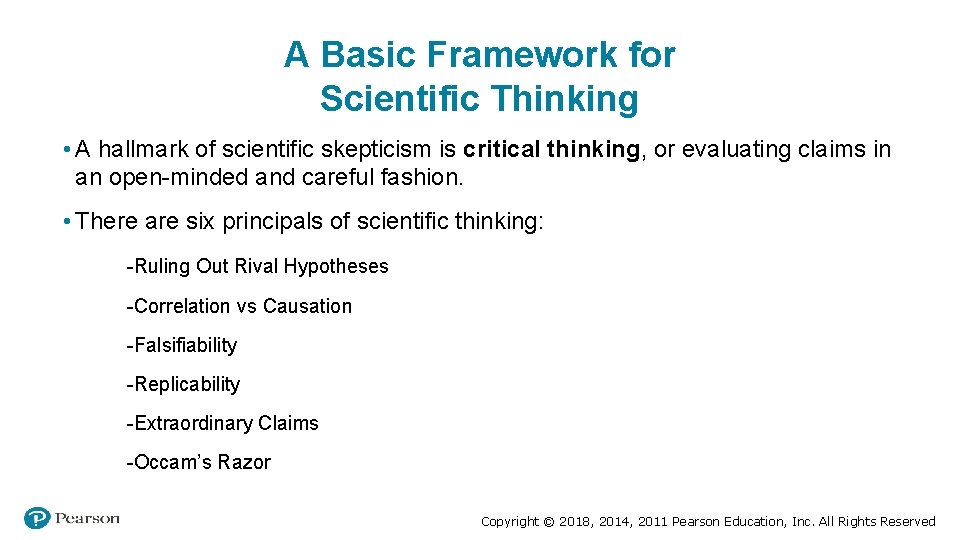
A Basic Framework for Scientific Thinking • A hallmark of scientific skepticism is critical thinking, or evaluating claims in an open-minded and careful fashion. • There are six principals of scientific thinking: -Ruling Out Rival Hypotheses -Correlation vs Causation -Falsifiability -Replicability -Extraordinary Claims -Occam’s Razor Copyright © 2018, 2014, 2011 Pearson Education, Inc. All Rights Reserved
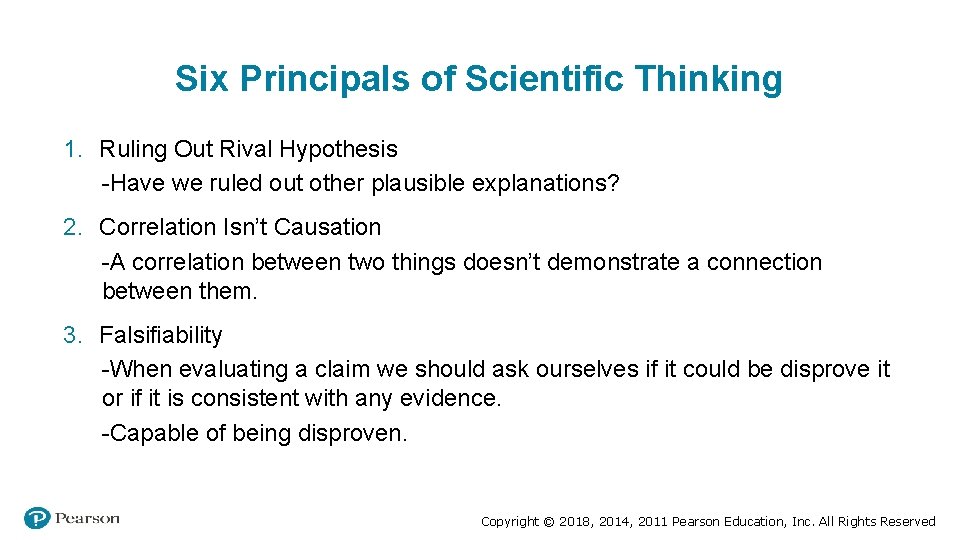
Six Principals of Scientific Thinking 1. Ruling Out Rival Hypothesis -Have we ruled out other plausible explanations? 2. Correlation Isn’t Causation -A correlation between two things doesn’t demonstrate a connection between them. 3. Falsifiability -When evaluating a claim we should ask ourselves if it could be disprove it or if it is consistent with any evidence. -Capable of being disproven. Copyright © 2018, 2014, 2011 Pearson Education, Inc. All Rights Reserved
Six Principals of Scientific Thinking 1. Replicability -We should ask ourselves if the evidence can be replicated. -Decline effect-size of findings shrink overtime. 2. Extraordinary Claims Require Extraordinary Evidence -Does the claim counter things we know, and is the evidence as extraordinary as the claim? 3. Occam’s Razor -We should generally select to more logical and simple explanation. Copyright © 2018, 2014, 2011 Pearson Education, Inc. All Rights Reserved
- Slides: 6