
Lesson 3 Identifying Characteristics of a Literary Figure
- Slides: 70
Lesson 3 Identifying Characteristics of a Literary Figure in Text & Decoding Words 1
Decoding Words When you are reading and come across a word that you do not know, 2
Decoding Words When you are reading and come across a word that you do not know, you can often decode or figure it out based on context clues that are words and phrases that come before and after the unknown word. 3
Decoding Words When you are reading and come across a word that you do not know, you can often decode or figure it out based on context clues that are words and phrases that come before and after the unknown word. Here are three decoding strategies you can use. 4
Decoding Strategy 1 Using Context Clue - Opposites A sentence will very often tell you if an unknown word means something opposite as a word you already know. 5
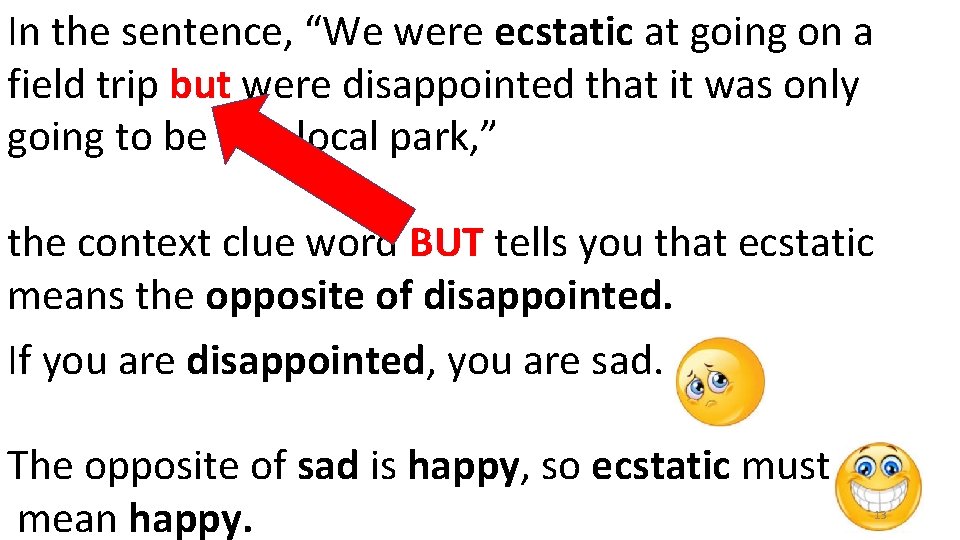
Decoding Strategy 1 Using Context Clue - Opposites A sentence will very often tell you if an unknown word means something opposite as a word you already know. For example look at the sentence, “We were ecstatic at going on a field trip but were disappointed that it was only going to be to a local park. ” 6
Decoding Strategy 1 Using Context Clue - Opposites A sentence will very often tell you if an unknown word means something opposite as a word you already know. For example look at the sentence, “We were ecstatic at going on a field trip but were disappointed that it was only going to be to a local park. ” Now look at the decoding strategy. 7
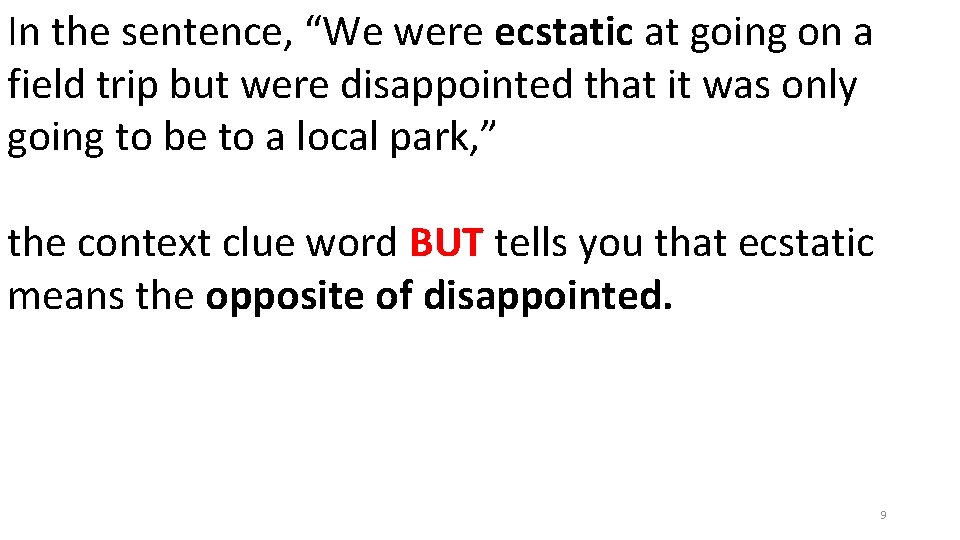
In the sentence, “We were ecstatic at going on a field trip but were disappointed that it was only going to be to a local park, ” 8
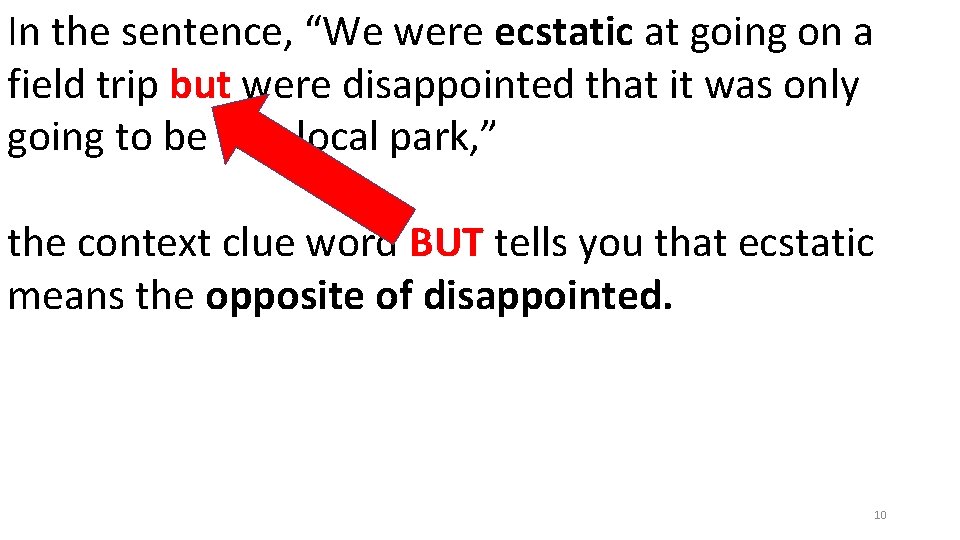
In the sentence, “We were ecstatic at going on a field trip but were disappointed that it was only going to be to a local park, ” the context clue word BUT tells you that ecstatic means the opposite of disappointed. 9
In the sentence, “We were ecstatic at going on a field trip but were disappointed that it was only going to be to a local park, ” the context clue word BUT tells you that ecstatic means the opposite of disappointed. 10
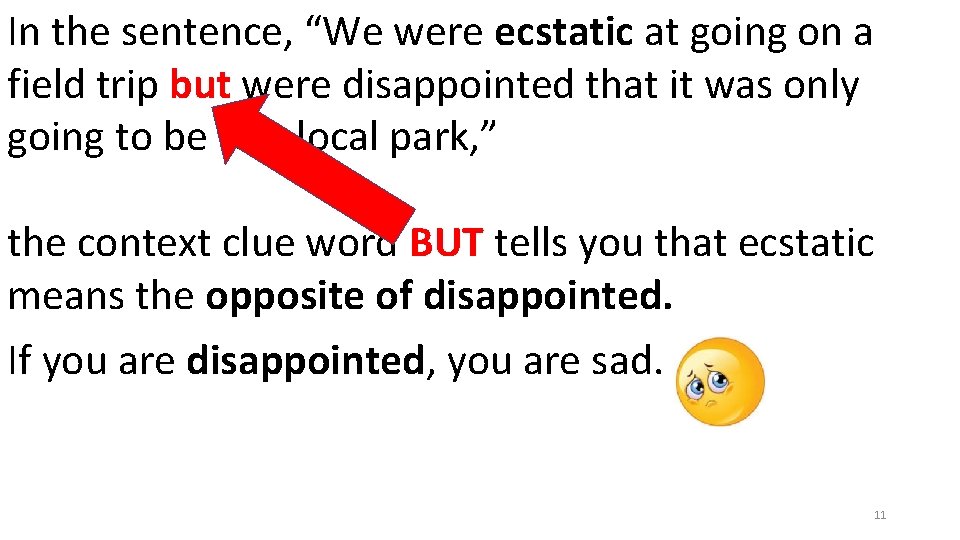
In the sentence, “We were ecstatic at going on a field trip but were disappointed that it was only going to be to a local park, ” the context clue word BUT tells you that ecstatic means the opposite of disappointed. If you are disappointed, you are sad. 11
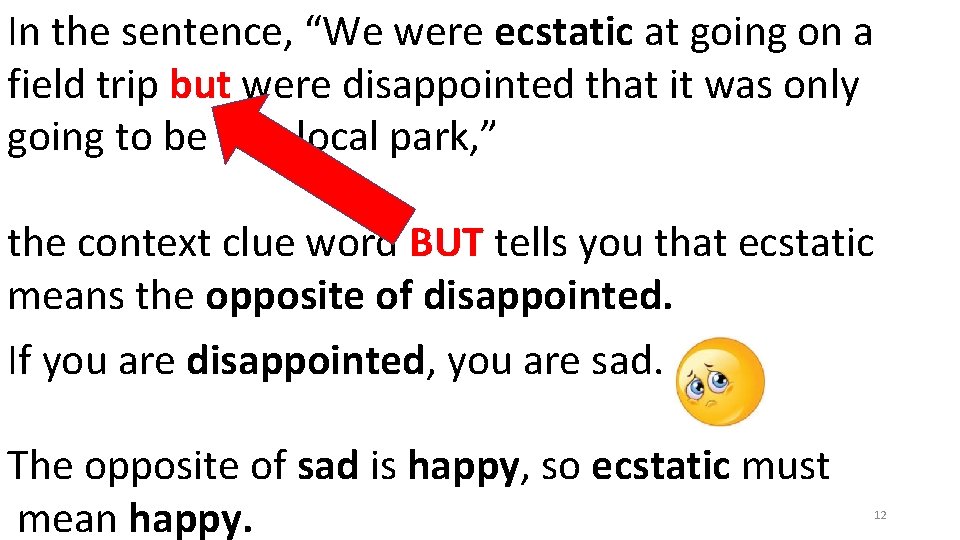
In the sentence, “We were ecstatic at going on a field trip but were disappointed that it was only going to be to a local park, ” the context clue word BUT tells you that ecstatic means the opposite of disappointed. If you are disappointed, you are sad. The opposite of sad is happy, so ecstatic must mean happy. 12
In the sentence, “We were ecstatic at going on a field trip but were disappointed that it was only going to be to a local park, ” the context clue word BUT tells you that ecstatic means the opposite of disappointed. If you are disappointed, you are sad. The opposite of sad is happy, so ecstatic must mean happy. 13
Decoding Strategy 2 Using Context Clue Similarities 14
Decoding Strategy 2 Using Context Clue Similarities A sentence will often tell you if an unknown word means something similar to a word you already know. 15
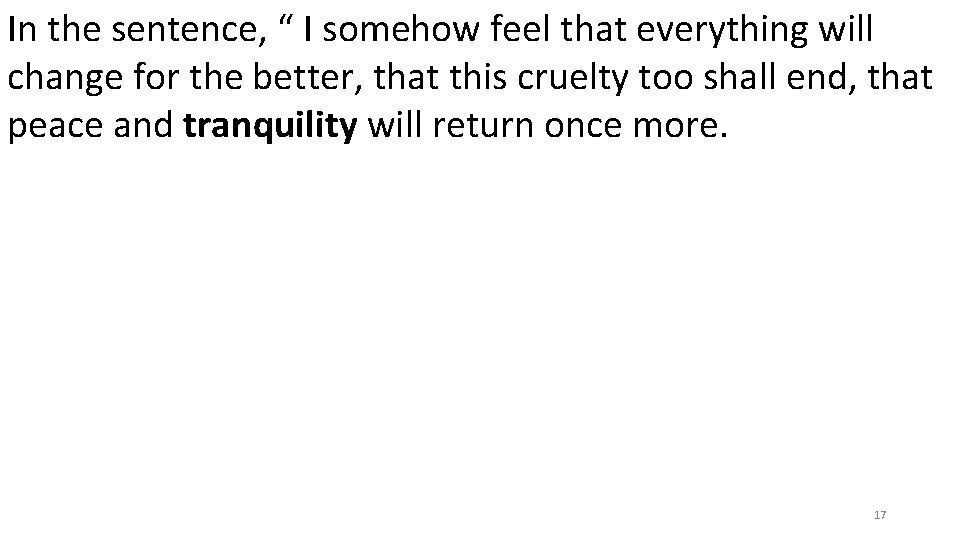
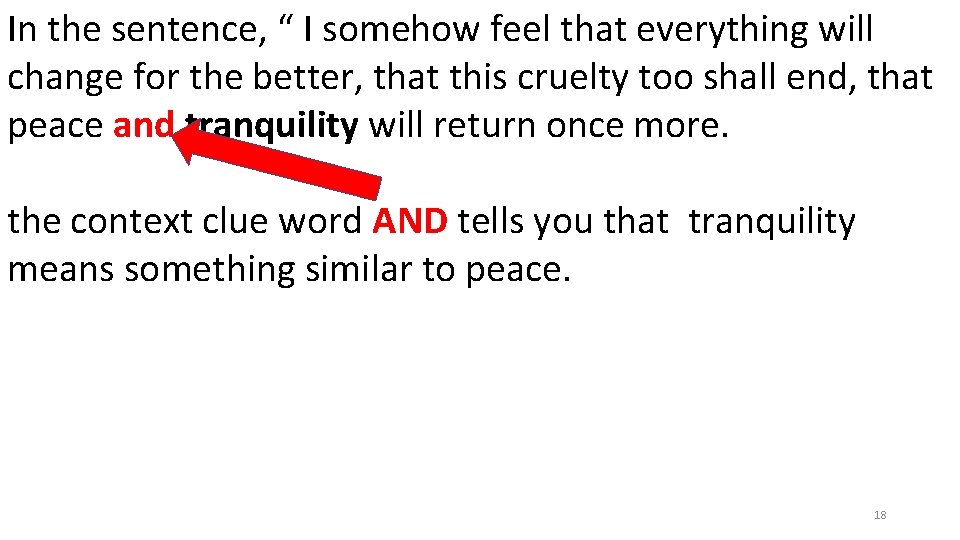
Decoding Strategy 2 Using Context Clue Similarities A sentence will often tell you if an unknown word means something similar to a word you already know. For example look at the sentence from Roll of Thunder, Hear My Cry, “ I somehow feel that everything will change for the better, that this cruelty too shall end, that peace and tranquility will return once more. 16
In the sentence, “ I somehow feel that everything will change for the better, that this cruelty too shall end, that peace and tranquility will return once more. 17
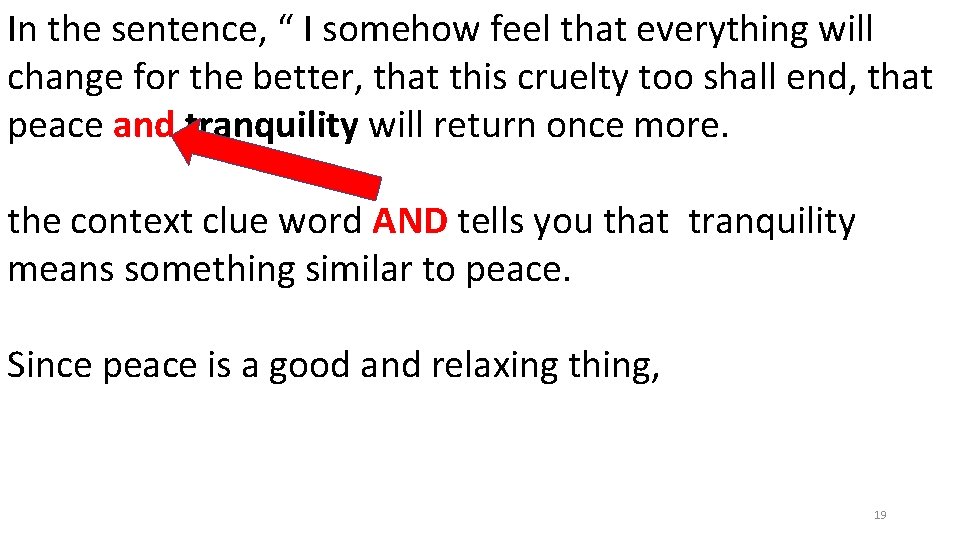
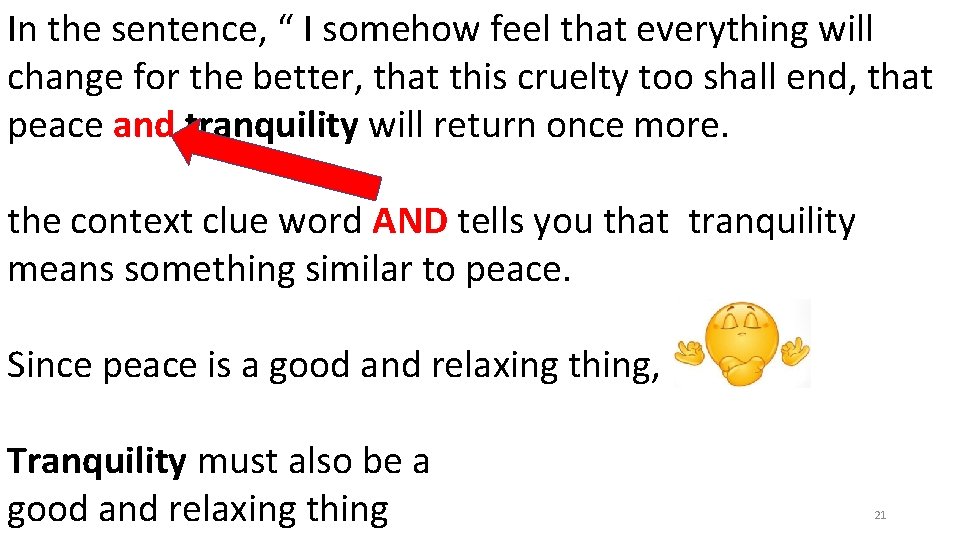
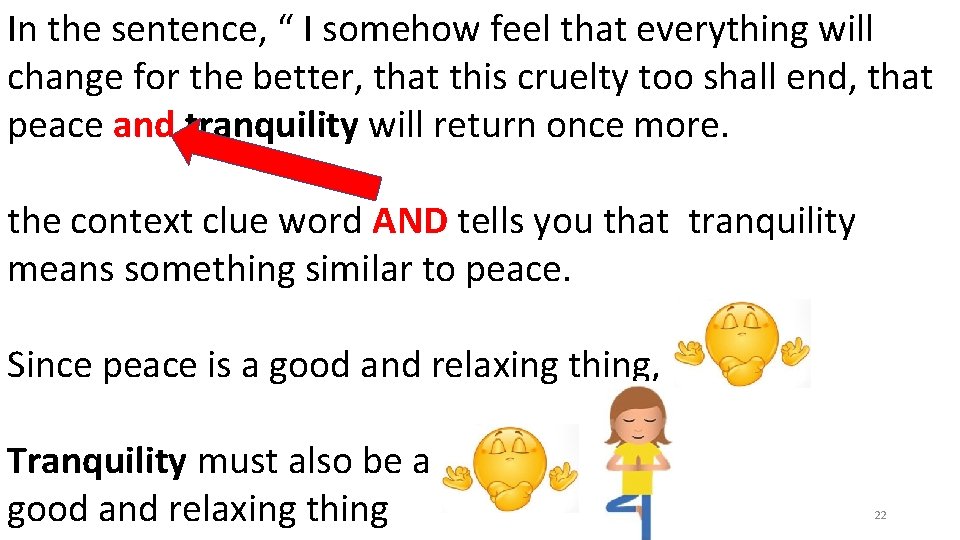
In the sentence, “ I somehow feel that everything will change for the better, that this cruelty too shall end, that peace and tranquility will return once more. the context clue word AND tells you that tranquility means something similar to peace. 18
In the sentence, “ I somehow feel that everything will change for the better, that this cruelty too shall end, that peace and tranquility will return once more. the context clue word AND tells you that tranquility means something similar to peace. Since peace is a good and relaxing thing, 19
In the sentence, “ I somehow feel that everything will change for the better, that this cruelty too shall end, that peace and tranquility will return once more. the context clue word AND tells you that tranquility means something similar to peace. Since peace is a good and relaxing thing, 20
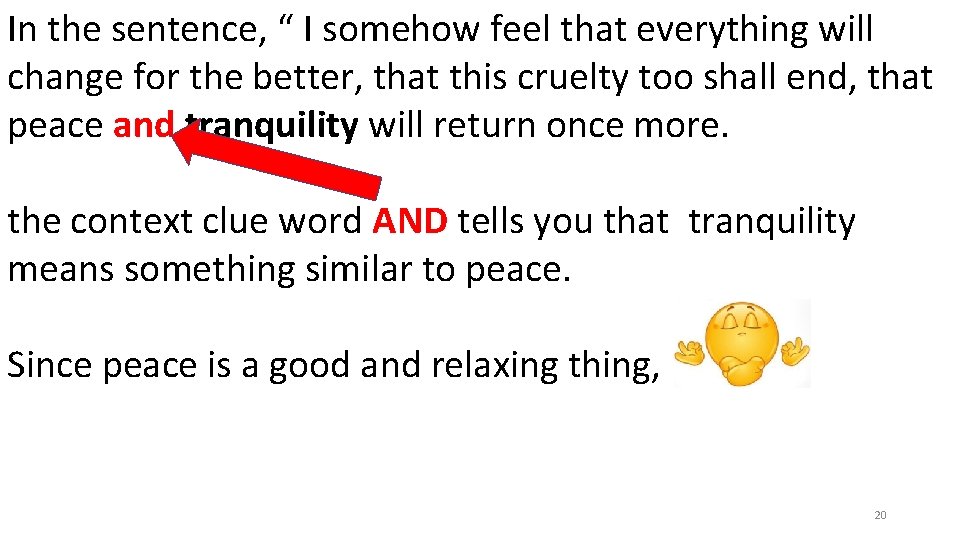
In the sentence, “ I somehow feel that everything will change for the better, that this cruelty too shall end, that peace and tranquility will return once more. the context clue word AND tells you that tranquility means something similar to peace. Since peace is a good and relaxing thing, Tranquility must also be a good and relaxing thing 21
In the sentence, “ I somehow feel that everything will change for the better, that this cruelty too shall end, that peace and tranquility will return once more. the context clue word AND tells you that tranquility means something similar to peace. Since peace is a good and relaxing thing, Tranquility must also be a good and relaxing thing 22
Decoding Strategy 3 Using Context Clue - Logic 23
Decoding Strategy 3 Using Context Clue - Logic A sentence will very often tell you what a word means by describing what it does, and the effects it has on things, people, and animals. 24
Decoding Strategy 3 Using Context Clue - Logic A sentence will very often tell you what a word means by describing what it does, and the effects it has on things, people, and animals. If you use this information to draw a logical conclusion about the word’s definition, you will most likely determine its meaning. 25
Here’s the strategy applied to the word mortgage. 26
For example look at this sentence from Roll of Thunder, Hear My Cry, 27
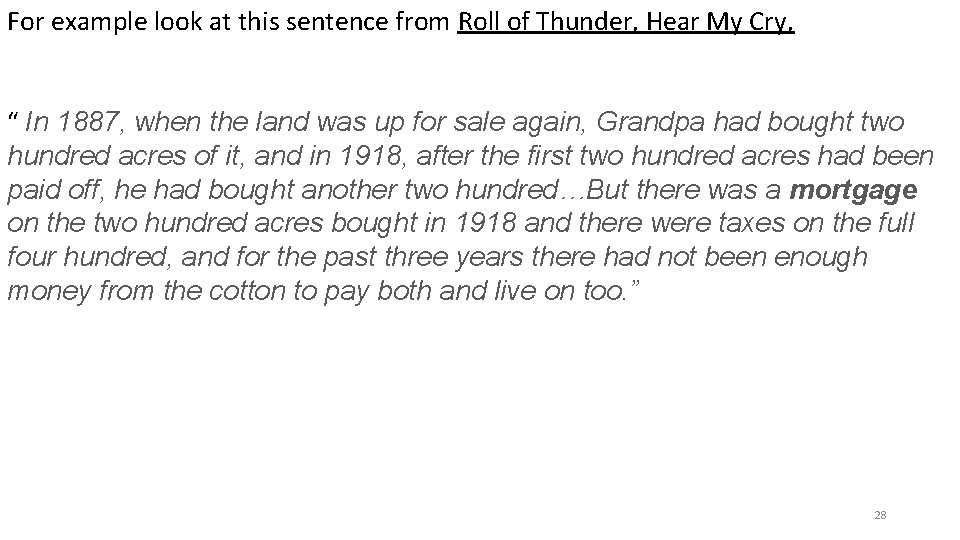
For example look at this sentence from Roll of Thunder, Hear My Cry, “ In 1887, when the land was up for sale again, Grandpa had bought two hundred acres of it, and in 1918, after the first two hundred acres had been paid off, he had bought another two hundred…But there was a mortgage on the two hundred acres bought in 1918 and there were taxes on the full four hundred, and for the past three years there had not been enough money from the cotton to pay both and live on too. ” 28
“ In 1887, when the land was up for sale again, Grandpa had bought two hundred acres of it, and in 1918, after the first two hundred acres had been paid off, he had bought another two hundred…But there was a mortgage on the two hundred acres bought in 1918 and there were taxes on the full four hundred, and for the past three years there had not been enough money from the cotton to pay both and live on too. ” What this excerpt tells you about a mortgage is: 29
“ In 1887, when the land was up for sale again, Grandpa had bought two hundred acres of it, and in 1918, after the first two hundred acres had been paid off, he had bought another two hundred…But there was a mortgage on the two hundred acres bought in 1918 and there were taxes on the full four hundred, and for the past three years there had not been enough money from the cotton to pay both and live on too. ” What this excerpt tells you about a mortgage is: • You had to pay on a mortgage like you had to pay taxes 30
“ In 1887, when the land was up for sale again, Grandpa had bought two hundred acres of it, and in 1918, after the first two hundred acres had been paid off, he had bought another two hundred…But there was a mortgage on the two hundred acres bought in 1918 and there were taxes on the full four hundred, and for the past three years there had not been enough money from the cotton to pay both and live on too. ” What this excerpt tells you about a mortgage is: • You had to pay on a mortgage like you had to pay taxes • A mortgage was on a piece of land 31
“ In 1887, when the land was up for sale again, Grandpa had bought two hundred acres of it, and in 1918, after the first two hundred acres had been paid off, he had bought another two hundred…But there was a mortgage on the two hundred acres bought in 1918 and there were taxes on the full four hundred, and for the past three years there had not been enough money from the cotton to pay both and live on too. ” What this excerpt tells you about a mortgage is: • You had to pay on a mortgage like you had to pay taxes • A mortgage was on a piece of land • There was a danger if you did not pay on the mortgage. 32
“ In 1887, when the land was up for sale again, Grandpa had bought two hundred acres of it, and in 1918, after the first two hundred acres had been paid off, he had bought another two hundred…But there was a mortgage on the two hundred acres bought in 1918 and there were taxes on the full four hundred, and for the past three years there had not been enough money from the cotton to pay both and live on too. ” What this excerpt tells you about a mortgage is: • You had to pay on a mortgage like you had to pay taxes • A mortgage was on a piece of land • There was a danger if you did not pay on the mortgage. CONCLUSION - So, a mortgage has to be a payment that must be made on a piece of property, just like taxes, and if you don’t pay it, bad things can happen. 33
“ In 1887, when the land was up for sale again, Grandpa had bought two hundred acres of it, and in 1918, after the first two hundred acres had been paid off, he had bought another two hundred…But there was a mortgage on the two hundred acres bought in 1918 and there were taxes on the full four hundred, and for the past three years there had not been enough money from the cotton to pay both and live on too. ” What this excerpt tells you about a mortgage is: • You had to pay on a mortgage like you had to pay taxes • A mortgage was on a piece of land • There was a danger if you did not pay on the mortgage. CONCLUSION - So, a mortgage has to be a payment that must be made on a piece of property, just like taxes, and if you don’t pay it, bad things can happen. 34
Here’s another example. 35
In the sentence, “Birds are always on the lookout for predators that might harm their young. ” 36
In the sentence, “Birds are always on the lookout for predators that might harm their young. ” This sentence tells us: Predators can harm young birds. 37
In the sentence, “Birds are always on the lookout for predators that might harm their young. ” This sentence tells us: Predators can harm young birds. Predators can be seen by birds. 38
In the sentence, “Birds are always on the lookout for predators that might harm their young. ” This sentence tells us: Predators can harm young birds. Predators can be seen by birds. Conclusion – predators are people or animals or both that can harm birds. If predators can harm birds, they probably can harm other animals. 39
In the sentence, “Birds are always on the lookout for predators that might harm their young. ” This sentence tells us: Predators can harm young birds. Predators can be seen by birds. Conclusion – predators are people or animals or both that can harm birds. If predators can harm birds, they probably can harm other animals. 40
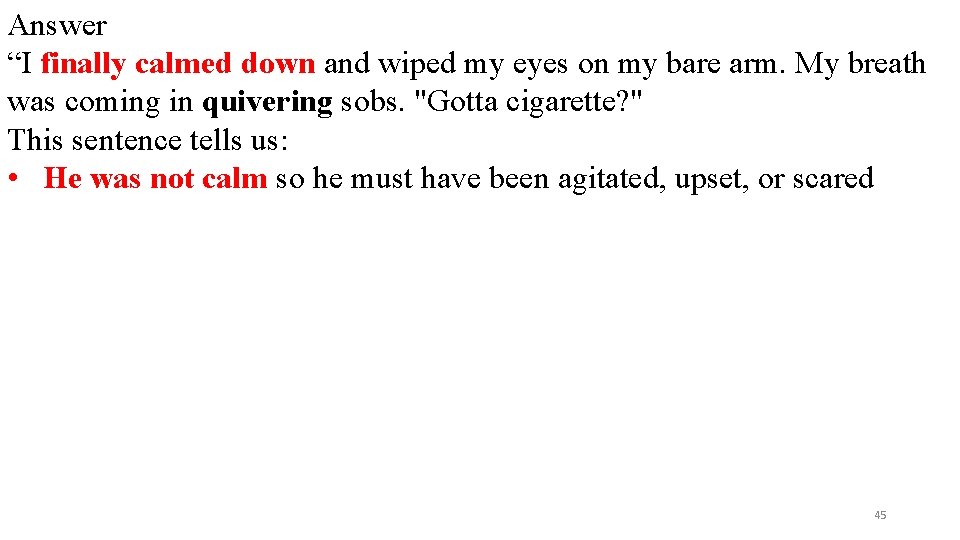
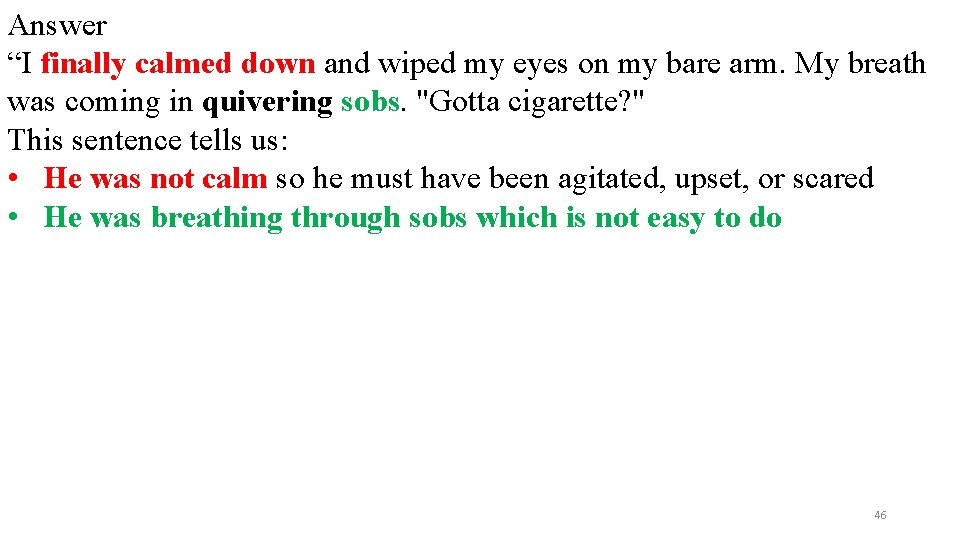
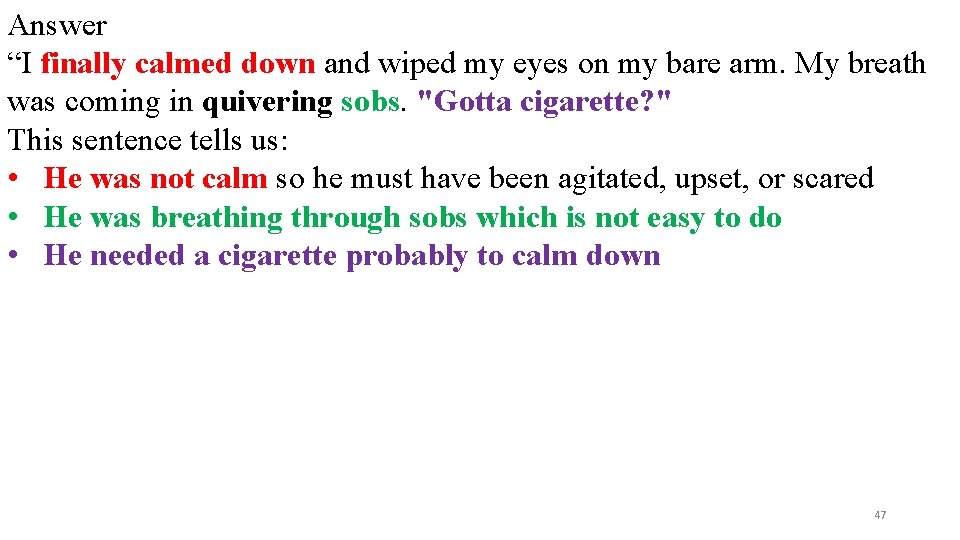
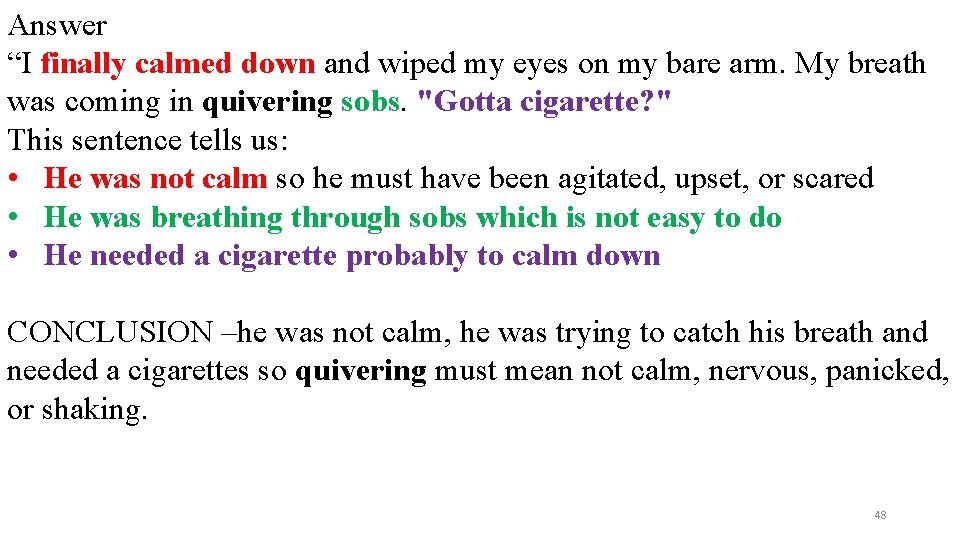
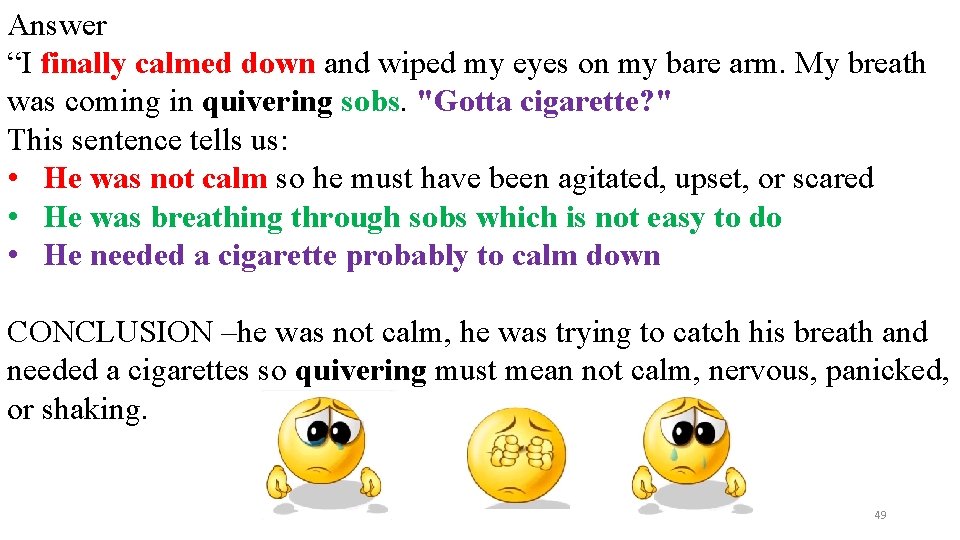
Here is a sentence from The Outsiders. “I finally calmed down and wiped my eyes on my bare arm. My breath was coming in quivering sobs. "Gotta cigarette? " 41
Here is a sentence from The Outsiders. “I finally calmed down and wiped my eyes on my bare arm. My breath was coming in quivering sobs. "Gotta cigarette? " Even if you know the meaning of this word, volunteer to use the logic strategy to decode its meaning. 42
Here is a sentence from The Outsiders. “I finally calmed down and wiped my eyes on my bare arm. My breath was coming in quivering sobs. "Gotta cigarette? " Even if you know the meaning of this word, volunteer to use the logic strategy to decode its meaning. Answer is on the next slide. 43
Answer “I finally calmed down and wiped my eyes on my bare arm. My breath was coming in quivering sobs. "Gotta cigarette? " This sentence tells us: 44
Answer “I finally calmed down and wiped my eyes on my bare arm. My breath was coming in quivering sobs. "Gotta cigarette? " This sentence tells us: • He was not calm so he must have been agitated, upset, or scared 45
Answer “I finally calmed down and wiped my eyes on my bare arm. My breath was coming in quivering sobs. "Gotta cigarette? " This sentence tells us: • He was not calm so he must have been agitated, upset, or scared • He was breathing through sobs which is not easy to do 46
Answer “I finally calmed down and wiped my eyes on my bare arm. My breath was coming in quivering sobs. "Gotta cigarette? " This sentence tells us: • He was not calm so he must have been agitated, upset, or scared • He was breathing through sobs which is not easy to do • He needed a cigarette probably to calm down 47
Answer “I finally calmed down and wiped my eyes on my bare arm. My breath was coming in quivering sobs. "Gotta cigarette? " This sentence tells us: • He was not calm so he must have been agitated, upset, or scared • He was breathing through sobs which is not easy to do • He needed a cigarette probably to calm down CONCLUSION –he was not calm, he was trying to catch his breath and needed a cigarettes so quivering must mean not calm, nervous, panicked, or shaking. 48
Answer “I finally calmed down and wiped my eyes on my bare arm. My breath was coming in quivering sobs. "Gotta cigarette? " This sentence tells us: • He was not calm so he must have been agitated, upset, or scared • He was breathing through sobs which is not easy to do • He needed a cigarette probably to calm down CONCLUSION –he was not calm, he was trying to catch his breath and needed a cigarettes so quivering must mean not calm, nervous, panicked, or shaking. 49
After decoding a word in a reading text, 50
After decoding a word in a reading text, be sure to verify that your definition is correct by checking the inferred meaning as you continue to read. 51
But wait, you’re not quite finished. 52
But wait, you’re not quite finished. Decoding words will show you what a word means when you are reading, 53
But wait, you’re not quite finished. Decoding words will show you what a word means when you are reading, but will you remember the definition of the word a week or more from now? 54
In order to remember the word’s definition, you must identify a way to remember it long -term. 55
In order to remember the word’s definition, you must identify a way to remember it long -term. There are ten ways to remember a word. 56
In order to remember the word’s definition, you must identify a way to remember it long -term. There are ten ways to remember a word. A review of these ways are on the following slides. 57
Ways to Remember Words 58
Ways to Remember Words Once you know the definition of a word, you must determine a way for you to remember it. You can use memory techniques such as: 59
Ways to Remember Words Once you know the definition of a word, you must determine a way for you to remember it. You can use memory techniques such as: 1. Mnemonics- memory tricks that help you remember things. (rhymes, songs, words that sound alike and mean the same) 60
Ways to Remember Words Once you know the definition of a word, you must determine a way for you to remember it. You can use memory techniques such as: 1. Mnemonics- memory tricks that help you remember things. (rhymes, songs, words that sound alike and mean the same) 2. Visualization – make up pictures and movies in your head (moving pictures) that tell a story using parts of a word to tell the story. 61
Ways to Remember Words Once you know the definition of a word, you must determine a way for you to remember it. You can use memory techniques such as: 1. Mnemonics- memory tricks that help you remember things. (rhymes, songs, words that sound alike and mean the same) 2. Visualization – make up pictures and movies in your head (moving pictures) that tell a story using parts of a word to tell the story. 3. Dialogue – force yourself to use a word several times in an everyday conversation with a parent, teacher, or friend. 62
Ways to Remember Words Once you know the definition of a word, you must determine a way for you to remember it. You can use memory techniques such as: 1. Mnemonics- memory tricks that help you remember things. (rhymes, songs, words that sound alike and mean the same) 2. Visualization – make up pictures and movies in your head (moving pictures) that tell a story using parts of a word to tell the story. 3. Dialogue – force yourself to use a word several times in an everyday conversation with a parent, teacher, or friend. 4. Prefixes and Roots - break a word into its prefix and root and use those parts of a word to remind you of other words with the same prefix or root and a similar definition 63
Ways to Remember Words Once you know the definition of a word, you must determine a way for you to remember it. You can use memory techniques such as: 1. Mnemonics- memory tricks that help you remember things. (rhymes, songs, words that sound alike and mean the same) 2. Visualization – make up pictures and movies in your head (moving pictures) that tell a story using parts of a word to tell the story. 3. Dialogue – force yourself to use a word several times in an everyday conversation with a parent, teacher, or friend. 4. Prefixes and Roots - break a word into its prefix and root and use those parts of a word to remind you of other words with the same prefix or root and a similar definition 5. Action – actually do something that demonstrates the meaning of a word. Use manipulatives if possible. 64
6. Games – play word games that require that you know definitions. (Simon Says and Pictionary) 65
6. Games – play word games that require that you know definitions. (Simon Says and Pictionary) 7. Memorization –memorize parts of poems, jingles, speeches, and songs that contain words you need to remember. 66
6. Games – play word games that require that you know definitions. (Simon Says and Pictionary) 7. Memorization –memorize parts of poems, jingles, speeches, and songs that contain words you need to remember. 8. Place and People association – identify where you have seen or heard a word before. It could be a place, on a package, in a commercial, or from a person you listen to on a regular basis like a teacher. 67
6. Games – play word games that require that you know definitions. (Simon Says and Pictionary) 7. Memorization –memorize parts of poems, jingles, speeches, and songs that contain words you need to remember. 8. Place and People association – identify where you have seen or heard a word before. It could be a place, on a package, in a commercial, or from a person you listen to on a regular basis like a teacher. 9. Classroom writing assignments – when you write papers for class on a piece of literature that you have studied, use a few words in your paper that the author used in the piece of literature. This will increase your academic vocabulary. This is not plagiarism. 68
6. Games – play word games that require that you know definitions. (Simon Says and Pictionary) 7. Memorization –memorize parts of poems, jingles, speeches, and songs that contain words you need to remember. 8. Place and People association – identify where you have seen or heard a word before. It could be a place, on a package, in a commercial, or from a person you listen to on a regular basis like a teacher. 9. Classroom writing assignments – when you write papers for class on a piece of literature that you have studied, use a few words in your paper that the author used in the piece of literature. This will increase your academic vocabulary. This is not plagiarism. 10. Word Walls – make your own or contribute to your class’s word walls where each word is displayed with a representative picture, mnemonic if possible, classroom dialogue that can be used in school, everyday dialogue that can be 69 used at home with family or friends.
And be sure to look up any word in a print or online dictionary to check the pronunciation if you are not sure how to pronounce it. 70