
Lesson 3 Epidemics Explained Module 7 Unit 21






- Slides: 23
Lesson 3 Epidemics Explained Module 7 Unit 21 1 st period
Objectives At the end of the lesson, you are expected to be able to: • identify the structure ofarranging one typeevents of in order discursive essays. • use the strategies of sequencing to put the text back together. • complete the sentences in Ex. 4 in your own words. • voice your feelings about epidemics.
Which of the following diseases is epidemic adj. ? AIDS,cancer, flu, Bird Flu, Hand-feet-Mouth Disease, heart disease headache, backache, toothache, stomachache TB = Tuberculosis 肺结核
• Death silently leapt from house to house, Till he nearly lost his prey (被掠食者 ). (P. 38) 2 Work in pairs. Do you think these Unfortunately, --Francis they are Macnamara all bloody truth. British statements are true (T) or false (F)? • Flu People dropped dead every like flies 1) kills millions of people year. (苍蝇). 2) Most diseases are very new. mourned their sons’ Grief-stricken mothers 3) Epidemics have affected historical events. kill, destroy death, 4) It takes years for a disease to spread worldwide. Till their tears ranout dry. 5) Epidemics can wipe up to half of the in a town or city population in urban areas. 6) More people died of a flu epidemic in 1918/1919 than died in World War I.
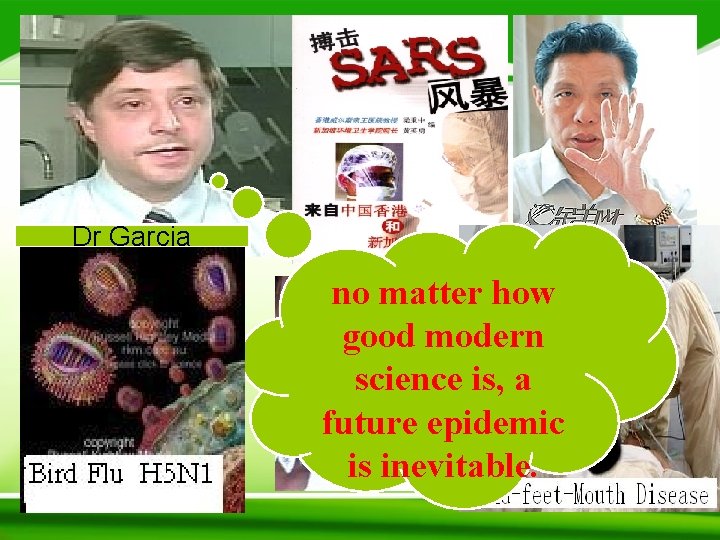
Dr Garcia no matter how good modern science is, a future epidemic is inevitable.
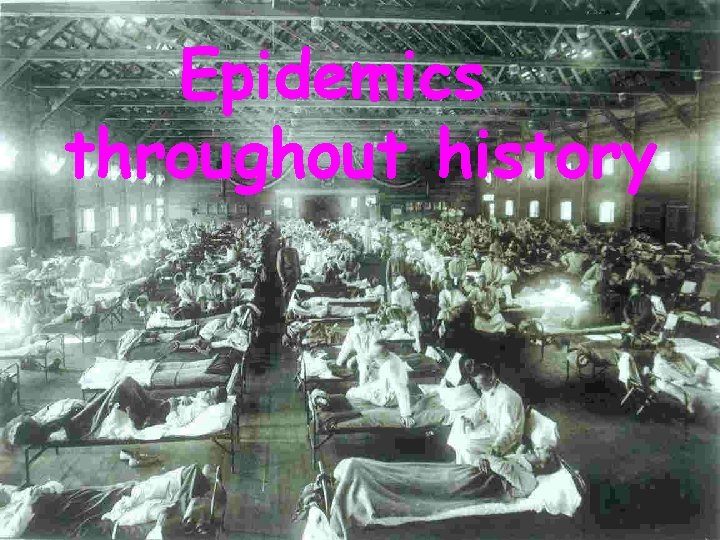
Epidemics throughout history
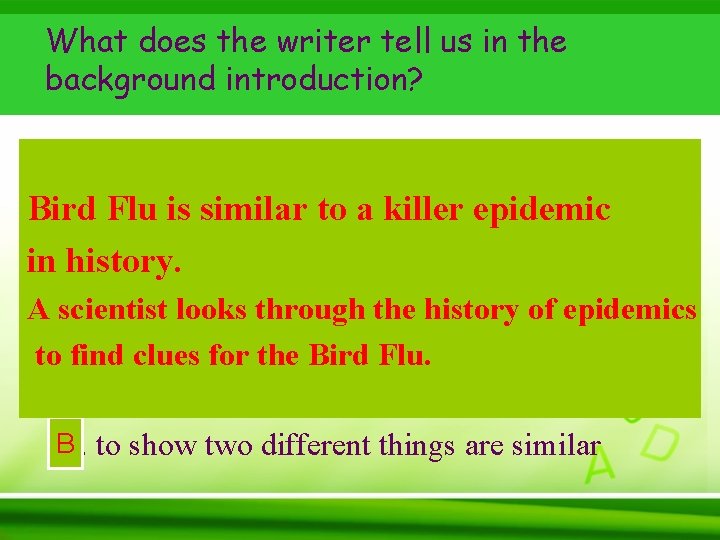
What does the writer tell us in the background introduction? • With recent press reports drawing parallels between Bird Flue and a killer epidemic in Bird Flu is similar to a killer epidemic the past, Jim Smith looks through the history in history. of epidemics for clues about what the future cluesthe for history Bird Fluof epidemics might hold. A scientist lookshold through • to find drawclues parallels for the Bird Flu. A. to draw the sign “=” B B. to show two different things are similar
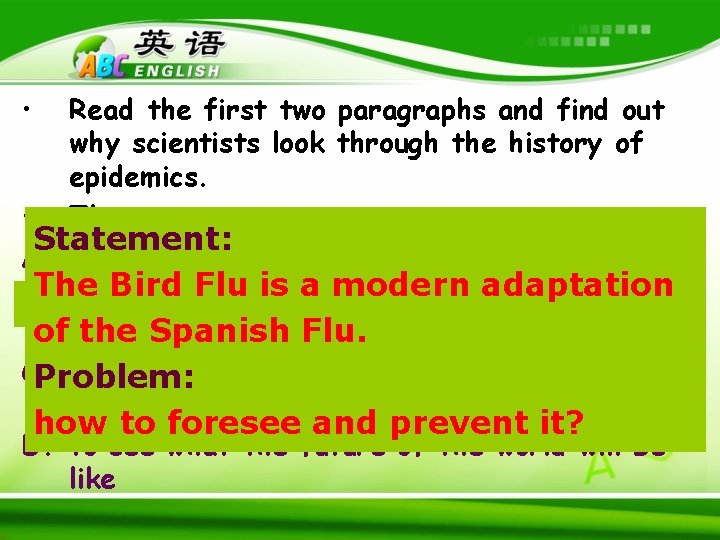
• Read the first two paragraphs and find out why scientists look through the history of epidemics. • They want ____. Statement: A. to find out how epidemics have happened The Bird Flu a modern adaptation B. to predict andisprevent epidemics in the of future the Spanish Flu. C. to see how bacteria and viruses have been Problem: affected human life how to foresee and prevent it? D. to see what the future of the world will be like
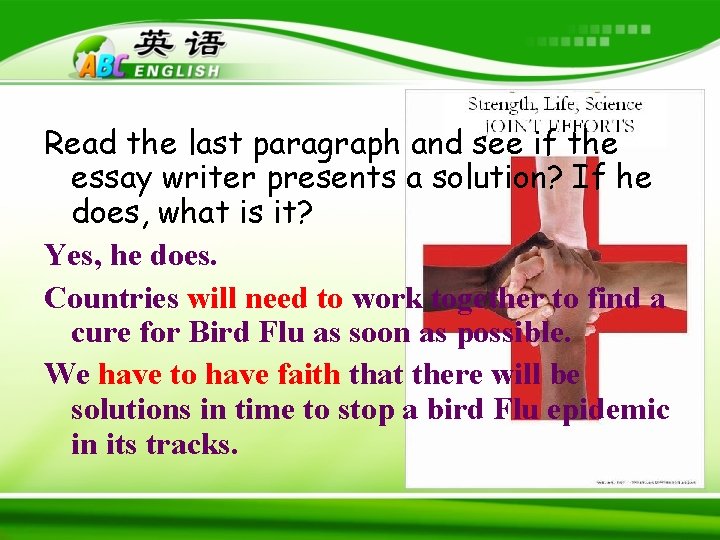
Read the last paragraph and see if the essay writer presents a solution? If he does, what is it? Yes, he does. Countries will need to work together to find a cure for Bird Flu as soon as possible. We have to have faith that there will be solutions in time to stop a bird Flu epidemic in its tracks.
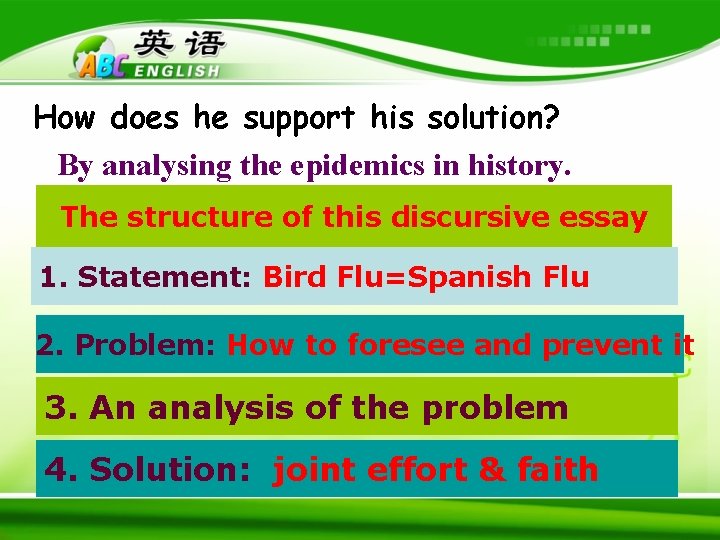
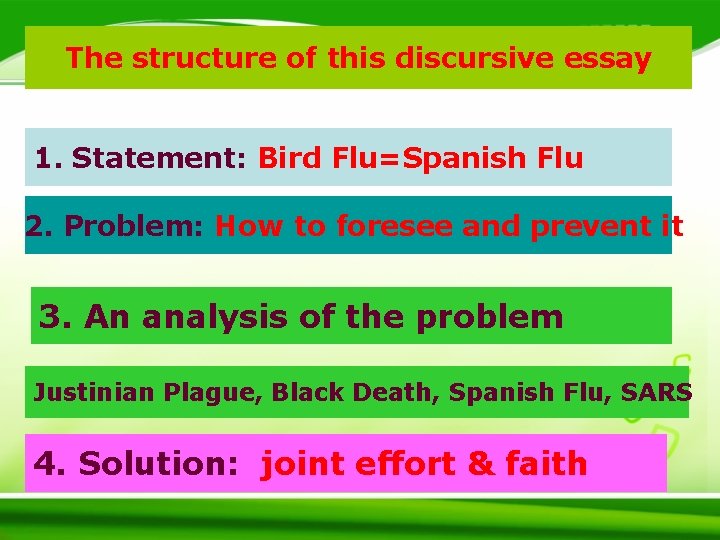
How does he support his solution? By analysing the epidemics in history. The structure of this discursive essay 1. Statement: Bird Flu=Spanish Flu 2. Problem: How to foresee and prevent it 3. An analysis of the problem 4. Solution: joint effort & faith
Please put the text back together. Tips: • Follow the timeline. • Read the sentences before and after the gaps.
Match the five paragraphs A Paragraph 3 B Paragraph 5 C Paragraph 8 D Paragraph 10 E Paragraph 12
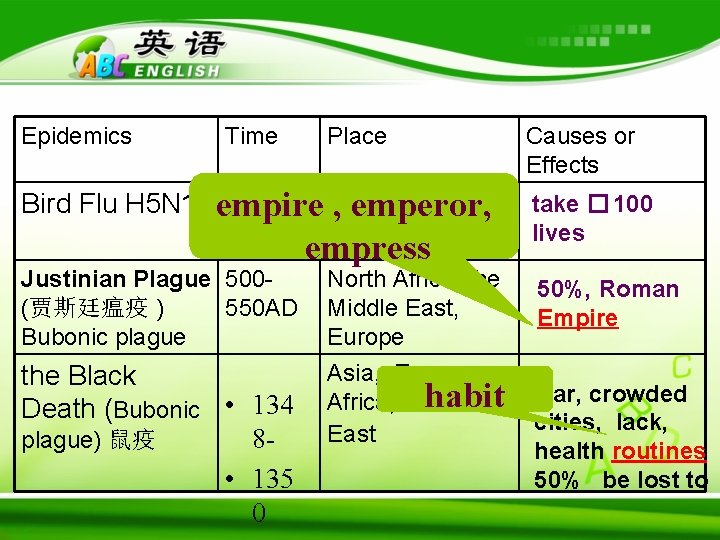
• What are the historical epidemics studied? • Justinian Plague, the Black Death, the Spanish Flu, the SARS • Read for the missing information and fill out the form. Put down the key words only.
Epidemics Bird Flu H 5 N 1 Time Place 1997— worldwide, empire , emperor, empress Justinian Plague 500(贾斯廷瘟疫 ) 550 AD Bubonic plague the Black Death (Bubonic • 134 8 plague) 鼠疫 • 135 0 Causes or Effects take � 100 lives North Africa, the 50%, Roman Middle East, Empire Europe Asia, Europe, Africa, thehabit Middle war, crowded cities, lack, East health routines 50% be lost to
Epidemics Time The Great Flu 1918 Epidemic (The Spanish Flu) SARS tablets Place similar as the Black Death China , Canada, Vietnam, 2002/2003 Singapore Hong Kong, --- Causes or Effects 50 million, 18 months, the young and fit new, doctors, no prescription, 9 months, 774, 8, 000
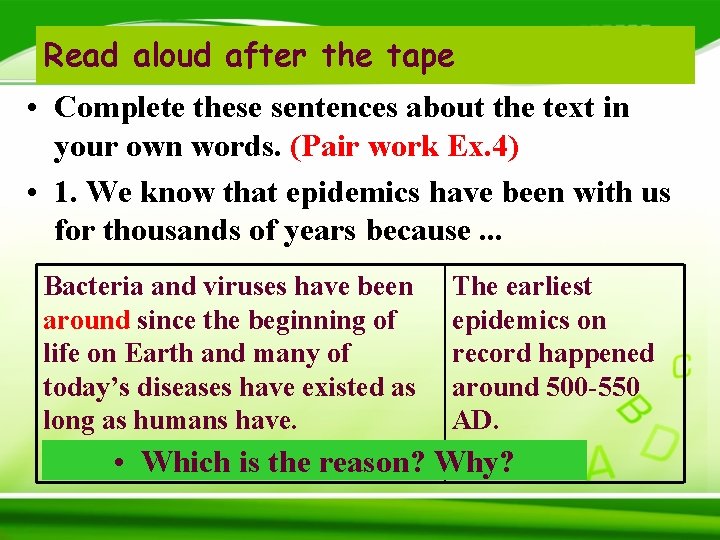
Read aloud after the tape • Complete these sentences about the text in your own words. (Pair work Ex. 4) • 1. We know that epidemics have been with us for thousands of years because. . . Bacteria and viruses have been around since the beginning of life on Earth and many of today’s diseases have existed as long as humans have. The earliest epidemics on record happened around 500 -550 AD. • Which is the reason? Why?
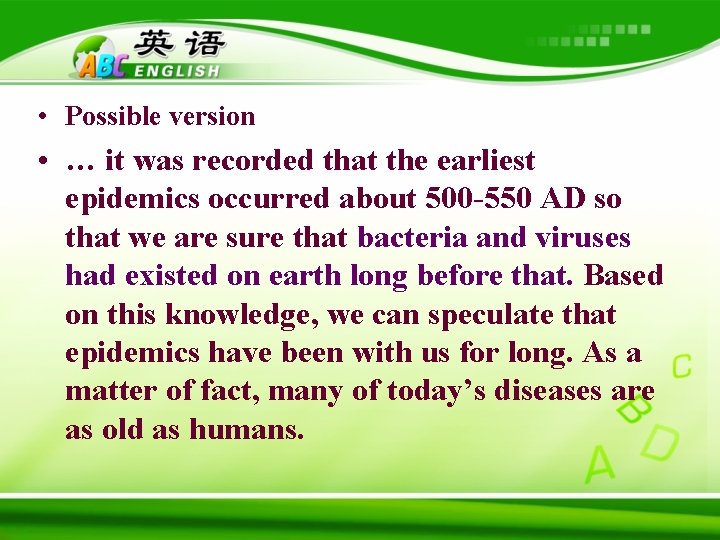
• Possible version • … it was recorded that the earliest epidemics occurred about 500 -550 AD so that we are sure that bacteria and viruses had existed on earth long before that. Based on this knowledge, we can speculate that epidemics have been with us for long. As a matter of fact, many of today’s diseases are as old as humans.
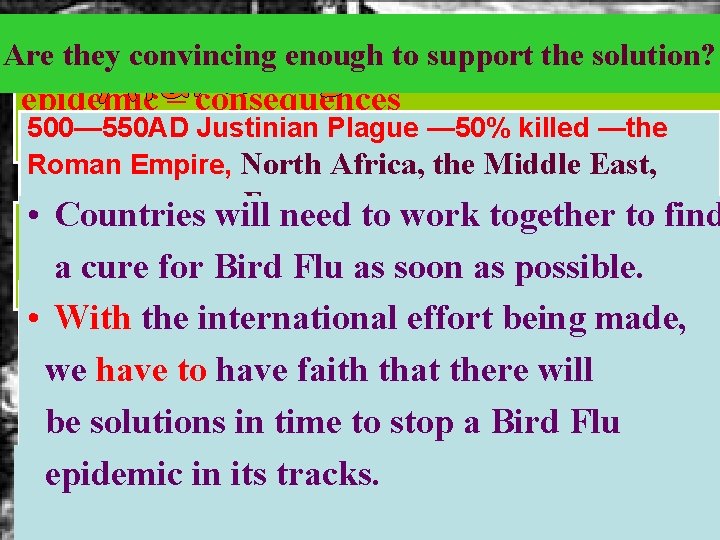
Are they convincing enough to support the solution? epidemic – consequences 500— 550 AD Justinian Plague — 50% killed —the Roman Empire, North Africa, the Middle East, 500— 550 AD Justinian Plague — up to Europe • Countries will need to work together to find 50% of the population were killed — the 1930’s, the Black Death — 50% lost to. Asia, Europe, fall of the. East Roman Empire adown curethefor Bird Flu as soon as possible. Africa, Middle Flu, 50 million killedbeing made, • 1918, With. Spanish the international effort 18 months, Asia, Europe, Africa, the Middle East we have to have faith that there will 2002—SARS – 9 months – 8, 000 – 774 Asia, be. Europe, solutions in time to stop. East a Bird Flu Africa, the Middle 1997—Bird Flutracks. –more than 100 lives, Asia, epidemic in its America– future ?
Latest breakthrough! Bird flu vaccine successful Scientists at the University of Hong Kong (HKU) and the US have developed an experimental H 5 N 1 Bird Flu vaccine for people. Initial tests on mice showed the vaccine to be highly effective and the speed of antibody response was high.
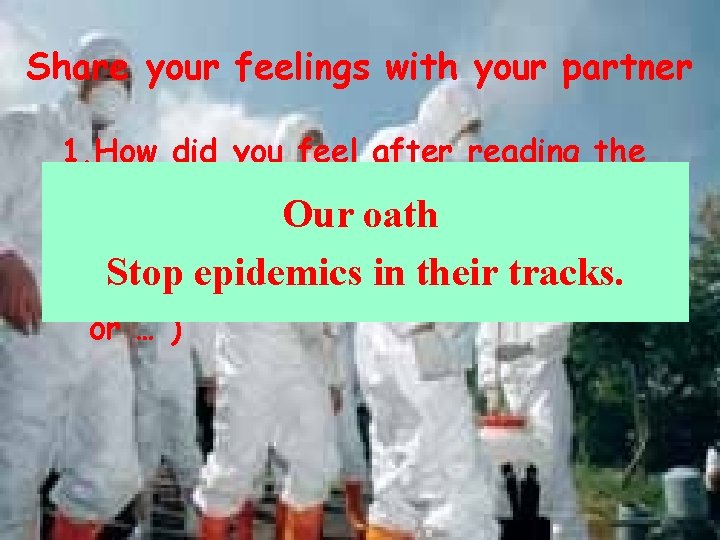
Share your feelings with your partner 1. How did you feel after reading the article? Our oath (Can science solve all the problems? Stopcan epidemics in their How you contribute to tracks. it? or … )
The structure of this discursive essay 1. Statement: Bird Flu=Spanish Flu 2. Problem: How to foresee and prevent it 3. An analysis of the problem Justinian Plague, Black Death, Spanish Flu, SARS 4. Solution: joint effort & faith
• Homework Page 86 Focus on reading Analyse the reading material Statement? Problem? Analysis of the problem (mention the aspects only) Solution
Thank you